
Sample Papers
Previous Year Papers
Syllabus
EXAM SYLLABUS
For effective preparation for the SSC GD Constable 2026 Exam, candidates should first understand the complete and updated syllabus. Planning a clear strategy based on the official syllabus is far more productive than studying randomly without proper direction.
For SSC GD there will be four sections:
1. General Intelligence and Reasoning
2. General Knowledge and General Awareness
3. Elementary Mathematics
4. English/ Hindi
The indicative syllabus for the Examination will be as follows: -
General Intelligence and Reasoning: Analytical aptitude and ability to observe and distinguish patterns will be tested through questions principally of non-verbal type. This component may include questions on analogies, similarities and differences, spatial visualization, spatial orientation, visual memory, discrimination, observation, relationship concepts, arithmetical reasoning and figural classification, arithmetic number series, non-verbal series, coding and decoding, etc.
General Knowledge and General Awareness: Questions in this component will be aimed at testing the candidate’s general awareness of the environment around him. Questions will also be designed to test knowledge of current events and such matters of everyday observations and experience in their scientific aspect as may be expected of any educated person. The test will also include questions relating to India and its neighbouring countries especially pertaining to sports, History, Culture, Geography, Economic Scene, General Polity, Indian Constitution, scientific Research etc. These Questions will be such that they do not require a special study of any discipline.
Elementary Mathematics: This Section will include questions on problems relating to Number Systems, Computation of Whole Numbers, Decimals and Fractions and the relationship between Numbers, Fundamental arithmetical operations, Percentages, Ratio and Proportion, Averages, Interest, Profit and Loss, Discount, Mensuration, Time and Distance, Ratio and Time, Time and Work, etc.
English/ Hindi: Candidates’ ability to understand basic English/ Hindi and their basic comprehension will be tested.
EXAM SYLLABUS WITH TOPIC WISE WEIGHTAGE
The syllabus for SSS GD Examination is given below:
Name of Test | Topic | Weightage |
General Intelligence and Reasoning | Coding-Decoding | 2 - 3 Q |
Missing Term | 2 - 3 Q | |
Venn Diagram | 1 - 2 Q | |
Syllogism | 2 - 4 Q | |
Paper Folding | 1 - 2 Q | |
Odd one out | 3 - 4 Q | |
Mathematics Operation | 1 - 2 Q | |
Analogy | 2 - 4 Q | |
Series (Missing/Number) | 4 - 5 Q | |
Sequence | 1 - 2 Q | |
Puzzle ( Linear Sitting Arrangement) | 2 - 3 Q | |
Mirror Image | 2 - 3 Q | |
Hidden Figure | 1 - 2 Q | |
Complete Figure | 2 - 3 Q | |
Elementary Mathematics | SI/ CI | 2 - 3 Q |
Profit/Loss | 2 - 3 Q | |
Mensuration | 3 - 4 Q | |
Ratio & Proportion | 2 - 3 Q | |
Number System | 1 - 2 Q | |
Time and Work | 2 - 3 Q | |
Simplification | 5 - 7 Q | |
Time, Speed, and Distance | 2 - 3 Q | |
Average | 2 - 3 Q | |
DI | 1 - 3 Q | |
General Awareness | History | 4 - 5 Q |
Geography | 3 - 4 Q | |
Polity | 2 - 3 Q | |
Science | 4 - 5 Q | |
EXAM SYLLABUS
For effective preparation for the SSC GD Constable 2026 Exam, candidates should first understand the complete and updated syllabus. Planning a clear strategy based on the official syllabus is far more productive than studying randomly without proper direction.
For SSC GD there will be four sections:
1. General Intelligence and Reasoning
2. General Knowledge and General Awareness
3. Elementary Mathematics
4. English/ Hindi
The indicative syllabus for the Examination will be as follows: -
General Intelligence and Reasoning: Analytical aptitude and ability to observe and distinguish patterns will be tested through questions principally of non-verbal type. This component may include questions on analogies, similarities and differences, spatial visualization, spatial orientation, visual memory, discrimination, observation, relationship concepts, arithmetical reasoning and figural classification, arithmetic number series, non-verbal series, coding and decoding, etc.
General Knowledge and General Awareness: Questions in this component will be aimed at testing the candidate’s general awareness of the environment around him. Questions will also be designed to test knowledge of current events and such matters of everyday observations and experience in their scientific aspect as may be expected of any educated person. The test will also include questions relating to India and its neighbouring countries especially pertaining to sports, History, Culture, Geography, Economic Scene, General Polity, Indian Constitution, scientific Research etc. These Questions will be such that they do not require a special study of any discipline.
Elementary Mathematics: This Section will include questions on problems relating to Number Systems, Computation of Whole Numbers, Decimals and Fractions and the relationship between Numbers, Fundamental arithmetical operations, Percentages, Ratio and Proportion, Averages, Interest, Profit and Loss, Discount, Mensuration, Time and Distance, Ratio and Time, Time and Work, etc.
English/ Hindi: Candidates’ ability to understand basic English/ Hindi and their basic comprehension will be tested.
EXAM SYLLABUS WITH TOPIC WISE WEIGHTAGE
The syllabus for SSS GD Examination is given below:
Name of Test | Topic | Weightage |
General Intelligence and Reasoning | Coding-Decoding | 2 - 3 Q |
Missing Term | 2 - 3 Q | |
Venn Diagram | 1 - 2 Q | |
Syllogism | 2 - 4 Q | |
Paper Folding | 1 - 2 Q | |
Odd one out | 3 - 4 Q | |
Mathematics Operation | 1 - 2 Q | |
Analogy | 2 - 4 Q | |
Series (Missing/Number) | 4 - 5 Q | |
Sequence | 1 - 2 Q | |
Puzzle ( Linear Sitting Arrangement) | 2 - 3 Q | |
Mirror Image | 2 - 3 Q | |
Hidden Figure | 1 - 2 Q | |
Complete Figure | 2 - 3 Q | |
Elementary Mathematics | SI/ CI | 2 - 3 Q |
Profit/Loss | 2 - 3 Q | |
Mensuration | 3 - 4 Q | |
Ratio & Proportion | 2 - 3 Q | |
Number System | 1 - 2 Q | |
Time and Work | 2 - 3 Q | |
Simplification | 5 - 7 Q | |
Time, Speed, and Distance | 2 - 3 Q | |
Average | 2 - 3 Q | |
DI | 1 - 3 Q | |
General Awareness | History | 4 - 5 Q |
Geography | 3 - 4 Q | |
Polity | 2 - 3 Q | |
Science | 4 - 5 Q | |
Current Affairs | 5 - 6 Q | |
Static GK | 6 - 7 Q | |
English/Hindi | Fill In The Blanks | 3 - 4 Q |
Sentence Improvement | 2 - 3 Q | |
Error Detection | 3 - 5 Q | |
Idioms & Phrases | 2 - 3 Q | |
Synonyms | 2 - 3 Q | |
Antonyms | 2 - 3 Q | |
One word substitution | 1 - 2 Q | |
Spelling check | 1 - 2 Q |
Format
EXAM PATTERN
This section explains the exam pattern for every stage of the selection process. Candidates appearing for SSC GD Recruitment 2026 should clearly understand the exam pattern before starting their preparation.
The Computer-Based Examination will consist of one Objective Type Paper containing 80 questions carrying 2 marks each with the following composition:
Part | Subject | Number of Questions | Maximum Marks | Duration/Time Allowed |
Part-A | General Intelligence and Reasoning | 20 | 40 | 60 minutes |
Part-B | General Knowledge and General Awareness | 20 | 40 | |
Part-C | Elementary Mathematics | 20 | 40 | |
Part-D | English/ Hindi | 20 | 40 | |
Total | 80 Question | 160 Marks | ||
Mode Of Examination
SSC GD Examination shall be held as a Computer Based Test. Questions shall be based on Multiple Choice Objective Type.
Medium Of Examination
The Computer-Based Examination will be conducted in English, Hindi and 13 Regional languages viz. (i) Assamese, (ii) Bengali, (iii) Gujarati, (iv) Kannada, (v) Konkani, (vi) Malayalam, (vii) Manipuri, (viii) Marathi, (ix) Odia, (x) Punjabi, (xi) Tamil, (xii) Telugu and (xiii) Urdu.
Marking Scheme
1. There will be a negative marking of 0.25 marks for each wrong answer. Candidates are, therefore, advised to keep this in mind while answering the questions.
2. There shall be no provision for re-evaluation/ re-checking of the scores. No correspondence in this regard shall be entertained.
3. The questions in the Computer-Based Examination will be of Matriculation level
Normalisation of Score
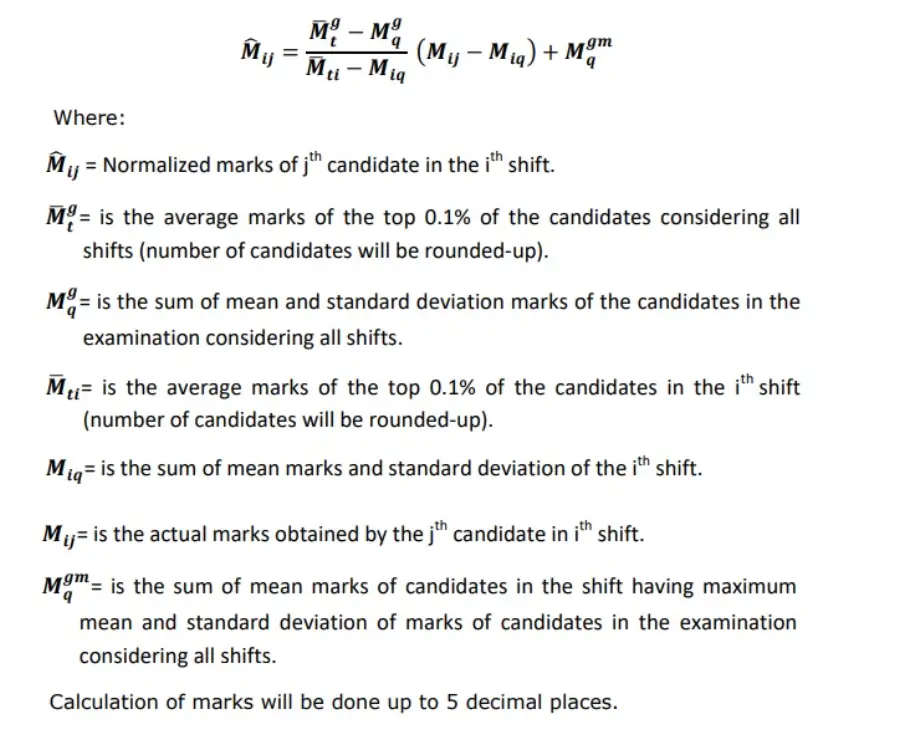
Marks scored by candidates in the Computer-Based Examination will be normalized by using the formula published by the Commission vide its Notice No: 1-1/2018-P&P-I dated 07-02-2019 and such normalized scores along with the bonus marks for NCC Certificate holders will be used to determine final merit and cut-off marks.
Physical Standard Test (PST)/ Physical Efficiency Test (PET)
Based on the performance in the CBE, candidates will be shortlisted for PST/ PET by the Commission. Physical Standard Test (PST) and Physical Efficiency Test (PET) will be conducted at various centres finalized by the CAPFs.
Physical Efficiency Test (PET)
Candidates have to clear the race within the Page 16 of 73 following time limits:
Event | Male | Female | Remarks |
Race | 5 Kms in 24 minutes | 1.6 Kms in 8 ½ minutes | For candidates other than those belonging to the Ladakh Region. |
1.6 Kms in 7 minutes | 800 metres in 5 minutes | For candidates of Ladakh Region. |
Physical Standard Test (PST)
Physical Standards for the posts are as follows: -
Height
Male: 170 cms 12.5.1.2
Female: 157 cms 12.5.1.3
Few categories of candidates are allowed relaxation in the heights mentioned above. Relaxed standard of height for such candidates are as follows:
S. No | Relaxation in Height to few categories of Candidate | Male (Cms) | Female (Cms) |
(a) | All candidates belonging to Scheduled Tribes. | 162.5 |
EXAM PATTERN
This section explains the exam pattern for every stage of the selection process. Candidates appearing for SSC GD Recruitment 2026 should clearly understand the exam pattern before starting their preparation.
The Computer-Based Examination will consist of one Objective Type Paper containing 80 questions carrying 2 marks each with the following composition:
Part | Subject | Number of Questions | Maximum Marks | Duration/Time Allowed |
Part-A | General Intelligence and Reasoning | 20 | 40 | 60 minutes |
Part-B | General Knowledge and General Awareness | 20 | 40 | |
Part-C | Elementary Mathematics | 20 | 40 | |
Part-D | English/ Hindi | 20 | 40 | |
Total | 80 Question | 160 Marks | ||
Mode Of Examination
SSC GD Examination shall be held as a Computer Based Test. Questions shall be based on Multiple Choice Objective Type.
Medium Of Examination
The Computer-Based Examination will be conducted in English, Hindi and 13 Regional languages viz. (i) Assamese, (ii) Bengali, (iii) Gujarati, (iv) Kannada, (v) Konkani, (vi) Malayalam, (vii) Manipuri, (viii) Marathi, (ix) Odia, (x) Punjabi, (xi) Tamil, (xii) Telugu and (xiii) Urdu.
Marking Scheme
1. There will be a negative marking of 0.25 marks for each wrong answer. Candidates are, therefore, advised to keep this in mind while answering the questions.
2. There shall be no provision for re-evaluation/ re-checking of the scores. No correspondence in this regard shall be entertained.
3. The questions in the Computer-Based Examination will be of Matriculation level
Normalisation of Score
Marks scored by candidates in the Computer-Based Examination will be normalized by using the formula published by the Commission vide its Notice No: 1-1/2018-P&P-I dated 07-02-2019 and such normalized scores along with the bonus marks for NCC Certificate holders will be used to determine final merit and cut-off marks.

Physical Standard Test (PST)/ Physical Efficiency Test (PET)
Based on the performance in the CBE, candidates will be shortlisted for PST/ PET by the Commission. Physical Standard Test (PST) and Physical Efficiency Test (PET) will be conducted at various centres finalized by the CAPFs.
Physical Efficiency Test (PET)
Candidates have to clear the race within the Page 16 of 73 following time limits:
Event | Male | Female | Remarks |
Race | 5 Kms in 24 minutes | 1.6 Kms in 8 ½ minutes | For candidates other than those belonging to the Ladakh Region. |
1.6 Kms in 7 minutes | 800 metres in 5 minutes | For candidates of Ladakh Region. |
Physical Standard Test (PST)
Physical Standards for the posts are as follows: -
Height
Male: 170 cms 12.5.1.2
Female: 157 cms 12.5.1.3
Few categories of candidates are allowed relaxation in the heights mentioned above. Relaxed standard of height for such candidates are as follows:
S. No | Relaxation in Height to few categories of Candidate | Male (Cms) | Female (Cms) |
(a) | All candidates belonging to Scheduled Tribes. | 162.5 | 150.0 |
(b) | All Scheduled Tribe candidates of North Eastern States (NE States). | 157.0 | 147.5 |
(c) | All Scheduled Tribe candidates of Left-Wing Extremism affected districts. | 160.0 | 147.5 |
(d) | Candidates falling in the categories of Garhwalis, Kumaonis, Dogras, Marathas and candidates belonging to the States/ UTs of Assam, Himachal Pradesh, Jammu & Kashmir and Ladakh. | 165.0 | 155.0 |
(e) | Candidates hailing from the North-Eastern States of Arunachal Pradesh, Manipur, Meghalaya, Mizoram, Nagaland, Sikkim and Tripura. | 162.5 | 152.5 |
(f) | Candidates hailing from Gorkha Territorial Administration (GTA) comprising of the three Sub-Divisions of Darjeeling District namely Darjeeling, Kalimpong and Kurseong and includes the following “Mouzas” Sub-Division of these Districts: - (1)Lohagarh Tea Garden (2) Lohagarh Forest (3) Rangmohan (4) Barachenga (5) Panighata (6) ChotaAdalpur (7) Paharu (8) Sukna Forest (9) Sukna Part-I (10) Pantapati Forest-I (11) Mahanadi Forest (12) Champasari Forest (13) SalbariChhatpart-II (14) Sitong Forest (15) Sivoke Hill Forest (16) Sivoke Forest (17) ChhotaChenga (18) Nipania. | 157.0 | 152.5 |
Chest
Male candidates should have the following standards of chest measurement:
Un-expanded: 80 cms
Minimum expansion: 5 cms
Few categories of candidates are allowed relaxation in chest measurement. Relaxed standards of chest measurement for such candidates are as follows:
S. No | Relaxation in Chest to few categories of Candidate | Un-expanded (cms) | Minimum Expansion (cms) |
(a) | All candidates belonging to Scheduled Tribes. | 76 | 5 |
(b) | Candidates falling in the categories of Garhwalis, Kumaonis, Dogras, Marathas and candidates belonging to the States/ UTs of Assam, Himachal Pradesh, Jammu& Kashmir and Ladakh. | 78 | 5 |
(c) | Candidates hailing from North-Eastern States of Arunachal Pradesh, Manipur, Meghalaya, Mizoram, Nagaland, Sikkim, Tripura and Gorkha Territorial Administration (GTA). | 77 | 5 |
Chest measurements for female candidates will not be taken. However, it will be ascertained that the chest is well-developed.
Weight: Proportionate to height and age as per medical standards.
Eligibility
ELIGIBILITY CRITERIA
Only those candidates who meet the eligibility conditions set by the Commission can apply for SSC GD 2026 Constable posts in forces such as BSF, CISF, CRPF, SSB, ITBP, AR, SSF, and NCB. The details regarding educational qualification, age limit, and other requirements are provided below.
Nationality
Indian citizen, or
Subject of Nepal or Bhutan, or
Tibetan refugee who came to India before 1 January 1962, or
Person of Indian origin who migrated from Pakistan, Burma, Sri Lanka, East African countries, etc., with the intention of permanently settling in India.
Age Limit
Minimum Age: 18 years
Maximum Age: 23 years
Age is calculated as of the date specified in the SSC notification.
Relaxation: Applicable for reserved categories as per government rules (SC/ST/OBC/PwD).
Educational Qualification
Candidates must have passed Class 10 (Matriculation) from a recognized board.
Physical Standards
Height: Minimum height varies by gender and category (generally 170 cm for men, 157 cm for women; relaxations for certain categories).
Chest: Minimum chest measurement for men (expanded chest 5 cm)
Weight: Proportionate to height and age.
Physical standards may vary slightly depending on the paramilitary force.
Medical Fitness
Candidates must be medically fit as per SSC standards.
No major deformities, chronic diseases, or disabilities that affect performance.
Other Requirements
Candidates should have a good moral character.
Should not have any criminal record.
Relaxation of Upper age limit
Category | Age Relaxation |
SC/ ST | 5 years |
OBC | 3 years |
Ex-Servicemen | 3 years after deduction of the military service rendered from the actual age as on the date of reckoning. |
Children and dependents of victims killed in the 1984 riots or communal riots of 2002 in Gujarat (Unreserved/ EWS) | 5 years |
Children and dependents of victims killed in the 1984 riots or communal riots of 2002 in Gujarat (OBC) | 8 years |
Children and dependents of victims killed in the 1984 riots or communal riots of 2002 in Gujarat (SC/ ST) | 10 years |
ELIGIBILITY CRITERIA
Only those candidates who meet the eligibility conditions set by the Commission can apply for SSC GD 2026 Constable posts in forces such as BSF, CISF, CRPF, SSB, ITBP, AR, SSF, and NCB. The details regarding educational qualification, age limit, and other requirements are provided below.
Nationality
Indian citizen, or
Subject of Nepal or Bhutan, or
Tibetan refugee who came to India before 1 January 1962, or
Person of Indian origin who migrated from Pakistan, Burma, Sri Lanka, East African countries, etc., with the intention of permanently settling in India.
Age Limit
Minimum Age: 18 years
Maximum Age: 23 years
Age is calculated as of the date specified in the SSC notification.
Relaxation: Applicable for reserved categories as per government rules (SC/ST/OBC/PwD).
Educational Qualification
Candidates must have passed Class 10 (Matriculation) from a recognized board.
Physical Standards
Height: Minimum height varies by gender and category (generally 170 cm for men, 157 cm for women; relaxations for certain categories).
Chest: Minimum chest measurement for men (expanded chest 5 cm)
Weight: Proportionate to height and age.
Physical standards may vary slightly depending on the paramilitary force.
Medical Fitness
Candidates must be medically fit as per SSC standards.
No major deformities, chronic diseases, or disabilities that affect performance.
Other Requirements
Candidates should have a good moral character.
Should not have any criminal record.
Relaxation of Upper age limit
Category | Age Relaxation |
SC/ ST | 5 years |
OBC | 3 years |
Ex-Servicemen | 3 years after deduction of the military service rendered from the actual age as on the date of reckoning. |
Children and dependents of victims killed in the 1984 riots or communal riots of 2002 in Gujarat (Unreserved/ EWS) | 5 years |
Children and dependents of victims killed in the 1984 riots or communal riots of 2002 in Gujarat (OBC) | 8 years |
Children and dependents of victims killed in the 1984 riots or communal riots of 2002 in Gujarat (SC/ ST) | 10 years |
Schedule
IMPORTANT DATES
The SSC GD Constable 2026 notification was released on 1 December 2025, with online applications open until 31 December 2025. The Computer-Based Test (CBT) is scheduled 23 February 2026, followed by the Physical Efficiency/Standard Test (PET/PST), medical examination, and document verification. Final selection will be based on performance in all these
EVENTS | DATES |
Online Application Form Date | 01.12.2025 to 31.12.2025 |
Last date and time for receipt of Online Application Form | 31.12.2025 |
Last date and time for making Online Fee Payment | 1.01.2026 |
Dates of ‘Window for Application Form Correction’ | 08.1.2026 to 10.1.2026 |
Schedule of Computer-Based Examination | 23.02.2026 (Postponed) |
IMPORTANT DATES
The SSC GD Constable 2026 notification was released on 1 December 2025, with online applications open until 31 December 2025. The Computer-Based Test (CBT) is scheduled 23 February 2026, followed by the Physical Efficiency/Standard Test (PET/PST), medical examination, and document verification. Final selection will be based on performance in all these
EVENTS | DATES |
Online Application Form Date | 01.12.2025 to 31.12.2025 |
Last date and time for receipt of Online Application Form | 31.12.2025 |
Last date and time for making Online Fee Payment | 1.01.2026 |
Dates of ‘Window for Application Form Correction’ | 08.1.2026 to 10.1.2026 |
Schedule of Computer-Based Examination | 23.02.2026 (Postponed) |
Analysis
EXAM ANALYSIS
Here’s a detailed analysis of the SSC GD Constable 2025 exam paper based on reviews, student feedback, and expert analysis:
1. Exam Format & Conduct
The SSC GD Constable 2025 Computer Based Test (CBT) was held from 4 February to 25 February 2025, with multiple shifts across these dates. The exam consisted of 80 questions to be completed in 60 minutes, covering four sections: General Intelligence & Reasoning, General Knowledge & Awareness, Elementary Mathematics, and English/Hindi. Each correct answer carried 2 marks and there was negative marking of 0.25 marks for each wrong answer.
2. Difficulty Level
Overall, the paper was considered easy to moderate, with moderate questions in reasoning, mathematics, and GK, and relatively easier questions in English/Hindi. Most students were able to attempt a good number of questions within time.
3. Section Wise Overview
General Intelligence & Reasoning: Usually easy to moderate, with about 11–15 questions involving basic analytical and logical reasoning.
General Knowledge & Awareness: Typically moderate, focusing on static GK and current affairs with around 10–13 questions.
Elementary Mathematics: Mostly easy to moderate, covering arithmetic topics like number system, simplification, ratio, percentage, etc., with around 12–13 questions.
English/Hindi Language: Usually considered easy, with around 15–19 questions from vocabulary, grammar, and comprehension.
4. Good Attempts & Expected Cut off
Candidates generally made 48–60 good attempts across shifts depending on difficulty on a given day. For example:
On 5 February shifts, most students attempted 50–58 questions correctly.
On 7 February shifts, good attempts ranged around 48–52 questions.
The expected cut off marks (last year) for the General category were estimated roughly in the range of 145–155, with lower ranges for reserved categories, based on overall difficulty and candidate performance.
5. Key Takeaways for Aspirants
The paper is balanced with questions from all four sections and does not lean heavily toward any single section.
English/Hindi tends to be easier, so students who are good in language skills can secure marks quickly.
General Knowledge is often moderate and requires good preparation in current affairs and static GK.
Aiming for 50+ correct attempts with minimal errors generally keeps you competitive for qualifying cutoffs.
6. Number of Applicants
Over 52 lakh candidates applied for the SSC GD 2025 exam, making it a highly competitive recruitment.
DATE & SHIFT WISE ANALYSIS
4 February 2025 – Day1 (Multiple Shifts)
The SSC GD 2025 exam started on 4 February 2025, and was conducted in several shifts across the day. Across shifts, the paper was reported as easy to moderate overall. Reasoning and English/Hindi sections were mostly easier, while General Knowledge and Mathematics ranged from easy to moderately challenging. In one shift, the good attempts (reasonable correct answers) ranged 51–65 out of 80. Section wise feedback showed: Reasoning about 12–15, GK around 11–13, Maths 10–13, and English/Hindi high attempts around 16–19 questions with ease.
5 February 2025 – Day 2
On 5 February, the analysis again showed an easy to moderate exam level. Candidates found Reasoning slightly easier, GK moderate, Mathematics manageable, and English/Hindi comparatively easier. One shift analysis reported overall 50–58 good attempts, with sections showing similar patterns as the first day.
6 & 7 February 2025 – Days 3–4
Across these days, review reports indicated consistent difficulty levels. For 6 February, candidates reported an easy to moderate overall paper with decent attempts in all four sections. On 7 February, feedback suggested the exam remained moderate, with GK and reasoning moderate and English/Hindi easier than others. Good attempts overall were approximately 48–52 in some shifts.
12 February 2025 – Mid Exam Day
On 12 February, analysis again showed the exam difficulty staying largely moderate. Candidates attempting around 60–65 questions with good accuracy were considered well placed. Section wise feedback from this day showed: Reasoning approximately 15–17 good attempts, GK moderate attempts around 12–14, mathematics midlevel attempts, and English/Hindi moderate attempts.
21 February 2025 – Later Phase
In the 21 February exam shifts, many candidates reported the overall exam as easy to moderate. Some feedback suggested that a very good performance could reach 65–70 correct attempts because Reasoning and Mathematics were easier in those shifts, while GK remained moderately challenging.
Overall Pattern (4–25 February 2025)
Across all dates from 4 to 25 February 2025, the SSC GD Constable exam maintained an easy to moderate level in most shifts. Most candidates could attempt between 48 and 65 questions with good accuracy depending on the shift. English/Hindi generally remained easier compared to other sections, while General Knowledge tended to be moderate. Reasoning and Mathematics varied from easy to moderate but remained manageable if prepared well.
Key Takeaways from 2025 Paper:
The exam across dates did not show any very high difficulty days; overall it stayed easy moderate.
Shifts in mid to later part of the schedule sometimes showed slightly higher good attempts, suggesting consistency in paper setting.
Time management and accuracy were crucial for high scores, given the 60 minute timeframe for 80 questions.
Aiming for 50+ correct answers was generally seen as a strong performance across most dates.
EXAM ANALYSIS
Here’s a detailed analysis of the SSC GD Constable 2025 exam paper based on reviews, student feedback, and expert analysis:
1. Exam Format & Conduct
The SSC GD Constable 2025 Computer Based Test (CBT) was held from 4 February to 25 February 2025, with multiple shifts across these dates. The exam consisted of 80 questions to be completed in 60 minutes, covering four sections: General Intelligence & Reasoning, General Knowledge & Awareness, Elementary Mathematics, and English/Hindi. Each correct answer carried 2 marks and there was negative marking of 0.25 marks for each wrong answer.
2. Difficulty Level
Overall, the paper was considered easy to moderate, with moderate questions in reasoning, mathematics, and GK, and relatively easier questions in English/Hindi. Most students were able to attempt a good number of questions within time.
3. Section Wise Overview
General Intelligence & Reasoning: Usually easy to moderate, with about 11–15 questions involving basic analytical and logical reasoning.
General Knowledge & Awareness: Typically moderate, focusing on static GK and current affairs with around 10–13 questions.
Elementary Mathematics: Mostly easy to moderate, covering arithmetic topics like number system, simplification, ratio, percentage, etc., with around 12–13 questions.
English/Hindi Language: Usually considered easy, with around 15–19 questions from vocabulary, grammar, and comprehension.
4. Good Attempts & Expected Cut off
Candidates generally made 48–60 good attempts across shifts depending on difficulty on a given day. For example:
On 5 February shifts, most students attempted 50–58 questions correctly.
On 7 February shifts, good attempts ranged around 48–52 questions.
The expected cut off marks (last year) for the General category were estimated roughly in the range of 145–155, with lower ranges for reserved categories, based on overall difficulty and candidate performance.
5. Key Takeaways for Aspirants
The paper is balanced with questions from all four sections and does not lean heavily toward any single section.
English/Hindi tends to be easier, so students who are good in language skills can secure marks quickly.
General Knowledge is often moderate and requires good preparation in current affairs and static GK.
Aiming for 50+ correct attempts with minimal errors generally keeps you competitive for qualifying cutoffs.
6. Number of Applicants
Over 52 lakh candidates applied for the SSC GD 2025 exam, making it a highly competitive recruitment.
DATE & SHIFT WISE ANALYSIS
4 February 2025 – Day1 (Multiple Shifts)
The SSC GD 2025 exam started on 4 February 2025, and was conducted in several shifts across the day. Across shifts, the paper was reported as easy to moderate overall. Reasoning and English/Hindi sections were mostly easier, while General Knowledge and Mathematics ranged from easy to moderately challenging. In one shift, the good attempts (reasonable correct answers) ranged 51–65 out of 80. Section wise feedback showed: Reasoning about 12–15, GK around 11–13, Maths 10–13, and English/Hindi high attempts around 16–19 questions with ease.
5 February 2025 – Day 2
On 5 February, the analysis again showed an easy to moderate exam level. Candidates found Reasoning slightly easier, GK moderate, Mathematics manageable, and English/Hindi comparatively easier. One shift analysis reported overall 50–58 good attempts, with sections showing similar patterns as the first day.
6 & 7 February 2025 – Days 3–4
Across these days, review reports indicated consistent difficulty levels. For 6 February, candidates reported an easy to moderate overall paper with decent attempts in all four sections. On 7 February, feedback suggested the exam remained moderate, with GK and reasoning moderate and English/Hindi easier than others. Good attempts overall were approximately 48–52 in some shifts.
12 February 2025 – Mid Exam Day
On 12 February, analysis again showed the exam difficulty staying largely moderate. Candidates attempting around 60–65 questions with good accuracy were considered well placed. Section wise feedback from this day showed: Reasoning approximately 15–17 good attempts, GK moderate attempts around 12–14, mathematics midlevel attempts, and English/Hindi moderate attempts.
21 February 2025 – Later Phase
In the 21 February exam shifts, many candidates reported the overall exam as easy to moderate. Some feedback suggested that a very good performance could reach 65–70 correct attempts because Reasoning and Mathematics were easier in those shifts, while GK remained moderately challenging.
Overall Pattern (4–25 February 2025)
Across all dates from 4 to 25 February 2025, the SSC GD Constable exam maintained an easy to moderate level in most shifts. Most candidates could attempt between 48 and 65 questions with good accuracy depending on the shift. English/Hindi generally remained easier compared to other sections, while General Knowledge tended to be moderate. Reasoning and Mathematics varied from easy to moderate but remained manageable if prepared well.
Key Takeaways from 2025 Paper:
The exam across dates did not show any very high difficulty days; overall it stayed easy moderate.
Shifts in mid to later part of the schedule sometimes showed slightly higher good attempts, suggesting consistency in paper setting.
Time management and accuracy were crucial for high scores, given the 60 minute timeframe for 80 questions.
Aiming for 50+ correct answers was generally seen as a strong performance across most dates.
Study Tips
STUDY TIPS
To perform well in the SSC GD 2026 exam, candidates should first gain a clear understanding of the syllabus and follow a well-structured 3–6 month study plan with emphasis on high-weightage topics in Reasoning, Mathematics, General Awareness, and Hindi/English. Regular practice of Previous Year Questions (PYQs) and mock tests is essential to enhance speed, accuracy, and effective time management.
Subject-wise Focus
Mathematics: Give priority to percentages, averages, profit & loss, and time & work; concentrate on shortcuts and remembering key formulas.
Reasoning: Practice coding–decoding, series, and puzzles regularly to strengthen logical thinking.
General Awareness: Focus on static GK such as history, geography, and polity, along with current affairs from the last six months.
Language (Hindi/English): Work on improving grammar rules and expanding vocabulary.
Practice & Revision:
Attempt full-length mock tests frequently to get comfortable with the CBT pattern and improve speed.
Prepare short notes for quick revision of important formulas and concepts.
Analyze mock tests carefully to spot weak areas and avoid mistakes, keeping negative marking in mind.
Physical Preparation:
Begin physical training for PET and PST along with written exam preparation to meet running, height, and chest requirements.
Strategy:
Stick to limited and reliable study resources to stay focused.
Set small, realistic daily targets to maintain consistency and motivation.
STUDY PLANS
6-month study plan
Month 1–2: Concept Building
Mathematics: Percentages, Ratio, Average, Profit & Loss, Time & Work (basics + practice).
Reasoning: Analogy, Series, Coding–Decoding, Direction, Blood Relation?
General Awareness: History, Geography, Polity (static GK)?
Language (Hindi/English): Grammar fundamentals and basic vocabulary?
Physical: Light running, stretching, basic fitness routine?
Month 3–4: Practice & Strengthening
Maths: Speed–Distance, Interest, Mensuration, mixed practice sets?
Reasoning: Puzzle, Syllogism, Seating Arrangement?
GA: Science basics + last 6 months current affairs?
Language: Comprehension, Error Spotting, Cloze Test?
Mocks: 1–2 sectional tests weekly?
Physical: Regular running practice for PET?
Month 5: Revision & Testing
Full syllabus revision with short notes?
PYQs: Solve previous year question papers?
Mock Tests: 2–3 full-length mocks per week with analysis?
Physical: Timed running, jump practice?
Month 6: Final Preparation
Fast revision of formulas, rules, and GK facts?
Mock Tests: 3–4 full mocks weekly (focus on speed & accuracy)?
Weak Areas: Improve mistakes, avoid negative marking?
Physical: Final PET/PST readiness
3-month study plan
Month 1 – Basics & Foundation
Mathematics: Percentages, Ratio & Proportion, Averages, Profit & Loss, Time & Work.
Reasoning: Analogy, Series, Coding–Decoding, Direction, Blood Relations.
General Awareness: Static GK – History, Geography, Polity.
Language (Hindi/English): Grammar basics and vocabulary building.
Physical: Start light running, stretching, and basic fitness exercises.
Month 2 – Practice & Improvement
Mathematics: Speed–Distance, Simple/Compound Interest, Mensuration.
Reasoning: Puzzles, Syllogism, Seating Arrangement.
GA: General Science + last 6 months’ Current Affairs.
Language: Reading Comprehension, Error Spotting, Cloze Test.
Mocks: Attempt 2 full-length mock tests per week.
Physical: Regular running practice to build stamina for PET.
Month 3 – Revision & Testing
Full syllabus revision with short notes and formulas.
PYQs: Practice previous years’ question papers.
Mock Tests: 3–4 full-length mocks per week with analysis.
Weak Areas: Focus on mistakes and avoid negative marking.
Physical: Final preparation for PET/PST standards.
1-month study plan
Week 1 – Core Revision
Mathematics: Percentages, Ratio & Proportion, Averages, Profit & Loss, Time & Work.
Reasoning: Analogy, Series, Coding–Decoding, Direction, Blood Relations.
General Awareness: Static GK – History, Geography, Polity.
Language (Hindi/English): Grammar basics and common vocabulary.
Physical: Start daily light running and basic exercises.
Week 2 – Practice Focus
Mathematics: Speed–Distance, Interest, Mensuration (important formulas).
Reasoning: Puzzles, Syllogism, Seating Arrangement.
GA: General Science + last 6 months’ Current Affairs.
Language: Reading Comprehension, Error Spotting, Cloze Test.
Mocks: Attempt 2 full-length mock tests.
Physical: Increase running distance gradually.
Week 3 – Full Revision & Testing
Complete syllabus revision with short notes and formulas.
PYQs: Solve previous years’ question papers.
Mocks: 3 full-length mock tests with detailed analysis.
Weak Areas: Work on mistakes and improve speed.
Physical: Timed running practice for PET.
Week 4 – Final Preparation
Quick revision of formulas, grammar rules, and GK facts.
Mocks: 4–5 full-length mock tests focusing on accu
...STUDY TIPS
To perform well in the SSC GD 2026 exam, candidates should first gain a clear understanding of the syllabus and follow a well-structured 3–6 month study plan with emphasis on high-weightage topics in Reasoning, Mathematics, General Awareness, and Hindi/English. Regular practice of Previous Year Questions (PYQs) and mock tests is essential to enhance speed, accuracy, and effective time management.
Subject-wise Focus
Mathematics: Give priority to percentages, averages, profit & loss, and time & work; concentrate on shortcuts and remembering key formulas.
Reasoning: Practice coding–decoding, series, and puzzles regularly to strengthen logical thinking.
General Awareness: Focus on static GK such as history, geography, and polity, along with current affairs from the last six months.
Language (Hindi/English): Work on improving grammar rules and expanding vocabulary.
Practice & Revision:
Attempt full-length mock tests frequently to get comfortable with the CBT pattern and improve speed.
Prepare short notes for quick revision of important formulas and concepts.
Analyze mock tests carefully to spot weak areas and avoid mistakes, keeping negative marking in mind.
Physical Preparation:
Begin physical training for PET and PST along with written exam preparation to meet running, height, and chest requirements.
Strategy:
Stick to limited and reliable study resources to stay focused.
Set small, realistic daily targets to maintain consistency and motivation.
STUDY PLANS
6-month study plan
Month 1–2: Concept Building
Mathematics: Percentages, Ratio, Average, Profit & Loss, Time & Work (basics + practice).
Reasoning: Analogy, Series, Coding–Decoding, Direction, Blood Relation?
General Awareness: History, Geography, Polity (static GK)?
Language (Hindi/English): Grammar fundamentals and basic vocabulary?
Physical: Light running, stretching, basic fitness routine?
Month 3–4: Practice & Strengthening
Maths: Speed–Distance, Interest, Mensuration, mixed practice sets?
Reasoning: Puzzle, Syllogism, Seating Arrangement?
GA: Science basics + last 6 months current affairs?
Language: Comprehension, Error Spotting, Cloze Test?
Mocks: 1–2 sectional tests weekly?
Physical: Regular running practice for PET?
Month 5: Revision & Testing
Full syllabus revision with short notes?
PYQs: Solve previous year question papers?
Mock Tests: 2–3 full-length mocks per week with analysis?
Physical: Timed running, jump practice?
Month 6: Final Preparation
Fast revision of formulas, rules, and GK facts?
Mock Tests: 3–4 full mocks weekly (focus on speed & accuracy)?
Weak Areas: Improve mistakes, avoid negative marking?
Physical: Final PET/PST readiness
3-month study plan
Month 1 – Basics & Foundation
Mathematics: Percentages, Ratio & Proportion, Averages, Profit & Loss, Time & Work.
Reasoning: Analogy, Series, Coding–Decoding, Direction, Blood Relations.
General Awareness: Static GK – History, Geography, Polity.
Language (Hindi/English): Grammar basics and vocabulary building.
Physical: Start light running, stretching, and basic fitness exercises.
Month 2 – Practice & Improvement
Mathematics: Speed–Distance, Simple/Compound Interest, Mensuration.
Reasoning: Puzzles, Syllogism, Seating Arrangement.
GA: General Science + last 6 months’ Current Affairs.
Language: Reading Comprehension, Error Spotting, Cloze Test.
Mocks: Attempt 2 full-length mock tests per week.
Physical: Regular running practice to build stamina for PET.
Month 3 – Revision & Testing
Full syllabus revision with short notes and formulas.
PYQs: Practice previous years’ question papers.
Mock Tests: 3–4 full-length mocks per week with analysis.
Weak Areas: Focus on mistakes and avoid negative marking.
Physical: Final preparation for PET/PST standards.
1-month study plan
Week 1 – Core Revision
Mathematics: Percentages, Ratio & Proportion, Averages, Profit & Loss, Time & Work.
Reasoning: Analogy, Series, Coding–Decoding, Direction, Blood Relations.
General Awareness: Static GK – History, Geography, Polity.
Language (Hindi/English): Grammar basics and common vocabulary.
Physical: Start daily light running and basic exercises.
Week 2 – Practice Focus
Mathematics: Speed–Distance, Interest, Mensuration (important formulas).
Reasoning: Puzzles, Syllogism, Seating Arrangement.
GA: General Science + last 6 months’ Current Affairs.
Language: Reading Comprehension, Error Spotting, Cloze Test.
Mocks: Attempt 2 full-length mock tests.
Physical: Increase running distance gradually.
Week 3 – Full Revision & Testing
Complete syllabus revision with short notes and formulas.
PYQs: Solve previous years’ question papers.
Mocks: 3 full-length mock tests with detailed analysis.
Weak Areas: Work on mistakes and improve speed.
Physical: Timed running practice for PET.
Week 4 – Final Preparation
Quick revision of formulas, grammar rules, and GK facts.
Mocks: 4–5 full-length mock tests focusing on accuracy and time management.
GA: Revise current affairs again.
Physical: Final PET/PST preparation and fitness maintenance.
General info
OVERVIEW
The SSC GD exam selects 10th-pass candidates for General Duty Constable posts in forces like BSF, CRPF, CISF, ITBP, SSB, and Assam Rifles. Selection involves a written test (CBT), physical test (PET/PST), medical exam, and document verification.
Particulars | Deatails |
Exam Full Name | SSC GD Constable (Staff Selection Commission General Duty) |
Exam Conducted By | Staff Selection Commission |
Amission Purpose | To select Constable (General Duty) in CAPFs, SSF & Rifleman (GD) in Assam Rifles |
Exam Level | National |
Exam Date | 23 February 2026 |
Official Website |
SELECTION PROCESS
The SSC GD selection process consists of multiple stages, including evaluation of theoretical knowledge along with mandatory physical and medical examinations. Only candidates who fulfill all academic, physical, and document verification requirements are considered for final appointment.
The recruitment process will consist of:
1. Computer-Based Examination (CBE)
2. Physical Standard Test (PST)
3. Physical Efficiency Test (PET)
4. Medical Examination (DME/ RME) and
5. Document Verification
Candidates scoring the following minimum qualifying marks (without adding bonus marks to NCC Certificate holders) in the Computer-Based Examination will be considered eligible for short-listing to the next stage (i.e., PST/ PET) of the Examination:
1. UR: 30%
2. OBC/EWS: 25%
3. All other categories: 20%
NCC Certificate holders will be granted the following incentive/ bonus marks provisionally which will be added to the normalized scores of the candidates:
1. NCC ‘C’ Certificate : 5% of maximum marks of Examination
2. NCC ‘B’ Certificate : 3% of maximum marks of Examination
3. NCC ‘A’ Certificate : 2% of maximum marks of Examination
Male and female candidates will be shortlisted state-wise, area-wise and categorywise based on their merit in the Computer-Based Examination (including NCC bonus marks, if applicable) for appearing in the PST/ PET. The number of candidates shortlisted for PST/ PET based on their merit in the Computer-Based Examination will be about 8 (Eight) times the number of vacancies to be filled up in the Recruitment Examination. More number of candidates can be shortlisted against the vacancies of SSF/ NCB.
The candidates, who are successful in the PST/ PET, will be considered eligible for shortlisting to the next stage i.e., Detailed Medical Examination (DME)/ Document Verification (DV).
The candidates, who are qualified in the PST/ PET and Medical Examination/ DV will be considered for inclusion in the final merit list.
On the basis of the normalized marks scored by candidates in the Computer-Based Examination (including NCC bonus marks), the final selection of candidates, along with force allocation, in each category namely Un-Reserved, SC, ST, OBC, EWS and ESM will be made separately for male and female candidates in respect of each Page 22 of 73 State/ UT and further earmarked area of Border Guarding and Militancy/ Naxal affected Districts wherever applicable. Selection of the candidates for SSF and NCB will be made on an All-India basis.
Resolution of Tie-cases
In the event of a tie in scores of candidates in the ComputerBased Examination (including NCC bonus marks), such cases will be resolved by applying the following criteria, one after another in the given order till the tie is resolved:
1. Marks in Part-A of the Computer-Based Examination.
2. Marks in Part-B of the Computer-Based Examination.
3. Date of Birth, with older candidates placed higher.
4. Alphabetical order of names of the candidates.
OVERVIEW
The SSC GD exam selects 10th-pass candidates for General Duty Constable posts in forces like BSF, CRPF, CISF, ITBP, SSB, and Assam Rifles. Selection involves a written test (CBT), physical test (PET/PST), medical exam, and document verification.
Particulars | Deatails |
Exam Full Name | SSC GD Constable (Staff Selection Commission General Duty) |
Exam Conducted By | Staff Selection Commission |
Amission Purpose | To select Constable (General Duty) in CAPFs, SSF & Rifleman (GD) in Assam Rifles |
Exam Level | National |
Exam Date | 23 February 2026 |
Official Website |
SELECTION PROCESS
The SSC GD selection process consists of multiple stages, including evaluation of theoretical knowledge along with mandatory physical and medical examinations. Only candidates who fulfill all academic, physical, and document verification requirements are considered for final appointment.
The recruitment process will consist of:
1. Computer-Based Examination (CBE)
2. Physical Standard Test (PST)
3. Physical Efficiency Test (PET)
4. Medical Examination (DME/ RME) and
5. Document Verification
Candidates scoring the following minimum qualifying marks (without adding bonus marks to NCC Certificate holders) in the Computer-Based Examination will be considered eligible for short-listing to the next stage (i.e., PST/ PET) of the Examination:
1. UR: 30%
2. OBC/EWS: 25%
3. All other categories: 20%
NCC Certificate holders will be granted the following incentive/ bonus marks provisionally which will be added to the normalized scores of the candidates:
1. NCC ‘C’ Certificate : 5% of maximum marks of Examination
2. NCC ‘B’ Certificate : 3% of maximum marks of Examination
3. NCC ‘A’ Certificate : 2% of maximum marks of Examination
Male and female candidates will be shortlisted state-wise, area-wise and categorywise based on their merit in the Computer-Based Examination (including NCC bonus marks, if applicable) for appearing in the PST/ PET. The number of candidates shortlisted for PST/ PET based on their merit in the Computer-Based Examination will be about 8 (Eight) times the number of vacancies to be filled up in the Recruitment Examination. More number of candidates can be shortlisted against the vacancies of SSF/ NCB.
The candidates, who are successful in the PST/ PET, will be considered eligible for shortlisting to the next stage i.e., Detailed Medical Examination (DME)/ Document Verification (DV).
The candidates, who are qualified in the PST/ PET and Medical Examination/ DV will be considered for inclusion in the final merit list.
On the basis of the normalized marks scored by candidates in the Computer-Based Examination (including NCC bonus marks), the final selection of candidates, along with force allocation, in each category namely Un-Reserved, SC, ST, OBC, EWS and ESM will be made separately for male and female candidates in respect of each Page 22 of 73 State/ UT and further earmarked area of Border Guarding and Militancy/ Naxal affected Districts wherever applicable. Selection of the candidates for SSF and NCB will be made on an All-India basis.
Resolution of Tie-cases
In the event of a tie in scores of candidates in the ComputerBased Examination (including NCC bonus marks), such cases will be resolved by applying the following criteria, one after another in the given order till the tie is resolved:
1. Marks in Part-A of the Computer-Based Examination.
2. Marks in Part-B of the Computer-Based Examination.
3. Date of Birth, with older candidates placed higher.
4. Alphabetical order of names of the candidates.
2025 exam
LATEST UPDATE
The Staff Selection Commission issued its official notification on 1 December 2025, announcing 25,487 vacancies for candidates who have completed Class 10.
The online application process is available on the official website ssc.gov.in, and candidates can submit their applications until 31 December 2025. Before applying, applicants must complete the mandatory One-Time Registration (OTR) process.
The Computer-Based Test (CBT) was originally scheduled to be conducted on 23 February 2026. The application fee is 100 rupees. However, women candidates and applicants belonging to SC and ST categories are exempted from paying the fee.
To be eligible, candidates must be between 18 and 23 years of age.
As per the latest update, the SSC GD written examination scheduled for 23 February 2026 has been postponed. The revised examination dates will be announced soon.
IMPORTANT DATES
The SSC GD Constable recruitment was announced on 1 December 2025, with 25,487 vacancies for 10th-pass candidates. Applications can be submitted online at ssc.gov.in until 31 December 2025.
EVENTS | DATES |
Online Application Form Date | 01.12.2025 to 31.12.2025 |
Last date and time for receipt of Online Application Form | 31.12.2025 |
Last date and time for making Online Fee Payment | 1.01.2026 |
Dates of ‘Window for Application Form Correction’ | 08.1.2026 to 10.1.2026 |
Tentative Schedule of Computer-Based Examination | 23.02.2026 (Postponed) |
VACANCY DETAILS
The Staff Selection Commission released the SSC GD 2026 notification on 1 December 2025, announcing vacancies for General Duty Constable posts. The vacancies are distributed category-wise and force-wise.
This year, 23,467 vacancies are available for male candidates across BSF, CISF, CRPF, SSB, ITBP, AR, and SSF, while 2,020 vacancies are for female candidates in BSF, CISF, CRPF, ITBP, and AR forces. Below is the detailed vacancy distribution for all paramilitary forces as released by the SSC.
Paramilitary Forces Vacancies
| Paramilitary Forces | Total Vacancies |
| Border Security Force (BSF) | 616 |
| Central Industrial Security Force (CISF) | 14595 |
| Central Reserve Police Force (CRPF) | 5490 |
| Sashastra Seema Bal (SSB) | 1764 |
| Indo-Tibetan Border Police (ITBP) | 1293 |
| Rifleman (General Duty) in Assam Rifles (AR) | 1706 |
| Secretariat Security Force (SSF) | 23 |
| Total | 25487 |
Category Wise Breakups
Force | Male | Total | Female | Total | ||||||||
SC | ST | OBC | EWS | UR | SC | ST | OBC | EWS | UR | |||
BSF | 78 | 58 | ||||||||||
LATEST UPDATE
The Staff Selection Commission issued its official notification on 1 December 2025, announcing 25,487 vacancies for candidates who have completed Class 10.
The online application process is available on the official website ssc.gov.in, and candidates can submit their applications until 31 December 2025. Before applying, applicants must complete the mandatory One-Time Registration (OTR) process.
The Computer-Based Test (CBT) was originally scheduled to be conducted on 23 February 2026. The application fee is 100 rupees. However, women candidates and applicants belonging to SC and ST categories are exempted from paying the fee.
To be eligible, candidates must be between 18 and 23 years of age.
As per the latest update, the SSC GD written examination scheduled for 23 February 2026 has been postponed. The revised examination dates will be announced soon.
IMPORTANT DATES
The SSC GD Constable recruitment was announced on 1 December 2025, with 25,487 vacancies for 10th-pass candidates. Applications can be submitted online at ssc.gov.in until 31 December 2025.
EVENTS | DATES |
Online Application Form Date | 01.12.2025 to 31.12.2025 |
Last date and time for receipt of Online Application Form | 31.12.2025 |
Last date and time for making Online Fee Payment | 1.01.2026 |
Dates of ‘Window for Application Form Correction’ | 08.1.2026 to 10.1.2026 |
Tentative Schedule of Computer-Based Examination | 23.02.2026 (Postponed) |
VACANCY DETAILS
The Staff Selection Commission released the SSC GD 2026 notification on 1 December 2025, announcing vacancies for General Duty Constable posts. The vacancies are distributed category-wise and force-wise.
This year, 23,467 vacancies are available for male candidates across BSF, CISF, CRPF, SSB, ITBP, AR, and SSF, while 2,020 vacancies are for female candidates in BSF, CISF, CRPF, ITBP, and AR forces. Below is the detailed vacancy distribution for all paramilitary forces as released by the SSC.
Paramilitary Forces Vacancies
| Paramilitary Forces | Total Vacancies |
| Border Security Force (BSF) | 616 |
| Central Industrial Security Force (CISF) | 14595 |
| Central Reserve Police Force (CRPF) | 5490 |
| Sashastra Seema Bal (SSB) | 1764 |
| Indo-Tibetan Border Police (ITBP) | 1293 |
| Rifleman (General Duty) in Assam Rifles (AR) | 1706 |
| Secretariat Security Force (SSF) | 23 |
| Total | 25487 |
Category Wise Breakups
Force | Male | Total | Female | Total | ||||||||
SC | ST | OBC | EWS | UR | SC | ST | OBC | EWS | UR | |||
BSF | 78 | 58 | 113 | 53 | 222 | 524 | 11 | 07 | 20 | 05 | 49 | 92 |
CISF | 1918 | 1391 | 2958 | 1321 | 5547 | 13135 | 205 | 152 | 326 | 150 | 627 | 1460 |
CRPF | 870 | 32 | 1343 | 598 | 2523 | 5366 | 15 | 08 | 27 | 08 | 66 | 124 |
SSB | 257 | 167 | 412 | 176 | 752 | 1764 | 0 | 0 | 0 | 0 | 0 | 0 |
ITBP | 146 | 139 | 219 | 109 | 486 | 1099 | 24 | 25 | 38 | 16 | 194 | 281 |
AR | 161 | 302 | 278 | 157 | 658 | 1556 | 14 | 30 | 25 | 10 | 150 | 229 |
SSF | 03 | 02 | 06 | 02 | 10 | 23 | 0 | 0 | 0 | 0 | 0 | 0 |
NCB | 0 | 0 | 0 | 0 | 0 | 0 | 0 | 0 | 0 | 0 | 0 | 0 |
JOB PROFILES
The General Duty Constable's tasks and responsibilities include maintaining law and order and providing security. The designated individual must be accessible around-the-clock. The SSC GD Constable is initially assigned as a guard or escort and is responsible for the following tasks.
1. When the Sub-Inspector and Assistant Sub-Inspector are not present, the GD Constable is responsible for overseeing all responsibilities and charges.
2. For investigations, constables can even need to solve cases.
3. They must also obey SHO's directions and operate under his supervision.
Force Name | Job Responsibilities |
BSF | 1. Protect the Indo-Pakistan and Indo-Bangladesh Border. |
ITBP | 1. Protect the India-China border (from Ladakh to Arunachal Pradesh). |
CISF | 1. Provide security to Public Sector Units and important infrastructures. |
SSB | 1. Monitor and prevent cross-border crimes and illegal activities. |
CRPF | 1. Maintain internal security across India. |
Assam Rifles | 1. Provide internal security and conduct counter-insurgency and border security operations. |
SALARY STRUCTURE
Pay Level -1 (Rs 18,000 to 56,900) for the post of Sepoy in NCB and Pay Level – 3 (Rs. 21,700/- to Rs. 69,100/-) for all other posts.
Perks and Allowances
1. House Rent Allowance.
2. Transportation Allowance
3. Medical Facilities
4. Pension Schemes
5. Annual Paid Leaves
6. Security Allowances
6. Field Allowances
HOW TO APPLY
Candidates can apply for SSC GD Recruitment 2026 to fill 25,487 vacancies through the official website ssc.gov.in from 1st to 31st December 2025 (application fee can be paid till 1st January 2026). Before completing the One-Time Registration (OTR), applicants should carefully check the eligibility criteria, syllabus, exam dates, and other details.
The application process includes filling in personal and educational information, uploading a photograph and signature (Aadhaar authentication is recommended), selecting the exam center, and paying an application fee of 100 (fee exemption available for female, SC, ST, and ESM candidates). The correction window will be open from 8th to 10th January 2026, and candidates must carry a recent photo ID for verification.
Candidates can apply online only from SSC GD official website, and no other mode of application will be accepted.
Step 1: Go to the official SSC website: ssc.gov.in.
Step 2: Once on the homepage, navigate to the "Apply" section and click on the "Apply" link.
Step 3: If you're a new user, you need to register yourself.
Step 4: Provide details such as your name, date of birth, email ID, and mobile number.
Step 5: Upon successful registration, you'll receive a Registration ID and password. Note them down for future use.
Step 6: Use your Registration ID and password to log in. Find the link for the SSC GD 2025 Exam and click on "Apply".
Step 7: Fill in details like name, father's name, mother's name, category, gender, nationality, etc.
Step 8: Enter your educational details such as the name of the school/college, board/university, marks obtained, etc.
Step 9: Select your preferred exam centres from the list provided.
Step 10: Upload a recent passport-sized colour photograph and signature (usually in JPEG format and within the specified size).
Documents | Dimensions | Format | File size |
Photo | 6.0 cm (width) x 2.0 cm (height) | JPEG/ .JPG | 10 KB-20 KB |
Signature | 6.0 cm (width) x 2.0 cm (height) | JPEG/ .JPG | 10 KB-20 KB |
Step 11: Pay the application fee using net banking, or debit/credit card.
Category | Application Fee |
General / OBC / EWS | 100/- Rupees |
Women candidates and candidates belonging to Scheduled Castes (SC), Scheduled Tribes (ST) and Ex-Servicemen (ESM) eligible for reservation are exempted from payment of fee. | No Fees |
Note: Fee can be paid online through BHIM UPI, Net Banking, or by using Visa, Master card, Maestro, RuPay Debit cards
Step 12: Before submitting, carefully review all the details you've entered to ensure there are no mistakes.
EXAM CENTERS
A candidate must indicate the Centre(s) in the Online Application Form where he/ she desires to take the Computer-Based Examination. Details about the Examination Centres and Regional Offices under whose jurisdiction these Examination Centres are located are as follows:
S. No | Examination Centres and Centre Code | SSC Region and States/ UTs under the jurisdiction of the Region | Address of the Regional Offices and their websites |
1 | Bhagalpur (3201), Darbhanga (3202), Muzaffarpur (3205), Patna(3206), Purnea (3209), Agra(3001), Bareilly (3005), Gorakhpur (3007), Jhansi (3008), Kanpur(3009), Lucknow (3010), Meerut(3011), Prayagraj(3003) and Varanasi(3013). | Central Region (CR)/ Bihar and Uttar Pradesh | Regional Director (CR), Staff Selection Commission, 34-A, Mahatma Gandhi Marg, Civil Lines, Kendriya Sadan, Prayagraj – 211001. (http://www.ssc-cr.org) |
2 | Port Blair (4802), Ranchi (4205), Balasore (4601), Berhampore (Odisha) (4602), Bhubaneshwar (4604), Cuttack (4605), Dhenkenal (4611), Rourkela (4610), Sambalpur (4609), Gangtok (4001), Burdwan (4404), Kolkata (4410) and Siliguri (4415). | Eastern Region (ER)/ Andaman & Nicobar Islands, Jharkhand, Odisha, Sikkim and West Benga | Regional Director (ER), Staff Selection Commission, 1 st MSO Building, (8th Floor), 234/4, Acharya Jagadish Chandra Bose Road, Kolkata, West Bengal-700020 (www.sscer.org) |
3 | Bengaluru (9001), Belagavi (9002), Kalaburagi (Gulbarga) (9005), Mangaluru (9008), Mysuru (9009), Shivamogga (9010), Hubballi (9011), Udupi (9012). Ernakulam (9213), Kollam (9210), Kottayam (9205), Kozhikode (9206), Thiruvananthapuram (9211) and Thrissur (9212). | Karnataka, Kerala Region (KKR)/ Lakshadweep, Karnataka and Kerala | Regional Director (KKR), Staff Selection Commission, 1 st Floor, “E” Wing, Kendriya Sadan, Koramangala, Bengaluru, Karnataka-560034 (www.ssckkr.kar.nic.in) |
4 | Bhopal (6001), Gwalior (6005), Indore (6006), Jabalpur (6007), Satna (6014), Sagar (6015), Ujjain (6016), Bilaspur (6202) and Raipur (6204). | Madhya Pradesh Region (MPR)/ Madhya Pradesh and Chhattisgarh | Regional Director (MPR), Staff Selection Commission, 5 th Floor, Investment Building, LIC Campus-2, Pandri, Raipur, Chhattisgarh-492004 (www.sscmpr.org) |
5 | Itanagar (5001), Dibrugarh (5102), Guwahati (Dispur) (5105), Jorhat (5107), Silchar (5111), Tejpur (5112), Imphal (5501), Shillong (5401), Aizwal (5701), Dimapur (5301), Kohima (5302), Agartala(5601), Churachandpur (5502) and Ukhrul (5503). | North Eastern Region (NER)/ Arunachal Pradesh, Assam, Manipur, Meghalaya, Mizoram, Nagaland and Tripura. | Regional Director (NER), Staff Selection Commission, Housefed Complex, Last Gate, BeltolaBasistha Road, P.O. Assam Sachivalaya, Dispur, Guwahati, Assam-781006 (www.sscner.org.in) |
6 | Delhi(2201), Ajmer(2401), Bikaner(2404), Jaipur(2405), Jodhpur(2406), Udaipur(2409), Dehradun(2002), Haldwani (2003) and Roorkee(2006) | Northern Region (NR)/ Delhi, Rajasthan and Uttarakhand | Regional Director (NR), Staff Selection Commission, Block No. 12, CGO Complex, Lodhi Road, New Delhi-110003 (www.sscnr.nic.in) |
7 | Chandigarh/ Mohali (1601), Hamirpur (1202), Shimla (1203), Jammu (1004), Samba (1010), Srinagar (J&K)(1007), Leh (1005), Amritsar(1404), Bathinda (1401)and Patiala(1403). | North Western Region (NWR)/ Chandigarh, Haryana, Himachal Pradesh, Jammu and Kashmir, Ladakh and Punjab | Regional Director (NWR), Staff Selection Commission, Block No. 3, Ground Floor, Kendriya Sadan, Sector-9, Chandigarh-160009 (www.sscnwr.org) |
8 | Chirala (8011), Guntur (8001), Kakinada (8009), Kurnool (8003), Nellore (8010), Rajahmundry (8004), Tirupati (8006), Vizianagaram (8012), Vijaywada (8008), Vishakhapatnam (8007), Puducherry (8401), Chennai (8201), Coimbatore (8202), Madurai (8204), Salem (8205), Tiruchirapalli (8206), Tirunelveli (8207), Vellore (8208), Hyderabad (8601), Karimnagar (8604) and Warangal (8603). | Southern Region (SR)/ Andhra Pradesh, Puducherry, Tamil Nadu and Telangana. | Regional Director (SR), Staff Selection Commission, 2 nd Floor, EVK Sampath Building, DPI Campus, College Road, Chennai, Tamil Nadu-600006 (www.sscsr.gov.in) |
9 | Panaji(7801), Ahmedabad(7001), Gandhinagar(7012), Mehsana(7013), Rajkot(7006), Surat(7007), Vadodara(7002), Amravati(7201), Aurangabad(7202), Jalgaon(7214), Kolhapur(7203), Mumbai(7204), Nagpur(7205), Nanded (7206), Nashik(7207) and Pune(7208). | Western Region (WR)/ Dadra and Nagar Haveli and Daman and Diu, Goa, Gujarat and Maharashtra | Regional Director (WR), Staff Selection Commission, 1 st Floor, South Wing, Pratishtha Bhawan, 101, Maharshi Karve Road, Mumbai, Maharashtra-400020 (www.sscwr.net) |
Note: A candidate has to give options for three centres, in the order of priority, within the same Region. No request for a change of centre will be considered later under any circumstances. Hence, the candidates should the centres carefully and indicate the same correctly in their Online Application Form.
ADMIT CARD
The SSC GD Admit Card 2026 for the Computer-Based Examination is likely to be released around February 19, 2026, approximately four days before the exam starts on February 23, 2026. Candidates will be able to download their admit cards from the official regional SSC websites by logging in with their Registration ID and Date of Birth.
The steps to download the SSC GD admit card are given below:
Step 1: Visit the official website of the Staff Selection Commission, https://ssc.gov.in/.
Step 2: On the homepage, click on the ‘Login or Register’ icon in the top right corner of the screen.
Step 3: Enter the registration number and password and submit with the captcha.
Step 4: Once you log in, the candidates will be redirected to the candidate’s dashboard, where they will find the link to download the admit card.
Step 5: Download and print the SSC GD Admit Card for future reference.
EXAM RESULT
The SSC GD result is announced after the release of the final answer key. It is published in PDF format, allowing candidates to download and save it for future reference. Qualified candidates should keep a copy of the result for the next stages of the selection process and during joining.
The steps to download the scorecard are given below:
Step 1. Visit the official website of the Staff Selection Commission, https://ssc.gov.in/.
Step 2. Click on the link to download the scorecard.
Step 3. Enter login credentials such as registration no/ roll no and password/ DOB.
Step 4. SSC GD scorecard appears on the screen.
Step 5. Download the scorecard and take its printout.
Exams News
SSC Plans Big Shift! New Vendor & Advanced Technology for Fully Digital Exams
The Staff Selection Commission (SSC) is planning a major transformation in its examination system by moving towards a fully digital and technology...
| Posted On: 02 Mar, 2026 | |
| Read More | |

SSC GD Exam 2026 Deferred, Fresh Dates To Be Announced
SSC has deferred the SSC GD Exam 2026 for CAPFs, SSF, and Assam Rifles. Check exam pattern, vacancy details, negative marking, and latest updates at ssc.gov.in...
| Posted On: 18 Feb, 2026 | |
| Read More | |
SSC GD Withheld Final Result 2025 Update Released
SSC issues important notice on SSC GD withheld final results. Final outcome to be released by CRPF after verification. Check details at ssc.gov.in...
| Posted On: 10 Feb, 2026 | |
| Read More | |

SSC GD Final Result 2026 Released In online Mode
SSC has announced the SSC GD Final Result 2026 for Constable (GD) posts. Check merit list, force allocation details, reservation rules, and steps to download the result PDF...
| Posted On: 16 Jan, 2026 | |
| Read More | |
SSC Exam Calendar 2026 Released: Tentative Schedule
SSC has released the tentative SSC Exam Calendar 2026 on ssc.gov.in. Check expected notification dates, application schedules, and exam months for CGL, CHSL, JE, GD and more...
| Posted On: 09 Jan, 2026 | |
| Read More | |
SSC Exam Schedule 2026 Released: CGL Tier-2, MTS, Havaldar & GD Dates Announced
SSC has released the exam schedule for CGL Tier-2, MTS & Havaldar 2025, and GD Constable 2026. Check exam dates, self-slotting details, and paper-wise timetable here...
| Posted On: 03 Jan, 2026 | |
| Read More | |

SSC GD Constable Recruitment 2026: Apply Online Before December 31
SSC GD Constable Recruitment 2026 online registration ends on December 31, 2026. Check eligibility, exam pattern, selection process, and apply at ssc.gov.in...
| Posted On: 30 Dec, 2025 | |
| Read More | |

SSC GD Admit Card 2025 Released For DV/DME
CRPF has released the SSC GD Admit Card 2025 for Document Verification and Detailed Medical Examination. DV/DME starts from November 12, 2025...
| Posted On: 04 Nov, 2025 | |
| Read More | |
SSC GD 2025 Final Answer Keys Released
SSC has released the final answer keys, response sheets, and marks for SSC GD 2025 exam. Candidates can download them from ssc.gov.in by July 10, 2025...
| Posted On: 27 Jun, 2025 | |
| Read More | |
SSC Selection Posts Phase XIII Registration Begins
SSC has initiated online registration for Selection Posts Phase XIII 2025 at ssc.gov.in. Apply by June 23...
| Posted On: 03 Jun, 2025 | |
| Read More | |

SSC GD 2024 Final Score Cards Released In Online Mode
Candidates who participated in the recruitment examination can now download their scorecards from the official SSC website...
| Posted On: 28 Feb, 2025 | |
| Read More | |
SSC GD Admit Card 2025 Released In Online Mode
Candidates whose exam is scheduled for February 4, 2025, can now download their call letters from the official website...
| Posted On: 01 Feb, 2025 | |
| Read More | |
SSC GD Constable 2024 Exam City Details Released
Staff Selection Commission (SSC) has released the exam city details for General Duty Constable 2024 in BSF, CISF, ITBP, CRPF, NCB, SSF & Assam Rifles...
| Posted On: 27 Jan, 2025 | |
| Read More | |
SSC GD Constable 2024 Re-Scheduled Exam Date Announced
Staff Selection Commission (SSC) has announced the re-scheduled exam date for General Duty Constable 2024 in BSF, CISF, ITBP, CRPF, NCB, SSF, Assam Rifles…
| Posted On: 03 Jan, 2025 | |
| Read More | |
SSC GD Constable 2023 Final Result Released
Staff Selection Commission (SSC) has released the General Duty Constable 2023 Final Result...
| Posted On: 14 Dec, 2024 | |
| Read More | |
SSC GD Constable 2024 Exam Date Announced
Staff Selection Commission (SSC) has announced the exam date for General Duty Constable 2024 in BSF, CISF, ITBP, CRPF, NCB, SSF, Assam Rifles…
| Posted On: 20 Nov, 2024 | |
| Read More | |
SSC GD Constable 2024 Application Correction Window Opened
Staff Selection Commission (SSC) has opened the application form correction window for the General Duty Constable in BSF, CISF, ITBP, CRPF, NCB, SSF, Assam Rifles 2024...
| Posted On: 04 Nov, 2024 | |
| Read More | |

SSC GD Constable 2022 DV/DME Date Announced
Staff Selection Commission (SSC) has announced the General Duty (GD) Constable 2022 Document Verification/Detailed Medical Examination Date...
| Posted On: 05 Jul, 2023 | |
| Read More | |

SSC GD Constable 2022 Final Marks Released
Staff Selection Commission (SSC) has released the General Duty (GD) Constable 2022 Final Marks...
| Posted On: 21 Sep, 2023 | |
| Read More | |
SSC GD Constable 2023 Admit Card Released
Staff Selection Commission (SSC) has released the General Duty Constable 2023 Admit Card...
| Posted On: 03 Feb, 2024 | |
| Read More | |
SSC GD Constable 2023 Re Exam Notice Released
Staff Selection Commission (SSC) has released the General Duty Constable 2023 Re Exam Notice...
| Posted On: 21 Mar, 2024 | |
| Read More | |
Online tests
Click
![]() |
![]() |
![]() |
|
Make learning fun with videos!

Aggregated videos
We spend time curating the best videos and playlists - so you don't have to!

Choose how you learn
Dont understand a topic ? We got you covered with your choice of creators