


Judge
Entry Level Qualification
Class Graduate
Career Fields
Legal Services
For Specially Abled


About Career
PARTICULARS | DESCRIPTION |
Name | Judge |
Purpose | Checking the installation Sites |
Career Field | Legal Services |
Required Entrance Exam | CLAT UG, CLAT PG, AILET UG, AILET PG, AILET PHD, LSAT, NMIMS LAT |
Average Salary | 10,00,000 - 13,00,000 Rs. Per Year |
Companies For You | District Judge, Civil Judge, Criminal Judge & Many More |
Who is Eligible | Graduate |
Judge is the highest and most respected position in the Indian or any country's judicial system. A Judge is someone who advises and administers justice in a court of law.
As a Judge, you will study and analyse various documents presented to you by the parties in a legal case - parties could be a plaintiff (a person or an organisation filing a legal case), a defendent (a person or an organisation charged with a civil, criminal or other offences), petitioner (who files a petition to obtain a court ruling about some matters) and a respondent (persons and organisations who are asked by a court to answer to some matters related to a petition.
As a Judge, you will study and analyse various evidences presented to you by the lawers representing a plaintiff or a petitioner and also analyse various evidences presented to you by the lawyers of of a defendent, a petitioner, or a respondent. You will listen to the arguments presented to you verbally as well as in writing by the plaintiffs, defendants, petitioners, and respondents. You will listen to the witnesses called by the parties and listen to their cross-examinations by the lawyers of the parties.
Based upon the various documents, documentary evidences, confessions of defendents, cross-examinations of the defendants, plaintiffs, and others, witnesses' inquiry and cross-examinations, arguments of lawyers of the parties in a legal case, you will pass various rulings and judgements which are in compliance with the provisions of a country's Constitution and various laws. You will rule impartially. Your rulings and judgements should be based on objective facts and data. You will interpret legal provisions and past rulings and judgements of various High Courts and the Supreme Court. You will ensure that justice prevails to the party which deserves justice.
You will ensure that while the parties commiting crime or offences are punished appropriately, innocents are cleared of charges.
The Judiciary of India protects the interest of the citizens. It is responsible for managing the various courts of law. It makes sure that the laws are applied appropriately under the overall principles of justice and jurisprudence.
There are various levels of judiciary having different types of courts, each having wide-ranging powers depending on the level of authority granted to them. These courts are administered and governed by Judges at different levels. For instance:
District Court
Every district in India has district courts which are also called the lower courts.
They usually exercise their control both on original side (Original jurisdiction means it has the power to hear a case for the first time. Such powers are shared by the High Court of the state) as well as appellate side (Appellate courts are the courts which have the power to review, change or overrule the decisions made by the lower courts).
Each state is divided into judicial districts headed by a district and session judge. In case of exercising jurisdiction in civil cases, you will be designated as a District Judge, whereas when presiding over criminal cases, you will be designated as a Session Judge. Moreover, Ddistrict Judge is also called the Metropolitan Session Judge when presiding over a district court in the city which is titled as ‘metropolitan area’ by the state.
High Court
High Courts are the most important civil and criminal courts which have the power to hear a case for the first time which in other terms is also called having original jurisdiction. The other important function of High Court is handling regulating appeals from lower courts or districts. The Chief Justice is the presiding officer in a High Court. The Judges of a High Court are nominated by the President of India.
The Chief Justice as well as the Governor of the state also play a major role in nominating the Judges in a High Court.
Supreme Court
The Supreme Court of India is the highest authority of India and the final court of appeal under the Constitution of India. The power of the Supreme Court lies in the form of its original, appellate and advisory jurisdictions. Appellate court is one which hears appeals and requests from lower courts. The Supreme Court takes appeals against the verdict of the High Court and other lower courts.
Petitions can be filed directly at the Supreme Court and it may decide whether the matter is suitable for hearing by the SC Judges or a Bench of Judges. If not, it will ask the party to file in High Courts/Lower Courts.The Primary role of a Supreme Court Judge is to take up the appeals against the judgements of the High Courts of various states. A Judge is appointed to the Supreme Court by the President on the recommendation of the collegium. Thr collegium is a group of the Chief Justice of India, four most senior Judges of the Supreme Court and the senior-most Judge addressing from the high court of a prospective appointee.
Key Roles and Responsibility
1. As a Judge you would have to read documents on pleadings and motions to ascertain facts and issues.(Pleadings are legal documents that are filed in a hearing which include complaints, answers, petitions, or declarations. These are to be presented in a particular format such as signed, typed, dated with the name of the court etc. Motions are formal requests made to a Judge for an order or Judgement. For example- a motion to postpone or continue the hearing date, a motion for rehearing of a case, a motion proposed for change of an order etc.)
2. As a Judge you would be overseeing cases in courts of law, enforcing the applicable code of conduct, and upholding laws and procedures.
3. As a Judge you would be monitoring proceedings to ensure that all applicable rules and procedures are followed.
4. As a Judge you would preside over hearings and listen to allegations made by plaintiffs to determine whether the evidence supports the charges.
5. As a Judge you would research legal issues and write opinions and decisions on cases.
6. As a Judge you would be advising attorneys, juries, litigants, and court personnel regarding conduct, issues, and proceedings.
7. As a Judge you would also interpret and enforce rules of procedure or establish new rules in situations where there are no procedures already established by law.
8. As a Judge you would also conduct preliminary hearings to decide issues such as whether there is reasonable and probable cause to hold defendants in felony cases. (Felony is a crime committed which is serious enough to be punishable by death or imprisonment. For example- murder, arson, homicide, treason, extortion etc.)
9. As a Judge you would supervise other judges, court officers, and the court's administrative staff.
10. As a Judge in a criminal court, you will determine the guilt or innocence of criminal defendants and imposes sentences on defendants found guilty.
11. As a Judge in civil cases, you will determine liability or damages.
12. As a Judge in civil cases, you will also be determining innocence and guilt and impose a sentence or penalty on the guilty party. He may also award compensation for damages to the innocent party.
Career Entry Pathway
Class 10 all subjects as per scheme of studies - Class 11-12 with any subject as per scheme of studies - 5-year integrated Law course (B.A. LLB/B.Com LLB/ B.Sc. LLB/BBA LLB) - Become a member of the State Bar Association and pass the AIBE of Bar Council of India –Appear for State Judicial Service Examination – Become a District Court Judge
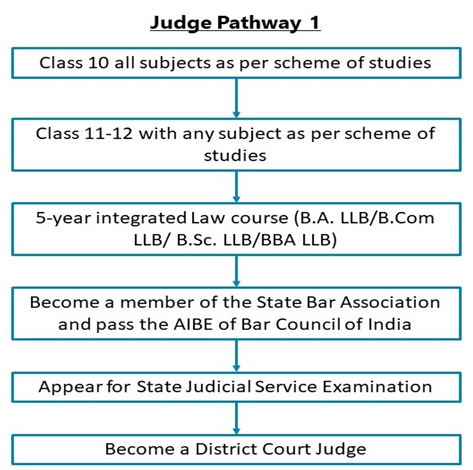
After completing Class 10 all subjects as per scheme of studies, complete Class 11-12 with any subject as per scheme of studies. You must go for graduation in Law and pursue five year integrated Law course in B.A LLB/B.Com LLB/ B.Sc. LLB/BBA LLB. It is important to become a member of the bar association i.e. by clearing the All India Bar Association (AIBE) conducted by the Bar Council of India and pass the AIBE of Bar Council of India. (All India Bar Examination is conducted to examine a candidate’s calibre to practice Law in India. You must have passed pursued LL.B. degree in order to be eligible for All India Bar Examination. On having cleared AIBE, you will be awarded with ‘Certificate of Practice’ by the Bar Council of India.) In order to become a District Judge, you willhave to appear for States Judicial Service Examinations which is the entry level exam for law graduates to become members of the subordinate Judiciary (Judge of District Court- Entry Level).
Class 10 all subjects as per scheme of studies - Class 11-12 with any subject as per scheme of studies - Bachelor’s degree in any subject - LLB - Become a member of the State Bar Association and appear for State Judicial Service Examination – Become a District Court Judge and practice law for minimum seven years- Appear for Higher Judicial Services Examination and practice as judge in Subordinate court for 10 years (in total) -– Qualify for the provisions made by the High Court Collegiums -Become a High Court Judge
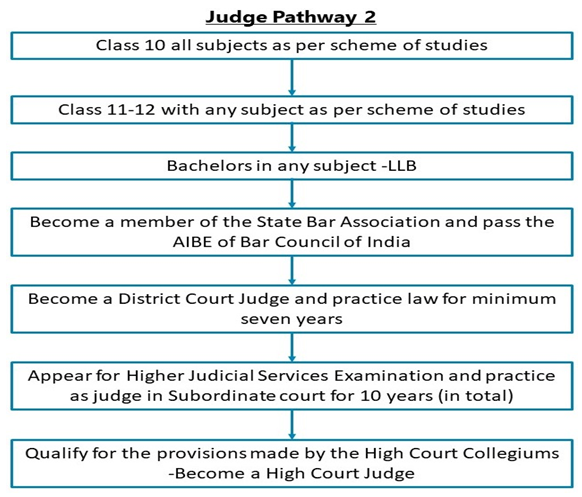
After completing Class 10 all subjects as per scheme of studies, complete Class 11-12 with any subject as per scheme of studies. Then you can pursue a Bachelor’s degree in any subject. Followed by LLB. You must appear for and successfully clear the All India Bar Examination (AIBE) conducted by the Bar Council of India. You must register with a State Judicial Service Exam for which no prior work experience is required. Law graduates can take State Judicial Service Exam in order to become a member of Judiciary. Although in order to appear for Higher Judicial services (HJS) exam you need to have a law degree in graduation with a minimum of seven years of litigating practice. After having cleared the second level of Judicial Service Examination i.e. Higher Judicial Services (HJS) you practice for ten years in total in any subordinate court under the Judicial Service of State. In order to become a High Court Judge, an advocate is required to have an average net professional annual income of RS. 7 Lakh in the preceding five years. As per the procedure, the High Court collegiums then send the names of candidates to be appointed as High Court Judges to the Law Ministry. After attaching the reports of the Intelligence bureau on the background of the candidates, the ministry forwards these reports to the Supreme Court collegium. The collegium then recommends the names of the suitable candidates for Judgeship.
Class 10 all subjects as per scheme of studies - Class 11-12 with any subject as per scheme of studies - Bachelor’s degree in any subject – L.L.B.- Become a member of the State Bar Association and Pass the AIBE and Practice Law – Appear for State Judicial Service Examination – Become a District Court Judge – Practice for ten years in Subordinate Court- Qualify for the provisions made by the High Court Collegiums - Get appointed as a High Court Judge andPractice in High Court for Five years – Get appointed as a Supreme Court Judge
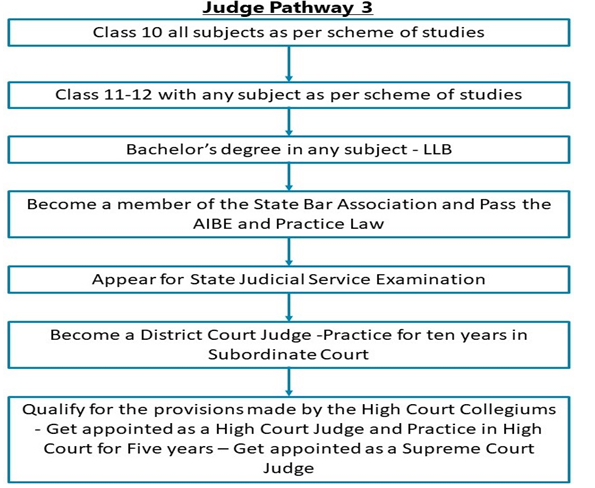
After completing Class 10 all subjects as per scheme of studies, complete Class 11-12 with any subject as per scheme of studies, you can go for L.L.B. You must appear for and successfully clear the All India Bar Examination (AIBE) conducted by the Bar Council of India. After having successfully passed the State Judicial service examination and Higher Judicial Service examination you must practise law for a minimum of ten years in subordinate courts. You must also practice for minimum of five years as a Judge in High Court. To be eligible for Judgeship in High Court, you need to have an average annual income of RS. 7 Lakh in the preceding five years. After having practiced for five years as a High Court Judge, you become eligible to be recommended for appointment as a Judge in Supreme Court.
Class 10 all subjects as per scheme of studies - Class 11-12 with any subject as per scheme of studies - 5-year integrated Law course (B.A. LLB/B.Com LLB/ B.Sc. LLB/BBA LLB) – LLM – Become a member of a State Bar Council and qualify the AIBE Exam – Practice as a Lawyer –Qualify for the provisions made by the High Court Collegiums - Get appointed as High Court Judge
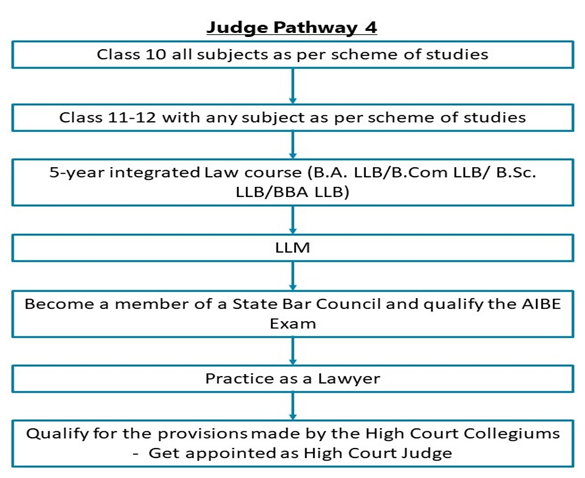
After completing Class 10 all subjects as per scheme of studies, complete Class 11-12 with any subject as per scheme of studies, you can go for a five year integrated Law course B.A. LLB/B.Com LLB/ B.Sc. LLB/BBA LLB. You can go for a master’s degree in Law i.e. LLM. You need to become a member of a State Bar Council. It is important to appear and qualify in the All Indian Bar Council Examination (AIBE) conducted by the Bar Council of India. In order to get appointed as a High Court Judge, you must have held for at least ten years a judicial office in the state or must have been an advocate of a High Court or two or more such courts in succession with an average annual income of RS. 7 Lakh in the preceding five years. As per the provisions of the High Court collegium, candidates who have an average annual income of RS. 7 Lakh will be only qualified for the recommendation by the Apex court’s collegium. After 20-25 years’ experience in litigating practice as a lawyer, you become a High Court Judge.
Class 10 all subjects as per scheme of studies - Class 11-12 with any subject as per scheme of studies - Bachelor’s degree in any subject - LLB – LLM– Become a member of a State Bar Council and qualify the AIBE Exam – Practice as a Lawyer –Qualify for the provisions made by the High Court Collegiums - Get appointed as High Court Judge
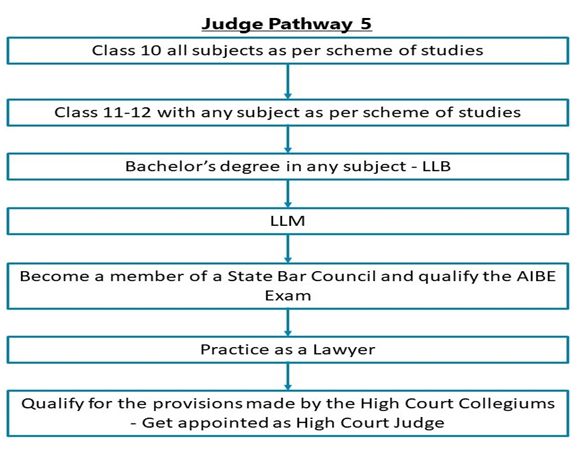
After completing Class 10 all subjects as per scheme of studies, complete Class 11-12 with any subject as per scheme of studies, you can pursue graduation in any course. Then you can go for a graduation in Law i.e. LLB and a master’s in LAW i.e. LLM. Then become a member of a State Bar Council. It is important to appear and qualify in the All India Bar Council (AIBE) conducted by the Bar Council of India post which you can continue practising as a Lawyer. To become a High Court Judge, you must have average net professional annual income of RS. 7 Lakh in the preceding five years before recommendation made by the collegium. The High Court Collegium then sends the names of candidates to be appointed as High Court Judges to the Law Ministry. With the necessary reports of the Intelligence Bureau on the background of Candidates, the ministry forwards it to the Supreme Court Collegium. After 20-25 years in litigating practice as a lawyer and qualifying for the necessary provisions made by the High Court collegium, you become eligible to be recommended for appointment as Judge in High Court.
Required Qualification & Competencies
First, after acquiring a degree in Law (LLB or BALLB/ BCom LLB/ BSc LLB/ BBA LLB), you will have to clear the All India Bar Examination (AIBE) which is conducted by the Bar Council of India.
(All India Bar Examination is conducted to examine a candidate’s calibre to practice Law in India.)
In order to become a District Judge, you will have to appear for States Judicial Service Examinations which is the entry level exam for law graduates to become members of the subordinate Judiciary (Judge of District Court- Entry Level).
Judicial Services Exam, which is also called the Provincial Civil Service examination or State Judicial Service Examination, is an entry-level examination for law graduates to become a member of subordinate judiciary. The exam is conducted by state judicial branch and thus the examination structure varies from state to state.
The State Judicial Service Examination is conducted in three stages- Preliminary examination, Mains exam and Viva/Personal Interview.
Judicial Services Exam, which is also called the Provincial Civil Service examination or State Judicial Service Examination, is an entry-level examination for law graduates to become a member of subordinate judiciary. The exam is conducted by state judicial branch and thus the examination structure varies from state to state.
The State Judicial Service Examination is conducted in three stages- Preliminary examination, Mains exam and Viva/Personal Interview.
The first stage i.e. the Preliminary Examination consists of two papers. Paper I carries 150 marks and Paper II carries 300 marks.
Paper I – General Knowledge
1. Aptitude
2. Current Affairs & Reasoning
3. English Comprehension
4. Précis Writing
Paper II – Law
1. Jurisprudence
2. Indian Constitution
3. Transfer of Property Act
4. Indian Evidence Act
5. Indian Penal Code
6. Civil Procedure Code
7. Criminal Procedure Code
8. Law of Contract
The second stage i.e. the Mains Examination consists of four to five papers (in several states)
Paper I – General Knowledge & Language
1. Current Affairs
2. General Knowledge
3. Essay
4. Translation
5. Precis Writing
6. Translation (Varies according to the state regional language)
Please note that the Papers II to Paper IV are all Law subjects mentioned below (not strictly in the same order as the structure varies according to the state):
1. Indian Contract Act
2. Indian Sale of Goods Act
3. Indian Partnership Act
4. Specific Relief Act
5. Civil Procedure Code
6. Law of Evidence
7. Law of Limitation & Law of Registration
8. Criminal Procedure Code,
9. Indian Penal Code
10. Indian Evidence Act
The Viva Voce/ Personal Interview test the suitability of a candidate for the State Judicial Services Examination. It may assess the following attributes in a candidate (these are only indicative and do not comprise all the criteria):
1. Analytical and logical abilities
2. Balance of judgement
3. Compassion and empathy
4. Critical abilities
5. Deductive and Inductive Reasoning abilities
6. Ethical thinking
7. Integrity and morality
The State Judicial examination provides Lower Judicial Services and Higher Judicial Services for which the eligibility of the candidates varies according to the state of examination. In order to appear for Lower Judiciary Services you need to have a degree in Law with no prior experience required. The age of candidate should be 21 – 35 years. Whereas, in order to appear for Higher Judicial services (HJS) exam you need to have a law degree in graduation with a minimum of seven years of litigating practice.
In order to appear for Higher Judicial services (HJS) exam you need to have a law degree in graduation with a minimum of seven years of litigating practice. After having cleared the second level of Judicial Service Examination i.e. Higher Judicial Services (HJS) you practice for ten years in total in any subordinate court under the Judicial Service of State and become eligible for nomination as a Judge in High Court.
Supreme Court Judges are recommended by the Collegium of the Supreme Court. Appointment finally depends upon the consent of the President of India who also consults the Ministry of Law before consenting an appointment.
These are the steps you can follow for Direct Recruitment in various positions as Judge in lower court, High Court and Supreme Court. You can also choose a direct career pathway by practicing as a lawyer for 20-25 years and become eligible as to be nominated as a Judge in High Court.
You need to be 65 years of age or less to become elected as Supreme Court Judge along with a minimum of ten years of working as an advocate in High Court or two equivalent session courts. In order to become a Judge, the number of years of experience varies according to the state. The Union Public Service Commission publishes an Annual Calendar every year which informs candidates of the dates of various examinations.
Compentencies Required
Interests
1. Enterprising- Enterprising occupations frequently involve starting up and carrying out projects. These occupations can involve leading people and making many decisions. Sometimes they require risk taking and often deal with business.
2. Social- Social occupations frequently involve working with, communicating with, and teaching people. These occupations often involve helping or providing service to others
Abilities
1. Inductive Reasoning- The ability to combine pieces of information to form general rules or conclusions (includes finding a relationship among seemingly unrelated events).
2. Deductive Reasoning- The ability to apply general rules to specific problems to produce answers that make sense.
3. Oral Comprehension- The ability to listen to and understand information and ideas presented through spoken words and sentences.
4. Speech Clarity- The ability to speak clearly so others can understand you.
5. Problem Sensitivity- The ability to tell when something is wrong or is likely to go wrong. It does not involve solving the problem, only recognizing there is a problem.
Knowledge
1. Law and Government- Knowledge of laws, legal codes, court procedures, precedents, government regulations, executive orders, agency rules, and the democratic political process.
2. English Language- Knowledge of the structure and content of the English language including the meaning and spelling of words, rules of composition, and grammar.
Skills
1. Critical-thinking- Preventing their personal assumptions from interfering with the proceedings, basing their decisions on specific meanings of the law; and being capable of weighing the facts, applying the law and rules, and making a decision relatively quickly.
2. Mediation skills- Being able to resolve disputes and promote settlement between the parties.
3. Excellent communication skills- Having outstanding listening skills in order to pay close attention to what is being said so as to evaluate and analyze information quickly and accurately.
4. Complex Problem Solving- Identifying complex problems and reviewing related information to develop and evaluate options and implement solutions.
5. Judgment and Decision Making- Considering the relative costs and benefits of potential actions to choose the most appropriate one.
Personality
1. You are always or mostly organized in your day to day life and activities.
2. You are always or mostly careful about your actions and behaviour.
3. You are always or mostly disciplined in your action and behaviour.
4. You are always calm or generally remain calm in most situations.
5. You are helpful to others sometimes.
6. You don't trust others easily.
7. You are always practical or in most situations.
Career - Job Opportunities & Profiles
You can become a judge at various levels of the Indian Judiciary System:
1. District Judge (Entry Level)
2. Civil Judge (Junior Division)
3. Criminal Judge (Junior Division)
After a Degree in law and becoming a member of the Bar council of India, you may appear and qualify State Judicial Service Exam in order to be eligible for the position of a District Judge (Entry Level) or Civil Judge (Junior Division) or Criminal Judge. Practising as a District Judge in entry level position or a Junior Division Civil Judge or a Criminal Judge in Junior Division you may be promoted to the position of senior and super senior divisions in the respective job positions. You can further appear and clear the Higher Judicial Services Examinations for which a minimum of seven years of litigating practise is required. You will be promoted to senior level positions as you clear the second level of Judicial Services i.e. Higher Judicial Services. With more number of years in litigating practice, you can expect more and more opportunities in senior level positions.
Recruitment Process
District Judge (Entry Level)/Civil Judge (Junior Division)/ Criminal Judge - You will be appointed through Direct Recruitment to become a District Judge(Entry Level)/Civil Judge (Junior Division)/ Criminal Judge via the State Judicial Service Examination. The Competitive Examination consists of Preliminary Test, Written Examination followed by a Viva-voce/ Personality Test. In order to be eligible for Judicial Officer in the rank of District Judge (Entry Level)/Civil Judge (Junior Division)/Criminal Judge you must have been practising as an advocate for not less than 7 years. On being selected, you will be on Probation period for two years from the date on which you join duty.
The appointment of District Judges in any state is made by the governor of the state in consultation with the High Court exercising jurisdiction in relation to that state.
High Court Judge - The selection process/nomination of High Court Judge depends on the decision made by the collegium. (A collegium is a group of the Chief Justice of India, four most senior judges of the court and the senior-most judge addressing from the high court of a prospective appointee.) The chief justice of the High Court may recommend some of the District Judges or Civil Judges for the position of the High Court Judge and may also recommend senior practising lawyers to become a Judge. The Chief Justice of the High Court is appointed by the President with the consultation of the Chief Justice of the Supreme Court and the Governor of the State.
In order to be a Judge in High Court, you should be a citizen of India, has at least ten years held a judicial office, or has at least been an advocate of a High Court for ten years or two or more courts in succession.
Supreme Court Judge - A judge is appointed to the Supreme Court by the president of the country on the recommendation of the collegium. The collegium of the Supreme Court might recommend some of the Chief Justices or the High Court Judges to be inducted as a Judge in the Supreme Court. You are eligible to become a Judge in Supreme Court if you are a citizen of India less than 65 years age, a Judge of one high court or more, for at least five years, or an advocate for at least ten years, or aneminent jurist, in the opinion of the president. Some of the judges in subordinate or lower or district courts after long years of service will be actually nominated to become the High Court Judges. After having gained a set number of years in service you may be recommended as Chief Justice of High court by the President along with the consultation of the Chief Justice of the Supreme Court and the Governor of the State.
Career Growth
After appearing for the State Judicial Services Exam you can become a District Judge at Entry Level. After having a minimum of seven years of litigating practice, you can appear for Higher Service Judicial Exam and practice as a Judge as a senior advocate.
After having held a judicial office for ten years or has a practice of ten years as an advocate in High Court or of two or more such courts in session, you can be consider getting recommended for a Judge in High Court. Further, having been a Judge of a High Court for at least five years or two or more such courts in succession, or having practised as an advocate of a high court or two or more of such courts in succession for at least ten years or be an eminent jurist in President’s opinion, you can become eligible for a judge in the Supreme Court.
To become a Judge in any of the Courts in India, you require years of hard work and practice to step up the ladder starting from District Court, High Court, Supreme Court and becoming the Chief Justice of India. Most promotions and recommendations are based on your years of practice as well on your performance and are done majorly by the senior Judges, Governors, Chief Justice of High Court and the President of India each depending on the position and authority in consideration.
Salary Offered
1. According to the 7th Pay Commission, following are the starting and maximum salaries of the following judicial officers:
2. As a Civil Judge Junior Division you would get around Rs. 77,840 - 1,25,800 per month.
3. As a Civil Judge Senior Division you would get around Rs. 1,11,080 - 1,51,770 per month.
4. As a District Judge (Entry Level) you would get around Rs. 1, 44,860 - 1,77,230 per month.
5. As a District Judge (Selection Grade) you would get around Rs. 1,62,140 - 1,97,520 per month.
6. As a District Judge (Super Time Scale) you would get around Rs. 1, 97,520 - 2,14,830 per month.
7. As a Judge of High Court your monthly earnings would be Rs.2, 25,000.
8. As a Chief Justice of High Court, your monthly earnings would be Rs.2, 50,000.
9. As a Supreme Court Judge, your monthly earnings would be Rs.2, 50,000.
10. As a Chief Justice of India, Your monthly earnings would be Rs.2, 80,000.
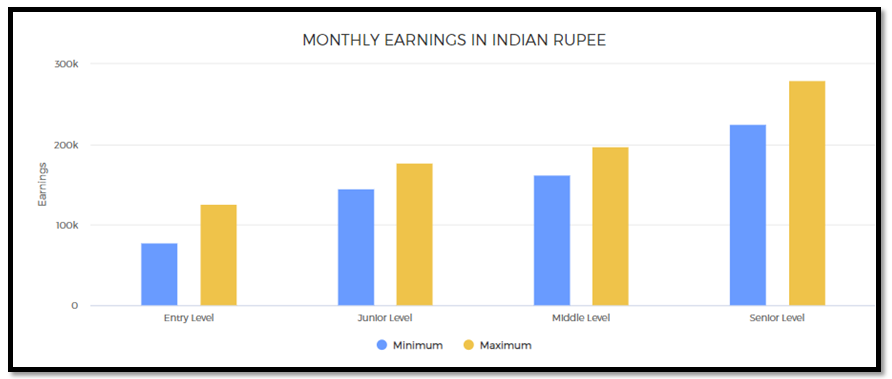
Monthly Earnings In Indian Rupee

1. Entry level: 0 - 2 years of work experience
2. Junior Level: From 1 to 12 years of work experience
3. Mid Level: From 5 to 20+ years of work experience
4. Senior Level: From 10 to 25+ years of work experience (there could be exceptions in some high-end technical, financial, engineering, creative, management, sports, and other careers; also in the near future, people will reach these levels much faster in many careers and in some careers, these levels will have no meaning as those careers will be completely tech skill driven such as even now, there is almost no level in a Cyber Security Expert’s job)
Work Activities
1. Addressing grievances and resolving conflicts- Handling complaints and grievance to resolve; resolving conflicts among co-workers or others at workplace or outside in relation to your work.
2. Assessing and determining compliance with standards, laws, rules and guidelines- Using relevant information, auditing information, processes and systems to determine whether organisations or people are complying with standards, laws, rules and guidelines.
3. Communicating with co-workers and others- Communicating with people in writing, verbally or otherwise inside your workplace and various other people who have professional relationships with your place of work including vendors, government officials, etc. or with people at large.
4. Getting Information- You will be observing, receiving, and otherwise obtaining information from all relevant sources.Ensuring that the proceeding is being conducted in compliance with the rules and the applicable law.
5. Decision making and problem solving- Analysis of data and information; evaluation of alternative decisions and results of decisions; taking the right decisions and solving problems.
6. Inspecting situations, events, and people- Inspecting situations, events and people to understand the reasons and causes for the situation or events to happen; inspecting people to understand reasons behind their behaviour and actions.
7. Providing advices and consultation to others- Giving advices or consultation to others about various issues, conceptual matters, know-hows, scientific matters, products or services.
Future Prospects
According to National Judicial Data Grid (NJDG), there are over 8804319 Civil Cases and over 22307561 Criminal Cases pending. Considering a rise in number of cases pending, the National Mission for Justice Delivery and Legal Reforms have taken measures to access the delay in the system and improving the accountability through implementing important changes. The Mission has been working towards bettering the infrastructure for courts including computerization as well as increasing manpower strength of Judiciary. The Mission is also incorporated towards re-establishment of court procedures for quick disposal of cases. With proper measures taken, the Indian Judiciary would be able to tackle the flooding of cases in the coming years. Indian legal services are expected to grow as more and more Indian companies are expanding internationally by establishing associations with international markets.
With a total number of 1200+ law schools, and around 70,000-80,000 enrolments every year, the legal services in India are going to witness more growth prospects in the coming years. Both inflow and outflow in Legal Outsourcing have been transforming law practice as law firms and corporate legal departments are looking for cost cutting techniques, increasing flexibility and expanding domestic capabilities. There is a huge demand for professional and experienced Judges in order to reduce the pressure from existing working professionals in this field. Therefore you may expect great future prospects in this career pathway.
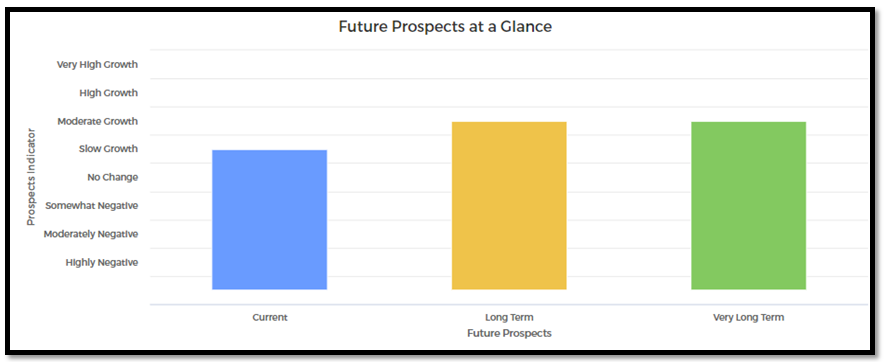
Future Prospects At a Glance


