

Geriatric Care Technologist
Entry Level Qualification
Class 10
Career Fields
Allied & Para Medical Science
For Specially Abled


Career Entrance Exam
NEET UG, NEET PG, JIPMER MSC/MPH, AIIMS MSC, AIIMS BSC, AIIMS PG INICET
About Career
PARTICULARS | DESCRIPTION |
Name | Geriatric Care Technologist |
Purpose | Operate, Calibrate, or Maintain Equipment |
Career Field | Allied & Para Medical Science |
Required Entrance Exam | NEET UG, NEET PG, JIPMER MSC/MPH, AIIMS MSC, AIIMS BSC, AIIMS PG INICET |
Average Salary | 150000 - 200000 Rs. Per Year |
Companies For You | Narayana Health, Batra Hospital & Medical Research Centre, Max Healthcare & Many More |
Who is Eligible | Class 10th Pass |
1. Geriatric Care Technologists are specialized healthcare professionals who manage and operate the various medical equipment used in the diagnosis and treatment of illnesses that affect the geriatric population.
2. They assist surgeons, physicians, geriatrician consultants (specialized doctors) as well as nurses and personal aides in successfully rendering healthcare services to and treating the elderly.
3. The “old” are people in their 70s and 80s who have chronic illnesses and are slowing down
Now that you know your area of work, let us understand what exactly you would do or be involved in as a Geriatric Care Technologist
1. As a Geriatric Care Technologist, you would be involved in performing healthcare-related tasks, such as monitoring the vital signs of elderly patients, conducting laboratory diagnostic tasks, assisting surgeons or other associated duties, under the general direction of doctors, and coordinating with nurses, personal aides or physiotherapists.
2. You will use specific biomedical equipment including spectrophotometers, calorimeters, flame photometers, or computer-controlled analyzers to specifically observe, monitor, evaluate, and treat a patient’s condition under the supervision of a doctor.
3. You will need to demonstrate extensive knowledge of physiology, functions of the normal human body, conditions arising due to aging, and assess the changes in an aged body resulting in and due to a disease.
Key Roles and Responsibilities
1. You will perform healthcare-related tasks, such as monitoring the vital signs of elderly patients, conducting laboratory diagnostic tasks or other associated duties, under the general direction of doctors, and coordinating with nurses, personal aides, or physiotherapists.
2. You will operate, calibrate, or maintain equipment used in quantitative or qualitative analysis, such as spectrophotometers, calorimeters, flame photometers, or computer-controlled analyzers.
3. You will select, assemble, clean, disinfect, set up as well as test laboratory biomedical equipment, geriatric & mobility care setups, and devices.
4. You will conduct chemical analysis of biological specimens, including blood, urine, or spinal fluid, to determine the presence of normal or abnormal components.
5. You will collect and study blood samples to determine the number of cells, their morphology, their blood group, blood type, or compatibility for transfusion purposes, using microscopic techniques.
6. You will enter data from the analysis of medical tests or clinical results into the computer for storage.
7. You will prepare and maintain records of client progress and services performed, reporting changes in client condition to seniors.
8. You will develop, standardize, evaluate, or modify procedures, techniques, or tests used in the analysis of specimens or medical laboratory experiments.
9. You will participate in case reviews, consulting with the team caring for the client, to evaluate the client's needs and plan for continuing services.
Career Entry Pathway
Class 10 all subjects as per scheme of studies – Class 11-12 Physics, Chemistry and Biology along with any other subject as per scheme of studies - B Sc [Hons] in Allied Health Sciences with specialization in Geriatric Care Technology/ Physician Assistant (B Sc PA)/ Paramedical Technology/ Prosthetics & Orthotics (BPO) / Occupational Therapy/ Emergency Medical Technology (B Sc EMT)/Respiratory Care Technology (B Sc RCT)/ Cardiac Care Technology(B Sc CCT) or similar.
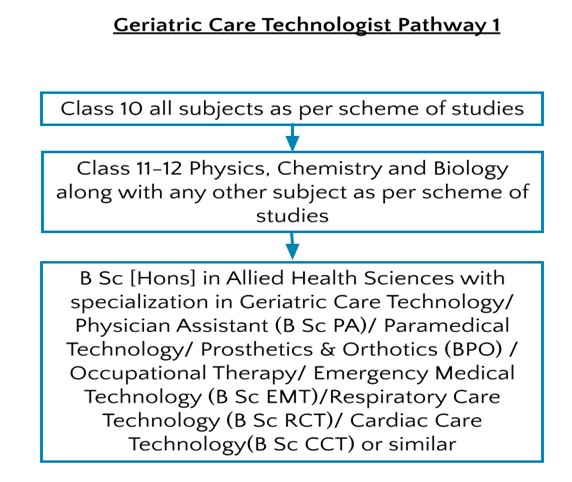
After completing Class 11-12 Physics, Chemistry, and Biology along with any other subject as per the scheme of studies, you may go for a B Sc [Hons] in Allied Health Sciences with a specialization in Geriatric Care Technology/ Physician Assistant (B Sc PA)/ Paramedical Technology/ Prosthetics & Orthotics (BPO) / Occupational Therapy/ Emergency Medical Technology (B Sc EMT) /Respiratory Care Technology (B Sc RCT)/ Cardiac Care Technology (B Sc CCT) or similar programs in related disciplines.
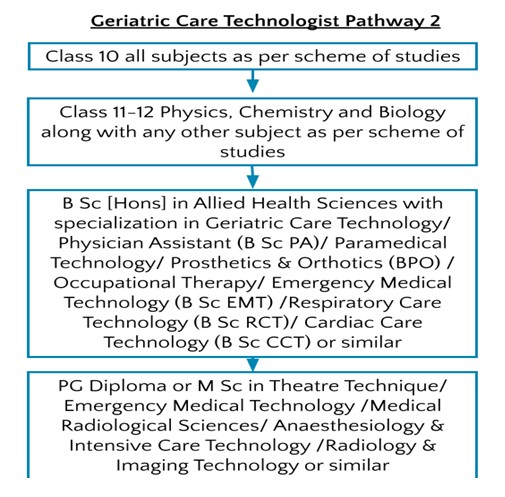
After completing Class 11-12 Physics, Chemistry, and Biology along with any other subject as per the scheme of studies you may go for a B Sc [Hons] in Allied Health Sciences with a specialization in Geriatric Care Technology/ Physician Assistant (B Sc PA)/ Paramedical Technology/ Prosthetics & Orthotics (BPO) / Occupational Therapy/ Emergency Medical Technology (B Sc EMT) /Respiratory Care Technology (B Sc RCT)/ Cardiac Care Technology (B Sc CCT) or similar programs in related disciplines. Thereafter, you may choose to pursue a PG Diploma or M Sc in Theatre Technique/ Emergency Medical Technology /Medical Radiological Sciences/ Anaesthesiology & Intensive Care Technology /Radiology & Imaging Technology or similar programs in related disciplines. If you go for an M Sc, you will have the option to continue further and complete your doctoral studies (Ph.D.). However, with a PG Diploma after graduation, a subsequent PhD is not possible.
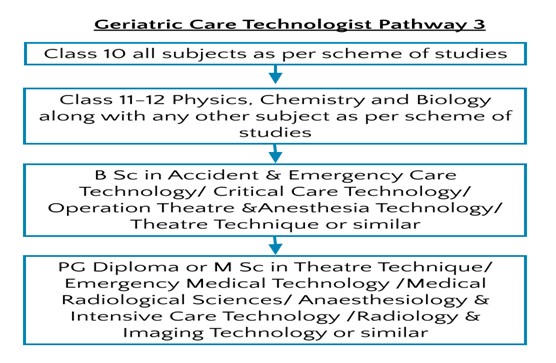
After Class 11-12 Physics, Chemistry, and Biology along with any other subject as per the scheme of studies, B Sc in Accident & Emergency Care Technology/ Critical Care Technology/ Operation Theatre &Anesthesia Technology/ Theatre Technique or similar – M Sc in Radiology & Imaging Technology / Medical Radiological Sciences/ Theatre Technique/ Anaesthesiology & Intensive Care Technology /Orthopaedic & Rehabilitation Technology or similar.
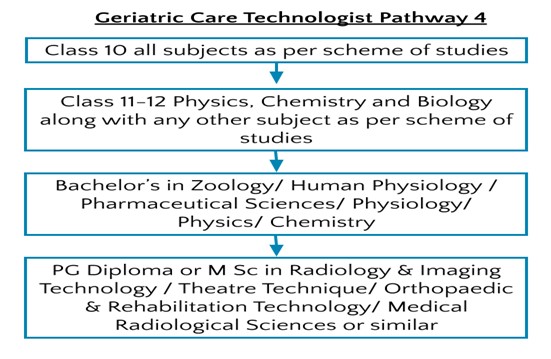
After completing Class 11-12 in Science stream with Physics, Chemistry, and Biology as mandatory subjects, you may go for a Bachelor’s in Zoology/ Human Physiology / Pharmaceutical Sciences/ Physiology/ Physics/ Chemistry. Thereafter you may go for a PG Diploma or M-Sc.
Required Qualification & Competencies
After Class 11-12 in Science stream, you may pursue:
1. B Sc [Hons] in Allied Health Sciences with specialization in Geriatric Care Technology/ Physician Assistant (B Sc PA)/ Paramedical Technology/ Prosthetics & Orthotics (BPO).
2. B Sc in Accident & Emergency Care Technology/ Critical Care Technology/ Operation Theatre &Anesthesia Technology/ Theatre Technique or similar.
3. Bachelor’s in Zoology/ Anatomy/ Physiology/ Human Physiology / Pharmaceutical Sciences/ Physics/ Chemistry.
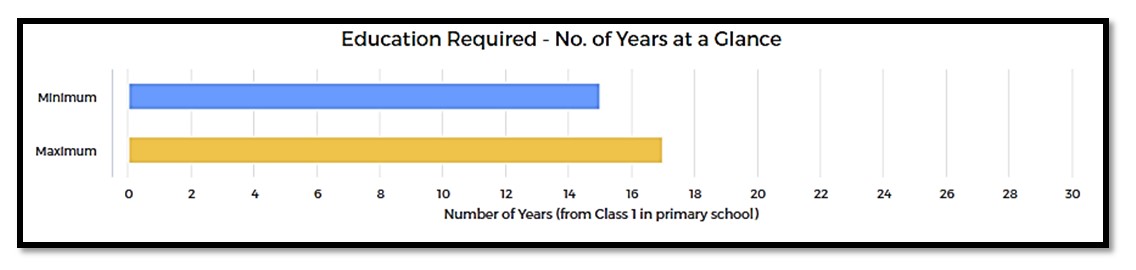
MINIMUM EDUCATION REQUIRED | MAXIMUM EDUCATION REQUIRED |
Under Graduate Undergraduate Degree / Honours Diploma / Graduate Diploma (equivalent to a Degree) Programs for which the minimum eligibility is a pass in Higher Secondary / Class XII School Leaving examination. | Post Graduate Postgraduate Degree / Diploma / Certificate Programs for which the minimum eligibility is a pass in Graduation / equivalent Diploma program like Honours Diploma or Graduate Diploma. |
Competencies Required
Interest
1. Realistic: You should have an interest in Realistic Occupations. Realistic occupations involve more practical and hands-on activities than paperwork or office work. Realistic occupations often involve physical activities for getting things done using various tools and equipment.
2. Conventional: You should have interests in Conventional Occupations. Conventional occupations involve repetitive and routine tasks as well as fixed processes or procedures for getting things done. These occupations involve working more with data, systems, and procedures and less with ideas or creativity.
3. Social: You should have an interest in Social Occupations. Social occupations involve helping or assisting others; these involve working with and communicating with people to provide various services; these may involve educating and advising others.
Knowledge
1. Healthcare Services: Knowledge of different fields that are related to offering various types of healthcare services to people; assisting physicians and surgeons to carry out diagnosis, treatment, and prevention of human diseases, ailments, and disorders. This includes knowledge of different practices apart from medicine which are used to treat and prevent human diseases or to provide holistic healthcare and wellness. This also includes knowledge about drugs and medicines.
2. Personal Care Service: Knowledge of how to provide various assistance and services to others. This includes looking after the needs of individuals, understanding what they need, and providing all assistance at home or elsewhere.
Skills
1. Active Listening: Giving full attention to what other people are saying, understanding the points being made by others, asking questions, etc.
2. Critical Thinking: Skills in analysis of complex situations, using of logic and reasoning to understand the situations and take appropriate actions or make interpretations and inferences.
3. Judgment and Decision Making: Skills in considering the pros and cons of various decision alternatives; considering costs and benefits; and making appropriate and suitable decisions.
4. Problem Solving: Skills in analysis and understanding of problems, evaluating various options to solve the problems, and using the best option to solve the problems.
5. Technical: Skills in using various technologies and technical methods including cardiovascular knowledge and use of medical technologies, performing diagnostic procedures, etc.
Abilities
1. Deductive Reasoning: The ability to apply general rules and common logic to specific problems to produce answers that are logical and make sense. For example, understanding the reasons behind an event or a situation using general rules and common logic
2. Inductive Reasoning: The ability to combine pieces of information from various sources, concepts, and theories to form general rules or conclusions. For example, analyzing various events or situations to come out with a set of rules or conclusions
3. Inter-Personal: The ability to build and maintain good relationships with others at workplaces and elsewhere.
4. Problem Sensitivity: The ability to tell when something is wrong or is likely to go wrong. It does not involve solving the problem, only recognizing there is a problem.
Personality
1. You are always or mostly organized in your day-to-day life and activities.
2. You remain calm in emergencies and work well under pressure
3. You always feel secure in your surroundings and most situations.
4. You are a soft-hearted person sometimes.
5. You trust others sometimes but not always.
6. You act independently sometimes but do not do so at some other times.
7. You are always practical in most situations.
Career - Job Opportunities & Profiles
After completing a Bachelor’s or Master’s, you may find work in a hospital as well as public/private medical and training colleges and other establishments. You may find work:
1. In multi-specialty government and private hospitals healthcare services are offered for the geriatric population.
2. In super-specialty or dedicated hospitals that treat geriatric conditions/diseases like BLK Super Speciality Hospital, Care Hospital, Artemis, F. O. R. Ortho & Neuro Hospital, Adiva Super Specialty Care, Apollo Hospitals, Bhagwati Hospital, MGS Super Specialty Hospital, Primus Super specialty, Medicheck Ortho Super Specialty, etc.
3. In nursing homes and health institutes that treat geriatric conditions & related diseases like Narayana Health, Batra Hospital & Medical Research Centre, Max Healthcare, V P S Rockland, MedantaMedicity, Jeewan Nursing Home & Hospital, Bensups, Fortis Healthcare Ltd., Febris Multispecialty, Atlanta Mediworld, Felix Healthcare, etc.
Career Growth
Geriatric Care Technician – Assistant Geriatric Care Technician – Geriatric Care Technologist – Senior Geriatric Care Technologist.
Salary Offered
1. As a Trainee or Technician at Entry level, you may earn around Rs. 12,000 to Rs. 15,000 per month.
2. At Junior-level with an experience of 1- 4 years you may earn around Rs. 15,000 – 35,000 per month or more.
3. At Mid-level with an experience of 5-12 years you may earn around Rs. 20,000 – 90,000 per month or more.
4. At Senior-level with an experience of 12-20 years you may earn around Rs. 35,000 – 1,40,000 per month or more.
5. Salaries are higher at government hospitals.
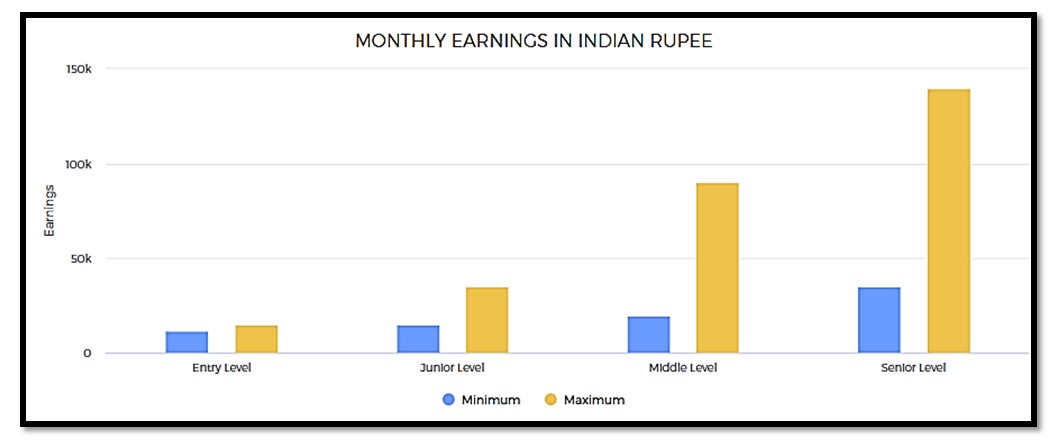
Monthly Earnings In Indian Rupee
Entry Level | Junior Level | Mid Level | Senior Level | ||||
Min Earning | Max Earning | Min Earning | Max Earning | Min Earning | Max Earning | Min Earning | Max Earning |
10000 | 30000 | 20000 | 60000 | 50000 | 90000 | 120000 | 200000 |
1. Entry level: 0 - 2 years of work experience
2. Junior Level: From 1 to 12 years of work experience
3. Mid Level: From 5 to 20+ years of work experience
4. Senior Level: From 10 to 25+ years of work experience (there could be exceptions in some high-end technical, financial, engineering, creative, management, sports, and other careers; also shortly, people will reach these levels much faster in many careers and some careers, these levels will have no meaning as those careers will be completely tech skill driven such as even now, there is almost no level in a Cyber Security Expert’s job)
Work Activities
1. Assisting and caring for people: Assisting people in availing of services; taking care of people in different situations; offering help and services to others.
2. Analyzing and interpreting data and information: Analysis of data and information to find facts, trends, reasons behind situations, etc.; interpretation of data to aid in decision-making.
3. Communicating with co-workers and others: Communicating with people in writing, verbally or otherwise inside your workplace and various other people who have professional relationships with your place of work including vendors, government officials, etc., or with people at large
4. Decision-making and problem-solving: Analysis of data and information; evaluation of alternative decisions and results of decisions; making the right decisions and solving problems.
5. Developing and maintaining interpersonal relationships: Developing professional relationships with co-workers and others outside organizations and maintaining good relationships.
6. Getting Information and learning: Observing, hearing, reading, using computers, or otherwise obtaining information and learning from it.
7. Handling administrative activities: Handling various administrative tasks and managing day-to-day operations.
8. Inspecting equipment, systems, structures, and materials: Inspecting equipment, systems, structures, and materials to ascertain quality, performance, defects, causes of errors, etc.
9. Inspecting situations, events, and people: Inspecting situations, events, and people to understand the reasons and causes for the situation or events to happen; inspecting people to understand reasons behind their behavior and actions.
10. Updating and using relevant knowledge: Keeping updated with the latest knowledge relevant to your fields of work and using the relevant knowledge in getting things done.
11. Using computers for work: Using computers for day-to-day office work; using computer software for various applications in day-to-day professional work; entering data and processing information; for writing.
12. Working in a team: Working in a team of people; developing a team; maintaining professional relationships among team members.
Future Prospects
1. By 2025, medical spending in India is expected to grow by almost 9 to 12% making India one of the world’s top ten in this zone. India’s earnings from medical tourism could exceed USD 9 billion.
2. Many private and government hospitals have adopted high-end technological services catering to rising demands. Therefore a career in this allied healthcare sector would witness immense demand in the upcoming years.
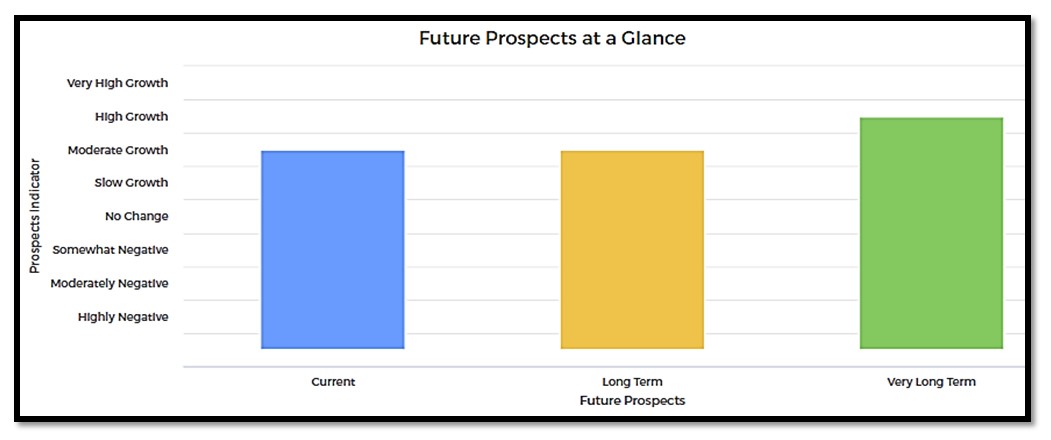
Future Prospects At A Glance
Current (0-1 year) | Long Term (2-5 years) | Very Long Term (6-10 years) |
Moderate Growth | Moderate Growth | High Growth |