
Computer Networking Technician
Entry Level Qualification
Class 12
Career Fields
Information Technology & Computer Science
For Specially Abled


Career Entrance Exam
About Career
As a Computer Networking Technician, you will be installing, testing, and maintaining various hardware equipment and devices such as an antenna, cables, hubs, routers, switches, servers etc. as well as various software such as device drivers and firewalls to establish, maintain and troubleshoot computer networks.
Your responsibility will be to ensure proper setup, upgrade and maintenance of the networks like LAN (local area network), WAN (wide area network), MPLS (Multiprotocol Label Switching), VPN (Virtual Private Networks)etc. You will be setting up both wired and wireless networks.
Key Roles and Responsibilities:
As a Computer Networking Technician, you will be engaged with one or more of the following roles and responsibilities:
1. Designing, implementing, monitoring and analyzing computer and information networks like LAN, WAN, VPN, intranets, extranets, and their performances etc.
2. Installing and maintaining security systems such as firewalls and anti-virus software.
3. Developing disaster recovery plans and solutions to network problems.
4. Developing network-related documents like purchase orders or maintenance log files etc.
5. Researching and testing modified or new software and hardware problems associated with computer networks.
6. Installing new equipment as and when required.
7. Coordinating with other network designers and engineers.
8. Communicating with vendors for gathering information related to products in use or new ones, future needs, issues with existing products etc.
PARTICULARS | DESCRIPTION |
Name | Computer Networking Technician |
Purpose | Installing and Maintaining |
Career Field | Mechanic & Technician |
Required Entrance Exam | No Entrance Exam |
Average Salary | 100000 - 300000 Rs. Per Year |
Companies For You | IT-Software / Software Services, IT-Hardware and Networking & Many More |
Who is Eligible | Class 10th Pass |
Career Entry Pathway
Class 10 all subjects as per scheme of studies - training at an ITI or similar institute for ‘Network Technician or related courses.
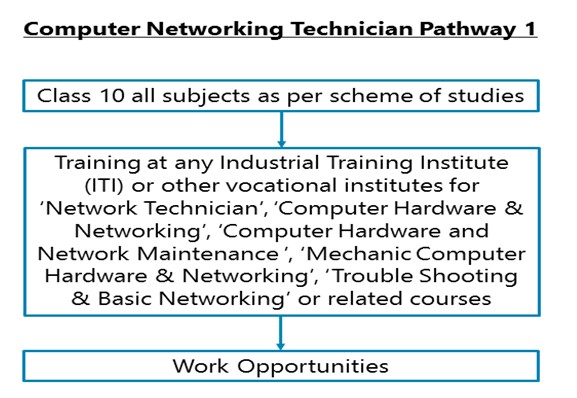
After Class 10, you can go for training at any Industrial Training Institute (ITI), National Skill Training Institute (NSTI), Regional Vocational Training Institute (RVTI), National Vocational Training Institute (NVTI), Industrial Training Center (ITC) or other vocational institutes for ‘Network Technician’, ‘Computer Hardware & Networking’, ‘Computer Hardware and Network Maintenance ’, ‘Mechanic Computer Hardware & Networking’, ‘Trouble Shooting & Basic Networking’ or related courses. This is a 2-year training course with 4 semesters (6 months each).
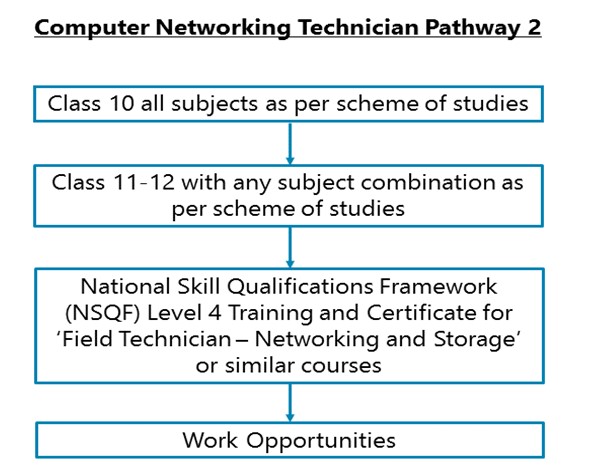
After Class 12, you can obtain a National Skill Qualification Framework (NSQF) Level 4 Training and Certificate for ‘Field Technician – Networking and Storage’ or similar courses. The total number of training hours is 360.
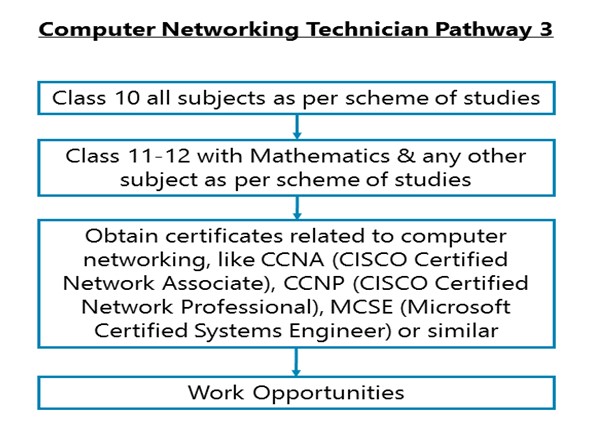
After Class 12, you can go for Skill training and certification in CCNA (CISCO Certified Network Associate), CCNP (CISCO Certified Network Professional), MCSE (Microsoft Certified Systems Engineer) etc.
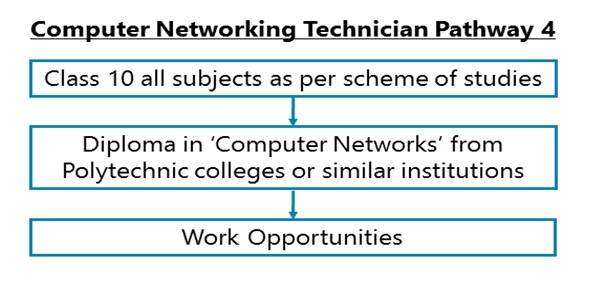
After Class 10, you can go for a Diploma in ‘Computer Networks’ from Polytechnic colleges or similar institutions.
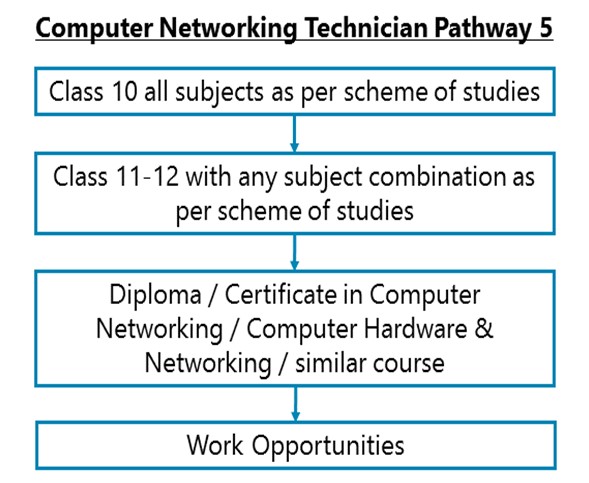
After Class 12, you can go for a Diploma / Certificate in Computer Networking / Computer Hardware & Networking or similar courses.
Required Qualification & Competencies
After Class 10, you can do the following:
1. National Skill Qualification Framework (NSQF) Certificate and Training.
2. National Apprenticeship Certificate (NAC) after apprenticeship training.
3. Diploma in related trades.
4. Take vocational training at an ITI (or similar institute).
5. Complete Class 11-12 and then go for Diploma / Certificate courses.
6. Complete Class 11-12 and then go for NSQF Certificate and Training.
Various private/public vocational training establishments offer related courses on:
1. Computer Networks
2. Computer Networks & Information Security
3. Computer Networking (Computer Science)
4. Network Technician
5. Computer and Peripherals Hardware Repair and Maintenance Mechanic
6. Computer Hardware and Network Maintenance
7. Computer Networking Technician
8. Computer Science & Engineering (Diploma)
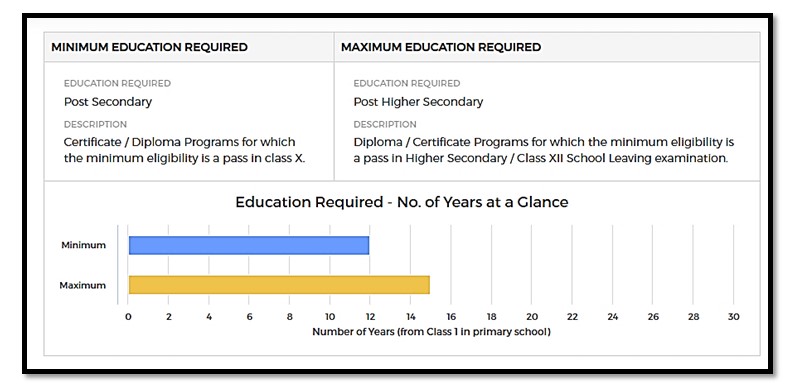
Competencies Required
1. You should have interests for Realistic Occupations. Realistic occupations involve more practical and hands-on activities than paperwork or office work. Realistic occupations often involve physical activities for getting things done using various tools and equipment.
2. You should have interests for Investigative Occupations. Investigative occupations involve working with ideas and quite a lot of thinking, often abstract or conceptual thinking. These involve learning about facts and figures; involve the use of data analysis, assessment of situations, decision making and problem-solving.
3. You should have interests for Conventional Occupations. Conventional occupations involve repetitive and routine tasks as well as fixed processes or procedures for getting things done. These occupations involve working more with data, systems, and procedures and less with ideas or creativity.
4. You should have knowledge of English Language - English grammar, words, spelling, sentence construction, using English to communicate with others, reading in English, etc.
5. You should have Electronics Instrument Repair and Maintenance Skills - performing repair and maintenance of different electronic machines, equipment, and devices.
6. You should have Problem Solving Skills - analysis and understanding of problems, evaluating various options to solve the problems and using the best option to solve the problems.
7. You should have critical thinking Skills –analysis of complex situations, using logic and reasoning to understand the situations and take appropriate actions or make interpretations and inferences.
8. You should have good hand-eye coordination.
9. You are always or mostly careful about your actions and behaviour.
10. You are practical always or in most situations.
11. You are always or mostly disciplined in your action and behaviour.
12. You are always or mostly serious about your actions and behaviour.
13. You are always or mostly organized in your day-to-day life and activities.
Career - Job Opportunities & Profiles
After your Diploma/Training/Certificate Courses, you can get many jobs in the field of Computer Networks with small to medium scale companies. Some of the jobs positions you can get are:
1. Computer Network and Systems -Technician
2. Computer Networking Technician
3. Technician – Network Administration
4. Computer Hardware & Networking Technician
5. Executive – Computer Hardware and Networks
6. Executive – Computer Networking
All industries will offer work opportunities. Some are:
1. IT-Software / Software Services
2. IT-Hardware and Networking
3. BFSI (Banking, Financial Services, and Insurance)
4. BPO (Business Process Unit), Call Centers, ITES (IT Enabled Services)
5. Telecom / ISP (Internet Service Provider)
6. Hospitals
7. Travel, Hotels, Restaurants, Airlines, Railways
Career Growth
With experience, you may expect to grow into higher levels of jobs. From a Computer Networking Technician, you may become a Senior Technician / Senior Technical Support Executive / similar. With 8-10 years of experience, you may become a Technical Team Lead. You may also set up your own firm for computer networks and related services like installation, troubleshooting, and maintenance. Many computer companies hire such firms for servicing their customers.
Salary Offered
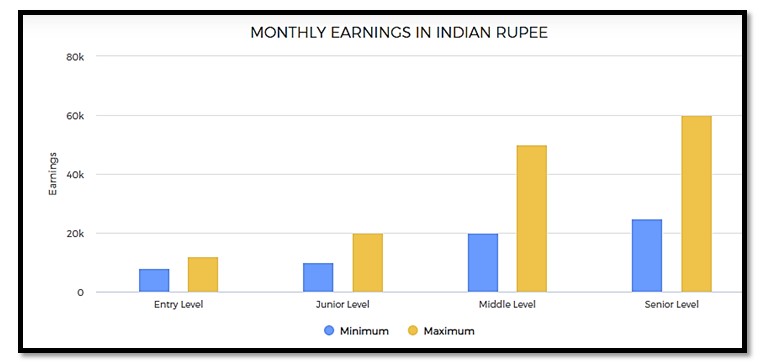
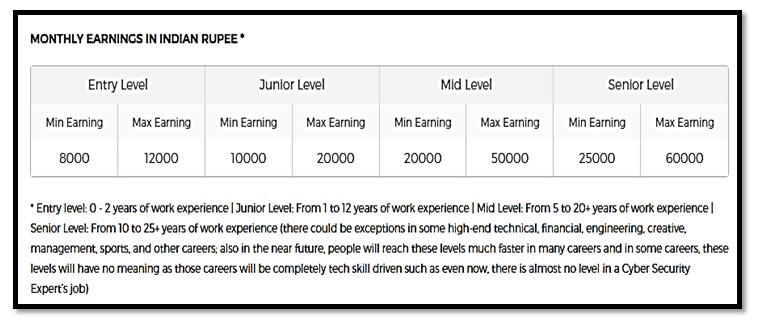
1. At the beginning of your career, you may earn about Rs. 8,000 – 12,000 or more per month depending upon the kind of organisation you are getting a job. Some companies may pay higher also.
2. With 1-3 years of experience, you may earn about Rs. 10,000-20,000 a month and with 8-10 years of experience, you may earn about Rs. 20,000-50,000 or more per month.
3. Senior technicians with 10+ years of experience can expect to get about Rs. 25,000 – 60,000 or more per month.
Work Activities
1. Working with computers, programming and performing technical tasks - Using/handling computers, computer systems and hardware for technical tasks, installing/dismantling related equipment.
2. Using computers for work - Using computers for day-to-day office work; using computer software for various applications in day-to-day professional work; entering data and process information; for writing.
3. Processing information - Searching, compiling, tabulating, calculating, auditing, verifying or otherwise dealing with information processing including data entry, transcription, recording, storing and maintaining databases.
4. Analysing and interpreting data and information - Analysis of data and information to find facts, trends, reasons behind situations, etc.; interpretation of data to aid in decision making.
5. Getting Information and learning - Observing, hearing, reading, using computers, or otherwise obtaining information and learning from it.
6. Identifying objects, actions, and events - Identifying various characteristics of objects; observing and understanding actions and events; understanding changes in actions and events.
Future Prospects
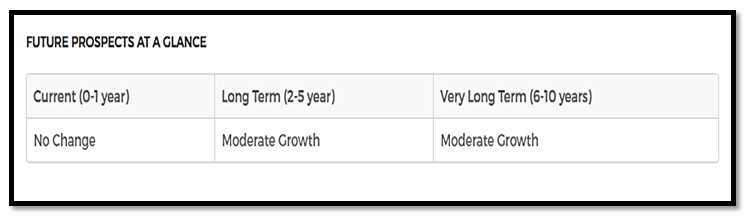
The future of Computer Hardware Technicianslooks promising. The IT & electronics industry in India is expected to grow at a steady annual rate of around 40% to touch the mark of 400 billion US Dollars. This is going to be boosted by the expansion in Indian Consumer Durables Sector and the Indian Appliance and Consumer Electronics Industry too. The latter is expected to reach more than 3 trillion Indian Rupees (more than 45 billion US Dollars).