

Visual Merchandiser
Entry Level Qualification
Class 12
Career Fields
Arts & Design
For Specially Abled


About Career
As a Visual Merchandiser, you will be creating attractive visual displays for various products such as clothing, jewelry, watches, etc. in retail outlets. You will aim to boost the advertising and marketing efforts of your company, while also maximizing the sales of the products your company sells through the retail outlets. You will design and develop the layouts of the retail stores of your company and design displays. You will help your interior and product teams build the stores and the displays as per your design and plan.
Visual merchandising is a pivotal part of a brand’s retail strategy of maximizing the aesthetics of a product/service to encourage and increase sales by capitalizing on the human tendency to ‘window-shop’. Thus, as a Visual Merchandiser, your goal will be to use your design and aesthetic skills to attract, engage, and motivate potential buyers to make the purchase. You will help retail businesses/stores or brands highlight and advertise their goods/services and maybe even their benefits. You will do so by creating optimal and eye-catching product displays and store layouts that will persuade customers (both existing and potential customers) to go through with the purchase.
Key Roles & Responsibilities
1. To plan, create, and implement a visual merchandising strategy for retail outlets.
2. To design window displays, sale signs/offers, walkway displays, counter displays, etc.
3. To research current marketing/sales trends and predict future trends and associated target market features.
4. To maintain and manage the budget by negotiating with vendors/suppliers of materials required for merchandise designing.
5. To combine designing skills with computer-aided design (CAD) software (AutoCAD, Mockshop, Adobe Creative Suite, etc.) to create compelling visuals.
6. To create innovative designs/presentations for seasonal merchandising.
7. To adjust displays according to season/festivities/special discounts or offers and assemble or dismantle visual displays in retail stores as and when necessary.
8. To collaborate with other teams/staff from design, marketing, and buying to create merchandising themes and plans/layouts in advance.
9. To meet with Business Managers, Sales Managers, and Retail Managers to discuss sales/marketing strategies.
10. To conduct ‘comp (comparison) research’ to stay updated with the latest trends in retail marketing.
11. To organize and adjust lighting systems and product positioning for optimal visual enhancement.
PARTICULARS | DESCRIPTION |
Name | Visual Merchandiser |
Purpose | Enhance Store Presentation |
Career Field | Arts & Design |
Required Entrance Exam | AIEED, IICD UG, IICD PG |
Average Salary | 200000 - 400000 Rs. Per Year |
Companies For You | like Shoppers Stop, Lifestyle, H & M & Many More |
Who is Eligible | Class 12th Pass |
Career Entry Pathway
Class 10 all subjects as per the scheme of studies - Class 11-12 with any subject as per the scheme of studies - BBA in Retail Management/Marketing.
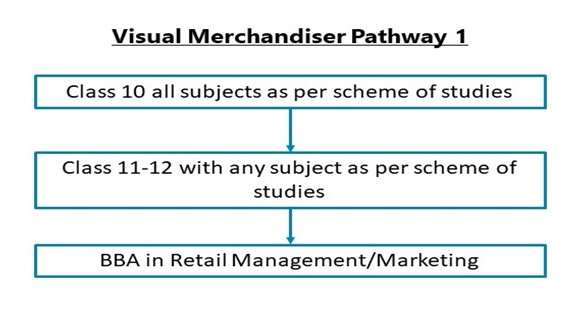
After completing your secondary level school studies (class 10), you can pursue your higher secondary level studies with any subject as per the scheme of studies. Then you can graduate with a BBA degree in Retail Management/Marketing.
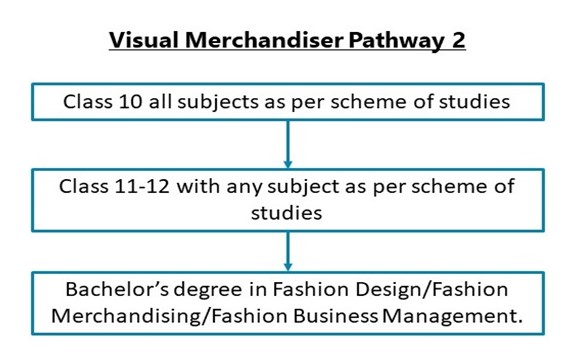
After completing your secondary level school studies (class 10), you can pursue your higher secondary level studies with any subject as per the scheme of studies. Then you can graduate with a Bachelor’s degree in Fashion Design/Fashion Merchandising/Fashion Business Management.
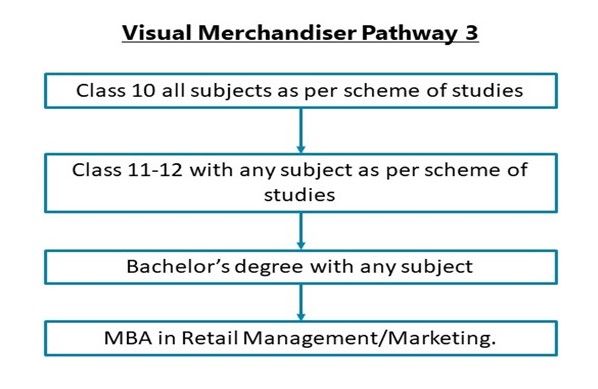
After completing your secondary level school studies (class 10), you can pursue your higher secondary level studies with any subject as per the scheme of studies. Then you can graduate with a Bachelor’s degree in any subject, and follow it up with an MBA in Retail Management/Marketing.
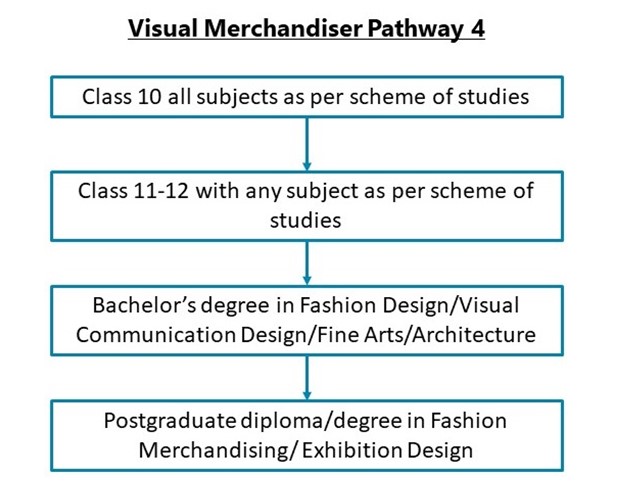
After completing your secondary level school studies (class 10), you can pursue your higher secondary level studies with any subject as per the scheme of studies. Then you can graduate with a Bachelor’s degree in Fashion Design/Visual Communication Design/Fine Arts/Architecture, and follow it up with a Postgraduate diploma/degree in Fashion Merchandising/Exhibition Design.
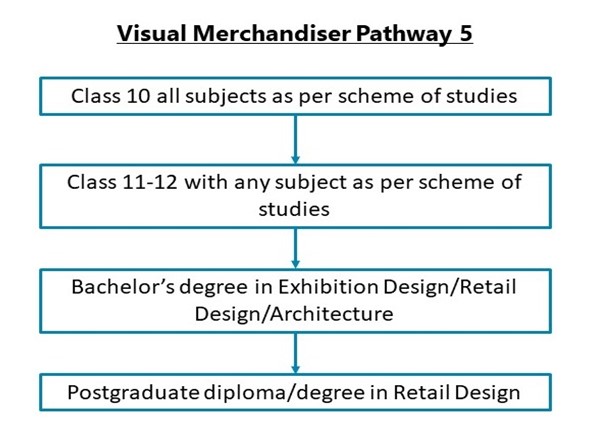
After completing your secondary level school studies (class 10), you can pursue your higher secondary level studies with any subject as per the scheme of studies. Then you can graduate with a Bachelor’s degree in Exhibition Design/Retail Design, and follow it up with a Postgraduate diploma/degree in Retail Design.
Required Qualification & Competencies
1. You can do a Bachelor’s degree in Fashion Communication / Fashion Design / Fashion Merchandising / Fashion Business Management Retail Design / Retail Management / in a similar field to build a career in Visual Merchandising.
2. Alternatively, you can study for a Bachelor’s degree in Fashion Design/ Textile Design / Accessories Design/Architecture, etc., and then do a Master’s degree or a Diploma in Fashion Merchandising / Fashion Communication / Fashion Business Management / Exhibition Design / Retail Design or in a related subject.
3. You can also do a Bachelor’s degree in any stream and then do an MBA in Retail Management.
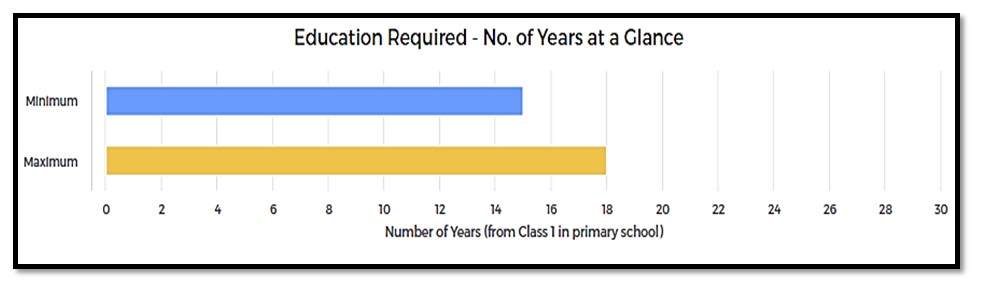
MINIMUM EDUCATION REQUIRED | MAXIMUM EDUCATION REQUIRED |
Under Graduate Undergraduate Degree / Honours Diploma / Graduate Diploma (equivalent to a Degree) Programs for which the minimum eligibility is a pass in Higher Secondary / Class XII School Leaving examination. | Post Graduate Postgraduate Degree / Diploma / Certificate Programs for which the minimum eligibility is a pass in Graduation / equivalent Diploma program like Honours Diploma or Graduate Diploma. |
Competencies Required
Interests
1. Artistic: You should have an interest in Artistic Occupations. Artistic occupations mostly involve working with creative ideas, art, and designs. These occupations involve abstract or conceptual thinking, and creative self-expression and often do not follow any set processes or rules for getting things done.
2. Enterprising: You should have an interest in Enterprising Occupations. Enterprising occupations involve taking initiative, initiating actions, and planning to achieve goals, often business goals. These involve gathering resources and leading people to get things done. These require decision-making, risk-taking, and action orientation.
3. Realistic: You should have an interest in Realistic Occupations. Realistic occupations involve more practical and hands-on activities than paperwork or office work. Realistic occupations often involve physical activities for getting things done using various tools and equipment.
Abilities
1. Abstract Reasoning: The ability to understand ideas that are not expressed in words or numbers; the ability to understand concepts that are not clearly expressed verbally or otherwise.
2. Deductive Reasoning: The ability to apply general rules and common logic to specific problems to produce answers that are logical and make sense. For example, understanding the reasons behind an event or a situation using general rules and common logic.
3. Fluency of Ideas: The ability to come up with several ideas about a topic (the number of ideas is important, not their quality, correctness, or creativity).
4. Inter-Personal: The ability to build and maintain good relationships with others at workplaces and elsewhere.
5. Originality: The ability to come up with unusual or innovative ideas about a given topic or situation, or to develop creative ways to solve a problem.
6. Selective Attention: The ability to concentrate on a task over a long period without being distracted.
7. Spatial Ability: The ability to visualize three-dimensional objects by looking at the objects on paper or visualize objects mentally in three dimensions.
8. Verbal Reasoning: The ability to think and reason with words; the ability to reason out ideas expressed in words.
9. Visualization: The ability to imagine how something will look after it is moved around or when its parts are moved or rearranged.
10. Written Comprehension: The ability to read and understand information and ideas presented in writing.
Knowledge
1. Creative Design: Knowledge of various techniques, methods, and specifications for creating and developing designs for various products and materials such as textiles, clothes, interiors, furniture, accessories, jewelry, animation, graphics, materials, film, video, web, user interfaces of digital devices, photography, etc.
Skills
1. Artistic and Visual Design: Skills in creating and developing designs that are visually appealing and attractive.
2. Critical Thinking: Skills in the analysis of complex situations, using logic and reasoning to understand the situations and take appropriate actions or make interpretations and inferences.
3. Judgment and Decision Making: Skills in considering the pros and cons of various decision alternatives; considering costs and benefits; and making appropriate and suitable decisions.
4. Material Design and Craft: Skills in creating and designing various items using different materials such as clay, wood, iron, gold, silver, gems, etc.
5. Problem Solving: Skills in analysis and understanding of problems, evaluating various options to solve the problems, and using the best option to solve the problems.
6. Reading Comprehension: Skills in understanding written sentences and paragraphs in work-related documents.
Personality
1. You are always imaginative in most situations.
2. You always prefer to experience new things and have new experiences or you mostly do.
3. You can always act independently or could do so in most situations.
4. You are somewhat organized in your day-to-day life and activities.
5. You trust others sometimes but not always.
6. You are helpful to others sometimes.
7. You are mostly impulsive in your actions and behavior.
Career - Job Opportunities & Profiles
1. As a Visual Merchandiser, you will be primarily recruited by the Fashion retail industry or any other industry in the retail business. Large retail chains like Marks & Spencer, H&M, Zara, Vero Moda, Reebok, etc., or Spencer’s Retail, Big Bazaar, etc.






2. If you get a job in the Fashion Industry, you will begin your career as an Assistant Manager (Merchandising) or as a Trainee Fashion Merchandiser. However, if you get into any other industry involved in the retail business, you will begin your career as an Assistant Manager (Retail Merchandising)/Retail Assistant Manager.
Work environment
Visual Merchandisers work in the typical setting of retail stores/outlets. While they mostly do the conceptualizing, planning, and designing tasks during normal working hours (9-5), the actual implementation process happens after the stores are closed to the public. So, working after hours is very normal in this profession. They may also need to travel from time to time visiting many outlets of the same brand or different outlets for research/comparison purposes.
Specialisation Tracks In This Career
1. Fashion Merchandising
Fashion Merchandising revolves around the study of fashion trends to determine merchandising strategies for fashion retail stores/fashion brands. It involved strategic analysis, marketing, management, and distribution of fashion products to boost profit maximization. While Fashion Merchandisers are not Fashion Designers, they are heavily involved with the Fashion Industry, that is, they are always aware of the latest fashion trends as well as the past trends. They make important decisions like what quantity of which product should be stocked, what is the latest style to go for, which vendors to liaise with, etc.
2. Retail Merchandising
Retail Merchandising involves a gamut of activities that push the sale of merchandise/products of a retail brand/outlet. Through Retail Merchandising, brands can highlight their products/services in a way that catches the customer’s eye. Retail Merchandisers are professionals who excel in planning and designing layouts and strategies that help the brand expand its customer base and increase sales.
Career Growth
You will enter the field either as an Assistant Manager (Merchandising) Trainee Merchandiser or Assistant Manager (Retail Merchandising). The next step of promotion would be to the position of Manager and further to Senior Manager. Gradually, as you gain more industry experience, you can upgrade to the level of Assistant Vice President, then to Associate Vice President, and then to the level of Vice President. The highest post is that of the President (Merchandising).
Salary Offered
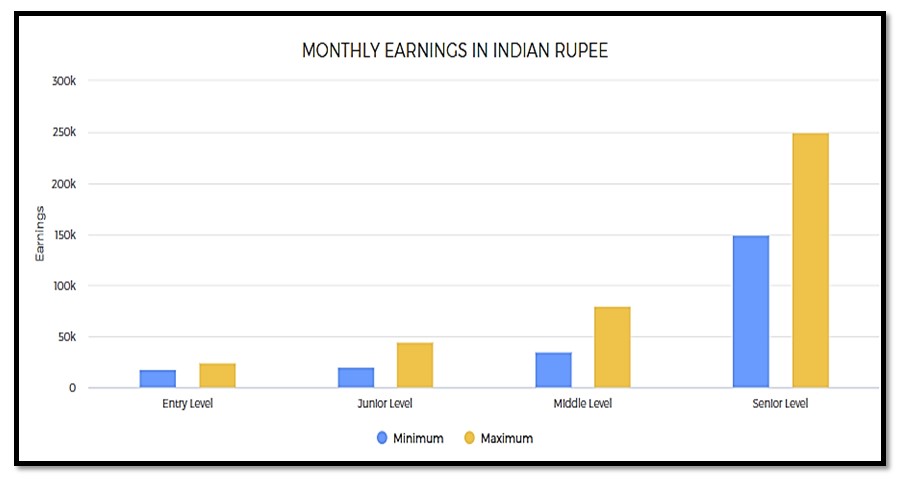
1. At the beginning of your career, you will earn around Rs. 18,000 - 25,000 per month.
2. After 5-7 years, your average monthly salary will increase and stand anywhere between Rs. 25,000 - 40,000.
3. After 10-12 years, your average monthly salary will range anywhere between Rs. 1,50,000 - 2,50,000.
Monthly Earnings In Indian Rupee
Entry Level | Junior Level | Mid Level | Senior Level | ||||
Min Earning | Max Earning | Min Earning | Max Earning | Min Earning | Max Earning | Min Earning | Max Earning |
18000 | 25000 | 20000 | 45000 | 35000 | 80000 | 150000 | 250000 |
1. Entry level: 0 - 2 years of work experience
2. Junior Level: From 1 to 12 years of work experience
3. Mid-Level: From 5 to 20+ years of work experience
4. Senior Level: From 10 to 25+ years of work experience (there could be exceptions in some high-end technical, financial, engineering, creative, management, sports, and other careers; also shortly, people will reach these levels much faster in many careers and some careers, these levels will have no meaning as those careers will be completely tech skill driven such as even now, there is almost no level in a Cyber Security Expert’s job)
Work Activities
1. Communicating with co-workers and others: Communicating with people in writing, verbally or otherwise inside your workplace and various other people who have professional relationships with your place of work including vendors, government officials, etc., or with people at large.
2. Creative thinking: Developing new ideas, concepts, innovative solutions to problems, newer ways of getting things done, designing products and services, creating works of art and craft, etc.
3. Decision-making and problem-solving: Analysis of data and information; evaluation of alternative decisions and results of decisions; making the right decisions and solving problems.
4. Getting Information and learning: Observing, hearing, reading, using computers, or otherwise obtaining information and learning from it.
5. Organising, planning, and prioritizing tasks: Planning and organizing tasks to achieve work goals; prioritizing tasks to achieve goals and making the best use of the time available.
6. Providing advice and consultation to others: Giving advice or consultation to others about various issues, conceptual matters, know-how, scientific matters, products, or services.
7. Scheduling tasks: Scheduling project timelines, tasks and activities.
8. Updating and using relevant knowledge: Keeping updated with the latest knowledge relevant to your fields of work and using the relevant knowledge in getting things done.
9. Using computers for work: Using computers for day-to-day office work; using computer software for various applications in day-to-day professional work; entering data and processing information; for writing.
10. Working in a team: Working in a team of people; developing a team; and maintaining professional relationships among team members.
Future Prospects
According to the latest IBEF (India Brand Equity Foundation) stats, the Indian retail industry is one of the fastest growing in the world. At present, India’s retail sector is booming exponentially not just in the major cities/metros but also in Tier-II and Tier-III cities. Furthermore, online retail is also growing simultaneously and it is predicted that the revenue generated from online retail will reach US$ 60 billion.
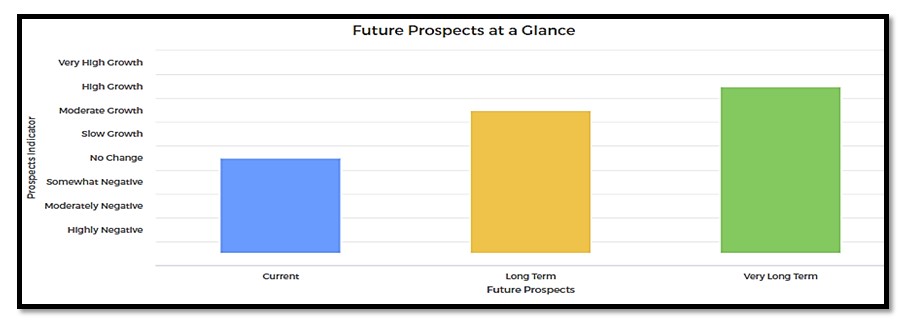
Future Prospects At A Glance
Current (0-1 year) | Long Term (2-5 years) | Very Long Term (6-10 years) |
No Change | Moderate Growth | High Growth |