


Human Computer Interaction (HCI) Expert
Entry Level Qualification
Class 12
Career Fields
Information Technology & Computer Science
For Specially Abled


Career Entrance Exam
TANCET MCA, TRIPURA JEE, JEE MAIN BE/BTECH, GATE, NIMCET MCA
About Career
PARTICULARS | DESCRIPTION |
Name | Human-Computer Interaction (HCI) Expert |
Purpose | Improve the Interaction |
Career Field | Information Technology & Computer Science |
Required Entrance Exam | TANCET MCA, TRIPURA JEE, JEE MAIN BE/BTECH, GATE, NIMCET MCA |
Average Salary | 700000 - 1500000 Rs. Per Year |
Companies For You | Microsoft India, Google, Adobe Systems India & Many More |
Who is Eligible | Class 12th Pass |
Human- Computer Interaction (HCI) Experts study how people interact with computing systems/ applications and to what extent various computing systems and applications are or are not developed for successful interactions. HCI is focused on the interfaces and interactions between people (users or operators) and various computing systems or applications.
HCI Experts design, build, develop, test, and modify various systems, devices, electronic units, equipment, machine parts, software applications etc. which are driven by computer hardware and software and which are required to be handled by, used or instructed by human users to carry out a particular task.
Therefore, HCI Experts are involved in the study, design, construction & implementation of human-centric interactive computer systems or applications.
Our relationship with technology is changing every day. Think of how much time we spend using mobile phones and computers. Most of us use mobile phones and computers more than 8 hours a day. Don’t we interact with our mobile phones as the first thing we do in the morning and the last thing before we go to sleep? Technology has become ever more immersive and interactive.
Human–computer interaction (HCI) – first, two simple examples
Consider there is a person who wants to do a task like writing an essay or piloting an airplane. What makes the taskeasier? Of course, the answer is simple – the use of a computer. In case of writing, the computer is a desktop/laptop/mobile phone/tab on which you are reading this article now. In such a case, the person would key in words and sentences using a keyboard (physical or on screen) and a word processing software like MS-Word or similar applications on android or iOS. Right?
In case of piloting an aircraft, the person will use several instruments, switches, etc. which can be operated manually. Or, the pilot can put the flying task to an auto-pilot and relax. Relax? Not exactly, but keeping a watch on all the flying parameters using a control panel or monitor. What is there in the heart of an auto-pilot? Simple, a computer. How does the pilot interact with the auto-pilot? By using a control panel.
HCI experts design these high level interfaces and interactive systems which makes the job of writing and flying an aircraft easier using a computer.
A user interface, such as a GUI (Graphical User Interface) or NUI (Natural User Interface), is how a human user interacts with any electronic computing system – HCI Experts design these
There are primarily 2 types of user interfaces on an electronic device: 1) the command line interface (CLI) (which contains text only) such as DOS, bash shell and 2) the composite user interface (CUI), which also includes images (e.g., windows, icons and menus) such as Windows 2010 etc. CUI can have types like graphical, multimedia, standard, virtual, augmented etc.
However, the academic discipline of HCI goes beyond designing screens & menus that are easier to use, into studying the reasons behind building specific functionalities into computers and the long-term effects that those will have on the human users and the societies at large.
Computation is passing ahead of just traditional computers into every object for which uses can be found – HCI Experts engineer how we interact with such objects
To cite a commonly popular example simplistically, take Cortana in your Window’s desktop or Amazon’s Alexa for answering regular questions from checking for train delays to playing music etc.
“They” are trained and pre-programmed to answer our queries and help us sail through our tasks while using a digital system (a computer, a mobile phone or a connected device). They are “taught” to behave in a certain way and answer only a given set of questions making our lives easier every day by enabling us to make simple voice commands.
They are not capable of learning by themselves which means if they do not know the answer to any of our question, they will never know by themselves unless human engineers fix a program that teaches them the new answer.
Similarly, any digital device that interacts with human users through any sort of input (electronic, text or voice) will require software scripts written and built inside to teach it how to interact.
You can think of multiple other examples – the user interfaces and interactive experiences that you have are all designed by HCI experts
Mobile phones, video games, remote controls, smart watches, soft drink machines, coffee machines, ATM machines, ticketing machines, library information systems, photocopiers, printers, media streaming devices, VR headsets, calculators, etc.
All of these are driven by computers – either fully or partially. These devices and applications are operated using our inputs – mostly through a graphical interface – inputs such as text / touch / voice / hand gesture / eye tracking / proximity tracking/ etc. and even brain controls. The first 3, text (in various languages too), voice and touch are mostly used.
Recently, Windows 10 has introduced Eye Control and Ease of Access categories of functionalities. Then there are Tobi eye gaze systems which work by having lights & cameras that are constantly sending and receiving information, a procedure called gaze tracking.
Moreover, brain-controlled inputs have already been introduced in prosthetic arms or bionic arms used for patients with a lost limb.
In mid-2019, a team of innovators from Carnegie Mellon University, in collaboration with the University of Minnesota, made a breakthrough. Using a noninvasive brain-computer interface (BCI), they have developed the first-ever successful mind-controlled robotic arm which is able to continuously track & follow a computer cursor on a computer screen.
Then, the LED display & media unit fitted in modern day consumer cars. Likewise, in military operations, imagine a guidance system designed for missiles that can be remotely operated by humans on the ground or in an aircraft. The interfacing systems in these are differently designed to suit the users.
All these work via various types of user interfaces
User interfaces are composed of 1 or more layers. UI layers may interact with one or more human senses, including: tactile UI (touch), visual UI (sight), auditory UI (sound), olfactory UI (smell), equilibrial UI (balance), and gustatory UI (taste).
Composite user interfaces (CUI) are UIs that interact with 2 or more senses. The most common CUI is a graphical user interface (GUI), which is composed of a tactile UI and a visual UI capable of displaying graphics. When sound is added to a GUI it becomes a multimedia user interface (MUI) such as Windows operating systems.
There are 3 broad categories of CUI: standard, virtual and augmented
Standard CUIs use standard human interface devices like keyboards, mice, computer monitors, mobile phone displays etc.
Virtual CUI is when the CUI blocks out the real world to create virtual reality for example a virtual reality headset with a head-mounted display and a small screen in front of the eyes (example: The Oculus Rift).
Augmented reality is when the CUI does not block out the real world but creates an interactive experience of a real-world environment where the objects that reside in the real world are enhanced.
Have you ever played or heard of “Pokémon GO” where users can play the game while driving, walking, cycling, inside a house etc. basically anywhere trying to fish out fictional Pokémon’s?This game uses Augmented Reality (AR).
HCI Experts research and develop the ways through which we interface and interact with computer systems
Visions of what researchers in this field seek to achieve vary. Most of them take an interest in the ways to enhance computer interfaces, to improve on a “desirable property” such as learnability, findability, and efficiency of use, such as:
1. Ways to implement interfaces such as through computer libraries.
2. Ways to evaluate & compare interfaces with respect to different properties.
3. Ways to study the sociocultural implications of human computer use.
4. Ways to determine whether or not the user is human or another computer.
5. Models and theories of varied human computer use.
Some Exciting Examples of Current Research
Augmented reality: helping the visually impaired to see better and navigate through a busy public road.
Natural Language Understanding: digital human-like digital assistants or bots like IPsoft’s Amelia that can be hired by businesses as a virtual worker to carry out key repetitive tasks and with whom users can have a normal conversation in full sentences rather than getting answers in a binary ‘yes’ and ‘no’.
Brain–computer interfaces: helping people with a disorder of consciousness such as coma, vegetative states or minimally conscious states to interact through basic cognitive tasks for making important life decisions (such as whether to seek therapy, where to live, and their views on end-of-life decisions).
Affective computing & Emotion recognition: financial decision making using ECG; video cameras to capture facial expressions, body posture, & gestures; sensors to detect emotional cues by directly measuring physiological data, such as skin temperature or galvanic resistance.
End User Development: how ordinary users could routinely tailor applications to their own needs and invent new applications based on their understanding i.e. tools that allow end-users who are not professional software developers to program computers.
IoT & Embedded Computation: from computerized cooking appliances to lighting & plumbing fixtures to window blinds to automobile braking systems to greeting cards capable of coordinating with each other as well as with the user
Social computing: how to form stable follower communities, how these communities evolve, how knowledge is created & processed among these followers, how people among different social groups and ethnicities are motivated to participate, etc. Recent developments spearheaded by Google, Cisco and Fox.
Key Roles and Responsibilities
You will be engaged with one or more of the following roles & responsibilities as well as other associated duties:
1. You will work to understand and build technology that harmonizes with & improves human capabilities, goals, and social environments through interdisciplinary research in design, computer science, and behavioral and social sciences.
2. You will apply theoretical expertise and innovation to create or apply new technology, such as adapting principles for applying computers to new uses.
3. You may be responsible for analyzing human performance related to a wide variety of scenarios involving consumer products, automobiles/bicycles/scooters, pedestrian behavior, occupational work and machinery etc. You will analyze human perceptual, and response capabilities in these scenarios.
4. To support such technology, you will compose, develop & maintain scripts (codes or computer programmes) to automate deployment (getting new software up and running properly in its environment, including installation, configuration, running, testing) and other tasks.
5. To assist in making such scripts or codes, you will research how people work, play, and communicate within groups, organizations, and social structures, then design, build, and evaluate technologies and tools to support human and social activities.
6. You will conduct logical analyses of business, scientific, engineering, and other technical problems, formulating mathematical models of problems for solution by computers.
7. You will be responsible for writing unit tests/ acceptance tests (software programs), and work closely with other engineering teams to build tools as well as microelectromechanical systems (MEMS).
8. You will employ computational tools to run analyses for various compound sets, compile and interpret results, and develop summary reports.
9. You will develop technical documentation that includes methods, procedures and analytical data including interpretation of results and a thorough impact analysis.
10. You will be preparing reports for communicating data analysis and/or modeling results to other computer scientists, domain experts, or engineers.
Career Entry Pathway
Class 10 all subjects as per scheme of studies – Class 11-12 Physics, Chemistry, and Mathematics along with any other subject as per scheme of studies – Bachelor’s degree in Computer Science & Engineering/ Computer Engineering/ Computational Science & Engineering or similar degree – Master’s degree in Computer Engineering/ Computer Science/ Computational Science/ Human Factor Engineering/ similar
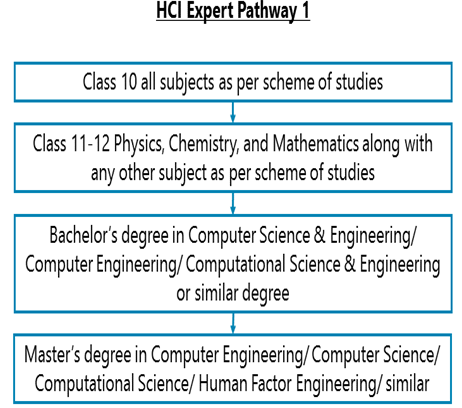
After completing Class 11-12 Physics, Chemistry, and Mathematics along with any other subject as per scheme of studies, you can go for Bachelor’s degree in Computer Science & Engineering/ Computer Engineering/ Computational Science & Engineering or similar degree. Then go for a Master’s degree in Computer Engineering/ Computer Science/ Computational Science/ Human Factor Engineering/ similar. Thereafter, you may go for a PhD in a relevant discipline.
Class 10 all subjects as per scheme of studies – Class 11-12 Physics, Chemistry, and Mathematics along with any other subject as per scheme of studies – Bachelor’s degree in Electrical Engineering/ Electronics Engineering/Communication Engineering – Master’s degree in Computer Engineering/ Computer Science/ Computational Science/ Human Factor Engineering/ Electrical Signal Processing/ Embedded System Design/ similar
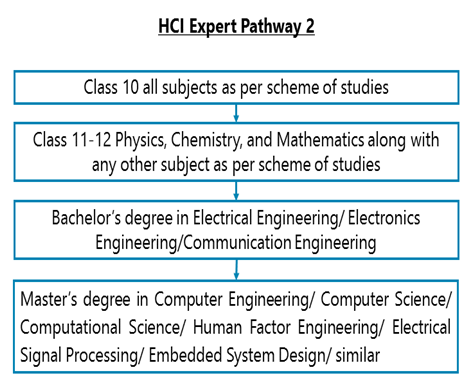
After completing Class 11-12 Physics, Chemistry, and Mathematics along with any other subject as per scheme of studies, you can go for a Bachelor’s degree in Electrical Engineering/ Electronics Engineering/Communication Engineering. Thereafter go for a Master’s degree in Computer Engineering/ Computer Science/ Computational Science/ Human Factor Engineering/ Electrical Signal Processing/ Embedded System Design/ similar. Thereafter, you may go for a PhD in a relevant discipline.
Class 10 all subjects as per scheme of studies – Class 11-12 Physics, Chemistry, and Mathematics along with any other subject as per scheme of studies – Bachelor’s degree in Computer Science & Engineering/ Computer Engineering / Electrical Engineering / Electronics Engineering/ similar– MEng in Computer Science (with specialization in HCI)/ MS in HCI/ Master’s in Human Computer Interaction (MHCI) or M Sc in Human Computer Interaction / Master’s in Educational Technology or similar
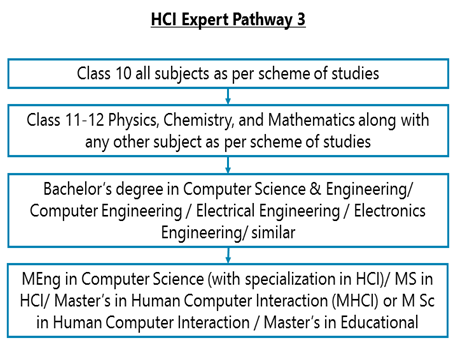
After completing Class 11-12 Physics, Chemistry, and Mathematics along with any other subject as per scheme of studies, you can go for Bachelor’s degree in Computer Science & Engineering/ Computer Engineering / Electrical Engineering / Electronics Engineering/ similar. Then go for M Tech or ME in Computer Science Engineering or Software Engineering/ MEng in Computer Science (with specialization in HCI)/ MS in HCI/ Master’s in Human Computer Interaction (MHCI) or M Sc in Human Computer Interaction/ Master’s in Educational Technology or similar. Thereafter, you may go for a PhD in a relevant discipline.
Class 10 all subjects as per scheme of studies – Class 11-12 Physics, Chemistry, and Mathematics along with any other subject as per scheme of studies – Bachelor’s in Computer Science/ Mathematics/ Statistics/ Physics/ Data Science/ Operations Research or similar – Master’s in Applied Mathematics/ Applied Physics/ Computer Science/ Data Science/ Operations Research/ Human Computer Interaction (MHCI) or M Sc in Human Computer Interaction/ Master’s in Educational Technology or similar
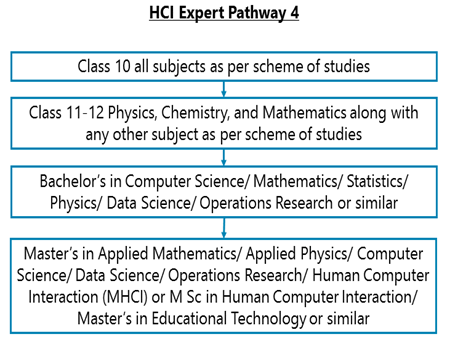
After completing Class 11-12 Physics, Chemistry, and Mathematics along with any other subject as per scheme of studies, you can go for a Bachelor’s in Computer Science/ Mathematics/ Statistics/ Physics/ Data Science/ Operations Research or similar. Then go for Master’s in Applied Mathematics/ Applied Physics/ Computer Science/ Data Science/ Operations Research/ Human Computer Interaction (MHCI) or M Sc in Human Computer Interaction/ Master’s in Educational Technology or similar. Thereafter, you may go for a PhD in a relevant discipline.
Class 10 all subjects as per scheme of studies – Class 11-12 Physics, Chemistry, and Mathematics along with any other subject as per scheme of studies – Bachelors’ in Human Factors Engineering/ Ergonomics/ Kinesiology/ Computer Science Engineering/ Software Engineering/ Mechanical Engineering/ Electrical & Electronics Engineering or similar – Master’s in Human Behavior/ Human Factors Engineering/ Ergonomics/ Kinesiology/ Mechatronics/ Bionics Engineering/ Educational Technology or similar
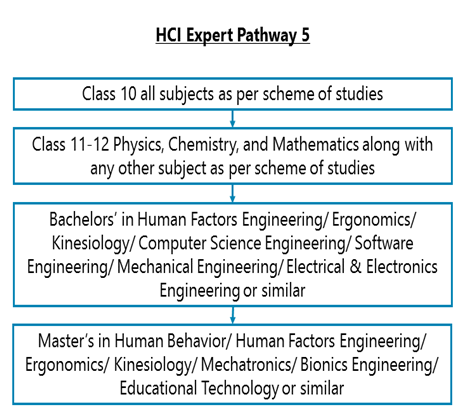
After completing Class 11-12 Physics, Chemistry, and Mathematics, Computer (optional) along with any other subject as per scheme of studies, you can go for a Bachelors’ in Human Factors Engineering/ Ergonomics/ Kinesiology/ Computer Science Engineering/ Software Engineering/ Mechanical Engineering/ Electrical & Electronics Engineering/ Electronics & Communication Engineering or similar. Then you may go for a Master’s in Human Behavior/ Human Factors Engineering/ Ergonomics/ Kinesiology/ Mechatronics/ Bionics Engineering/ Educational Technology or similar. Thereafter, you may go for a PhD in a relevant discipline.
Class 10 all subjects as per scheme of studies – Class 11-12 with Mathematics & any other subject as per scheme of studies – Bachelor’s in Design/ Social Sciences/ Economics/ Linguistics or similar – Master’s in HCI or User Interaction Design or Experimental Psychology or Computational Linguistics or similar
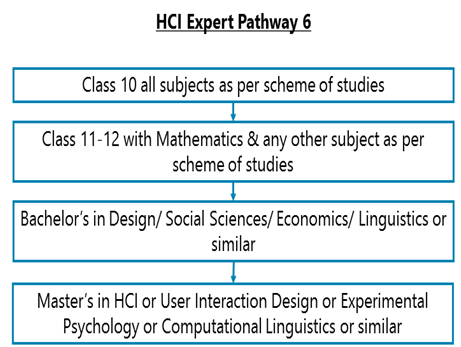
After completing Class 11-12 with Mathematics & any other subject as per scheme of studies, then go for Bachelor’s in Social Sciences/ Industrial or Product Design/ Human & Social Sciences/ Applied Social Science/ Social Studies/ Economics/ Behavioral Science/ Linguistics or similar, then go for a Master’s in Human Computer Interaction (MHCI) or User Interaction Design or Experimental Psychology or Computational Linguistics or Applied Linguistics or similar disciplines. Thereafter, you may go for a PhD in a relevant discipline.
Class 10 all subjects as per scheme of studies – Class 11-12 Physics, Chemistry, and Mathematics, Computer along with any other subject as per scheme of studies – Bachelor’s in Computer Science/ Software Engineering/ DUAL Bachelor’s degree in Mathematics & Computer Science or similar - Master’s in Educational Technology or Computer Science or Computer Applications or similar
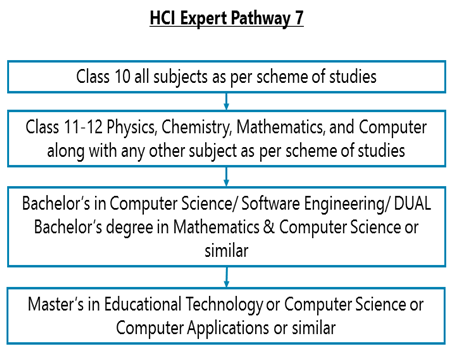
After completing Class 11-12 Physics, Chemistry, and Mathematics, Computer along with any other subject as per scheme of studies, you can go for a Bachelor’s in Computer Science/ Software Engineering/ DUAL Bachelor’s degree in Mathematics & Computer Science or similar. Then go for a Master’s in Educational Technology or Computer Science or Computer Applications or Human Computer Interaction (MHCI) or M Sc in Human Computer Interaction/ M Sc in Human Centered Interactive Technologies or closely related subjects. Thereafter, you may go for a PhD in a relevant discipline.
Class 10 all subjects as per scheme of studies – Class 11-12 Physics, Chemistry, and Mathematics, Computer along with any other subject as per scheme of studies – B Sc (Honours) in Applied Computing: Human Computer Interaction / Computer Science/ IT or similar/ Bachelor’s in Education Technology – Master’s (optional)
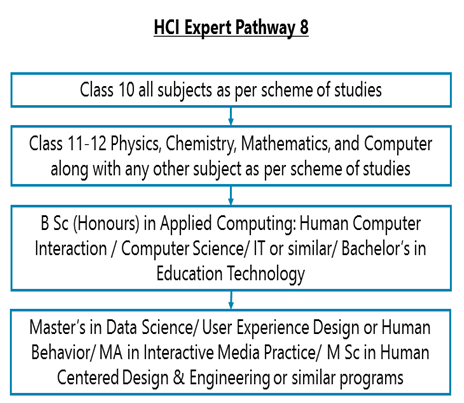
After completing Class 11-12 Physics, Chemistry, and Mathematics, Computer along with any other subject as per scheme of studies, you can go for B Sc (Honours) in Applied Computing: Human Computer Interaction / Bachelor’s in Computer Science/ IT or similar/ Bachelor’s in Education Technology. Then go for Master’s in Data Science/ User Experience Design or Human Behavior/ MA in Interactive Media Practice/ M Sc in Human Centered Design & Engineering or similar programs. Thereafter, you may go for a PhD in a relevant discipline.
Class 10 all subjects as per scheme of studies – Class 11-12 Physics, Chemistry, and Mathematics, Biology along with any other subject as per scheme of studies – Bachelor’s in Cognitive Sciences/ Computational Neuroscience or similar disciplines – MSc by Research/ MA in Interactive Media Practice/ M Sc in HCI or similar programs
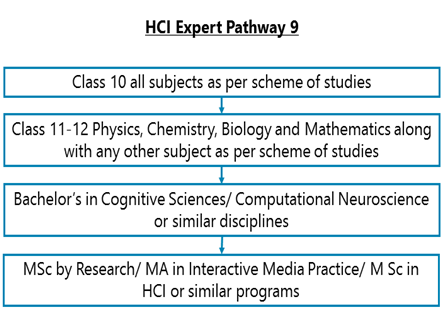
After completing Class 11-12 Physics, Chemistry, and Mathematics, Biology along with any other subject as per scheme of studies, you can go for a Bachelor’s in Cognitive Sciences/ Computational Neuroscience/ Computational& Behavioral Neuroscience or similar disciplines. Then go for MSc by Research in Human-Computer Interaction or Master’s in User Experience Design or Human Behavior/ M Sc in Human-Computer Interaction Design/ MA in Interactive Media Practice/ M Sc in HCI / M Sc in Human Centered Design & Engineering or similar programs. Thereafter, you may go for a PhD in a relevant discipline.
Required Qualification & Competencies
To get into this field, you will need to pass Class 10 all subjects as per scheme of studies. Then you must complete Class 11-12 with :
1. Physics. Chemistry, Mathematics along with any other subject as per scheme of studies
2. Physics. Chemistry, Mathematics, Computer Science along with any other subject as per scheme of studies
3. Physics, Mathematics & Computer along with any other subject as per scheme of studies
4. Mathematics along with any other subject as per scheme of studies
5. Physics, Chemistry, Mathematics and Biology along with any other subject as per scheme of studies
After Class 11-12:
1. You can go for a Bachelor’s in Computer Science or any of the engineering fields especially Electrical/Electronics, Electronics & Communication. Information Systems Engineering or similar.
2. You can go for a Bachelor degree in Physics, Mathematics, Statistics, Psychology, Applied Computing (or similar courses), Life Science, Chemistry, Cognitive Sciences, Computational Neuroscience, Data Science, Operations Research, Economics, Social Sciences, Behavioral Science, Industrial/ Product Design, Education Technology or similar disciplines.
3. You can go for a Bachelor’s degree in Computer Applications, IT or similar
You can study for a Bachelor’s / Master’s / Doctoral degree in any of the following fields (Note that all these fields may not offer you a degree at all three levels, that is in Bachelor’s, Master’s and Doctoral. Some fields may offer a degree only at the Master’s or at the Doctoral level):
1. Animation and Game Design
2. Applied Computing
3. Artificial Intelligence
4. Artificial Intelligence & Machine Learning
5. Augmented Reality/Virtual Reality Engineering
6. Bioelectrical Engineering
7. Bioelectronics Engineering
8. Biomedical Engineering
9. Biomedical Instrumentation & Devices
10. Bionics Engineering
11. Communication Engineering
12. Computational Neuroscience
13. Computational Sciences
14. Computational Sciences & Engineering
15. Computer Applications
16. Computer Graphics, Augmented & Virtual Reality
17. Computer Networks
18. Computer Vision
19. Data Science
20. Data Science & Engineering
21. Digital Electronics
22. Electrical and Computer Engineering
23. Electrical and Electronics Engineering
24. Electrical Drives & Systems
25. Electrical Signal Processing & Systems
26. Electronic Systems & Devices
27. Electronics & Communication Engineering
28. Electronics & Instrumentation
29. Electronics and Computer Engineering
30. Electronics Engineering
31. Embedded Systems and VLSI Design
32. Game Design & Development
33. Human Centered Computing
34. Information and Computer Engineering and Technologies
35. Information and Computer Technology
36. Information Science & Engineering
37. Information Technology
38. Internet of Things
39. Mathematics and Computer Science
40. Mechanical Engineering
41. Mechatronics engineering
42. Microelectronics
43. Mobile Computing
44. Neural Engineering
45. Programming and Software Engineering
46. Robotics
47. Software Engineering
48. VLSI Design
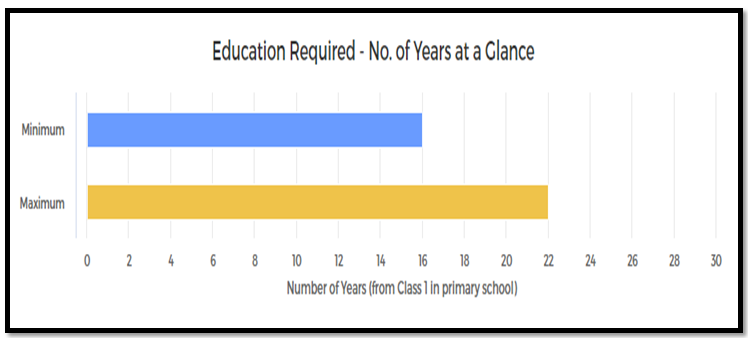
MINIMUM EDUCATION REQUIRED | MAXIMUM EDUCATION REQUIRED |
Under Graduate Undergraduate Degree / Honours Diploma / Graduate Diploma (equivalent to a Degree) Programs for which the minimum eligibility is a pass in Higher Secondary / Class XII School Leaving examination. | Doctoral All Ph.D. or equivalent degree programs for which the minimum eligibility is a Postgraduate or a Pre-Doctoral degree. |
COMPETENCIES REQUIRED
Interests
1. You should have interests for Investigative Occupations. Investigative occupations involve working with ideas and quite a lot of thinking, often abstract or conceptual thinking. These involve learning about facts and figures; involve use of data analysis, assessment of situations, decision making and problem solving.
2. You should have interests for Realistic Occupations. Realistic occupations often involve physical activities for getting things done using various tools and equipment.
3. You should have interests for Enterprising Occupations. Enterprising occupations involve taking initiatives, initiating actions, and planning to achieve goals, often business goals. These involve gathering resources and leading people to get things done. These require decision making, risk taking and action orientation.
Technological Skills
1. You may need experience with one or more machine learning libraries such as scikit-learn, MLlib, Tensor Flow, PyTorch, Keras , Caffe or Theano etc. and at least one data-analysis or scripting language (e.g. The Math Works MATLAB, Mathematica, python, R)
2. You may need experience with scripting technologies including Bash, KSH, Perl, Python, VBScript, Windows PowerShell, Ruby, Java, JavaScript, Chef, Puppet, etc.; network tools such as iptables, Linux IPVS, HAProxy, etc.; system monitoring tools such as Nagios, Cacti, Munin, Big; enterprise backup tools such as NetBackup, Legato, TSM.
3. You may need experience with the broad application of 1 or more higher level programming languages such as Python, Java/Scala, MATLAB, R or C/C++.
4. You may need experience with virtualization technologies such as Bochs, Xen, VMWare; installing, configuring, & maintaining services such as Bind, Apache, MySQL, nginx; messaging frameworks such as RabbitMQ, Kafka, Storm, Hadoop
5. You may need a sound understanding of operating system software suchas Linux, Oracle Solaris, Shell script, UNIX etc.; systems management tools experience for e.g. SCCM, BigFix, Next ink, etc.; development environment software such as Apache Kafka, Eclipse IDE, Microsoft Azure, Visual Basic, Visual Studio, National Instruments LabVIEW and Ruby.
6. You should have an understanding of and experience with any of these: sensors& sensing techniques, perception & cognition, AR/VR/Mixed Reality, input devices, signal processing, sociology, design, animation, hardware, visualization, ethnography, experimental design, haptics, and distributed systems.
Skills
1. You should have Scientific Skills - in using various scientific rules and methods to get things done or solve problems.
2. You should have Technical Skills - using various technologies and technical methods to get things done or solve problems.
3. You should have Quality Control Analysis Skills - conducting tests and inspections of products, services, or processes to evaluate quality or performance.
4. You should have experience working independently under general direction within the scope of an assignment and use sound judgment in determining methods, techniques, and evaluation criteria.
5. You should have Systems Analysis Skills - determining how a system should work and how changes in conditions, operations, or the environment will affect outcomes.
6. You should have enough verbal and written communication skills necessary to effectively collaborate in a team environment and present technical ideas/results.
7. You should have Critical Thinking skills- Skills in the analysis of complex situations, using logic and reasoning to understand the situations and take appropriate actions or make interpretations and inferences.
8. You should have Judgment and Decision Making Skills - considering pros and cons of various decision alternatives; considering costs and benefits; taking appropriate and suitable decisions.
9. You should have Problem Solving Skills - Skills in analysis and understanding of problems, evaluating various options to solve the problems and using the best option to solve the problems.
10. You may need Programming Skills - writing computer programs for various applications, installation of computer programs and troubleshooting of problems in computer programs or software.
11. You should have Systems Evaluation Skills - identifying measures or indicators of system performance and the actions needed to improve or correct performance, relative to the goals of the system.
Ability
1. You should have Deductive Reasoning Ability - apply general rules and common logic to specific problems to produce answers that are logical and make sense. For example, understanding the reasons behind an event or a situation using general rules and common logic.
2. You should have Problem Sensitivity - The ability to tell when something is wrong or is likely to go wrong. It does not involve solving the problem, only recognizing there is a problem.
3. You should have Inductive Reasoning Ability - to combine pieces of information from various sources, concepts, and theories to form general rules or conclusions. For example, analyzing various events or situations to come out with a set of rules or conclusions.
4. You should have Information Ordering Ability - to arrange things or actions in a certain order or pattern according to a specific rule or set of rules (e.g., patterns of numbers, letters, words, pictures, mathematical operations).
5. You should have Oral Comprehension Ability - listen to and understand information and ideas presented through spoken words and sentences.
6. You should have Oral Expression Ability - communicate information and ideas in speaking so others will understand.
7. You should have Fluency of Ideas - The ability to come up with several ideas about a topic (the number of ideas is important, not their quality, correctness, or creativity).
Personality Traits
1. You are always or mostly careful about your actions and behaviour.
2. You are always or mostly disciplined in your action and behaviour.
3. You are always calm or generally remain calm in most situations.
4. You can always act independently or could do so in most situations.
5. You always prefer to experience new things and have new experiences, or you mostly do.
Career - Job Opportunities & Profiles
At the beginning of your career, after your graduation or post-graduation, you can get a job in a software engineering / IT consulting/ IT product engineering/ or similar rolein an Information Technology software, products, services, and consulting company. You may also get a job in a similar role in a consumer company which is technology focused.
You may also start working as Doctoral Fellow in a university (a Doctoral Fellowship leads to a Ph.D. degree). If you opt for a Ph.D., after completion of your Ph.D., you can get opportunities as a Post-Doctoral Fellow in a university department or centre or start working with an Information Technology software, services, and consulting company. You may also get a job in a similar role in a consumer company which is technology focused.
Most of the work opportunities will be in a high-end computer science lab of:
1. An IT software company such as: Microsoft, Oracle, SAP, Symantec, Adobe, etc.




2. IT Product Company such as: Apple, HP, Dell, etc.



3. IT services company such as: Google, Facebook, Amazon, etc.



4. IT consulting company such as: IBM, Atos, etc.


5. A consumer company such as: Samsung, Philips, Sony, Tesla, etc.



6. Companies which design and develop “ambient intelligence” based products using various microprocessors/ electronic systems / devices / applications for limited or bulk consumption such as: Intel, Nvidia, Qualcomm, CISCO, Samsung, Siemens, Verizon, Ericsson, Imec, Nokia, etc.




You may also find opportunities in a high-end computer or computational science lab of a university department or centre. You may join as a Doctoral Fellow/ Post – Doctoral Fellow/ Assistant Professor/ in a similar role depending upon your qualifications.
Following are some of the job roles that you may find after your degree:
1. HCI/ HMI Expert
2. Research Programmer
3. Research Scientist: HCI
4. Design Thinking Expert
5. Knowledgebase Engineer
6. Learning Engineer - HCI
7. Experience Designer
8. Research Engineer
9. AI Consultant
10. Interaction Designer
11. Interaction Design Researcher
12. Conversational Designer
13. Usability Analyst
14. User Experience Designer
15. Human Factors Engineer
16. Usability Specialist
17. Interaction Designer
18. Information Architect
SPECIALISATION TRACKS IN THIS CAREER
HCI Expert (Neural Engineering)
The primary objective of HCI Experts practicing in this sub-domain is to imitate and simulate human brain functions in electronic devices, super computers, robots etc. Two main things that they try to copy is ‘learning from experience’ and ‘discovering new knowledge’. The goal of such research and development is to build systems and devices that can carry out information exchange or enable interactions between brain or nervous system and an electrical / mechanical / computational / other device (Brain Machine Interface (BMI) or Mind Machine Interface (MMI). In the future we will see many applications such as a computer operated with mental commands only; an artificial limb that has senses for example touch and feel.
HCI Expert (Conversational Experience Design, NLP and Speech Recognition)
HCI experts can help machines understand the vast nuances of human languages too, and to learn how to respond in a way we can comprehend. NLP and Speech Processing experts write codes to enable computers to communicate with people using everyday language. They deal with conversion of information from computer database into readable human language and vice versa. Speech Recognition involves recognition of phonetics and words (the way humans of different nationalities speak a language or the same language with distinct dialects).
HCI Expert (Optometry, Visual Computing and Image Recognition)
HCI Experts practicing in this sub-domain deal with how computers can be made to gain high-level understanding from digital images or videos. In most computer applications earlier, they were pre-programmed to solve a particular task, but HCI Experts are now building methods based on learning which are today becoming increasingly common. Some HCI Researchers are today focusing on healthcare by enabling a computer to assess a few photographic data to diagnose a patient such as detecting the presence of tumors or measuring organ dimensions etc.
HCI Expert (Hybrid Human-centered AI & Machine Learning)
AI is the technology and ML is one of the many techniques to bring about this technology. Machine Learning is a current application of AI based around the idea that machines when given access to data, can learn for themselves. HCI Experts can make computers capable of reading text and deciding whether the person who wrote the text is complaining or congratulating; then listening to a piece of music, understanding whether it is likely to make someone happy or sad, and finding other pieces of music to match the mood; even composing their own music expressing the same themes which they know is likely to be appreciated! For example, Viv (currently acquired by Samsung) is an AI platform that is adaptable in the sense if it does not know the answer to your question, it will go and write its own pre-code, find your answer, and get back to you with a result, without you having to do so much as lift a finger! It is quite unlike Siri or Alexa which are pre-programmed and cannot do anything that they weren’t coded to do. Another simple example of this would be the recommender systems that work to recommend you videos based on your browsing history on YouTube or Netflix and saves you the harassment of typing into looking for a particular item hosted by these websites. The example may sound simple but a lot of math, equations & powerful algorithms go into fetching out and filtering useful data from a person’s enormous browsing history and yield perfectly worthy options for viewers.
HCI Expert (Bioprosthetic/ Medical Devices/ Biokinematics)
This sub-area includes clinical and biological applications such as the replacement/ enhancement of organs or other body parts as well as bio-electronic devices& systems used in delivery of healthcare. This involves designing, developing, and construction of artificial limbs, organs, surgical robots etc. HCI Experts collaborate with roboticists to develop and build useful mechanical devices that can work automatically but can also be controlled remotely or through our brain if connected with our body. HCI Experts may specialize in applications dealing with studies of human/ animal motion including motion tracking systems, electrophysiology of muscle/ brain activity, various digital interfaces for monitoring physiological function, and other behavioral/ cognitive research techniques. An excellent example here would be the ‘i-Limb hand’ or prosthetic arm for patients with lost arms. These mechanical arms are trained to interact with the brains of patients with a lost arm and can follow human instructions when attached to the body.
HCI Expert (Cognitive Computing)
How humans approach problem solving is the primary focus of this sub-field. Siri, Google assistant, Cortana, and Alexa are few of the best illustrations of exemplary contributions of HCI Experts specializing in Cognitive Computing, all with a common goal of simulating human thought processes in a computerized model. Similarly, IBM's cognitive computer system, Watson (development team led by principal investigator David Ferrucci) could help in lung cancer treatment in NY. Today around 80% of nurses working with Watson follows its guidance.
HCI Expert (Avionics, Automotive and Mobility systems)
The key focus area here is “autonomous driving”. The ultimate motives of HCI Experts practicing in the field of Avionics, Automotive and Mobility systems is to bridge the gap between the driverand the control systems in a surface vehicle like cars or buses, an operating air vehicle or enhance functionalities of the controlling systems in an unmanned aerial vehicle (UAV) such as satellite systems or space rotors etc. which are not physically driven by humans. While designing & developing surface transportation systems meant for herding through road traffic, an understanding of “human motion” and “public human behavior” is also of great concern as is the mechanism of detecting & recognizing human-object interaction. Such HCI Experts design intelligent systems which can process information from multiple sensors & sources and present it to the driver/ pilot enabling her to make an informed decision while on flight or take critical decisions in the absence of a human driver too. Futuristically, this wave has the potential to even completely remove the need of a pilot/ driver.
HCI Expert (Robotics, Gesture and Motion Control)
This is a vast field that reigns in HCI Experts along with Mechanical and Electronics Engineers where they together train robotic devices to display motion in a specific manner or execute tasks that require movements in different directions or produce an action that is governed by specific inputs from a human user. Some HCI Experts today are focusing on writing codes to enable intelligent robots to mimic a human by capturing visual inputs such as following the dance steps of a human and imitating them etc. Gesture and motion control would also include examples of ‘smart’ wearable devices such as magnetic fitness wristbands like FitBit®.
HCI Expert (IoT-Internet of Things)
HCI Experts may specialize in the design, build and construction of networks of objects that can autonomously communicate with each other and connect with us humans through cellular networks, satellite, Wi-Fi, Bluetooth, or directly the Internet. Such a network can work on its own without requiring human intervention all the time. These networks of Internet or otherwise connected objects able to collect and exchange data is commonly abbreviated as IoT today. IoT is an industry revolutionizing concept being realized materially now. Examples that fall into this scope include security systems, thermostats, cars, electronic appliances such as lights in household, alarm clocks, speaker systems, vending machines etc. connected forming a web / system. From computerized cooking appliances to lighting & plumbing fixtures to window blinds to automobile braking systems to greeting cards, allcan be made capable of coordinating with each other as well as with the user.
CAREER GROWTH
If you begin in the role of a software engineer, you can progress as follows (it varies company wise and the actual names of jobs positions could be quite different):
Software Engineer – Senior Software Engineer – Lead Software Engineer – Principal Engineer/ Director of Engineering – Head of Engineering / Vice President of Engineering –President of Engineering / similar role.
If you begin in an IT consulting role, then you can progress as follows:
Associate – Assistant Consultant – Associate Consultant – Senior Consultant – Associate Vice President – Vice President – President
(Consulting companies can also have Engineering roles as described above)
If you begin in an IT product engineering role, then you can progress as follows:
Product Engineer – Senior Product Engineer – Lead Product Engineer – Principal Engineer/ Director of Engineering – Head of Engineering / Vice President of Engineering – President of Engineering / similar role.
If you are working in a university department or a centre, then your career progression could be as follows:
Research Associate (after your Master’s degree) – Doctoral Fellow (if you enroll for a doctoral degree) – Post-Doctoral Fellow / Assistant Professor / similar role (after your Ph.D.) – Associate Professor – Professor / Director of a centre or department – Senior Professor / Dean / President of a centre. Some may get promoted to university wide roles such as Proctor/ Vice President/ Pro-Vice Chancellor/ Vice Chancellor / Chancellor, etc.
Salary Offered
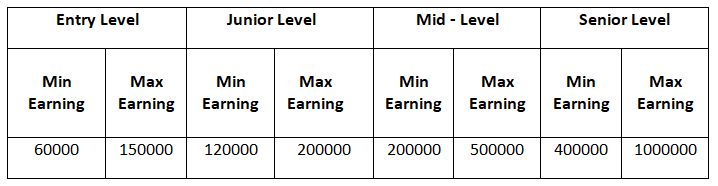
1. At the entry level jobs at India locations of various companies, you may expect to get about Rs. 60,000 – 1,50,000 or even more a month. In junior level jobs (after 5+ years of experience), you can make about Rs. 1,20,000 – 2,00,000 or even more per month. Higher salaries are offered to graduates and post graduates of premier engineering institutes.
2. In mid-level jobs with companies in India, you can expect to earn about Rs. 2,00,000 – 5,00,000 or even more a month.
3. In senior-leveljobswith companies in India, you can expect to earn about Rs. 4,00,000 – 10,00,000 or even more a month.
Global (US/Canada/UK)
1. If you are posted at global locations or opt for a job abroad after obtaining a degree from a US/Canada/UK university, you may look forward to the following earning (indicative only – actual salaries may be more or less):
2. Jobs after your MS/ similar post graduate degree: US Dollar 4,000-6,000 or more a month. If you are from a premier university you will get higher salaries.
3. Mid-level jobs will get you about US Dollar 6,500-10,000 or more a month.
4. Senior-level jobs will get you about US Dollar 12,000-20,000 or more a month along with other bonus, allowances, stock options, etc.
5. Most senior leaders in top companies earn between US Dollar 6,00,000-20,000,000 or even more in salaries, bonus, allowances, stock options, etc.
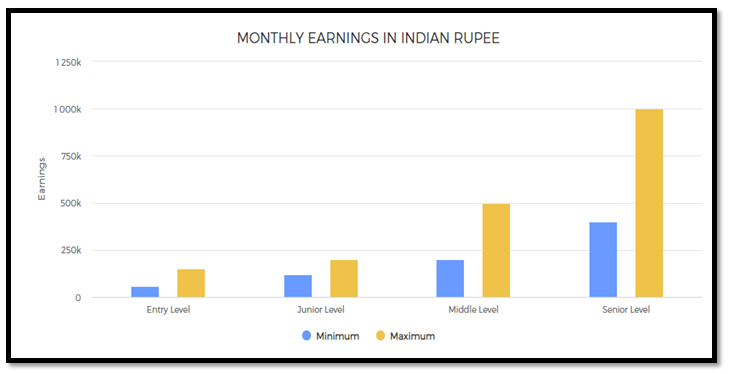
MONTHLY EARNINGS IN INDIAN RUPEE
1. Entry level: 0 - 2 years of work experience
2. Junior Level: From 1 to 12 years of work experience
3. Mid-Level: From 5 to 20+ years of work experience
4. Senior Level: From 10 to 25+ years of work experience (there could be exceptions in some high-end technical, financial, engineering, creative, management, sports, and other careers; also in the near future, people will reach these levels much faster in many careers and in some careers, these levels will have no meaning as those careers will be completely tech skill driven such as even now, there is almost no level in a Cyber Security Expert’s job)
Work Activities
1. Analysing and interpreting data and information - Analysis of data and information to find facts, trends, reasons behind situations, etc.; interpretation of data to aid in decision making.
2. Computing - using various computer software applications; writing algorithm for various computer and mobile applications; using software applications for scientific and technical work.
3. Creative thinking - Developing new ideas, concepts, innovative solutions to problems, newer ways of getting things done, designing products and services, creating work of art and craft, etc.
4. Drawing, drafting, laying out and specifying objects, equipment, devices, tools, and systems - Creating and developing designs, drawings, layouts and specifications about how to construct, manufacture, assemble, build, use, and maintain various devices, tools and systems.
5. Fabricating, assembling, and constructing equipment, devices and products - Fabricating, assembling, constructing products, equipment, devices and tools; testing and calibrating products, equipment, devices, tools and systems.
6. Getting Information and learning - Observing, hearing, reading, using computers, or otherwise obtaining information and learning from it.
7. Making decisions and solving problems - Analysis of data and information; evaluation of alternative decisions and results of decisions; taking the right decisions and solving problems.
8. Organising, planning and prioritizing tasks - Planning and organising tasks in order to achieve work goals; prioritizing tasks to achieve goals and making the best use of the time available.
9. Processing information - Compiling, tabulating, calculating, auditing, verifying or otherwise dealing with information processing including data entry, transcription, recording, storing and maintaining databases.
10. Strategic planning - Developing visions and goals, developing strategies and action plans for achieving visions and goals.
11. Updating and using relevant knowledge - Keeping updated with the latest knowledge relevant to your fields of work and use of the relevant knowledge in getting things done.
12. Using computers for work - Using computers for day-to-day office work; using computer software for various applications in day-to-day professional work; entering data and process information; for writing.
13. Working in a team - Working in a team of people; developing team; maintaining professional relationships among team members.
14. Working with computers, programming and performing technical tasks - Using computers and computer systems, hardware and software for programming, developing software and / or hardware, developing computer applications, systems, and networks; developing mobile applications.
Future Prospects
You can expect a bright future in this field as the industry statistics are very encouraging.
The global market for Human Machine Interface (HMI) Solutions is projected to reach USD 7.6 billion by 2025, driven by the emerging new digital era where humans and machine will work alongside each other. China ranks as the fastest growing market with a growth rate of 10.2%. The United States, Japan and Europe represent large markets worldwide with a combined share of 65.7% of the market.
The Global Affective Computing Market accounted for USD 17.06 billion in 2018 and is expected to reach USD 182.21 billion by 2027 growing at a rate of 30.1% compounded annually during 2018-2027.
Rising need for socially intelligent artificial agents and growing need for telehealth-related affective computing solutions are some of the factors fueling the market growth.
The Global Eye Tracking market was valued at USD 268.7 million in 2016 and is expected to grow at a rate of 27.5% compounded annually during 2017 to 2025. Eye tracking is a sensor-based technology that enables a digital display device to know exactly where your eyes are focused. It determines your presence, attention, focus, drowsiness, consciousness or other mental states while working with the device.
Global AI in IoT market size is expected to grow from USD 5.1 billion in 2019 to USD 16.2 billion by 2024, at a rate of 26.0% compounded annually.
Ambient Intelligence (AMI) can be defined as the electronic and computer systems that can sense and respond to human presence and interaction. The Global Ambient Intelligence Market will grow at a rate of 7.6% compounded annually during 2017-2026.
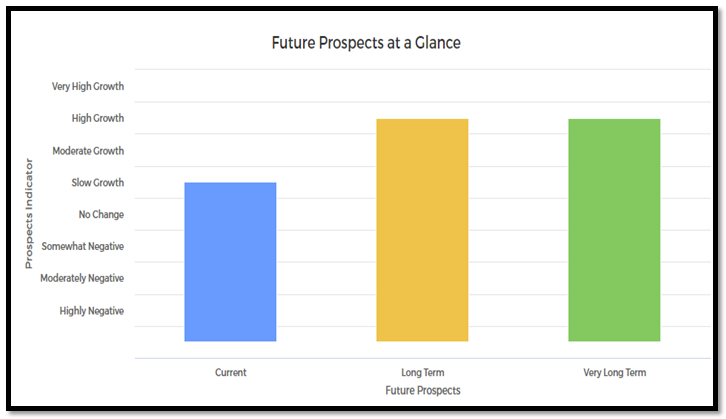
FUTURE PROSPECTS AT A GLANCE
Current (0-1 year) | Long Term (2-5 year) | Very Long Term (6-10 years) |
Slow Growth | High Growth | High Growth |