
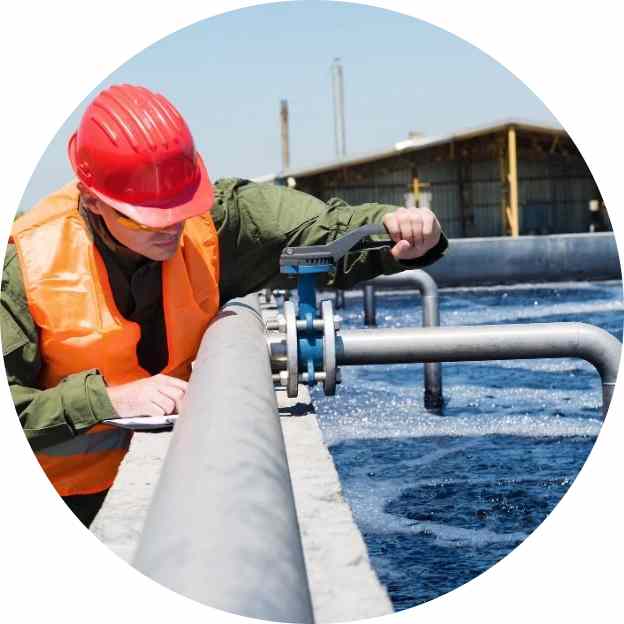
Water Resources Engineer
Entry Level Qualification
Class 12
Career Fields
Engineering & Technology
For Specially Abled


About Career
PARTICULARS | DESCRIPTION |
Name | Water Resources Engineer |
Purpose | Water Management |
Career Field | Engineering & Technology |
Required Entrance Exam | GATE, SSC JE |
Average Salary | 500000 - 1200000 Rs. Per Year |
Companies For You | Jacobs Engineering, WSP Global, CH2M Hill & Many More |
Who is Eligible | Class 12th Pass |
Water Resources Engineering is the quantitative study of the hydrologic cycle -- the distribution & circulation of water linking the earth's atmosphere, land and oceans. Water Resources Engineers are concerned with applications like the management of the urban water supply, the design of urban storm-sewer systems, design of hydraulic structures such as sewage conduits, dams & breakwaters, flood forecasting, etc.
Some more examples
They also deal with the management of waterways for erosion protection, environmental management such as prediction of mixing & transport of pollutants in surface water, water flow in an isolated environment (pipe, pump) or in an open channel (river, lake, ocean), etc.
Familiar application areas
Hydroelectric-power development, water supply, irrigation and navigation are some other familiar applications of water resources engineering which involves the utilization of water in a beneficial way.
In the present day context
Water Resources Engineers are emerging as one of those engineering communities which are in the greatest demand in recent times especially in the developing countries with expanding populations where the preservation of the natural environment including natural water reservoir systems is a prime concern now.
These Engineers play a vital role in the optimal planning, design & operation of water resource systems. Optimal means showing maximum efficiency. Work opportunities are quite varied in this field. Positions are available in large & small consulting firms, and at all levels of government (municipal, state and central).
Key Roles and Responsibilities
As a water Resources Engineer, you will be engaged with one or more of the following roles and responsibilities:
1. You will apply technology and scientific principles to the planning, functional design, operation of water storage tanks, distribution networks or other water storage facilities &management of hydraulic systems or facilities such as domestic / industrial water treatment plants, including advanced facilities with UV disinfection systems, surge overflow basins, aerobic digesters, batch reactors or other facilities.
2. You will perform hydraulic analyses of water distribution networks /water supply systems to test for pressure losses or to mitigate risks as well as improve operational efficiency.
3. You will gather and analyze water use data to forecast water demand.
4. You will conduct feasibility studies and cost-benefit analyses for the construction of facilities such as water supply systems, runoff collection networks, water & wastewater treatment plants, or wastewater collection systems.
Runoff water is the part of the water cycle that flows overland as surface water instead of being absorbed into groundwater or evaporating.
5. You will analyze floodplain drainage systems or stormwater systems to stabilize river banks, repair channel streams, control erosion, or design bridges and may design water distribution systems for potable / non-potable water.
6. You will draw engineering schematics, sketches, plans or specifications and create technical designs, calculations, diagrams, and final working drawings.
7. You will check construction plans, design calculations, or cost estimations to ensure completeness, accuracy, or conformity to engineering standards or practices.
8. You will plan alteration or modification of existing hydraulic structures to improve safety or function.
9. You will perform hydrological analyses, using 3D simulation software, forecast the dispersion of chemical pollutants in the water supply or to model the movement of water.
10. You will generate documentation and prepare administrative, technical, or statistical reports containing distinct technical information about planning, confidential descriptions or specifications for labor or materials, project budgets, schedules, or information about performance weaknesses or other details.
Career Entry Pathway
Class 10 all subjects as per scheme of studies – Class 11-12 Physics, Chemistry, Mathematics along with any other subject as per scheme of studies – B Tech / BE in Civil Engineering – Work opportunities
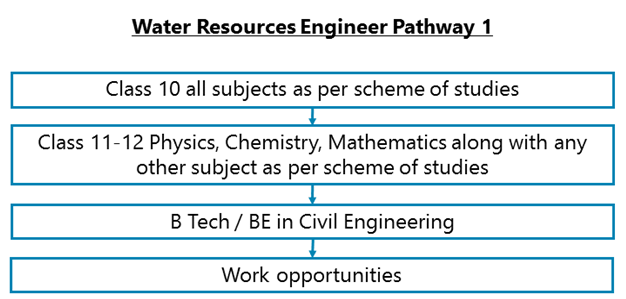
After completing Class 11-12 Physics, Chemistry, Mathematics then B Tech / BE in Civil Engineering, you can proceed to specialize in Water Resources Engineering by virtue of industrial experience instead of opting for post-graduation or higher qualifications. You will find work opportunities in hydraulics /hydrologic/urban development or civil utilities divisions of many private or public sector engineering companies, after graduation.
Class 10 all subjects as per scheme of studies - Class 11-12 Physics, Chemistry, Mathematics along with any other subject as per scheme of studies - B Tech / BE in Civil Engineering - M Tech / ME / MSc
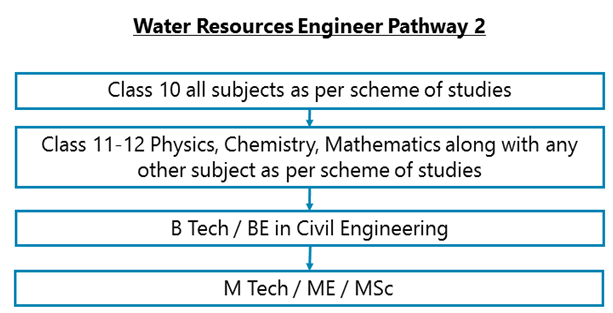
After completing Class 11-12 Physics, Chemistry, Mathematics along with any other subject as per scheme of studies, you can go for B Tech / BE in Civil Engineering. Then go for M Tech / ME / MSc in Civil Engineering, Water Resources Engineering, Water Resources & Hydraulic Engineering, Water & Environmental Engineering, Civil Engineering, Water Resources Engineering & Management, RS-GIS with specialization in Water Resources, or similar.
Class 10 all subjects as per scheme of studies – Class 11-12 Physics, Chemistry, Mathematics along with any other subject as per scheme of studies - BE / B Tech in Civil Engineering – M Tech/P.G.Training Certificate/P.G. Diploma
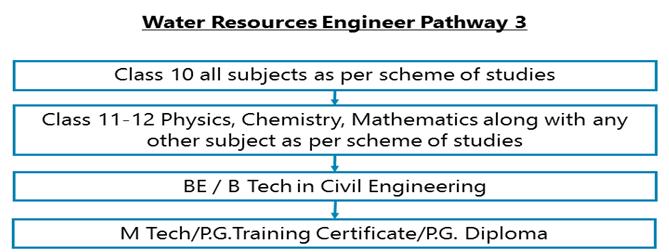
After completing Class 11-12 Physics, Chemistry, Mathematics along with any other subject as per scheme of studies then BE / B Tech in Civil Engineering or Civil Engg with specialization in Environmental & Water Resources, you can go for M Tech/P.G.Training Certificate/P.G. Diploma in Water Resource Development & Management.
Class 10 all subjects as per scheme of studies – Class 11-12 Physics, Chemistry, Mathematics along with any other subject as per scheme of studies- B.E./B.Tech. in Electrical, Mechanical & Agricultural Engineering - P.G.Training Certificate/P.G. Diploma/M.Tech. Degree
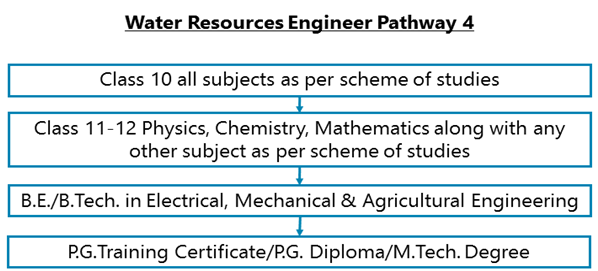
After completing Class 11-12 Physics, Chemistry, Mathematics along with any other subject as per scheme of studies then B.E./B.Tech. in Electrical, Mechanical & Agricultural Engineering, you can go for P.G.Training Certificate/P.G. Diploma/M.Tech. degree in Water Resource Development & Management.
Class 10 all subjects as per scheme of studies – Class 11-12 Physics, Chemistry, Mathematics along with any other subject as per scheme of studies – AMIE in Civil Engineering – GATE – M Tech
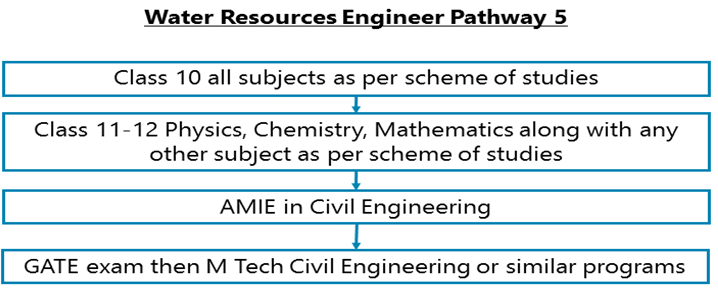
After completing Class 11-12 Physics, Chemistry, Mathematics along with any other subject as per scheme of studies, then go for AMIE in Civil Engineering. Then clear GATE exam to apply for M Tech in Civil Engineering or similar programs.
Class 10 all subjects as per scheme of studies – Diploma in Civil Engineering – Direct entry 2nd year B Tech/BE Civil Engineering - M Tech
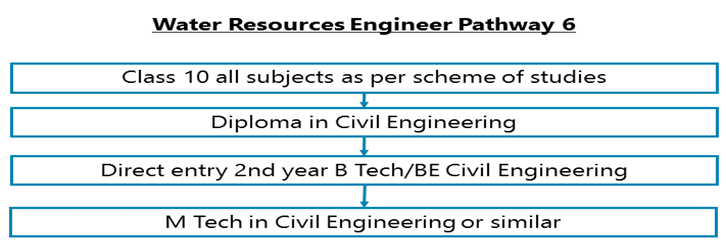
After completing Class 10 with any subjects, Science and Mathematics, you can go for a Diploma in Civil Engineering and complete it to get direct lateral entry to 2nd year B Tech/BE Civil Engineering. Then you may go for a M Tech in Civil Engineering or similar.
Class 10 all subject as per scheme of studies – Polytechnic Diploma in Civil/Mechanical/Electrical/Computer/Architecture/Chemical Engineering – 4 year B Tech in Water Resource Engineering / 2 year Advanced Diploma in Water Resources Engineering (ADWRE) from IGNOU
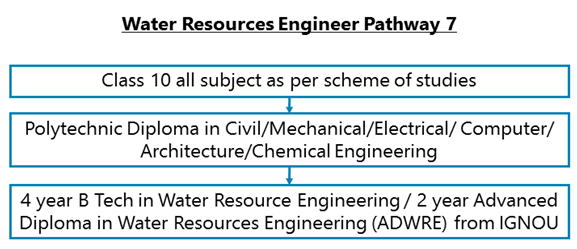
After completing Class 10 all subjects as per scheme of studies, you can go for a Diploma in Civil/Mechanical/Electrical/Computer/Architecture/Chemical Engineering, you can start working and simultaneously do a 4 year B Tech in Water Resource Engineering / 2 year Advanced Diploma in Water Resources Engineering (ADWRE) from IGNOU in online/distance mode. You will only have to enroll for practical sessions in a nearby authorized study center.
Class 10 all subjects as per scheme of studies – Class 11-12 Physics, Chemistry, Mathematics along with any other subject as per scheme of studies – B Tech / BE in Civil Engineering – PG Diploma
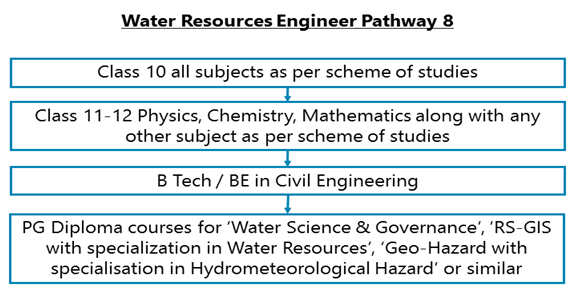
After completing Class 11-12 Physics, Chemistry, Mathematics along with any other subject as per scheme of studies then B Tech / BE in Civil Engineering, you can go for PG Diploma courses for ‘Water Science & Governance’, ‘RS-GIS with specialization in Water Resources’, ‘Geo-Hazard with specialisation in Hydrometeorological Hazard’ or similar.
Class 10 all subjects as per scheme of studies – Class 11-12 Physics, Chemistry, Mathematics along with any other subject as per scheme of studies – Bachelor degree in Physics, Mathematics, Statistics, Chemistry, Geology, Atmospheric Science, Economics, Geography, Agricultural Science – Post graduation in respective field – M.Tech in Water Resources Engineering and Management
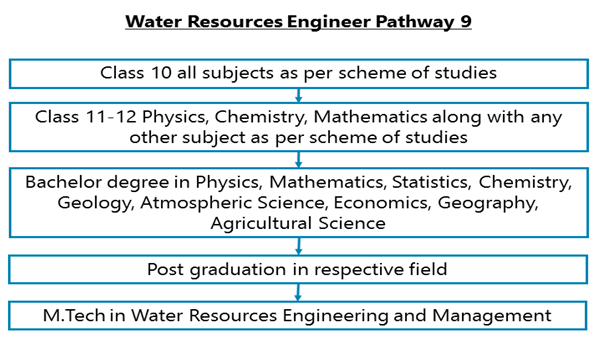
After completing Class 11-12 Physics, Chemistry, Mathematics along with any other subject as per scheme of studies, you can go for a Bachelor degree in Physics, Mathematics, Statistics, Chemistry, Geology, Atmospheric Science, Economics, Geography, Agricultural Science followed by post graduation in your respective field. Then go for M.Tech Water Resources Engineering and Management.
Class 10 all subjects as per scheme of studies – Class 11-12 Physics, Chemistry, and Mathematics along with any other subject as per scheme of studies– B.E./ B.Tech. in Civil Engineering/ Agricultural Engineering / Water Resources Engineering / Structural Engineering – M.Tech. in Remote Sensing & GIS (Geographic Information System) with specialisation in Water Resources
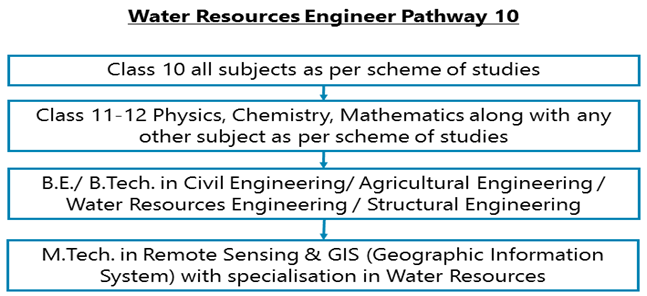
After completing Class 11-12 Physics, Chemistry, and Mathematics along with any other subject as per scheme of studies, go for B.E./ B.Tech. in Civil Engineering/ Agricultural Engineering / Water Resources Engineering / Structural Engineering or similar. Then pursue M.Tech. in Remote Sensing & GIS (Geographic Information System) with specialisation in Water Resources.
Class 10 all subjects as per scheme of studies – Class 11-12 Physics, Chemistry, and Mathematics along with any other subject as per scheme of studies– B.Sc. in Geology – M.Sc. in Geology - M.Tech in Remote
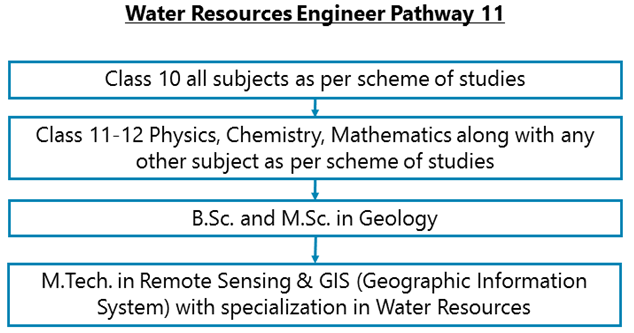
After completing Class 11-12 Physics, Chemistry, and Mathematics along with any other subject as per scheme of studies, then opt for B.Sc. and M.Sc. in Geology. Thereafter, pursue M.Tech. in Remote Sensing & GIS (Geographic Information System) with specialization in Water Resources.
Class 10 all subjects as per scheme of studies – Class 11-12 Mathematics and Physics/ Chemistry / Statistics/ Biology / Computer Science along with any other subject as per scheme of studies– B.Sc. in Environmental Science – M.Sc. in Environmental Science - M.Tech in Remote Sensing & GIS (Geographic Information System) with specialisation in Water Resources
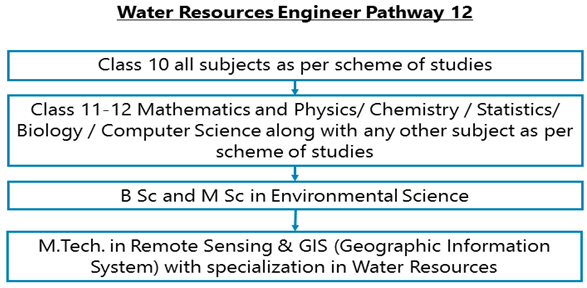
After completing Class 11-12 Mathematics and Physics/ Chemistry / Statistics/ Biology / Computer Science along with any other subject as per scheme of studies, go for B Sc and M Sc in Environmental Science. Thereafter, pursue M.Tech. in Remote Sensing & GIS (Geographic Information System) with specialization in Water Resources.
Class 10 all subjects as per scheme of studies – Class 11-12 with Physics, Chemistry, and Mathematics along with any other subject as per scheme of studies - BE / B Tech in any branch of Engineering – Interdisciplinary Research [PhD] in Water Research, urban water systems or similar
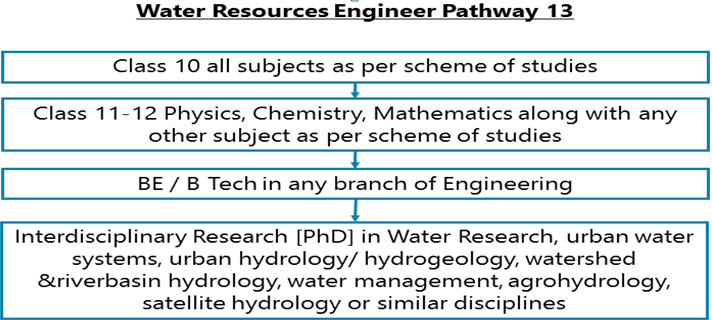
After completing Class 11-12 Physics, Chemistry, and Mathematics along with any other subject as per scheme of studies, you can go for BE / B Tech in any branch of Engineering. Thereafter, pursue individual university funded Interdisciplinary Research [PhD] in Water Research, urban water systems, urban hydrology/ hydrogeology, watershed &riverbasin hydrology, water management, agrohydrology, satellite hydrology or similar disciplines.
Class 10 subjects as per scheme of studies – Class 11-12 Physics, Chemistry, and Mathematics along with any other subject as per scheme of studies - BSc in Physics/ Chemistry/ Mathematics/ Statistics/ Environmental Sciences/ Geology/ Hydrogeology/ Atmospheric Sciences/ Agricultural Sciences (with Mathematics compulsory) – MSc in respective subject - Interdisciplinary Research [PhD] in Water Research, urban water systems or similar
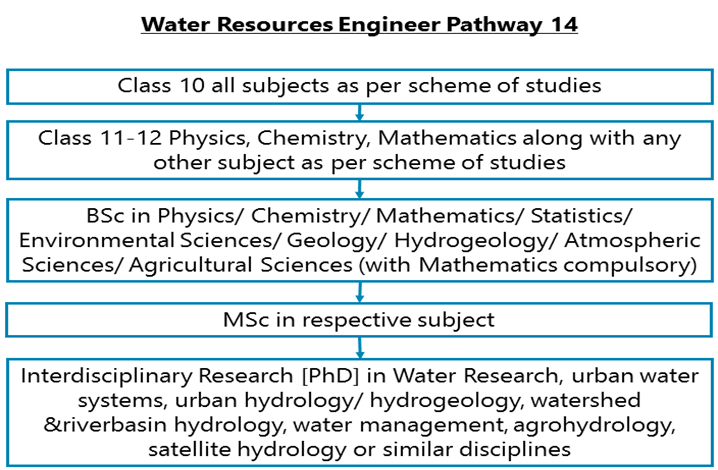
After completing Class 11-12 Physics, Chemistry, and Mathematics along with any other subject as per scheme of studies, you can go for BSc in Physics/ Chemistry/ Mathematics/ Statistics/ Environmental Sciences/ Geology/ Hydrogeology/ Atmospheric Sciences/ Agricultural Sciences. You must have Mathematics as a compulsory subject during graduation. Then pursue a Master degree program in your respective subject. Thereafter, pursue individual university funded Interdisciplinary Research [PhD] in Water Research, urban water systems, urban hydrology/ hydrogeology, watershed &riverbasin hydrology, water management, agrohydrology, satellite hydrology or similar disciplines.
Class 10 all subjects as per scheme of studies – Class 11-12 Physics, Chemistry, and Mathematics along with any other subject as per scheme of studies – 4 year Bachelor of Science degree program - Interdisciplinary Research [PhD] in Water Research, urban water systems or similar
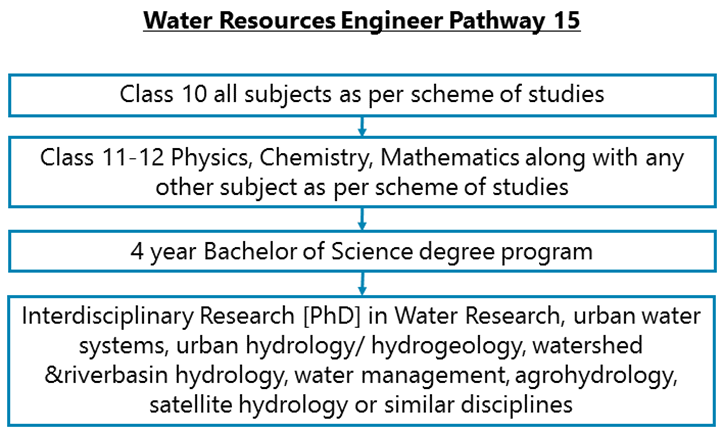
After completing Class 11-12 Physics, Chemistry, and Mathematics along with any other subject as per scheme of studies, you can go for a 4 year Bachelor of Science degree program. Thereafter, pursue individual university funded Interdisciplinary Research [PhD] in Water Research, urban water systems, urban hydrology/ hydrogeology, watershed &riverbasin hydrology, water management, agrohydrology, satellite hydrology or similar disciplines.
Class 10 all subjects as per scheme of studies – Class 11-12 Physics, Chemistry, Mathematics/Biology along with any other subject as per scheme of studies –Bachelor degree in Agricultural Sciences/Chemical Engineering/Biological Sciences/Environmental Sciences/Engineering with at least 1 paper of Mathematics - Master's degree – NET or GATE - PhD in Irrigation Water Management
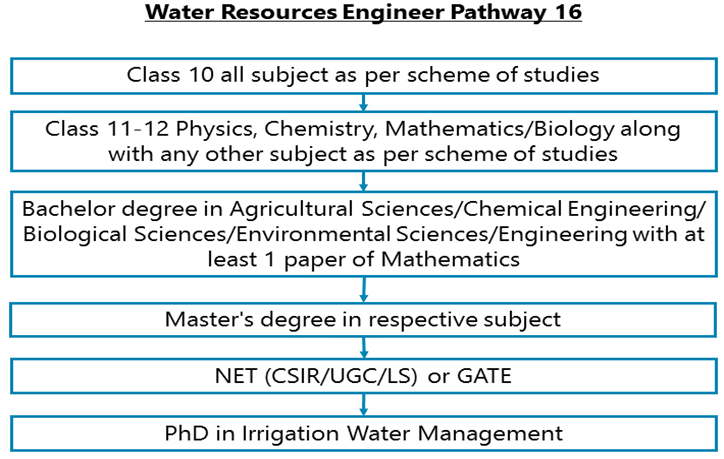
After completing Class 11-12 Physics, Chemistry, Mathematics along with any other subject as per scheme of studies, go for a Bachelor degree in Agricultural Sciences/Chemical Engineering/Biological Sciences/Environmental Sciences/Engineering with at least 1 paper of Mathematics. Then pursue a Master degree in your respective field. Then appear for NET (CSIR/UGC/LS) or GATE and apply for PhD in Irrigation Water Management or similar disciplines. The acceptability of NET or GATE scores will depend on university’s discretion. Some of them may even accept only GATE scores for entry into PhD programs.
Class 10 all subjects as per scheme of studies – Class 11-12 Physics, Chemistry, Mathematics along with any other subject as per scheme of studies - B.E./B.Tech in Civil,Electrical, Mechanical & Agricultural Engineering - M.E./M.Tech in respective field – PhD in Water Resource Development & Management
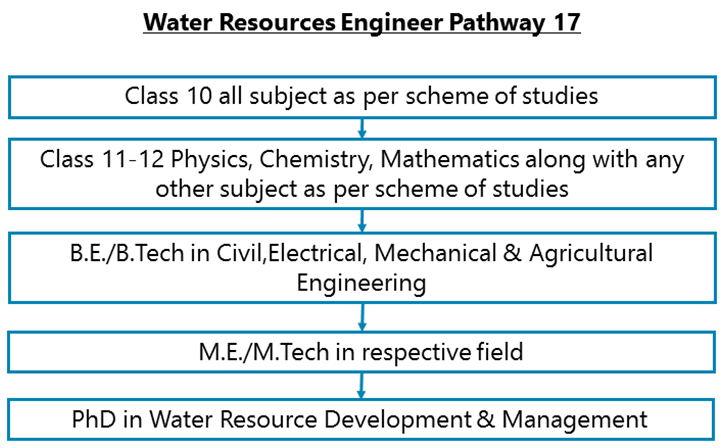
After completing, Class 11-12 Physics, Chemistry, Mathematics along with any other subject as per scheme of studies, go for B.E./B.Tech and M.E./M.Tech in Civil, Electrical, Mechanical or Agricultural Engineering. Then apply for PhD in Water Resource Development & Management. GATE or NET scores may not be necessary for all universities.
Required Qualification & Competencies
To get into this field, you will need to pass Class 10 with all subjects as per scheme of studies. Then you must complete Class 11-12 Physics, Chemistry, and Mathematics along with any other subject as per scheme of studies.
Then you can do a degree in Civil Engineering or you can first study for a 4 year Bachelor of Science degree or complete both Bachelor & Master degrees with Mathematics as a compulsory subject during graduation.
Civil engineering graduates can proceed to specialize in Water Resources Engineering by virtue of industrial experience instead of opting for post graduation or higher qualifications.
If you are not from an Engineering background, you will have to clear GATE exam at any cost to get an entry into this field.
You have to specialize in Water Resources Engineering or similar disciplines either at the post graduation or higher level because no college / institution offers direct Bachelor degree program in this field other than IGNOU which offers a 4 year B Tech course to working Diploma holders. There is also an option of exiting this course at the end of 2 years with an Advanced Diploma certificate. Some colleges abroad also provide ‘M Sc’ courses in this discipline.
Such specialized ‘Bachelor’ degree programs are typically unavailable and very few exist abroad in UK / USA including one or two integrated MEng BEng programs and individual BEng (Hons) programs which are mostly open to native but not to international graduates.
You can study for a Bachelor’s / Master’s / Doctoral degree in any of the following fields (Note that all these fields may not offer you a degree at all three levels, that is in Bachelor’s, Master’s and Doctoral. Some fields may offer a degree only at the Master’s or at the Doctoral level):
1. Water Resources Engineering
2. Civil and Construction Engineering
3. Civil Engineering
4. Civil Engineering with Sustainability
5. Civil & Coastal Engineering
6. Water Sciences & Technology
7. Watershed Management
8. Water and Coastal Management
9. Land & Water Resources Engineering
10. Soil & Water Conservation Engineering
11. Water Policies
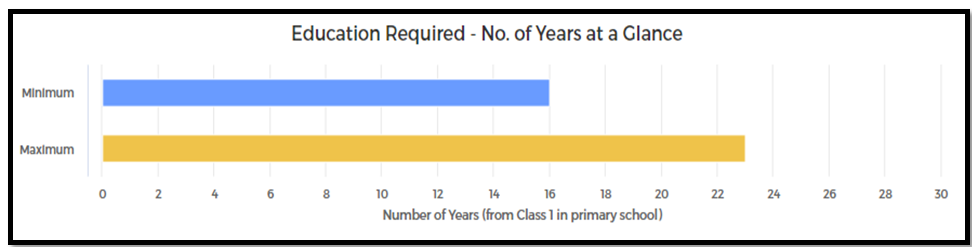
MINIMUM EDUCATION REQUIRED | MAXIMUM EDUCATION REQUIRED |
Under Graduate | Doctoral |
COMPETENCIES REQUIRED
Interests
1. You should have interests for Investigative Occupations. Investigative occupations involve working with ideas and quite a lot of thinking, often abstract or conceptual thinking. These involve learning about facts and figures; involve use of data analysis, assessment of situations, decision making and problem-solving.
2. You should have interests for Realistic Occupations. Realistic occupations involve more practical and hands-on activities than paperwork or office work. Realistic occupations often involve physical activities for getting things done using various tools and equipment.
3. You should have interests for Enterprising Occupations. You should have interests for Enterprising Occupations. Enterprising occupations involve taking initiatives, initiating actions, and planning to achieve goals, often business goals. These involve gathering resources and leading people to get things done. These require decision making, risk taking and action orientation.
Knowledge
1. You should have knowledge of Engineering and Technology - Knowledge of various applications of one or more branches of Engineering Science & Technology to manufacture and produce various goods or construct or erect various structures. This includes knowledge about design, development, prototype testing, manufacturing, construction, installation, repair and maintenance.
2. You should have knowledge of Technical and Engineering Design - Knowledge of various techniques, methods, specifications and tools for creating, developing and laying out designs of various structures, systems, equipment, devices, and processes. This includes developing blueprints, drawing and models.
3. You should have knowledge of Civil construction - Knowledge of materials, methods, and the tools involved in the construction or repair of structures.
4. You should have knowledge of Physical Science - Knowledge of physical principles, laws, their interrelationships, and applications to understand fluid, material, earth, ocean, atmosphere, and space dynamics, as well as mechanical, electrical, atomic and subatomic structures, properties, and processes.
5. You should have knowledge of Computers–for using computers for various technical and academic purposes.
Skills
1. You should have Systems Analysis Skills - determining how a system should work and how changes in conditions, operations, or the environment will affect outcomes.
2. You should have Technical Skills - using various technologies and technical methods to get things done or solve problems.
3. You should have Systems Evaluation Skills - identifying measures or indicators of system performance and the actions needed to improve or correct performance, relative to the goals of the system.
4. You should have Technical Design and Drawing Skills - creating and developing designs and drawings for various structures, machines, equipment, and devices.
5. You should have Quality Control Analysis Skills - conducting tests and inspections of products, services, or processes to evaluate quality or performance.
6. You should have Critical Thinking skills- Skills in the analysis of complex situations, using logic and reasoning to understand the situations and take appropriate actions or make interpretations and inferences.
7. You should have Judgment and Decision Making Skills - considering pros and cons of various decision alternatives; considering costs and benefits; taking appropriate and suitable decisions.
8. You should have Problem Solving Skills - Skills in analysis and understanding of problems, evaluating various options to solve the problems and using the best option to solve the problems.
Ability
1. You should have Deductive Reasoning Ability - apply general rules and common logic to specific problems to produce answers that are logical and make sense. For example, understanding the reasons behind an event or a situation using general rules and common logic.
2. You should have Problem Sensitivity - The ability to tell when something is wrong or is likely to go wrong. It does not involve solving the problem, only recognizing there is a problem.
3. You should have Inductive Reasoning Ability - The ability to combine pieces of information from various sources, concepts, and theories to form general rules or conclusions. For example, analyzing various events or situations to come out with a set of rules or conclusions.
4. You should have Oral Comprehension Ability - listen to and understand information and ideas presented through spoken words and sentences.
You should have Oral Expression Ability - communicate information and ideas in speaking so others will understand.
Personality Traits
1. You are always imaginative or in most situations.
2. You are always or mostly careful about your actions and behaviour.
3. You are always or mostly disciplined in your action and behaviour.
4. You are always calm or generally remain calm in most situations.
5. You can always act independently or could do so in most situations.
6. You always prefer to experience new things and have new experiences, or you mostly do.
Career - Job Opportunities & Profiles
At the beginning of your career, you can get a job as an Engineering Intern / Graduate Engineer Trainee and then proceed to following work roles in an industry or business segment to specialize in Water Resources Engineering.
You can become a Water Resources Engineer by virtue of your industrial experience with engineering design/ planning/ project management/consulting agencies or companies right after your graduation in Civil Engineering itself and you need not go for post-graduation at all.
There is ample opportunity for entrepreneurship too may be as an Engineering Consultant you can set up your own consultancy.
However, after your Master’s degree, you may surpass internships and traineeships to directly get your first job as a:
1. Junior Engineer
2. Water Resources Engineer
3. Resident Engineer
4. Sub-cluster Engineer
5. Junior Application Engineer
6. Executive Engineer
7. Site Engineer
8. Assistant Engineer
9. Superintending Engineer
10. Project Engineer
Some types of recruiting companies are:
1. Companies which provide planning & engineering services such as Larsen and Toubro Hydrocarbon Engineering Limited, Tata Projects, HCC (Hindustan Construction Company), Gammon India, Mahindra & Mahindra, Wirtgen Group, HLL Infra Tech Services Ltd., Honeywell etc.



2. Companies which conduct inspections and remedial rehabilitation of existing structures or operating in the Building Industry specifically ecology & environmental consultants, domestic and industrial waste management consultants, industrial safety and accident prevention consultants, materials testing/ assaying/ analysing/ inspection agenciessuch as Hydac India Private Limited, Asphalt India Corporation, Kanmore India, BORSIG GmbH, Gannon Dunkerley& Company Limited, Isolux Corsan Engineering and Construction India Private Limited etc.



3. Government Public Works Departments / Public Administration or Town & Regional Planning Organizations / Authorities / Ministries or even defense organizations including Engineers India, Heavy Water Board, Hindustan Aeronautics Limited, National Water Development Agency, Border Security Force,Bharat Electronics Limited, Department of Water Resources etc.
SPECIALISATION TRACKS IN THIS CAREER
1. Water Resource Engineer (Remote Sensing & Numerical Modeling)
This is a highly sought after discipline in recent times when satellite-based remote sensing (RS) and simulation modeling is being used successfully as an alternative that provides consistent information required for efficient water resources management. The usefulness of RS for crop classification, rainfall, and snowfall estimation, soil moisture analysis, surface& groundwater use can be used for water resources planning and management effectively. Professionals are highly trained in RS and modeling techniques for which specialized training programs are offered by various institutes.
2. Water Resource Engineer (Urban Utilities & Municipal Infrastructure Design)
Water Resources Engineers form an essential part of Urban Engineering crews globally in all engineering enterprises/government departments as they are integral to planning urban residential/industrial systems. They are concerned with municipal/urban infrastructure. This involves water-supply networks, waster water management & disposal, sewers, etc. In the case of large plants or buildings, campuses or facilities, Water Resource Engineers are required for site civil works which are similar in scope & type as municipal infrastructure, namely, potable water supply (including fire hydrants), on-site wastewater treatment plants, site drainage including sedimentation & retention ponds or basins, etc.
3. Water Resource Engineer (Surface & Ground Water Hydrology)
Water Resource Engineers may specialize in studies of above-earth water and water below the surface of the Earth. Their focus includes rainfall & runoff, the routes that surface water takes (for example through rivers or reservoirs), the occurrence of floods & droughts, distribution & movement of water in the soil & rocks of the Earth's crust (ground water). Groundwater engineering, another name for hydrogeology, is concerned with groundwater movement and design of wells, pumps, & drains.
4. Water Resource Engineer (Design of Hydrologic Systems & Advanced Hydraulics)
Hydraulic Controls Engineers or Design Engineers are capable of performing analysis & detailed designing (including documentation) of hydraulic & pneumatic fluid power, controls systems and equipment.This means pipes / channels / waterways or any other equipment/ device that allow water or any fluid to flow through it. This is a highly profitable branch of service and professionals are pleasantly remunerated. Some of them are specialized in building systems for mitigation hazards, including earthquake, flood, and tornados.Professionals have to be innovative and creative to constantly create better suited versions of existing designs.
5. Water Resource Engineer (Computational Hydraulics)
Computational hydraulics is an applied science field which revolves around simulation by computers of various physical processes of flow & transport in open water bodies like in seas, rivers, estuaries, lakes, channels, etc. Engineers are responsible for executing fluid dynamics projects, including solid modeling, meshing, model setup, result post-processing, and report writing. They need to be trained in using processing & post-processing software such as ANSYS FLUENT, including Gambit, SpaceClaim, and/or Design Modeler, Ansys Mesher, FieldView and Tecplot. Professionals are usually trained through enterprise experience instead of college degrees.
6. Water Resource Engineer (Morphodynamics and Hydrology - Coastal Areas & Wetlands)
Water Resource Engineers may specialize in studies of the natural water systems around coastal areas or wetlands & marshes. Specific focus lies on important services, including flood mitigation, fresh water supply, erosion control and carbon sequestration.Engineers deal with the environmental setting of a wetland as well as the hydrological connectivity between a wetland & the adjacent terrestrial & aquatic systems. This is a complex ecosystem and needs years of experience in locations with identical morphodynamics (study of landscape changes due to erosion & sedimentation).
7. Water Resources Engineer (River Engineering)
River Engineers plan human intervention in the course, characteristics, or flow of a river. This is generally accompanied with the objective of acquiring a defined benefit such as to manage the water resources, to protect against flooding, or to make passage along or across rivers easier, to make a stream more suitable for navigation or for navigation by larger vessels, to restrict water to a certain area so that it can be made available for agriculture, to reduce natural erosion etc. This process is alternatively called hydromodification,which also extends to non-riverine bodies such as coastal waters, estuaries, bays and lakes.
8. Water Resource Engineer (Oceanic Hydrodynamics)
Water Resources Engineers focusing on marine hydrodynamics & oceanic engineering deal with a diverse environment with vast engineering problems requiring solutions. This includes applications to coastal, offshore & subsea engineering, naval architecture, fluid mechanics, offshore geotechnics, marine renewable structures etc. Field trips are an essential aspect here. This involves some of the world-leading oil & gas and marine renewable energy enterprises. Marine energy (primarily mechanical from waves) is produced when electricity generators are placed on the surface of the ocean. The energy provided is most often used in desalination plants, power plants and water pumps.
9. Water Resources Engineer (Waste Water Management)
Water Resources Engineers may work with ecology & environmental consultants, domestic & industrial waste management consultants, industrial safety & accident prevention consultants, materials testing/ assaying/ analysing/ inspection agencies to study & design wastewater disposal networks as well as treatment plants in urban or industrial zones. Wastewater is the combination of liquid & water-transported wastes from commercial buildings, industrial facilities, households, and institutions that may enter the sewer system.
CAREER GROWTH
If you join as a Graduate Engineer Intern/Trainee/Engineer-in-Training, then after completion of your training, you will be positioned as General Engineer / Storm Water Engineer / Research Reservoir Engineer / Hydrologic or Hydraulic Modeling Specialist / Stability & Control Engineer / Design Engineer- New Product Development or similar positions. However, if you join after your Master’s degree, you can directly get a job as any one of these positions.
The next level of promotion will be to Senior level, as a Senior Project Engineer – Hydrology / Senior Water Resources Engineer / Senior Drainage Engineer / Senior Hydraulic Engineer / Senior Flood Control Engineer or similar.
After 5+ years of experience, you can expect to become a Lead Engineer and after 7-10 years of experience, a Principal Engineer / Or Chief Engineer / or principal Lead Engineer / Project Manager - Water Resources. In some private companies, the growth is rather faster.
Then after 15-20 years of experience, you may grow as a Deputy Chief Engineer / Chief Engineer / Senior Engineering Director/ Vice President Product Support Engineering / Senior Vice President / President / Director of Programs - Product Development /Executive Director / Chief Executive Officer.
If you wish to continue in the education/teaching/ training community, you will progress through roles like Visiting Faculty/Associate Professor, Professor/Guest Faculty, Senior Lecturer, Dean (Research), Director (Reseach) etc. in educational institutions or academic & research establishments.
Salary Offered
1. At the entry-level jobs, after your post-graduation depending upon the institution where you are graduating from, you may expect to get about Rs. 40,000 – 1,00,000 or even more a month. In junior level jobs (after 4-5 years of post-graduation), you can make about Rs. 60,000 – 1,50,000 or more per month.
2. In mid-level engineering jobs in India (after 8-10 years of post-graduation), you can expect to earn about Rs. 70,000 – 3,00,000 or even more a month.
3. In senior-level engineering jobs in India (after 15 years of post-graduation), you can expect to earn about Rs. 1,50,000 – 5,00,000 or even more a month.
Global (US)
1. At the entry level jobs, after your Master degree depending upon the institution where you are graduating from, you may expect to get about USD 3,000 – 6,000 or even more a month. You may get these jobs right after your Bachelor degree in Civil Engineering provided you have 3-4 years of relevant engineering experience.
2. After 4-5 years of work experience, you may expect to earn around USD 4,500 to USD8,000 a month or more depending on your job location and roles.
3. In mid-level engineering jobs (after 8-10 years of post-graduation), you can expect to earn about USD 5500 – 8500 or even more a month.
4. In senior-level engineering jobs (after 15 years of post-graduation), you can expect to earn about USD 8,000 – 10,000 or even more a month. Senior corporate leaders get much more than this; their total remuneration including performance bonuses could be as high as 2 million dollars a year.
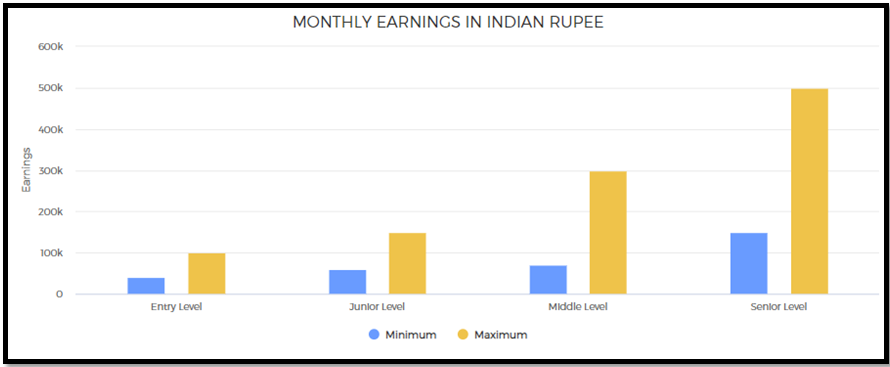
MONTHLY EARNINGS IN INDIAN RUPEE

1. Entry level: 0 - 2 years of work experience
2. Junior Level: From 1 to 12 years of work experience
3. Mid Level: From 5 to 20+ years of work experience
4. Senior Level: From 10 to 25+ years of work experience (there could be exceptions in some high-end technical, financial, engineering, creative, management, sports, and other careers; also in the near future, people will reach these levels much faster in many careers and in some careers, these levels will have no meaning as those careers will be completely tech skill driven such as even now, there is almost no level in a Cyber Security Expert’s job)
Work Activities
1. Analysing and interpreting data and information - Analysis of data and information to find facts, trends, reasons behind situations, etc.; interpretation of data to aid in decision making.
2. Assessing and evaluating quality - Assessing and evaluating quality of materials, systems, processes, products, services, etc.
3. Creative thinking - Developing new ideas, concepts, innovative solutions to problems, newer ways of getting things done, designing products and services, creating work of art and craft, etc.
4. Drawing, drafting, laying out and specifying objects, equipment, devices, tools, and systems - Creating and developing designs, drawings, layouts and specifications about how to construct, manufacture, assemble, build, use, and maintain various equipment, devices, tools and systems.
5. Fabricating, assembling, and constructing equipment, devices and products - Fabricating, assembling, constructing or otherwise manufacturing products, equipment, devices and tools; testing and calibrating products, equipment, devices, tools and systems.
6. Getting Information and learning - Observing, hearing, reading, using computers, or otherwise obtaining information and learning from it.
7. Inspecting equipment, systems, structures, and materials - Inspecting equipment, systems, structures, and materials to ascertain quality, performance, defects, causes of errors, etc.
8. Making decisions and solving problems - Analysis of data and information; evaluation of alternative decisions and results of decisions; taking the right decisions and solving problems.
9. Monitoring processes, systems and performance - Observing and recording information on various criteria to monitor mechanical, electronics, electrical and other processes and systems; monitoring progress of projects and tasks.
10. Organising, planning and prioritizing tasks - Planning and organising tasks in order to achieve work goals; prioritizing tasks to achieve goals and making the best use of the time available.
11. Processing Information - Compiling, tabulating, calculating, auditing, verifying or otherwise dealing with information processing including data entry, transcription, recording, storing and maintaining databases.
12. Strategic planning - Developing visions and goals, developing strategies and action plans for achieving visions and goals.
13. Updating and using relevant knowledge - Keeping updated with the latest knowledge relevant to your fields of work and use of the relevant knowledge in getting things done.
14. Using computers for work - Using computers for day-to-day office work; using computer software for various applications in day-to-day
15. Working in a team - Working in a team of people; developing team; maintaining professional relationships among team members.
Future Prospects
You can expect a decent future in this field as the industry growth prospects are encouraging.
Basic equipment involved in rainwater harvesting as a segment reached USD1.1 million and should reach USD1.3 millionat a compounded rate of 5.1%.
The Advanced Water Treatment Systems market revenue is estimated at USD4.5 billion and is expected to grow at a compounded rate of 14.3%.
The Global Smart Irrigation Systems Market stood at USD 538.7 million in 2017 and is estimated to expand with a compounded rate of 15.7% from 2017 - 2025. The Global Precision Irrigation Systems Market is estimated to expand with a compounded rate of 13% from 2017 - 2025.
The Global Water Treatment Technologies market accounted for USD 5242.73 million and is expected to reach USD 12362.08 million by 2026 growing at a compounded rate of 10.0% during 2017-2026.
The Waterway Transportation Market worldwide is projected to grow by USD 57.6 billion to reach over USD 36 billion by the year 2025, driven by a compounded growth rate of 8.9%.
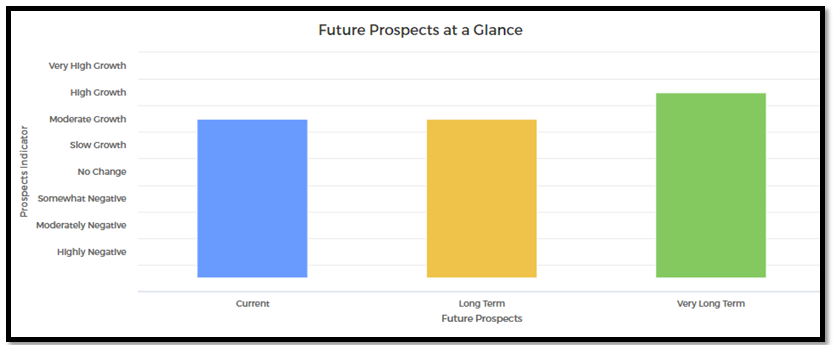
FUTURE PROSPECTS AT A GLANCE
