

CAD Software Operator
Entry Level Qualification
Class 12
Career Fields
Information Technology & Computer Science
For Specially Abled


Career Entrance Exam
About Career
PARTICULARS | DESCRIPTION |
Name | CAD Software Operator |
Purpose | Design and Drafting |
Career Field | Information Technology & Computer Science |
Required Entrance Exam | CUET UG, JEE MAIN BE/BTECH, NIMCET MCA |
Average Salary | 90000 - 200000 Rs. Per Year |
Companies For You | Autodesk, Bentley Systems, McNeel & Many More |
Who is Eligible | Class 12th Pass |
1. As a CAD (Computer-aided design) Software Operator, you will be involved in using computer technology to design and draft (make technical drawings) products, structures, or parts. It has several uses, from designing tools, products, and machinery to all types of buildings like homes, and industrial and commercial structures. A design is a working solution to a problem or a requirement.
2. You will be creating detailed technical drawings using computer software according to the specifications or descriptions given to you by presiding designers, architects, engineers, art directors, application engineers, project managers, team leads, or clients. You may be making new drawings or modifying existing ones according to the directions given to you.
3. CAD Operators work in a typical office environment. As a CAD Software Operator, you will be working on specialized computers having the required software needed to draw designs of various kinds of structures, products, and systems. CAD Designers may either work with 2D (surface modeling) plans or 3D (solid modeling) plans. You may need to work for nearly 9-10 hours daily or may also be required to work extra hours to meet project deadlines.
Key Roles and Responsibilities
As a CAD Operator, you will be engaged with one or more of the following roles and responsibilities: -
1. You will be creating high-quality, detailed technical drawings and plans using computer software.
2. You will be using a host of software programs (like Autodesk, AutoCAD, CoreICAD, SmartDraw, ARCHICAD, etc.) to create designs in 2D and 3D.
3. You will be designing/redesigning complex layouts by collaborating with design engineers, architects, application engineers, project managers, team leads, clients, layout artists, etc. to understand their written or verbal specifications and requirements as well as offer technical suggestions to them when needed.
4. You will be ensuring that drawings and designs are compliant with industry and safety standards and protocols.
5. You will be reviewing existing design layouts to find and resolve problems involving compatibility with basic design concepts.
6. You will be communicating with other designers and staff members and keep them updated about the progress, any alterations to the design specifications, etc.
7. You will be actively involved in the engineering and manufacturing design review process to evaluate design concepts or make required recommendations.
8. You will be assisting junior team members in CAD drawing and design tasks.
9. You will be maintaining notes, design calculations, and other documentation such as drawings, bill of materials, list of design parameters, etc., for future reference.
10. You will be regularly updating the database of design records for future reference purposes.
11. You will stay updated on techniques and technology, third-party items, services databases, and industry trends, by researching current literature, talking with colleagues, participating in educational programs, attending professional seminars or conferences, or attending meetings or workshops.
Career Entry Pathway
Class 10 all subjects as per the scheme of studies – NSQF Level 3 Training and Certificate for ‘CAD Operator’ or similar courses.
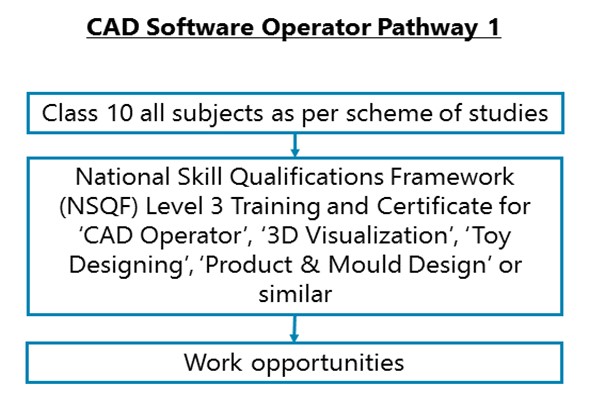
After Class 10, you need to undergo National Skill Qualifications Framework (NSQF) Level 3 Training and Certificate for ‘CAD Operator’, ‘3D Visualization’, ‘Toy Designing’, ‘Product & Mould Design’, or similar courses. The total hours of training will be 300-2080.
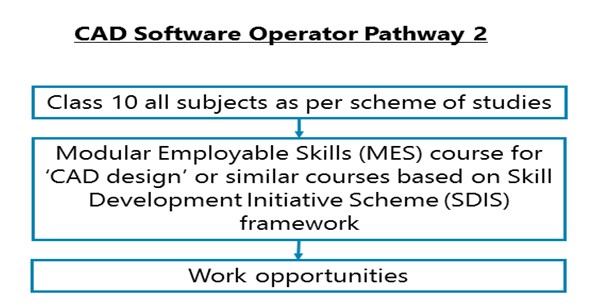
After Class 10, you can enroll in a Modular Employable Skills (MES) course for ‘CAD design’ or similar courses based on the Skill Development Initiative Scheme (SDIS) framework under the Ministry of Labour and Employment of India.
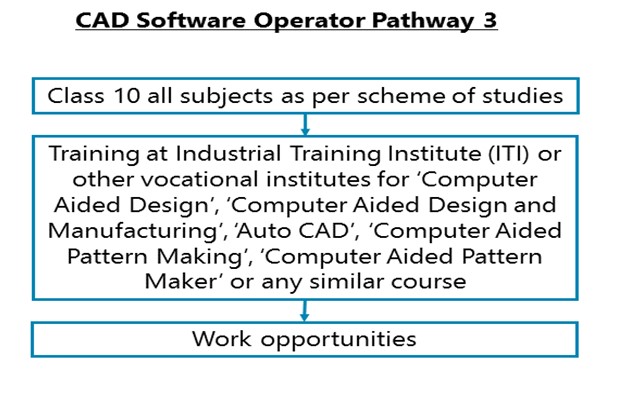
After Class 10, you need to undergo training at Industrial Training Institute (ITI), National Skill Training Institute (NSTI), Regional Vocational Training Institute (RVTI), National Vocational Training Institute (NVTI), Industrial Training Center (ITC), Vast Vocational Training Institute (VVTI) or other vocational institutes for ‘Computer Aided Design’, ‘Computer Aided Design and Manufacturing’, ‘Auto CAD’, ‘Computer Aided Pattern Making’, ‘Computer Aided Pattern Maker’ or any similar course.
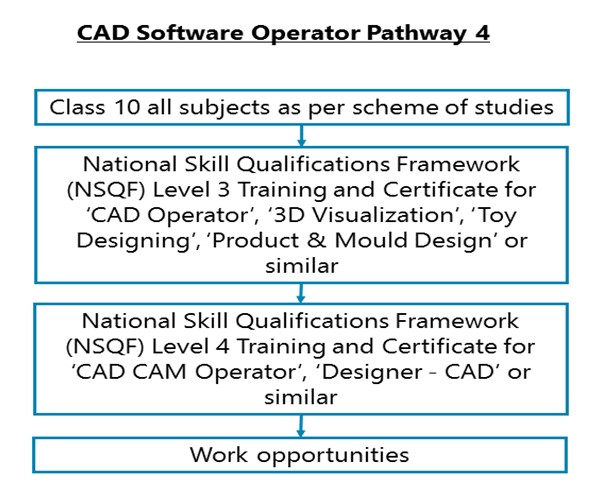
After Class 10, you need to undergo National Skill Qualifications Framework (NSQF) Level 3 Training and Certificate for ‘CAD Operator’, ‘3D Visualization’, ‘Toy Designing’, ‘Product & Mould Design’, or similar courses. The total hours of training will be 300-2080. Then you can go for National Skill Qualifications Framework (NSQF) Level 4 Training and Certificate for ‘CAD CAM Operator’, ‘Designer - CAD’, or similar courses. The total hours of training will be 120-1040.
Required Qualification & Competencies
After Class 10, you have the following options:
1. Certificate / Diploma courses.
2. ITI courses.
3. MES courses.
4. NSQF courses.
After Class 11-12, you can also go for B.Voc./ Certificate / Diploma courses irrespective of any industry orientation.
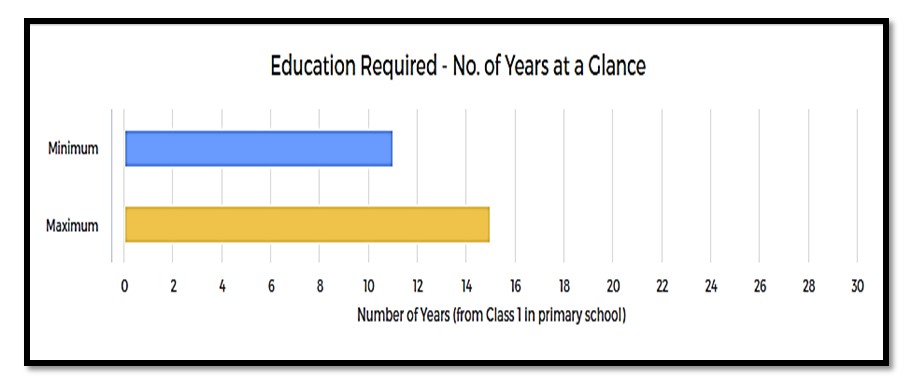
MINIMUM EDUCATION REQUIRED | MAXIMUM EDUCATION REQUIRED |
Post-Secondary Certificate / Diploma Programs for which the minimum eligibility is a pass in class X. | Post Higher Secondary Diploma / Certificate Programs for which the minimum eligibility is a pass in Higher Secondary / Class XII School Leaving examination. |
Competencies Required
1. You should have an interest in Conventional Occupations. Conventional occupations involve repetitive and routine tasks as well as fixed processes or procedures for getting things done. These occupations involve working more with data, systems, and procedures and less with ideas or creativity.
2. You should have an interest in Artistic Occupations. Artistic occupations mostly involve working with creative ideas, art, and designs. These occupations involve abstract or conceptual thinking, and creative self-expression and often do not follow any set processes or rules for getting things done.
3. You should have an interest in Realistic Occupations. Realistic occupations involve more practical and hands-on activities than paperwork or office work. Realistic occupations often involve physical activities for getting things done using various tools and equipment.
4. You should know Creative Design - Knowledge of various techniques, methods, and specifications for creating and developing designs for various products like animation, graphics, web, user interfaces of digital devices, photography, etc.
5. You should have knowledge of Computers - computer hardware and software, computer programming, computer networks, computer and mobile applications.
6. You may need knowledge of Fine Arts - the theories and techniques required for producing various works of fine arts such as painting, drawing, illustration, sculpture, digital art, installation art, craft, visual art, etc.
7. You should have Critical Thinking Skills- analysis of complex situations, using logic and reasoning to understand the situations and take appropriate actions or make interpretations and inferences.
8. You should have Active Listening Skills - Giving full attention to what other people are saying, understanding the points being made by others, asking questions, etc.
9. You will need skills in handling software packages such as CATIA, ArcInfo and ArcMap (ESRI) AutoCAD Map Series (AutoDesk), AutoCAD 2002 (AutoDesk), AutoCAD Map 6.0 (AutoDesk), MicroStation and GeoGraphic (Bentley), Architectural Desktop (AutoDesk), and MapInfo.
10. You should have Visualization Ability - The ability to imagine how something will look after it is moved around or when its parts are moved or rearranged.
11. You should have Selective Attention - The ability to concentrate on a task over a long period without being distracted.
12. You should have a Visual Color Discrimination Ability - match or detect differences between colors, including shades of color and brightness.
13. You should have Oral Comprehension Ability – listen to and understand information and ideas presented through spoken words and sentences.
14. You should have Oral Expression Ability – communicate information and ideas in speaking so others will understand.
15. You may need Abstract Reasoning Ability – understand ideas that are not expressed in words or numbers; the ability to understand concepts that are not clearly expressed verbally or otherwise.
16. You may need Written Comprehension Ability - read and understand information and ideas presented in writing.
17. You are always or mostly dependent on others or set rules and procedures.
18. You always or mostly prefer to stick within a routine or carry out routine and repetitive activities.
Career - Job Opportunities & Profiles
CAD Operators can find numerous job opportunities in various segments of the industry including Construction-Architecture (Civil and Mechanical sectors), Interior Designing, Gems and Jewelry, Manufacturing, Textile-Handloom-Leather, Glass, Ceramic, etc. as:
1. CAD Operator
2. CAD CAM Solution Expert
3. CAD/CAM Customizer
4. CAD CAM Executive
5. 3D Visualizer
6. CAD / CAM Tool Professional
7. CAD CAM Programmer
8. Junior CAD Designer
9. Patternmaker
10. Civil Drafter – CAD/CAM
11. Mechanical Drafter – CAD/CAM
12. CAD Print Designer
13. Auto CAD Designer
Career Growth
1. At the beginning of your career, you can bag entry-level roles such as Trainee Designer, Assistant CAD Programmer, Junior Design Artist, Associate Level Designer, etc.
2. After you’ve gained sufficient experience in any particular industry, you can get promoted to roles like Senior 3D Visualizer, Team Lead, Design Head, Project Lead, Strategic Head, Experience Solution Architect, etc.
Salary Offered
1. In entry-level jobs, you can expect a monthly salary package of around Rs. 7,000 - 16,000 or more.
2. As you gain about 6-10 years of experience and move on to mid-level roles in the field, your average monthly salary will be anywhere around Rs. 15,000 - 30,000, or more depending upon your job title and position.
3. For senior-level job positions (with 12-20 years of experience), the salary package ranges anywhere between Rs. 25,000 - 45, 000 per month or more.
4. After 12+ years of experience, you can expect around Rs. 30,000 - 55, 000 per month or more.
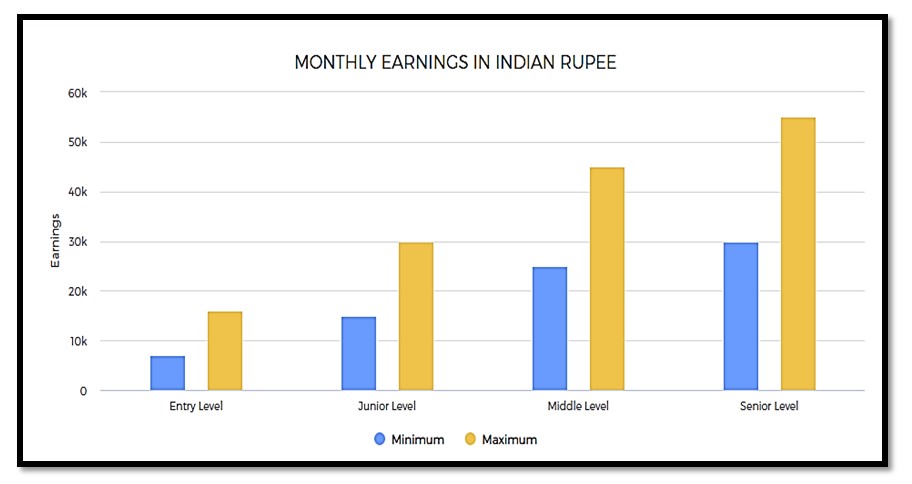
Monthly Earnings In Indian Rupee
Entry Level | Junior Level | Mid Level | Senior Level | ||||
Min Earning | Max Earning | Min Earning | Max Earning | Min Earning | Max Earning | Min Earning | Max Earning |
7000 | 16000 | 15000 | 30000 | 25000 | 45000 | 30000 | 55000 |
1. Entry level: 0 - 2 years of work experience
2. Junior Level: From 1 to 12 years of work experience
3. Mid-Level: From 5 to 20+ years of work experience
4. Senior Level: From 10 to 25+ years of work experience (there could be exceptions in some high-end technical, financial, engineering, creative, management, sports, and other careers; also shortly, people will reach these levels much faster in many careers and some careers, these levels will have no meaning as those careers will be completely tech skill driven such as even now, there is almost no level in a Cyber Security Expert’s job)
Work Activities
1. Working with computers, programming, and performing technical tasks -Using computers and computer systems, both hardware and software for programming, developing software and/or hardware, developing computer applications, systems, and networks; developing mobile applications.
2. Computing - Computing using various computer software applications; using software applications for scientific and technical work.
3. Creative thinking - Developing new ideas, concepts, innovative solutions to problems, newer ways of getting things done, designing products and services, creating works of art and craft, etc.
4. Getting Information and learning - Observing, hearing, reading, using computers, or otherwise obtaining information and learning from it, collaborating with the Rigging Artists (they create the skeletons of the animation models).
5. Identifying objects, actions, and events - Identifying various characteristics of objects; observing and understanding actions and events; understanding changes in actions and events.
6. Analysing and interpreting data and information - Analysis of data and information to find facts, trends, reasons behind situations, etc.; interpretation of data to aid in decision-making.
7. Organising, planning, and prioritizing tasks - Planning and organizing tasks to achieve work goals; prioritizing tasks to achieve goals and making the best use of the time available.
8. Updating and using relevant knowledge - Keeping updated with the latest knowledge relevant to your fields of work and using the relevant knowledge in getting things done.
9. Using computers for work - Using computers for day-to-day office work; using computer software for various applications in day-to-day professional work; entering data and processing information; for writing.
10. Communicating with co-workers and others - Communicating with people in writing, verbally or otherwise inside your workplace and various other people who have professional relationships with your place of work including vendors, government officials, etc., or with people at large.
Future Prospects
1. You can expect a bright future in this field as the industry growth prospects are encouraging. CAD/CAM design falls under the purview of the IT Enabled Services industry. The IT & ITeS industry in India is predicted to reach the 300 billion US dollar mark. The global CAD software market is predicted to touch the 12,124 million US dollar mark showing tremendous growth in the Asia-Pacific region including India, Japan, and China.
2. CAD / CAM design has emerged as a major thrust area in the Indian outsourcing scenario especially in the field of advanced medical devices, automotive, and diagnostic tools. Outsourcing from India means Indian qualified professionals migrating to other countries for work. In the next 20 years developed countries will see a huge workforce deficit and once again will outsource from developing countries including India.
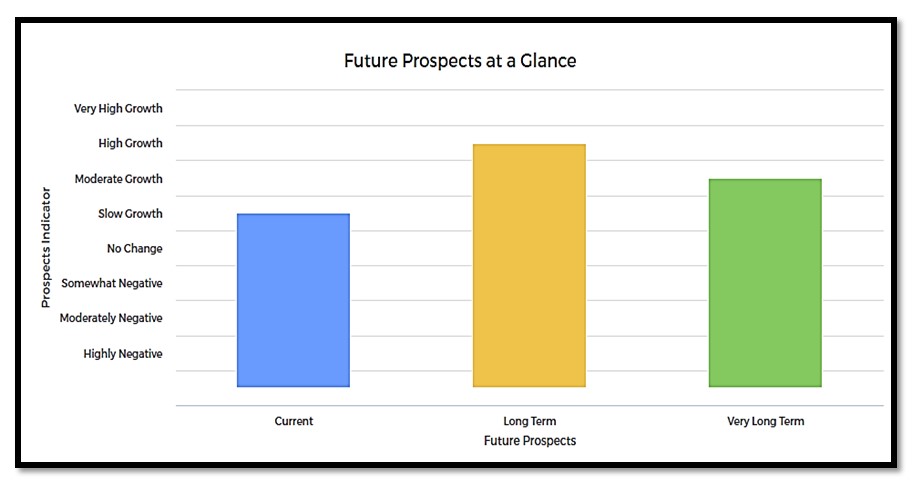
Future Prospects At A Glance
Current (0-1 year) | Long Term (2-5 years) | Very Long Term (6-10 years) |
Slow Growth | High Growth | Moderate Growth |