 CURRENT AFFAIRS

 CURRENT AFFAIRS
Description

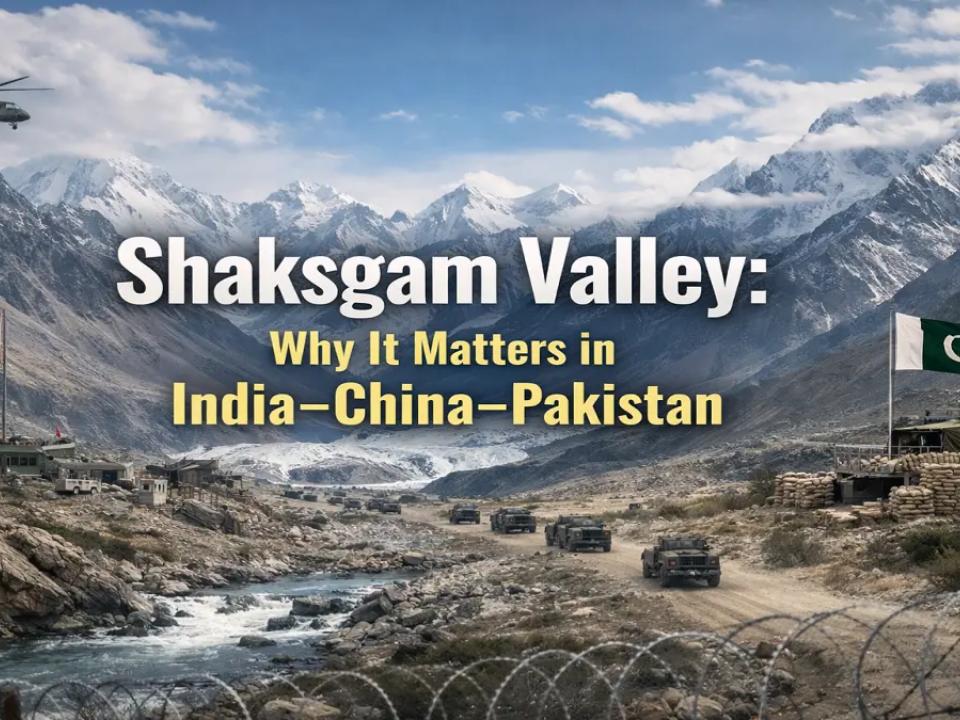
Shaksgam Valley has emerged as a recurring point of contention in discussions on India’s northern borders, particularly amid evolving dynamics between India, China, and Pakistan. Although sparsely populated and geographically harsh, the valley occupies a sensitive position in South Asia’s strategic landscape due to competing territorial claims and its proximity to critical military zones.
For civil services preparation, the issue is relevant because it links territorial disputes, external security, border infrastructure, and regional geopolitics, making it useful for both GS Paper II and GS Paper III.
Why Has Shaksgam Valley Drawn Attention Recently?
The region returned to prominence after China publicly dismissed India’s claim, reiterating its control over the area. This statement fits into a broader pattern of Chinese assertiveness along disputed boundaries.
At the same time, reports of expanded road and logistics infrastructure have raised strategic concerns, as such development improves accessibility in a region traditionally constrained by altitude and terrain.
Physical and Political Location
Shaksgam Valley often referred to as the Trans-Karakoram Tract is located in the northern part of Pakistan-Occupied Kashmir, adjoining China’s Xinjiang region.
Its surrounding features include:
Xinjiang (north)
Gilgit–Baltistan region of PoK (south and west)
Siachen Glacier zone (east)
Despite its inhospitable environment, the valley’s position at the junction of multiple strategic regions enhances its geopolitical value.
Transfer of Control: The 1963 Agreement
Control over the valley shifted following a boundary agreement between China and Pakistan in 1963, under which Pakistan handed over the territory to China.
India rejects this agreement on the grounds that:
Pakistan had no sovereign authority over the area
the region forms part of the former princely state of Jammu & Kashmir
Why the Agreement Remains Legally Contentious
The treaty includes a provision allowing boundary revision after the Kashmir dispute is resolved. This clause is often cited by India to argue that the agreement itself acknowledges the unsettled status of the territory.
Strategic Relevance from India’s Perspective
The importance of Shaksgam Valley lies less in population or resources and more in military geography.
Impact on Siachen Sector
Situated north of the Siachen Glacier, activity in the valley has implications for India’s defensive posture in one of the most sensitive high-altitude zones in the world.
Connectivity Near Karakoram Pass
Its location near the Karakoram Pass provides strategic depth and potential mobility between Xinjiang and PoK, raising surveillance and security concerns for India.
Intensifying the Two-Front Scenario
China’s presence in the valley strengthens the possibility of operational coordination with Pakistan, complicating India’s security planning along both western and northern borders.
Infrastructure Expansion and Strategic Signalling
India’s unease is primarily driven by China’s construction footprint in the region. Improved infrastructure can:
enable quicker force mobilisation
strengthen logistical endurance
sustain deployments in extreme climatic conditions
Such developments risk altering the strategic balance without overt military confrontation.
India’s Official Position
India has consistently maintained that:
Shaksgam Valley is part of Indian territory
the 1963 transfer lacks legal validity
no third country has the right to alter the status of disputed areas
the issue is inseparable from the broader Jammu & Kashmir dispute
Wider Regional Context: Karakoram Highway and CPEC
The transfer of the valley marked an early phase of China–Pakistan strategic alignment, which later manifested in projects such as the Karakoram Highway.
This cooperation has expanded into initiatives like the China–Pakistan Economic Corridor (CPEC), which India opposes because it passes through territory India claims, raising concerns over sovereignty and long-term security implications.
Welcome to Notopedia.com, your free learning platform that caters to the diverse needs of students and aspirants across a spectrum of entrance exams and educational endeavors. Whether you're preparing for highly anticipated exams like CAT, NEET, JEE Main, or bank job vacancies, our platform offers a wealth of resources to guide you towards success. Stay up-to-date with the latest exam dates, announcements, and results for various government recruitment exams, including SSC CGL, CHSL, NDA, and UPSC. Explore comprehensive study materials, sample papers, and exam patterns to hone your skills and boost your confidence. From important dates like CBSE Class 10 and 12 date sheets to exam-specific information like JEE Main application form date, we cover it all. Notopedia.com is your go-to source for everything from admissions and admit cards to scholarships and college information. Whether you're aiming for a career in defense, government, banking, or higher education, our free learning platform equips you with the knowledge and resources you need to excel. Join us in your educational journey and unlock a world of opportunities, guidance, and comprehensive support.
For more Updates and Information - Visit Notopedia's Bulletin Board
For Latest Sarkari Jobs - Visit Notopedia's Sarkari Jobs Section
For access to more than 20,000 Colleges - Visit Notopedia's College Section
For School Studies and Exams Preparation across 14 Boards - Visit Notopedia's School Section
For Comprehensive Preparation of Sarkari Job Exams - Visit Notopedia's Sarkari Exams Section
- Shaksgam Valley India China dispute
- Trans Karakoram Tract
- China Pakistan Boundary Agreement 1963
- Shaksgam Valley UPSC
- India China border disputes
- Shaksgam Valley strategic importance
- CPEC and Shaksgam Valley
- Pakistan Occupied Kashmir China
The Notopedia Bulletin Board
News about the latest admissions, results, upcoming government jobs, Sarkari exams and many more.


