 CURRENT AFFAIRS

 CURRENT AFFAIRS
Description

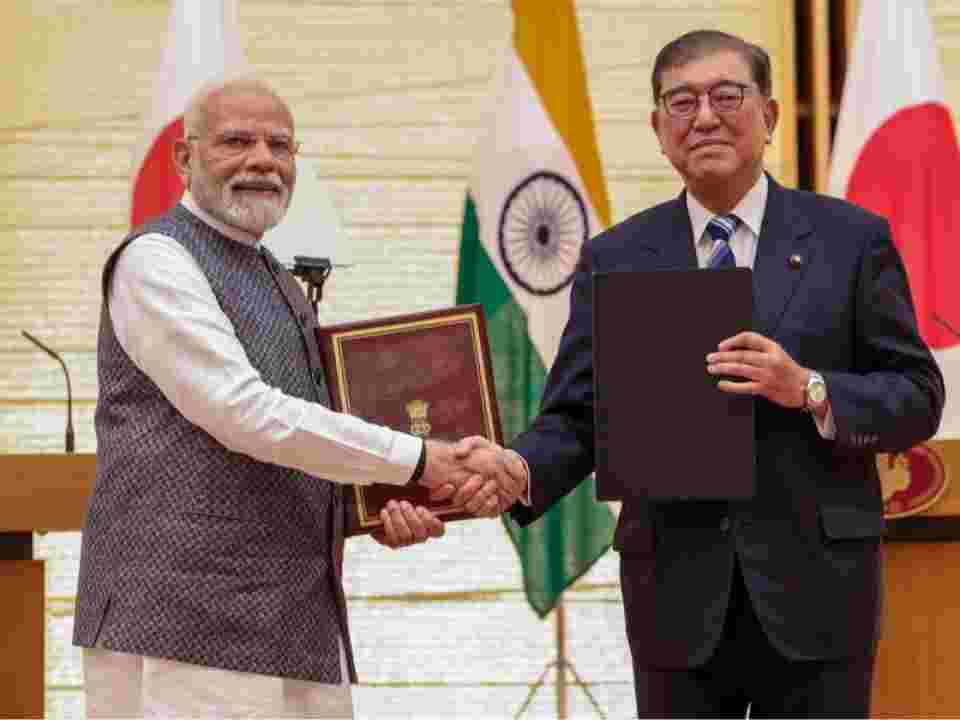
India and Japan have formalized a Joint Credit Mechanism (JCM) agreement under Article 6.2 of the Paris Agreement, marking a significant step toward strengthening climate cooperation, advancing carbon markets, and accelerating green investments. The agreement, signed at a time of global trade tensions and supply chain disruptions, positions India to secure sustainable growth while diversifying its strategic partnerships.
Background And Strategic Significance
The pact was signed between the Ministry of Environment, Forest and Climate Change (India) and the Government of Japan. It forms part of a larger bilateral framework valued at nearly ¥10 trillion (approx. Rupees 6 trillion), which also includes collaboration in:
Artificial Intelligence (AI)
Defence and security technologies
Semiconductor manufacturing
Access to critical minerals
This cooperation becomes even more critical in light of recent geopolitical and economic developments:
The United States imposed 50% tariffs on several Indian exports, raising concerns about India’s trade competitiveness.
The U.S. also formally withdrew from the Paris Climate Agreement, creating uncertainty in global climate finance negotiations.
India, seeking to become a hub for manufacturing and clean technologies, now gains a reliable partner in Japan, which has long experience in energy efficiency and decarbonisation technologies.
Rare Earth Supply Chain Challenges
Rare earth elements are essential for semiconductors, renewable energy technologies, and advanced defence applications.
In April 2025, China imposed a ban on exports of key rare earth elements such as samarium, gadolinium, and terbium, disrupting global supply chains.
Although China later relaxed restrictions for India, the crisis revealed the dangers of overdependence on a single source.
India is now incentivising domestic exploration, mining, and processing of rare earths, but challenges remain due to high costs, environmental risks, and limited technical expertise.
The India–Japan cooperation under JCM is expected to indirectly support rare earth security by fostering joint innovation, sustainable processing methods, and diversified supply chains.
Carbon Trading And Climate Finance
The Joint Credit Mechanism (JCM) enables bilateral trade of carbon credits and aligns with Article 6.2 of the Paris Agreement. Its objectives include:
Reduction of greenhouse gases using advanced technologies and market-based mechanisms.
Transfer of low-carbon and renewable energy technologies from Japan to India.
Capacity building and financing support to meet India’s climate commitments.
This partnership comes at a time when global climate finance discussions remain stalled, with developed and developing nations divided over funding responsibilities. The JCM creates an alternative, bilateral pathway to ensure continued progress on climate targets.
Role Of COP30 In Belem, Brazil
The timing of the agreement is crucial, as it precedes the COP30 Climate Summit (2025) in Brazil, where global negotiators will revisit rules for international carbon markets.
So far, only 23 countries have submitted updated Nationally Determined Contributions (NDCs) under the Paris Agreement.
The India-Japan JCM model demonstrates how bilateral agreements can complement multilateral processes.
Experts highlight that transparent and credible rules for carbon trading must be finalised to avoid duplication and ensure environmental integrity.
India’s Domestic Carbon Market
India has already taken steps to build its own emissions trading system:
In 2023, the government launched the Carbon Credit Trading Scheme (CCTS).
A National Designated Authority (NDA) was set up to monitor and approve carbon transactions.
With Japanese investments and technology under the JCM, India can accelerate deployment of clean energy, green hydrogen, and carbon capture projects, helping achieve its Net Zero target by 2070.
Broader Implications And Future Prospects
The JCM strengthens India’s energy transition strategy while reducing reliance on Western climate financing.
It boosts India’s standing as a regional leader in sustainable innovation and green technology.
The initiative could serve as a model for other developing countries, particularly those struggling to access climate finance through multilateral frameworks.
Key Takeaways For Exams
Article 6.2 of the Paris Agreement enables countries to meet their NDCs through cooperative approaches, including carbon credit trading.
It allows for technology transfer, capacity building, and financial flows from developed to developing countries.
Under this mechanism, nations can generate and trade Internationally Transferred Mitigation Outcomes (ITMOs).
The India-Japan JCM represents a pioneering bilateral model to support decarbonisation, sustainable trade, and strategic economic resilience.
Welcome to Notopedia.com, your free learning platform that caters to the diverse needs of students and aspirants across a spectrum of entrance exams and educational endeavors. Whether you're preparing for highly anticipated exams like CAT, NEET, JEE Main, or bank job vacancies, our platform offers a wealth of resources to guide you towards success. Stay up-to-date with the latest exam dates, announcements, and results for various government recruitment exams, including SSC CGL, CHSL, NDA, and UPSC. Explore comprehensive study materials, sample papers, and exam patterns to hone your skills and boost your confidence. From important dates like CBSE Class 10 and 12 date sheets to exam-specific information like JEE Main application form date, we cover it all. Notopedia.com is your go-to source for everything from admissions and admit cards to scholarships and college information. Whether you're aiming for a career in defense, government, banking, or higher education, our free learning platform equips you with the knowledge and resources you need to excel. Join us in your educational journey and unlock a world of opportunities, guidance, and comprehensive support.
For more Updates and Information - Visit Notopedia's Bulletin Board
For Latest Sarkari Jobs - Visit Notopedia's Sarkari Jobs Section
For access to more than 20,000 Colleges - Visit Notopedia's College Section
For School Studies and Exams Preparation across 14 Boards - Visit Notopedia's School Section
For Comprehensive Preparation of Sarkari Job Exams - Visit Notopedia's Sarkari Exams Section
- India Japan JCM 2025
- Joint Credit Mechanism Article 6.2
- Paris Agreement carbon trading
- India Net Zero 2070
- India Japan climate partnership
- Green investment in India
- Rare earth supply chain India Japan
- COP30 Brazil 2025
- Carbon Credit Trading Scheme
The Notopedia Bulletin Board
News about the latest admissions, results, upcoming government jobs, Sarkari exams and many more.


