 CURRENT AFFAIRS

 CURRENT AFFAIRS
Description

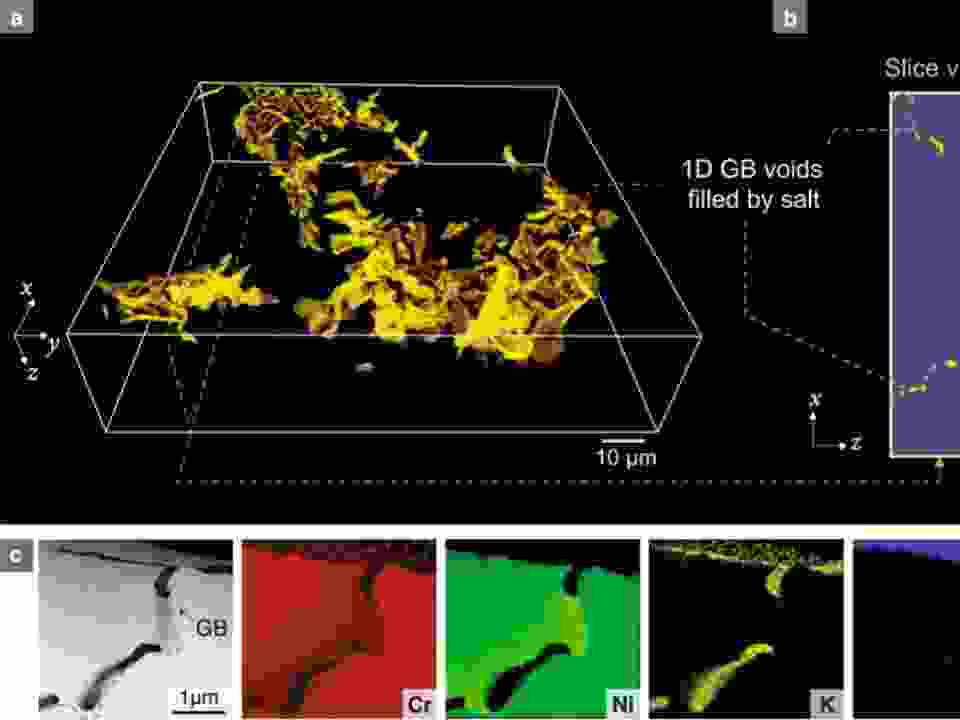
A new type of corrosion known as 1D wormhole corrosion has recently been discovered by scientists. This corrosion is distinguished by a wormhole-like 1D morphology that can function as a mass-flow pathway. This type of corrosion is important for understanding material degradation mechanisms in molten salt environments, especially in relation to next-generation nuclear power plants that use molten salts as coolants.
About 1D Wormhole Corrosion
When exposed to molten fluoride salt, a nickel-chromium alloy experiences 1D wormhole corrosion, a highly localised form of penetrating corrosion. This type of corrosion results in the formation of a permeable network of tunnels along grain boundaries. Molten salt fills these tunnels, leaving voids along the grain boundaries.
Implications For Material Degradation Mechanisms In Molten Salt Environments
The discovery of 1D wormhole corrosion has important implications for understanding the mechanisms of material degradation in molten salt environments. Molten salts are a promising coolant candidate for next-generation nuclear power plants. These power plants will be safer, more efficient, and more environmentally friendly than current nuclear power plants. Molten salts are particularly appealing as coolants due to their high thermal conductivity and boiling point. As a result, they are ideal for transferring heat away from the reactor core as well as generating electricity.
The use of molten salts as coolants, on the other hand, can result in material degradation mechanisms such as corrosion. The discovery of 1D wormhole corrosion sheds light on the various types of corrosion that can occur in molten salt environments. This can assist scientists and engineers in developing materials that are more corrosion resistant in these environments.
Importance For Next-Generation Nuclear Power Plants
The discovery of 1D wormhole corrosion has important implications for ongoing efforts to design next-generation nuclear power plants. These power plants are intended to use molten salts as coolants, and the discovery of this type of corrosion highlights the need for materials that are more corrosion resistant in molten salt environments. The use of corrosion-resistant materials is critical for ensuring the safety and reliability of next-generation nuclear power plants.
Furthermore, the discovery of 1D wormhole corrosion can assist scientists and engineers in designing better monitoring and maintenance systems for these power plants. Scientists and engineers can develop better methods for detecting and repairing corrosion damage by understanding the types of corrosion that can occur in molten salt environments.
For more Updates and Information - Visit Notopedia's Bulletin Board
For Latest Sarkari Jobs - Visit Notopedia's Sarkari Jobs Section
For access to more than 20,000 Colleges - Visit Notopedia's College Section
For School Studies and Exams Preparation across 14 Boards - Visit Notopedia's School Section
For Comprehensive Preparation of Sarkari Job Exams - Visit Notopedia's Sarkari Exams Section
- 1D Wormhole Corrosion
- Molten salts
- nuclear power plants
The Notopedia Bulletin Board
News about the latest admissions, results, upcoming government jobs, Sarkari exams and many more.


