

Polymer Technologist (Diploma)
Entry Level Qualification
Class Graduate
Career Fields
Mechanic & Technician
For Specially Abled


Career Entrance Exam
About Career
1. Polymers have complex chemical structures inside but on the outside they have different colors as well as textures and are used for a variety of purposes. The most common polymers in our lives are plastic and nylon which are both synthetic (made by man) polymers. There are many natural polymers too like silk, rubber etc. These are made by nature.
2. As a Polymer Technologist after your Diploma, you will mainly be making refined commercial polymer for raw unusable polymers using various technologies. The refined commercial polymer is then used to make bottles, tubes, furniture, luggage, boxes, pipes, packets, garments etc.
3. You will be involved in studying the nature, structures, and specific properties of different polymers and their combinations, and their responses to external forces in order to build new polymers with specific properties so that they can be used in a variety of products, applications and in various environments.
4. You will also have to test different polymers for determining their mechanical strength, individual weight, magnetic and electrical properties, and resistance to heat, and cold etc. You may also need to suggest improvements in the production processes in order to meet both manufacturer and governmental safety and quality standards.
5. As a Polymer Technologist, you will generally work in large factories and engineering plants with several design engineers, technicians and other professionals as part of a team. You may have to work full time which may be over 50 hours per week. You may also be involved in providing training to junior factory workers regarding how to follow protocols and deadlines.
Key Roles and Responsibilities:
As a Polymer Technologist, you will be engaged with one or more of the following roles and responsibilities: -
1. You need to have knowledge of and work with commercial polymer processing techniques that are used to produce refined polymers (like plastic) from raw polymers. Some of the technical names of such processes are extrusion, moulding, pultrusion etc.
2. You will help senior engineers in designing, evaluating, installing, operating, or maintaining various systems, processes, instruments and devices used at polymer processing units.
3. You will work with senior technologists while performing experiments as well as computer modeling for studying nature, structures, and specific properties of different polymers and their combinations, and their responses to external forces.
4. You will be involved in testing different polymers for determining their mechanical strength, individual weight, magnetic and electrical properties, and resistance to heat, and cold etc.
5. You will work towards determining ways to combine or strengthen polymers or build new polymers with specific properties so that they can be used in a variety of products, applications and in various environments.
6. You will be working towards introducing improvements in the production processes to utilize equipment and materials effectively thereby maximizing output.
7. You will assist in testing individual parts and products for ensuring that both manufacturer and governmental safety and quality standards are met.
8. You will assist senior technologists, support personnel, procurement, maintenance, or quality control teams in writing, reviewing, or maintaining technical documentation.
9. You will be helping in supervising the work of other junior technicians, as well as training the team of workers on quality assurance and safety protocols
10. You will enhance both your professional and technical knowledge (about new technologies and competitive products) by reviewing existing literature, discussing with colleagues, attending educational seminars and conferences, reviewing professional publications, etc.
PARTICULARS | DESCRIPTION |
Name | Polymer Technologist (Diploma) |
Purpose | Research & Analysing Data |
Career Field | Mechanic & Technician |
Required Entrance Exam | No Entrance Exam |
Average Salary | 150000 - 300000 Rs. Per Year |
Companies For You | Reliance Industries Limited, LG Polymers India Pvt Ltd. & Many More |
Who is Eligible | Graduate |
Career Entry Pathway
Class 10 all subjects as per scheme of studies - Diploma in Polymer Technology
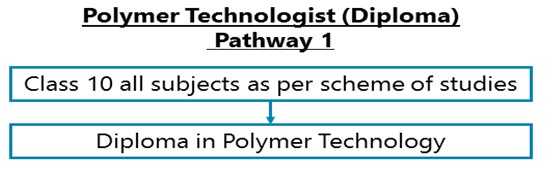
After completing Class 10 all subjects as per scheme of studies, you can do a Diploma in Polymer Technology or Plastic Technology or similar from any Polytechnic college or an equivalent institute. Diploma is a 3-year course. Diploma may also be done as a sandwich course (3.5 years) or part-time (4 years). Sandwich courses have periods of industrial training in between.
Class 10 all subjects as per scheme of studies - training for ‘Plastic Technology’ or similar trades at an ITI or similar institute – admission to 2nd year of Diploma in ‘Polymer Technology’
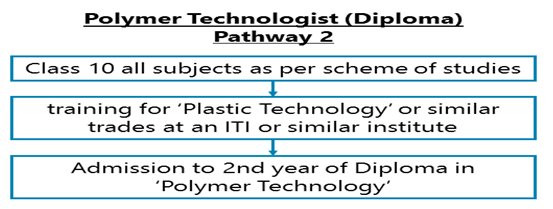
After completing Class 10 all subjects as per scheme of studies, you can go for training at any Industrial Training Institute (ITI), National Skill Training Institute (NSTI), Regional Vocational Training Institute (RVTI), National Vocational Training Institute (NVTI), Industrial Training Center (ITC) or other vocational institutes for ‘Plastic Processing Operator’, ‘Extrusion Machine Operator (Plastic)’, ‘Multi Skill Training Plastic Sector’ or similar trades. You will sit for All India Trade Test (AITT) to get a National Trade Certificate (NTC) after this course. This exam is held twice a year in the months of February and July. Then you can be admitted directly to the 2nd year of Polymer Technology or Plastic Technology Diploma or similar in Polytechnic colleges or equivalent institutions through lateral entry route. Minimum duration of the ITI training has to be 2 years.
Class 10 all subjects as per scheme of studies - Class 11-12 Physics, Chemistry, and Mathematics along with any other subject as per scheme of studies - admission to 2nd year of Diploma in ‘Polymer Technology’
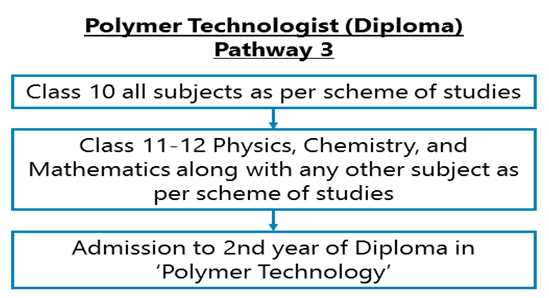
After completing Class 11-12 Physics, Chemistry, and Mathematics along with any other subject as per scheme of studies, you can be admitted directly to the 2nd year of Polymer Technology Diploma or Plastic Technology Diploma in Polytechnic colleges or equivalent institutions through lateral entry route.
Required Qualification & Competencies
After completing Class 10, you need to go for a Diploma course in Polymer Technology or Plastic Technology or similar specializations from any Polytechnic college or equivalent institutions located at a number of cities and towns across the country. These Diploma courses are output-oriented technical skill training programs with the objective of turning a student or non-worker to a professional.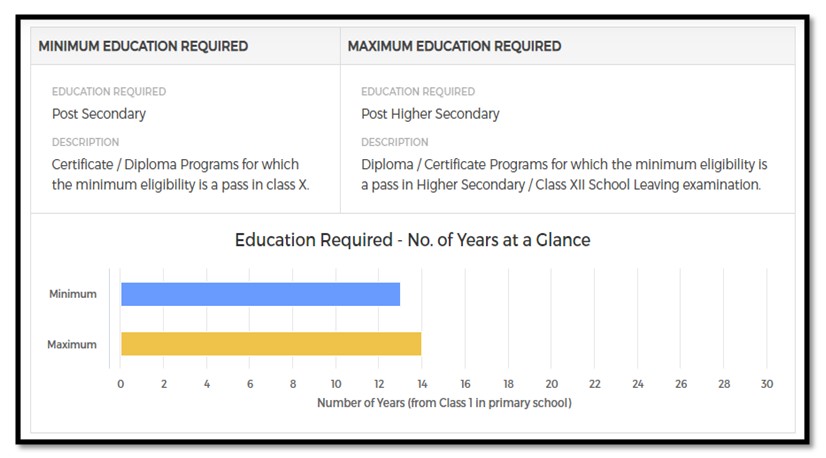
Competencies Required
1. You should have interests for Realistic Occupations. Realistic occupations involve more practical and hands-on activities than paperwork or office work. Realistic occupations often involve physical activities for getting things done using various tools and equipment.
2. You should have interests for Conventional Occupations. Conventional occupations involve repetitive and routine tasks as well as fixed processes or procedures for getting things done. These occupations involve working more with data, systems, and procedures and less with ideas or creativity.
3. You should have interests for Investigative Occupations. Investigative occupations involve working with ideas and quite a lot of thinking, often abstract or conceptual thinking. These involve learning about facts and figures; involve the use of data analysis, assessment of situations, decision making and problem-solving.
4. You should have knowledge of Production and Processing - raw materials, production machinery, production systems, production processes, quality control, and other techniques for manufacturing or construction and distribution of goods.
5. You should have knowledge of Engineering and Technology - various applications of one or more branches of Engineering Science & Technology to manufacture and produce various goods or construct or erect various structures. This includes knowledge about design, development, prototype testing, manufacturing, construction, installation, repair and maintenance.
5. You should have knowledge of Technical and Engineering Design - Knowledge of various techniques, methods, specifications and tools for designing, developing, testing, and evaluating integrated systems for managing industrial production processes, manufacturing plants, structures, and systems. This includes studying blueprints, drawing, and models.
6. You should have knowledge of Mechanical Engineering & Technology - Mechanical Engineering & Technologies which include design, development, testing, manufacturing, installation, operations, repair and maintenance of different machinery, devices, equipment and tools.
7. You should have knowledge of Mathematics - Knowledge of arithmetic, algebra, geometry, and other mathematical disciplines and their applications.
8. You should have Active Listening Skills - Giving full attention to what other people are saying, understanding the points being made by others, asking questions, etc.
9. You should have Critical Thinking Skills - analysis of complex situations, using logic and reasoning to understand the situations and take appropriate actions or make interpretations and inferences.
10. You should have complex Problem Solving Skills - analysis and understanding of problems, evaluating various options to solve the problems and using the best option to solve the problems.
11. You should have Judgment and Decision Making Skills - Skills in considering pros and cons of various decision alternatives; considering costs and benefits; taking appropriate and suitable decisions.
12. You should have Active Learning Skills - Focused and continuous learning from various sources of information, observation and otherwise for application in getting work done.
Career - Job Opportunities & Profiles
These are some of the industries that will require your services as a Polymer Technologist:
1. Chemicals / Petro Chemical / Plastic / Rubber
2. Printing / Packaging
3. Consumer Electronics / Appliances / Durables
4. Oil and Gas / Energy / Power / Infrastructure
5. Water Treatment / Waste Management
6. Ceramics / Sanitary ware
7. Architecture / Interior Design
8. Electricals / Switchgears
9. Textiles / Garments / Accessories
10. Construction / Engineering
11. FMCG / Foods / Beverage
Some of the companies which may hire a Polymer Technologist are: Reliance Industries Limited, Enplasin (Engineered Polymers India Pvt. Ltd.), LG Polymers India Pvt Ltd., Nilkamal Ltd, Safari Industries India Ltd., Next Polymers Ltd., etc.





Career Growth
You can certainly grow through job roles like Manager - Commodity Polymer Trade, Technical Service Engineer, Product Head, Project Manager, Chief Supervisor, Production Line Supervisor, Senior Manager - Polymer Packaging, Plant Head, Lead Engineer - Polymer etc.
Salary Offered
1. In the entry-level jobs: You may expect to get about Rs. 12,000.00 –20,000.00 a month or more.
2. Salaries increase with your work experience and as you get promoted.
3. After you’ve gained experience of 1-5 years you may expect Rs. 15,000.00 – 30,000.00 a month or more.
4. With 6-12 years of work experience, you may expect to get about Rs. 25,000.00 – 50,000.00 a month or more.
5. With 12-15 years of work experience, you may expect to get about Rs. 50,000.00 –70,000.00 a month or more.
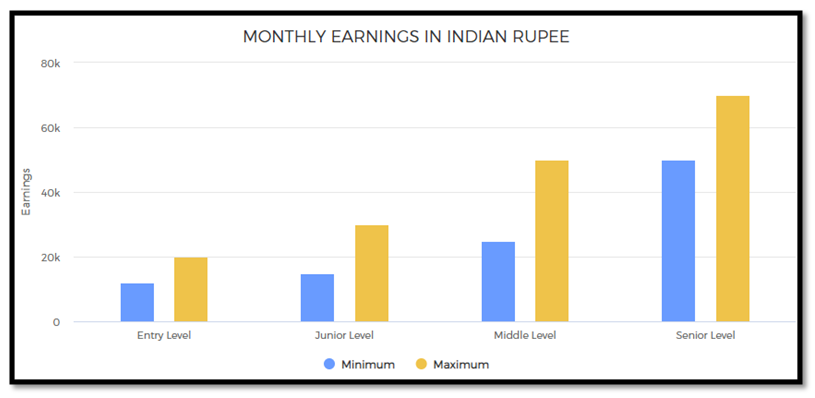
Monthly Earnings In Indian Rupee
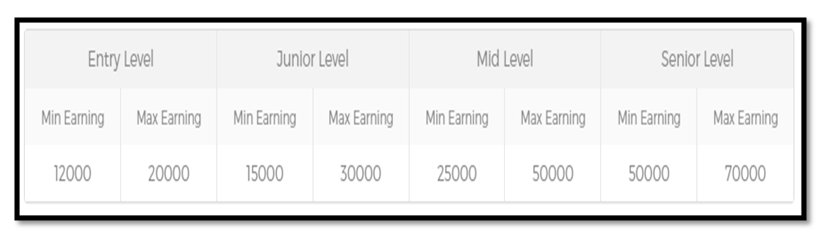
1. Entry level: 0 - 2 years of work experience
2. Junior Level: From 1 to 12 years of work experience
3. Mid Level: From 5 to 20+ years of work experience
4. Senior Level: From 10 to 25+ years of work experience (there could be exceptions in some high-end technical, financial, engineering, creative, management, sports, and other careers; also in the near future, people will reach these levels much faster in many careers and in some careers, these levels will have no meaning as those careers will be completely tech skill driven such as even now, there is almost no level in a Cyber Security Expert’s job)
Work Activities
1. Inspecting equipment, systems, structures, and materials - Inspecting equipment, systems, structures, and materials to ascertain quality, performance, defects, causes of errors, etc.
2. Identifying objects, actions, and events - Identifying various characteristics of objects; observing and understanding actions and events; understanding changes in actions and events.
3. Making decisions and solving problems - Analysis of data and information; evaluation of alternative decisions and results of decisions; taking the right decisions and solving problems.
4. Getting Information and learning - Observing, hearing, reading, using computers, or otherwise obtaining information and learning from it.
5. Managing and supervising - Managing and supervising work of others; setting goals; giving instructions; monitoring work performance, etc.
6. Monitoring use of resources - Monitoring and controlling use of resources like land and materials as well as spending of money.
7. Organising, planning and prioritising tasks - Planning and organising tasks in order to achieve work goals; prioritising tasks to achieve goals and making the best use of the time available.
8. Processing information - Searching, compiling, tabulating, calculating, auditing, verifying or otherwise dealing with information processing including data entry, transcription, recording, storing and maintaining databases.
9. Analyzing and interpreting data and information - Analysis of data and information to find facts, trends, reasons behind situations, etc.; interpretation of data to aid in decision making.
10. Updating and using relevant knowledge - Keeping updated with the latest knowledge relevant to your fields of work and use of the relevant knowledge in getting things done.
11. Communicating with co-workers and others - Communicating with people in writing, verbally or otherwise inside your workplace and various other people who have professional relationships with your place of work including vendors, government officials, etc. or with people at large.
12. Working in a team - Working in a team of people; developing team; maintaining professional relationships among team members.
Future Prospects
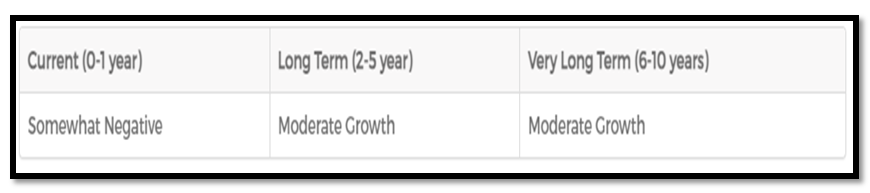
You can expect a moderately bright future in this field as the industry growth prospects are encouraging. Polymer consumption growth is expected to be around 10.4% with increasing urbanization which will reach 35%. Consumer Durables and Packaging Sector are among the key growing industrial domains. The manufacturing capacity addition in the ‘Thermoplastics’ space will be around 1700 kilo tones per annum (KTA). The Indian Plastic industry is emerging as one of the fastest growing global markets with a growth rate of 12%, plastics consumption of the country is expected to increase from the current 12 million metric tonnes per annum to 20 million metric tonnes per annum. To enhance sustainability, there is a movement towards recycling and reuse of plastic. The sectors like 3D printing, robotics, etc. are set to redefine polymer technology.
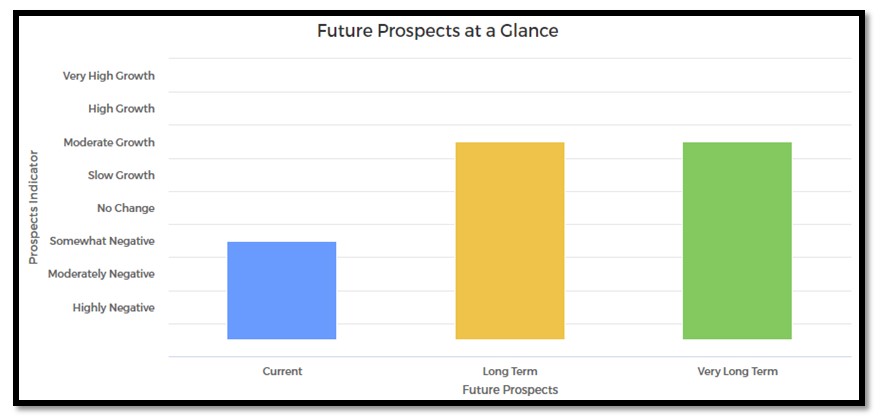
Future Prospects At A Glance