
Fisheries Scientist
Entry Level Qualification
Class Post Graduate
Career Fields
Education & Teaching
For Specially Abled


About Career
PARTICULARS | DESCRIPTION |
Name | Fisheries scientists |
Purpose | Overseeing Genetic Variations & Genetic Expression |
Career Field | Education & Teaching |
Required Entrance Exam | No Entrance Exam |
Average Salary | 150000 - 400000 Rs. Per Year |
Companies For You | Avanti Feeds Ltd, Apex Frozen Foods, Coastal Corp & Many More |
Who is Eligible | Graduate |
Fisheries scientists are involved in research and study of different species and types of fishes such as Katla (Indian Carp), Hilsa, Tilapia, Trout, Pomfret, Rawas (Indian Salmon), Bhetki (Barramundi), Bombay Duck, Bangda (Indian Mackerel), Magur, Pangus & Barali (Indian catfishes), Tiger Prawn, Tuna, Sardines, etc. Fisheries Scientist research and study about various aspects such as:
1. Fish biology including evolution and adaptation
2. How fishes interact with other fishes and other marine organism
3. Factors that influence growth and de-growth of fish population
4. Migration of fishes, which factors lead to migration, and how migration takes place
5. How pollution and contaminated water bodies affect fish life cycle
As a Fisheries Scientist, you will be involved in studying and analyzing the biology and life cycles of different species of fishes which breed in freshwater (that of rivers, lakes, ponds, etc.), saltwater (seawater), brackish water (mix of fresh and saltwater mostly found in estuaries and where a river meets a sea), fisheries (where fishes are farmed), etc. You will study fish habitats and the areas of water or seabed where fishes breed. You will study different technologies and methods used in breeding, harvesting, processing, and storing fishes.
You will research and study to find out ways to conserve fish population, especially the endangered species and species, the population of which are rapidly decreasing due to overharvesting or excessing fishing such as Atlantic Cod, Herring, and California’s Sardines. You will research, study, and implement methods to control/cure diseases among fishes. You will analyze fish larvae/eggs for research and develop methods to conserve fish populations in a balanced ecosystem.
Let us first get a brief understanding of what exactly is Fisheries Sciences?
Fisheries Sciences is an umbrella term under which all the disciplines of managing and understanding fisheries are associated. Some of these are – limnology, which is the study of inland waters (including freshwater and saline both); oceanography, which is the study of marine life and ecosystems; marine biology, which is the scientific study of marine life, and sea organisms; ecology, which is the scientific study of ecosystems, freshwater conservation, etc. All these are integrated together to study fisheries.
You can understand fisheries as the activity which involves harvesting of fishes and other aquatic organisms from the oceans, sea, or rivers (also called Capture Fisheries) or raising them in lakes or ponds (also called Aquaculture/ Culture fisheries).
What would a Fisheries Scientist research on and how?
Not only do scientists research the fishes, they conduct practical lab tests such as electrophoresis or other DNA identification technology to analyze the molecular phylogeny of aquaculture species. Molecular Phylogeny is the diversification of a species; it separates and divides different species and groups of fishes.
Electrophoresis is a process used in laboratories to separate macromolecules based on their size. This process is widely used in DNA, RNA or protein analysis.
As a Fisheries Scientist, you would also conduct experiments to identify the use of other aquatic organisms and resources for improving the health of fishes. For example you would extract substances from seaweeds such as kelps. These seaweeds are the multicellular marine algae which are essential for protecting and capturing carbon content. Scientists research and identify the benefits of extracting seaweeds and other marine organisms for aquatic resource management, feed processing etc. You would also use biotechnological tools such as molecular diagnostic methods, use of vaccines to identify and improve the disease resistance in fishes.
As a Fisheries Scientist you would study the nutritional requirements and the digestive enzymes of certain fishes such as carps and catfishes. These studies would focus on formulation of feeds (food for fishes) as well study various growth stages of fishes.
Key Roles and Responsibilities
As a Fisheries Scientist you will be engaged with one or more of the following roles and responsibilities:
1. You would perform routine diagnostic tests and experiments according to protocols.
2. You would design, set up, and execute experiments related to analysis of fisheries biology and fish technology.
3. You would be overseeing at genetic variations and gene expression in different species of fishes to determine how things are passed from one generation to another.
4. You would be involved in identifying the effect of pollutants on pre-harvest fish quality
5. You would be involved in developing new methods to diagnose and treat diseases in fishes and analyse the factors involved such as polluted or toxic water bodies etc.
6. You would also assist in the processing of different type of products using advanced technology in fish farming, harvesting, and spawning.
7. You would be responsible for ensuring effective and sustainable use of fishery resources and identify factors that are against it
8. You would be involved in the evaluation of quality standards of processing plants
9. You would also be involved in maintaining accurate and timely records of laboratory work.
10. You would also evaluate data, prepare technical reports and make scientific presentations of the experiments.
Career Entry Pathway
Class 10 all subjects as per scheme of studies – Class 11-12 Physics, Chemistry, and Biology along with any other subject as per scheme of studies – Bachelor’s degree in Fisheries Science (B.F.Sc.) or similar – Look for work opportunities in Fishery industries
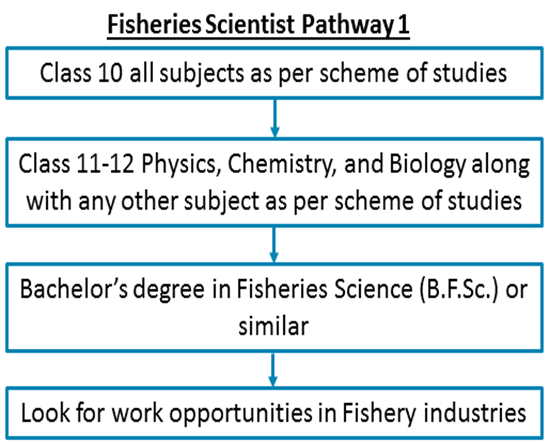
After completing Class 11-12 Physics, Chemistry, and Biology along with any other subject as per scheme of studies you can go for Bachelor’s degree in Zoology/ Biology/ Marine Biology / Similar subjects. After completing your B.F.Sc. you may start looking for a job in fishery industry and work as a Trainee.
Class 10 all subjects as per scheme of studies – Class 11-12 Physics, Chemistry, and Biology along with any other subject as per scheme of studies – Bachelor’s degree in Zoology/ Biology/ Marine Biology / Similar subjects – Master’s degree in Zoology/ Biology/ Marine Biology / Similar subjects – PhD in Fisheries Science or similar disciplin
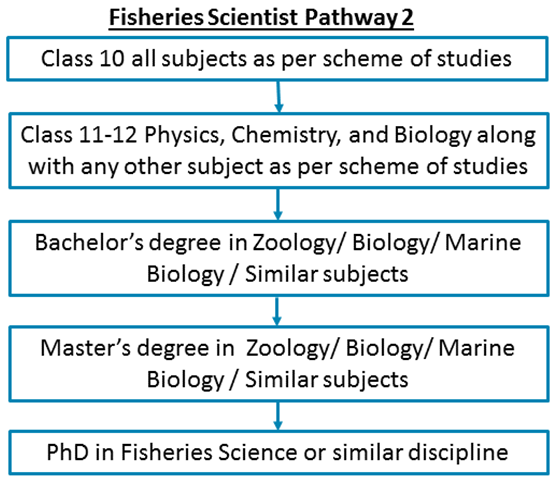
After completing Class 11-12 Physics, Chemistry, and Biology along with any other subject as per scheme of studies you can go for Bachelor’s degree in Zoology/ Biology/ Marine Biology / Similar subjects. After graduation you can then pursue a Master’s degree in Zoology/ Biology/ Marine Biology / Similar subjects followed by a PhD in Fisheries Science or similar discipline
Class 10 all subjects as per scheme of studies – Class 11-12 Physics, Chemistry, and Biology along with any other subject as per scheme of studies – Bachelor’s degree in Fisheries Sciences (B.F.Sc.) / similar – Masters in Fisheries Sciences (M.F.Sc.) in Fisheries Science/ Industrial Fisheries/ Mari culture/ Marine Biology/ Coastal Aquaculture/ Aquatic Biology and Fisheries/ Aquaculture/ Aquaculture and Fishery Microbiology/ Applied Fisheries and Aquaculture/ Fish Processing Technology and Aquaculture or similar discipline – PhD in Fisheries Sciences or similar discipline
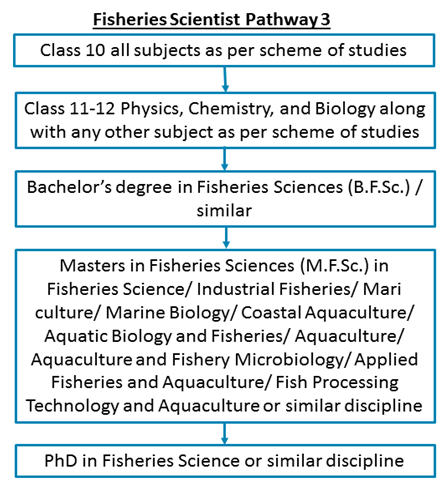
After completing Class 11-12 Physics, Chemistry, and Biology along with any other subject as per scheme of studies you can go for a Bachelor’s degree in Fisheries Sciences (B.F.Sc.) / similar. After graduation you need to pursue a Masters in Fisheries Sciences (M.F.Sc.) in Fisheries Science/ Industrial Fisheries/ Mari culture/ Marine Biology/ Coastal Aquaculture/ Aquatic Biology and Fisheries/ Aquaculture/ Aquaculture and Fishery Microbiology/ Applied Fisheries and Aquaculture/ Fish Processing Technology and Aquaculture or similar discipline followed by a PhD in Fisheries Sciences or similar discipline
Class 10 all subjects as per scheme of studies – Class 11-12 Physics, Chemistry, and Biology along with any other subject as per scheme of studies – B.F.Sc – Apply for and qualify State Public Service Commission examination - Become Inspector of Fisheries/ Fisheries Officer/ Assistant Fisheries Department Officer (AFDO) etc. – Work in State Fisheries Development Corporation/ Fish Farmers Development Agency (FFDA) or similar govt. agencies for few years – M.F.Sc – PhD in Fisheries Sciences
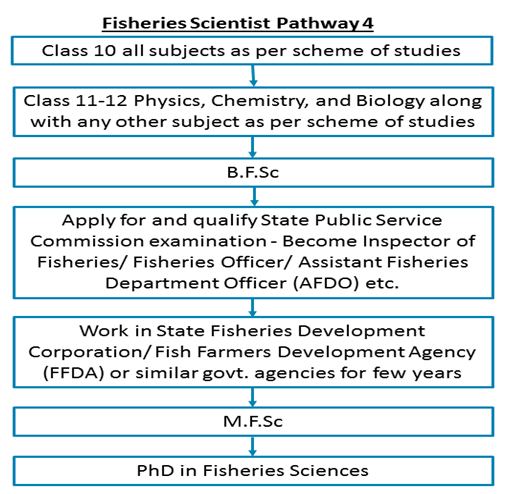
After completing Class 11-12 Physics, Chemistry, and Biology along with any other subject as per scheme of studies you can go for B.F.Sc. After graduation you can apply for and qualify State Public Service Commission* for the post of Inspector of Fisheries/ Fisheries Officer/ Assistant Fisheries Department Officer (AFDO) etc. After clearing the examination you can start working in State Fisheries Development Corporation/ Fish Farmers Development Agency (FFDA) or similar govt. agencies for few years. If you want to study further and pursue research in your field, you need to go for a degree in M.F.Sc followed by a PhD in Fisheries Sciences. *State Public Service Commission examination takes place in several states such as Tamil Nadu, West Bengal, Karnataka, etc. for the posts of Fisheries Officer/Inspector of Fisheries etc. in the Fisheries Department for various states.
Class 10 all subjects as per scheme of studies – Class 11-12 Physics, Chemistry, and Biology along with any other subject as per scheme of studies – B.F.Sc – M.F.Sc – Apply for and qualify ICAR NET Examination conducted by Agriculture Scientists Recruitment Board (ASRB) – Work as Assistant Professor/Lecturer in State Agricultural Universities (SAUs) or Agricultural Universities (AUs) – PhD in Fisheries Sciences – Work as a Fisheries Scientist
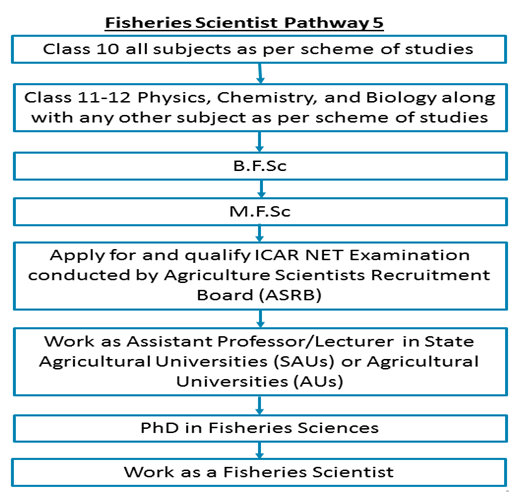
This pathway is for those students who wish to work in academic institutes as Assistant Professor/Lecturer. After completing Class 11-12 Physics, Chemistry, and Biology along with any other subject as per scheme of studies, you can go for graduation in B.F.Sc i.e. Bachelors in Fisheries Science followed by a Masters in the same discipline i.e. M.F.Sc. After completing graduation and post-graduation you need to apply for and qualify ICAR NET Examination conducted by Agriculture Scientists Recruitment Board (ASRB). You can start working as an Assistant Professor/Lecturer in State Agricultural Universities. If you wish to research further in Fisheries Sciences and want to become a Scientist, then you need to pursue a PhD in Fisheries Sciences or similar scientific discipline. Agricultural Scientist Recruitment Board (ASRB) conducts an All India Competitive Exam known as ICAR NET. The exam is conducted for the candidates who wish to apply for Assistant Professor/Lecturer in State Agricultural Universities/ Agricultural Universities.
Class 10 all subjects as per scheme of studies – Class 11-12 Physics, Chemistry, and Biology along with any other subject as per scheme of studies - Bachelor’s degree in Fishery Science/Marine Biology/Zoology/Life Science/Botany or similar field - Apply for Young Professional I at Central Marine Fisheries Research Institute (CMFRI) - Work as a Researcher at CMFRI
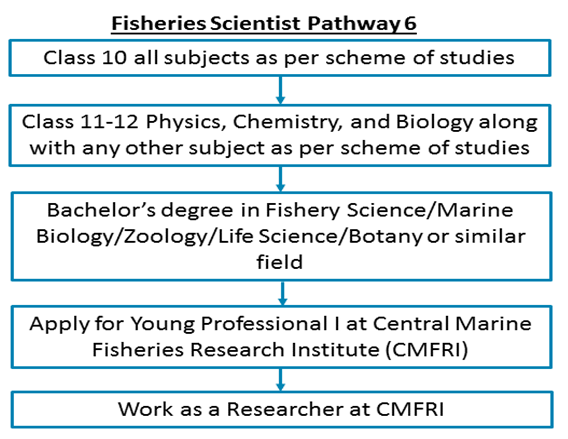
This pathway is for those graduates who wish to work as researcher at Central Marine Fisheries Research Institute. After completing Class 11-12 Physics, Chemistry, and Biology along with any other subject as per scheme of studies you must go for a Bachelor’s degree in Fishery Science/Marine Biology/Zoology/Life Science/Botany or similar field. After completing your bachelor’s degree you can apply for the post of Young Professional I at Central Marine Fisheries Research Institute under ICAR. You would initially work at the Research Centre of ICAR-CMFRI, Chennai, with monthly emoluments of Rs.15, 000 per month. You would also be required to undertake on-board cruises along north Tamil Nadu coast for data collection and analysis.
Class 10 all subjects as per scheme of studies – Class 11-12 Physics, Chemistry, and Biology along with any other subject as per scheme of studies - Bachelor’s degree in Fishery Science/Marine Biology/Zoology/Life Science/Botany or similar field - Work for at least 2 years in relevant field – Apply for Young Professional II post at Central Marine Fisheries Research Institute (CMFRI) – Work as a Researcher at CMFRI
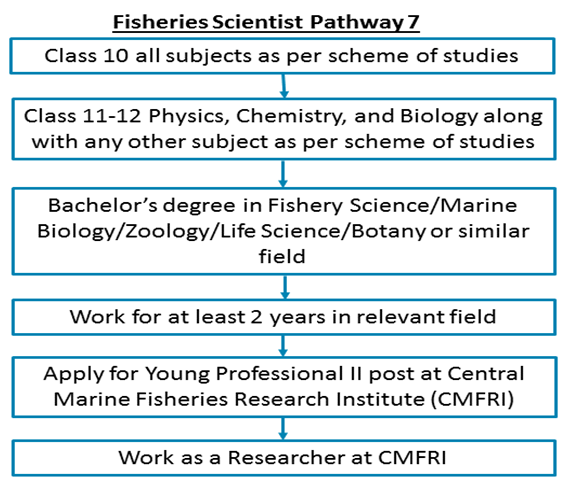
This pathway is for those graduates who wish to work as researcher at Central Marine Fisheries Research Institute and who have relevant experience in the industry. After completing Bachelor’s degree in Fisheries Science with 2 years’ experience in relevant field, you can apply for the post of Young Professional II (Fisheries). As a Young Professional II you would work at the research centre of ICAR- CMFRI, Chennai with monthly emoluments of Rs.25, 000 per month.
Required Qualification & Competencies
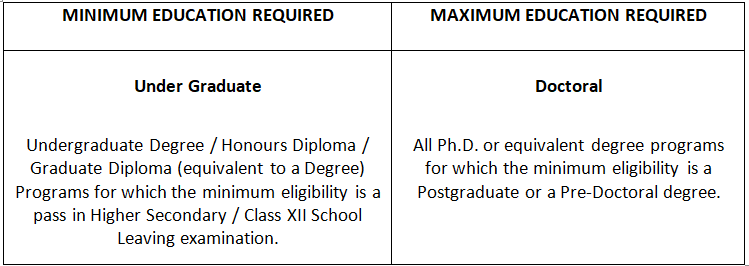
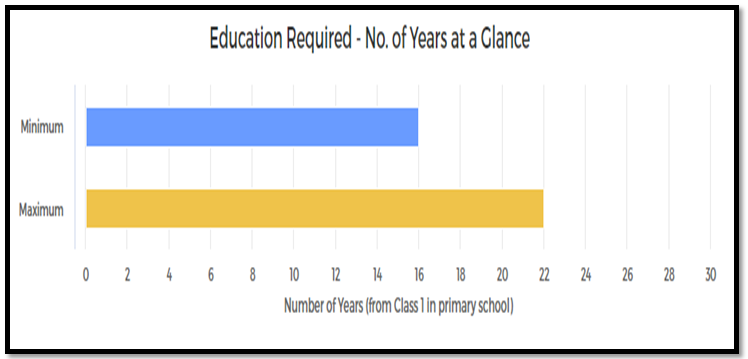
To become a Fisheries Scientist, you have to study in one or more of these fields during your Bachelor’s, Master’s or Doctoral level. Please note that you may not find courses in all these fields in the Bachelor’s, Master’s or Doctoral level:
1. Aquatic Biology and Fisheries
2. Biological Oceanography
3. Coastal Aquaculture and Marine
4. Fish Endocrinology
5. Fish Genetics and Biotechnology
6. Fish Processing Technology
7. Fish Product Technology
8. Fisheries Extension & Education
9. Fisheries Resource Management
10. Fishery Economics
11. Fishery Engineering
12. Fishery Microbiology
13. Fishery Science and Aquaculture
14. Fishery Sciences
15. Industrial Fisheries
16. Limnology and Fisheries
17. Marine Biology
18. Marine Biology and Fisheries
Compentencies Required
Interest
1. Investigative: You should have interests for Investigative Occupations. Investigative occupations involve working with ideas and quite a lot of thinking, often abstract or conceptual thinking. These involve learning about facts and figures; involve use of data analysis, assessment of situations, decision making and problem-solving.
2. Realistic: You should have interests for Realistic Occupations. Realistic occupations involve more practical and hands-on activities than paperwork or office work. Realistic occupations often involve physical activities for getting things done using various tools and equipment.
Knowledge
Biological Sciences: Knowledge of plants and animals, their anatomical structure, cell structure, tissues, physiological functions, evolution, and all other related aspects.
Skills
1. Active Learning: Focused and continuous learning from various sources of information, observation and otherwise for application in getting work done.
2. Coordination: Skills in working together with other people to get things done.
3. Critical Thinking: Skills in analysis of complex situations, using of logic and reasoning to understand the situations and take appropriate actions or make interpretations and inferences.
4. Judgment and Decision Making: Skills in considering pros and cons of various decision alternatives; considering costs and benefits; taking appropriate and suitable decisions.
5. Problem Solving: Skills in analysis and understanding of problems, evaluating various options to solve the problems and using the best option to solve the problems.
6. Reading Comprehension: Skills in understanding written sentences and paragraphs in work related documents.
7. Scientific: Skills in using various scientific rules and methods to get things done or solve problems.
Abilities
1. Deductive Reasoning: The ability to apply general rules and common logic to specific problems to produce answers that are logical and make sense. For example, understanding the reasons behind an event or a situation using general rules and common logic
2. Inductive Reasoning: The ability to combine pieces of information from various sources, concepts, and theories to form general rules or conclusions. For example, analysing various events or situations to come out with a set of rules or conclusions
3. Information Ordering: The ability to arrange things or actions in a certain order or pattern according to a specific rule or set of rules (e.g., patterns of numbers, letters, words, pictures, mathematical operations).
4. Oral Comprehension: The ability to listen to and understand information and ideas presented through spoken words and sentences.
5. Written Comprehension: The ability to read and understand information and ideas presented in writing.
6. Written Expression: The ability to communicate information and ideas in writing so others will understand
Personality
1. You are somewhat organised in your day-to-day life and activities.
2. You are somewhat careful about your actions and behavior.
3. You are imaginative sometimes.
4. You prefer to experience new things and have new experiences sometimes.
5. You act independently sometimes but do not do so in some other times.
6. You are always practical or in most situations.
Career - Job Opportunities & Profiles
As a Fisheries Scientist, you may find work in:
1. Research Institutes/Universities under Indian Council of Agricultural Research (ICAR) such as Central Marine Fisheries Research Institute, Central Inland Fisheries Research Institute, Central Institute of Fisheries Technology, Central Institute of Fisheries Education, National Bureau of Fish Genetic Resources, Central Institute of Freshwater Aquaculture, Central Institute of Brackishwater Aquaculture, Directorate of Coldwater Fisheries Research, etc.
2. Central &State Government agencies or corporations such as fisheries Survey of India (FSI), National Institute of Oceanography(NIO), Indian National Centre for Ocean and Information Services(INCOIS), etc.
3. Aquaculture firms, fish processing, seafood suppliers and marine export companies such as: Avanti Feeds Ltd, Apex Frozen Foods, Coastal Corp, Waterbase Ltd., Falcon Marine Exports ltd, Ananda Group, Indotech Marine, Netfish, Goldmarine Exports, BMR group, C Shore Foods, Jeelani Marine Products, Pearl Coast Marine Foods, etc.









After completing graduation or post-graduation in Fisheries Sciences you may find work as Inspector of Fisheries/Assistant Fisheries Development Officer (AFDO)/ Fisheries Extension Officer (FEO) and similar positions in Central & State Government agencies or corporations such as Marine Product Export Development Authority (MPEDA) Export Inspection Agency ( EIA), Coastal Aquaculture Authority of India (CAA), Food Safety and Standards Authority of India (FSSAI)&Fish Farmers Development Agency (FFDA), Brackish water Farmers Development Agency (BFDA), etc.
Specialisation Tracks In This Career
Fisheries Scientist (Marine)
Marine Fisheries Scientists are involved in the research and study of the marine fishes such as black pomfret, Indian mackerel, seer fish, little tunny, yellow fin tuna, etc. The study focuses on developing management advisories of important marine fish stocks, developing models and software’s for fish stock assessment statistical analysis of fishery data. They also study and develop information system for marine fisheries sustainability.
Fisheries Scientist (Inland)
Inland Fisheries Scientists are involved in the research and study of fishes such as Rohus, Mrigals, Catlas etc. These fishes are usually found in rivers, lakes, and other small water bodies. The study focuses on the breeding, spawning, harvesting and feed processing of these fishes.
Fish Biotechnologist
Fish Biotechnologists are involved in identifying ways to increase fish production by using modern biotechnologies. The study focuses on investigating fish genes in identifying natural fish growth factors, in enhancing the quality and quantity of fish reared in aquaculture.
Fisheries Scientist (Nutrition)
Fishery Nutrition Scientists are involved in the research and study of the composition of fish with a focus on nutritional value. The scientists specializing in this field study the proteins, vitamins, minerals, etc. found in fish which are water and fat soluble and also play a significant role in human nutrition; bio-molecules present in fishes such as peptides, collagen, and squalene etc.
Fisheries Scientist (Aquaculture)
Aquaculture Fisheries Scientists are involved in the study and research of how the processes of breeding, rearing and harvesting of fishes and other organisms takes place and how these processes can be made to increase the quality of fisheries production and improve resource management.
Fisheries Scientist (Mariculture)
Mariculture Fisheries Scientists are involved in the research and study of marine organisms for food and other nutritional sea products. The study focuses on developing ways to ensure high quality farming of marine fishes for food products like finfish, prawns or oysters and non-food products like jewellery or cosmetics.
Fisheries Scientist (Aquatic Animal Health)
Scientists specialising in Aquatic Animal Health are involved in studying and identifying threats to the aquatic animals form infections and diseases. The study focuses on identifying the impact of various infectious diseases which may be caused by pathogens such as viruses, bacteria, fungi, protozoa and parasites.
Fisheries Scientist (Fish Processing)
Scientists specialising in Fish Processing are involved in the study and research of fish and fish products and how the final products are used for commercial purposes starting from catching/harvesting/breeding of fishes. The research is conducted to study the various processes ranging from fish harvesting till the final commercial use.
Fisheries Scientist (Fishery Resource Management)
Scientists specialising in Fishery Resource Management are involved in identifying ways to protect fishery resources. The study focuses on gathering information, analysing and decision-making in regards to govern fisheries activities to ensure efficient fish productivity.
Career Growth
After completing master’s you would start working as a Research Associate.
After Research Associate you will grow as Senior Research Associate. There is no scope of growth unless you complete PhD. In some government agencies/corporations you may work as Fisheries Development Officer or Inspector of Fisheries.
Research Associate – Senior Research Associate
After completing Masters, you may also join as a Junior Research Fellow and then become a Senior Research Fellow
Junior Research Fellow – Senior Research Fellow
If you want to work in the field of scientific research in institutes or universities, you may progress as:
Scientist – Senior Scientist – Principal Scientist – Project Director - Chief Scientist
If you want to work in the field of teaching at university/institutions, you may progress as:
Assistant Professor – Associate Professor – Professor – Dean/ Director
In aquaculture and fish processing industry, you may grow as
Trainee – Assistant Manager (Fisheries) or for a specific function such as Aquaculture/ Processing/ Export, etc. or Fisheries Officer or Project Officer, etc. – Manager/ Senior Officer / Senior Project Officer, etc. – Deputy General Manager – General Manager and so on.
Salary Offered
1. As a Trainee at Entry Level (after completing B.F.Sc. or similar degree) you would earn around 12,000-20,000 per month
2. At a Junior Level (after completing M.F.Sc.) with 2-3 years of experience, you may earn around Rs.15,000-25,000 per month
3. At Mid-level with an experience of around 8-12 years, you may earn around Rs.25, 000 – 90,000 per month
4. At senior-level with an experience of around 15-25 years, you may earn around Rs.60,000 – 2,50,000 per month
5. As a Research Associate, (after completing M.F.Sc.) you may get a stipend of around Rs.15,000 – 20,000 per month
6. As a Junior Research Fellow (after completing master’s degree) you may get a stipend of around Rs.25, 000 – 30, 000 per month
7. As a Senior Research Fellow (after 1-2 years of experience as Junior Research Fellow) you may get around Rs.35, 000 per month
8. As a Post-Doctoral Fellow (after completing PhD) you may get around Rs.40,000 – 45,000 per month
9. As a Scientist, you will earn around Rs.84, 074 to Rs.98, 970 per month.
10. As a Senior Scientist, you will earn around Rs.1, 12, 004 to Rs.1, 65, 869 per month.
11. As a Principal Scientist, you will earn around Rs.1, 98, 986 to Rs.2, 45, 669 per month.
12. As a Project Director (in most institutes of ICAR), you will earn around Rs.2, 50, 000 to Rs.2, 88,894
13. As a Chief Scientist, you will earn around Rs.2, 72,003 to Rs.3,05,652 per month.
If you begin your career in teaching and research
1. As an Assistant Professor Grade-II: Rs.67, 700 Rs.1, 03, 881 per month.
2. As an Assistant Professor Grade I: Rs.1, 01, 500 to Rs.2, 04, 700 per month.
3. As an Associate Professor, you will earn around Rs.1, 39, 600 to Rs.2, 11, 300 per month.
4. As a Professor, you will earn around Rs.1, 44, 200 to Rs.2, 24, 100 per month.
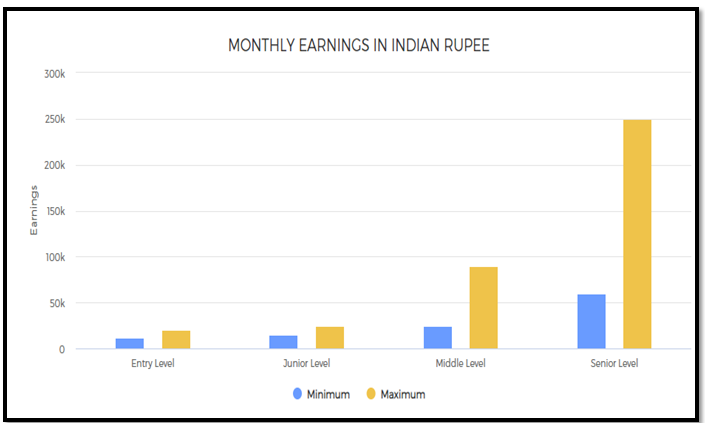
Monthly Earnings In Indian Rupee
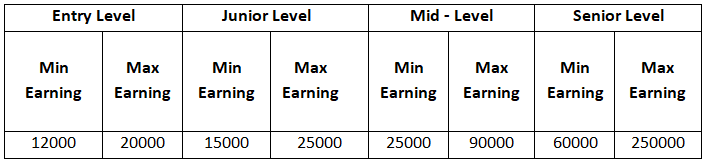
1. Entry level: 0 - 2 years of work experience
2. Junior Level: From 1 to 12 years of work experience
3. Mid Level: From 5 to 20+ years of work experience
4. Senior Level: From 10 to 25+ years of work experience (there could be exceptions in some high-end technical, financial, engineering, creative, management, sports, and other careers; also in the near future, people will reach these levels much faster in many careers and in some careers, these levels will have no meaning as those careers will be completely tech skill driven such as even now, there is almost no level in a Cyber Security Expert’s job)
Work Activities
1. Communicating with co-workers and others: Communicating with people in writing, verbally or otherwise inside your workplace and various other people who have professional relationships with your place of work including vendors, government officials, etc. or with people at large.
2. Decision making and problem-solving: Analysis of data and information; evaluation of alternative decisions and results of decisions; taking the right decisions and solving problems.
3. Getting Information and learning: Observing, hearing, reading, using computers, or otherwise obtaining information and learning from it.
4. Inspecting situations, events, and people: Inspecting situations, events and people to understand the reasons and causes for the situation or events to happen; inspecting people to understand reasons behind their behaviour and actions.
5. Organising, planning and prioritising tasks: Planning and organising tasks in order to achieve work goals; prioritising tasks to achieve goals and making the best use of the time available.
6. Providing advices and consultation to others: Giving advices or consultation to others about various issues, conceptual matters, know-hows, scientific matters, products or services.
7. Updating and using relevant knowledge: Keeping updated with the latest knowledge relevant to your fields of work and use of the relevant knowledge in getting things done.
8. Using computers for work: Using computers for day-to-day office work; using computer software for various applications in day-to-day professional work; entering data and process information; for writing.
9. Working in a team: Working in a team of people; developing team; maintaining professional relationships among team members.
Future Prospects
According to National Fisheries Development Board, India is the 3rd largest fish producing country in the world. It contributes about 7% to the global fish production. It is estimated that around 14 million people are engaged in fisheries and related activities and a total of US$ 6.80 billion marine products were exported in the Fiscal. The total fish production was estimated to be around 12.60 metric tonnes. An approximate number of 50 different types of fish and shellfish products are being exported to more than 70 countries in the world. The fish production is expected to increase in the coming years. Therefore a career in Fisheries would be in demand in the future as well.
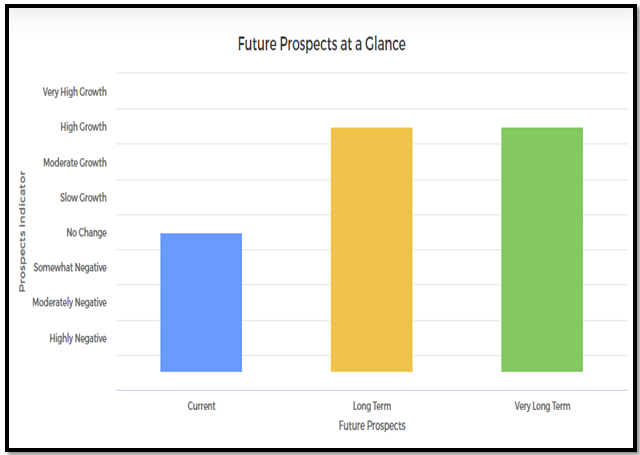
Future Prospects At a Glance
