
Electronics & Communication Engineer
Entry Level Qualification
Class 12
Career Fields
Engineering & Technology
For Specially Abled


Career Entrance Exam
OJEE, TRIPURA JEE, COMEDK, CUSAT, JEE MAIN BE/BTECH, GATE, BITSAT PG, BITSAT PHD, NMIMS CET, TANCET MTECH/MARCH, MHTCET, WBJEE, KEAM, GUJCET
About Career
Electronic & Communication Engineers research, develop, design, and test various electrical and electronic components as well as electronic and communication equipment, devices and systems. They design electronic circuits or microprocessors (called IC or Integrated Circuits and PCBA or Printed Circuit Board Assembly) that run all the electronic equipment and devices right from the mobile phones and the computers to the television sets and automated washing machines.
It is almost impossible to imagine our world today without Electronics. Apart from the mobile phones, computers, television sets, and washing machines, there is a humongous range of products that we use in our day-to-day life and industrial production. We communicate using our mobile phones through GSM (Global System for Mobile) or CDMA (Code Division Multiple Access) protocols that work on telecommunication networks which consists of various infrastructure, hardware and software such as satellites, routers, signal receivers, signal emitters, switches, system operating software, and so on.
PARTICULARS | DESCRIPTION |
Name | Electronic & Communication Engineers |
Purpose | Analyze, Design and Construct Power Electronics, Electric Drives |
Career Field | Engineering & Technology |
Required Entrance Exam | No Entrance Exam |
Average Salary | 3,00,000 - 10,00,000 Rs. Per Year |
Companies For You | Dell, Microsoft, Dell EMC, HP, SanDisk & Many More |
Who is Eligible | Post Graduate |
Key Roles and Responsibilities
As an Electronics & Communication Engineer / Designer / Researcher, you will be engaged with one or more of the following roles and responsibilities:
1. You will draw engineering schematics, sketches or specifications for constructing, relocating, or installing electrical & electronic equipment, facilities, products, or systems.
2. You will analyze, design and construct electrical & electronic circuit layouts and manage design projects (from planning to completion) that requires design of digital control systems, telecommunication networks, photonic integrated circuits (PICs), linear controllers, power electronics, electric drives, semiconductor devices, image processors, or involves cross-cutting technologies in Machine / Computer vision, signals and communications, such as MIMO technology etc.
3. You will develop concepts, design, architecture and prototypes; you will test, debug, and validate digital / analog electronics systems designed for a specific purpose or a function or a set of functions.
4. You may have to use your computing and engineering mathematics skills as well as knowledge of extended C and assembly language programming techniques, the design and testing of microprocessor systems, the application of differential equations and linear algebra to describe complex engineering systems.
5. You will generate documentation containing distinct information about product development, confidential descriptions or specifications of hardware or software, product costs, or information about product performance weaknesses or other details.
6. You will use analytical or scientific software such as Dassault System’s CATIA, Mentor Graphics PADS, Xilinx Integrated Software Environment ISE and designing tools such as AnsoftSimplorer, Synopsys Saber, The MathWorks MATLAB, Visual Numerics PV-WAVE (all these are run on high end computers); you may also use component oriented development software such as C++, Java, Dot Net, Python etc.
7. You will use various instruments for testing such as oscilloscopes, high voltage probes, thermocouples and current clamps.
8. You will recommend design modifications to or repair of electronics components and systems, based on various factors such as service, cost, environment, or system capabilities.
9. You will collaborate with product development team, materials procurement team, fabrication team and others to ensure that designs are made as per standards and specifications.
Career Entry Pathway
Class 10 all subjects as per scheme of studies – Class 11-12 Physics, Chemistry, Mathematics along with any other subject as per scheme of studies – Undergraduate degree in Electrical and Electronics Engineering, Electronics & Communication Engineering or similar.
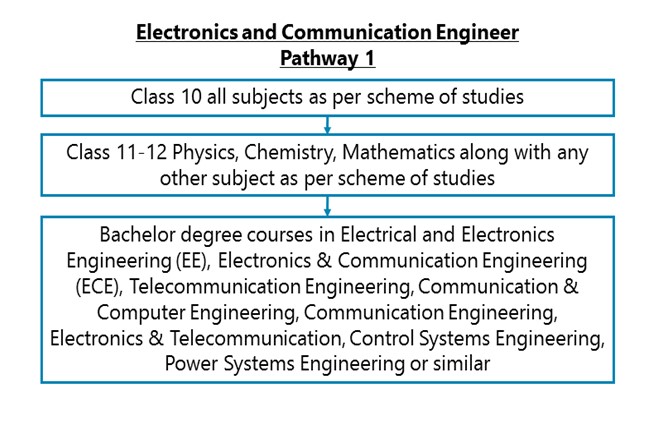
After completing Class 11-12 Physics, Chemistry, Mathematics along with any other subject as per scheme of studies, you can go for a B. Tech (Bachelor of Technology) / BE or B Eng (Bachelor of Engineering) / BSc (Hons) / or BSEE (Bachelor of Science in Electrical Engineering) / AMIE or similar Bachelor degree courses in Electrical and Electronics Engineering (EE), Electronics & Communication Engineering (ECE), Telecommunication Engineering, Communication & Computer Engineering, Communication Engineering, Electronics & Telecommunication, Control Systems Engineering, Power Systems engineering or similar. AMIE (Associate Member of Institution of Engineers) is a B. Tech level examination in engineering, for non-formal engineering education, conducted by Institution of Engineers of India (IEI), the largest multidisciplinary body of engineers in the country, and is recognized as equivalent to B.E/B.Tech.
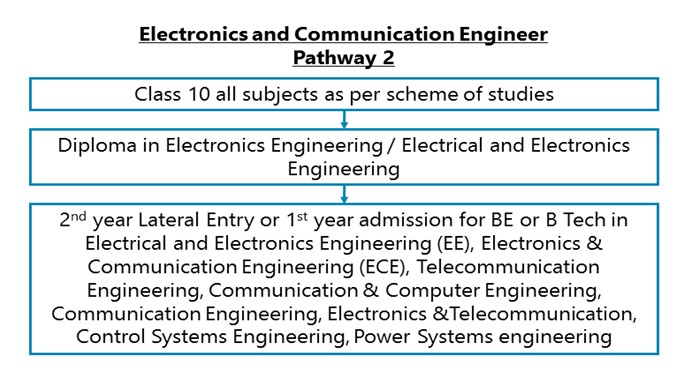
After completing Class 10 all subjects as per scheme of studies, you can go for a Diploma in Electronics Engineering / Electrical and Electronics Engineering. Then you may get a lateral entry (direct entry into 2nd year) in BE or B Tech in Electrical and Electronics Engineering (EE), Electronics & Communication Engineering (ECE), Telecommunication Engineering, Communication & Computer Engineering, Communication Engineering, Electronics &Telecommunication, Control Systems Engineering, Power Systems engineering or similar. You may also take admission to 1st year of Engineering degrees in case lateral entry is not an option for some colleges. You may also go for AMIE exams. AMIE (Associate Member of Institution of Engineers) is a B. Tech level examination in engineering conducted by Institution of Engineers of India (IEI) and is recognized as equivalent to B.E/B.Tech. Diploma students have an edge over Class 11-12 students in this case and must study fewer subjects during AMIE course.
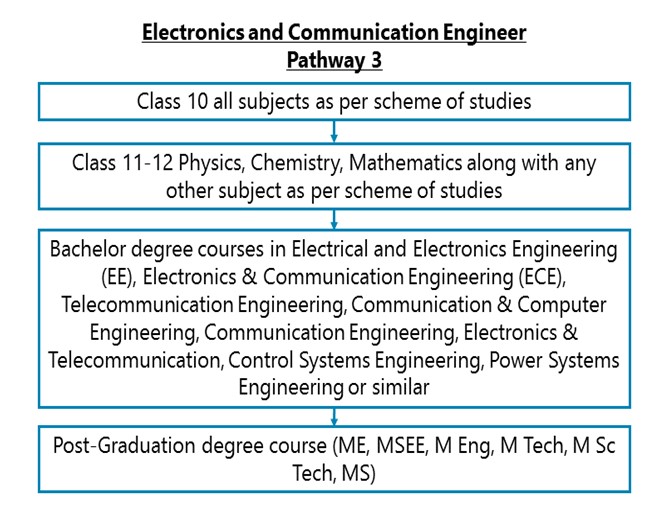
After completing Class 11-12 Physics, Chemistry, Mathematics along with any other subject as per scheme of studies, you can go for a B. Tech (Bachelor of Technology) / BE or B Eng (Bachelor of Engineering) / or BSEE (Bachelor of Science in Electrical Engineering) / B Sc (Hons) / AMIE or similar Bachelor degree courses in Electrical and Electronics Engineering (EE), Electronics & Communication Engineering (ECE), Telecommunication Engineering, Communication & Computer Engineering, Communication Engineering, Electronics & Telecommunication, Control Systems Engineering, Power Systems engineering or similar. Then you can go for a Post-Graduation degree course (ME, MSEE, M Eng, M Tech, M Sc Tech, MS) in Electrical and Electronics Engineering (EE), Electronics & Communication Engineering (ECE), Telecommunication Engineering, Communication and Computer Engineering, Systems Engineering, Control Engineering, Communication Engineering, Electronics & Telecommunication, power engineering or similar.
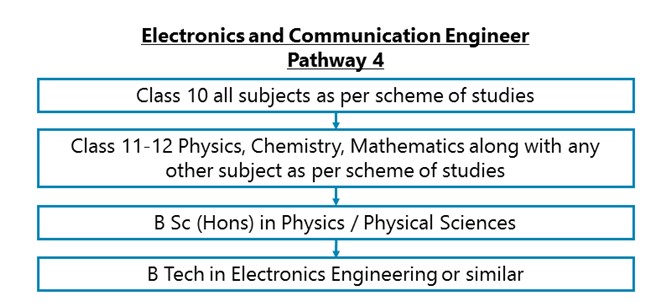
After completing Class 11-12 Physics, Chemistry, Mathematics along with any other subject as per scheme of studies, you can go for a B Sc (Hons) in Physics. Then get directly enrolled for B Tech in Electronics Engineering or similar. This pathway is offered by select universities in India such as the University of Calcutta.
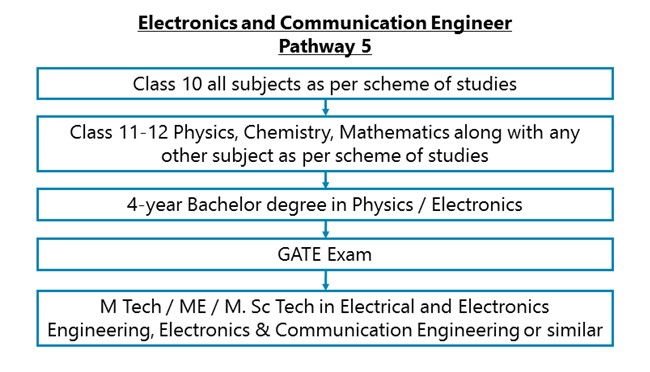
After completing Class 11-12 Physics, Chemistry, Mathematics along with any other subject as per scheme of studies, you can go for a 4- year Bachelor’s or Integrated Master’s degree courses in Physics / Electronics. Then appear for GATE Exam to get enrolled in M Tech or ME or M. Sc Tech in Electrical and Electronics Engineering (EE), Electronics & Communication Engineering (ECE), Telecommunication Engineering, Communication and Computer Engineering, Communication Engineering, Electronics & Telecommunication or similar.
Required Qualification & Competencies
You can study for a Bachelor’s / Master’s / Doctoral degree in any of the following fields (Note that all these fields may not offer you a degree at all three levels, that is in Bachelor’s, Master’s and Doctoral. Some fields may offer a degree only at the Master’s or at the Doctoral level):
1. Electronics & Communication Engineering
2. Electrical and Electronics Engineering
3. Communication Engineering
4. Electronic Systems & Devices
5. Electronics
6. Electronics & Instrumentation
7. Electronics and Biomedical Engineering
8. Electronics and Computer Engineering
9. Telecommunication Engineering
10. Electrical and Electronics Engineering
11. Communication and Computer Engineering
12. Fibre optics and Optical Communication
13. Power Electronics
14. Communications Networks and Signals
15. Communications Systems
16. Optical Communications Networks
17. RF and Microwave Engineering
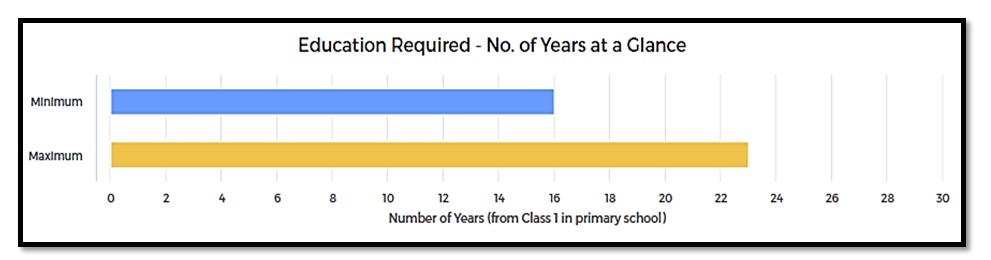
MINIMUM EDUCATION REQUIRED | MAXIMUM EDUCATION REQUIRED |
Under Graduate Undergraduate Degree / Honours Diploma / Graduate Diploma (equivalent to a Degree) Programs for which the minimum eligibility is a pass in Higher Secondary / Class XII School Leaving examination. | Post-Doctoral Post Ph.D. programs for which the minimum eligibility is a Doctoral degree. |
Competencies Required
Interests
1. You should have interests for Investigative Occupations. Investigative occupations involve working with ideas and quite a lot of thinking, often abstract or conceptual thinking. These involve learning about facts and figures; involve use of data analysis, assessment of situations, decision making and problem solving.
2. You should have interests for Realistic Occupations. Realistic occupations involve more practical and hands-on activities than paperwork or office work. Realistic occupations often involve physical activities for getting things done using various tools and equipment.
3. You should have interests for Enterprising Occupations. You should have interests for Enterprising Occupations. Enterprising occupations involve taking initiatives, initiating actions, and planning to achieve goals, often business goals. These involve gathering resources and leading people to get things done. These require decision making, risk taking and action orientation.
Knowledge
1. You may need knowledge of Electrical and Electronics - Knowledge of circuit boards, processors, chips, electronic system design, electronic equipment, electrical equipment and appliances, electrical power generation, etc.
2. You should have knowledge of Telecommunication and Networking - Knowledge about telecommunication network, telecommunication technologies, network management and operations of various equipment and systems for transmission and broadcasting.
3. You should have knowledge of Computers–for using computers for various technical and academic purposes.
4. You should have knowledge of Engineering and Technology - design, development, prototype testing, manufacturing, construction, installation, repair and maintenance of electrical and electronics equipment. / systems.
5. You should have knowledge of Technical and Engineering Design - Knowledge of various techniques, methods, specifications and tools for creating, developing and laying out designs of various machines, equipment, devices, structures, systems and processes. This includes developing blueprints, drawing and models.
6. You should have knowledge of analytical or scientific software such as Dassault System’s CATIA, Mentor Graphics PADS, Xilinx Integrated Software Environment ISE and designing tools such as AnsoftSimplorer, Synopsys Saber, The MathWorks MATLAB, Visual Numerics PV-WAVE (all these are run on high end computers); you may also use component oriented development software such as C++, Java, Dot Net, Python etc.
Skills
1. You should have Systems Analysis Skills - determining how a system should work and how changes in conditions, operations, or the environment will affect outcomes.
2. You should have Technical Skills - using various technologies and technical methods to get things done or solve problems.
3. You should have Systems Evaluation Skills - identifying measures or indicators of system performance and the actions needed to improve or correct performance, relative to the goals of the system.
4. You should have Technical Design and Drawing Skills - creating and developing designs and drawings for various structures, machines, equipment, and devices.
5. You should have Quality Control Analysis Skills - conducting tests and inspections of products, services, or processes to evaluate quality or performance.
6. You should have Critical Thinking skills- Skills in the analysis of complex situations, using logic and reasoning to understand the situations and take appropriate actions or make interpretations and inferences.
7. You should have Judgment and Decision Making Skills - considering pros and cons of various decision alternatives; considering costs and benefits; taking appropriate and suitable decisions.
8. You should have Problem Solving Skills - Skills in analysis and understanding of problems, evaluating various options to solve the problems and using the best option to solve the problems.
Ability
1. You should have Oral Comprehension Ability - listen to and understand information and ideas presented through spoken words and sentences.
2. You should have Oral Expression Ability - communicate information and ideas in speaking so others will understand.
3. You should have Deductive Reasoning Ability - apply general rules and common logic to specific problems to produce answers that are logical and make sense. For example, understanding the reasons behind an event or a situation using general rules and common logic.
4. You should have Problem Sensitivity - The ability to tell when something is wrong or is likely to go wrong. It does not involve solving the problem, only recognizing there is a problem.
5. You should have Inductive Reasoning Ability - The ability to combine pieces of information from various sources, concepts, and theories to form general rules or conclusions. For example, analyzing various events or situations to come out with a set of rules or conclusions.
Personality Traits
1. You are always imaginative or in most situations.
2. You are always or mostly care about your actions and behavior.
3. You are always or mostly disciplined in your action and behavior.
4. You are always calm or generally remain calm in most situations.
5. You can always act independently or could do so in most situations.
6. You always prefer to experience new things and have new experiences, or you mostly do.
Career - Job Opportunities & Profiles
After your Master’s degree, you may surpass internships and traineeships to directly get your first job as a:
1. Electronics Engineer
2. Physical Design Engineer
3. Evaluation Engineer
4. Process Engineer
5. Integrated Circuit Design Engineer (IC Design Engineer)
6. Product Test Engineer
7. Radio Frequency Engineer (RF Engineer)
8. Research and Development Engineer (R&D Engineer)
9. Analog / RF IC Designer
Some types of recruiting companies are:
1. Companies involved in designing and manufacturing various electronic and computer products such as Apple Inc., Dell, Microsoft, Dell EMC, HP, SanDisk, Micron Technologies, Honeywell, etc.






2. Companies which design and develop various electronic systems (such as microcontrollers) and devices for industrial clients such as NXP, Foxconn Technologies, Texas Instruments, Microchip Technologies, Silicon Labs, Cypress, Thales, Cadence Design, Rockwell Collins, Ametek, Analog Devices, Rockwell Automation, Synopsis, Valeo, TE Connectivity, etc.









3. Consumer and industrial electronics companies such as LG, Samsung, Sony, Toshiba, Honeywell, Panasonic, Hitachi, Fujitsu, Lenovo, etc.









4. Government Departments / Organizations / Authorities / Ministries such as ISRO, TRAI, NASA, Federal Communications Commission, CTIA – The Wireless Association, National Cable & Telecommunications Association, Ofcom etc.



5. Companies which design and produce microprocessors or semiconductor chips such as Intel, Qualcomm, Broadcom, Samsung, AMD, and Toshiba (remember that Silicon semiconductor chip production could be outsourced by these companies from a fabrication company such as Global Foundries, but these companies design the chips).



Specialisation Tracks In This Career
1. Electronics & Communication Engineer (Automotive Electronics)
Electronics Engineers design electronic and microelectronic systems for engine control units, radio, cooling system controls, braking systems, airbags, ignition systems, cabin entertainment devices, etc. used in ground vehicles such as consumer cars, trucks, motorcycles, off-road vehicles, forklifts, race cars, tractors, and excavators. This is one of the most popular sub-fields of employment among Electronics Engineers.
2. Electronics & Communication Engineer (Avionics)
Engineers specializing in aviation electronics, also known as avionics, deal with the electrical systems used by spacecraft and aircraft to maintain safe flight. Most functions in military craft, space shuttles, and commercial planes depend upon complex electronic systems which are composed of actuators, photonic circuits, sensors, display panels, and much more. A common example, in this case, would be fly-by-wire. A computing system reads sensor input and transmits that information electrically to the plane's actuators, which in turn control the plane's flight. This discards the need for pilot manually controlling a plane as it flies.
3. Electronics & Communication Engineer (Bioelectronics)
Bioelectronics is the application of electrical engineering principles to biology. Bio electromagnetics, instrumentation, neural networks, robotics, and sensor technologies are some of the exemplary disciplines within this field of practice. For an example, in food testing, a number of novel types of biosensors containing tissue, organelles, microorganisms, cell receptors, antibodies, enzymes, nucleic acids, etc. are being invented to detect the presence of pathogens or disease causing agents or any type of commercial adulterating agents such as “carrageenan” used especially widely in the dairy / meat industry as a thickening and glazing agent for chicken meat, frozen yoghurt etc. A 2019 invention by Malaysian scientists detects the content of this compound in food items by using double-stranded DNA.
4. Electronics & Communication Engineer (Biomedical Electronics)
Electronics Engineers design / build electronic systems employed in medical imaging devices, artificial body part replacements, biomedical sensors, treatment of disease, patient rehabilitation, and for improving health. For example, the glucose monitor is a portable device that allows diabetic patients to control and measure blood sugar levels. Similarly, Bioelectronic Implant Devices used to treat patients with chronic pain, epilepsy, deafness, Parkinson's, and blindness.
5. Electronics & Communication Engineer (Control Engineering)
This is a relatively new field of study. Electronic Controls Engineers measure/ test the output performances of electronic systems such as the cruise and sail controls in ships, fighter aircraft control, etc. Systems may also be designed to perform without requiring human input. These are called automatic control systems. Engineers basically test the feedbacks of a system. For example, in transport with cruise control, the vehicle's speed is continuously monitored and fed back to the system, which adjusts the motor's torque accordingly. Where there is regular feedback, control theory determines how the system responds to such feedback.
Career Growth
1. If you join as a Graduate Engineer Intern, then after completion of your training, you will be positioned as Electronics Systems Engineer / R&D Engineering / Product Development Engineer / Physical Design Engineer / Hardware Systems Engineer / Component Development Engineer / or similar positions. However, if you join after your Master’s degree, you can directly get a job as any one of these positions.
2. The next level of promotion will be to Senior Engineer level – as a Senior Test Engineer / Senior Project Engineer / Senior Product Development Engineer / Senior Hardware Systems Engineer / Manager - Hardware Development Engineering or similar.
3. After 5-7 years of experience, you can expect to become a Lead Engineer and after 12-15 years of experience, a Principal Systems Engineer / Or Chief Engineer / or Principal Lead Engineer.
4. Then after 15-20 years of experience, you may grow as a Vice President / Senior Vice President / President / Director of Programs - Product Development / Executive Director / Chief Executive Officer.
Salary Offered
1. After your Bachelor’s degree, as a Trainee Electronics Engineer, you may expect to make about Rs. 25,000 – 80,000 or even more a month. Higher salaries are paid to graduates from premier engineering institutions.
2. At the entry level jobs, after your Master’s degree in Engineering/Technology, depending upon the institution where you are graduating from, you may expect to get about Rs. 40,000 – 1,00,000 or even more a month.
3. In mid-level engineering jobs in India (after 8-10 years of post-graduation), you can expect to earn about Rs. 70,000 – 3,00,000 or even more a month.
4. In senior-level engineering jobs in India (after 15 years of post-graduation), you can expect to earn about Rs. 1,50,000 – 5,00,000 or even more a month.
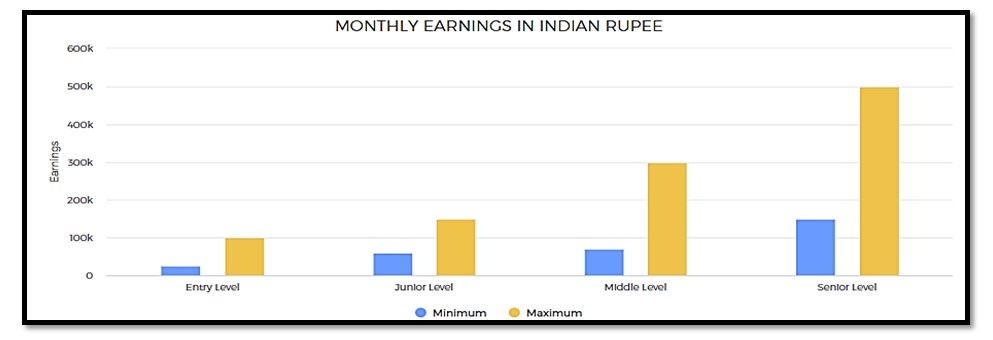
Monthly Earnings In Indian Rupee
Entry Level | Junior Level | Mid Level | Senior Level | ||||
Min Earning | Max Earning | Min Earning | Max Earning | Min Earning | Max Earning | Min Earning | Max Earning |
25000 | 100000 | 60000 | 150000 | 70000 | 300000 | 150000 | 500000 |
1. Entry level: 0 - 2 years of work experience
2. Junior Level: From 1 to 12 years of work experience
3. Mid Level: From 5 to 20+ years of work experience
4. Senior Level: From 10 to 25+ years of work experience (there could be exceptions in some high-end technical, financial, engineering, creative, management, sports, and other careers; also in the near future, people will reach these levels much faster in many careers and in some careers, these levels will have no meaning as those careers will be completely tech skill driven such as even now, there is almost no level in a Cyber Security Expert’s job)
Work Activities
1. Analysing and interpreting data and information - Analysis of data and information to find facts, trends, reasons behind situations, etc.; interpretation of data to aid in decision making.
2. Assessing and evaluating quality - Assessing and evaluating the quality of materials, systems, processes, products, services, etc.
3. Creative thinking - Developing new ideas, concepts, innovative solutions to problems, newer ways of getting things done, designing products and services, creating work of art and craft, etc.
4. Drawing, drafting, laying out and specifying objects, equipment, devices, tools, and systems - Creating and developing designs, drawings, layouts and specifications about how to construct, manufacture, assemble, build, use, and maintain various equipment, devices, tools, and systems.
5. Fabricating, assembling, and constructing equipment, devices and products - Fabricating, assembling, constructing or otherwise manufacturing products, equipment, devices and tools; testing and calibrating products, equipment, devices, tools and systems.
6. Getting Information and learning - Observing, hearing, reading, using computers, or otherwise obtaining information and learning from it.
7. Inspecting equipment, systems, structures, and materials - Inspecting equipment, systems, structures, and materials to ascertain quality, performance, defects, causes of errors, etc.
8. Making decisions and solving problems - Analysis of data and information; evaluation of alternative decisions and results of decisions; taking the right decisions and solving problems.
9. Monitoring processes, systems and performance - Observing and recording information on various criteria to monitor mechanical, electronics, electrical and other processes and systems; monitoring the progress of projects and tasks.
10. Organizing, planning and prioritizing tasks - Planning and organizing tasks in order to achieve work goals; prioritizing tasks to achieve goals and making the best use of the time available.
11. Processing Information - Compiling, tabulating, calculating, auditing, verifying or otherwise dealing with information processing including data entry, transcription, recording, storing and maintaining databases.
12. Strategic planning - Developing visions and goals, developing strategies and action plans for achieving visions and goals.
13. Updating and using relevant knowledge - Keeping updated with the latest knowledge relevant to your fields of work and use of the relevant knowledge in getting things done.
14. Using computers for work - Using computers for day-to-day office work; using computer software for various applications in day-to-day professional work; entering data and process information; for writing.
15. Working in a team - Working in a team of people; developing a team; maintaining professional relationships among team members.
Future Prospects
You can expect a bright future in this field as the industry growth prospects are encouraging. The evolution of smart technology (electronics & semiconductor based) has considerably changed the outlook in various industries like automotive, manufacturing, infrastructure, agriculture, healthcare, construction etc.
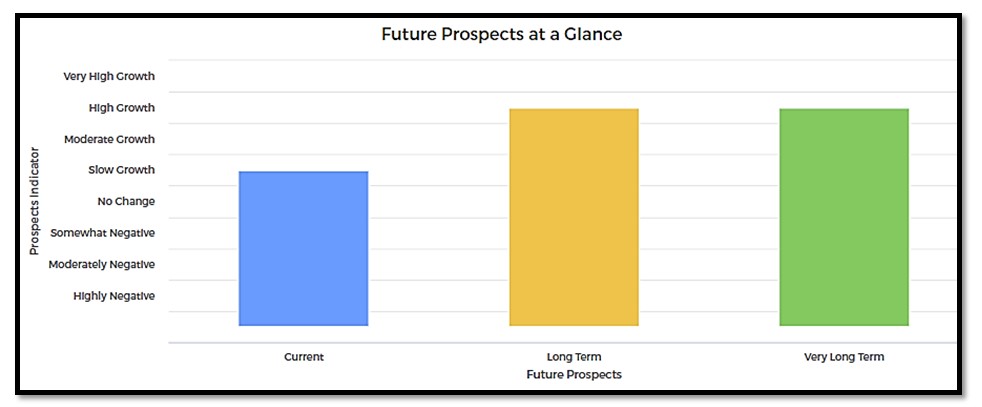
Future Prospects At A Glance
Current (0-1 year) | Long Term (2-5 year) | Very Long Term (6-10 years) |
Slow Growth | High Growth | High Growth |


