
Oceanographer
Entry Level Qualification
Class Post Graduate
Career Fields
Education & Teaching
For Specially Abled


Career Entrance Exam
About Career
Oceanographer is a scientist who studies the physical, chemical or biological aspects of the oceans.
As an Oceanographer, you will also study physical properties within the ocean boundaries. As an Oceanographer, you will work to predict monsoon, and its strength each year. You will study marine biology and help with conservation effects. Some of you will also be involved in environmental researches in the ocean including pollution and plastic problems and animals and lives affected by them.
PARTICULARS | DESCRIPTION |
Name | Oceanographer |
Purpose | working out at sea |
Career Field | Mathematics & Science |
Required Entrance Exam | No Entrance Exam |
Average Salary | 300000 - 500000 Rs. Per Year |
Companies For You | National Institute of Oceanographer, Research centres and laboratories & Many More |
Who is Eligible | Graduate |
Key roles and responsibilities
As an Oceanographer, depending on your field of specialisation, you would havethe following roles and responsibilities:
1. If you are working out at sea and in the field then you will often be involved in physical and risky research.
2. You will travel around the world and find places where you can go underneath to complete your research.
3. If you are a physical oceanographer then you will observe and collect data on temperature, waves, currents and tides.
4. If you are a chemical oceanographer, then you will collect data and evidence to find chemical properties of the ocean along with its environment.
5. If you are a geological oceanographer, then you will collect data and observation related to the ocean floor.
6. If you are working in laboratories, then you will plan your research and observe and analyse the data.
7. You will perform experiments to conclude more evidence on your data.
8. You will analyse the results of the research and write scientific findings.
9. You will share your research with the government, scientists, conservationist, public through a research paper, journals, news media, etc.
Career Entry Pathway
Class 10 all subjects as per scheme of studies– Class 11-12 Physics, Chemistry and Mathematics along with any other subject as per scheme of studies – UG in Marine Science/ Oceanography (Honours or specialisation in Physics is an advantage)
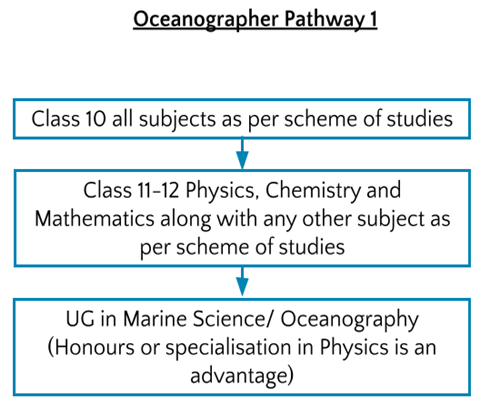
After your Class 10 all subjects as per scheme of studies pursue Class 11-12 Physics, Chemistry and Mathematics along with any other subject as per scheme of studies and then study for an undergraduate degree in Marine Science/ Oceanography (Honours or specialisation in Physics is an advantage).
Class 10 all subjects as per scheme of studies– Class 11-12 Physics, Chemistry, Biology and Mathematics along with any other subject as per scheme of studies-UG in Marine Science/ Oceanography/ Zoology/ Botany/ Chemistry/ Mathematics/ Earth Science/ Physics/ Geography/ similar field (Honours or specialisation in Physics is an advantage) – PG in Marine Science/ Oceanography
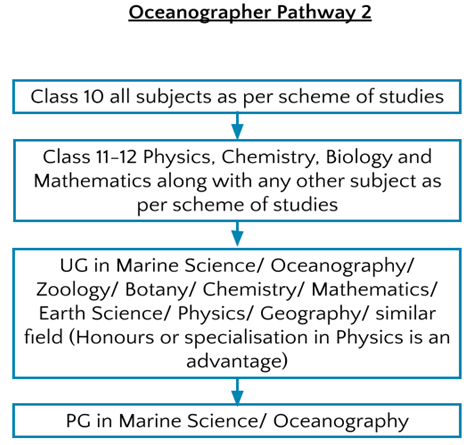
After your Class 10 all subjects as per scheme of studies pursue Class 11-12 Physics, Chemistry, Biology and Mathematics along with any other subject as per scheme of studies and then study for an undergraduate degree in Marine Science/ Oceanography/ Zoology/ Botany/ Chemistry/ Mathematics/ Earth Science/ Physics/ Geography/ similar field (Honours or specialisation in Physics is an advantage) followed by a master’s degree in Science stream in Marine Science/ Oceanography/ similar field.
Class 10 all subjects as per scheme of studies– Class 11-12 Physics, Chemistry, Biology and Mathematics along with any other subject as per scheme of studies– UG in Marine Science/ Oceanography/ Zoology/ Botany/ Chemistry/ Mathematics/ Earth Science/ Physics/ Geography/ similar field – PG in Oceanography/ Marine Science/ similar field – Ph.D. in Oceanography/ Marine Science/ similar field.
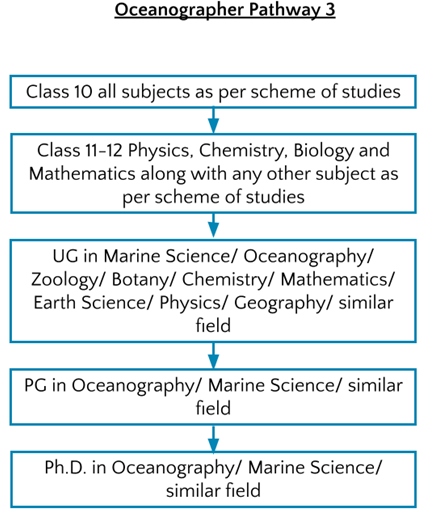
After your Class 10 all subjects as per scheme of studies pursue Class 11-12 Physics, Chemistry, Biology and Mathematics along with any other subject as per scheme of studies and then study for an undergraduate degree in Marine Science/ Oceanography/ Zoology/ Botany/ Chemistry/ Mathematics/ Earth Science/ Physics/ Geography/ similar field (Honours or specialisation in Physics is an advantage) followed by a master’s degree in Science stream in Marine Science/ Oceanography/ similar field. After a Master’s Degree, you can take a Ph.D. in Marine Science/ Oceanography/ similar field.
Class 10 all subjects as per scheme of studies– Class 11-12 Physics, Chemistry, Biology and Mathematics along with any other subject as per scheme of studies– UG in Marine Science/ Oceanography/ Zoology/ Botany/ Chemistry/ Mathematics/ Earth Science/ Physics/ Geography/ similar field – PG in Oceanography/ Marine Science/ similar field – Engineering in Oceanography
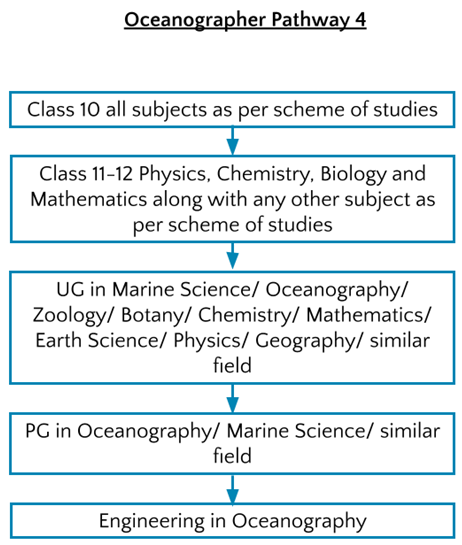
After your Class 10 all subjects as per scheme of studies pursue Class 11-12 Physics, Chemistry, Biology and Mathematics along with any other subject as per scheme of studies and then study for an undergraduate degree in Marine Science/ Oceanography/ Zoology/ Botany/ Chemistry/ Mathematics/ Earth Science/ Physics/ Geography/ similar field (Honours or specialisation in Physics is an advantage) followed by a master’s degree in Science stream in Marine Science/ Oceanography/ similar field. After a Master’s Degree, you can study for a Master’s of Engineering in Oceanography.
Required Qualification & Competencies
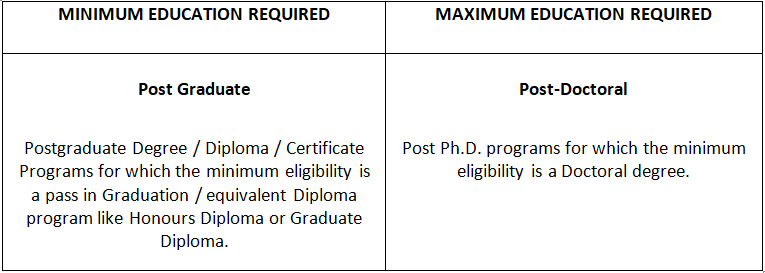
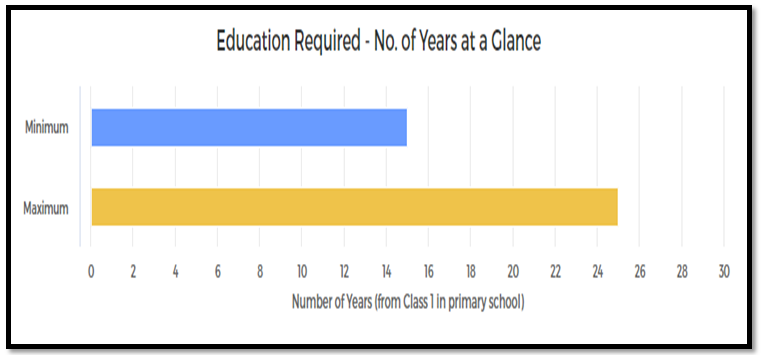
To become an Oceanographer, first you should have a basic degree in Natural Sciences (Physics, Chemical Sciences / Earth Sciences / Biological Sciences / Marine Sciences) or in Ocean Engineering/Civil Engineering/Geotechnical Engineering. Then you should opt for a Master’s degree.
To become an Oceanographer you must complete at least a Master’s Degree or a Ph.D. in any one of the following fields:
1. Biological Oceanography
2. Chemical Oceanography
3. Geological Oceanography
4. Ocean Sciences
5. Oceanography
6. Physical Oceanography
7. Ocean Engineering
Compentencies Required
Interests
1. Realistic: You should have interests for Realistic Occupations. Realistic occupations involve more practical and hands-on activities than paperwork or office work. Realistic occupations often involve physical activities for getting things done using various tools and equipment.
2. Investigative: You should have interests for Investigative Occupations. Investigative occupations involve working with ideas and quite a lot of thinking, often abstract or conceptual thinking. These involve learning about facts and figures; involve use of data analysis, assessment of situations, decision making and problem solving.
3. Conventional: You should have interests for Conventional Occupations. Conventional occupations involve repetitive and routine tasks as well as fixed processes or procedures for getting things done. These occupations involve working more with data, systems, and procedures and less with ideas or creativity.
Abilities
1. Abstract Reasoning: The ability to understand ideas which are not expressed in words or numbers; the ability to understand concepts which are not clearly expressed verbally or otherwise.
2. Category Flexibility: The ability to generate or use different sets of rules for combining or grouping things in different ways.
3. Deductive Reasoning: The ability to apply general rules and common logic to specific problems to produce answers that are logical and make sense. For example, understanding the reasons behind an event or a situation using general rules and common logic.
4. Flexibility of Closure: The ability to identify or detect a pattern (a figure, object, word, or sound) that is hidden among other distracting materials.
5. Fluency of Ideas: The ability to come up with a number of ideas about a topic (the number of ideas is important, not their quality, correctness, or creativity).
6. Inductive Reasoning: The ability to combine pieces of information from various sources, concepts, and theories to form general rules or conclusions. For example, analysing various events or situations to come out with a set of rules or conclusions.
7. Information Ordering: The ability to arrange things or actions in a certain order or pattern according to a specific rule or set of rules (e.g., patterns of numbers, letters, words, pictures, mathematical operations).
8. Mathematical Reasoning: The ability to choose the right mathematical methods or formulas to solve a problem.
9. Numerical Reasoning: The ability to add, subtract, multiply, divide, and perform other basic numerical calculations correctly.
10. Oral Comprehension: The ability to listen to and understand information and ideas presented through spoken words and sentences.
11. Oral Expression: The ability to communicate information and ideas in speaking so others will understand.
12. Verbal Reasoning: The ability to think and reason with words; the ability to reason out ideas expressed in words.
13. Written Comprehension: The ability to read and understand information and ideas presented in writing.
14. Written Expression: The ability to communicate information and ideas in writing so others will understand.
Knowledge
1. Chemical Science: Knowledge of the chemical composition, structure, and properties of substances and of the chemical processes and transformations that they undergo. This includes uses of chemicals and their interactions, toxicity, production techniques, and disposal methods.
2. Mathematics: Knowledge of arithmetic, algebra, geometry, calculus, trigonometry, statistics, and other mathematical disciplines and their applications.
3. Physical Science: Knowledge of physical principles, laws, their interrelationships, and applications to understand fluid, material, earth, ocean, atmosphere, and space dynamics, as well as mechanical, electrical, atomic and sub- atomic structures, properties and processes.
Skills
1. Active Learning: Focused and continuous learning from various sources of information, observation and otherwise for application in getting work done.
2. Critical Thinking: Skills in analysis of complex situations, using of logic and reasoning to understand the situations and take appropriate actions or make interpretations and inferences.
3. Judgment and Decision Making: Skills in considering pros and cons of various decision alternatives; considering costs and benefits; taking appropriate and suitable decisions.
4. Problem Solving: Skills in analysis and understanding of problems, evaluating various options to solve the problems and using the best option to solve the problems.
5. Reading Comprehension: Skills in understanding written sentences and paragraphs in work related documents.
6. Scientific: Skills in using various scientific rules and methods to get things done or solve problems.
7. Technical: Skills in using various technologies and technical methods to get things done or solve problems.
Personality
1. You are somewhat organised in your day-to-day life and activities.
2. You are somewhat careful about your actions and behaviour.
3. You are somewhat disciplined in your action and behaviour.
4. You trust others sometimes but not always.
5. You are helpful to others sometimes.
6. You remain calm in difficult situations sometimes but some other times you are anxious.
7. Sometimes you feel secure in your surroundings and situations but some other times you don't.
8. You prefer to experience new things and have new experiences sometimes.
9. You act independently sometimes but do not do so in some other times.
10. You are always practical or in most situations.
Career - Job Opportunities & Profiles
Most of the universities and college will hire you as a professor at the position of Junior Professor or Assistant Professor. If you are into research, then you will be hired at the position of research associate.
1. Research laboratories will hire you as a scientist/scientist officer with the lowest grade “C” or Project Assistant.
2. Private Industries will hire you are as Research Scientist, Technical Consultant, etc.
3. NGOs and Environmental companies will hire you as an Assistant Oceanographer.
You can find job opportunities at the following facilities:
1. National research institutes like National Institute of Oceanographer.
2. Institutes of scientific learning like IISc, IIA, RRI, TIFR, etc.
3. Oceanography department of colleges and Universities.
4. Research centres and laboratories.
5. Environmental Organizations and NGOs.
6. Ocean Instrumentation and manufacturing companies.
Work Environment
You would be required to spend most of your working time in laboratories or under the ocean. In labs, you will be working on the research on the material or evidence that you have collected underwater or on theoretical researches. Your work in labs will be full time with regular work hours. You might work with other researches and scientists. However underwater, there will be no working hours and you will work as long as you have the physical capacity and you have completed your part of the research. Sometimes, you will work for hours underwater in different regions of the world under different conditions.
Specialisation Tracks In This Career
Biological Oceanographer
Biological Oceanographer is an expert who specialises in the study of process in the ocean that control the productive of marine life. They study the ecology of marine lives in ocean along with the physical, chemical and ecological environment of marine animals.
Chemical Oceanographer
Chemical Oceanographer is an expert who specialises in the study of chemistry in the ocean. They study the seawater properties, chemical elements in ocean, etc. and their effect on the climates especially through the cyclones.
Geological Oceanographer
Geological Oceanographer is an expert who studies the geology of the ocean floor. As ocean floor is made of different tectonic plates, they also study the movement of tectonic plates.
Physical Oceanographer
Physical Oceanographer is an expert who studies the physical properties and attributes of the ocean like ocean currents, surface waves, surface tides, currents, etc.
Career Growth
1. The career growth in university and college states from Assistant Professor and then Associate Professor, Professor and Professor Emeritus. Professors can also get administrative positions such as Director/Dean/Vice Chancellor, etc
2. If you are hired as a research associate, then you will go on to become a Doctoral Research Fellow, then Post-Doctoral Research Fellow and then Scientist in Progressive Grades.
3. Research laboratories will hire you as a scientist/scientist officer with the lowest grade and the grade changes from low to high. In India, grades are “Scientist “C” as the joining level and then D, E, F, G, H, etc. A senior level scientist can also get into administrative positions like Principal Scientist, Assistant Director, Deputy Director, Director, etc
4. If you join a private organisation as a research scientist, then you will move to senior research scientist and principal scientist with work experience.
Salary Offered
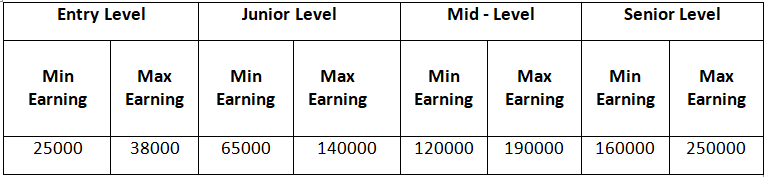
1. At the entry level, you can join as a research associate with a basic salary of Rs. 25,000 to 30,000. As a doctoral research fellow (junior research fellow) you would be earning around Rs. 35,000 to 38,000 per month. At the entry level, as a Scientist (grade C) you would be earning around Rs. 80,000 to 100,000 per month. As an assistant professor, you would be earning anything between Rs. 65,000 to 70,000 per month. As an assistant Oceanographer, you will be earning anything between Rs. 25,000 to 60,000 per month.
2. At the junior level with a work experience of 2-6 years, you would be earning anything between 1, 20, 000 to 1,40,000 per month.
3. At the middle level with an experience of 10-12 years, you would be earning anything between 1, 40,000 to 1, 90,000 per month as a scientist and 1, 20,000 to 1,60,000 as an associate professor.
4. At the senior level of over 15 years of work experience, you would be earning anything between 1, 60,000 to 2, 50,000 per month as a professor and 2,10,000 to 2,50,000 per month as a Scientist.
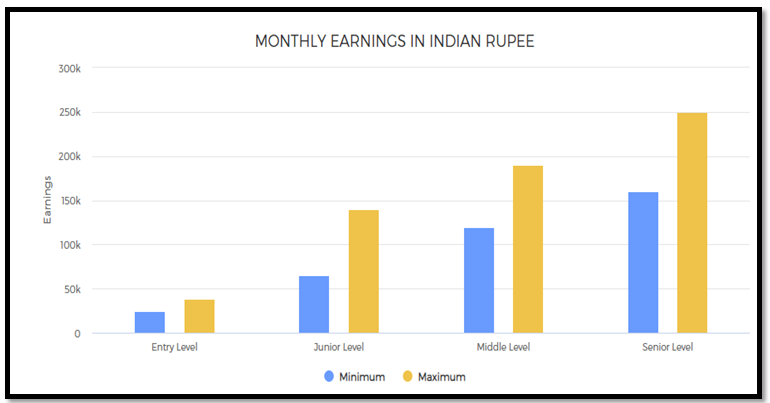
Monthly Earnings In Indian Rupee
Work Activities
1. Analysing and interpreting data and information: Analysis of data and information to find facts, trends, reasons behind situations, etc.; interpretation of data to aid in decision making.
2. Calculating and computing: Calculating or computing using various mathematical formula and functions using computers or otherwise; doing financial or commercial calculations or computations.
3. Communicating with co-workers and others: Communicating with people in writing, verbally or otherwise inside your workplace and various other people who have professional relationships with your place of work including vendors, government officials, etc. or with people at large.
4. Decision making and problem solving: Analysis of data and information; evaluation of alternative decisions and results of decisions; taking the right decisions and solving problems.
5. Getting Information and learning: Observing, hearing, reading, using computers, or otherwise obtaining information and learning from it.
6. Identifying objects, actions, and events: Identifying various characteristics of objects; observing and understanding actions and events; understanding changes in actions and events.
7. Inspecting equipment, systems, structures, and materials: Inspecting equipment, systems, structures, and materials to ascertain quality, performance, defects, causes of errors, etc.
8. Inspecting situations, events, and people: Inspecting situations, events and people to understand the reasons and causes for the situation or events to happen; inspecting people to understand reasons behind their behaviour and actions.
9. Providing advices and consultation to others: Giving advices or consultation to others about various issues, conceptual matters, know-hows, scientific matters, products or services.
10. Updating and using relevant knowledge: Keeping updated with the latest knowledge relevant to your fields of work and use of the relevant knowledge in getting things done.
11. Using computers for work: Using computers for day-to-day office work; using computer software for various applications in day-to-day professional work; entering data and process information; for writing.
12. Working in a team: developing and maintaining professional relationships among team members. team: Working in a team of people.
Future Prospects
Oceanographer is a scientific career and most of the jobs are in teaching, government research agencies, and NGOs and environmental agencies. Most of these career options have moderate growth as it is a niche subject so education-related careers are limited. Similarly, government jobs (research and scientific) are not based on market demand and thus they are constant. Environment jobs are mostly depending on funds provided for research and thus again has limited growth capacity. Overall, you should enter this career if you have a passion to work in this field. If you have it, then you have a bring future. But remember that job opportunities are few and far between.
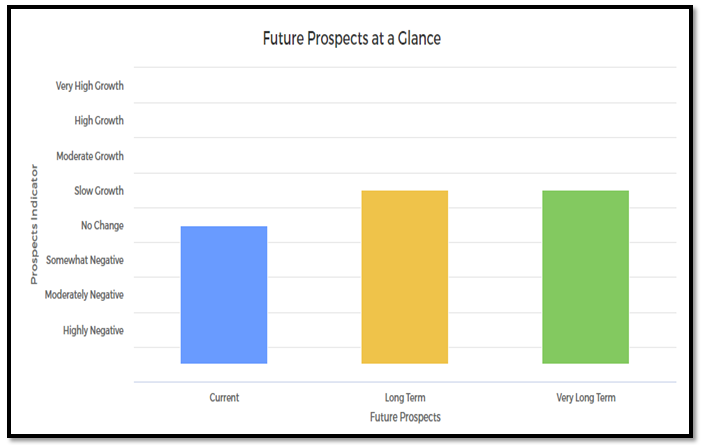
Future Prospects At a Glance
