

Supply Chain/Logistics Manager
Entry Level Qualification
Graduate
Career Fields
Business & Management
For Specially Abled


About Career
Supply Chain and Logistics Managers specialise in managing the flow of goods and services. As a Supply Chain/Logistics Manager, you will oversee the movement of raw material from suppliers and their storage locations to your company's warehouses, storage or factories. You will also manage dispatch of finished products from your company's production facility to distributors and finally to retailers (like shops, malls, etc.). You will ensure that raw materials are received and finished products are dispatched within the least cost possible and within a reasonable time.
Thus, you will work to ensure that the company you work for is never short of raw materials for production and the finished products reach customers efficiently. In cases where you company does not manufacture any finished products but trade in it, then your job will be to ensure that the products you intend to sell to end consumers are sourced in the right time with the least possible cost. You will manage warehousing and storage of the inventory of the products. Then you will manage the dispatch of the products to the end consumers.
Key roles and responsibilities
As a Supply Chain Manager, depending upon whether you work for large corporate conglomerates or for small town organizations, your duties and responsibilities will vary.
1. You will be managing the product life cycle from its design to its delivery to the final consumer. You will work on all the activities like purchasing, transportation, inventory, material requirements planning, warehousing, or receiving.
2. You will allocate material, supplies, and products to concerned teams.
3. You will develop a business relationship with both suppliers and consumers.
4. You will understand the client’s need and make sure they are met.
5. You will review logistics and identify the areas of improvement.
6. You will work on strategies that will bring the cost and time lower for transportation of goods.
7. You will understand the right number of equipment and staffing levels to load, unload, move, or store materials.
8. You will review all modes of transportation of goods along with routes and then decide the optimal route to minimize effort, time and money.
9. You will set performance measurement metrics to compare, evaluate all supply chain factors.
10. You will implement new methods and processes of the supply chain to improve efficiency.
PARTICULARS | DESCRIPTION |
Name | Supply Chain/Logistics Manager |
Purpose | Allocate Material, Supplies & Products |
Career Field | Business & Management |
Required Entrance Exam | No Entrance Exam |
Average Salary | 300000 - 1500000 Rs. Per Year |
Companies For You | Amazon, Flipkart, Snapdeal, & Many More |
Who is Eligible | Class 12th Pass |
Career Entry Pathway
Class 10 all subjects as per scheme of studies - Class 11-12 with any subject combination as per scheme of studies – UG in any discipline – PG in Business Administration / Business Management / Operations Management / Supply Chain Management and related subjects.
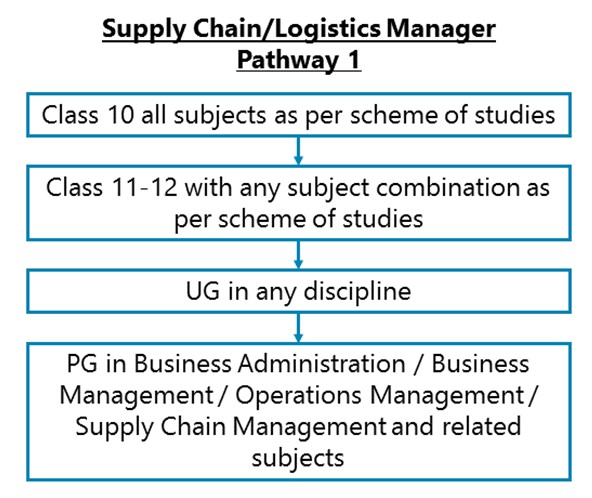
After your Class 11-12 with any subject combination as per scheme of studies in your higher secondary school and then study for an undergraduate degree in any discipline followed by a master’s degree in Business Administration / Business Management / Operations Management / Supply Chain Management and related subjects.
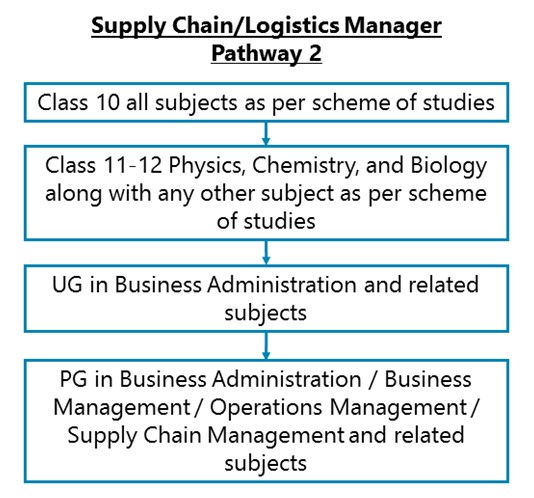
After your Class 11-12 with any subject combination as per scheme of studies in your higher secondary school and then study for an undergraduate degree in Business Administration followed by a master’s degree in Business Administration / Business Management / Operations Management / Supply Chain Management and related subjects. Although anyone can complete a Master’s Degree in Business Administration, having same at UG level helps.
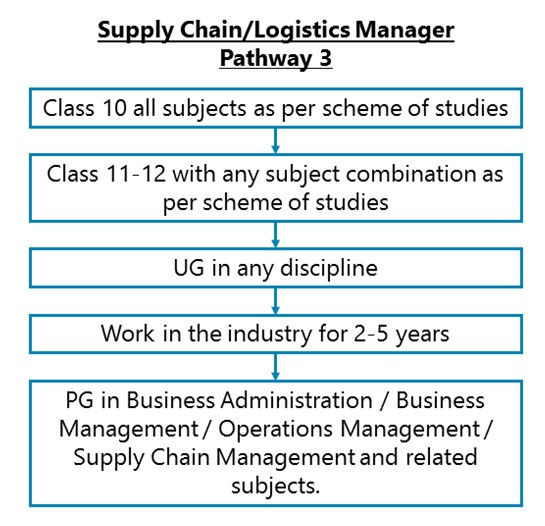
After your Class 11-12 with any subject combination as per scheme of studies in your higher secondary school and then study for an undergraduate degree in any discipline and then work in the industry for a few years. Now, you can join an Executive Master’s course in Business Administration / Business Management / Operations Management / Supply Chain Management and related subjects.
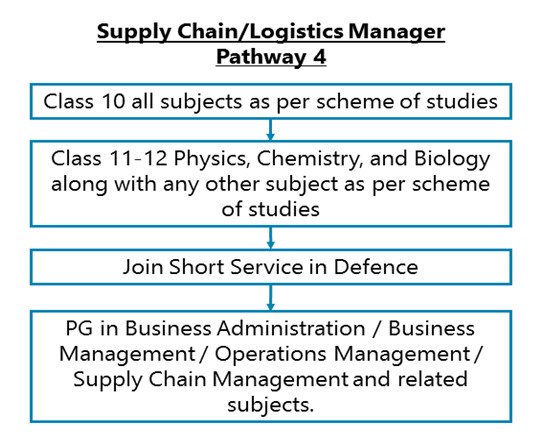
After your Class 11-12 with any subject combination as per scheme of studies in your higher secondary school and then join short service commission of Indian defence forces. You work for 10-14 years and then retire from Defence. Now you can complete your Executive PG in Business Administration / Business Management / Operations Management / Supply Chain Management and related subjects.
Required Qualification & Competencies
Undergraduate studies after school
1. To become a Supply Chain / Logistics Manager, you can take multiple pathways. You can study Business Management Business Administration in under graduation as B.B.A. or B.B.M.
2. You can also study Engineering by taking a course in B.E. or B.Tech.
3. Alternatively, you can study Supply Chain Management / Operations / Economics with any other subjects.
4. You can also study Science, Commerce, and Arts with any subjects in under graduation.
Post Graduate studies
1. After graduation, you can study Business Administration (M.B.A.) in Commercial Operations Management, Supply Chain Management, Commercial Shipping & Logistics, Business Support Operations Management, Food & Beverage Services Operations, Quality Management, Supply Chain Analytics, Supply Chain Finance, Foreign Trade, Inventory Management, Cargo Management, Freight Forwarding, International Trade Procedures, International Transportation & Logistics Management, Logistics, Logistics and Supply Chain Management, Materials Management, Port & Shipping Management (Business), Port Management, Purchase Management, Shipping Management etc.
2. Alternatively, you can also study 1 year or 2 year Post Graduate Programs Post Graduate Diplomas in Commercial Operations Management, Supply Chain Management, Commercial Shipping & Logistics, Business Support Operations Management, Food & Beverage Services Operations, Quality Management, Supply Chain Analytics, Supply Chain Finance, Foreign Trade, Inventory Management, etc.
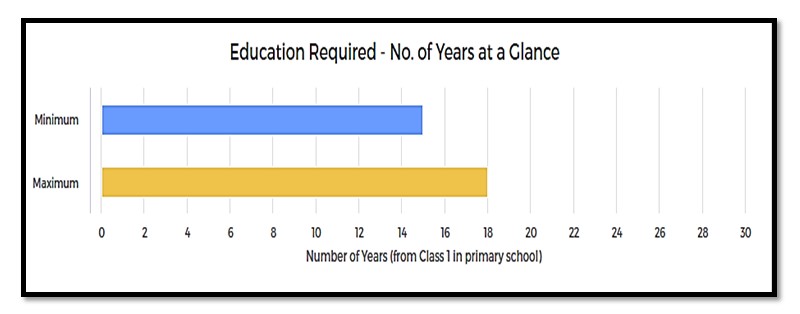
MINIMUM EDUCATION REQUIRED | MAXIMUM EDUCATION REQUIRED |
Under Graduate Undergraduate Degree / Honours Diploma / Graduate Diploma (equivalent to a Degree) Programs for which the minimum eligibility is a pass in Higher Secondary / Class XII School Leaving examination. | Post Graduate Postgraduate Degree / Diploma / Certificate Programs for which the minimum eligibility is a pass in Graduation / equivalent Diploma program like Honours Diploma or Graduate Diploma. |
Competencies Required
You should have the following occupational interests:
1. Enterprising: You should have interests for Enterprising Occupations. Enterprising occupations involve taking initiatives, initiating actions, and planning to achieve goals, often business goals. These involve gathering resources and leading people to get things done. These require decision making, risk-taking, and action orientation.
2. Conventional: You should have interests for Conventional Occupations. Conventional occupations involve repetitive and routine tasks as well as fixed processes or procedures for getting things done. These occupations involve working more with data, systems, and procedures and less with ideas or creativity.
Following personality attributes are required:
1. You always or mostly prefer to stick within a routine or carry out routine and repetitive activities.
2. You are always or mostly dependent on others or on set rules and procedures.
3. You are always practical or in most situations.
4. You are always or mostly disciplined in your action and behaviour.
5. You are always or mostly organised in your day-to-day life and activities.
You should have the following skills and knowledge:
1. Active Listening: Giving full attention to what other people are saying, understanding the points being made by others, asking questions, etc.
2. Coordination: Skills in working together with other people to get things done.
3. Reading Comprehension: Skills in understanding written sentences and paragraphs in work related documents.
4. Supervising: Skills in Supervising and monitoring the performance of others, businesses, and different projects.
5. Administration: Knowledge of various administrative and operational functions in managing a business or an organization such as general administration, facility management, front office management, back office management, etc.
6. Customer Service: Knowledge about how to provide customer services. This includes understanding customer needs, helping customers to use products and services, answering customer queries, handling customer complaints and grievances, and evaluating customer satisfaction.
7. Transportation: Knowledge of principles and methods for moving people or goods by air, rail, sea, river, or road, or otherwise, including the relative costs and benefits.
You should have the following aptitudes and abilities:
1. Oral Comprehension - The ability to listen to and understand information and ideas presented through spoken words and sentences.
2. Oran Expression - The ability to communicate information and ideas in speaking so others will understand.
3. Written Comprehension - The ability to read and understand information and ideas presented in writing.
4. Written Expression - The ability to communicate information and ideas in writing so others will understand.
5. Deductive Reasoning - The ability to apply general rules and common logic to specific problems to produce answers that are logical and make sense. For example, understanding the reasons behind an event or a situation using general rules and common logic.
Career - Job Opportunities & Profiles
1. If you start your career in warehouse operations, you can start as a Warehouse Assistant Manager.
2. You can start your career in the purchasing side of the business as Assistant Manager /Management Trainee (Purchase).
3. If you are into the quality control side, you can join the quality and control department as Management Trainee (Quality) or Quality Executive.
4. If you are into Supply Chain Consulting, then you may start as a Supply Chain Management Trainee.
5. In transportation (sea or air freight), you may start as Logistics Manager – Sea/ Air Exports.
You will get a career opportunity in the following types of organizations:
1. All leading online retail organization like Amazon, Flipkart, Snapdeal, etc.



2. All leading food delivery, gift delivery, flower delivery, and other delivery start-ups.
3. Logistics organizations like FedEx.
4. Air and Sea Freight transportation organizations
5. Warehousing organization.
6. Supply Chain Department of Car, mobile, electronic and electrical manufacturing companies like Hyundai, Suzuki, OPPO Mobile, Samsung, LG, etc.
7. Purchasing department of Hotels and Hotel chains, Hostels, Resorts like Taj Group, Oberoi Group, Zostel, etc.
Work Environment
As a Supply Chain Manager, you will be working in most of the industries. However, while as working in a Supply Chain Department of a Company, you might be only required to work in official hours and mostly from office, but if you are in logistics, transport, retail, and warehousing companies, you might be working sometime out of official work hours. You will also visit warehouses, vendors, etc. You might also travel out of the city to remote places. The job can be stressful as logistics is a fast-paced work. You need to schedule daily work and solve many logistics related problems.
Specialisation Tracks In This Career
1. Logistics Manager
Logistics Managers specialise in the efficient transportation of raw material from the source to warehouse/factory, etc. They ensure what kind of transportation to use to reduce cost and lower transportation time. They also take care of the transportation of everything they come in or goes out of the organization. As a logistics manager, you will manage any physical items like food, materials, animals, equipment, and liquids; as well as intangible items, such as time and information. You will manage inventory, packaging, transportation, warehousing and even security of products.
2. Materials Manager
Materials managers specialise in the planning of total material requirement. As a material manager, you will communicate with your supplier about the materials required. If you are searching for a new supplier, then you will ask for quotations from different suppliers and chose the best one. You will also decide the amount to be spent on materials across the supply chain. You will create replenishment plans for materials and fix a minimum inventory level of materials before they are sourced again.
3. Supply Chain Analytics Expert
Supply Chain Analytics Expert specialises improving the operational efficiency and effectiveness by initiating decisions driven by data at the strategic and operational level. As a supply chain analytics expert, you will use analytics to solve different supply chain and logistics problems at sourcing, manufacturing, distribution, and logistics.
4. Store Manager (Inventory Manager)
Store Managers specialise in the keeping optimal level of a stock mix of a company. The stock mix is a mix of all products that company manufacturers. As a stock manager, you will manage the stock of the company based on the demand for each product. You will request for stocks from stores to head offices, from there they will be sent to vendors, from vendors stocks goes to the warehouse and from there to distributors and stores.
5. Cargo Manager
Cargo Manager specialises in the shipment of cargo through air or ship. They work in logistics companies and handles clients who want to ship their products. They take care of all costing, assisting in cargo documentation, taking necessary fees from the client, following all regulations, etc.
Career Growth
1. If you start your career in warehouse operations, you can start as a Warehouse Assistant Manager.
2. You can start your career in the purchasing side of the business as Assistant Manager /Management Trainee (Purchase).
3. If you are into the quality control side, you can join the quality and control department as Management Trainee (Quality) or Quality Executive.
4. If you are into Supply Chain Consulting, then you may start as a Supply Chain Management Trainee.
5. In transportation (sea or air freight), you may start as Logistics Manager – Sea/ Air Exports.
6. The career growth in university and college states from Assistant Professor and then Associate Professor, Professor and Professor Emeritus. Professors can also get administrative positions such as Director/Dean/Vice Chancellor, etc.
Salary Offered
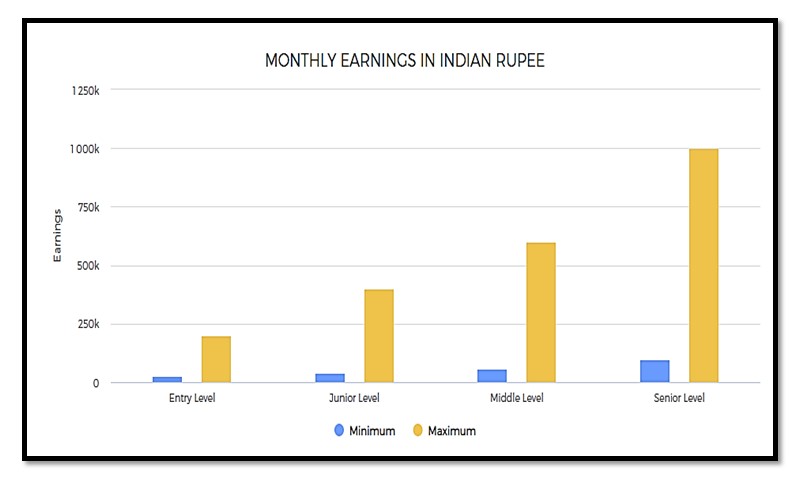
1. At the entry level, as an Assistant Manager-Logistics and Supply Chain, you will be earning anything between Rs. 25,000 to 1,50,000 per month.
2. At the junior level after 2-5 years of experience, you will be earning anywhere between Rs. 40,000 – 4,00,000 per month.
3. At the middle level of 6-12 years of work experience, your earning will rise to Rs. 60,000-5,00,000 per month.
4. At the senior level after 12 years of work experience, your earning will be between Rs. 1,00,000 to 10,00,000 per month.
Monthly Earnings In Indian Rupee
Entry Level | Junior Level | Mid Level | Senior Level | ||||
Min Earning | Max Earning | Min Earning | Max Earning | Min Earning | Max Earning | Min Earning | Max Earning |
25000 | 200000 | 40000 | 400000 | 60000 | 600000 | 100000 | 1000000 |
1. Entry level: 0 - 2 years of work experience
2. Junior Level: From 1 to 12 years of work experience
3. Mid Level: From 5 to 20+ years of work experience
4. Senior Level: From 10 to 25+ years of work experience (there could be exceptions in some high-end technical, financial, engineering, creative, management, sports, and other careers; also in the near future, people will reach these levels much faster in many careers and in some careers, these levels will have no meaning as those careers will be completely tech skill driven such as even now, there is almost no level in a Cyber Security Expert’s job)
Work Activities
1. Decision making & problem solving: Analysis of data and information; evaluation of alternative decisions and results of decisions; taking the right decisions and solving problems.
2. Communicating with co-workers: Communicating with people in writing, verbally or otherwise inside your workplace and various other people who have professional relationships with your place of work including vendors, government officials, etc. or with people at large.
3. Developing and maintaining interpersonal relationships: Developing professional relationships with co-workers and others outside organizations and maintaining good relationships.
4. Working in a team: Working in a team of people; developing a team; maintaining professional relationships among team members.
5. Analysis and interpretation of data and information: Analysis of data and information to find facts, trends, reasons behind situations, etc.; interpretation of data to aid in decision making.
Future Prospects
India is fast becoming a hub of logistics and supply chain due to a rise in manufacturing thanks to initiatives like Make in India along with GST reforms. As per a report, India is expected to increase its global trade share from 2.4% to 6% by 2025. The size will increase from 1065 Billion USD to 5670 Billion USD (nearly 5.3 times). At the same time, India is expected to have Free Trade Agreements with over 50 countries in 2025 from 11 at present. These favourable trade agreements too will increase Indian share in the global exports and imports, thus consolidating the supply chain and logistics sector in India. Also, in three years, the supply chain has seen an influx of FDI and Indian investment. Thus, a healthy and growing supply chain, logistics and exports in India mean a healthy job opportunity for someone working in the Supply Chain Industry.
Future Prospects At A Glance
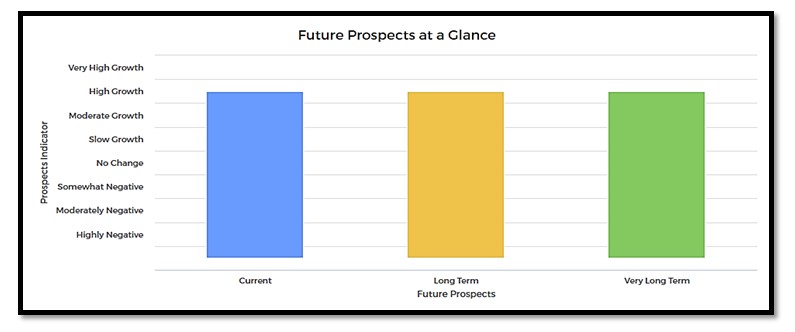
Current (0-1 year) | Long Term (2-5 year) | Very Long Term (6-10 years) |
High Growth | High Growth | High Growth |


