

Small Businessman/ Entrepreneur
Entry Level Qualification
Class 12
Career Fields
Business & Management
For Specially Abled


About Career
Anyone can start with a small amount of money and basic skills of doing any small-scale businesses. An Entrepreneur is a person who does not work under someone but they are businesspersons working for themselves. Entrepreneurship encourages doing business for yourself and making profits as you work. There is no fixed salary but money comes with profit. It is an opportunity for people who are skilled in doing business but cannot work in organizations due to lack of specific skill sets.
Entrepreneurs choose any category of business and work to promote the business. A shopkeeper is an entrepreneur, small dhaba owner is an entrepreneur, an owner of godown is an entrepreneur, flower seller is an entrepreneur, bakery person is an entrepreneur, etc. If you become a bakery owner, it is your work to maintain the bakery, market it, serve people, do sales, etc. Therefore, the complete running of the business is the job of entrepreneur. He or she works to make the business profitable each day.
Key Roles and Responsibilities
As an Entrepreneur, you will be engaged with one or more of the following roles and responsibilities:
1. Making plans for the business and thereby decide what to produce or source, how to produce or source the products, how to deliver services, whom to sell, where to sell, when to sell, etc.
2. Organising all resources for producing and delivering the products and services - capital, infrastructure (such as a shop or a factory), human resources, materials, etc.
3. Overseeing production, service delivery and sales processes in the business.
4. Overseeing accounting and financial transactions.
5. Overseeing sourcing of raw materials or finished goods; overseeing stock management and inventory management.
6. Overseeing product distribution processes or service delivery processses.
7. Meeting and interacting with customers.
8. Resolving problems and issues in business.
PARTICULARS | DESCRIPTION |
Name | Small Businessman/ Entrepreneur |
Purpose | Making Plans For The Business |
Career Field | Business & Management |
Required Entrance Exam | No Entrance Exam |
Average Salary | 40000 - 700000 Rs. Per Year |
Companies For You | Telecommunications, Auto / Auto-ancillary, Oil and Gas & Many More |
Who is Eligible | Class 12th Pass |
Career Entry Pathway
Class 10 all subjects as per scheme of studies – Class 11-12 with any subject combination as per scheme of studies – Diploma / Certificate / B. Voc courses in ‘Entrepreneurship’ or any other disciplines.
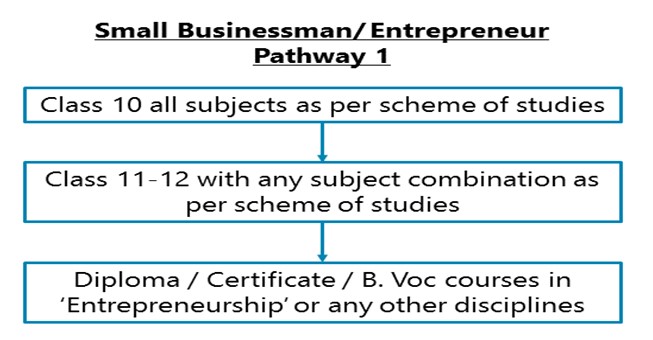
After Class 12, you can go for a Diploma / Certificate or B. Voc degree (Bachelor of Vocation) course in ‘Entrepreneurship’, ‘Entrepreneurship Development’, ‘Entrepreneurship Administration and Business Laws’, ‘Entrepreneurship Development’, ‘Entrepreneurship & Business Management’, ‘Entrepreneurship Administration’, ‘Entrepreneurship, Innovation and Design Thinking’ or any other disciplines. If your business is a startup, you can register it with the Department of Industrial Policy and Promotion (DIPP) of India to enjoy income tax, funding, patent-related or other benefits. You will be exempt from paying any income tax for a period of up to 3 years. You must also remember to register within 5 years of business incorporation (you need to get a business incorporation certificate from the government for this). The procedure can be followed as at https://www.startupindia.gov.in/.
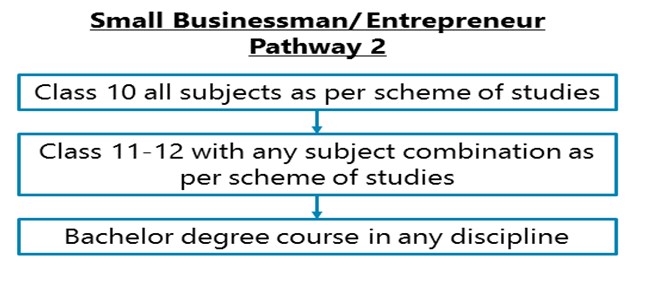
After Class 12, you need to finish your Bachelor’s degree in any discipline. If your business is a startup, you can register it with the Department of Industrial Policy and Promotion (DIPP) of India to enjoy income tax, funding, patent-related or other benefits. You will be exempt from paying any income tax for a period of up to 3 years. You must also remember to register within 5 years of business incorporation (you need to get a business incorporation certificate from the government for this). The procedure can be followed as at https://www.startupindia.gov.in/.
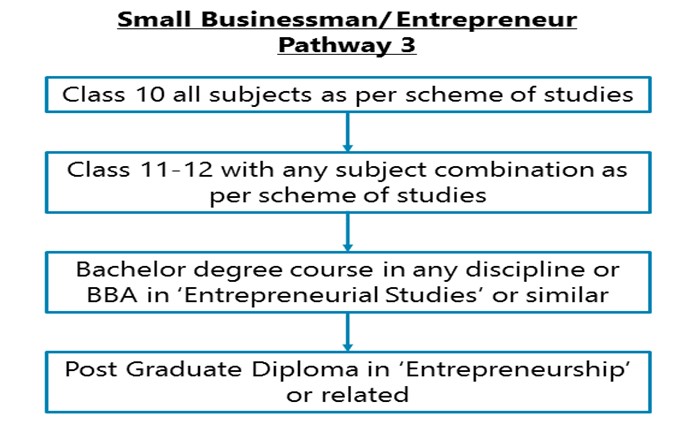
After Class 12, you must complete your Bachelor degree course in any discipline or BBA (Bachelors on Business Administration) in ‘Entrepreneurial Studies’ or similar fields. Then you can go for a Post Graduate Diploma in ‘Entrepreneurship’, ‘Entrepreneurship Development’, ‘Entrepreneurial Studies’, ‘Business Studies’, ‘Business Entrepreneurship’, ‘Management – Development Studies’ or related courses. If your business is a startup, you can register it with the Department of Industrial Policy and Promotion (DIPP) of India to enjoy income tax, funding, patent-related or other benefits. You will be exempt from paying any income tax for a period of up to 3 years. You must also remember to register within 5 years of business incorporation (you need to get a business incorporation certificate from the government for this). The procedure can be followed as at https://www.startupindia.gov.in/.
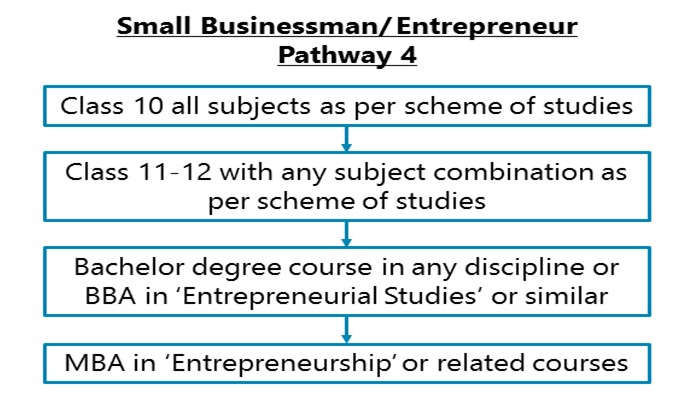
After Class 12, then BBA (Bachelors on Business Administration) in ‘Entrepreneurial Studies’ or similar fields, you can go for MBA (Master of Business Administration) in ‘Entrepreneurship’, ‘Decision Sciences’, ‘Social Entrepreneurship’, ‘Entrepreneurship & Family Business’, ‘Hospitality Entrepreneurship’ or similar courses. If your business is a startup, you can register it with the Department of Industrial Policy and Promotion (DIPP) of India to enjoy income tax, funding, patent-related or other benefits. You will be exempt from paying any income tax for a period of up to 3 years. You must also remember to register within 5 years of business incorporation (you need to get a business incorporation certificate from the government for this). The procedure can be followed as at https://www.startupindia.gov.in/.
Required Qualification & Competencies
1. Structured training and formal certification are not pre-requisites for becoming an Entrepreneur. However, it is advisable to complete at least graduation before becoming an Entrepreneur.
2. You can also work for a few years in any company before becoming an Entrepreneur. Work experience gives you a number of industry contacts, financial resources as well as exposure to a commercial environment.
Various private / public vocational training establishments offer related courses on:
1. Entrepreneurship and Innovation Studies
2. Entrepreneurship
3. Innovation & Entrepreneurship
4. Social Entrepreneurship
5. Creative Entrepreneurship & Creative Industries
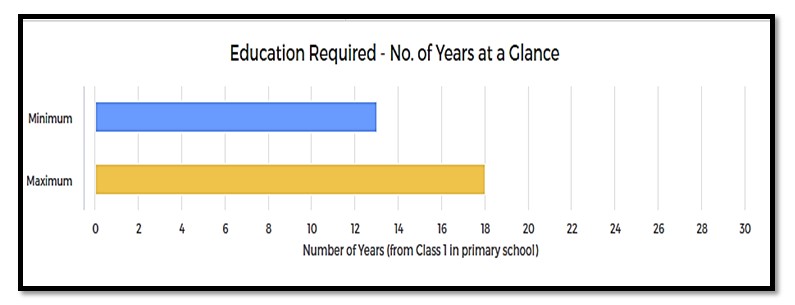
MINIMUM EDUCATION REQUIRED | MAXIMUM EDUCATION REQUIRED |
Post Higher Secondary Diploma / Certificate Programs for which the minimum eligibility is a pass in Higher Secondary / Class XII School Leaving examination. | Post Graduate Postgraduate Degree / Diploma / Certificate Programs for which the minimum eligibility is a pass in Graduation / equivalent Diploma program like Honours Diploma or Graduate Diploma. |
Competencies Required
1. You should have interests for Enterprising Occupations. Enterprising occupations involve taking initiatives, initiating actions, and planning to achieve goals, often business goals. These involve gathering resources and leading people to get things done. These require decision making, risk taking, and action orientation.
2. You should have interests for Social Occupations. Social occupations involve helping or assisting others; these involve working with and communicating with people to provide various services; these may involve educating and advising others.
3. You should have interests for Realistic Occupations. Realistic occupations involve more practical and hands-on activities than paperwork or office work. Realistic occupations often involve physical activities for getting things done using various tools and equipment.
4. You should have knowledge of Sales and Promotion - the various principles, theories, methods, systems, and processes to communicate and promote the benefits of various products or services of an organisation to a targeted group of customers, influencing their buying decisions and convincing them to buy the products or services.
5. You should have knowledge of Communications and Media - how different media such as print, television, radio, and social media works; how to produce content such as news, articles, audio-visual programs, etc. for different media. This includes various ways to inform and entertain people via print, audio, audio-visual and online media.
6. You should have knowledge of Customer Service - how to provide customer services. This includes understanding customer needs, helping customers to use products and services, answering customer queries, handling customer complaints and grievances, and evaluating customer satisfaction.
7. You should have knowledge of Personal Care Service - Knowledge of how to provide various assistance and services to others. This includes looking after the needs of individuals, understanding what they need and provide all assistance at home or elsewhere.
8. You should have knowledge of Computers - computer software and applications, to be used for regular data entry / retrieval and updating virtual databases.
9. You should have Active Listening Skills - Giving full attention to what other people are saying, understanding the points being made by others, asking questions, etc.
10. You should have Instruction Skills - training others how to do something.
11. You should have Service Orientation Skills - to help and assist people.
12. You should have Persuasion Skills - persuading others to change their minds or behavior.
13. You should have Judgment and Decision Making Skills - considering the pros and cons of various decision alternatives; considering costs and benefits; taking appropriate and suitable decisions.
14. You should have Supervising Skills - Supervising and monitoring the performance of yourself, others, businesses, and different projects.
15. You should have Directing Skills - directing others' actions to get things done.
16. You should have Problem Solving Ability - analysis and understanding of problems, evaluating various options to solve the problems and using the best option to solve the problems.
17. You should have Deductive Reasoning Ability - apply general rules and common logic to specific problems to produce answers that are logical and make sense. For example, understanding the reasons behind an event or a situation using general rules and common logic.
18. You always prefer to experience new things and have new experiences or you mostly do.
19. You can always act independently or could do so in most situations.
20. You are always or mostly careful about your actions and behavior.
21. You are always or mostly organized in your day-to-day life and activities.
22. You are always friendly and outgoing; you love to be in the company of people always or most of the times.
Career - Job Opportunities & Profiles
Your business may operate in any among primary, secondary, tertiary or quaternary sectors. Primary sector deals with producing raw materials that include occupations like farming, mining, fishing, etc. Secondary sector deals with making things (manufacturing) using machines, like car making or steel industries. Tertiary or service sector deals with providing a service like nursing, teaching, etc. Quaternary sector deals with research and development oriented occupations like software / game / website design etc.
The various industries that you may choose to serve to include:
1. Agriculture / Agro-based or Allied Industries
2. Telecommunications
3. Foods / Beverage / FMCG (Fast Moving Consumer Goods)
4. Auto / Auto-ancillary
5. Education / Teaching
6. Travel and related
7. Medical / Healthcare
8. Oil and Gas / Power / Infrastructure / Energy
9. Industrial Products
10. BFSI (Banking, Financial Service, Insurance)
11. Accounts and Finance
12. Construction / Engineering
The functional areas that you may cover include:
1. Sales / Retail
2. Production / Maintenance / Quality
3. Purchase / Logistics / Supply Chain
4. Accounts / Finance / Tax / Insurance
5. Human Resource / Recruitment
6. Customer Service / Operations
7. Marketing / Advertising
Career Growth
If you can flourish as a self-employed individual, your business may grow to serve a broad range of clientele or a multitude of customers and you can certainly become a successful businessman.
Salary Offered
1. One can earn a lot of money over the years. Entrepreneurship is about starting a business and building wealth. An entrepreneur builds wealth through direct revenues, investments, investing in other businesses, buying and selling equity, etc. Entrepreneurs can become multi-millionaires in this way.
2. However, the earning potential of Entrepreneurs depends on the operational functional area, industry statistics and personal capacities like importunity, passion, preparation and earning appetite of an individual.
3. At the entry level: Your earnings may vary on an average anywhere between Rs. 3000 to Rs. 60,000 or more per month depending on the factors as mentioned here.
4. After 1-6 years, you may expect about Rs. 10,000 – Rs. 1, 00, 000 per month or more.
5. After 6-12 years, you may make about Rs. 15,000 – Rs. 2, 00,000 or more per month.
6. After 12-20 years, you may expect to make about Rs. 20,000 – Rs. 3, 00,000 or more per month.
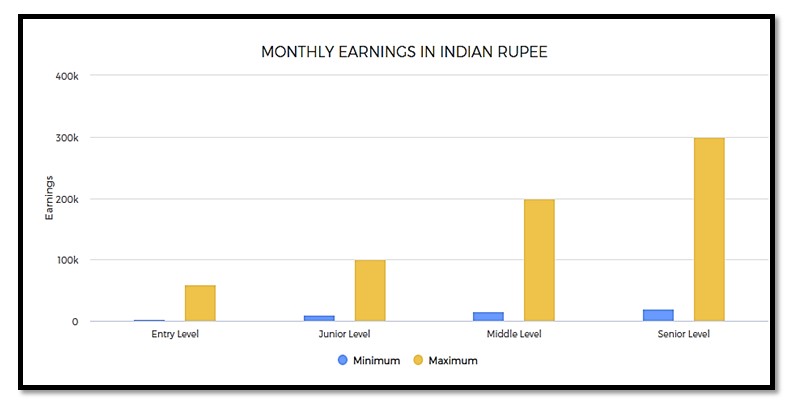
Monthly Earnings In Indian Rupee
Entry Level | Junior Level | Mid-Level | Senior Level | ||||
Min Earning | Max Earning | Min Earning | Max Earning | Min Earning | Max Earning | Min Earning | Max Earning |
3000 | 60000 | 10000 | 100000 | 15000 | 200000 | 20000 | 300000 |
1. Entry level: 0 - 2 years of work experience
2. Junior Level: From 1 to 12 years of work experience
3. Mid-Level: From 5 to 20+ years of work experience
4. Senior Level: From 10 to 25+ years of work experience (there could be exceptions in some high-end technical, financial, engineering, creative, management, sports, and other careers; also in the near future, people will reach these levels much faster in many careers and in some careers, these levels will have no meaning as those careers will be completely tech skill driven such as even now, there is almost no level in a Cyber Security Expert’s job)
Work Activities
1. Getting Information and learning– Observing, hearing, reading, using computers, or otherwise obtaining information and learning from it.
2. Communicating with co-workers and others - Communicating with people in writing, verbally or otherwise inside your workplace and various other people who have professional relationships with your place of work including vendors, government officials, etc. or with people at large.
3. Communicating with customers – Communicating with customers of your organisation verbally or otherwise.
4. Analysing and interpreting data and information - Analysis of data and information to find facts, trends, reasons behind situations, etc.; interpretation of data to aid in decision making.
5. Creative thinking - Developing new ideas, concepts, innovative solutions to problems, newer ways of getting things done, designing products and services, creating work of art and craft, etc.
6. Strategic planning - Developing visions, developing strategies and action plans for others to achieve goals.
7. Working directly with people – Working directly with people to offer them products and services, providing assistance, etc.
8. Using computers for work - Using computers for day-to-day office work; using computer software for various applications in day-to-day professional work; entering data and process information; for writing.
9. Processing information - Searching, compiling, tabulating, calculating, auditing, verifying or otherwise dealing with information processing including data entry, transcription, recording, storing and maintaining databases.
10. Organising, planning and prioritising tasks - Planning and organisating tasks to achieve goals and making the best use of the time availableprioritising tasks in order to achieve work goals; organising.
Future Prospects
India is the youngest nation when it comes to Entrepreneurs. We have the third largest startup base in the world with above 14,000 recognized Startups. The greatest growth promoting factor leading to this sudden rise in entrepreneurial ideas among Indians is technological advancements. In this era, we can think of a lot more types of services and products related to the use of today’s location-neutral scientific technology that the bygone era could not provide. Greater than 8,200 startups were acknowledged by Department of Industrial Policy and Promotion (DIPP) of India in 2018 alone, creating more than 89,000 new jobs this year hence taking the total to 1, 41, 775 jobs contributed by startups.
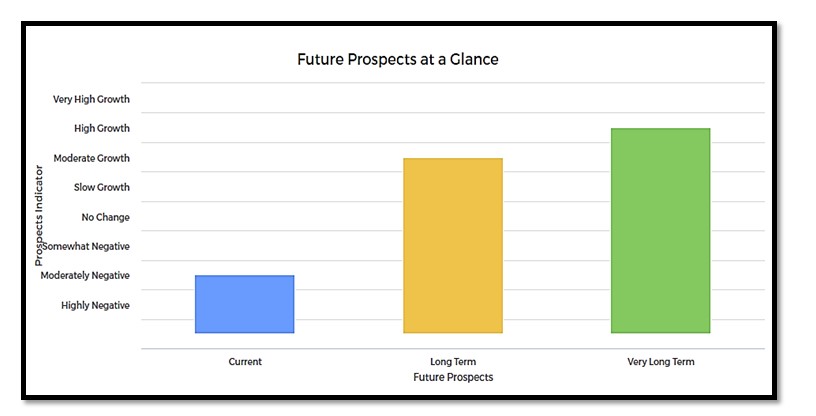
Future Prospects At A Glance
Current (0-1 year) | Long Term (2-5 year) | Very Long Term (6-10 years) |
Moderately Negative | Moderate Growth | High Growth |