


Retail Operations Support Worker
Entry Level Qualification
Class 12
Career Fields
Business & Management
For Specially Abled


Career Entrance Exam
About Career
As a Retail Operations Support Worker, you could be involved in various tasks in a retail store such as Big Bazar or a neighborhood supermarket or even in a small grocery store. You could be involved in managing inventory tasks such as unloading items from trucks, storing items properly, keep records of the inventory, order for fresh stocks, and so on. You could also be involved in helping customers to find products, answer various queries, help them to shop, prepare bills, accept payments, etc.
Key roles and responsibilities
As a Retail Operations Support Worker your key responsibilities will include:
1. Greeting customers and catering to their wants or needs.
2. Recommending, selecting, and helping locate merchandise based on what the customer asks for.
3. Calculate and present bill for purchases, and process payment.
4. Solve people’s queries regarding your store.
5. Providing customers with information about ongoing sales and store policies and practices.
6. Performing an inventory of stock and restocking new stock.
7. Keeping an eye out for theft and other fraudulent activities at the workplace.
8. Receiving, moving, storing, and delivering products while working in a team.
PARTICULARS | DESCRIPTION |
Name | Retail Operations Support Worker |
Purpose | Recommending, Selecting, and Helping |
Career Field | Business & Management |
Required Entrance Exam | No Entrance Exam |
Average Salary | 150000 - 300000 Rs. Per Year |
Companies For You | Starbucks, Costo, Nike, & Many More |
Who is Eligible | Class 12th Pass |
Career Entry Pathway
Class 10 all subjects as per scheme of studies – Class 11-12 with any subject combination as per scheme of studies - Entry-level employment in retail.
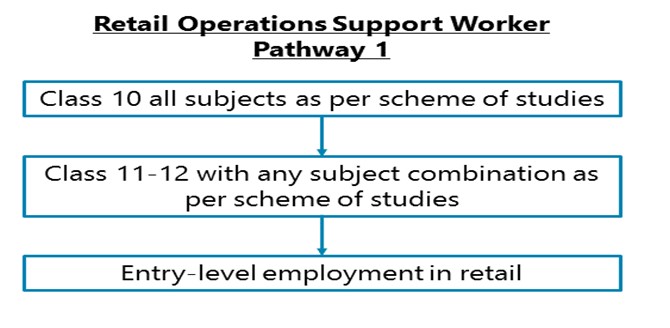
Retail work does not require any formal qualifications, as such you will be eligible to apply for entry-level retail jobs as soon as you are of legal working age ideally having finished at least Class 10. Completing Higher Secondary education is highly advisable as a 12th pass qualification may be a prerequisite for many openings and to improve upon skills many recruiters look for such as ability to perform transactions, handle accounts, operate computers or fluency in languages like English. Experience is highly valuable and is necessary to acquire better-paying jobs and specializing in certain area of retail.
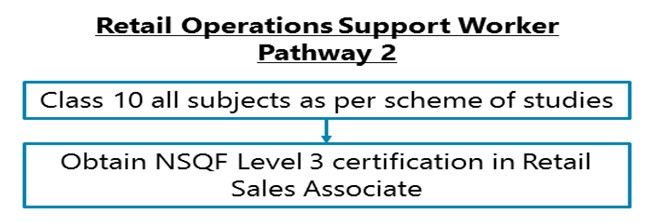
You can obtain NSQF (National Skills Qualification Framework) Level 3 certification in Retail Sales Associate, after completing Class 10, which will give you the necessary knowledge needed to work as a Retail Operations Support Worker. For this certificate, you need to be 14 years of age.
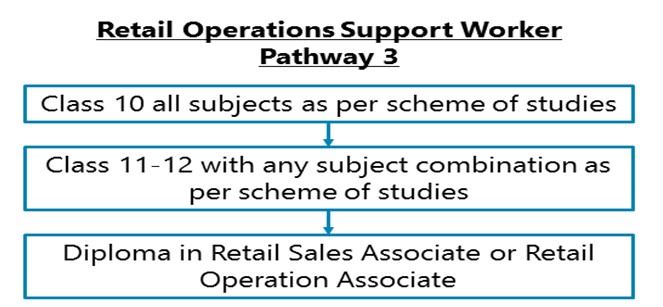
If you wish to continue your schooling till the intermediate, you can finish Class 12 and then opt for the diploma.
Required Qualification & Competencies
School
Retail work does not require any specialized educational qualification. You can apply for this job role as soon as you are of legal working age, preferably having finished class 10. It is highly advisable you that you complete higher secondary qualification for better prospects, and maintain the option of transitioning to a different profession if necessary.
Diploma
After you’ve passed your class 10th or class 12th (depending on your preference), you can opt for a Diploma in Retail Sales Associate or Retail Operation Associate.
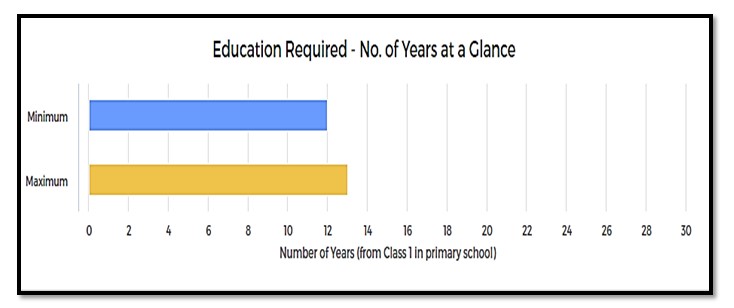
MINIMUM EDUCATION REQUIRED | MAXIMUM EDUCATION REQUIRED |
Post Higher Secondary Diploma / Certificate Programs for which the minimum eligibility is a pass in Higher Secondary / Class XII School Leaving examination. | Post Higher Secondary Diploma / Certificate Programs for which the minimum eligibility is a pass in Higher Secondary / Class XII School Leaving examination. |
Competencies Required
Interest
1. Enterprising: Enterprising occupations frequently involve starting up and carrying out projects. These occupations can involve leading people and making many decisions. Sometimes they require risk taking and often deal with business.
2. Conventional: Conventional occupations frequently involve following set procedures and routines. These occupations can include working with data and details more than with ideas. Usually, there is a clear line of authority to follow.
Knowledge
1. Customer Service: Knowledge about how to provide customer services. This includes understanding customer needs, helping customers to use products and services, answering customer queries, handling customer complaints and grievances, and evaluating customer satisfaction.
2. Marketing: Knowledge of the various principles, theories, methods, systems and processes to understand the needs of a category of customers and then creating, communicating, and delivering various products and services in order to satisfy the needs of the customers.
Skills
1. Active Learning: Focused and continuous learning from various sources of information, observation and otherwise for application in getting work done.
2. Active Listening: Giving full attention to what other people are saying, understanding the points being made by others, asking questions, etc.
3. Communication in English: Skills in communicating effectively in writing as well as verbally with others in English language.
4. Coordination: Skills in working together with other people to get things done.
5. Critical Thinking: Skills in analysis of complex situations, using of logic and reasoning to understand the situations and take appropriate actions or make interpretations and inferences.
6. Judgment and Decision Making: Skills in considering pros and cons of various decision alternatives; considering costs and benefits; taking appropriate and suitable decisions.
7. Managing Material Resources: Skills in sourcing, buying, storing, and use of appropriate raw materials, machines, equipment, and devices for various purposes such as industrial manufacturing, building construction, etc.
8. Negotiation: Skills in bringing others together and trying to reconcile differences.
9. Problem Solving: Skills in analysis and understanding of problems, evaluating various options to solve the problems and using the best option to solve the problems.
Abilities
1. Abstract Reasoning: The ability to understand ideas which are not expressed in words or numbers; the ability to understand concepts which are not clearly expressed verbally or otherwise.
2. Deductive Reasoning: The ability to apply general rules and common logic to specific problems to produce answers that are logical and make sense. For example, understanding the reasons behind an event or a situation using general rules and common logic.
3. Fluency of Ideas: The ability to come up with a number of ideas about a topic (the number of ideas is important, not their quality, correctness, or creativity).
4. Inter-Personal: The ability to build and maintain good relationships with others at workplaces and elsewhere.
5. Intrapersonal: The ability to clearly understand your strengths and weaknesses, what your capabilities are, what you can do and cannot do, what you like and dislike.
6. Selective Attention: The ability to concentrate on a task over a long period of time without being distracted.
7. Speed of Closure: The ability to quickly make sense of, combine, and organize information into meaningful patterns.
8. Problem Sensitivity: The ability to tell when something is wrong or is likely to go wrong. It does not involve solving the problem, only recognizing there is a problem.
Personality
1. You are always or mostly organised in your day-to-day life and activities.
2. You always feel secure in your surroundings and in most situations.
3. You are a soft-hearted person sometimes.
4. You trust others sometimes but not always.
5. You are helpful to others sometimes.
6. You remain calm in difficult situations sometimes but some other times you are anxious.
Career - Job Opportunities & Profiles
Following are some of the job opportunities commonly available for Retail Operations Support Workers. Oftentimes you will have to combine a few of these roles for your particular job:
1. Floor Associate
2. Logistics Associate
3. Store Associate
4. Inventory Assistant
5. Salesperson
6. Sales executive
7. Store operations associate
Work environment
You will work in retail stores and deal with changing shift hours, weekend work, and a vaguely defined, ever-changing scope of work based on the store’s needs.
Career Growth
In this line of work, vertical growth is limited as retail work is largely unskilled and there is an upper ceiling for support workers unless they transition to a specialized skill set. However, you will find many opportunities for lateral growth, as with increased experience in a particular area of retail (such as fashion, footwear, clothing etc.) you can try to seek out higher paying prospects in roles with more responsibilities.
Salary Offered
1. In the entry level jobs, you will earn between Rs. 8,000 - 10,000 a month.
2. With 2-5 years of experience, you may get between Rs. 10,000 - 20,000 a month.
3. With 6-12 years of experience, in Store Supervisor positions, you may earn between Rs. 25,000-40,000 a month.
4. With 12+ years of experience, you may earn between Rs. 40,000 - 50,000 a month.
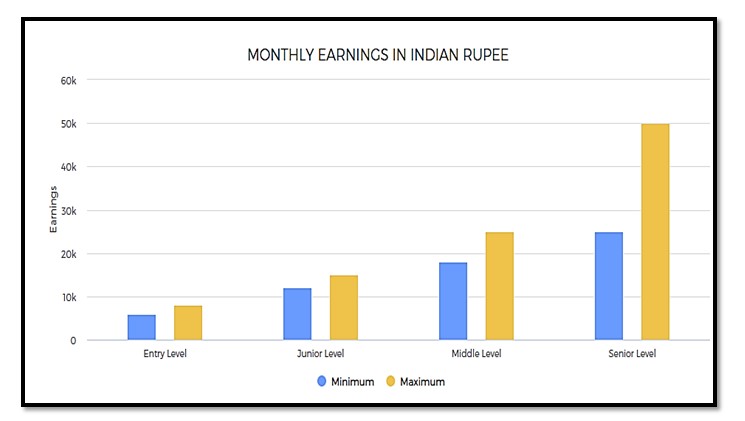
Monthly Earnings In Indian Rupee
Entry Level | Junior Level | Mid-Level | Senior Level | ||||
Min Earning | Max Earning | Min Earning | Max Earning | Min Earning | Max Earning | Min Earning | Max Earning |
6000 | 8000 | 12000 | 15000 | 18000 | 25000 | 25000 | 50000 |
1. Entry level: 0 - 2 years of work experience
2. Junior Level: From 1 to 12 years of work experience
3. Mid-Level: From 5 to 20+ years of work experience
4. Senior Level: From 10 to 25+ years of work experience (there could be exceptions in some high-end technical, financial, engineering, creative, management, sports, and other careers; also in the near future, people will reach these levels much faster in many careers and in some careers, these levels will have no meaning as those careers will be completely tech skill driven such as even now, there is almost no level in a Cyber Security Expert’s job)
Work Activities
1. Analysing and interpreting data and information: Analysis of data and information to find facts, trends, reasons behind situations, etc.; interpretation of data to aid in decision making.
2. Communicating with co-workers and others: Communicating with people in writing, verbally or otherwise inside your workplace and various other people who have professional relationships with your place of work including vendors, government officials, etc. or with people at large.
3. Communicating with customers: Communicating with potential and existing customers of your organisation in writing, verbally or otherwise.
4. Decision making and problem solving: Analysis of data and information; evaluation of alternative decisions and results of decisions; taking the right decisions and solving problems.
5. Developing and maintaining inter-personal relationships: Developing professional relationships with co-workers and others outside organisations and maintaining good relationships.
6. Getting Information and learning: Observing, hearing, reading, using computers, or otherwise obtaining information and learning from it.
7. Inspecting situations, events, and people: Inspecting situations, events and people to understand the reasons and causes for the situation or events to happen; inspecting people to understand reasons behind their behaviour and actions.
8. Leading: Inspiring and motivating co-workers to work to achieve specific goals; enabling and facilitating others to perform tasks effectively; addressing issues and solving problems in order to help people perform well.
9. Managing and supervising: Manging and supervising work of others; setting goals; giving instructions; monitoring work performance, etc.
10. Negotiating: Negotiating terms, conditions, costs, prices and about other issues.
11. Organising, planning and prioritising tasks: Planning and organising tasks in order to achieve work goals; prioritising tasks to achieve goals and making the best use of the time available.
12. Scheduling tasks: Scheduling project timelines, tasks and activities.
13. Working in a team: Working in a team of people; developing team; maintaining professional relationships among team members.
Future Prospects
The growing average prosperity of citizens in tier-I and tier-II cities have created the ideal environment for the retail industry to thrive. Many established retail franchises are expanding their operations and even renowned international chains have started up operations in the country to aggressively exploit this growing market by opening up multiple outlets and support facilities in all major towns and cities thus creating a demand for roles of various kinds in retail operations. Therefore, the future prospects in this vocation seem bright.
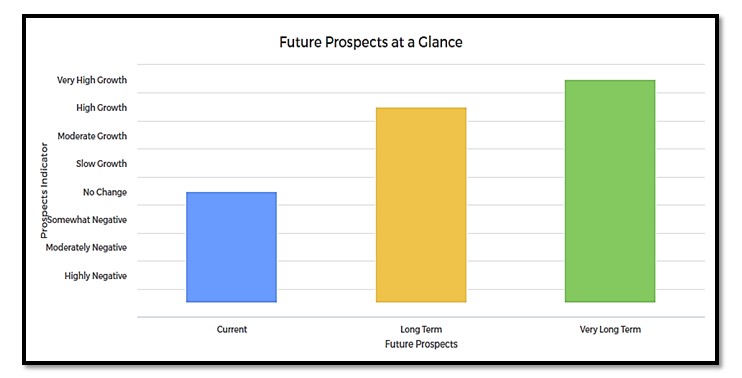
Future Prospects At A Glance
Current (0-1 year) | Long Term (2-5 year) | Very Long Term (6-10 years) |
No Change | High Growth | Very High Growth |