

Choreographer
Entry Level Qualification
Class 10
Career Fields
Arts & Design
For Specially Abled


Career Entrance Exam
About Career
1. As a Choreographer, you will mainly be responsible for designing dance routines, ballets, and performances for a stage event, a dance drama, movies, television series, wedding functions, cheerleaders, gymnasts, dance reality shows, fashion shows, theatres etc. You have to ultimately train and teach your dancers the moves that you have designed. You may also have to take auditions to select new dancers for your team.
2. Typically, Choreographers develop dancing skills at a very early age and start practising ever since to gradually identify specific areas of their interest.
3. You may need to combine existing steps or innovate new movements for a dance performance. You may have to interact with art directors to discuss dance concepts and themes for performances. You may also need to design the costumes that you want your dancers to wear, the light effects during the performances and the music which suits the dance theme that you have designed.
4. You have to be creative, innovative and most importantly understand human emotions and concepts and express it in an interesting way for creating effective and attractive sequential dance steps.
Key Roles and Responsibilities
As a Choreographer, you will be engaged with one or more of the following roles and responsibilities: -
1. Designing dances for dance companies, individual dancers, opera, musical theatres, fashion shows, television productions, films, special events, musical parades etc. involving amateur and professional dancers.
2. Reading and studying musical scores and storylines for determining how to translate moods and ideas into dance movements.
3. Choosing the sound effects, music, or spoken narrative that accompanies a dance performance.
4. Auditioning and assessing amateur as well as professional dancers and performers before beginning to train them.
5. Directing rehearsals and instructing dancers about how to use certain dance steps and the techniques involved for achieving the desired effects.
6. Recording the dance moves during rehearsals to ensure correct postures, formations and movements.
7. Learning constantly from other dance forms, keeping yourself updated with popular dance routines and experimenting with different types of dance steps, dancers, formations, sequences etc.
8. Discussing stage requirements with technicians, light men and specialists for producing additional effects required to enhance a stage performance.
9. Designing and suggesting costume requirements for the dancers and ensuring swift costume changes in between the performance.
PARTICULARS | DESCRIPTION |
Name | Choreographer |
Purpose | Directing Rehearsals and instructing |
Career Field | Arts & Design |
Required Entrance Exam | No Entrance Exam |
Average Salary | 30000 - 200000 Rs. Per Year |
Companies For You | Academic / Cultural Institutions, Film Production Units, & Many More |
Who is Eligible | Class 10th Pass |
Career Entry Pathway
Class 10 all subjects as per scheme of studies – NSQF Level 3 Training and Certificate for ‘Dancer’ or similar courses
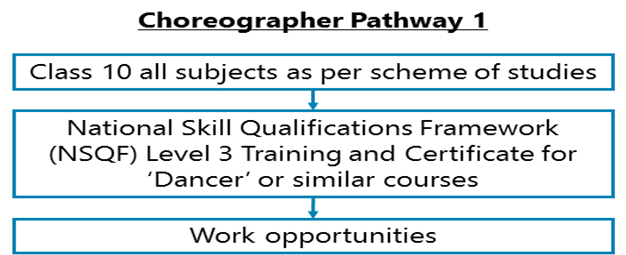
After Class 10, you need to undergo National Skill Qualifications Framework (NSQF) Level 3 Training and Certificate for ‘Dancer’ or similar courses. The total number of training hours will be 400.
Class 10 all subjects as per scheme of studies – Class 11-12 with any subject combination as per scheme of studies - Diploma / Certificate course in ‘Dance’ or similar disciplines
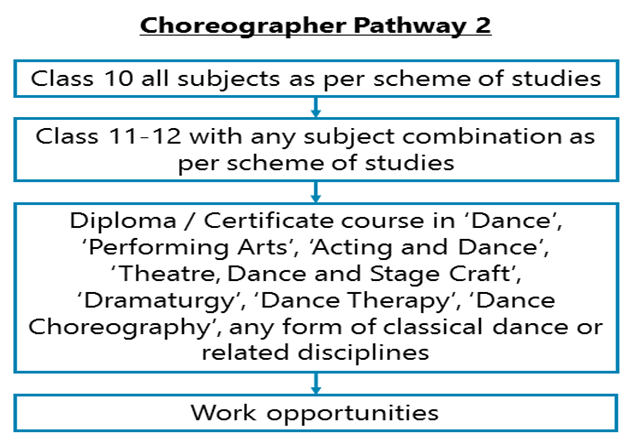
After Class 11-12, you can go for a Diploma / Certificate course in ‘Dance’, ‘Performing Arts’, ‘Acting and Dance’, ‘Theatre, Dance and Stage Craft’, ‘Dramaturgy’, ‘Dance Therapy’, ‘Dance Choreography’, any form of classical dance or related disciplines.
Class 10 all subjects as per scheme of studies – Class 11-12 with any subject combination as per scheme of studies – B. Voc in ‘Contemporary Dance’ or related disciplines
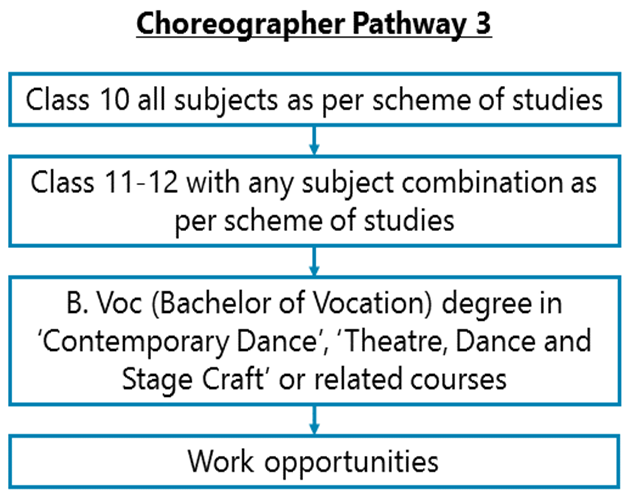
After Class 11-12, you can go for a B. Voc (Bachelor of Vocation) degree in ‘Contemporary Dance’, ‘Theatre, Dance and Stage Craft’ or related courses.
Class 10 all subjects as per scheme of studies – Class 11-12 with any subject combination as per scheme of studies – BPA in ‘Dance’ or similar
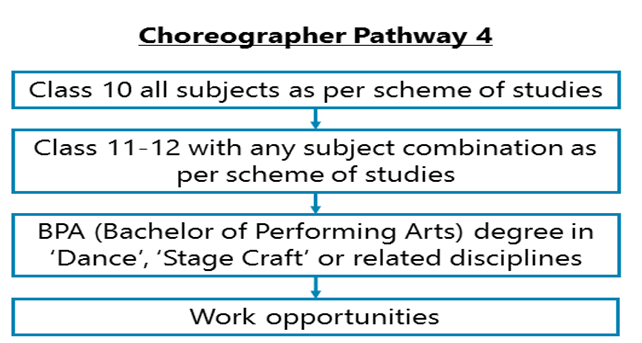
After Class 11-12, you can go for a BPA (Bachelor of Performing Arts) degree in ‘Dance’, ‘Stage Craft’ or related disciplines.
Class 10 all subjects as per scheme of studies – Class 11-12 with any subject combination as per scheme of studies – Bachelor degree in ‘Choreography’
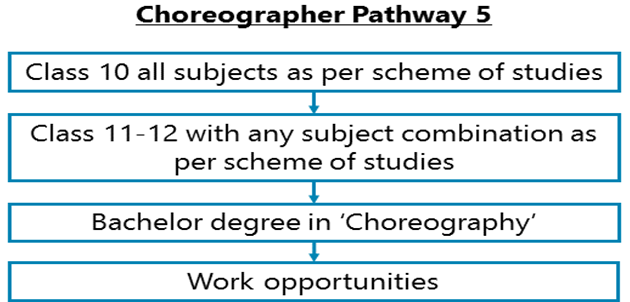
After Class 11-12, you can go for a Bachelor degree in ‘Choreography’ offered by a number of universities across the country. This is usually a course of 3 years.
Required Qualification & Competencies
1. Structured and formal education is not a pre-requisite although training and experience in performing arts or dance is necessary for becoming a Choreographer. It is advisable to complete at least a senior secondary level of education (Class 11-12) or equivalent first.
2. After Class 10, you can go for NSQF Level 3 courses.
After Class 11-12, you can go for:
1. Diploma / Certificate courses.
2. B. Voc degree courses.
3. BPA degree courses.
4. Bachelor degree courses.
You can simply learn any form of dance while you are in school, then get into formal training classes right after you finish school, practice as a dancer for a few years before you can become a Choreographer.
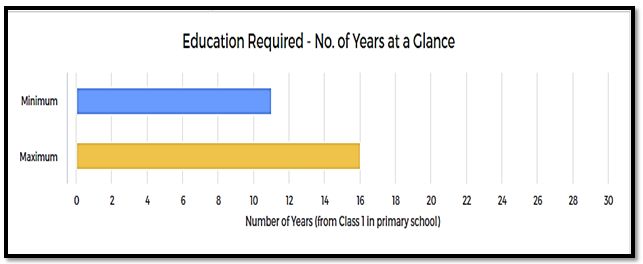
MINIMUM EDUCATION REQUIRED | MAXIMUM EDUCATION REQUIRED |
Post-Secondary Certificate / Diploma Programs for which the minimum eligibility is a pass in class X. | Under Graduate Undergraduate Degree / Honours Diploma / Graduate Diploma (equivalent to a Degree) Programs for which the minimum eligibility is a pass in Higher Secondary / Class XII School Leaving examination. |
Competencies Required
1. You should have an interest in Artistic Occupations. Artistic occupations mostly involve working with creative ideas, art, and designs. These occupations involve abstract or conceptual thinking, and creative self-expression and often do not follow any set processes or rules for getting things done.
2. You should have an interest in Social Occupations. Social occupations involve helping or assisting others; these involve working with and communicating with people to provide various services; these may involve educating and advising others.
3. You should have an interest in Enterprising Occupations. Enterprising occupations involve taking initiative, initiating actions, and planning to achieve goals, often business goals. These involve gathering resources and leading people to get things done. These require decision-making, risk-taking and action orientation.
4. You should know about Fine Arts- Knowledge about the theories and techniques required for producing, composing and performing works of music, dance, drama, etc.
5. You should have knowledge of Education and Training - Knowledge of various principles and methods of developing training or teaching curriculum, the design of instructional methods, teaching and instructing individuals and groups.
6. You should have Active Listening Skills - Giving full attention to what other people are saying, understanding the points being made by others, asking questions, etc.
7. You should have Active Learning Skills - Focused and continuous learning from various sources of information, observation and otherwise for application in getting work done.
8. You should have Instruction Skills –training others how to do something.
9. You should have Bodily-Kinesthetic Intelligence - The ability to coordinate the movement of your arms, legs, and bodily motion; the ability to keep or regain your body balance when in an unstable position; the ability to quickly and repeatedly bend, stretch, twist, or reach out with your body, hands, arms, fingers, or legs.
10. You should have Physical Stamina - The ability to exert yourself physically over long periods without getting winded or out of breath.
11. You are always imaginative or in most situations.
12. You always prefer to experience new things and have new experiences or you mostly do.
13. You are fun-loving; you enjoy interacting with people and enjoying yourself.
14. You are always or mostly disciplined in your action and behavior.
Career - Job Opportunities & Profiles
1. You may find work as Choreographer, Performing Arts Coach, Dance Teacher, Dance Instructor, Dance Trainer, Specialist – Dance, Contributing Editor – Dance, etc. in schools, colleges, academic / cultural institutions, film production units, media and television companies, theatre groups, ballet companies, advertising agencies and so on.
2. You may also get several opportunities as a Choreographer to meet and work under the supervision of eminent Choreographers, theatre and media personalities etc. if you start by participating in dance reality shows that are conducted at various locations across the country.
3. If you complete your graduation in ‘Dance’ or ‘Choreography’, you may get opportunities for fieldwork and internships with prominent artists.
4. Prestigious organizations like the Indian Council for Cultural Relations (ICCR), Ministry of External Affairs, Department of Culture, Ministry of Human Resource Development, Sangeet Natak Akademi also provide teaching & choreography assignments internationally, apart from research & production grants, and fellowships, to graduates.
Career Growth
1. You may start as a dancer, then a Choreographer and grow to become an internationally renowned choreographer and performer. You may also start your own school and expand the volume of your trainees.
2. You may also participate in dance reality shows, earn fame and work with eminent film personalities and production units or choreograph for award ceremonies, films and advertisements.
Salary Offered
1. The earning potential of Choreographers depends on the personal capacity, importunity, passion, preparation and earning appetite of an individual. You may expect to earn in lakhs per month if you can establish yourself in the film and media industry ultimately.
2. This is a difficult field with immense competition. However, if you can participate in dance reality shows at an early age, earn fame and work with eminent film personalities and production units, you may end up choreographing for award ceremonies, films and advertisements to earn in lakhs per month.
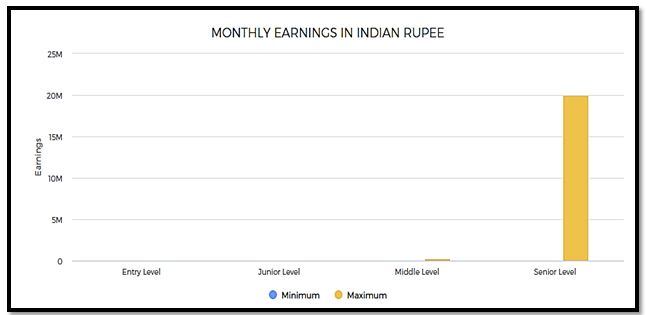
Monthly Earnings In Indian Rupee
Entry Level | Junior Level | Mid-Level | Senior Level | |||||
Min Earning | Max Earning | Min Earning | Max Earning | Min Earning | Max Earning | Min Earning | Max Earning | |
2000 | 15000 | 5000 | 20000 | 30000 | 250000 | 60000 | 20000000 | |
1. Entry level: 0 - 2 years of work experience
2. Junior Level: From 1 to 12 years of work experience
3. Mid-Level: From 5 to 20+ years of work experience
4. Senior Level: From 10 to 25+ years of work experience (there could be exceptions in some high-end technical, financial, engineering, creative, management, sports, and other careers; also in the near future, people will reach these levels much faster in many careers and in some careers, these levels will have no meaning as those careers will be completely tech skill driven such as even now, there is almost no level in a Cyber Security Expert’s job)
Work Activities
1. Creative Thinking -Developing new ideas, concepts, innovative solutions to problems, new dance forms, etc.
2. Performing physical activities - Performing physical activities that require the use of your arms and legs and moving your whole body, such as climbing, lifting, balancing, walking, stooping, and handling of materials.
3. Getting Information and learning - Observing, hearing, reading, using computers, or otherwise obtaining information and learning from it.
4. Updating and using relevant knowledge - Keeping updated with the latest knowledge relevant to your fields of work and use of the relevant knowledge in getting things done.
5. Working directly with people - Working directly with people to offer services, providing assistance, etc.
6. Developing and maintaining inter-personal relationships - Developing professional relationships with co-workers and others outside organizations and maintaining good relationships.
7. Managing and supervising - Managing and supervising work of others; setting goals; giving instructions; monitoring work performance, etc.
8. Working in a team - Working in a team of people; developing a team; maintaining professional relationships among team members.
9. Coaching and developing - Identifying training and professional development needs of others; coaching and training them to develop skills to perform tasks and improve performance.
10. Training and teaching - Understanding educational and training needs of others, developing training programs and educational programs, conducting training programs, teaching and instructing others.
Future Prospects
The road ahead for this pathway looks decently bright. The growth in the sub-sectors of the Indian Media and Entertainment Industry showed good growth. The Television industry is expected to grow in terms of employment volume to 0.64 million by 2022 from 0.28 million in 2017, translating to a human resource requirement of 0.36 million. The overall industry growth of Media and Entertainment Sector has been estimated at a rate of 13.10% compounded annually to touch the mark of 39.68 billion US Dollars by 2023 from 22.28 billion US Dollars in 2018.
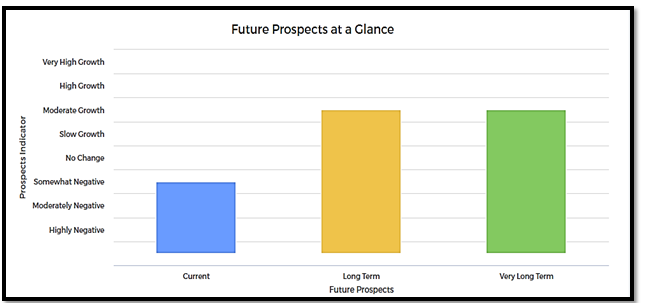
Future Prospects At A Glance
Current (0-1 year) | Long Term (2-5 year) | Very Long Term (6-10 years) |
Somewhat Negative | Moderate Growth | Moderate Growth |