

Social Scientist
Entry Level Qualification
Class Graduate
Career Fields
Humanities, Liberals Arts & Social Science
For Specially Abled


About Career
PARTICULARS | DESCRIPTION |
Name | Social Scientist |
Purpose | Analyze Social Patterns |
Career Field | Hospitality, Tourism & Transport Services |
Required Entrance Exam | No Entrance Exam |
Average Salary | 250000 - 400000 Rs. Per Year |
Companies For You | Amnesty International, World Health Organization (WHO) & Many More |
Who is Eligible | Post Graduate |
1. As a Social Scientist, you will be studying, assessing, and researching about as well resolving challenges concerning one or more complex aspects of our societies (local, national, regional, and global)– such aswelfare of the elderly, environmental changes, inequality among people, economic & political turmoil, movement of people (migration), social development, human rights, international relations, criminal justice, religion & traditions, demography/ population studies, tribal welfare, the military systems, natural disasters, epidemics, and so on.
2. These are some of the many areas where you can work as a Social Scientist. You will have several contributions to make such as devising ways to mitigate social trauma (suffering) or preventing social issues or finding solutions to introduce a happier & healthier way of being applicable to different cultures of societies. Let us take up some of the most prominent & interesting challenges in the current scenario.
Example 1 – Helping our Seniors
1. You must know that with the exponential advancement in medical and healthcare sciences as well as in engineering, the individual life expectancies of us Homo sapiens (the current occupants of this planet) have increased manifold.
2. This has led to increasing populations of the elderly. Japan has a staggering volume of the aged and has an inverted age pyramid (populations of age groups)! The top of an age pyramid indicates the elderly and the base indicates lower ages.
3. Social Gerontology is the academic field concerning the social aspect of growing old and welfare of the elderly. Social Scientists are in great demand to apply their expertise in improving support services towards the elderly for educating, researching, and advancing the broader causes of older people.
4. They play a crucial role, facilitating absolute handholding, in helping seniors achieve what they call ‘active aging’ by coming up with exciting programs, initiatives and services to assist their physical, cognitive and socio-emotional well-being. Their work can also influence law and policies that affect the way society perceives and treats our seniors.
Example 2 – The Curious Case of Personoids
1. Then humanoids or personoids (human like robots or human intelligence inside computers/ software or human with capabilities enhanced by artificial intelligence or robotic technologies- whatever you can think of), when they become real in another couple of decades (they will certainly do), will have to be taught everything about how humans behave in a groups, how our societies work or what kinds of problems our societies have, how they understand a language on a context, how they explain things with different words, how humans emote & behave, etc. This is because, to be part of human societies, they have to have these knowledges so that their communication and interactions with humans become effective and free of conflicts.
2. Understand that these knowledge’s, at least some basic knowledge about these, have to be built into the fully or partially artificial personoids or they should be taught through interactions. Social Scientists are working to structure and build such knowledges now and they will be called in for training or teaching them in the future.
Example 3 – There will still be humans
1. With these world-shattering innovations and transformations in our lives as we know it, we will be rendered completely unable to cope with the adjustments that will be needed in us (those who are still completely human or partially human), in order to use these technologies, wherever it may be, in all places where active human life takes some form.
2. Like say, a park while taking a stroll or playing professional games or at office doing work or in school/ college studying or say if we participate in a paradeor while watching television or listening to music (if at all television or music remain the way we know it now)! Currently, we cannot completely imagine what transformations may be brought about to which social aspect of our lives.
3. Because our societies will be transforming radically, working people (remember not just office, maybe students or others too) will also require mental & physical aid for readjusting to a new transformed life.
4. We may have super extended abilities too which we will have to use frequently in the years to come, say, detachable wings to get to office! Today, extended abilities are just limited to office software and little tiny bits of automated gadgets etc. Behold the future!
5. Every innovation which is utilized across societies for a purpose by several thousands of users has complex social aspects which can be addressed by Social Scientists. Social Scientists will have to theorize how to deal with such implementation of artificial intelligence or such extended abilities.
Example 4 –What when disease strikes?
1. Say when, the recent public health emergency caused due to the spread of the new type of Coronavirus (n-CoV) from China had impacted the welfare of civilians tremendously, even across national boundaries as the virus spread via air as well as asymptomatically (a person may spread without being ill but while carrying the virus).
2. The response measures that are being implemented have varying social effect on citizens and these measures vary from country to country. Social Scientists study differential effects of these measures on citizens across different demographics amongst the population targeted. Response measures create differences and social inequalities too.
3. Social Scientists may also propose suitable counter-balancing ideas & collaborative efforts involving even the international community to mitigate these social inequalities. Social Scientists, if involved, can play a crucial role in containing and managing such outbreaks. The medical interventions are as essential as the social interventions for coordinating corrective action internationally.
Example 5 – Where Art Thou Headed
1. Let us consider another example of the academic study of people migrating from one place to another.Social Scientists may be Migration Scholars too. Migration Scholars specialize in the academic study of human migration (size, structure, and distribution of migrant populations) or the movement of people across or within transnational boundaries, spanning different cultures and traditions.
2. They may specialize in archaeological studies focusing on early human migration flows, the spread of civilization and the development of trade routes & settlements. They may study how migration flows interact with literature & the arts or how cities & migrant populations interact or the economic results of migration.
3. They may work on issues involving undocumented and globally minor populations. They may also scrutinize the behavior of certain nation-state governments which criminalize migrant populations. They may deal with how migrants are frequently treated as criminals, deviants, and security risks by certain nation-states.
Key Roles And Responsibilities
You will be engaged in one or more of the following roles and responsibilities as well as other associated duties:
1. You will plan and conduct research to develop and test theories about societal issues such as group relations, poverty, crime, religion, natural resource management, youth/ gender issues, natural aging etc.
2. You will collect data about the attitudes, values, and behaviors of people in groups, using observation, interviews, and review of documents.
3. You will screen potential subjects to determine their suitability as study participants.
4. You will develop, implement, and evaluate methods of data collection, such as questionnaires or interviews.
5. You will administer standardized tests to research subjects, or interview them to collect research data.
6. You will observe group interactions and roles to collect data, identify problems, evaluate progress, and determine the need for additional change.
7. You will conduct internet-based & library research; you will prepare, manipulate, and manage extensive databases and perform descriptive analyses of data, using specific technical computer software.
8. You will consult with and advise individuals such as administrators, social workers, and legislators regarding social issues and policies, as well as the implications of research findings.
9. You will prepare tables, graphs, fact sheets, and written reports summarizing research results.
Career Entry Pathway
Class 10 all subjects as per scheme of studies – Class 11-12 with any subject as per scheme of studies – BA in Sociology/ Social Science/ Social Studies or similar – Master’s in Sociology/ Social Science/ Social Studies/ Social Science Research/Sociology & Social Research / Applied Social Science / Comparative Sociology or similar – Ph.D.
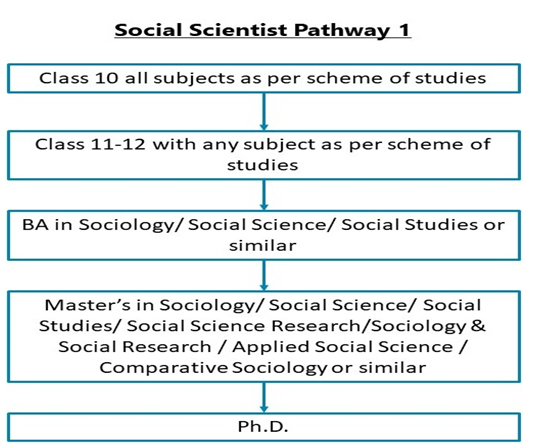
After completing Class 11-12 with any subject as per scheme of studies, you can go for a BA in Sociology/ Social Science/ Social Studies or similar then go for a Master’s in Sociology/ Social Science/ Social Studies/ Social Science Research/Sociology & Social Research / Applied Social Science / Comparative Sociology or similar. Thereafter you may go for doctoral studies with or without an M Phil degree. You may specialize in any such area of your interest within this field as applied / public sociology, women's studies, cultural sociology, urban sociology, gerontology, human rights, rural sociology, disaster management, political sociology, water resource policies, folklore studies, human ecology, youth studies, environmental sociology, demography & population studies, rehabilitation science or others.
Class 10 all subjects as per scheme of studies – Class 11-12 with any subject as per scheme of studies – Bachelor’s in Social Science/ Social & Policy Studies / Sociology and Media / English & Sociology or similar – MA in International Relations/ Defense & Strategic Studies / Criminology/ Applied Social Science / Comparative Sociology / Social Science Research/Sociology & Social Research or similar – Ph.D.
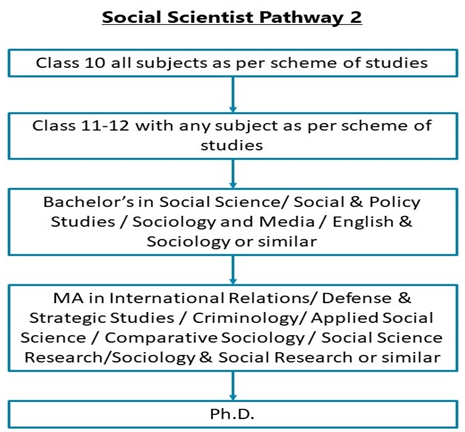
After completing Class 11-12 with any subject as per scheme of studies, you can go for a Bachelor’s in Social Science/ Social & Policy Studies / Sociology and Media / English & Sociology or similar. Then go for an MA in International Relations/ Defense & Strategic Studies / Criminology/ Applied Social Science / Comparative Sociology / Social Science Research/Sociology & Social Research or similar Thereafter you may go for doctoral studies with or without an M Phil degree. You may specialize in any such area of your interest within this field as international studies, defense studies, military sociology, urban sociology, criminology, applied / public sociology, comparative sociology, human rights, disaster management, political sociology, water resource policies, folklore studies, human ecology, youth studies, environmental sociology, demography & population studies, cultural sociology, rehabilitation science or others.
Class 10 all subjects as per scheme of studies – Class 11-12 Mathematics along with any other subject as per scheme of studies – B Sc in Social Science / Applied Social Science / Human & Social Sciences/ Health & Social Science or similar – Master’s in Computational Social Science/ Social Data Science / Gerontology & Ageing/ Applied Social Data Science or similar – Ph.D.
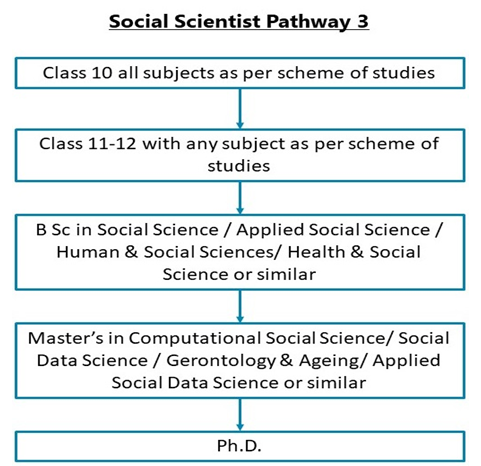
After completing Class 11-12 Mathematics along with any other subject as per scheme of studies, you can go for a B Sc in Social Science / Applied Social Science / Human & Social Sciences/ Health & Social Science or similar. Then you may go for a Master’s in Computational Social Science/ Social Data Science / Gerontology & Ageing/ Applied Social Data Science or similar disciplines. Thereafter you may go for doctoral studies with or without an M Phil degree. You may specialize in any such area of your interest within this field as computational social science, social data science, gerontology & ageing, applied social data science, international studies, human rights, disaster management, water resource policies, industrial sociology, energy studies, human ecology, youth studies, environmental sociology, demography & population studies, rehabilitation science or others.
Required Qualification & Competencies
To get into this field, you need to complete Class 10 all subjects as per scheme of studies. Then you have to complete Class 11-12 with any subject as per scheme of studies.
After Class 11-12:
You can go for a Bachelor’s degree in Sociology/ Social Science/ Social Studies / Sociology and Media / English & Sociology / Social Science / Applied Social Science / Human & Social Sciences/ Health & Social Science or similar disciplines
You can study for a Bachelor’s / Master’s / Doctoral degree in any of the following fields (Note that all these fields may not offer you a degree at all three levels, that is in Bachelor’s, Master’s and Doctoral. Some fields may offer a degree only at the Master’s or at the Doctoral level):
1. Social Science
2. Sociology
3. Applied Sociology
4. Comparative Sociology
5. Computational Sociology
6. Cultural Sociology
7. Community Science and Studies
8. Consumer Sciences & Studies
9. Criminology
10. Development Studies
11. Disaster Management
12. Energy Studies
13. Folklore and Culture Studies
14. Gender Studies
15. Gerontology
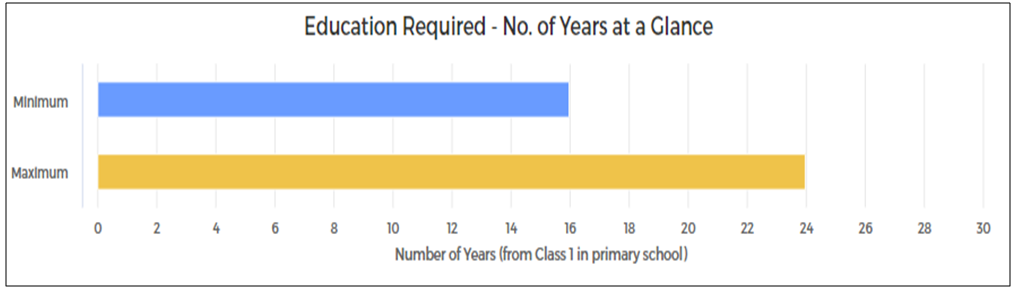
MINIMUM EDUCATION REQUIRED | MAXIMUM EDUCATION REQUIRED |
EDUCATION REQUIRED Under Graduate DESCRIPTION Undergraduate Degree / Honours Diploma / Graduate Diploma (equivalent to a Degree) Programs for which the minimum eligibility is a pass in Higher Secondary / Class XII School Leaving examination. | EDUCATION REQUIRED Post-Doctoral DESCRIPTION Post Ph.D. programs for which the minimum eligibility is a Doctoral degree. |
Competencies Required
Interests
1. You should have interests for Social Occupations. Social occupations involve helping or assisting others; these involve working with and communicating with people to provide various services; these may involve educating and advising others.
2. You should have interests for Investigative Occupations. Investigative occupations involve working with ideas and quite a lot of thinking, often abstract or conceptual thinking. These involve learning about facts and figures; involve use of data analysis, assessment of situations, decision making and problem solving.
3. You should have interests for Enterprising Occupations. You should have interests for Enterprising Occupations. Enterprising occupations involve taking initiatives, initiating actions, and planning to achieve goals, often business goals. These involve gathering resources and leading people to get things done. These require decision making, risk taking and action orientation.
Knowledge & Skills
1. You should have knowledge of Sociology - Knowledge of how humans behave in groups, how societies form, social norms, human relationships, social interactions, cultures and societal trends.
2. You should have Active Listening Skills - Giving full attention to what other people are saying, understanding the points being made by others, asking questions, etc.
3. You should have Coordination Skills - working together with other people to get things done.
4. You should have Critical Thinking skills- Skills in the analysis of complex situations, using logic and reasoning to understand the situations and take appropriate actions or make interpretations and inferences.
5. You should have Judgment and Decision Making Skills - considering pros and cons of various decision alternatives; considering costs and benefits; taking appropriate and suitable decisions.
6. You should have Problem Solving Skills - Skills in analysis and understanding of problems, evaluating various options to solve the problems and using the best option to solve the problems.
7. You should have Reading Comprehension Skills - Skills in understanding written sentences and paragraphs in work related documents.
Ability
1. You should have Written Expression Ability - The ability to communicate information and ideas in writing so others will understand.
2. You should have Verbal Reasoning Ability - The ability to think and reason with words; the ability to reason out ideas expressed in words.
3. You should have Information Ordering Ability – The ability to arrange things or actions in a certain order or pattern according to a specific rule or set of rules (e.g., patterns of numbers, letters, words, pictures, mathematical operations).
4. You should have Oral Comprehension Ability - listen to and understand information and ideas presented through spoken words and sentences.
5. You should have Oral Expression Ability - communicate information and ideas in speaking so others will understand.
6. You should have Problem Sensitivity - The ability to tell when something is wrong or is likely to go wrong. It does not involve solving the problem, only recognizing there is a problem.
7. You should have Deductive Reasoning Ability - apply general rules and common logic to specific problems to produce answers that are logical and make sense. For example, understanding the reasons behind an event or a situation using general rules and common logic.
8. You should have Inductive Reasoning Ability - The ability to combine pieces of information from various sources, concepts, and theories to form general rules or conclusions. For example, analyzing various events or situations to come out with a set of rules or conclusions.
9. You must have Inter-Personal Ability - The ability to build and maintain good relationships with others at workplaces and elsewhere.
Personality Traits
1. You are always or mostly caring, supportive, sympathetic and kind to others.
2. You can always act independently or could do so in most situations.
3. You always prefer to experience new things and have new experiences, or you mostly do.
4. You are always or mostly careful about your actions and behaviour.
5. You are always or mostly disciplined in your action and behaviour.
6. You are always calm or generally remain calm in most situations.
Career - Job Opportunities & Profiles
Before starting out with a permanent industrial role, you must look for volunteering opportunities with organizations and / or businesses while completing your education. This will help you develop the skills relevant to this industry. Such volunteering work opportunities exist with schools, community education or social work departments, or with groups including young people, victims of crime or homeless people etc.
If you start as a Program Intern / Project Intern or Extern or Trainee, then after completing your internship or traineeship you may rise to such positions as these.
1. Applied Social Scientist
2. Research Scientist-Social Science
3. Policy Officer
4. Survey Scientist
5. Social Researcher
6. Sustainability Science Researcher-Social Responsibility
7. Well-Being Quantitative Researcher
8. Community Development Worker
9. International Aid/Development Worker
10. Population Data Scientist
11. Implementation Research Scientist
12. Youth Worker
13. Charity Officer
14. People Research Scientist
15. Family Support Worker
Typical employers include:
1. Charitable, counseling, voluntary organizations/ NGOs
2. Any government owned corporations, ministries, or departments in central/ state governments such as transportation, health, agriculture, urban/ rural development, defense, treasury, labor, public services, education etc.
3. Media companies, marketing & PR firms
4. Social & market research organizations, survey companies like Nielsen etc. which conduct mass live data collection
5. International policy-making and advisory organizations such as WHO, UN, International Food Policy Research Institute, IUCN, Organization for Economic & Co-operation Development etc.
6. Giant IT companies. These generally look for Doctorates though. Some are Google, Amazon, Facebook, Microsoft etc. for positions like Research Scientist, Sustainability Science Researcher, Researcher - Social Media Collective. Here you will be expected to offer solutions with empirical & critical perspectives to complex socio-technical issues for these IT service providers and hardware manufacturing companies. You may be building analytical models and working with structured & unstructured data sets. You may participate in demographical and survey studies which help in crucial business decision making.




7. Experimentation-oriented analytics firms like Applied Predictive Technologies (which was acquired by MasterCard® recently)
8. On the academic faculty of universities, research institutions etc.
Specialisation Tracks In This Career
1. Social Scientist (Applied / Public Sociology)
Applied Sociologists use their research findings as well as sociological theory to resolve real-life problems in the ongoing activities contained within applied or practical settings, like offices, parks, schools, and other places where daily life takes place. Research is the foundation of applied sociology. Sociological Practice is a more appropriate term. Applied Sociologists / Social Scientists use sociological theory, methods & skills to collect and analyze data, to communicate their findings and to understand & resolve social problems.
2. Social Scientist (Defense Studies)
Social Scientists may specialize in defense studies which is an interdisciplinary research area, considering basic politological (description, analysis & prediction of political behavior), communicological (how we create & use messages to affect our social environment) and sociological findings. They are experts in the field of national & international security, teamwork, conflict resolution and strategic thinking. They study social dimensions of security, defense, military and peace in a contemporary world.
3. Social Scientist (Comparative Sociology)
Comparative Sociologists study the comparison of the social processes between nation states, or across different types of society (for example capitalist and socialist). Some seek similarity across different countries and cultures. This field may be more appropriately called cross-national research, as essentially all sociological analyses are comparative.
4. Social Scientist (Women's Studies)
Social Scientists specializing in this area draw on feminist & interdisciplinary methods in order to place women’s lives and experiences at the center of their study. They examine social and cultural constructs of gender; systems of privilege & oppression; and the relationships between power & gender as they intersect with other identities such as race, socio-economic class, and disability.
5. Social Scientist (International Studies)
Social Scientists specializing in International Studies focus on the major political, economic, social, & cultural issues that dominate the international and national boundaries. They have to study politics, economics and law on a global level. They have a profound contemporary & historical understanding of global societies, cultures, languages & systems of government and of the complex relationships between them.
6. Computational Sociologist
Computational Sociologists specialize in the computationally intensive methods (like software to analyze research data) to analyze and model social phenomena. They use computer simulations, artificial intelligence, complex statistical and mathematical tools, etc. to develop and test social theories.
7. Social Scientist (Criminology)
Social Scientists specializing in Criminology deal with the scientific study of the nature, extent, management, causes, control, consequences, & prevention of criminal behavior, both on individual as well as social levels. Criminologists often look for behavioral patterns of a possible criminal. They also conduct research & investigations, developing theories and composing results, and often solving crimes.
8. Social Scientist (Rehabilitation Science)
Social Scientists specializing in Rehabilitation Therapy & Science work with people to help them restore normal day to day physical functionalities, mental abilities, and work life after a debilitating illness, accidental injuries, surgeries, imprisonment, or addiction. They also deal with people having disabilities who need to develop physical and mental abilities to lead a normal, healthy and work life.
9. Migration Scholar
Migration Scholars specialize in the academic study of human migration (size, structure, and distribution of migrant populations) or the movement of people across or within transnational boundaries, spanning different cultures and traditions. They may specialize in archaeological studies focusing on early human migration flows, the spread of civilization and the development of trade routes & settlements. They may study how migration flows interact with literature and the arts or how cities & migrant populations interact or the economic results of migration. They may work on issues involving undocumented populations. They may also scrutinize the behavior of certain nation-state governments which criminalize migrant populations.
10. Social Scientist (Cultural Sociology)
Cultural Sociologists specialize in the analysis of culture. They research and analyze how cultural aspects, that describe the way of life of a person, affect human connections. They study class system, caste system, customs, and traditions, language, religion, artifacts, etc. in cultural sociology.
11. Social Scientist (Demography & Population Studies)
Social Scientists specializing in Demography & Population Studies focus on the study of population in respect to environment, geography & climate or with respect to race by taking consideration of mortality, fertility, birth rate, life expectancy, marriage traditions like polygamy, health, and genes etc.
12. Social Scientist (Environmental Sociology)
Environmental Sociologists specialize in the study of interactions between societies and their natural environments. They study how social factors can influence environmental resource management and social factors can cause environmental issues and how society responds to these problems.
13. Social Scientist (Youth Studies)
Social Scientists specializing in Youth Studies are devoted to the study of the development, history, culture, psychology, and politics of youth. They not only study specific cultures of young people, but also their relationships, roles & responsibilities throughout the larger societies. Studies in this area particularly encourage the understanding of experiences that are predominantly manifested among young people, generalized phenomenon as well as social change.
14. Social Scientist (Human Ecology)
Human Ecologists specialize in the study of the relationship between humans and their natural and social environment. They study the role of social, cultural and psychological factors that maintain the ecosystem. They also study the effect of population density on health, social organization, and environmental quality.
15. Social Scientist (Energy Studies)
Social Scientists specializing in Energy Studies examine the relationship between energy systems and society. They focus on a range of topics revolving around the intersection of energy technologies, fuels, and resources on one side; and social processes and influences - including communities of energy users, people affected by energy production, social institutions, customs, traditions, behaviors, and policies - on the other. They are interested in the social aspects of energy production or use, as well as sometimes policymaking.
16. Social Scientist (Industrial Sociology)
Industrial Sociologists are the experts who specialize in the study of trends in technological change, globalization, work organization, managerial practices, and employment and how these trends are affecting the changing pattern of inequality in modern societies. They study the effect of industry and its factors on human relations, human society, families, and social order.
17. Social Scientist (Folklore Studies)
Social Scientists may specialize in Folklore Studies. Folklore means the traditional expressive culture shared within various groups: familial, ethnic, occupational, religious or regional. They study a wide range of creative & symbolic forms of expressions such as custom, belief, technical skill, language, literature, art, architecture, music, play, dance, drama, ritual, pageantry, handicraft among these social groups. ‘Folk’ was traditionally applied only to rural, frequently poor and illiterate may be the peasant classes. However, contemporarily the word relates to a social group which includes two or more persons with common traits, who express their shared identity through distinctive traditions.
18. Social Scientist (Military Sociology)
Military Sociologists are experts who specialize in the study of the military as a social group. They study civil-military relations, life after military duty, military as a profession, etc. and how these factors are affecting social relations within the military and outside the military.
19. Social Scientist (Water Resource Policies)
Social Scientists may specialize in the policy-making processes that affect the collection, preparation, use and disposal of water to support human uses and protect environmental quality. They address provision, use, disposal & sustainability decisions concerning water resources extensively or scarcely used by particular social groups, broad regions as well as cross-national locations.
20. Social Scientist (Political Sociology)
Political sociologists specialize in the study of political factors like the state, civil society, family, citizenships, social-political movement through sociological analysis. They study, why particular class, caste, group of people and nationality vote or do not vote. They study how certain class, a caste of people has been popular in politics, what make cast-based politics in India, etc.
Career Growth
1. The career growth in university and college begins from Assistant Professor and then Associate Professor, Professor and Professor Emeritus. Professors can also get administrative positions such as Director/Dean/Vice Chancellor, etc.
2. If you are hired as a research associate, then you will go on to become a Doctoral Research Fellow, then Post-Doctoral Research Fellow in Progressive Grades.
3. If you join the private industry in Research / Scientific or related roles, you may progress to the Senior Level, Lead -> Principal -> Chief levels, and then gradually move on to become Research Director or VP-Strategy etc.
Salary Offered
Industrial Work
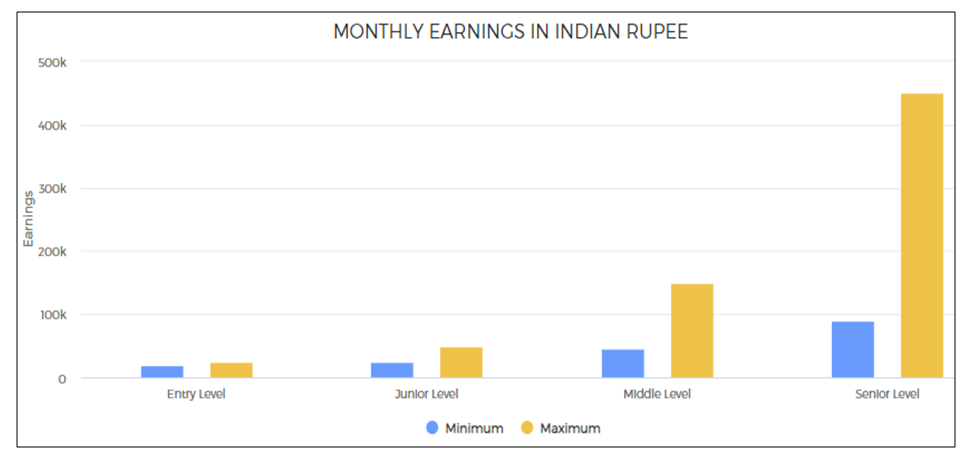
1. At the entry level jobs, after your post-graduation, you may expect to get about Rs. 20,000 – 25,000 or even more a month. In junior level jobs (after 4-5 years of post-graduation), you can make about Rs. 25,000 – 50,000 or more per month.
2. In mid-level jobs in India, you can expect to earn about Rs. 45,000 – 150,000 or even more a month.
3. In senior-level jobs in India, you can expect to earn about Rs. 90,000 – 4,50,000 or even more a month.
Research
1. After a Master’s degree, stipend in India while doing PhD is about Rs. 35,000-38,000 a month in a university or research centre or as a Research Associate with a salary of about Rs. 15,000-20,000 a month.
2. After a PhD, stipend for Post-Doctoral Fellows in a research institution or university research centre is Rs. 40,000-45,000 a month.
3. In other organizations/companies mostly after a Ph.D. or after a Post-Doctoral Fellowship, salaries in India may vary between Rs. 50,000-1,20,000 a month or even more.
Academia
As per the Government prescribed salary scales at colleges and universities:
1. Assistant Professor Grade II: Rs 57700 to Rs 117200 per month
2. Assistant Professor Grade I: Rs 101500 to Rs 204700 per month
3. Associate Professor: Rs 139600 to Rs 211300 per month
4. Professor: Rs 144200 to Rs 224100 per month
Professionals on the faculty of private establishments have varied ranges too :
1. Qualified Master’s: Rs. 20,000 – 35,000 per month or more
2. Qualified PhD: Rs. 45,000 – 85,000 per month or more
3. Higher qualifications: Rs. 55,000 – 1,50,000 per month or more
Monthly Earnings In Indian Rupee
Entry Level | Junior Level | Mid Level | Senior Level | ||||
Min Earning | Max Earning | Min Earning | Max Earning | Min Earning | Max Earning | Min Earning | Max Earning |
20000 | 25000 | 25000 | 50000 | 45000 | 150000 | 90000 | 450000 |
1. Entry level: 0 - 2 years of work experience
2. Junior Level: From 1 to 12 years of work experience
3. Mid Level: From 5 to 20+ years of work experience
4. Senior Level:From 10 to 25+ years of work experience (there could be exceptions in some high-end technical, financial, engineering, creative, management, sports, and other careers; also in the near future, people will reach these levels much faster in many careers and in some careers, these levels will have no meaning as those careers will be completely tech skill driven such as even now, there is almost no level in a Cyber Security Expert’s job)
Work Activities
1. Assisting and caring for people - Assisting people in availing of services; taking care of people in different situations; offering help and services to others.
2. Creative thinking - Developing new ideas, concepts, innovative solutions to problems, newer ways of getting things done, designing products and services, creating work of art and craft, etc.
3. Getting Information and learning - Observing, hearing, reading, using computers, or otherwise obtaining information and learning from it.
4. Identifying objects, actions, and events - Identifying various characteristics of objects; observing and understanding actions and events; understanding changes in actions and events
5. Inspecting situations, events, and people - Inspecting situations, events and people to understand the reasons and causes for the situation or events to happen; inspecting people to understand reasons behind their behavior and actions
6. Leading - Inspiring and motivating co-workers to work to achieve specific goals; enabling and facilitating others to perform tasks effectively; addressing issues and solving problems in order to help people perform well.
7. Providing advices and consultation to others - Giving advices or consultation to others about various issues, conceptual matters, or know-hows
8. Working directly with people - Working directly with people to offer them products and services, providing assistance, etc.
Future Prospects
1. Social sciences play an integral role in today’s globalized world. It is reported that 60% of global leaders graduated with a social science degree. With increasing impoverishment across nations in the world, Social Scientists are required to think creatively & independently in order to understand, scrutinize and re-assess common perceptions of the social world.
2. With their cross-cultural understanding of the world, they are heavily in demand across industrial verticals to appreciate the complexity & diversity of social situations, make reasoned arguments, and apply different research methods, analysis & statistical techniques to develop opinions and new ideas on societal issues.
3. Tomorrow’s most important discoveries into why people do what they do will most likely come from business innovation than university research. The best & most rigorous social science experiments will be done for profit. Google, Facebook, Amazon, Microsoft, Netflix, Alibaba and scores of other global enterprises conduct literally thousands of experiments on their networks every day.
4. Many or most of these ‘socio-tech-experiments’ or “people analytics” yield marginal shifts in terms of increments in design. But with literally billions of measurable customers, client, & channel interactions a year, these could no doubt lead to profitably disruptive innovations too.
Future Prospects At A Glance
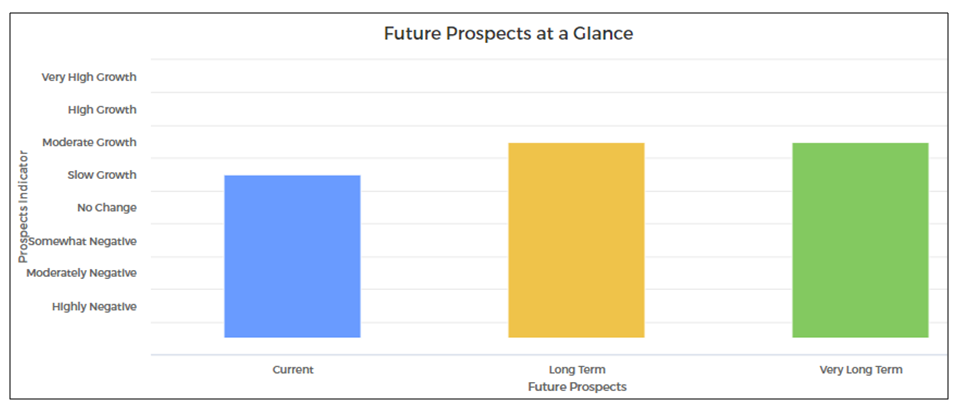
Current (0-1 year) | Long Term (2-5 year) | Very Long Term (6-10 years) |
Slow Growth | Moderate Growth | Moderate Growth |