

Sanskrit Litterateur
Entry Level Qualification
Class 12
Career Fields
Humanities, Liberals Arts & Social Science
For Specially Abled


About Career
1. A Litterateur is a person who is engaged in studying and writing literature as a profession. Most Litterateurs are involved in creating and writing various works of literature such as poems, verses, stories, novels, and plays. Some of them study various works of literature to appreciate, analyse, criticise and interpret. Some of them translate works of literature from one language into another.
2. Sanskrit Litterateurs write, study, research, analyse, interpret, criticise, and translate scriptures, verses, fictions, plays, and other documents written in Sanskrit in the ancient, medieval as well as modern age. For example, Vedas, Upanishads, Puranas, various other works of fiction.
3. As a few examples - you may study, analyse, give a new line of interpretation or even write a complete treatise (a long discourse or dissertation) on various Puranas (Puranas are ancient sacred verses in Hinduism) such as Markandeya, Matsya, Vamana, Vishnu, Brahma, and Kalki Purana; you may study and discover new dimensions of the epics Ramayana and Mahabharata; you may study and interpret the tales of the Panchatantra to make it relevant for the modern age; you may study and interpret the works of Kalidasa such as Raghuvamsa and Meghaduta.
Key Roles And Responsibilities:
As a Sanskrit Litterateur, you may get engaged in any one or more roles such as:
1. Sanskrit Scholar: As a Scholar, you will be typically studying and researching on Sanskrit literature which could be ancient scriptures, works of literature, and documents. You will study and research to analyse and interpret.
2. Language Specialist: As a Language Specialist (typically referred to as Linguist), you will be involved in understanding the nuances of Sanskrit language – how did it originate, how did it evolve, how did it develop, how the words formed, and how it is evolving now. You will help in analysing dialects, manner of speech, correct usage, and so on.
3. Sanskrit language Teacher: You can be a Sanskrit Teacher in a mainstream school where Sanskrit is offered as a subject or in a Sanskrit Pathshala (special schools for studying Sanskrit from a young age) such as the Hemachandra Sanskrit Pathshala in Ahmedabad and Parmarth Niketan in Rishikesh.
PARTICULARS | DESCRIPTION |
Name | Sanskrit Litterateur |
Purpose | Studying & Researching |
Career Field | Humanities, Liberals Arts & Social Science |
Required Entrance Exam | CUET UG, CUET PG |
Average Salary | 150000 - 300000 Rs. Per Year |
Companies For You | Cultural and Heritage Organizations, Language and Literature Schools & Many More |
Who is Eligible | Class 12th |
Career Entry Pathway
Class 10 all subjects as per scheme of studies - Class 11-12 Sanskrit Language along with any subject as per scheme of studies – Bachelor’s degree in Sanskrit (Shastri) – Diploma and Certificate courses.
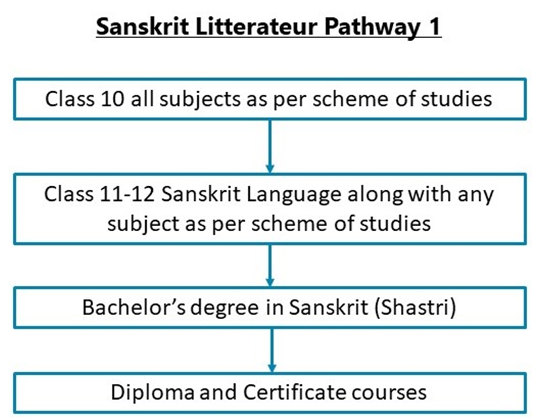
After completing Class 10 all subjects as per scheme of studies, then Class 11-12 Sanskrit Language along with any subject as per scheme of studies you can go for a B.A. in Sanskrit (Shastri). After a bachelor’s degree you can study for a diploma or certificate course in Temple Management, Paurohitya, Jyotisha, Vastushastra, etc
Class 10 all subjects as per scheme of studies - Class 11-12 Sanskrit Language along with any subject as per scheme of studies – Bachelor’s degree in Sanskrit (Shastri) – B.Ed. (Shiksha Shastri).
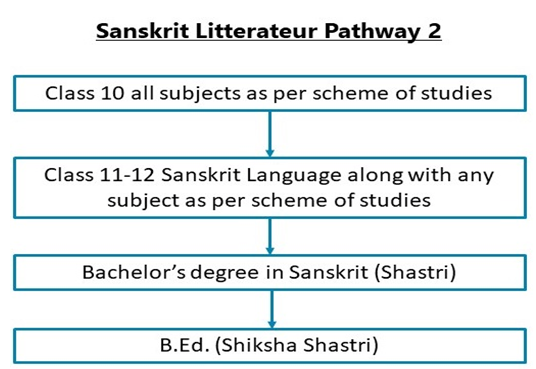
After completing Class 10 all subjects as per scheme of studies, then Class 11-12 Sanskrit Language along with any subject as per scheme of studies, you can go for a Bachelor’s degree in Sanskrit (Shastri). After acquiring a bachelor’s degree, you can pursue a B.Ed. in Sanskrit to get opportunities in school teaching. You may also opt to do an M.Ed. after B.Ed.
Class 10 all subjects as per scheme of studies - Class 11-12 Sanskrit Language along with any subject as per scheme of studies –Bachelor’s degree in Sanskrit (Shastri) – a Master’s degree in Sanskrit (Acharya)
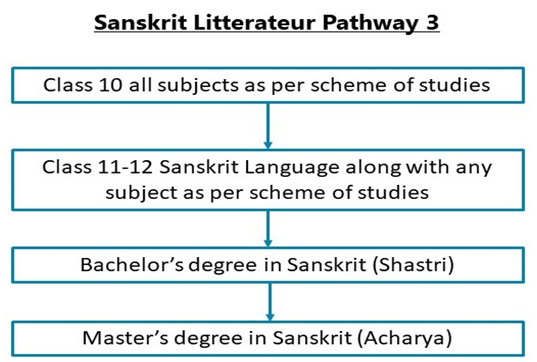
After completing Class 10 all subjects as per scheme of studies, then Class 11-12 Sanskrit Language along with any subject as per scheme of studies, you can go for graduation in Sanskrit (Shastri) followed by a master’s or a post graduate degree in Sanskrit.
Class 10 all subjects as per scheme of studies - Class 11-12 Sanskrit Language along with any subject as per scheme of studies – Bachelor’s degree in Sanskrit (Shastri) - a Master’s degree in Sanskrit (Acharya) – M.Phil. (Vidhyanidhi) – Ph.D. (Vidyavaridhi).
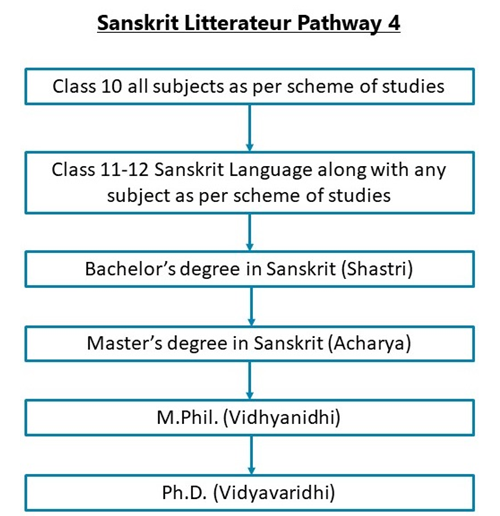
After completing Class 10 all subjects as per scheme of studies, then Class 11-12 Sanskrit Language along with any subject as per scheme of studies, you can go for graduation in Sanskrit (Shastri) followed by a master’s or a post graduate degree in Sanskrit. Then you can either go for an M.Phil. in Sanskrit first or directly enrol into a Ph.D. You can do a Ph.D. after M.Phil. as well. "
Required Qualification & Competencies
1. To become a Sanskrit Litterateur, you should start learning the language from school. You should pass your secondary examination and higher secondary examination with Sanskrit as a language.
2. You may also opt for a two year course in Prak-Shastri. A student who has passed either Prak–Shastri or equivalent examination (Class 12) with Sanskrit may be admitted to B.A. (Hons) Sanskrit (Shastri).
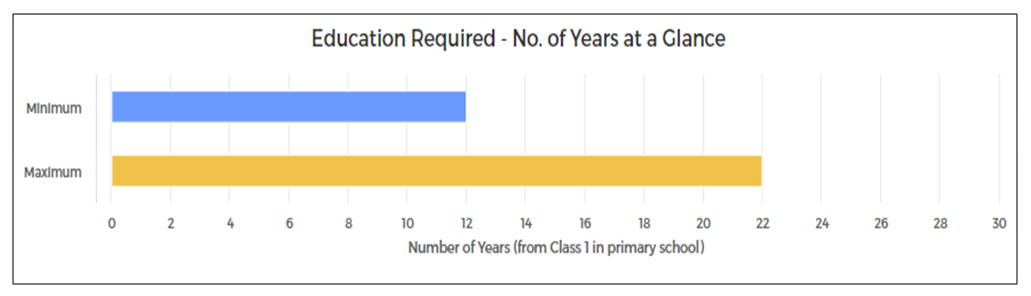
MINIMUM EDUCATION REQUIRED | MAXIMUM EDUCATION REQUIRED |
EDUCATION REQUIRED Post Higher Secondary DESCRIPTION Diploma / Certificate Programs for which the minimum eligibility is a pass in Higher Secondary / Class XII School Leaving examination. | EDUCATION REQUIRED Post-Doctoral DESCRIPTION Post Ph.D. programs for which the minimum eligibility is a Doctoral degree. |
Competencies Required
Interests
1. Investigative: You should have interests for Investigative Occupations. Investigative occupations involve working with ideas and quite a lot of thinking, often abstract or conceptual thinking. These involve learning about facts and figures; involve use of data analysis, assessment of situations, decision making and problem solving.
2. Artistic: You should have interests for Artistic Occupations. Artistic occupations mostly involve working with creative ideas, art and designs. These occupations involve abstract or conceptual thinking, creative self-expression and often do not follow any set processes or rules for getting things done.
3. Social: You should have interests for Social Occupations. Social occupations involve helping or assisting others; these involve working with and communicating with people to provide various services; these may involve educating and advising others.
Abilities
1. Abstract Reasoning: The ability to understand ideas which are not expressed in words or numbers; the ability to understand concepts which are not clearly expressed verbally or otherwise.
2. Deductive Reasoning: The ability to apply general rules and common logic to specific problems to produce answers that are logical and make sense. For example, understanding the reasons behind an event or a situation using general rules and common logic.
3. Fluency of Ideas: The ability to come up with a number of ideas about a topic (the number of ideas is important, not their quality, correctness, or creativity).
4. Inductive Reasoning: The ability to combine pieces of information from various sources, concepts, and theories to form general rules or conclusions. For example, analysing various events or situations to come out with a set of rules or conclusions.
5. Oral Comprehension: The ability to listen to and understand information and ideas presented through spoken words and sentences.
6. Oral Expression: The ability to communicate information and ideas in speaking so others will understand.
7. Verbal Reasoning: The ability to think and reason with words; the ability to reason out ideas expressed in words.
8. Written Comprehension: The ability to read and understand information and ideas presented in writing.
9. Written Expression: The ability to communicate information and ideas in writing so others will understand.
Knowledge
1. Sanskrit Language: Knowledge about the grammar, words, spelling, sentence construction, etc. of Sanskrit and using the language to communicate with others, reading, etc.
2. Education and Training: Knowledge of various principles and methods of developing training or teaching curriculum, design of instructional methods, developing course materials, teaching and giving instruction individuals and groups.
Skills
1. Active Learning: Focused and continuous learning from various sources of information, observation and otherwise for application in getting work done.
2. Communication in Sanskrit: Skills in communicating effectively in writing as well as verbally with others in Sanskrit language.
3. Critical Thinking: Skills in analysis of complex situations, using of logic and reasoning to understand the situations and take appropriate actions or make interpretations and inferences.
4. Instruction: Skills in training others how to do something.
5. Reading Comprehension: Skills in understanding written sentences and paragraphs in work related documents.
6. Teaching: Skills in teaching and educating others about various academic and applied subjects across different academic fields.
7. Writing: Skills in communicating effectively in writing as appropriate for the needs of the readers.
Personality
1. You are a soft-hearted person sometimes.
2. You trust others sometimes but not always.
3. You are helpful to others sometimes.
4. You are self-satisfied sometimes but some other times you don't feel satisfied with your life and situations.
5. You are imaginative sometimes.
6. You prefer to experience new things and have new experiences sometimes.
7. You act independently sometimes but do not do so in some other times.
8. You are caring, supportive, sympathetic and kind to others sometimes.
Career - Job Opportunities & Profiles
1. After your B.Ed. in Sanskrit, you may get a job as an Assistant Teacher of Sanskrit
2. After your PhD in Sanskrit, you may get a job as a Lecturer or Assistant Professor.
3. In this field, most of the work opportunities are in the roles of a School Teacher and Assistant Professor in the beginning of your career.
4. You may also get an opportunity as a Research Fellow after your M.A./M.Phil. In a University or Sanskrit institute.
There are other roles, in which you may find temporary or freelance work:
1. Writer / Editor / Proofreader with a publishing house
2. Translator
You may also decide to be a Scholar independently and to earn your regular expenses you may take up a job which may not be related to Sanskrit.
Specialisation Tracks In This Career
1. Sanskrit Teacher (School Teacher)
You will be teaching Sanskrit to school students – either in mainstream schools under various boards or in specialised Sanskrit schools called Pathshala or Gurukul. Some of the Pathshalas are run as a full-fledged school which imparts education in various subjects apart from Sanskrit. Some of Pathashals and Gurukuls are devoted to teaching Sanskrit only. In these schools, students of all ages study to learn Sanskrit.
2. Professor (Sanskrit)
Sanskrit Professors study, research, and teach Sanskrit language and literature in higher education institutions such as colleges and universities. There are mainstream colleges and universities which offer Sanskrit as an undergraduate or postgraduate subject. There are also the specialised Sanskrit universities and higher education institutions such as Sanskrit University in Kolkata and Shri Lal Bahadur Shastri Rashtriya Sanskrit Vidyapeeth in New Delhi.
3. Linguist (Sanskrit)
As a Sanskrit Linguist, you will study and research about how Sanskrit originated, how has it evolved over the ages, the different properties of Sanskrit speech and languages, and how Sanskrit has changed and developed. You will apply your knowledge in various areas – from History and Anthropology to Sociology and Computer Science
4. Writer (Sanskrit)
You will create and write various works of literature in Sanskrit such as novels, poems, verses, short stories, plays, fictions, etc. You may also work as an Editor and Proof reader in Sanskrit with various publication houses.
Career Growth
1. In a school, you first join as an Assistant Teacher after B.Ed. (as a Trained Graduate Teacher or as a Trained Post Graduate Teacher depending upon whether you have Bachelor degree or a Master degree along with a B.Ed.). You will then become a Senior Teacher after 8-12 years of experience. You can become a Teacher-in-Charge or the Head of the Department after 15-20 years of experience.
2. In colleges and universities, you will first join as an Assistant Professor. After 8-12 years of experience, you will become an Associate Professor provided your performance is line with the UGC guidelines. Then after at least 15 years of experience, you will become a Professor. All promotions are based upon UGC guidelines. Some of the Professors can get promotions as Department Heads, Deans, Directors, Vice Chancellors, etc.
Salary Offered
As a School Teacher, at the beginning of your career, you will get about Rs. 10,000-15,000 per month in a private school or about Rs. 25,000-30,000 in a Government-run or Government aided school. As a Senior Teacher, you will earn about Rs. 35,000-45,000 and at senior pay scales after having 20+ years of experience, you will earn about Rs. 60,000-80,000 per month.
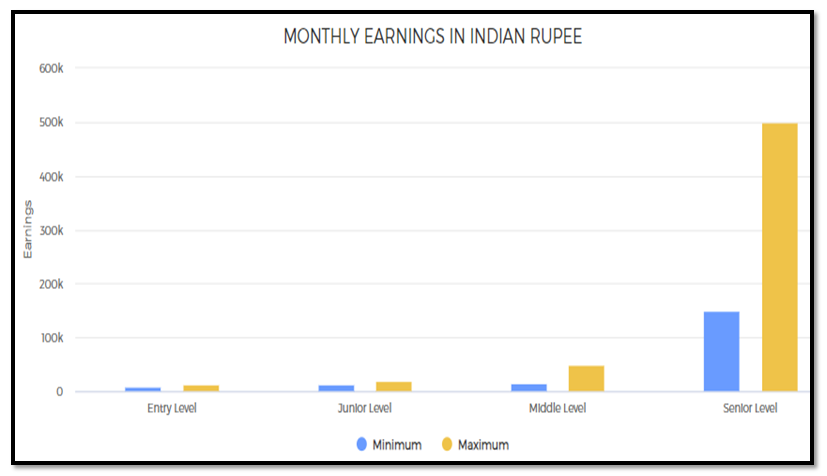
Monthly Earnings In Indian Rupee
Entry Level | Junior Level | Mid Level | Senior Level | ||||
Min Earning | Max Earning | Min Earning | Max Earning | Min Earning | Max Earning | Min Earning | Max Earning |
8000 | 12000 | 12000 | 20000 | 15000 | 50000 | 150000 | 500000 |
1. Entry level: 0 - 2 years of work experience
2. Junior Level: From 1 to 12 years of work experience
3. Mid Level: From 5 to 20+ years of work experience
4. Senior Level: From 10 to 25+ years of work experience (there could be exceptions in some high-end technical, financial, engineering, creative, management, sports, and other careers; also in the near future, people will reach these levels much faster in many careers and in some careers, these levels will have no meaning as those careers will be completely tech skill driven such as even now, there is almost no level in a Cyber Security Expert’s job)
Work Activities
1. Thinking Creatively- Developing, designing, or creating new applications, ideas, relationships, systems, or products, including artistic contributions.
2. Getting Information and learning- Observing, hearing, reading, using computers, or otherwise obtaining information and learning from it.
3. Analysing and interpreting data and information- Analysis of data and information to find facts, trends, and reasons behind situations etc. interpretation of data to aid in decision making.
4. Updating and using relevant knowledge- Keeping updated with the latest knowledge relevant to your fields of work and use of the relevant knowledge in getting things done.
5. Translating and interpreting- Translating or interpreting information for other people which is written or spoken in languages that other people do not understand.
6. Training and Teaching Others- Identifying the educational needs of others, developing formal educational or training programs or classes, and teaching or instructing others.
Future Prospects
India is considered to hold the position of the largest country with the largestnumber of higher education institutions in the world. The educational sector in the Indian markets still needs to be developed further so as to bring in more opportunities in this particular field. The Indian government is also targeting at raising current gross enrolment ratio into colleges to 30% . This will help in boosting up the growth in education as well as distance education in India. Although Sanskrit still needs to be reintroduced in many sectors, a career in this field will witness a slow growth but eventually, with ample experience, you may expect great career opportunities.
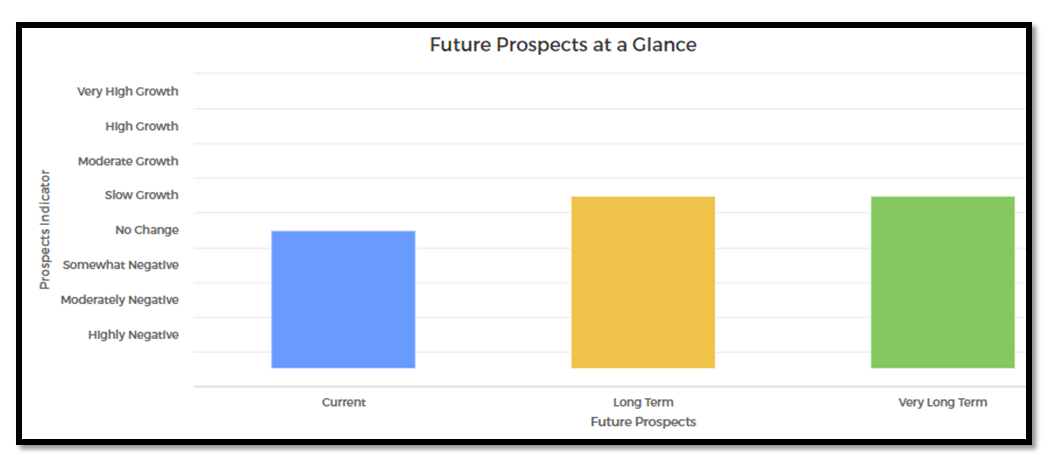
Future Prospects At A Glance
Current (0-1 year) | Long Term (2-5 year) | Very Long Term (6-10 years) |
No Change | Slow Growth | Slow Growth |