

Bioinformatician
Entry Level Qualification
Class Graduate
Career Fields
Agriculture & Food Science
For Specially Abled


About Career
PARTICULARS | DESCRIPTION |
Name | Bioinformatician |
Purpose | Analyze Biological Data |
Career Field | Mathematics & Science |
Required Entrance Exam | No Entrance Exam |
Average Salary | 300000 - 400000 Rs. Per Year |
Companies For You | Elucidata, Premas Life Sciences, BIS Research & Many More |
Who is Eligible | Graduate |
Bioinformatician or Bioinformatics Scientist is an expert who uses mathematical modelling, various computational methods, and computer software to collect, compile, store, analyse, interpret and visualize large volumes of biological data.
See a few examples of large volume of biological data:
The human, animal or plant genome or DNA sequencing data (as you know a human genome is the complete sequence of the nucleic acid bases Adenine, Guanine, Thymine, and Cytosin; these may form numerous sequences in a DNA; these sequences represent information) and RNA sequencing data (similarly, four nucleic acid bases, Adenine, Guanine, Cytosine and Uracil, form numerous sequences in RNA molecules; each sequence represent information). The information in DNA and RNA sequences are used by a living cell to produce proteins. Again understand that proteins are formed by a sequence of amino acids. These DNA and RNA sequencing data is an example of a very large volume of biological data sets.
Then consider the term Proteomics which is involves sequencing proteome. A proteome is the entire set of proteins that can be produced by a living cell by expressing the DNA and RNA sequence information. So you can understand the data from the entire set of proteins in humans or animals would be a very large volume of data.
Such large set of biological data requires specialist knowledge for compiling, formatting, storing, processing, analysis, interpretation andvisualisation. Bioinformatician or Bioinformatics Scientists are specialists who are involved in these functions. They study the nature of the biological data produced in an experiment or in a biological process at the molecular level, design and build a mathematical or statistical model (or methods), and write algorithms for processing and analysis of such data. They use different computation tools and software to use the models and algorithms for the data analysis.
Bioinformatician or Bioinformatics Scientists help in interpretation of biological data and help biological scientists and others visualise the data analysis and interpretation so that they can make sense of the data, meaning, use the information and insights in research and studies in different fields of medical science, pharmaceutical science, and biological science.
Key roles and responsibilities
As a Bioinformatics Scientist, depending on your field of specialisation, you would havethe following roles and responsibilities:
1. You will develop new software applications or make changes to the existing to meet specific scientific project needs.
2. You will communicate research results to another scientist, through conference presentations, scientific publications, or project reports.
3. You will create new methods and analytical tools to complete your research goals.
4. You will consult with researchers to analyse problems, recommend technology-based solutions, or determine computational strategies.
5. You will analyse large molecular datasets, such as raw microarray data, genomic sequence data, or proteomics data, for clinical or basic research purposes.
Career Entry Pathway
Class 10 all subjects as per scheme of studies– Class 11-12 Physics, Chemistry and Mathematics along with any other subject as per scheme of studies– UG in Bioinformatics Engineering
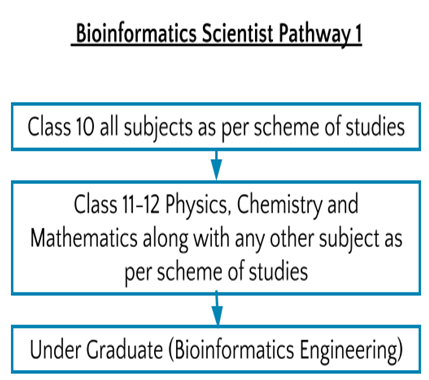
After Class 11-12 Physics, Chemistry and Mathematics along with any other subject as per scheme of studies, you can study science stream with Physics, Chemistry & Mathematics in your higher secondary school and then study for an undergraduate degree in Bioinformatics Engineering.
Class 10 all subjects as per scheme of studies– Class 11-12 Physics, Chemistry and Mathematics along with any other subject as per scheme of studies– UG in Bioinformatics Engineering – PG in Bioinformatics Engineering
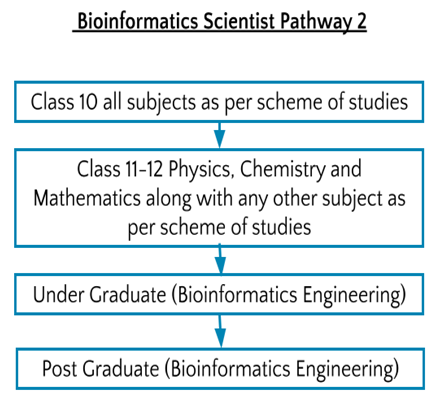
After Class 11-12 Physics, Chemistry and Mathematics along with any other subject as per scheme of studies, you can study science stream with Physics, Chemistry & Mathematics in your higher secondary school and then study for an undergraduate degree in Bioinformatics Engineering followed by a master’s degree in Bioinformatics Engineering.
Class 10 all subjects as per scheme of studies– Class 11-12 Physics, Chemistry and Mathematics along with any other subject as per scheme of studies– UG in Bioinformatics Engineering – PG in Bioinformatics Engineering – Ph.D. in Bioinformatics Engineering
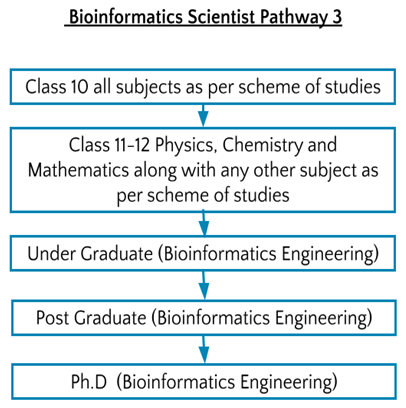
After Class 11-12 Physics, Chemistry and Mathematics along with any other subject as per scheme of studies, then study for an undergraduate degree in Bioinformatics Engineering followed by a post-graduate degree in Bioinformatics Engineering. Further, you can take Bioinformatics Engineering in Ph.D. and complete the doctoral degree.
Class 10 all subjects as per scheme of studies– Class 11-12 Physics, Chemistry and Mathematics along with any other subject as per scheme of studies– UG in Bioinformatics – PG in Bioinformatics
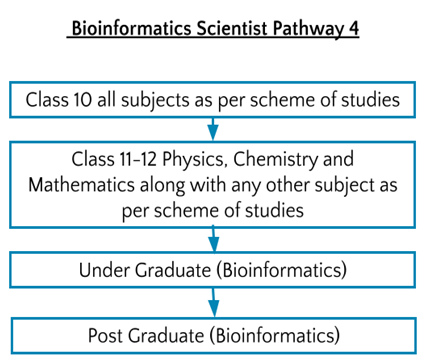
After Class 11-12 Physics, Chemistry and Mathematics along with any other subject as per scheme of studies, you can study science stream with Physics, Chemistry & Mathematics in your higher secondary school and then study for an undergraduate degree in Bioinformatics followed by a master’s degree in Bioinformatics.
Class 10 all subjects as per scheme of studies– Class 11-12 Physics, Chemistry and Mathematics along with any other subject as per scheme of studies–– UG in Bioinformatics – PG in Bioinformatics – Ph.D. in Bioinformatics
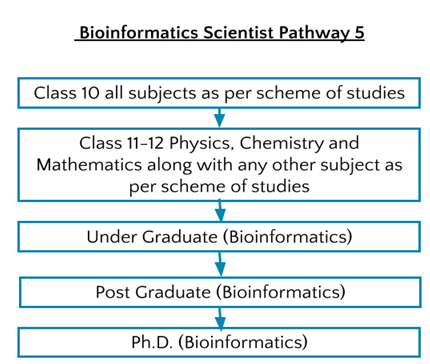
After Class 11-12 Physics, Chemistry and Mathematics along with any other subject as per scheme of studies, you can study science stream with Physics, Chemistry & Mathematics in your higher secondary school and then study for an undergraduate degree in Bioinformatics followed by a master’s degree in Bioinformatics. Now you can further go for a Ph.D. degree in Bioinformatics.
Required Qualification & Competencies
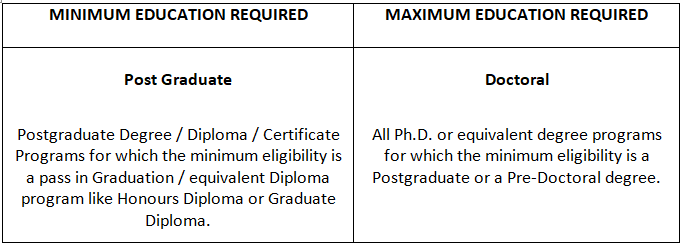
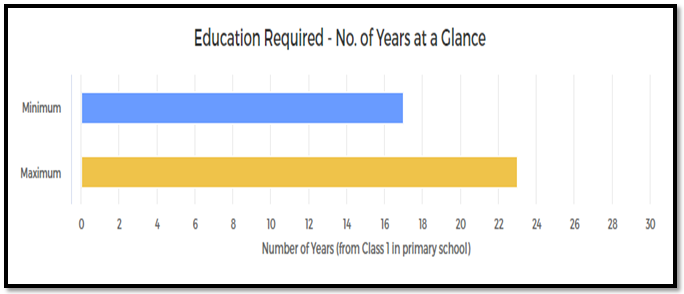
To become a Bioinformatician, you can study for obtaining a bachelor’s degree in any Biological Science, Bioengineering or related subject. You can also study for a degree in Mathematics or Statistics. After your bachelor’s degree you can do a Master’s degree in any of the following field or in any other related field:
1. Bioinformatics
2. Biostatistics (Biology)
3. Computational Biology
4. Medical Bioinformatics
Compentencies Required
Interests
1. Investigative: You should have interests for Investigative Occupations. Investigative occupations involve working with ideas and quite a lot of thinking, often abstract or conceptual thinking. These involve learning about facts and figures; involve use of data analysis, assessment of situations, decision making and problem solving.
2. Realistic: You should have interests for Realistic Occupations. Realistic occupations involve more practical and hands-on activities than paperwork or office work. Realistic occupations often involve physical activities for getting things done using various tools and equipment.
Abilities
1. Abstract Reasoning: The ability to understand ideas which are not expressed in words or numbers; the ability to understand concepts which are not clearly expressed verbally or otherwise.
2. Deductive Reasoning: The ability to apply general rules and common logic to specific problems to produce answers that are logical and make sense. For example, understanding the reasons behind an event or a situation using general rules and common logic.
3. Flexibility of Closure: The ability to identify or detect a pattern (a figure, object, word, or sound) that is hidden among other distracting materials.
4. Inductive Reasoning: The ability to combine pieces of information from various sources, concepts, and theories to form general rules or conclusions. For example, analysing various events or situations to come out with a set of rules or conclusions.
5. Inter-Personal: The ability to build and maintain good relationships with others at workplaces and elsewhere.
6. Naturalistic Intelligence: The ability to recognise different flora and fauna of the world; sensitivity towards nature and natural surrounding; sensitivity towards the needs of different flora and fauna.
7. Numerical Reasoning: The ability to add, subtract, multiply, divide, and perform other basic numerical calculations correctly.
8. Originality: The ability to come up with unusual or innovative ideas about a given topic or situation, or to develop creative ways to solve a problem.
9. Verbal Reasoning: The ability to think and reason with words; the ability to reason out ideas expressed in words.
10. Written Comprehension: The ability to read and understand information and ideas presented in writing.
Knowledge
1. Biological Sciences: Knowledge of plants and animals, their anatomical structure, cell structure, tissues, physiological functions, evolution, and all other related aspects.
2. Active Learning: Focused and continuous learning from various sources of information, observation and otherwise for application in getting work done.
3. Coordination: Skills in working together with other people to get things done.
4. Critical Thinking: Skills in analysis of complex situations, using of logic and reasoning to understand the situations and take appropriate actions or make interpretations and inferences.
5. Judgment and Decision Making: Skills in considering pros and cons of various decision alternatives; considering costs and benefits; taking appropriate and suitable decisions.
6. Problem Solving: Skills in analysis and understanding of problems, evaluating various options to solve the problems and using the best option to solve the problems.
7. Reading Comprehension: Skills in understanding written sentences and paragraphs in work related documents.
8. Scientific: Skills in using various scientific rules and methods to get things done or solve problems.
9. Technical: Skills in using various technologies and technical methods to get things done or solve problems.
Personality
1. You are always or mostly organised in your day-to-day life and activities.
2. You are a soft-hearted person sometimes.
3. You trust others sometimes but not always.
4. You are helpful to others sometimes.
5. You prefer to experience new things and have new experiences sometimes.
6. You act independently sometimes but do not do so in some other times.
Career - Job Opportunities & Profiles
1. If you are into data science, then you will be hired as Bioinformatics Trainee or Bioinformatics Research Associate or as Bioinformatician.
2. If you are into designing software and programmes then you may be hired as a software engineer trainee.
3. If you are into teaching, then you may join college or university at the profile of an assistant professor.
4. If you are into research, then you can join a research institutes and Data research companies at the role of research associate.
5. If you are into scientific research, then you can join as a Scientist with Grade “C”.
Different types of companies can offer you a job. Such as:
1. Biological data research companies like Elucidata, Premas Life Sciences, BIS Research, etc.



2. Pharmaceutical Companies like Ranbaxy, Cipla, etc.


3. Medical Biotechnology companies like Biocon, etc.
4. College and Universities in the field of Bioinformatics (including IITs).
Work Environment
Bioinformaticians work full time in office. If you are on the programming side, then you will be involved in creating software or tools for other researchers. You will work with other researches to understand the problem they want to solve and thus seek clarification of software or tools they need. You will have urgent requirements sometimes if the project is delicate. Most of the time you will work full working hours from the office
If you will be working on the research, then you will be under tremendous pressure as each research can involve analysing 100s of GB of data. This will mean you can be under pressure to deliver accurate results. However, you will be collaborating with several other informaticians.
Career Growth
1. The career growth in university and college states from Assistant Professor and then Associate Professor, Professor and Professor Emeritus. Professors can also get administrative positions such as Director/Dean/Vice Chancellor, etc
2. If you are hired as a research associate (in institutes), then you will go on to become a Doctoral Research Fellow, then Post-Doctoral Research Fellow and then Scientist in Progressive Grades.
3. If you are hired as a research associate in the research firm, then you will be promoted to senior research associate and then Research Analyst.
4. If you are hired as Bioinformatics Trainer or Bioinformatics Research Lead or Bioinformatician, then you will be promoted to Senior Scientific Bioinformatics, ten research head, then Senior Project head and then Head of Research.
5. If you are hired as Software Engineer, then you will be promoted to Senior Software Engineer, Project Manager, then Tea Leader and then head of IT.
6. Research laboratories will hire you as a scientist/scientist officer with the lowest grade and the grade changes from low to high. In India, grades are “Scientist “C” as the joining level and then D, E, F, G, H, etc. A senior-level scientist can also get into administrative positions like Principal Scientist, Assistant Director, Deputy Director, Director, etc.
Salary Offered
1. At the entry level, if you join as Bioinformatics Trainer or Bioinformatics Research Lead or Bioinformatician, then you will be earning anything between Rs. 25,000 to 50,000 per month. If you can join as a research associate, then your salary will be Rs. 25,000 to 30,000 per month. As a doctoral research fellow (junior research fellow) you would be earning around Rs. 35,000 to 38,000per month.
2. At the entry level, as a Scientist (grade C) you would be earning around 80,000 to 100,000 per month. As an assistant professor, you would be earning anything between 65,000 to 70,000per month. As a software engineer, you will be earning around Rs. 15,000 to 40,000 per month.
3. At the junior level with a work experience of 2-6 years, you would be earning anything between Rs. 30,000 to 1, 80,000 per month.
4. At the middle level with an experience of 10-12 years, you would be earning anything between Rs. 1,40,000 to 1,90,000 per month as a scientist and Rs. 1,20,000 to 1,60,000 as a professor and Rs. 80,000 to 2,40,000 as an analyst/ researcher.
5. At the senior level of over 15 years of work experience, you would be earning anything between Rs. 1,60,000 to 2,00,000 per month as a professor and Rs. 2,10,000 to 2,50,000 per month as a Scientist. As an Analyst, you would be earning anything between Rs. 1, 20,000 to 3,00,000 per month.
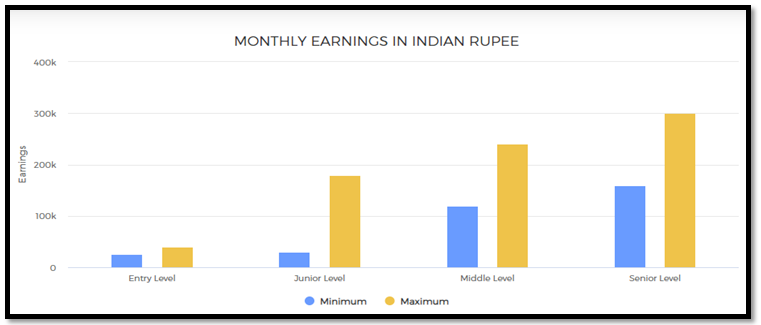
Monthly Earnings In Indian Rupee
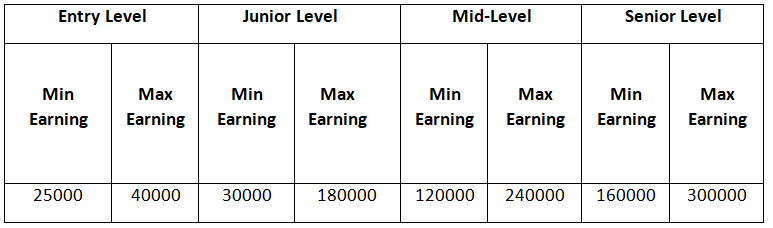
1. Entry level: 0 - 2 years of work experience
2. Junior Level: From 1 to 12 years of work experience
3. Mid-Level: From 5 to 20+ years of work experience
4. Senior Level: From 10 to 25+ years of work experience (there could be exceptions in some high-end technical, financial, engineering, creative, management, sports, and other careers; also in the near future, people will reach these levels much faster in many careers and in some careers, these levels will have no meaning as those careers will be completely tech skill driven such as even now, there is almost no level in a Cyber Security Expert’s job)
Work Activities
1. Analysing and interpreting data and information: Analysis of data and information to find facts, trends, reasons behind situations, etc.; interpretation of data to aid in decision making.
2. Communicating with co-workers and others: Communicating with people in writing, verbally or otherwise inside your workplace and various other people who have professional relationships with your place of work including vendors, government officials, etc. or with people at large.
3. Decision making and problem solving: Analysis of data and information; evaluation of alternative decisions and results of decisions; taking the right decisions and solving problems.
4. Getting Information and learning: Observing, hearing, reading, using computers, or otherwise obtaining information and learning from it.
5. Updating and using relevant knowledge: Keeping updated with the latest knowledge relevant to your fields of work and use of the relevant knowledge in getting things done.
6. Using computers for work: Using computers for day-to-day office work; using computer software for various applications in day-to-day professional work; entering data and process information; for writing.
7. Working in a team: Working in a team of people; developing team; maintaining professional relationships among team members.
Future Prospects
Indian Medical industry is growing exponentially riding on strong demand due to rising incomes, greater health awareness and increase in access to insurance. It might grow to 373 Billion USD as per a report by ibef.org. Also, with the introduction of Ayushman Bharat, Insurance and medical benefit are given by Government of India, more and more people will start using medical facilities. The hospital industry is expected to go up at a rate of 16-17% per year. These augur well for Bioinformaticians.
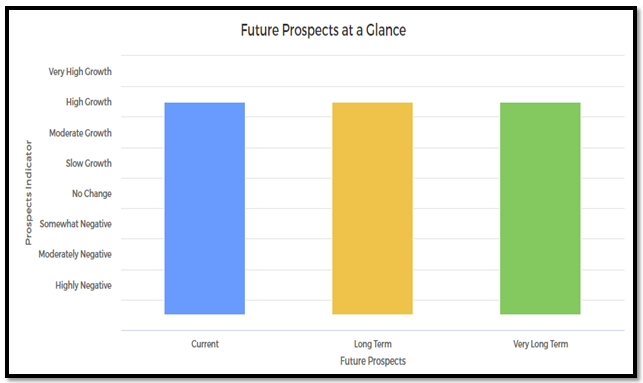
Future Prospects At a Glance
