

ENT Consultant / Head & Neck Surgeon
Entry Level Qualification
Class 12
Career Fields
Medical Services
For Specially Abled


About Career
1. As an ENT Consultant or Head and Neck Surgeon, you will be dealing with the treatment of diseases, infections, injuries, and defects concerning regions around or within ears, nose, throat, face, voice box, forehead, the area above the top of the cervical spine and related structures of the head and neck, through medications or surgeries. They are special doctors who are also known as otolaryngologists, ENT surgeons, ENT doctors or otorhinolaryngologists.
2. You will have to handle issues related to larynx (voice box), sinuses, upper pharynx (mouth and throat), oral cavity, as well as structures of the neck and face in both children and adults.You may also deal with surgical management of cancers and benign (non-cancer) tumors (mass of unwanted cells) of the head and neck if you specialize in oncologic surgery after your graduation.
3. This field of Otorhinolaryngology (ear, nose and throat) is one of the most competitive specialties in the medical space. Doctors / Surgeons specialized in otolaryngology are also among the highest paid.
Key Roles and Responsibilities
As an ENT Consultant or Head and Neck Surgeon, you will be engaged with one or moreof the following roles and responsibilities: -
1. You will be examining a patient for obtaining information on medical / physical conditions, history, personal choices, and tendencies to ascertain necessary medical attention or associated surgical procedures.
2. You will be diagnosing bodily disorders and clinical conditions and suggest therapeutic treatments, such as medicines or necessary surgeries, in hospital wards, clinics, or operating rooms.
3. You will be conferring with other medical professionals for determining nature of treatment required or to obtain historical data to construct a patient’s medical portfolio and plan further treatment.
4. You will be involved in recording patient’s condition or progress throughout the tenure of your treatment sessions, writing reports and maintaining proper registers containing patient information (case histories) or assist your personal clinic attendants to do the same.
5. You will be providing consultation and surgical assistance to other surgeons and physicians as and when required.
6. You will be directing and coordinating activities of assistants, residents, nurses, specialists, and other medical staffs and when required.
7. You will be managing surgery services, including planning, arranging, scheduling and coordinating processes, or procuring of equipment and supplies.
8. You will be involved in conducting research regarding new technologies, surgical techniques, instruments and surgical supplies that can improve diagnostic standards as well as operating procedures and outcomes.
PARTICULARS | DESCRIPTION |
Name | ENT Consultant / Head & Neck Surgeon |
Purpose | Diagnose and Treat Disorders |
Career Field | Allied & Para Medical Science |
Required Entrance Exam | NEET UG, NEET PG, AIIMS PG INICET |
Average Salary | 9,00,000 - 10,00,000 Per Year |
Companies For You | ENT Specialist, Consultant ENT, Head and Neck Surgeon & Many More |
Who is Eligible | Graduate |
Career Entry Pathway
Class 10 all subjects as per scheme of studies – Class 11-12 Physics, Chemistry, and Biology along with any other subject as per scheme of studies – MBBS – MS (ENT)
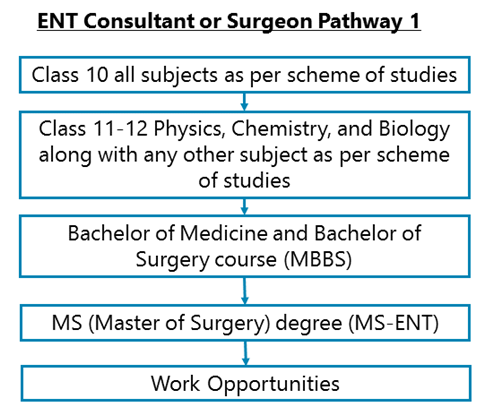
After completing Class 11-12 Physics, Chemistry, and Biology along with any other subject as per scheme of studies, you need to finish your graduation with an MBBS degree. Then you can go for a post-graduation program for an MS (Master of Surgery) degree in ENT speciality.
Class 10 all subjects as per scheme of studies – Class 11-12 Physics, Chemistry, and Biology along with any other subject as per scheme of studies – MBBS – MS (ENT) – M. Ch.
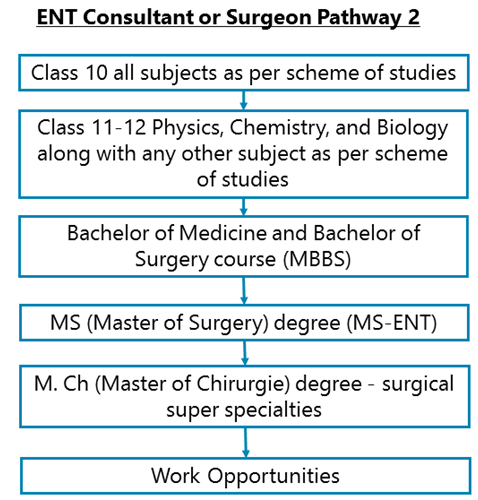
After completing Class 11-12 Physics, Chemistry, and Biology along with any other subject as per scheme of studies, you need to finish your graduation with an MBBS degree. Then you can go for a post graduation program for an MS (Master of Surgery) in ENT (Ear Nose Throat) degree. Then you can pursue an M.Ch. (Master of Chirurgie) degree which focuses on surgical super specialties in various domains like Surgical Gastroenterology, Plastic Surgery, Paediatric Surgery, Neuro Surgery, Cardio Thoracic Surgery, Oncology etc.
Class 10 all subjects as per scheme of studies – Class 11-12 Physics, Chemistry, and Biology along with any other subject as per scheme of studies – MBBS – DNB
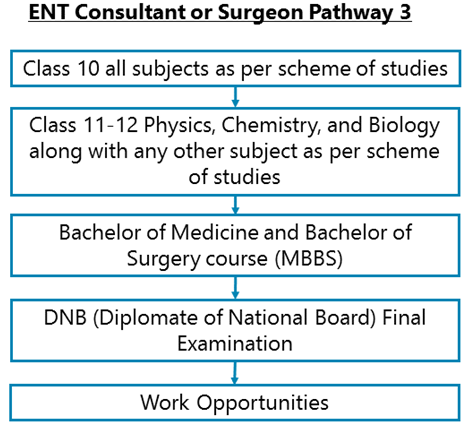
After completing Class 11-12 Physics, Chemistry, and Biology along with any other subject as per scheme of studies, you need to finish your graduation with an MBBS degree. You can go for DNB (Diplomate of National Board) Final Examination after completing 5-year DNB training successfully. You will only get 2 attempts for the practical examination if you pass the theory exam.
Class 10 all subjects as per scheme of studies – Class 11-12 Physics, Chemistry, and Biology along with any other subject as per scheme of studies – MBBS – DNB - FNB
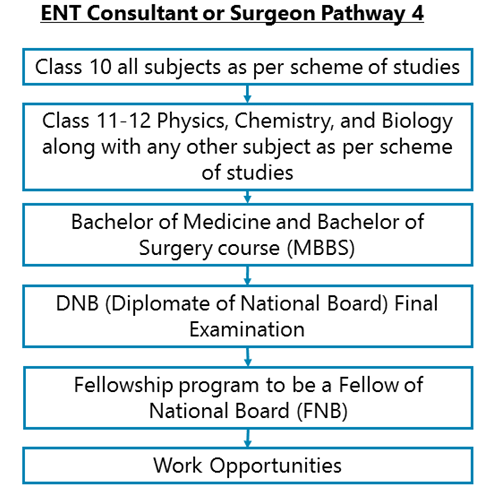
After completing Class 11-12 Physics, Chemistry, and Biology along with any other subject as per scheme of studies, you need to finish your graduation with an MBBS degree. Then you can go for DNB (Diplomate of National Board) Final Examination after completing 5-year DNB training successfully. You will only get 2 attempts for the practical examination if you pass the theory exam. Then you can pursue fellowship program to be a Fellow of National Board (FNB).
Required Qualification & Competencies
1. After Class 11-12, you can go for your Bachelor of Medicine and Bachelor of Surgery course (MBBS).
2. After your graduation, you can go for a Post Graduate level program like MS (ENT), DNB.
3. DNB is considered equivalent to MS. The only difference is for MD and MS you will be trained in medical colleges with hundreds of patients and for DNB you will be trained in big private hospitals with much lesser number of patients.
4. If you are interested in higher qualifications, you can go for FNB, M. Ch.
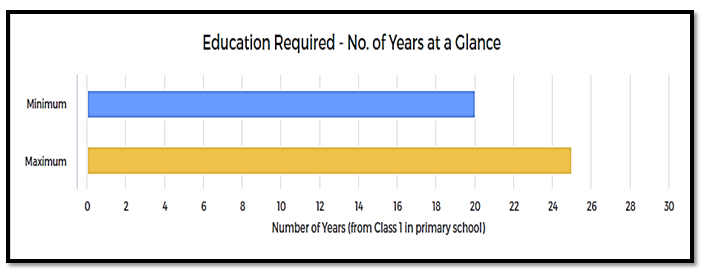
MINIMUM EDUCATION REQUIRED | MAXIMUM EDUCATION REQUIRED |
Post Graduate Postgraduate Degree / Diploma / Certificate Programs for which the minimum eligibility is a pass in Graduation / equivalent Diploma program like Honours Diploma or Graduate Diploma. | Post-Doctoral Post Ph.D. programs for which the minimum eligibility is a Doctoral degree. |
Competencies Required
1. You should have interests for Investigative Occupations. Investigative occupations involve working with ideas and quite a lot of thinking, often abstract or conceptual thinking. These involve learning about facts and figures; involve use of data analysis, assessment of situations, decision making and problem solving.
2. You should have interests for Realistic Occupations. Realistic occupations involve more practical and hands-on activities than paperwork or office work. Realistic occupations often involve physical activities for getting things done using various tools and equipment.
3. You should have interests for Social Occupations. Social occupations involve helping or assisting others; these involve working with and communicating with people to provide various services; these may involve educating and advising others.
4. You should have knowledge of Healthcare Science and Services - different fields which are related to offering various types of healthcare services to people; assisting physicians and surgeons to carry out diagnosis, treatment and prevention of human diseases, ailment and disorders. This includes knowledge of different practices apart from medicine which are used to treat and prevent human diseases or to provide holistic healthcare and wellness. This also includes knowledge about drugs and medicines.
5. You should have knowledge of Medicine - the science of diagnosis, treatment and prevention of human diseases, ailment, injuries and disorders. This includes understanding the symptoms, knowledge of the diagnostic processes, knowledge of the treatment procedures and medicines, and preventive healthcare measures.
6. You should have knowledge of Biological Sciences - humans, their anatomical structure, cell structure, tissues, physiological functions, evolution, and all other related aspects.
7. You should have knowledge of Personal Care Service - how to provide various assistance and services to others. This includes looking after the needs of individuals, understanding what they need and provide all assistance at home or elsewhere.
8. You should have Active Listening Skills - Giving full attention to what other people are saying, understanding the points being made by others, asking questions, etc.
9. You should have Critical Thinking skills- Skills in the analysis of complex situations, using logic and reasoning to understand the situations and take appropriate actions or make interpretations and inferences.
10. You should have Reading Comprehension Skills - Skills in understanding written sentences and paragraphs in work related documents.
11. You should have Instruction Skills - training others how to do something.
12. You should have Judgment and Decision Making Skills - considering pros and cons of various decision alternatives; considering costs and benefits; taking appropriate and suitable decisions.
13. You should have Problem Solving Skills - Skills in analysis and understanding of problems, evaluating various options to solve the problems and using the best option to solve the problems.
14. You should have Persuasion Skills- persuading others to change their minds or behaviour.
15. You should have Oral Comprehension Ability - listen to and understand information and ideas presented through spoken words and sentences.
16. You should have Oral Expression Ability - communicate information and ideas in speaking so others will understand.
17. You should have Deductive Reasoning Ability - apply general rules and common logic to specific problems to produce answers that are logical and make sense. For example, understanding the reasons behind an event or a situation using general rules and common logic.
18. You should have Problem Sensitivity - The ability to tell when something is wrong or is likely to go wrong. It does not involve solving the problem, only recognizing there is a problem.
19. You should have Inductive Reasoning Ability - The ability to combine pieces of information from various souces, concepts, and theories to form general rules or conclusions. For example, analysing various events or sitations to come out with a set of rules or conclusions.
20. You should have Near Vision - The ability to see details at close range (within a few feet of the observer).
21. You should have Perceptual Speed - The ability to quickly and accurately compare similarities and differences among sets of letters, numbers, objects, pictures, or patterns. The things to be compared may be presented at the same time or one after the other. This ability also includes comparing a presented object with a remembered object.
22. You should have Arm-Hand Steadiness - The ability to keep your hand and arm steady while moving your arm or while holding your arm and hand in one position.
23. You are always or mostly careful about your actions and behaviour.
24. You are always or mostly disciplined in your action and behaviour.
25. You are always or mostly a soft-hearted person.
26. You are always or mostly helpful to others.
27. You are always calm or generally remain calm in most situations.
28. You can always act independently or could do so in most situations.
Career - Job Opportunities & Profiles
1. You can find work as an ENT Specialist, Consultant ENT, Head and Neck Surgeon, Oncologic Surgeon, Rhinologist, Otologist, Maxillofacial Surgeon etc. in various government and private hospitals, nursing homes, institutions, medical colleges, medical aid industry, quarter nary sector (research based industrial jobs in the healthcare segment) etc.
2. You can also set up your personal clinic to practice as an independent Otolaryngologist or ENT Specialist helping people treat disease, defects, infections, injuries etc. associated with ears, nose, throat, face, voice box and the area above the top of the cervical spine etc.
Specialisation Tracks In This Career
1. Otolaryngologist
Otolaryngologists are commonly called ENT consultants. They are medical practitioners who are specialized in treating diseases associated with ears, nose and throat.
2. Pediatric Otolaryngologist
This branch of Otolaryngology deals with children and their diseases(like ear infection, cleft lip correction, hearing problems, cochlear implant etc.) associated with ears, nose, throat, face, voice box and the area above the top of the cervical spine. It applies to patients in the age range of birth till 18 years. Otolaryngologists specialized in Pediatric Otolaryngology usually need to complete their post graduation. They usually also go for additional courses like Diploma in child health (DCH).
3. Head and Neck Surgeon
Head and Neck Surgeons perform surgeries concerning the regions around or within ears, nose, throat, face, voice box, forehead, and the area above the top of the cervical spine. They have to complete their post-graduation degrees before practicing. Some may specialize in oncologic (cancer related) cases too.
4. Otologist/Neurotologist
The branch of clinical medicine dealing with neurological disorders of the ear is called Neuro-otology or Neurotology. Doctors handling such cases are called Neurotogists. They are also essentially surgeons and are trained in handling surgical cases too. They have to complete their post-graduation degrees before practicing.
5. Rhinologist/Sinus Surgeon
Rhinologiststreat nasal problems that include sinuses, sleep apnea, snoring, allergy, diseases in the nasal passageway, and chronic sinusitis. Sinus surgeons specialize in endoscopic or laparoscopic surgeries concerning sinuses.
6. Maxillofacial Surgeon
Maxillofacial Surgeons are those who specialize in facial reconstructive and plastic surgery. They deal with treatment of injuries, diseases, and defects in the head, jaws, face, neck and the hard or soft tissues of the maxillofacial (jaws and face) and oral (mouth) regions. This is a globally recognized specialty in the surgery segment.
Career Growth
1. From entry-level positions, you may progress to be Senior Consulting Medical Officer, Resident Medical Officer, Senior ENT Surgeon or Chief / Head of Department, Chairman, Director etc.
2. If you are in the Academia, you may progress to become a full-time professor and later a Senior Lecturer or the Head of the Department in various universities.
3. You may also write books related to Otolaryngology and on allied topics addressing frequently asked questions of families or patients in general.
Salary Offered
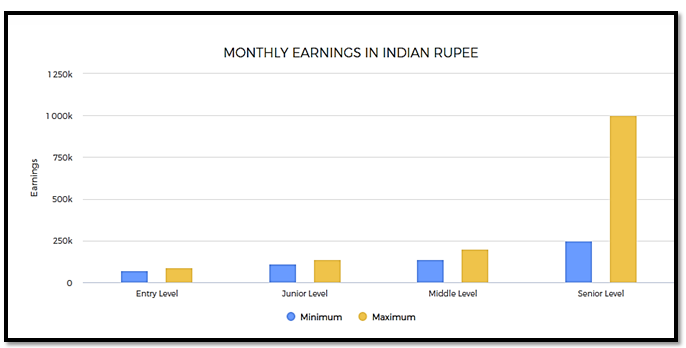
1. In the entry-level jobs: you may expect about 70,000.00 – Rs.90, 000.00 or more per month.
2. After having 1-6 years of experience, you may expect about Rs. 80,000 – Rs. 1, 10, 000 per month or more.
3. After having 6-12 years of experience, you may expect about Rs. 1, 20,000.00 – Rs. 2, 00,000 per month or more.
4. In the senior level jobs, with 13+ years of work experience, you may expect to get about Rs. 2,00,000 – Rs. 12,00,000 per month or even more depending upon your position and the company you are working with.
Monthly Earning In Indian Rupee
Entry Level | Junior Level | Mid-Level | Senior Level | |||||
Min Earning | Max Earning | Min Earning | Max Earning | Min Earning | Max Earning | Min Earning | Max Earning | |
70000 | 90000 | 110000 | 140000 | 140000 | 200000 | 250000 | 1000000 | |
1. Entry level: 0 - 2 years of work experience
2. Junior Level: From 1 to 12 years of work experience
3. Mid-Level: From 5 to 20+ years of work experience
4. Senior Level: From 10 to 25+ years of work experience (there could be exceptions in some high-end technical, financial, engineering, creative, management, sports, and other careers; also in the near future, people will reach these levels much faster in many careers and in some careers, these levels will have no meaning as those careers will be completely tech skill driven such as even now, there is almost no level in a Cyber Security Expert’s job)
Work Activities
1. Inspecting situations, events, and people - Inspecting situations, events and people to understand the reasons and causes for the situation or events to happen; inspecting people to understand reasons behind their conditions, behaviour and actions.
2. Analyzing and interpreting data and information - Analysis of data and information to find facts, trends, reasons behind situations, etc.; interpretation of data to aid in decision making.
3. Providing advices and consultation to others - Giving advices or consultation to others about various issues, conceptual matters, know-hows, scientific matters, products or services.
4. Getting Information and learning - Observing, hearing, reading, using computers, or otherwise obtaining information and learning from it.
5. Working directly with people - Working directly with people to offer them products and services, providing assistance, etc.
6. Assisting and caring for people - Assisting people in availing of services; taking care of people in different situations; offering help and services to others.
7. Developing and maintaining inter-personal relationships - Developing professional relationships with co-workers and others outside organisations and maintaining good relationships.
8. Processing information - Compiling, tabulating, calculating, auditing, verifying or otherwise dealing with information processing including data entry, transciption, recording, storing and maintaining databases.
9. Strategic planning - Developing visions and goals, developing strategies and action plans for achieving visions and goals.
10. Making decisions and solving problems - Analysis of data and information; evaluation of alternative decisions and results of decisions; taking the right decisions and solving problems.
11. Updating and using relevant knowledge - Keeping updated with the latest knowledge relevant to your fields of work and use of the relevant knowledge in getting things done.
12. Using computers for work - Using computers for day-to-day office work; using computer software for various applications in day-to-day professional work; entering data and process information; for writing.
Future Prospects
1. The road ahead for this career pathway seems uphill.The Healthcare Market in India has a potential to increase 3 fold to 133.44 billion US Dollars. Indian Government is willing to expand public health spending to 2.5% of GDP by 2025. Pradhan Mantri Jan Arogya Yojana (PMJAY) launched in 2018 provides 7,124.54 US Dollars each to over 100 million families every year.
2. The Healthcare Industry in India is one of the fastest growing sectors and it is expected to reach $280 billion. The major focus is on quality of service and hence skilled labor is much required to sustain growth of this industry. The Services Sector (including community, social and personal services) is the key economic growth driver in India. It is the dominant sector in India’s GDP, has also attracted significant FDI (Foreign Direct Investment) in 2018 itself and generated large scale employment opportunities.
3. India’s earnings from medical tourism could exceed US$ 9 billion. By 2025, medical spending in India is expected to grow by almost 9 to 12% making India one of the world’s top ten in this zone. India’s pharmaceutical industry is projected to expand ata rate of22.4% compounded annually. This should take it to the mark of 55 billion US Dollars. Presently, the industry is expanding at a healthy rate of 9-10% year-on-year. The workforce requirement in India’s Healthcare sector is predicted to grow to 74 lakh from 35.9 lakhs in 2013 to meet the market demand.

Future Prospects At A Glance
Current (0-1 year) | Long Term (2-5 year) | Very Long Term (6-10 years) |
Very High Growth | Very High Growth | Very High Growth |