
Photographer
Entry Level Qualification
Class 12
Career Fields
Performing Arts
For Specially Abled


Career Entrance Exam
About Career
1. As a Photographer, you can pursue your career in various segments like photojournalism, portrait photography, wedding photography, landscape photography, forensic photography, real estate photography, sports photography, travel photography, wildlife photography, food photography or freelance photography.
2. Photography is critical to a broad range of industries from fashion to food to real estate to news & entertainment to science & engineering and others. In this field, you will find many working as freelancers and selling their shots/images as stock photos or to different corporate houses requiring their services.
3. You may be using traditional photographic equipment or modern imaging technology at work. There is a multitude of varied career choices in this field today. Each choice comes with the demand for different skill sets and offers separate opportunities but the one common factor being love for the lens.
4. Photojournalism is a branch of journalism that involves capturing news stories in the form of pictures/images. Wedding photography is a very lucrative business to get into. You can start as an assistant to professional wedding photographers in their studios and then form your own business unit focusing on weddings. Portrait photography is for a single person or a group of people who may be to capture a variety of moments or situations.
5. As a landscape/travel photographer, you have to travel to separate locations for documenting images of natural spaces, man-made monuments etc. You may be working with travel magazines, media houses or selling your shots/images as stock photos or to different publications. Forensic photography involves working with crime investigation or police departments for documenting crime scene or forensic photos.
6. Food photography is an emerging field. As a Food Photographer, you may work with food blogs or magazines or as a food blogger to take pictures in a unique style. As a real estate photographer, you will mainly be capturing commercial properties for property agents to shoot their on-sale properties or sell your own services as a freelancer.
7. As a Wildlife Photographer, you may sell your shots of plants, animals or nature to different publications. You may also work as a camera operator/cameraman in film and television shooting sets. For any type of photography, you need to be able to create visual interest for your target audience and remember the ‘rule of thirds’ (every image should be divided into 9 blocks with two vertical and two horizontal lines, every essential element in the picture should be positioned along these lines or at their intersection points).
PARTICULARS | DESCRIPTION |
Name | Photographer |
Purpose | Capture And Create Visual Images |
Career Field | Performing Arts |
Required Entrance Exam | No Entrance Exam |
Average Salary | 100000 - 300000 Rs. Per Year |
Companies For You | Magazines, Media Houses, Film & Television Companies & Many More |
Who is Eligible | Any One |
Key Roles and Responsibilities:
As a Photographer, you will be engaged with one or more of the following roles and responsibilities: -
1. You will be photographing people, merchandise, landscapes, or other subjects, using digital or film cameras and devices.
2. You may be developing negatives or using computer software for producing finished prints and images. You will be using traditional or digital cameras and a variety of other instruments like filters, tripods, and flash attachments.
3. You will be determining the desired composition of the images and picture, adjusting and selecting equipment, subjects, and lighting to get the desired effects.
4. You will be adjusting shutter speeds, apertures, and camera focus according to various factors like field depth, lighting, film type, subject motion, and film speed.
5. You may be manipulating and enhancing digital or scanned images for creating desired effects, using specialized software or computers.
6. You may have to determine project goals, equipment needs,and locations by studying assignments and consulting with advertising staff or clients.
7. You may have to produce digital, computer-readable images from the film, using photofinishing laboratories and flatbed scanners.
8. You will be developing and printing exposed films, using touch-up tools, chemicals, printing and developing equipment etc.
9. You may be employing various specialized photographic techniques and materials, including ultraviolet and infrared films, photogrammetry, macro photography, and sensitometry.
10. You may have to create captions accompanying a photo shot (maybe a title, location, and date) to help a viewer understand the context of a picture better. An effective caption describes what is not visible in the photograph and must not repeat what is already shown.
Career Entry Pathway
Class 10 all subjects as per scheme of studies –– Class 11-12 with any subject as per scheme of studies - Diploma / Foundation / Certificate / Advanced Diploma courses in ‘Photography’ or related courses
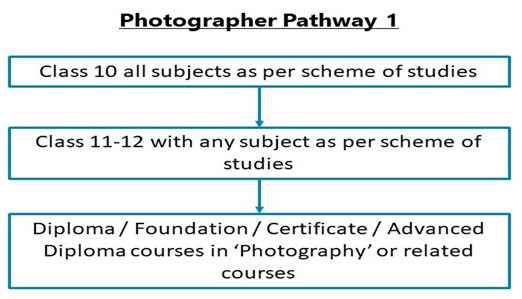
After completing Class 10 all subjects as per scheme of studies, then Class 11-12 with any subject as per scheme of studies, you can go for Diploma / Foundation / Certificate / Advanced Diploma courses in ‘Photography’, ‘Basic Photography’, ‘Tabletop Photography’, ‘Professional Photography’, ‘Digital Photo Editing’, ‘Fashion Photography’ or related courses. There are various institutes which offer these courses in distance learning mode too meaning you do not have to go to the Institute for classes other than for practical training (whenever applicable). However, there are other institutes which provide coaching in the regular mode where you have to visit the Institute for taking the classes
Class 10 all subjects as per scheme of studies –– Class 11-12 with any subject as per scheme of studies - B. Voc course in ‘Media Studies’ or related courses
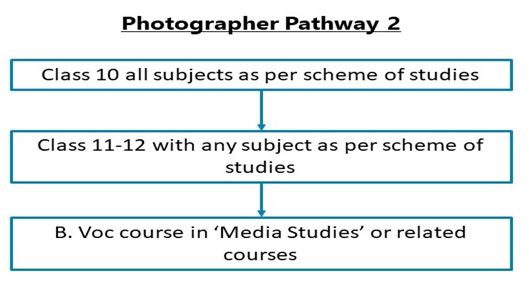
After completing Class 10 all subjects as per scheme of studies, then Class 11-12 with any subject as per scheme of studies, you can go for a B. Voc. (Bachelor of Vocation) course in ‘Media Studies’, ‘Photography’, ‘Photography and Digital Photo Editing’, ‘Photography and Videography’, ‘Photography and Visual Effects’ or related disciplines. There are various institutes which offer this course in distance learning mode too meaning you do not have to go to the Institute for classes other than for practical training (if applicable). However, there are other institutes which provide coaching in the regular mode where you have to visit the Institute for taking the classes. These courses are generally for 1-3 years
Class 10 all subjects as per scheme of studies –– Class 11-12 with any subject as per scheme of studies - Bachelors degree in ‘Photography’ or similar courses
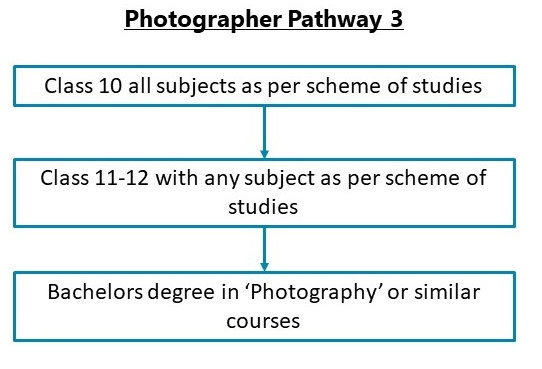
After completing Class 10 all subjects as per scheme of studies, then Class 11-12 with any subject as per scheme of studies, you can go for a Bachelors Degree (B.A.-Bachelor of Arts, B. Sc.-Bachelor of Science, B.F.A.-Bachelor of Fine Arts, B.C.A.-Bachelor of Creative Arts or similar) in ‘Photography and Digital Imaging’, ‘Communication Design’, ‘Photography’, ‘Photography Design’, ‘Visual Arts and Photography’, ‘Photography And Cinematography’, ‘Digital Photography, ‘Film, Photography & Media’, ‘Journalism, Mass Communication & Photography’, ‘Photography and New Media’, ‘Art in Digital Photography’, ‘Studio Art’, ‘Photography and Video’ or similar courses. These are all usually 3-year courses
Class 10 all subjects as per scheme of studies –– Class 11-12 with any subject as per scheme of studies - Bachelors in ‘Photography and Digital Imaging’ or similar courses – Master Degree / Advanced Diploma / Post Graduate Diploma in ‘Photography’ or similar disciplines
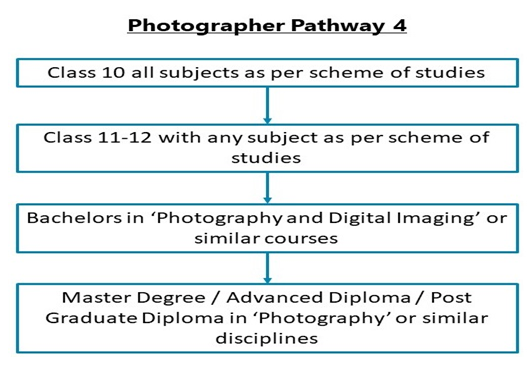
After completing Class 10 all subjects as per scheme of studies, then Class 11-12 with any subject as per scheme of studies, you need to complete your Bachelors Degree (B.A.-Bachelor of Arts, B. Sc.-Bachelor of Science, B.F.A.-Bachelor of Fine Arts, B.C.A.-Bachelor of Creative Arts or similar) in ‘Photography and Digital Imaging’, ‘Communication Design’, ‘Photography’, ‘Photography Design’, ‘Visual Arts and Photography’, ‘Photography And Cinematography’, ‘Photography and Visual Design’, ‘Digital Photography’, ‘Media Studies’, ‘Media Management’, ‘Film, Photography & Media’, ‘Journalism, Mass Communication & Photography’, ‘Photography and New Media’, ‘Art in Digital Photography’, ‘Studio Art’, ‘Photography and Video’ or similar courses. Then you can go for a Master degree (M.A.-Master in Arts, M.F.A.- Master in Fine Arts or similar) / Advanced Diploma / Post Graduate Diploma in ‘Photography And Videography’, ‘Photography and Digital Imaging’, ‘Communication Design’, ‘Photography’, ‘Visual Arts and Photography’, ‘Photography And Cinematography’, ‘Digital Photography, ‘Film, Photography & Media’, ‘Journalism, Mass Communication & Photography’, ‘Photography and New Media’, ‘Art in Digital Photography’, ‘Studio Art’ or related disciplines
Required Qualification & Competencies
After Class 11-12, you can go for:
1. Diploma / Certificate / Advanced Diploma courses.
2. B. Voc. Courses.
3. Bachelors Degree (B.A.-Bachelor of Arts, B. Sc.-Bachelor of Science, B.F.A.-Bachelor of Fine Arts, B.C.A.-Bachelor of Creative Arts) with Photography as a major or specialisation.
After your Bachelors Degree, you can go for Masters degree (M.A.-Masters in Arts, M.F.A.-Masters in Fine Arts or similar) / Advanced Diploma / Post Graduate Diploma in related disciplines with specialisation in Photography/ Photography Design.
Various private/public vocational training establishments / colleges / reputed photographers across India offer various courses on:
1. Photography
2. Photography Design
3. Digital Photography
4. Photojournalism
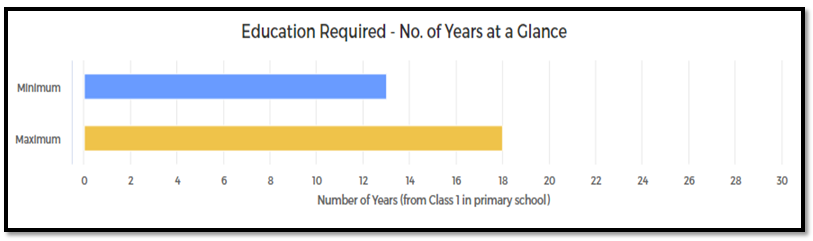
MINIMUM EDUCATION REQUIRED | MAXIMUM EDUCATION REQUIRED |
Post Higher Secondary | Post Graduate |
Compentencies Required
1. You should have interests for Artistic Occupations. Artistic occupations mostly involve working with creative ideas, art, and designs. These occupations involve abstract or conceptual thinking, creative self-expression and often do not follow any set processes or rules for getting things done.
2. You should have interests for Enterprising Occupations. Enterprising occupations involve taking initiatives, initiating actions, and planning to achieve goals, often business goals. These involve gathering resources and leading people to get things done. These require decision making, risk-taking and action orientation.
3. You should have interests for Investigative Occupations. Investigative occupations involve working with ideas and quite a lot of thinking, often abstract or conceptual thinking. These involve learning about facts and figures; involve the use of data analysis, assessment of situations, decision making and problem-solving.
4. You should have knowledge of Communications and Media - Knowledge of how different media such as print, television, radio, and social media works; how to produce content such as news, articles, audio-visual programs, etc. for different media. This includes various ways to inform and entertain people via print, audio, audio-visual and online media.
5. You should have Originality - The ability to come up with unusual or innovative ideas about a given topic or situation, or to develop creative ways to solve a problem.
6. You should have Fluency of Ideas - The ability to come up with a number of ideas about a topic (the number of ideas is important, not their quality, correctness, or creativity).
7. You are mostly impulsive in your action and behaviour.
8. You are always imaginative or in most situations.
9. You act independently sometimes but do not do so in some other times.
10. You prefer to experience new things and have new experiences sometimes.
Career - Job Opportunities & Profiles
You will get job opportunities as a Photographer in various commercial/public sector enterprises, magazines, media houses, film and television companies, or as an intern under professional photographers or in other agencies. Some examples are:
1. Newspapers
2. News agencies
3. Websites
4. Television Companies
5. Magazine and other periodical publishers
6. Journals
7. Event management compnies
8. Television production companies
9. Syndicated photographers' agencies (some photographers joining in a partnership to work for various clients)
10. Photography studios
11. Film production companies (as still photographer or in Cinematography, provided you are trained in Cinematography or motion picture photography)
You may get roles like:
1. Photographer
2. Assistant Photographer
3. Fashion Photographer
4. Press Photographer
5. Product Photographer
6. Professional Photographer
7. Still Photographer
8. Staff Photographer
9. Photo Lab Technician
10. Developer, Photographic
11. Photojournalist
12. Process Cameraman
13. Digital Camera Photographer
14. Photographer General
15. Photographer in Media
16. Still Photographer
17. Photographer in Studio
You may also work as a freelance photographer but you have to establish and maintain wide contacts among potential clientsin order to work independently.
Specialisation Tracks In This Career
Portrait Photographer
As a Portrait Photographer, you will have to cover various verticals starting from schools to weddings. You may specialize in wedding photography, newborn photography or family photography including pets.You will have to handle several other responsibilities like making appointments, billing your clients, processing and framing images/photosetc. if you have your own business or are self-employed.You may also sell your shots/images as stock photos.
Commercial Photographer
As a Commercial Photographer, you will mainly be helping your clients capture their target market with their products or services. You will be photographing buildings, commercial properties, official equipment, corporate projects, merchandise, company employees, catalogs, websites, advertisements etc. Several companies need this service for company records, reports, symposiums, annual presentations etc. This is one of the most lucrative careers in photography. You may have to operate out of your own studio or work at a chosen location. You may specialize in real estate, sports, travel, fashion, art & lifestyle, wildlife, landscapes, food, education & training, electronics,and hardware or others.You will have to handle several other responsibilities like making appointments, billing your clients, processing and framing images/photosetc. if you have your own business or are self-employed. You may also sell your shots / images as stock photos.
Scientific Photographer
As a Scientific Photographer, you need to document various subjects like experiments, technical information etc. You may have to bring images, which are not visible to the human eye, to life. You may have to use specialized instruments and techniques for infrared photography, micrography or underwater photography and others. You may be working with research facilities, government agencies, media houses or universities. You will have to handle several other responsibilities like making appointments, billing your clients, processing and framing images/photosetc. if you have your own business or are self-employed. You may also sell your shots/images as stock photos.
Photojournalist
As a Photojournalist or Press Photographer, you will be capturing news stories in the form of pictures/images. You may work with major newspapers, magazines, media houses, newswires, websites, radio stations, television companies, periodical publishers or journals operating in both online and print media spaces. Your job will be to reproduce first-hand information in the form of photographs about events, facts, ideas,and people. You have to be a skilled storyteller, whether your photographs are accompanied with written text or not. Your photographs must convey the correct message to the audience.You may be on direct payroll with a media house or may also work as a freelancer. You may have to cover national/local events, court proceedings, politics, forensic studies or sports.You will have to handle several other responsibilities like making appointments, billing your clients, processing and framing images/photosetc. if you have your own business or are self-employed. You may also sell your shots/images as stock photos.
Freelance Photographer
As a Freelance Photographer, you will be working out of your own studio. You can operate in just about any industry and specialize in news, events, fashion etc. It is slightly more challenging to establish oneself as a Freelance Photographer, especially to develop and maintain industry contacts.You may cover weddings, family, pets, businesses, corporate events, restaurants, food blogs etc.You may also sell your shots/images as stock photos.
Fashion Photographer
Fashion Photographers shoot models in different locations to showcase fashion clothing. They also shoot during fashion shows. They may work with models to create their portfolios or with fashion designers to shoot clothes designed by them.
Wildlife Photographer
Wildlife Photographers shoot wildlife or animals in their habitats. Wildlife photography is an exciting and high paying field of photography but it takes many years to learn to shoot wildlife. Wildlife photographers use several devices for shooting wildlife.
Travel Photographer
Travel Photographers shoot at various destinations or locations of tourist interests. They may shoot buildings, scenic places, nature, city life, etc.
Food Photographer
Food Photographers specialise in taking photographs of food dishes, wines, and liquor. They shoot fine dining dishes, exotic wines, and liquor in various settings like a studio, restaurant, hotel, etc. for various purposes such as making an advertisement for a restaurant.
Career Growth
From entry-level job positions as Photographer, Assistant Photographer, Fashion Photographer, Press Photographer, Product Photographer, Professional Photographer, Still Photographer etc., you may grow into a team leader role managing work of a few photographers. In medium and large scale companies, you may have a position as a Senior Photographer, Chief Photographer, Head – Media Planning etc. after 15+ years of experience.
Salary Offered
1. Most photographers begin as an individual and working on a project either assisting a senior photographer or working independently. They earn on a project basis. For a day’s work, a beginner may get just about Rs. 2,000.
2. Someone with a good portfolio may start getting Rs. 10,000-20,000 or even more for a day’s work. Wedding and fashion photographers may earn much more. A good photographer doing wedding photography may get Rs. 25,000-1,00,000 a day. A Fashion Photographer may get Rs. 50,000 – 2,00,000 for a day’s work. A reputed fashion photographer may take about Rs. 10,00,000 or even more for a day’s work. They make 15-20 crore a month.
3. But photography is a highly crowded and competitive field. It’s difficult to establish your presence. But nevertheless, if you are dedicated and focused, in about 5-6 years, you may make a decent Rs. 25,000-50,000 a month. After 10-12 years, you may earn much more.
4. Wildlife Photography is another very lucrative field but it takes a long time to establish yourself as an independent photographer. You have to work as an Assistant for a long time. You may make about Rs. 50,000 – 2,00,000 or more for a project which may last for a few weeks. Reputed Wildlife Photographers take about Rs. 15,00,000 – 1 crore or even more for a project, depending upon the nature of photography required and the duration of the project.
5. Photographers hardly get a permanent job except in some media companies. Here, at a junior level, one can earn about Rs. 10,000-22,000 a month. In the middle level, one can make about Rs. 20,000 – 50,000 a month. A senior photographer may make about Rs. 50,000 – 25,00,000 or even more per month.
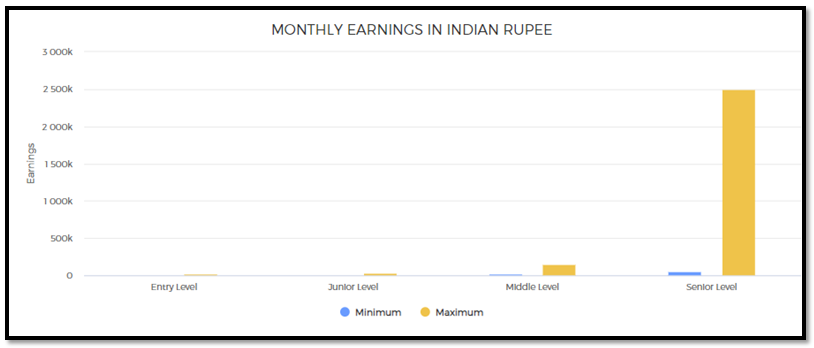
Monthly Earnings In Indian Rupee
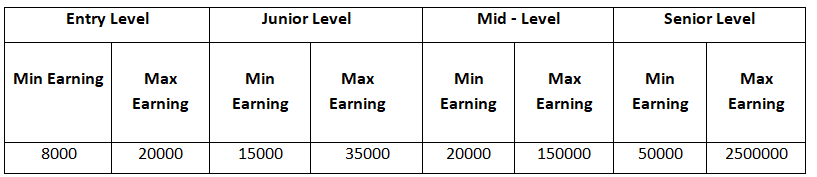
1. Entry level: 0 - 2 years of work experience
2. Junior Level: From 1 to 12 years of work experience
3. Mid Level: From 5 to 20+ years of work experience
4. Senior Level: From 10 to 25+ years of work experience (there could be exceptions in some high-end technical, financial, engineering, creative, management, sports, and other careers; also in the near future, people will reach these levels much faster in many careers and in some careers, these levels will have no meaning as those careers will be completely tech skill driven such as even now, there is almost no level in a Cyber Security Expert’s job)
Work Activities
1. Getting Information and learning - Observing, hearing, reading, using computers, or otherwise obtaining information and learning from it.
2. Creative thinking - Developing new ideas, concepts, innovative solutions to problems, newer ways of getting things done, designing products and services, creating work of art and craft, etc.
3. Identifying objects, actions, and events - Identifying various characteristics of objects; observing and understanding actions and events; understanding changes in actions and events.
4. Inspecting situations, events, and people - Inspecting situations, events and people to understand the reasons and causes for the situation or events to happen; inspecting people to understand reasons behind their behaviour and actions.
5. Assessing and evaluating quality- Assessing and evaluating the quality of materials, systems, processes, products, services, etc.
6. Developing and maintaining inter-personal relationships - Developing professional relationships with co-workers and others outside organisations and maintaining good relationships.
7. Communicating with co-workers and others– Communicating with people in writing, verbally or otherwise inside your workplace and various other people who have professional relationships with your place of work.
8. Presenting and demonstrating work to others – you will need to present and demonstrate your work to others such as clients, co-workers, and superiors.
9. Working in a team - Working in a multi-disciplinary team of people; developing a team; maintaining professional relationships among team members.
Future Prospects
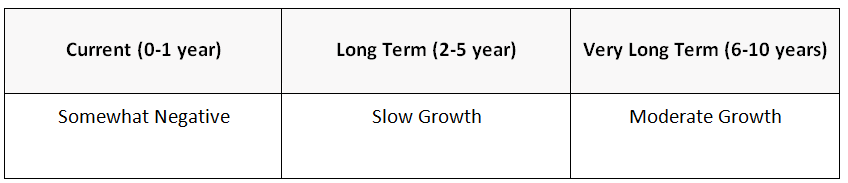
The road ahead for this pathway looks sunny and uphill. The growth in the sub-sectors of the Indian Media and Entertainment Industry showed decent growth. The Television industry is expected to grow in terms of employment volume to 0.64 million from 0.28 million in , translating to a human resource requirement of 0.36 million.
The overall industry growth of Media and Entertainment Sector has been estimated at a rate of 13.10% compounded annually to touch the mark of 39.68 billion US Dollars by 2023 from 22.28 billion US Dollars in 2018. India’s media consumption has been growing at an alarming rate of 9% compounded annually. This is 9 times that in the US and 2 times that in China. Revenues from the Advertising sector are forecasted to reach 18.39 billion US Dollars by 2023 from 9.44 billion US Dollars in 2018. Digital Advertising industry in India is expected to grow at a rate of 32% compounded annually to touch the mark of 2.93 billion US Dollars.
Various lens makers like Fujifilm and Zeiss have stated that the Indian market is an extremely important and dynamic market. The Photo and Imaging market in India (especially the professional photography segment) has been showing immense potential. In the lightweight cameras and an interchangeable lens or mirror-less categories, Indian consumers have been showing tremendous interest. The demand for autofocus and zoom lens is very high and constantly growing in India especially in the wedding photography segment.
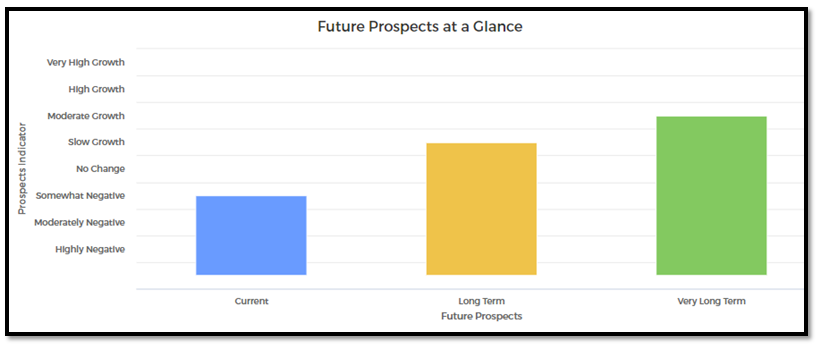
Future Prospects At a Glance