


Anesthesiologist
Entry Level Qualification
Class 12
Career Fields
Medical Services
For Specially Abled


About Career
1. Anesthesiology deals with the administration (application) of anesthetics or sedatives to make patients insensitive to pain during surgeries by suppressing their consciousness. As an Anesthesiologist, you will be as responsible as the participating surgeons for a patient’s condition before (preoperative), during (intra-operative) and after (postoperative) a surgery. You can become an anesthesiologist only after you complete your graduation in medicine with an MBBS degree and also complete your post-graduation in Anesthesiology.
2. You will have to examine a patient before proceeding with the anesthetic procedures, confer with the participating surgeons, properly place the patient on the operating table and administer the anesthetics using local, spinal, intravenous, or caudal techniques. You will be responsible for constantly recording the patient’s condition as long as she is anesthetized. You will have to provide life support and revive a patient to normalcy after the medical procedures are completed.
3. As an Anesthesiologist, you will be medically inducing coma to prepare a patient for a surgery, to temporarily stop all protective reflexes (body movements naturally performed to protect from foreign agents) like blinking, coughing, sneezing etc. and to render the patient completely insensible to pain. You may have to focus on a specific area on the patient’s body where the surgery is being performed or generally for the entire body as a whole. Accordingly, it is called local anesthesia or general anesthesia.
Key Roles and Responsibilities
1. As an Anesthesiologist, you will be engaged with one or moreof the following roles and responsibilities: -
2. You will be examining a patient, obtaining medical history, and using diagnostic tests for determining risks during obstetrical, surgical, and other medical procedures.
3. You will be monitoring patient before, during, and after anesthesia and neutralize complications or adverse reactions.
4. You will be conferring with other medical professionals for determining the nature and method of administering anesthetics to make patiently insensible to pain.
5. You will be positioning a patient on the operating table for maximizing comfort and surgical accessibility.
6. You will be administering general or specific anesthetics or sedatives during medical procedures to patients, using local, spinal, intravenous, or caudal techniques.
7. You will be providing life support and airway management assistance and help in preparing patients for critical or emergency surgeries.
8. You will be constantlyrecordingnature and degree of anesthesia and patient’s condition throughout the procedure, writing reports and maintaining proper documentation of your surgical sessions.
9. You will be coordinating administration of anesthetics with participating surgeons, nurses, medical technicians and other healthcare providers during a surgery.
10. You will be involved in conducting research regarding new technologies, surgical techniques, instruments and surgical supplies that can improve diagnostic standards as well as operating procedures and outcomes.
PARTICULARS | DESCRIPTION |
Name | Anesthesiologist |
Purpose | Administer Anesthesia To Patients |
Career Field | Medical Services |
Required Entrance Exam | NEET UG, NEET PG |
Average Salary | 72000 - 300000 Rs. Per Year |
Companies For You | Hospitals, Surgical Centers, Clinics & Many More |
Who is Eligible | Class 12th Pass |
Career Entry Pathway
Class 10 all subjects as per scheme of studies – Class 11-12 Physics, Chemistry, and Biology along with any other subject as per scheme of studies – MBBS – PG Diploma in Anesthesiology
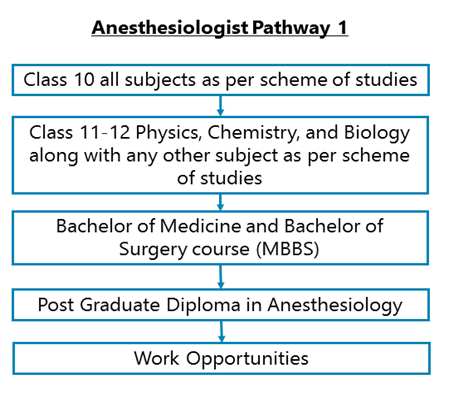
After completing Class 11-12 Physics, Chemistry, and Biology along with any other subject as per scheme of studies, you need to finish your graduation with an MBBS degree. Then you can go for a Post Graduate Diploma in Anesthesiology.
Class 10 all subjects as per scheme of studies – Class 11-12 Physics, Chemistry, and Biology along with any other subject as per scheme of studies – MBBS – MD / MS in Anesthesiology
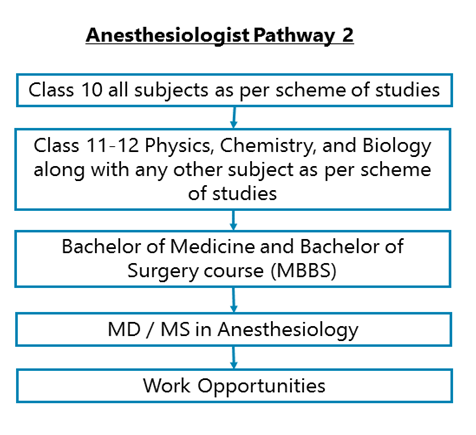
After completing Class 11-12 Physics, Chemistry, and Biology along with any other subject as per scheme of studies, you need to finish your graduation with an MBBS degree. Then you can go for an MD (Doctor of Medicine) or MS (Master of Surgery) degree in Anesthesiology.
Class 10 all subjects as per scheme of studies – Class 11-12 Physics, Chemistry, and Biology along with any other subject as per scheme of studies –MBBS– MD / MS in Anesthesiology – DM or M. Ch.
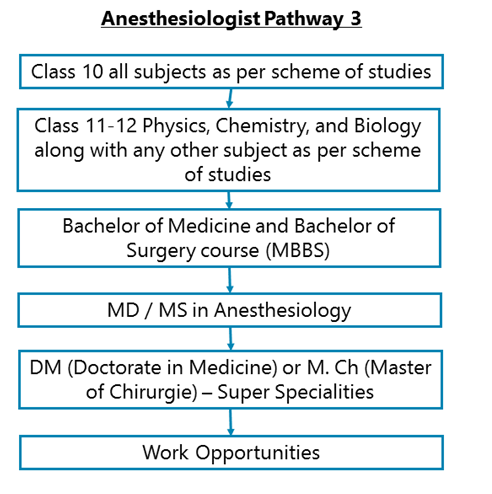
After completing Class 11-12 Physics, Chemistry, and Biology along with any other subject as per scheme of studies, you need to finish your graduation with an MBBS degree. Then you can go for an MD (Doctor of Medicine) or MS (Master of Surgery) degree in Anesthesiology. Then you can pursue a DM (Doctorate in Medicine) or M. Ch (Master of Chirurgie) which focuses on super specialties like Cardiac anesthesia, Thoracic anesthesia, Neuro-anesthesia, General Anesthesia, Critical Care Anesthesia, Paediatric Anesthesia (Regional & General), Organ Transplant Anesthesia etc.
Class 10 all subjects as per scheme of studies – Class 11-12 Physics, Chemistry, and Biology along with any other subject as per scheme of studies – MBBS - DNB
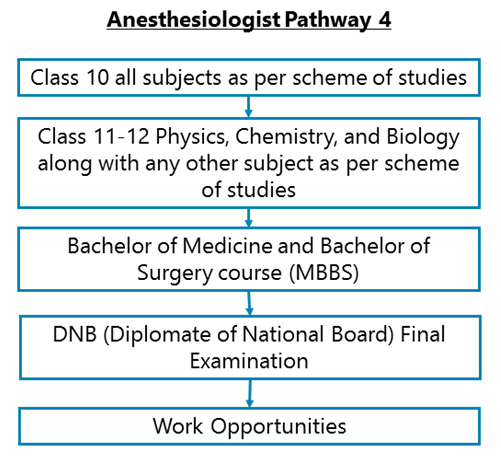
After completing Class 11-12 Physics, Chemistry, and Biology along with any other subject as per scheme of studies, you need to finish your graduation with an MBBS degree. Then you can go for DNB (Diplomate of National Board) Final Examination after completing 5-year DNB training successfully. You will only get 2 attempts for the practical examination if you pass the theory exam.
Class 10 all subjects as per scheme of studies – Class 11-12 Physics, Chemistry, and Biology along with any other subject as per scheme of studies – MBBS – DNB - FNB
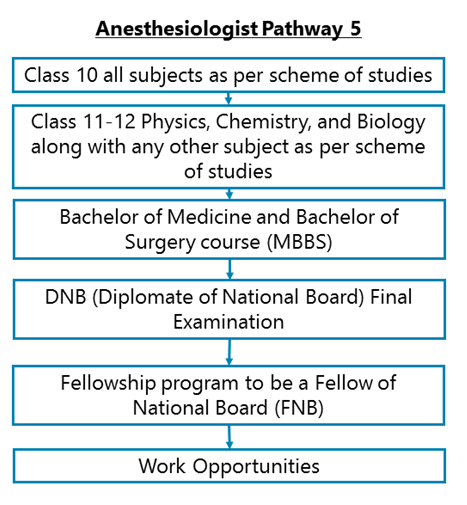
After completing Class 11-12 Physics, Chemistry, and Biology along with any other subject as per scheme of studies, you need to finish your graduation with an MBBS degree. Then you can go for DNB (Diplomat of National Board) Final Examination after completing 5-year DNB training successfully. You will only get 2 attempts for the practical examination if you pass the theory exam. Then you can pursue the post-doctoral fellowship program to be a Fellow of National Board (FNB) in any of the super specialties like Cardiac anesthesia, Thoracic anesthesia, Neuro-anesthesia, General Anesthesia, Critical Care Anesthesia, Paediatric Anesthesia (Regional & General), Organ Transplant Anesthesia etc.
Required Qualification & Competencies
1. Anesthesiology is a broad specialization (Master degrees) which is pursued by medical graduates after their college degrees. You can also get training for super specializations (Doctoral degrees) like cardio-thoracic, neuro, pediatric anesthesia after you complete your post-graduation.
2. After Class 11-12, you can go for your Bachelor of Medicine and Bachelor of Surgery course (MBBS).
3. After your graduation, you can go for a Post Graduate Diploma or Master level program like MD, DNB, MS for specializing in Anesthesia.
4. DNB is considered equivalent to MD / MS. The only difference is for MD and MS you will be trained in medical colleges with hundreds of patients and for DNB you will be trained in big private hospitals with much lesser number of patients.
5. If you are interested in super specializations under ‘Anesthesia’, you can also go for higher qualifications like DM, FNB, M. Ch.
Various private / public educational establishments offer the following or related courses:
Anesthesiology
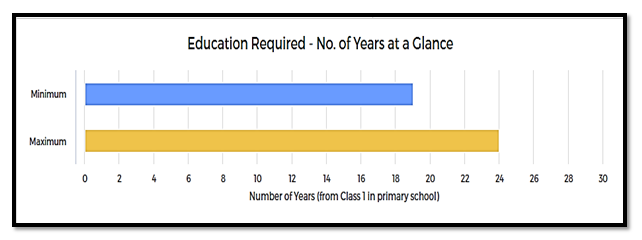
MINIMUM EDUCATION REQUIRED | MAXIMUM EDUCATION REQUIRED |
Post Graduate Postgraduate Degree / Diploma / Certificate Programs for which the minimum eligibility is a pass in Graduation / equivalent Diploma program like Honors Diploma or Graduate Diploma. | Doctoral All Ph.D. or equivalent degree programs for which the minimum eligibility is a Postgraduate or a Pre-Doctoral degree. |
Competencies Required
1. You should have interests for Investigative Occupations. Investigative occupations involve working with ideas and quite a lot of thinking, often abstract or conceptual thinking. These involve learning about facts and figures; involve use of data analysis, assessment of situations, decision making and problem solving.
2. You should have interests for Realistic Occupations. Realistic occupations involve more practical and hands-on activities than paperwork or office work. Realistic occupations often involve physical activities for getting things done using various tools and equipment.
3. You should have interest’s for Social Occupations. Social occupations involve helping or assisting others; these involve working with and communicating with people to provide various services; these may involve educating and advising others.
4. You should have knowledge of Healthcare Science and Services - different fields which are related to offering various types of healthcare services to people; assisting physicians and surgeons to carry out diagnosis, treatment and prevention of human diseases, ailment and disorders. This includes knowledge of different practices apart from medicine which are used to treat and prevent human diseases or to provide holistic healthcare and wellness. This also includes knowledge about drugs and medicines.
5. You should have knowledge of Medicine - the science of diagnosis, treatment and prevention of human diseases, ailment, injuries and disorders. This includes understanding the symptoms, knowledge of the diagnostic processes, knowledge of the treatment procedures and medicines, and preventive healthcare measures.
6. You should have knowledge of Biological Sciences - humans, their anatomical structure, cell structure, tissues, physiological functions, evolution, and all other related aspects.
7. You should have Active Listening Skills - Giving full attention to what other people are saying, understanding the points being made by others, asking questions, etc.
8. You should have Critical Thinking skills- Skills in the analysis of complex situations, using logic and reasoning to understand the situations and take appropriate actions or make interpretations and inferences.
9. You should have Reading Comprehension Skills - Skills in understanding written sentences and paragraphs in work related documents.
10. You should have Instruction Skills - training others how to do something.
11. You should have Judgment and Decision Making Skills - considering pros and cons of various decision alternatives; considering costs and benefits; taking appropriate and suitable decisions.
12. You should have Problem Solving Skills - Skills in analysis and understanding of problems, evaluating various options to solve the problems and using the best option to solve the problems.
13. You should have Persuasion Skills- persuading others to change their minds or behavior.
14. You should have Oral Comprehension Ability - listen to and understand information and ideas presented through spoken words and sentences.
15. You should have Oral Expression Ability - communicate information and ideas in speaking so others will understand.
16. You should have Deductive Reasoning Ability - apply general rules and common logic to specific problems to produce answers that are logical and make sense. For example, understanding the reasons behind an event or a situation using general rules and common logic.
17. You should have Problem Sensitivity - The ability to tell when something is wrong or is likely to go wrong. It does not involve solving the problem, only recognizing there is a problem.
18. You should have Inductive Reasoning Ability - The ability to combine pieces of information from various sources, concepts, and theories to form general rules or conclusions. For example, analyzing various events or stations to come out with a set of rules or conclusions.
19. You should have Near Vision - The ability to see details at close range (within a few feet of the observer).
20. You should have Perceptual Speed - The ability to quickly and accurately compare similarities and differences among sets of letters, numbers, objects, pictures, or patterns. The things to be compared may be presented at the same time or one after the other. This ability also includes comparing a presented object with a remembered object.
21. You should have Arm-Hand Steadiness - The ability to keep your hand and arm steady while moving your arm or while holding your arm and hand in one position.
22. You are always or mostly careful about your actions and behavior.
23. You are always or mostly disciplined in your action and behavior.
24. You are always or mostly a soft-hearted person.
25. You are always or mostly helpful to others.
26. You are always calm or generally remain calm in most situations.
27. You can always act independently or could do so in most situations
Career - Job Opportunities & Profiles
1. You can find work in various government and private hospitals, nursing homes, institutions, medical colleges, medical aid industry, quaternary sector (research based industrial jobs in the healthcare segment) etc.
2. After your master degree, you will be eligible to practice or work as a specialist in Anesthesiology after obtaining a specialist certificate from the Medical Council of India (MCI).
3. After your doctoral degree you are eligible to work in super specialty clinics and hospitals.
4. If you obtain a degree in medicine from any country other than India, you need to appear for an examination conducted by MCI in order to be eligible to practice in the country.
Specialisation Tracks In This Career
Anesthesiologist (Cardio-Thoracic Anesthesia)
Anesthesiologists specialized in providing preoperative (before surgery), intraoperative (during surgery), and postoperative (after surgery) care for cardiothoracic surgery and related invasive procedures usually complete their Doctoral studies after their Master degrees.
Anesthesiologist (Neuro-anesthesia)
Anesthesiologists who deal with complex relationships of anesthetic medications for neurosurgical procedures and associated critical care issues surrounding the management of patients undergoing neurosurgeries usually complete their Doctoral studies after their Master degrees.
Anesthesiologist (General Anesthesia)
Anesthesiologists who are involved in inducing coma medically (loss of protective reflexes – blinking, coughing, sneezing etc.) by administering general anesthetic agents to patients before or during surgeries usually need to complete their post-graduation degrees.
Intensivist (Critical Care Anesthesia)
Intensivists work in critical or intensive care units in hospitals and nursing homes. They serve patients who are critically or terminally ill. They need to be competent in technical procedures and devices used in a broad spectrum of conditions involving critically ill patients or terminally ill patients. They usually complete their Doctoral studies before joining the labor market.
Anesthesiologist (Pediatric Anesthesia)
This branch of Anesthesiology deals with children and their diseases. It applies to patients in the age range of birth till 18 years. Anesthesiologists specialized in Pediatric Anesthesia usually need to complete their Doctoral degree after their Master’s program.
Anesthesiologist (Organ Transplant Anesthesia)
Organ transplants, including liver, heart, pancreas, and kidney transplants require extremely specialized anesthesiology skills and experienced Anesthesiologists. Anesthesiologists specialized in Organ Transplant Anesthesia usually need to complete their Doctoral degree after their Master’s program.
Anesthesiologist (Obstetrics Anesthesia)
Obstetrics deals with providing peripartum (before, during or after childbirth) care to women. Anesthesiologists specializing in obstetrical cases usually need to complete their Doctoral degree after their Master’s program.
Career Growth
1. From entry-level positions you may progress to be Senior Anesthesiologist or Chief / Head of Department, Chairman, Director etc.
2. If you are in the Academia, you may progress to become a full-time professor and later a Senior Lecturer or the Head of the Department in various universities.
3. You may also write books related to Anesthesiology and on allied topics addressing frequently asked questions offamilies or patients in general.
Salary Offered
1. In the entry-level jobs: you may expect about 70,000.00 – Rs.90, 000.00 or more per month.
2. After having 1-6 years of experience, you may expect about Rs. 80,000 – Rs. 1, 20,000 per month or more.
3. After having 6-12 years of experience, you may expect about Rs. 1, 40,000.00 – Rs. 2, 50,000 per month or more.
4. In the senior level jobs, with 13+ years of work experience, you may expect to get about Rs. 2,00,000 – Rs. 4,00,000 per month or even more depending upon your position and the company you are working with.
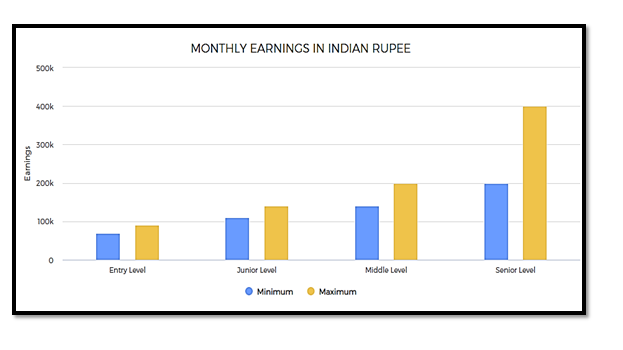
Monthly Earning In Indian Rupee
Entry Level | Junior Level | Mid Level | Senior Level | |||||
Min Earning | Max Earning | Min Earning | Max Earning | Min Earning | Max Earning | Min Earning | Max Earning | |
70000 | 90000 | 110000 | 140000 | 140000 | 200000 | 200000 | 400000 | |
1. Entry level: 0 - 2 years of work experience
2. Junior Level: From 1 to 12 years of work experience
3. Mid-Level: From 5 to 20+ years of work experience
4. Senior Level: From 10 to 25+ years of work experience (there could be exceptions in some high-end technical, financial, engineering, creative, management, sports, and other careers; also in the near future, people will reach these levels much faster in many careers and in some careers, these levels will have no meaning as those careers will be completely tech skill driven such as even now, there is almost no level in a Cyber Security Expert’s job)
Work Activities
1. Inspecting situations, events, and people: Inspecting situations, events and people to understand the reasons and causes for the situation or events to happen; inspecting people to understand reasons behind their conditions, behaviour and actions.
2. Analysing and interpreting data and information: Analysis of data and information to find facts, trends, reasons behind situations, etc.; interpretation of data to aid in decision making.
3. Providing advices and consultation to others: Giving advices or consultation to others about various issues, conceptual matters, know-hows, scientific matters, products or services.
4. Translating and interpreting: Translating or interpreting information for other people which are written or spoken in languages that other people do not understand.
5. Getting Information and learning: Observing, hearing, reading, using computers, or otherwise obtaining information and learning from it.
6. Working directly with people: Working directly with people to offer them products and services, providing assistance, etc.
7. Assisting and caring for people: Assisting people in availing of services; taking care of people in different situations; offering help and services to others.
8. Performing for people: Performing various tasks for people to help them, and assist them.
9. Developing and maintaining inter-personal relationships: Developing professional relationships with co-workers and others outside organisations and maintaining good relationships.
10. Processing information: Compiling, tabulating, calculating, auditing, verifying or otherwise dealing with information processing including data entry, transciption, recording, storing and maintaining databases.
11. Strategic planning: Developing visions and goals, developing strategies and action plans for achieving visions and goals.
12. Making decisions and solving problems: Analysis of data and information; evaluation of alternative decisions and results of decisions; taking the right decisions and solving problems.
13. Updating and using relevant knowledge: Keeping updated with the latest knowledge relevant to your fields of work and use of the relevant knowledge in getting things done.
14. Using computers for work: Using computers for day-to-day office work; using computer software for various applications in day-to-day professional work; entering data and process information; for writing.
Future Prospects
1. The road ahead for this career pathway seems uphill.The Healthcare Market in India has the potential to increase 3 fold to 133.44 billion US Dollars. Indian Government is willing to expand public health spending to 2.5% of GDP by 2025. Pradhan Mantri Jan Arogya Yojana (PMJAY) launched in 2018 provides 7,124.54 US Dollars each to over 100 million families every year.
2. The major focus is on quality of service and hence skilled labor is much required to sustain growth of this industry. The Services Sector (including community, social and personal services) is the key economic growth driver in India. It is the dominant sector in India’s GDP, has also attracted significant FDI (Foreign Direct Investment) in 2018 itself and generated large scale employment opportunities.
3. India’s earnings from medical tourism could exceed US$ 9 billion. Medical spending in India is expected to grow by almost 9 to 12% making India one of the world’s top ten in this zone. India’s pharmaceutical industry is projected to expand at a rate of 22.4% compounded annually.

Future Prospects At A Glance
Current (0-1 year) | Long Term (2-5 year) | Very Long Term (6-10 years) |
Very High Growth | Very High Growth | Very High Growth |