

Construction and Infrastructure Manager
Entry Level Qualification
Class Graduate
Career Fields
Architecture & Planning
For Specially Abled


Career Entrance Exam
About Career
As a construction manager, you will oversee the work and development of construction projects of buildings such as commercial, industrial, residential, schools, hospitals, etc., and infrastructure of roads, bridges, power plants, etc. You will supervise a range of construction activities while coordinating with Architects, Engineers, Contractors, Consultants, and other tradespersons such as stonemasons, carpenters, technicians, etc. You will pan the whole strategy of the project by preparing the budgets and timelines to achieve. As a construction manager, you will oversee the project from beginning to end while ensuring it progresses as per the blueprint of design. You may either work on a particular project or work on a wide variety of projects though some of you may become self-employed. You will be required to use the technical and scientific aspects to complete the projects. Sometimes, construction managers delegate their work to subcontractors and other construction specialists.
Key roles and responsibilities
As a construction manager, you will be required to fulfill the following roles and responsibilities.
1. Your primary role will be to plan, direct, control, and manage all the activities concerned with the construction.
2. You will hire the labours and workers as per the requirement at the construction sites.
3. You will monitor the progress of the project and review the work of engineers, architects, contractors, and other trade workers.
4. You will ensure that the project is completed within the timeline by achieving the cost standard and budget.
5. You will be responsible for preparing the necessary documents and negotiating the agreements and contracts with clients, architects, consultants, suppliers, contractors, etc.
6. You will check the quality of the material, tools, and equipment, supplied to the site.
7. At the time of emergencies and mishappenings such as weather conditions, disasters, strikes, etc., you will deal with the circumstances of the situation.
8. You will ensure the safety measures have been taken to prevent any damage, accident, or delay.
9. You will prepare the budget estimate the overall cost of the project and evaluate its effectiveness.
10. You will examine the status of the activities carried out at the site and make revised reports to further provide the information to all the trade workers.
11. You will ensure to provide a productive and healthy working environment for all the workers and labors.
12. You will prepare the strategy of construction methods to be followed by engineers, architects, etc.
13. You will interpret the technical information for the labors.
14. As per the requirement of the project, you must comply with the legal requirements such as obtaining the proper certificates and licenses to work on any Municipal Land or authorized property.
15. You will consult with the architect regarding the designs or drawings to make any further changes.
PARTICULARS | DESCRIPTION |
Name | Construction and Infrastructure Manager |
Purpose | Oversee The Planning, Execution, & Completion |
Career Field | Architecture & Planning |
Required Entrance Exam | JEE MAIN BARCH, NATA |
Average Salary | 300000 - 600000 Rs. Per Year |
Companies For You | DLF Limited, Tata Projects, Gammon India & Many More |
Who is Eligible | Graduate |
Career Entry Pathway
Class 10 all subjects as per the scheme of studies - Class 11-12 Physics, Chemistry, and Mathematics along with any other subject as per the scheme of studies UG in Civil Engineering/ Construction Engineering/ Construction and Infrastructure Engineer/ similar field.
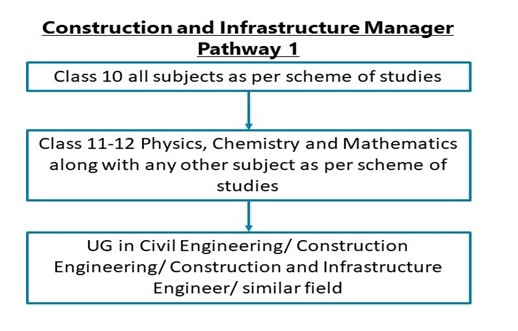
After your secondary level of schooling with Science and Mathematics, you can study Science Stream in your higher secondary school with Physics, Chemistry, and Mathematics and then study for an Undergraduate Engineering Degree in Civil Engineering/ Construction Engineering/ Construction and Infrastructure engineering/ similar field.
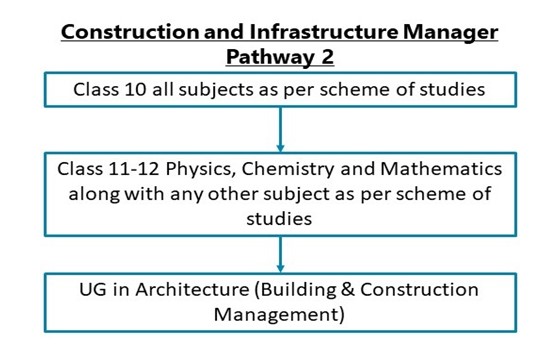
After your secondary level of schooling with Science and Mathematics, you can study Science Stream in your higher secondary school with Physics, Chemistry, and Mathematics and then study for a 5-year Undergraduate Degree in Architecture (Building and construction Management).
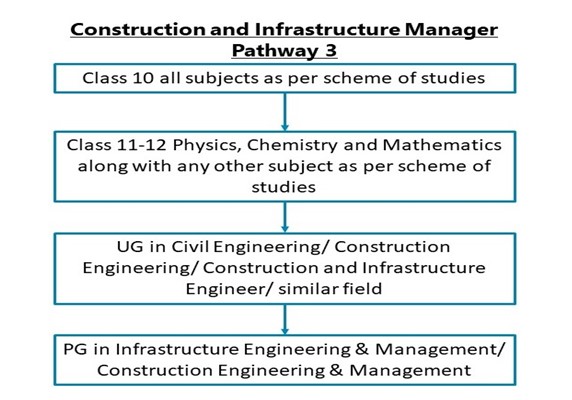
After your secondary level of schooling with Science and Mathematics, you can study Science Stream in your higher secondary school with Physics, Chemistry, and Mathematics and then study for an Undergraduate Engineering Degree in Civil Engineering/ Construction Engineering/ Construction and Infrastructure engineering/ similar field. Now you can study for a master’s engineering degree in Infrastructure Engineering and management/ Construction Engineering and management.
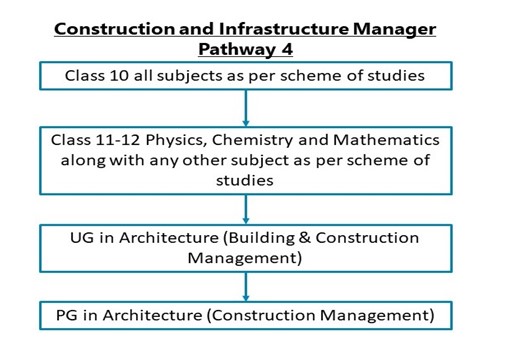
After your secondary level of schooling with Science and Mathematics, you can study Science Stream in your higher secondary school with Physics, Chemistry, and Mathematics and then study for a 5-year Undergraduate Degree in Architecture (Building and construction Management). Now you can study for a master’s degree in architecture in construction management.
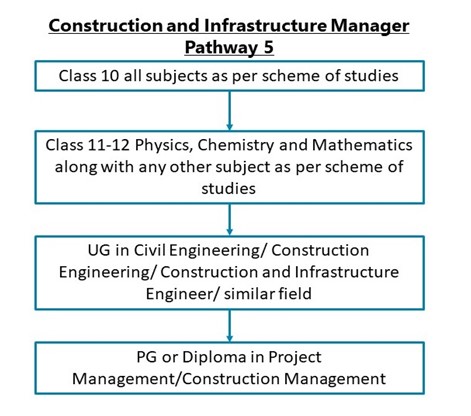
After your secondary level of schooling with Science and Mathematics, you can study Science Stream in your higher secondary school with Physics, Chemistry, and Mathematics and then study for an Undergraduate Engineering Degree in Civil Engineering/ Construction Engineering/ Construction and Infrastructure engineering/ similar field. Then you can study for a Post Graduate Diploma in Project Management/Construction Management.
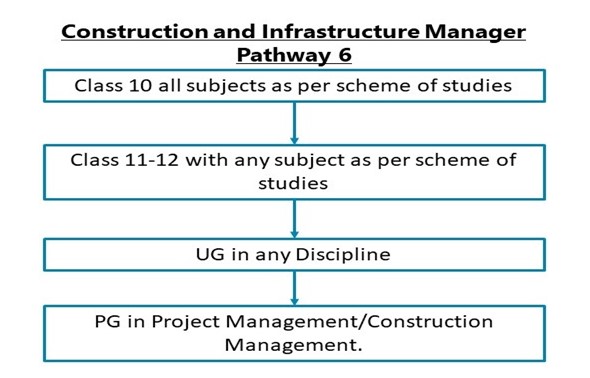
After your secondary level of schooling with Science and Mathematics, you can study any stream in your higher secondary school and then study for an Undergraduate Degree in any subject followed by a master’s degree in Project Management/Construction Management.
Required Qualification & Competencies
You can do a Bachelor’s degree in Civil Engineering / Construction Engineering / Construction Engineering and Technology / Architecture or a related field. Then you may opt for a Post Graduate Degree or Diploma in Construction Management / Building Engineering and management / a related field.
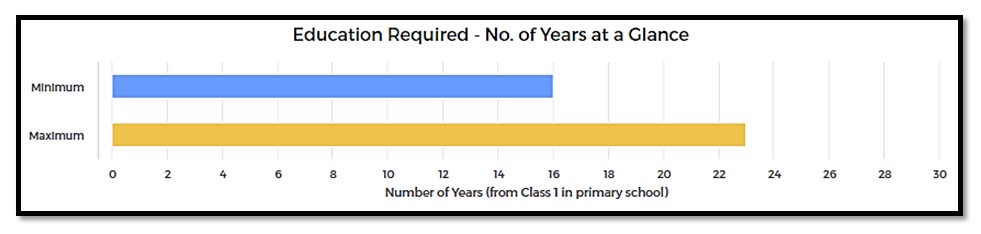
MINIMUM EDUCATION REQUIRED | MAXIMUM EDUCATION REQUIRED |
Under Graduate Undergraduate Degree / Honours Diploma / Graduate Diploma (equivalent to a Degree) Programs for which the minimum eligibility is a pass in Higher Secondary / Class XII School Leaving examination. | Doctoral All Ph.D. or equivalent degree programs for which the minimum eligibility is a Postgraduate or a Pre-Doctoral degree. |
Competencies Required
Interests
1. Enterprising: You should have an interest in Enterprising Occupations. Enterprising occupations involve taking initiative, initiating actions, and planning to achieve goals, often business goals. These involve gathering resources and leading people to get things done. These require decision-making, risk-taking, and action orientation.
2. Realistic: You should have an interest in Realistic Occupations. Realistic occupations involve more practical and hands-on activities than paperwork or office work. Realistic occupations often involve physical activities for getting things done using various tools and equipment.
3. Conventional: You should have interests in Conventional Occupations. Conventional occupations involve repetitive and routine tasks as well as fixed processes or procedures for getting things done. These occupations involve working more with data, systems, and procedures and less with ideas or creativity.
Abilities
1. Abstract Reasoning: The ability to understand ideas that are not expressed in words or numbers; the ability to understand concepts that are not clearly expressed verbally or otherwise.
2. Deductive Reasoning: The ability to apply general rules and common logic to specific problems to produce answers that are logical and make sense. For example, understanding the reasons behind an event or a situation using general rules and common logic.
3. Emotional Intelligence: The ability to understand your own and others' emotions and feelings; empathy for others; adjusting your behavior or self-control and self-regulation according to others' emotions and situations.
4. Flexibility of Closure: The ability to identify or detect a pattern (a figure, object, word, or sound) that is hidden among other distracting materials.
5. Inductive Reasoning: The ability to combine pieces of information from various sources, concepts, and theories to form general rules or conclusions. For example, analyzing various events or situations to come out with a set of rules or conclusions.
6. Inter-Personal: The ability to build and maintain good relationships with others at workplaces and elsewhere.
7. Intrapersonal: The ability to clearly understand your strengths and weaknesses, what your capabilities are, what you can and cannot do, and what you like and dislike.
8. Mechanical Reasoning: The ability to apply basic physical principles and theories to understand how mechanical objects such as tools and machinery work and the ability to understand the rules or laws governing the work of machinery, tools, and bodies in motion.
9. Numerical Reasoning: The ability to add, subtract, multiply, divide, and perform other basic numerical calculations correctly.
10. Oral Comprehension: The ability to listen to and understand information and ideas presented through spoken words and sentences.
11. Oral Expression: The ability to communicate information and ideas in speaking so others will understand.
12. Originality: The ability to come up with unusual or innovative ideas about a given topic or situation, or to develop creative ways to solve a problem.
13. Problem Sensitivity: The ability to tell when something is wrong or is likely to go wrong. It does not involve solving the problem, only recognizing there is a problem.
14. Spatial Ability: The ability to visualize three-dimensional objects by looking at the objects on paper or visualize objects mentally in three dimensions.
15. Speed of Closure: The ability to quickly make sense of, combine, and organize information into meaningful patterns.
16. Verbal Reasoning: The ability to think and reason with words; the ability to reason out ideas expressed in words.
17. Written Comprehension: The ability to read and understand information and ideas presented in writing.
18. Written Expression: The ability to communicate information and ideas in writing so others will understand.
Knowledge
1. Administration: Knowledge of various administrative and operational functions in managing a business or an organization such as general administration, facility management, front office management, back office management, etc.
2. Business Management: Knowledge of managing a business which involves planning what to do, organizing resources and people, leading and supervising work activities of people, and monitoring performances of people as well as the performance of the business. This includes knowledge of marketing, finance, human resources management, operations management, etc.
3. Civil construction: Knowledge of materials, methods, and tools involved in the construction or repair of houses, buildings, or other structures such as industrial factories, dams, bridges, highways, and roads.
4. Electrical and Electronics: Knowledge of circuit boards, processors, chips, electronic system design, electronic equipment, electrical equipment and appliances, electrical power generation, etc.
5. Engineering and Technology: Knowledge of various applications of one or more branches of Engineering Science and technology to manufacture and produce various goods or construct or erect various structures. This includes knowledge about design, development, prototype testing, manufacturing, construction, installation, repair, and maintenance.
6. English Language: Knowledge about English grammar, words, spelling, sentence construction, using English to communicate with others, reading in English, etc.
7. Mechanical Engineering & Technology: Knowledge of Mechanical Engineering and technologies which include design, development, testing, manufacturing, installation, operations, repair, and maintenance of different machinery, devices, equipment, and tools.
8. Physical Science: Knowledge of physical principles, laws, their interrelationships, and applications to understand fluid, material, earth, ocean, atmosphere, and space dynamics, as well as mechanical, electrical, atomic, and sub- atomic structures, properties, and processes.
9. Production and Processing: Knowledge of raw materials, production machinery, production systems, production processes, quality control, and other techniques for manufacturing or construction and distribution of goods.
10. Technical and Engineering Design: Knowledge of various techniques, methods, specifications, and tools for creating, developing, and laying out designs of various machines, equipment, devices, manufacturing plants, structures, systems, and processes. This includes developing blueprints, drawings, and models.
11. Telecommunication and Networking: Knowledge about telecommunication networks, telecommunication technologies, network management, and operations of various equipment and systems for transmission and broadcasting.
Skills
1. Active Learning: Focused and continuous learning from various sources of information, observation, and otherwise for application in getting work done.
2. Active Listening: Giving full attention to what other people are saying, understanding the points being made by others, asking questions, etc.
3. Communication in English: Skills in communicating effectively in writing as well as verbally with others in the English language.
4. Communication in Vernacular Languages: Skills in communicating effectively in writing as well as verbally with others in a local or indigenous language such as Hindi, Tamil, Telugu, Gujarati, Bengali, Assamese, etc.
5. Coordination: Skills in working together with other people to get things done.
6. Critical Thinking: Skills in the analysis of complex situations, using logic and reasoning to understand the situations and take appropriate actions or make interpretations and inferences.
7. Directing: Skills in directing others' actions to get things done.
8. Equipment Sourcing: Skills in sourcing the right equipment for different purposes such as industrial manufacturing, civil, mechanical, and electrical construction, etc.
9. Judgment and Decision Making: Skills in considering the pros and cons of various decision alternatives; considering costs and benefits; and taking appropriate and suitable decisions.
10. Managing Financial Resources: Skills in determining how money should be spent to get the work done, and accounting for these expenditures.
11. Managing Human Resources: Skills in motivating, developing, and leading people as they work, identifying the best people for the job.
12. Managing Material Resources: Skills in sourcing, buying, storing, and use of appropriate raw materials, machines, equipment, and devices for various purposes such as industrial manufacturing, building construction, etc.
13. Negotiation: Skills in bringing others together and trying to reconcile differences.
14. Operations and Process Analysis: Skills in the analysis of operations and processes such as industrial manufacturing, chemical processing, etc. to device better and more efficient operational processes and systems.
15. Persuasion: Skills in persuading others to change their minds or behavior.
16. Problem Solving: Skills in analysis and understanding of problems, evaluating various options to solve the problems, and using the best option to solve the problems.
17. Reading Comprehension: Skills in understanding written sentences and paragraphs in work-related documents.
18. Supervising: Skills in Supervising and monitoring the performance of others, businesses, and different projects.
19. Technical: Skills in using various technologies and technical methods to get things done or solve problems.
20. Technical Design and Drawing: Skills in creating and developing designs and drawings for various structures, machines, equipment, and devices.
21. Time Management: Skills in prioritizing work, and managing time effectively.
22. Troubleshooting: Skills in determining causes of operating errors and deciding what to do about it.
23. Writing: Skills in communicating effectively in writing as appropriate for the needs of the readers.
Personality
1. You are always or mostly organized in your day-to-day life and activities.
2. You are always calm or generally remain calm in most situations.
3. You always feel secure in your surroundings and most situations.
4. You are a soft-hearted person sometimes.
5. You trust others sometimes but not always.
6. You are helpful to others sometimes.
7. You are imaginative sometimes.
8. You prefer to experience new things and have new experiences sometimes.
9. You act independently sometimes but do not do so at some other times.
10. You are friendly and outgoing sometimes, but not always. You prefer the company of people sometimes but not always.
11. You are always practical in most situations.
Career - Job Opportunities & Profiles
1. As a construction manager, you will get various job opportunities in construction companies, municipalities, private companies, colleges/universities, government agencies, etc.
2. If you are into the sales side of the construction business, then you will join as an assistant sales manager.
3. If you are in a consulting firm, you will join as an assistant consultant engineer.
4. Some of you may join as an infrastructure analyst trainee.
5. If you are into construction then you may join as a construction project manager, construction engineer, site engineer, infrastructure engineer, technical field engineer, etc.
6. Most universities and colleges will hire you as a professor at the position of junior professor or assistant professor.
Work environment
A construction manager usually works during office hours but sometimes they are required to work irregular hours by doing overtime, night shifts, and even on public holidays as per the requirement of the project, such as building roads and bridges. You will travel from site to site and sometimes travel long distances for the completion of multiple projects. Some of you will work from the office while some spend long hours supervising the work at the field/site. A construction manager often faces pressure during work due to budget constraints, meeting deadlines, and problems that arise in the project. On average, a construction manager works more than 40 hours a week.
Specialisation Tracks In This Career
1. Architect
As an architect, you will make the designs and drawings of houses, factories, schools, hospitals, and other structures.
2. Civil Engineer
A civil engineer constructs and builds the structures as per the drawing. They work on various infrastructure projects in both the public and private sectors such as building airports, tunnels, dams, sewage treatment, bridges, etc. They handle all repair and maintenance work.
3. Environmental Engineer
As an environmental engineer, you apply the principles of environmental science and engineering. You will help in developing solutions to environmental problems such as recycling, water and air pollution, waste disposal, climate change, etc.
4. Geotechnical Engineer
As a geotechnical engineer, you will examine and study the chemical components of the soil, rocks, etc. to be used in the construction. You will check the quality of the land on which the project needs to be built and also prevent it from crumbling and erosion.
Career Growth
1. If you start your career as a junior site engineer, construction engineer, infrastructure engineer, or technical field engineer then with work experience, you will be promoted to senior site engineer/construction engineer/infrastructure engineer. Technical field engineer and then you will become a project manager and then senior superintendent.
2. If you start your career as a Project Manager then with experience you will be promoted to Senior Project Manager, then General Manager, then Deputy General Manager with further experience. Some of you will even become a project head.
3. If you start your career as a sales manager, then with experience you will become a senior sales manager then an area manager, and then a regional manager. Some of you may then become Head of Sales or VP of Sales.
4. career growth in university and college starts with the assistant professor and then associate professor, professor, and professor emeritus. Professors can also get administrative positions such as Director / Dean / Vice Chancellor, etc.
Salary Offered
1. At an entry-level, with 0 years of experience, you will earn around Rs. 25,000 to 50,000 per month at junior posts such as civil engineer, assistant engineer, assistant consultant engineer, site engineer, etc. As an assistant sales manager, you might earn anything from Rs. 20,000 to 1,00,000 per month. As a professor, you might earn from Rs. 50,000 to 70,000 per month.
2. After 2-6 years of experience, you will earn around Rs. 30,000 to 1,00,000 per month. If you are into sales then you might earn on the higher side even up to Rs. 2,00,000.
3. At mid-level with an experience of 6-12 years of experience, you will earn around Rs. 75,000 to 3,00,000 per month as a senior project manager, senior construction manager, sales manager, etc.
4. With an experience of 15-20 years, you will earn around Rs 1,00,000 to 5,00,000 per month.
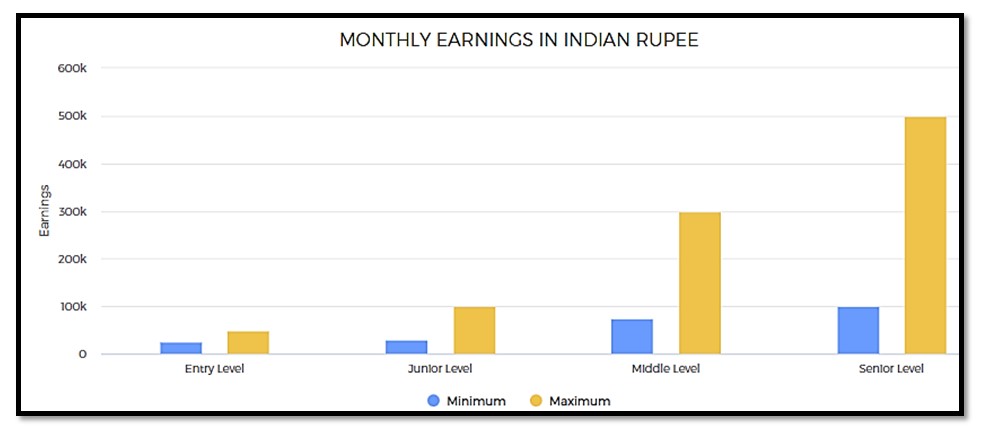
Monthly Earnings In Indian Rupee
Entry Level | Junior Level | Mid Level | Senior Level | ||||
Min Earning | Max Earning | Min Earning | Max Earning | Min Earning | Max Earning | Min Earning | Max Earning |
25000 | 50000 | 30000 | 100000 | 75000 | 300000 | 100000 | 500000 |
1. Entry level: 0 - 2 years of work experience
2. Junior Level: From 1 to 12 years of work experience
3. Mid Level: From 5 to 20+ years of work experience
4. Senior Level: From 10 to 25+ years of work experience (there could be exceptions in some high-end technical, financial, engineering, creative, management, sports, and other careers; also shortly, people will reach these levels much faster in many careers and some careers, these levels will have no meaning as those careers will be completely tech skill driven such as even now, there is almost no level in a Cyber Security Expert’s job)
Work Activities
1. Addressing grievances and resolving conflicts: Handling complaints and grievances to resolve; resolving conflicts among co-workers or others at the workplace or outside of your work.
2. Analysing and interpreting data and information: Analysis of data and information to find facts, trends, reasons behind situations, etc.; interpretation of data to aid in decision-making.
3. Assessing and evaluating quality: Assessing and evaluating the quality of materials, systems, processes, products, services, etc.
4. Coaching and developing: Identifying training and professional development needs of others; coaching and training them to develop skills to perform tasks and improve performance.
5. Communicating with co-workers and others: Communicating with people in writing, verbally or otherwise inside your workplace and various other people who have professional relationships with your place of work including vendors, government officials, etc., or with people at large.
6. Communicating with customers: Communicating with potential and existing customers of your organization in writing, verbally, or otherwise.
7. Creative thinking: Developing new ideas, concepts, innovative solutions to problems, newer ways of getting things done, designing products and services, creating works of art and craft, etc.
8. Decision-making and problem-solving: Analysis of data and information; evaluation of alternative decisions and results of decisions; taking the right decisions and solving problems.
9. Developing and maintaining interpersonal relationships: Developing professional relationships with co-workers and others outside organizations and maintaining good relationships.
10. Drawing, drafting, laying out, and specifying objects, equipment, devices, tools, and systems: Creating and developing designs, drawings, layouts, and specifications about how to construct, manufacture, assemble, build, use, and maintain various equipment, devices, tools, and systems.
11. Estimating quantity, cost, time, and resources: Estimating sizes, volumes, distance, and quantity; estimating and determining time, costs, and resources; estimating materials required to perform a task.
12. Getting Information and learning: Observing, hearing, reading, using computers, or otherwise obtaining information and learning from it.
13. Handling administrative activities: Handling various administrative tasks and managing day-to-day operations.
14. Inspecting equipment, systems, structures, and materials: Inspecting equipment, systems, structures, and materials to ascertain quality, performance, defects, causes of errors, etc.
15. Inspecting situations, events, and people: Inspecting situations, events, and people to understand the reasons and causes for the situation or events to happen; inspecting people to understand reasons behind their behavior and actions.
16. Leading: Inspiring and motivating co-workers to work to achieve specific goals; enabling and facilitating others to perform tasks effectively; addressing issues and solving problems in order to help people perform well.
17. Managing and supervising: Managing and supervising the work of others; setting goals; giving instructions; monitoring work performance, etc.
18. Monitoring processes, systems and performance: Observing and recording information on various criteria to monitor mechanical, electronic, electrical, and other processes and systems; monitoring progress of projects and tasks.
19. Monitoring use of resources: Monitoring and controlling the use of resources like land and materials as well as spending of money.
20. Negotiating: Negotiating terms, conditions, costs, prices, and about other issues.
21. Organising, planning, and prioritizing tasks: Planning and organizing tasks to achieve work goals; prioritizing tasks to achieve goals and making the best use of the time available.
22. Providing advice and consultation to others: Giving advice or consultation to others about various issues, conceptual matters, know-how, scientific matters, products, or services.
23. Recruiting, enlisting, and placing people resources: Sourcing, recruiting, selecting, enlisting and placing people in different positions and tasks in an organization or for getting work done.
24. Scheduling tasks: Scheduling project timelines, tasks and activities.
25. Strategic planning: Developing visions and goals, developing strategies and action plans for achieving visions and goals.
26. Updating and using relevant knowledge: Keeping updated with the latest knowledge relevant to your fields of work and use of the relevant knowledge in getting things done.
27. Using computers for work: Using computers for day-to-day office work; using computer software for various applications in day-to-day professional work; entering data and processing information; for writing.
28. Working in a team: Working in a team of people; developing a team; and maintaining professional relationships among team members.
Future Prospects
The construction industry is on the verge of sustainable growth. Also, the introduction of various construction projects such as ‘Housing for All’ and ‘Smart City Mission’ will direct the growth of this sector. The infrastructure sector is the largest receiver of FDI inflows. At present, it requires an investment of 50 trillion which will provide attractive opportunities in the future. In the coming years, the growing population and business growth will accelerate the demand for the construction of houses, schools, hospitals, etc.
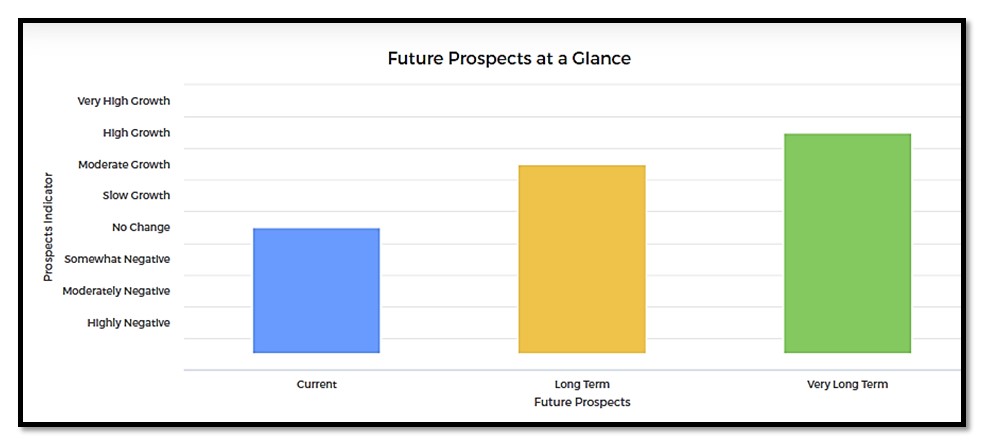
Future Prospects At A Glance
Current (0-1 year) | Long Term (2-5 years) | Very Long Term (6-10 years) |
No Change | Moderate Growth | High Growth |