
Dairy Technologist
Entry Level Qualification
Class 10
Career Fields
Agriculture & Food Science
For Specially Abled


Career Entrance Exam
BHU UET, BHU PET, BHU RET, WBJEE, KEAM, TSEAM CET, AP EAPCET, ICAR PG, ICAR PHD, ICAR UG
About Career
Dairy Technologist is a food technologist who specializes in Dairy products. You know Amul. You also know that each year Amul comes with new products, and new flavors and sometimes removes old products from its plants. As a dairy technologist, you will be responsible for the production of dairy products, at two levels:
1. Development of new products: You will work within the legal framework to produce new types, and flavors of dairy products that are safe for human consumption.
2. Regular production of existing products: You will work to ensure that the daily production of products is done under prescribed legal and hygiene conditions. You will be responsible for the nutrition values in the product, the quality, chemical /natural flavors added, the weight of packaged products, etc.
Key Roles and Responsibilities
As a dairy technologist, you will have several responsibilities including the following:
1. You will check raw ingredients (especially milk) for maturity or stability for processing.
2. You will also do a quality, safety, and nutritional value check on the final products.
3. You will inspect food processing areas and ensure that the plant is complying with all government regulations, safety and sanity standards are maintained, and there is proper waste management.
4. You will evaluate food processing storage operations. You will also develop or assist in developing quality assurance programs.
5. You will work on new methods that can help you improve the chemical composition of food, flavor, color, texture, nutritional value, etc.
6. You will stay up to date with new regulations, norms, and laws related to food science in India and abroad where your products are exported.
7. You will conduct research and experiments to improve the lives of Dairy animals, and their productivity also increases.
8. You will work to create new food products. You will also work to create new ways to develop existing products including process, packaging, and delivery systems.
9. You will keep yourself updated with new scientific developments happening across the world in the dairy field.
10. You will communicate your new scientific research to the fellow community, food producers, government, and the public.
11. Regularly travel to the facilities to oversee the implementation of new projects.
12. You will do basic research seeks to understand the biological and chemical processes by which dairy products can be produced.
13. You will work with little supervision, forming your hypotheses and developing your research methods. Also, you will often lead teams of technicians or students who help in your research.
Career Entry Pathway
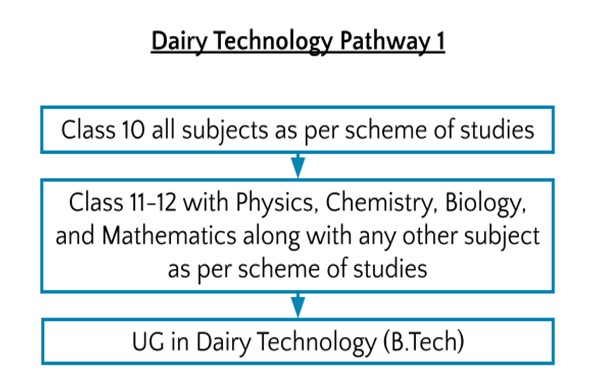
Class 10 all subjects as per the scheme of studies– Class 11-12 in Science stream with Physics, Chemistry, Biology, and Mathematics along with any other subject as per the scheme of studies– UG in Dairy Technology (B.Tech.).
After Class 11-12 in Science stream with Physics, Chemistry, Biology, and Mathematics along with any other subject as per the scheme of studies, you can study science stream with Physics, Chemistry, and mathematics in your higher secondary school and then study for an undergraduate degree in Engineering Physics followed by a master’s degree in Engineering Physics.
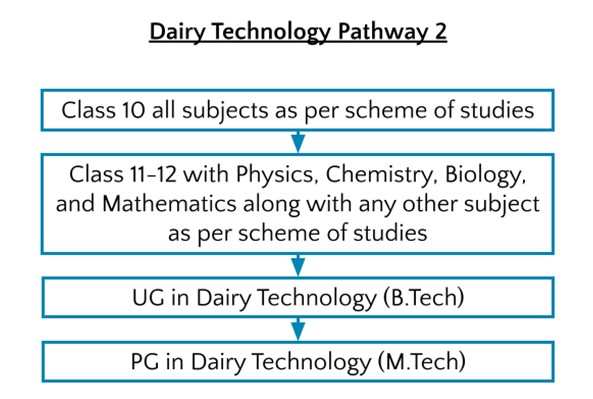
After Class 11-12 in Science stream with Physics, Chemistry, Biology, and Mathematics along with any other subject as per the scheme of studies, you can study science stream with Physics, Chemistry, Biology, and mathematics in your higher secondary school and then study for an undergraduate engineering degree in Dairy Technology followed by a master’s degree in Dairy Technology (M.Tech.).
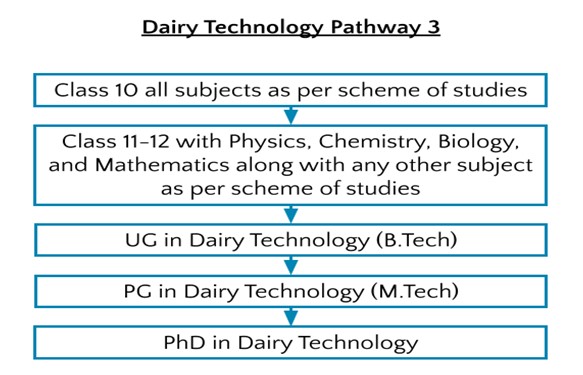
After Class 11-12 in Science stream with Physics, Chemistry, Biology, and Mathematics along with any other subject as per the scheme of studies, you can study science stream with Physics, Chemistry, Biology, and mathematics in your higher secondary school and then study for an undergraduate engineering degree in Dairy Technology followed by a master’s degree in Dairy Technology (M.Tech.). Further, you can take Dairy Technology in Ph.D. and complete the doctorate.
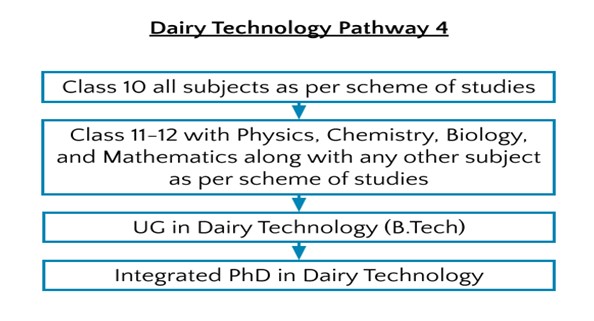
After Class 11-12 in Science stream with Physics, Chemistry, Biology, and Mathematics along with any other subject as per the scheme of studies, you can study science stream with Physics, Chemistry, Biology, and mathematics in your higher secondary school and then study for an undergraduate engineering degree in Dairy Technology followed by an integrated Ph.D. in Dairy Technology.
Required Qualification & Competencies
Undergraduate studies after school:
1. To become a Dairy Technologist, you should complete your schooling with Physics, and Mathematics and join for an undergraduate course of B.Tech. in Dairy Technology.
Post Graduate studies:
1. After finishing B.Tech., you can take an M.Tech. in Dairy Technology.
2. You can go for further studies by choosing to complete a Ph.D. in Dairy Technology.
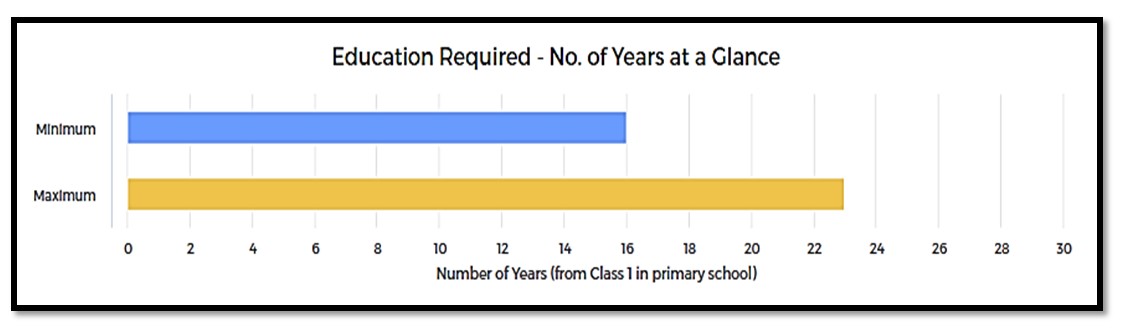
MINIMUM EDUCATION REQUIRED | MAXIMUM EDUCATION REQUIRED |
Under Graduate Undergraduate Degree / Honours Diploma / Graduate Diploma (equivalent to a Degree) Programs for which the minimum eligibility is a pass in Higher Secondary / Class XII School Leaving examination. | Doctoral All Ph.D. or equivalent degree programs for which the minimum eligibility is a Postgraduate or a Pre-Doctoral degree. |
Competencies Required
You should have the following occupational interests:
1. Investigative - You should have an interest in Investigative Occupations. Investigative occupations involve working with ideas and quite a lot of thinking, often abstract or conceptual thinking. These involve learning about facts and figures; involve the use of data analysis, assessment of situations, decision-making, and problem-solving.
2. Realistic - You should have an interest in Realistic Occupations. Realistic occupations involve more practical and hands-on activities than paperwork or office work. Realistic occupations often involve physical activities for getting things done using various tools and equipment.
3. Conventional - You should have interests in Conventional Occupations. Conventional occupations involve repetitive and routine tasks as well as fixed processes or procedures for getting things done. These occupations involve working more with data, systems, and procedures and less with ideas or creativity.
The following personality attributes are required:
1. You are always or mostly organized in your day-to-day life and activities.
2. You are always or mostly disciplined in your actions and behavior.
3. You are always practical in most situations.
4. You always or mostly care about your actions and behavior.
You should have the following skills and knowledge:
1. Reading Comprehension - Skills in understanding written sentences and paragraphs in work-related documents.
2. Active Listening - Giving full attention to what other people are saying, understanding the points being made by others, asking questions, etc.
3. Critical Thinking - Skills in the analysis of complex situations, using logic and reasoning to understand the situations and take appropriate actions or make interpretations and inferences.
4. Active Learning - Focused and continuous learning from various sources of information, observation, and otherwise for application in getting work done.
5. Chemical Science - Knowledge of the chemical composition, structure, and properties of substances and of the chemical processes and transformations that they undergo. This includes the uses of chemicals and their interactions, toxicity, production techniques, and disposal methods.
6. Biological Science - Knowledge of plants and animals, their anatomical structure, cell structure, tissues, physiological functions, evolution, and all other related aspects.
7. Production & Processing - Knowledge of raw materials, production machinery, production systems, production processes, quality control, and other techniques for manufacturing or construction and distribution of goods.
You should have the following aptitudes and abilities:
1. Oral Comprehension - The ability to listen to and understand information and ideas presented through spoken words and sentences.
2. Written Comprehension - The ability to read and understand information and ideas presented in writing.
3. Inductive Reasoning - The ability to combine pieces of information from various sources, concepts, and theories to form general rules or conclusions. For example, analyzing various events or situations to come out with a set of rules or conclusions.
4. Problem Sensitivity - The ability to tell when something is wrong or is likely to go wrong. It does not involve solving the problem, only recognizing there is a problem.
5. Category Flexibility - The ability to generate or use different sets of rules for combining or grouping things in different ways.
Career - Job Opportunities & Profiles
1. Dairy farms are the biggest recruiters of Dairy technologists. At the entry level, you may join a dairy in the role of Dairy Plant Supervisor or as a Graduate Engineer Trainee.
2. After you finish the Master’s degree, you can even join universities and colleges at the entry-level position of Junior Professor or Assistant Professor.
3. After your Master’s degree, research laboratories and research farms will hire you as a research associate officer with the lowest grade.
4. If you start your career with an FMCG or food industry, then they will hire you are a Trainee Microbiologist or Trainee Food Technologist.
You can find job opportunities at the following facilities:
1. Dairy farms
2. Dairy cooperatives like Amul, Mother Dairy, Saras, etc.

3. Ice cream companies like Vadilal, Kwality Wall’s, Havmor, etc.



4. Research and development agencies.
5. Agriculture and Dairy Colleges and Universities.
6. Quality control department of each State Government.
7. Milk Product Manufacturing companies.
8. FMCG and food production companies.
9. Dairy Equipment Manufacturing companies
Work Environment
As a Dairy Technologist, you will work in offices, laboratories, dairy farms, and fields. Most of the time is spent at processing plants where you would be required to inspect food products, processes, and machinery. The job will be mostly 8 hours with limited overtime. The work is not stressful for most of the year but inspection, quality control check, etc. will be stressful. You need to take care of insecurity by wearing gloves, masks, and appropriate clothing. The environment of the plants can sometimes be filled with an odor that you might not like. Sometimes you might be in the lab at temperatures below 0 degrees also.
Specialisation Tracks In This Career
1. Dairy Chemist
Dairy Chemists work on the chemical composition of dairy products. They work to monitor the quality of products based on the chemical composition of fat content, protein content, lactose content, total solids, pH level, alcohol test, sucrose content, etc. They also work to find adulteration by water.
2. Dairy Engineer
Dairy Engineers use technology to improve total dairy production. They work on building equipment and machinery with better efficiency.
3. Dairy Microbiologist
Dairy Microbiologists work to keep a check on the microorganisms’ growth in dairy products. They work to control bacterial, fungal, and other microorganisms’ growth.
4. Dairy Economist
Dairy Economists work to understand the financial and commercial aspects of the dairy business.
5. Dairy Business Manager
Dairy Business Managers work to manage the overall facilities of dairy. They see the management side of the dairy including using a computer and mathematical tools to solve managerial problems.
Career Growth
1. My career growth in university and college started as an Assistant Professor and then as Associate Professor, Professor, and Professor Emeritus. Professors can also get administrative positions such as Director/Dean/Vice Chancellor, etc.
2. If you join a dairy plant, then you join as a dairy plant supervisor and later become assistant manager or Dairy plant manager. With a few years of work experience, you become a purchasing officer then a Logistics Manager, and finally a Quality control officer.
3. If you join the food industry, FMCG, etc., then you will start your career as a Trainee Microbiologist or Trainee Food Technologist. With experience, you will become a Quality Assurance Executive, Assistant Manager, Senior Manager, Deputy Manager (Quality), and Production Manager.
4. If you are hired as a research associate (JRF and SRF), then you will go on to become a Doctoral Research Fellow, then a Post-Doctoral Research Fellow, and then a Scientist in Progressive Grades.
Salary Offered
1. At the entry-level, you can join as a dairy plant supervisor or graduate engineer trainee and earn around 20,000 INR to 30,000 INR per month. If you join as an assistant professor, then you might earn anything between 60,000 to 70,000 INR per month. In private industries, you would be earning anything between 20,000 and 30,000 INR per month.
2. At the junior level with a work experience of 2-5 years, you would be earning anything between 25,000 INR to 1,00,000 INR per month.
3. At the middle level with an experience of 5-10 years, you would be earning anything between 40,000 INR to 1,50,000 INR per month.
4. At the senior level of over ten years of work experience, you would be earning anything between 50,000 INR to 2,00,000 INR or more per month.
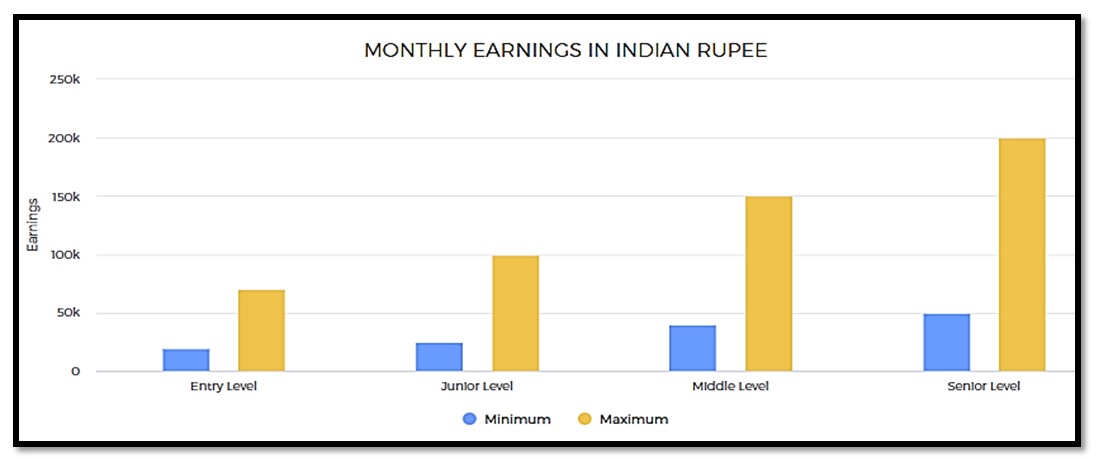
Monthly Earnings In Indian Rupee
Entry Level | Junior Level | Mid Level | Senior Level | ||||
Min Earning | Max Earning | Min Earning | Max Earning | Min Earning | Max Earning | Min Earning | Max Earning |
20000 | 70000 | 25000 | 100000 | 40000 | 150000 | 50000 | 200000 |
1. Entry level: 0 - 2 years of work experience
2. Junior Level: From 1 to 12 years of work experience
3. Mid-Level: From 5 to 20+ years of work experience
4. Senior Level: From 10 to 25+ years of work experience (there could be exceptions in some high-end technical, financial, engineering, creative, management, sports, and other careers; also shortly, people will reach these levels much faster in many careers and some careers, these levels will have no meaning as those careers will be completely tech skill driven such as even now, there is almost no level in a Cyber Security Expert’s job)
Work Activities
As a Dairy Technologist, you might be involved in various applied areas of Dairying and Food Scientist. In these areas, you might be involved in different activities such as:
1. Decision making - Analysis of data and information; evaluation of alternative decisions and results of decisions; taking the right decisions and solving problems.
2. Communicating with co-workers & others- Communicating with people in writing, verbally or otherwise inside your workplace and various other people who have professional relationships with your place of work including vendors, government officials, etc., or with people at large.
3. Getting Information and learning - Observing, hearing, reading, using computers, or otherwise obtaining information and learning from it. Information can be in any form.
4. Analysis and interpretation of data and information - Analysis of data and information to find facts, trends, reasons behind situations, etc.; interpretation of data to aid in decision-making.
Future Prospects
India is the largest producer and consumer of dairy products. In 2016, according to Business Wire, the Indian dairy industry was worth 5,000 billion INR. Presently the organized sector constitutes only 20% of this market, 46 percent is still unorganized, and 34% is consumed locally. These data show that there is immense potential for the organized dairy industry in India. If the market doesn’t grow, the organized sector can still increase by four times. This potential means there is a high prospect for a career in this field. The ice cream market is growing at a rate of 15-20% per year, and the cheese industry is growing at a rate of over 31% per year.
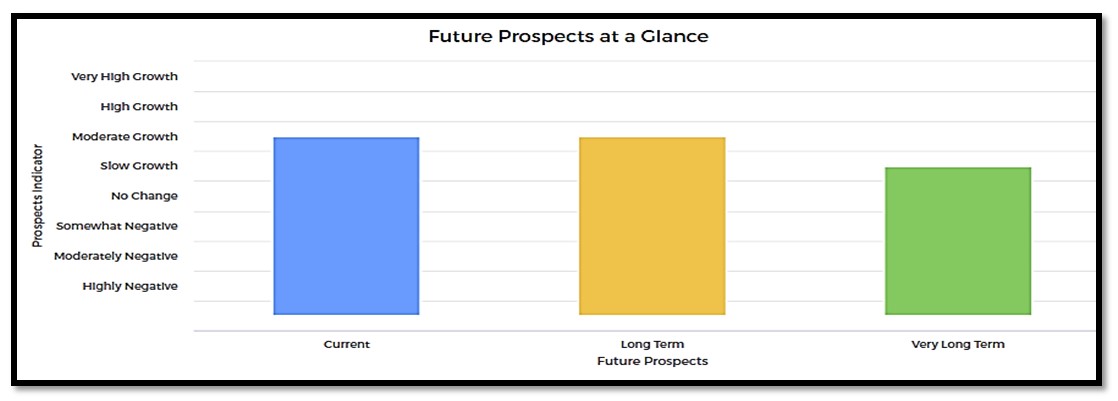
Future Prospects At A Glance
Current (0-1 year) | Long Term (2-5 years) | Very Long Term (6-10 years) |
Moderate Growth | Moderate Growth | Slow Growth |