


Event Associates/Operative
Entry Level Qualification
Class 10
Career Fields
Hospitality, Tourism & Transport Services
For Specially Abled


Career Entrance Exam
About Career
As an event associate, you’ll work in close collaboration with Event Planners and Event Managers. Your role will primarily be assisting Event Planners/Managers in setting up various kinds of events - be it informal events such as marriage parties, anniversaries, and birthday parties, or formal events like conventions, conferences, exhibitions, product launches, and so on.
It will be your duty to ensure that everything in an event goes according to the plan and meets the client’s demands. You’ll perform various duties throughout the lifecycle of an event - from the setup to the cleanup - including setting up stalls, decorations, stages, backdrops, presentation panels, various types of displays, arranging accommodation and transportation facilities, and catering and dining, among other things.
Key roles and responsibilities:
1. Accompanying the Events Planner/Manager to both internal and external events.
2. Providing technical, logistical, and administrative support to supervisors.
3. Attending all meetings set up with the client to act as a second point of contact.
4. Helping set up and dismantle stalls, decorations, seating areas, stages, backdrops, presentation panels, and various types of displays, throughout the lifecycle of the event.
5. Promoting professional events (conventions, conferences, trade fairs, etc.) across social media platforms as well as through other means such as the distribution of pamphlets, leaflets, etc. They may also promote various events by organizing roadshows.
6. Communicating and negotiating with all vendors (room service, caterers, musical band, florists, decorators, electrical and sound equipment suppliers, hotel and banquet managers as well as other support staff at event venues,.) throughout the entire lifecycle of every event and obtain the required services at a minimal cost.
7. Overseeing the production of marketing and printed materials.
8. Monitoring and keeping track of the expenses and bills.
PARTICULARS | DESCRIPTION |
Name | Event Associates/Operative |
Purpose | Inventory Management |
Career Field | Hospitality, Tourism & Transport Services |
Required Entrance Exam | No Entrance Exam |
Average Salary | 100000 - 200000 Rs. Per Year |
Companies For You | Assistant Event Manager/ Senior Associate & Many More |
Who is Eligible | Any One |
Career Entry Pathway
Class 10 all subjects as per scheme of studies- Diploma in Event Management/Event and Exhibition Management/Similar courses.
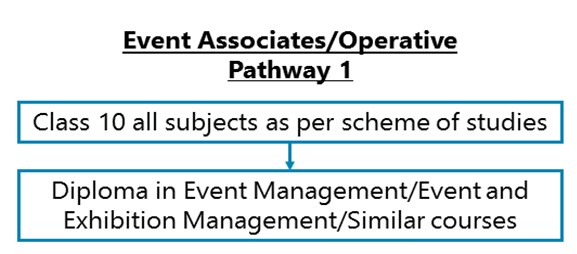
After Class 10 all subjects as per scheme of studies, you can opt for a Diploma in Event Management or Event and Exhibition Management or any other similar courses. Generally, the duration of such diploma courses is one year.
Class 10 all subjects as per scheme of studies – Class 11-12 with any subject combination as per scheme of studies - Diploma in Event Management/Similar courses.
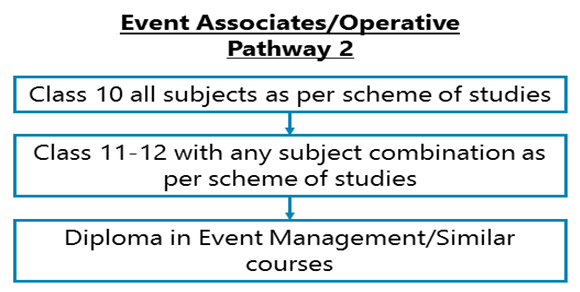
After completing Class 11-12 with any subject combination as per scheme of studies, you can get a Diploma degree in Event Management or other such similar courses.
Class 10 all subjects as per scheme of studies – Class 11-12 with any subject combination as per scheme of studies - ITI course in Event Management Assistant.
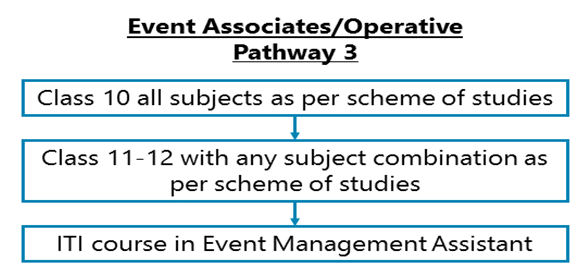
After completing Class 11-12 with any subject combination as per scheme of studies, you can take up an ITI course in Event Management Assistant.
Class 10 all subjects as per scheme of studies – Class 11-12 with any subject combination as per scheme of studies - BBA in Event Management/Similar undergraduate degree course.
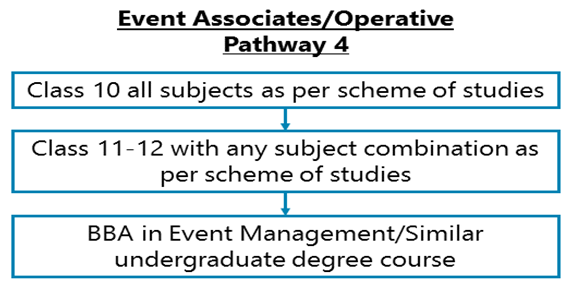
After completing Class 11-12 with any subject combination as per scheme of studies, you can opt for a BBA in Event Management or any other similar undergraduate degree course that is relevant to the industry.
Required Qualification & Competencies
Undergraduate studies after school:
1. Once you’ve completed your class 10, you can either choose to complete your higher secondary school studies or you can directly opt for Diploma/ITI courses in Event Management/Outdoor Event Management/Event and Exhibition Management.
2. If you wish to study even further, you can choose to get a Bachelor’s degree in Business Administration with Event Management specialization or similar courses. This increases your chances of bagging well-paying jobs in the field.
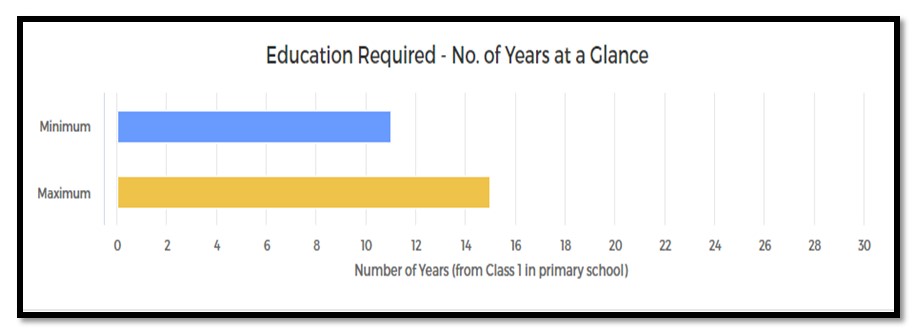
MINIMUM EDUCATION REQUIRED | MAXIMUM EDUCATION REQUIRED |
Post-Secondary Certificate / Diploma Programs for which the minimum eligibility is a pass in class X. | Under Graduate Undergraduate Degree / Honours Diploma / Graduate Diploma (equivalent to a Degree) Programs for which the minimum eligibility is a pass in Higher Secondary / Class XII School Leaving examination. |
Competencies Required
Interests
1. Enterprising: You should have interests in Enterprising Occupations. Enterprising occupations involve taking initiatives, initiating actions, and planning to achieve goals, often business goals. These involve gathering resources and leading people to get things done. These require decision making, risk-taking, and action orientation.
2. Conventional: You should have interests in Conventional Occupations. Conventional occupations involve repetitive and routine tasks as well as fixed processes or procedures for getting things done. These occupations involve working more with data, systems, and procedures and less with ideas or creativity.
3. Social: You should have interests in Social Occupations. Social occupations involve helping or assisting others; these involve working with and communicating with people to provide various services; these may involve educating and advising others.
Knowledge
1. Administration: Knowledge of various administrative and operational functions in managing a business or an organization such as general administration, facility management, front office management, back-office management, etc.
2. Customer Service: Knowledge about how to provide customer services. This includes understanding customer needs, helping customers to use products and services, answering customer queries, handling customer complaints and grievances, and evaluating customer satisfaction.
3. English Language: Knowledge about English grammar, words, spelling, sentence construction, using English to communicate with others, reading in English, etc.
4. Personal Care Service: Knowledge of how to provide various assistance and services to others. This includes looking after the needs of individuals, understanding what they need and provide all assistance at home or elsewhere.
Skills
1. Active Listening: Giving full attention to what other people are saying, understanding the points being made by others, asking questions, etc.
2. Coordination: Skills in working together with other people to get things done.
3. Directing: Skills in directing others' actions to get things done.
4. Judgment and Decision Making: Skills in considering the pros and cons of various decision alternatives; considering costs and benefits; taking appropriate and suitable decisions.
5. Problem Solving: Skills in analysis and understanding of problems, evaluating various options to solve the problems and using the best option to solve the problems.
6. Service Orientation: Skills in or a keen interest to help and assist people.
7. Supervising: Skills in Supervising and monitoring the performance of others, businesses, and different projects.
Abilities
1. Emotional Intelligence: The ability to understand you’re own and others' emotions and feelings; empathy for others; adjusting your behaviour or self-control and self-regulation according to others' emptions and situations.
2. Inter-Personal: The ability to build and maintain good relationships with others at workplaces and elsewhere.
3. Selective Attention: The ability to concentrate on a task over a long period of time without being distracted.
4. Verbal Reasoning: The ability to think and reason with words; the ability to reason out ideas expressed in words.
5. Written Expression: The ability to communicate information and ideas in writing so others will understand.
Personality
1. You are always or mostly organised in your day-to-day life and activities.
2. You are always or mostly a soft-hearted person.
3. You are always or mostly helpful to others.
4. You are somewhat disciplined in your action and behaviour.
5. You are caring, supportive, sympathetic and kind to others sometimes.
Career - Job Opportunities & Profiles
After you have completed a Diploma / ITI / Bachelor’s degree course in Event Management, you can begin working as an Event Associate or an Event Management Assistant or an Event Coordinator for Senior Event Planners/Managers.
Some of the top recruiters for Event Associate/Operatives are: 360 degrees, Cox and King, Percept D Mark, Party Cruisers, Sita Conferences, PixalMate Media, TIC Events Group, Outlook Network Entertainments, Eblitz, Sercon, Tafcon Group, etc.



Career Growth
Usually, growth opportunities in this field are moderate. You can get opportunities for promotion as you gain more and more industry experience and knowledge over the years. In about 5-10 years’ time, you may grow into mid-level roles such as Assistant Event Manager/ Senior Associate, etc. In about 10-15 years, you can become an Event Manager / Senior Event Manager.
Salary Offered
1. Salaries of Event Associates will vary according to the job profile they will be taking up.
2. In entry-level job titles, you can expect a salary package ranging anywhere between Rs. 8,000-15,000 per month. However, as you gain industry experience, you can opt for job positions with a higher salary range.
3. In mid-level jobs with over 6-12 years of experience, the salary range goes a little higher, ranging from Rs. 15,000-30,000 per month.
4. Senior-level jobs that demand over 12-20 years of experience offer an average annual salary ranging between Rs. 24,000-35,000 per month.
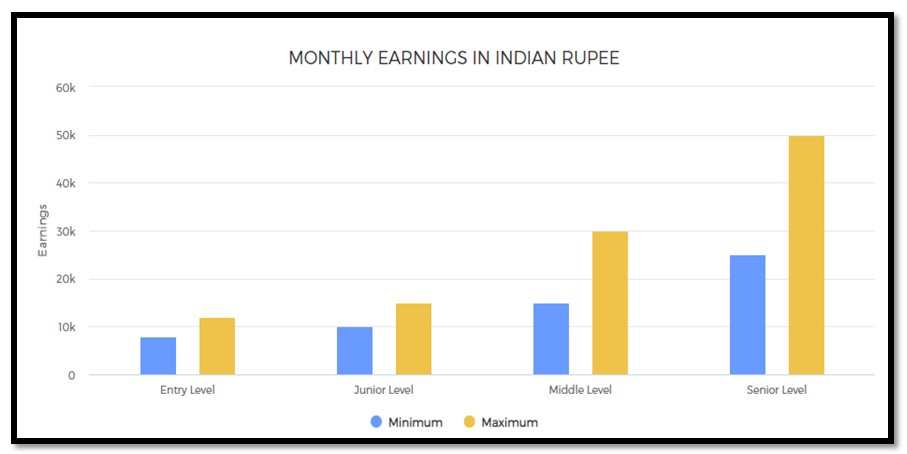
Monthly Earnings In Indian Rupee
Entry Level | Junior Level | Mid-Level | Senior Level | ||||
Min Earning | Max Earning | Min Earning | Max Earning | Min Earning | Max Earning | Min Earning | Max Earning |
8000 | 12000 | 10000 | 15000 | 15000 | 30000 | 25000 | 50000 |
1. Entry level: 0 - 2 years of work experience
2. Junior Level: From 1 to 12 years of work experience
3. Mid-Level: From 5 to 20+ years of work experience
4. Senior Level: From 10 to 25+ years of work experience (there could be exceptions in some high-end technical, financial, engineering, creative, management, sports, and other careers; also in the near future, people will reach these levels much faster in many careers and in some careers, these levels will have no meaning as those careers will be completely tech skill driven such as even now, there is almost no level in a Cyber Security Expert’s job)
Work Activities
1. Addressing grievances and resolving conflicts: Handling complaints and grievance to resolve; resolving conflicts among co-workers or others at the workplace or outside in relation to your work.
2. Assisting and caring for people: Assisting people in availing of services; taking care of people in different situations; offering help and services to others.
3. Communicating with co-workers and others: Communicating with people in writing, verbally or otherwise inside your workplace and various other people who have professional relationships with your place of work including vendors, government officials, etc. or with people at large.
4. Communicating with customers: Communicating with potential and existing customers of your organization in writing, verbally or otherwise.
5. Developing and maintaining inter-personal relationships: Developing professional relationships with co-workers and others outside organizations and maintaining good relationships.
6. Getting Information and learning: Observing, hearing, reading, using computers, or otherwise obtaining information and learning from it.
7. Handling administrative activities: Handling various administrative tasks and managing day-to-day operations.
8. Managing and supervising: Manging and supervising work of others; setting goals; giving instructions; monitoring work performance, etc.
9. Organizing, planning and prioritizing tasks: Planning and organizing tasks in order to achieve work goals; prioritizing tasks to achieve goals and making the best use of the time available.
10. Scheduling tasks: Scheduling project timelines, tasks and activities.
11. Updating and using relevant knowledge: Keeping updated with the latest knowledge relevant to your fields of work and use of the relevant knowledge in getting things done.
12. Working directly with people: Working directly with people to offer them products and services, providing assistance, etc.
13. Working in a team: Working in a team of people; developing a team; maintaining professional relationships among team members.
Future Prospects
As India's economy has been growing fast over the last few decades, the number of events is also growing fast. It is difficult to estimate exactly how it is growing, but for example, according to an article in the new Indian Express, the MICE industry (comprising of events such as meetings, incentive tours, conferences, and exhibitions) is growing at a rate of 8% every year. 8% annual growth rate is a high growth rate. Even India's wedding industry is growing fast. At present, the size of the wedding industry could be over Rs. 50,000 crores. These figures indicate that work opportunities for event professionals will also be growing.
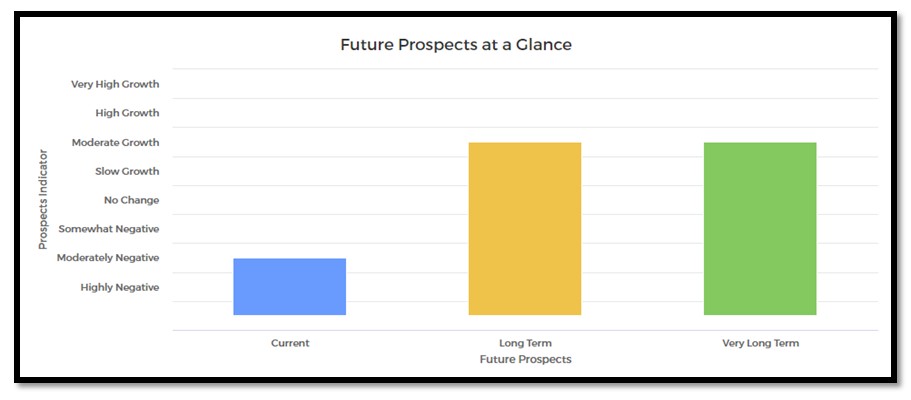
Future Prospects At A Glance
Current (0-1 year) | Long Term (2-5 year) | Very Long Term (6-10 years) |
Moderately Negative | Moderate Growth | Moderate Growth |