


Indian Economic Service Officer
Entry Level Qualification
Class Graduate
Career Fields
Government & Defense Services
For Specially Abled


Career Entrance Exam
About Career
PARTICULARS | DESCRIPTION |
Name | Indian Economic Service Officer |
Purpose | Checking the installation Sites |
Career Field | Government & Defense Services |
Required Entrance Exam | UPSC IAS |
Average Salary | 9,00,000 - 12,00,000 Rs. Per Year |
Companies For You | Planning Commission, Ministry of economic affairs & Many More |
Who is Eligible | Graduate |
1. Civil Services Officers are one of the most important administrative authorities of India. Civil Services officers run governments’ administration – both at the central and the state level. The Indian Economic Service Officers are a part of the administrative civil service under Group A of the Central Civil Services of the Government of India (GOI).
2. Indian Economic Services Officers work at the executive level. They are responsible for undertaking economic analysis (examining the economic systems or study of the production processes of various industries to determine how effectively the economy is operating), providing advices in designing and formulating development policies and plans, implementing projects, strengthening delivery systems, monitoring and evaluating public benefit programs.
3. As an Indian Economic Services Officer, you will serve in a diverse range of subject areas such as finance, social sector, rural development, education, health, agriculture, industry, trade, transport, and information technology. You will deal with development issues and contribute to policy-making in various departments/agencies and services of the Central Government.
As an Indian Economic Services Officer, you will be posted across different Ministries and Departments of the Central Government dealing with economic and social sectors such as:
1. Planning Commission
2. Ministry of economic affairs
3. National Sample Survey Organisation (NSSO)
4. Department of Economic Affairs
5. Department of Expenditure
6. Department of Financial Services
7. Department of Investment and Public Asset Management
8. Department of Revenue
The Indian Economic Services Officers are also deputed to serve in various domestic and international organizations such as UN bodies, foreign governments, state governments, and regulatory bodies. Officers of the Indian Economic Services are directly recruited on the basis of Indian Economic Service examination (IES) which is conducted by the UPSC.
Key Roles and Responsibilities
As an Indian Economic Services officers, you would be involved in the following key roles and responsibilities:
1. You would be involved in matters related to economic advisory, economic administration, implementation of development policies and programs, besides dealing with other areas such as economic reforms, regulations, price fixation, and monitoring and evaluation.
2. You would be involved in almost all the sectors of government functioning - for example, providing economic basis of policymaking and continuity in policymaking.
3. You would be required to be closely associated with and involved in the economic reforms in various Ministries/ Departments to which you are posted.
4. You would also advise the concerned Ministries/ Departments, on a continuous basis, on all policy matters having a bearing on internal and external economic management, and facilitate reforms in the fields/ sectors concerned.
5. You would provide the Ministries/ Departments with inputs on all policy-related matters, and their economic implications.
6. You would be required to monitor and evaluate various policy parameters from economic perspectives laid down in the Fiscal Responsibility and Budget Management Act 2003, and assist the Ministry of Finance in preparing annual or any other periodical statement required for complying with the provisions of the said Act.
7. You would also interact with the Chief Economic Adviser in the Department of Economic Affairs to ensure economic implications of policy changes are comprehensively analyzed, and facilitate individual Ministries/ Departments to spearhead reforms in the direction envisaged by the Government.
Career Entry Pathway
Class 10 all subjects as per scheme of studies - Class 11-12 with any subject as per scheme of studies – Bachelors in Economics (with specialisation in Applied Economics/Business Economics/Econometrics or similar field) – Post-Graduate Degree in Economics (with specialisation in Applied Economics/Business Economics/Econometrics or similar field) – Apply for and qualify in the Indian Economics Service examination – Become an Indian Economic Service Officer
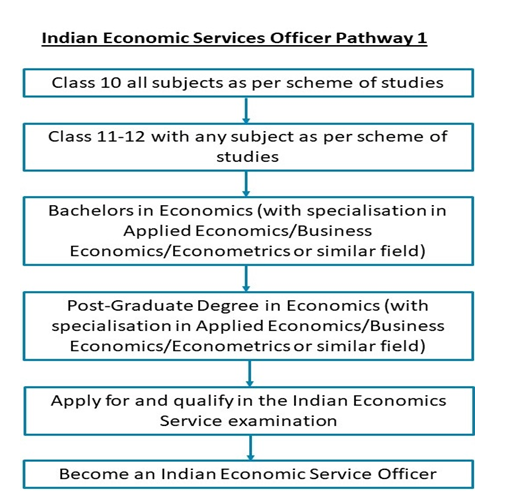
After completing Class 10 all subjects as per scheme of studies and Class 11-12 with any subject as per scheme of studies you can pursue a Bachelor’s degree in Economics with specialisation in Applied Economics/Business Economics/Econometrics or any similar field. A post-graduate degree in economics with specialisation in Applied Economics/Business Economics/Econometrics or similar field is a prerequisite in order to be qualified for the Indian Economic Service examination. After acquiring a master’s degree you must apply for and qualify the IES exam to be directly recruited as Indian Economic Service officer.
Required Qualification & Competencies
In order to be eligible for Indian Economic Service Examination, you must hold a Post-Graduate degree in Degree in Economics (with specialization in Applied Economics/Business Economics/Econometrics or any similar field). The minimum age to be eligible for IES exams is 21 years and the maximum age is 30 years. The Indian Economic Service examinations and recruitment are conducted by the Union Public Service Commission (UPSC).
The examination is conducted in two parts. Part I comprises of total 6 papers of 1000 marks. The first two papers will be of subjective type and carries 100 marks each and the other four papers are of 200 marks each.
1. Part I-Written examination
General English
1. Essays
2. Comprehension Passage
General Studies
1. Current Events - National & International
2. Indian Geography
3. Indian History
4. Indian Polity
5. Indian Constitution
6. Policy & Governance
7. Environmental Studies
8. Science & Technology
General Economics-I
1. Theory of Consumer’s Demand
2. Theory of Production
3. Welfare Economics
4. Theory of Value
5. Theory of Distribution
6. Quantitative Methods in Economics
General Economics-II
1. Economic Thought
2. The Concept of National Income and Social Accounting
3. Theory of Employment, Money & Finance
4. Financial and Capital Market
5. Economic growth and development
6. International Economics
7. Balance of Payments
8. Global Institutions
General Economics-III
1. Public Finance
2. Environmental Economics
3. Industrial Economics
4. State, market, and planning
Indian Economics
1. History of development & Planning
2. Federal Finance
3. Budgeting and Fiscal Policy
4. Poverty, unemployment, and Human Development
5. Agriculture and Rural Development Strategies
6. India’s experience with Urbanisation and Migration
7. Industry: Strategy of industrial development
8. Labour
9. Foreign Trade
10. Money and Banking
11. Inflation
2. Part II- Viva-voce carrying a maximum of 200 marks
The Union public service commission conducts an interview round for those who have successfully cleared the exam. Interview will be conducted of total of 200 marks to assess the suitability of a candidate for the Indian Economic Services. It may assess the following attributes in a candidate (these are only indicative and do not comprise all the criteria):
1. Analytical and logical abilities
2. Balance of judgment
3. Compassion and empathy
4. Critical abilities
5. Deductive and Inductive Reasoning abilities
6. Ethical thinking
7. Integrity and morality
8. Intellectual abilities
9. Interpersonal abilities
10. Leadership abilities
11. Multi-faceted interests and depth of interests
12. Power of expression
13. Self-awareness or intra-personal abilities
14. Understanding of social issues and challenges
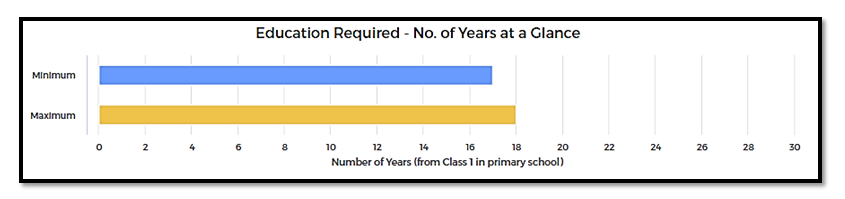
MINIMUM EDUCATION REQUIRED | MAXIMUM EDUCATION REQUIRED |
Post Graduate Postgraduate Degree / Diploma / Certificate Programs for which the minimum eligibility is a pass in Graduation / equivalent Diploma program like Honours Diploma or Graduate Diploma. | Post Graduate Postgraduate Degree / Diploma / Certificate Programs for which the minimum eligibility is a pass in Graduation / equivalent Diploma program like Honours Diploma or Graduate Diploma. |
Competencies Required
Interests
1. Investigative: You should have interests for Investigative Occupations. Investigative occupations involve working with ideas and quite a lot of thinking, often abstract or conceptual thinking. These involve learning about facts and figures; involve use of data analysis, assessment of situations, decision making and problem-solving.
2. Enterprising: You should have interests for Enterprising Occupations. Enterprising occupations involve taking initiatives, initiating actions, and planning to achieve goals, often business goals. These involve gathering resources and leading people to get things done. These require decision making, risk-taking, and action orientation.
3. Conventional: You should have interests for Conventional Occupations. Conventional occupations involve repetitive and routine tasks as well as fixed processes or procedures for getting things done. These occupations involve working more with data, systems, and procedures and less with ideas or creativity.
Abilities
1. Deductive Reasoning: The ability to apply general rules and common logic to specific problems to produce answers that are logical and make sense. For example, understanding the reasons behind an event or a situation using general rules and common logic
2. Fluency of Ideas: The ability to come up with a number of ideas about a topic (the number of ideas is important, not their quality, correctness, or creativity).
3. Inductive Reasoning: The ability to combine pieces of information from various sources, concepts, and theories to form general rules or conclusions. For example, analyzing various events or situations to come out with a set of rules or conclusions
4. Numerical Reasoning: The ability to add, subtract, multiply, divide, and perform other basic numerical calculations correctly.
5. Oral Comprehension: The ability to listen to and understand information and ideas presented through spoken words and sentences.
6. Problem Sensitivity: The ability to tell when something is wrong or is likely to go wrong. It does not involve solving the problem, only recognizing there is a problem.
7. Selective Attention: The ability to concentrate on a task over a long period of time without being distracted.
8. Speed of Closure: The ability to quickly make sense of, combine, and organize information into meaningful patterns.
9. Written Comprehension: The ability to read and understand information and ideas presented in writing.
10. Written Expression: The ability to communicate information and ideas in writing so others will understand
Knowledge
1. Economics: Knowledge of economic principles and practices; understanding how various resources such as land, labor, and capital are used; how market demands rise and fall; how a country collects and spends money; and similar other economic issues and situations.
2. Mathematics: Knowledge of arithmetic, algebra, geometry, calculus, trigonometry, statistics, and other mathematical disciplines and their applications.
3. Administration: Knowledge of various administrative and operational functions in managing an organization such as general administration, facility management, front office management, back-office management, etc.
4. English Language: Knowledge about English grammar, words, spelling, sentence construction, using English to communicate with others, reading in English, etc.
Skills
1. Active Learning: Focused and continuous learning from various sources of information, observation and otherwise for application in getting work done.
2. Active Listening: Giving full attention to what other people are saying, understanding the points being made by others, asking questions, etc.
3. Communication in English: Skills in communicating effectively in writing as well as verbally with others in English language.
4. Coordination: Skills in working together with other people to get things done.
5. Critical Thinking: Skills in analysis of complex situations, using of logic and reasoning to understand the situations and take appropriate actions or make interpretations and inferences.
6. Directing: Skills in directing others' actions to get things done
7. Instruction: Skills in training others how to do something.
8. Judgment and Decision Making: Skills in considering pros and cons of various decision alternatives; considering costs and benefits; taking appropriate and suitable decisions.
9. Managing Financial Resources: Skills in determining how money should be spent to get the work done, and accounting for these expenditures.
10. Managing Human Resources: Skills in motivating, developing, and leading people as they work, identifying the best people for the job.
11. Negotiation: Skills in bringing others together and trying to reconcile differences.
12. Persuasion: Skills in persuading others to change their minds or behaviour.
13. Problem Solving: Skills in analysis and understanding of problems, evaluating various options to solve the problems and using the best option to solve the problems.
14. Reading Comprehension: Skills in understanding written sentences and paragraphs in work related documents.
15. Service Orientation: Skills in or keen interest to help and assist people
16. Supervising: Skills in Supervising and monitoring the performance of others, businesses, and different projects.
17. Time Management: Skills in prioritizing work, managing time effectively.
18. Writing: Skills in communicating effectively in writing as appropriate for the needs of the readers.
Personality
1. You are always or mostly organised in your day-to-day life and activities.
2. You always feel secure in your surroundings and in most situations.
3. You are always self-satisfied or feel satisfied with your life in most situations.
4. You are a soft-hearted person sometimes.
5. You trust others sometimes but not always.
6. You are helpful to others sometimes.
7. You remain calm in difficult situations sometimes but some other times you are anxious.
8. You are imaginative sometimes.
9. You prefer to experience new things and have new experiences sometimes.
10. You act independently sometimes but do not do so in some other times.
11. You are friendly and outgoing sometimes, but not always. You prefer the company of people sometimes but not always.
12. You are caring, supportive, sympathetic and kind to others sometimes.
Career - Job Opportunities & Profiles
You will be appointed to the service as Assistant Director or a Research Officer after undergoing probationary training including the Foundation course (conducted for the All India Services and the Central Civil Services), training on Economics at the Institute of Economic Growth, Delhi, and training/ attachment at various national level Institutes of repute across the country.
As an Indian Economic Service Officer you will be recruited in the following Ministries and Departments:
1. Planning Commission
2. Ministry of economic affairs
3. National Sample Survey
4. Department of Economic Affairs
5. Department of Expenditure
6. Department of Financial Services
7. Department of Investment and Public Asset Management
8. Department of Revenue
Career Growth
1. If you begin your career after appointment as a Research Officer you would progress as:
Research Officer–Senior Research Officer - Deputy Economic Adviser - Economic Adviser - Senior Economic Adviser - Chief Economic Adviser
2. If you begin your career after appointment as Assistant Director you would progress as:
Assistant Director - Deputy Director - Joint Director – Adviser - Senior Adviser - Principal Adviser
Salary Offered
According to the 7th Central Pay Commission,
As Research Officer, you would earn around Rs. 69,237 – 95,796 per month
As Senior Research Officer, you would earn around, Rs. 82,809 – 1,42,245 per month
As Economic Adviser, you would earn around, Rs. 1,56,987 - 1,72,314 per month
As Senior Economic Adviser, you would earn around, Rs. 2,11,837 – 2,59,462 per month
As Chief Economic Adviser, you would earn around, Rs. 2,39,462 – 2,76,962 per month
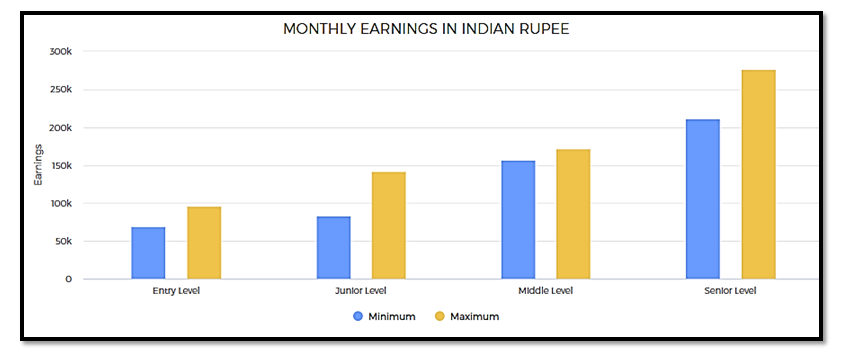
Monthly Earning IN Indian Rupee
Entry Level | Junior Level | Mid Level | Senior Level | |||||
Min Earning | Max Earning | Min Earning | Max Earning | Min Earning | Max Earning | Min Earning | Max Earning | |
69237 | 95796 | 82809 | 142245 | 156987 | 172314 | 211837 | 276962 | |
1. Entry level: 0 - 2 years of work experience
2. Junior Level: From 1 to 12 years of work experience
3. Mid Level: From 5 to 20+ years of work experience
4. Senior Level: From 10 to 25+ years of work experience
Work Activities
1. Addressing grievances and resolving conflicts: Handling complaints and grievance to resolve; resolving conflicts among co-workers or others at workplace or outside in relation to your work.
2. Analyzing and interpreting data and information: Analysis of data and information to find facts, trends, reasons behind situations, etc.; interpretation of data to aid in decision making.
3. Assessing and determining compliance with standards, laws, rules and guidelines: Using relevant information, auditing information, processes and systems to determine whether organizations or people are complying with standards, laws, rules and guidelines.
4. Communicating with co-workers and others: Communicating with people in writing, verbally or otherwise inside your workplace and various other people who have professional relationships with your place of work including vendors, government officials, etc. or with people at large
5. Decision making and problem-solving: Analysis of data and information; evaluation of alternative decisions and results of decisions; taking the right decisions and solving problems.
6. Developing and maintaining inter-personal relationships: Developing professional relationships with co-workers and others outside organizations and maintaining good relationships.
7. Estimating quantity, cost, time and resources: Estimating sizes, volumes, distance, and quantity; estimating and determining time, costs, and resources; estimating materials required to perform a task.
8. Getting Information and learning: Observing, hearing, reading, using computers, or otherwise obtaining information and learning from it.
9. Handling administrative activities: Handling various administrative tasks and managing day-to-day operations.
10. Inspecting situations, events, and people: Inspecting situations, events and people to understand the reasons and causes for the situation or events to happen; inspecting people to understand reasons behind their behaviour and actions.
11. Leading: Inspiring and motivating co-workers to work to achieve specific goals; enabling and facilitating others to perform tasks effectively; addressing issues and solving problems in order to help people perform well.
12. Managing and supervising: Managing and supervising work of others; setting goals; giving instructions; monitoring work performance, etc.
13. Monitoring use of resources: Monitoring and controlling the use of resources like land and materials as well as spending of money.
14. Organizing, planning and prioritizing tasks: Planning and organizing tasks in order to achieve work goals; prioritizing tasks to achieve goals and making the best use of the time available.
15. Providing advices and consultation to others: Giving advices or consultation to others about various issues, conceptual matters, know-hows, scientific matters, products or services.
16. Scheduling tasks: Scheduling project timelines, tasks and activities.
17. Strategic planning: Developing visions and goals, developing strategies and action plans for achieving visions and goals.
18. Working in a team: Working in a team of people; developing team; maintaining professional relationships among team members.
Future Prospects
1. According to the 68th Annual Report submitted by Union Public Service Commission, a total number of21, 831 applied for Indian Economic Service /Indian Statistical Services examination. A total of only 2, 804 appeared in the examination while only 104 candidates interviewed/ whose service records were evaluated out of which only 44 candidates were recommended for appointment to the Indian Economic Service/Indian Statistical Service posts.
2. The number of seats available for Junior Scale of Indian Economic Service (IES) posts is 32 Seats and for Indian Statistical Service (ISS)are 33 seats. Although Indian Economic Services/Indian Statistical Services examination is very tough to crack with such high end competition, but a career as IES/ISS officer offers great opportunities and perks.
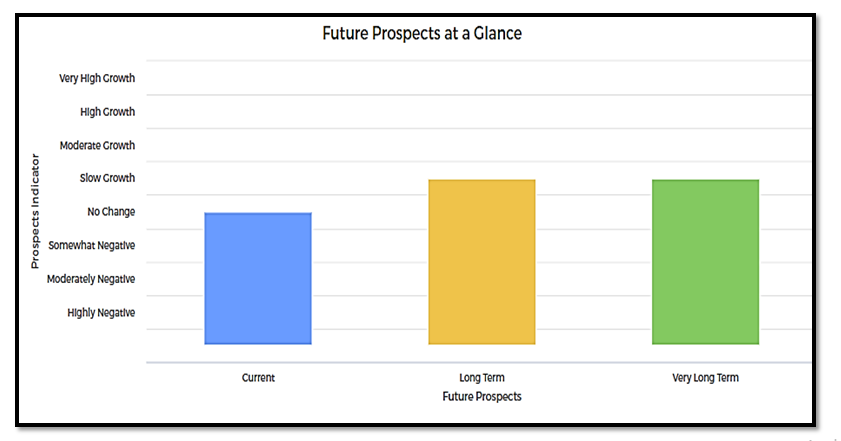
Future Prospects At A Glance
Current (0-1 year) | Long Term (2-5 year) | Very Long Term (6-10 years) |
No Change | Slow Growth | Slow Growth |