

Gem Cutting & Polishing Craftsman
Entry Level Qualification
Class 12
Career Fields
Apparel & Accessories
For Specially Abled


Career Entrance Exam
About Career
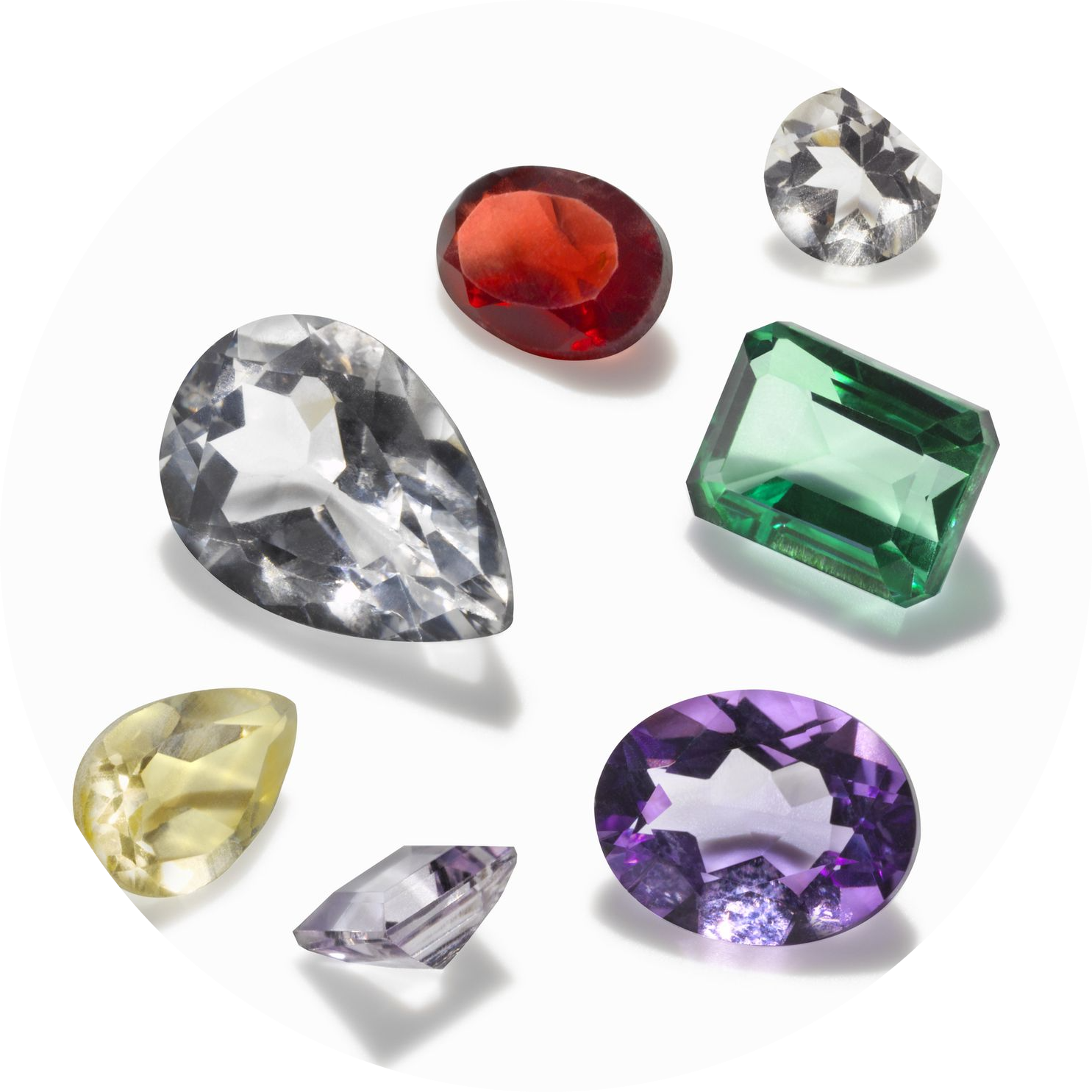
1. As a Gem Cutting and polishing Craftsman, you will be involved in measuring, cutting, shaping, and polishing natural as well as synthetic gemstones according to prescribed design, shape and measurement marks. You will use various materials to remove scratches and polish the stone with a polishing wheel.
2. You will have to examine the gems during processing to ensure angle accuracy or position of polishing holes, using magnifying glasses and other handheld tools. You will have to polish gems and stones according to clarity grades following established rules and grading systems. Different gems and stones need different scales of polishing.
3. You will have to analyze the surfaces of gems and their internal structures using handheld or power tools. You may have to sort rough unpolished gemstones into different categories to determine the extent of polishing that they need. This is a very challenging job overall and needs alertness as well as a keen interest.
Key Roles and Responsibilities
As a gem-cutting & Polishing Craftsman, you will be engaged with one or more of the following roles and responsibilities: -
1. Examining gemstones for determining or selecting the cuts that will result in the biggest, best-quality stones.
2. Grinding, sanding, cleaning, or polishing parts or objects for correcting defects or for preparing surfaces to work upon, using hand and power tools.
3. Polishing gems and stones according to polishing standards and clarity grades following established rules and grading systems. Different gems and stones need different scales of polishing.
4. Applying appropriate solutions and chemicals or using proper materials like Tripol polishing compound (used to remove scratches from surfaces) etc. to wet/dry surfaces of gemstones, equipment, objects, or parts, using hand tools.
5. Verifying the quality of finished workpieces by inspecting and comparing them to templates, noting their measurements, or testing them with equipment or machinery.
6. Labelling and properly marking workpieces according to set standards.
7. Removing finished workpieces from work tables or equipment, using hand or other tools, and placing them in appropriate locations.
PARTICULARS | DESCRIPTION |
Name | Gem Cutting & Polishing Craftsman |
Purpose | Polishing gems and stones |
Career Field | Apparel & Accessories |
Required Entrance Exam | NID DAT UG, AIEED |
Average Salary | 80000 - 150000 Rs. Per Year |
Companies For You | Gem Cutter, Gem Cutter and Finisher, Gem Polisher and Setter & Many More |
Who is Eligible | Class 12th Pass |
Career Entry Pathway
Class 8 in school - MES course for ‘Gem Cutting Assistant’ or similar courses.
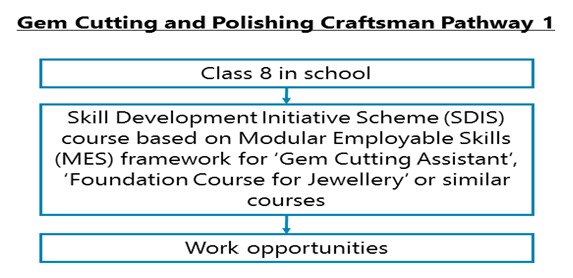
After completing Class 8 in school, you can enroll for a Skill Development Initiative Scheme (SDIS) course for ‘Gem Cutting Assistant’, ‘Foundation Course for Jewellery’, or similar courses based on the Modular Employable Skills (MES) framework under the Ministry of Labour and Employment of India.
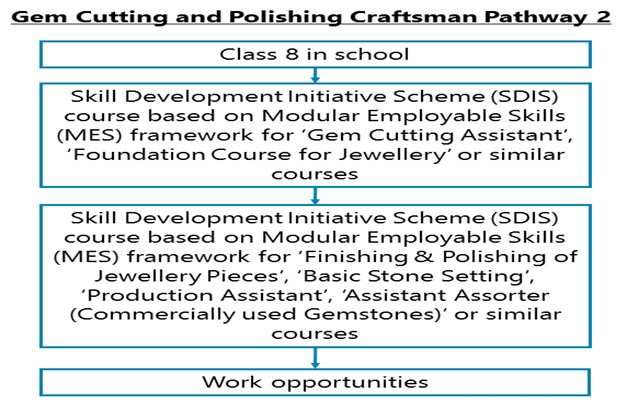
After completing Class 8 in school, you can enroll for a Skill Development Initiative Scheme (SDIS) course for ‘Gem Cutting Assistant’, ‘Foundation Course for Jewellery’, or similar courses based on the Modular Employable Skills (MES) framework under the Ministry of Labour and Employment of India. Then you can go for Skill Development Initiative Scheme (SDIS) course for ‘Finishing & Polishing of Jewellery Pieces’, ‘Basic Stone Setting’, ‘Production Assistant’, ‘Assistant Assorted (Commercially used Gemstones)’ or similar courses based on Modular Employable Skills (MES) framework under the Ministry of Labour and Employment of India.
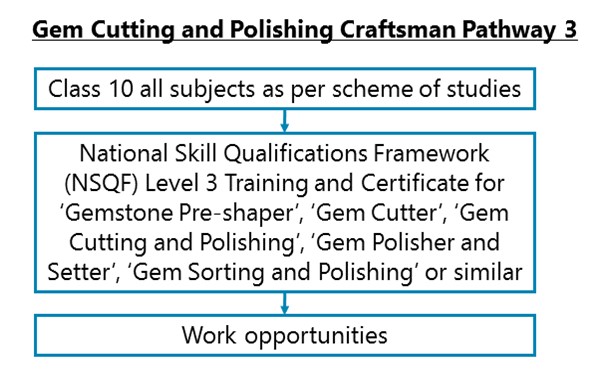
After Class 10, you can go for National Skill Qualifications Framework (NSQF) Level 3 Training and Certificate for ‘Gemstone Pre-shaper’, ‘Gem Cutter’, ‘Gem Cutting and Polishing’, ‘Gem Polisher and Setter’, ‘Gem Sorting and Polishing’ or similar courses. The total hours of training will be 60-150.
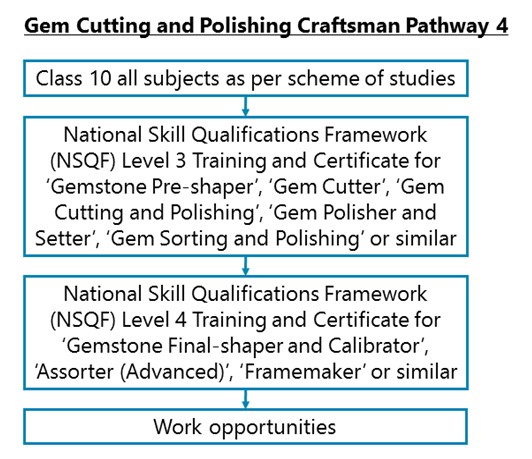
After Class 10, you can go for National Skill Qualifications Framework (NSQF) Level 3 Training and Certificate for ‘Gemstone Pre-shaper’, ‘Gem Cutter’, ‘Gem Cutting and Polishing’, ‘Gem Polisher and Setter’, ‘Gem Sorting and Polishing’ or similar courses. The total hours of training will be 60-150. Then you can apply for National Skill Qualifications Framework (NSQF) Level 4 Training and Certificate for ‘Gemstone Final-shaper and Calibrator’, ‘Assorted (Advanced)’, ‘Framemaker’, or similar courses. The total hours of training will be 60-330.
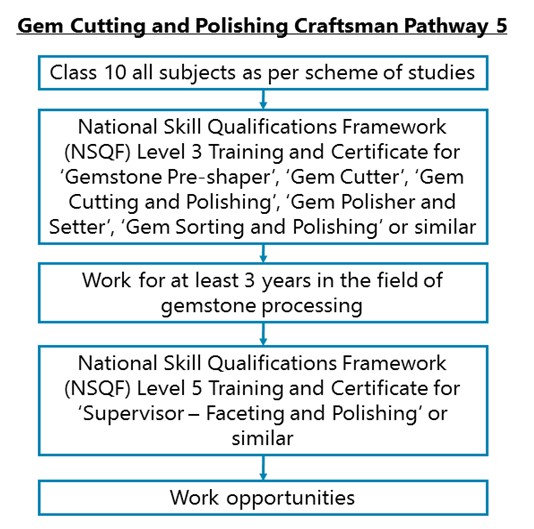
After Class 10, you can go for National Skill Qualifications Framework (NSQF) Level 3 Training and Certificate for ‘Gemstone Pre-shaper’, ‘Gem Cutter’, ‘Gem Cutting and Polishing’, ‘Gem Polisher and Setter’, ‘Gem Sorting and Polishing’ or similar courses. The total hours of training will be 60-150. Then you need to work for at least 3 years in the field of gemstone processing. Then you can go for National Skill Qualifications Framework (NSQF) Level 5 Training and Certificate for ‘Supervisor – Faceting and Polishing’ or similar courses. The total hours of training will be 120.
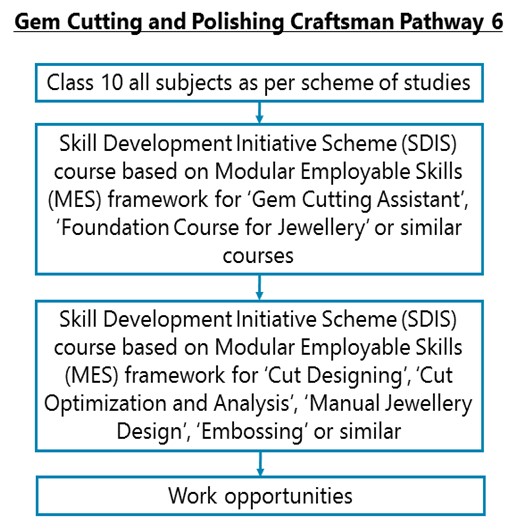
After Class 10, you can enroll for the Skill Development Initiative Scheme (SDIS) course for ‘Gem Cutting Assistant’, ‘Foundation Course for Jewellery’, or similar courses based on the Modular Employable Skills (MES) framework under the Ministry of Labour and Employment of India. Then you can go for Skill Development Initiative Scheme (SDIS) course for ‘Cut Designing’, ‘Cut Optimization and Analysis’, ‘Manual Jewellery Design’, ‘Embossing’ or similar courses based on Modular Employable Skills (MES) framework under the Ministry of Labour and Employment of India.
Required Qualification & Competencies
After Class 8 in school, you can go for MES courses. After Class 10, you can go for:
1. MES courses.
2. NSQF Level 3/4/5 courses.
Various public/private establishments offer related courses on:
1. Jewellery and Precious Metal Worker
2. Jewellery Design
3. Gemology
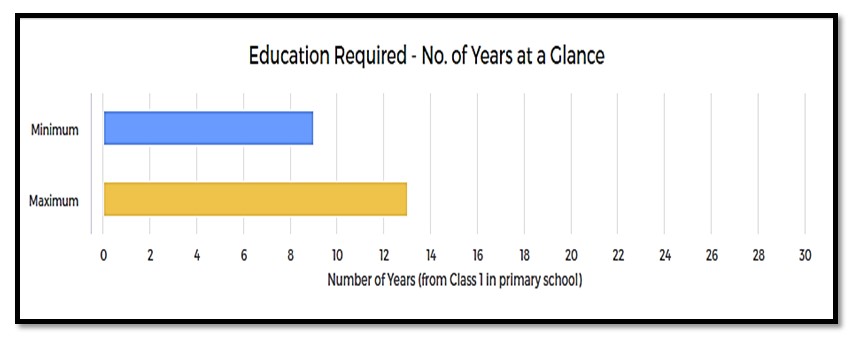
MINIMUM EDUCATION REQUIRED | MAXIMUM EDUCATION REQUIRED |
Under Secondary Certificate Programs for which the minimum eligibility is a pass in any class below class X. | Post-Secondary Certificate / Diploma Programs for which the minimum eligibility is a pass in class X. |
Competencies Required
1. You should have an interest in Conventional Occupations. Conventional occupations involve repetitive and routine tasks as well as fixed processes or procedures for getting things done. These occupations involve working more with data, systems, and procedures and less with ideas or creativity.
2. You should have an interest in Artistic Occupations. Artistic occupations mostly involve working with creative ideas, art, and designs. These occupations involve abstract or conceptual thinking, and creative self-expression and often do not follow any set processes or rules for getting things done.
3. You should have an interest in Realistic Occupations. Realistic occupations involve more practical and hands-on activities than paperwork or office work. Realistic occupations often involve physical activities for getting things done using various tools and equipment.
4. You should know Creative Design - Knowledge of various techniques, methods, and specifications for creating and developing designs for various products like animation, graphics, web, user interfaces of digital devices, photography, etc.
5. You should have knowledge of Computers - computer hardware and software, computer programming, computer networks, computer and mobile applications.
6. You may need knowledge of Fine Arts - the theories and techniques required for producing various works of fine arts such as painting, drawing, illustration, sculpture, digital art, installation art, craft, visual art, etc.
7. You should have Critical Thinking Skills- analysis of complex situations, using logic and reasoning to understand the situations and take appropriate actions or make interpretations and inferences.
8. You should have Active Listening Skills - Giving full attention to what other people are saying, understanding the points being made by others, asking questions, etc.
9. You will need skills in handling software packages such as CATIA, ArcInfo and ArcMap (ESRI) AutoCAD Map Series (AutoDesk), AutoCAD 2002 (AutoDesk), AutoCAD Map 6.0 (AutoDesk), MicroStation and GeoGraphic (Bentley), Architectural Desktop (AutoDesk), and MapInfo.
10. You should have Visualization Ability - The ability to imagine how something will look after it is moved around or when its parts are moved or rearranged.
11. You should have Selective Attention - The ability to concentrate on a task over a long period without being distracted.
12. You should have a Visual Color Discrimination Ability - match or detect differences between colors, including shades of color and brightness.
13. You should have Oral Comprehension Ability – listen to and understand information and ideas presented through spoken words and sentences.
14. You should have Oral Expression Ability – communicate information and ideas in speaking so others will understand.
15. You may need Abstract Reasoning Ability – understand ideas that are not expressed in words or numbers; the ability to understand concepts that are not clearly expressed verbally or otherwise.
16. You may need Written Comprehension Ability - read and understand information and ideas presented in writing.
17. You are always or mostly dependent on others or set rules and procedures.
18. You always or mostly prefer to stick within a routine or carry out routine and repetitive activities.
Career - Job Opportunities & Profiles
You may find numerous work opportunities in the Gems and Jewellery sector as:-
1. Gem Cutter
2. Gem/Stone Polisher
3. Gem Cutter and Finisher
4. Gem Polisher and Setter
5. Gem Sorter and Cutter
Career Growth
With work experience, you can grow to become a Gem Inspector, Supervisor – Shaping, Senior Gem Cutter, Senior Gem Polisher, Raw Material Procurement Supervisor, Processing Inspector, etc.
Salary Offered
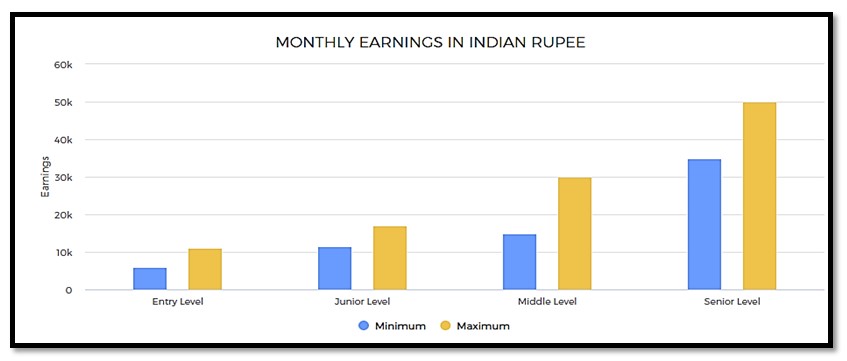
1. As an apprentice or trainee, you may expect about Rs. 6,000 -11,000 or more a month.
2. After 1-3 years of experience, you may expect about Rs. 11,500 -17,000 or more a month.
3. After 5-10 years of experience, you may expect about Rs. 15,000 - 30,000 or more a month.
4. Senior and experienced Gem Cutters & Polishers may earn about Rs. 35,000-50,000 or even more a month.
Monthly Earnings In Indian Rupee
Entry Level | Junior Level | Mid-Level | Senior Level | ||||
Min Earning | Max Earning | Min Earning | Max Earning | Min Earning | Max Earning | Min Earning | Max Earning |
6000 | 11000 | 11500 | 17000 | 15000 | 30000 | 35000 | 50000 |
1. Entry level: 0 - 2 years of work experience
2. Junior Level: From 1 to 12 years of work experience
3. Mid-Level: From 5 to 20+ years of work experience
4. Senior Level: From 10 to 25+ years of work experience (there could be exceptions in some high-end technical, financial, engineering, creative, management, sports, and other careers; also shortly, people will reach these levels much faster in many careers and some careers, these levels will have no meaning as those careers will be completely tech skill driven such as even now, there is almost no level in a Cyber Security Expert’s job)
Work Activities
1. Operating machines, equipment, devices, systems, and processes - Using various methods and techniques to operate machines, equipment, devices, systems, and processes in industrial and other settings.
2. Estimating quantity, cost, time, and resources - Estimating sizes, volumes, distance, and quantity; estimating and determining the time, costs, and resources; estimating materials required to perform a task.
3. Assessing and evaluating quality - Assessing and evaluating the quality of materials, systems, processes, products, services, etc.
4. Decision-making and problem-solving - Analysis of data and information; evaluation of alternative decisions and results of decisions; taking the right decisions and solving problems.
5. Handling and moving objects and materials - Using hands or otherwise using physical strength to handle and move objects and materials; maneuver, install, lift, place, manipulate, etc.
6. Inspecting equipment, systems, structures, and materials - Inspecting equipment, systems, structures, and materials to ascertain quality, performance, defects, causes of errors, etc.
7. Identifying objects, actions, and events - Identifying various characteristics of objects; observing and understanding actions and events; understanding changes in actions and events.
8. Performing physical activities - Performing physical activities that require the use of your arms and legs and moving your whole body.
9. Communicating with co-workers and others- Communicating with people in writing, verbally or otherwise inside your workplace and various other people who have professional relationships with your place of work including vendors, government officials, etc., or with people at large.
Future Prospects
1. The future of this pathway seems decently bright. The employment generation, foreign exchange earnings, rising income levels, number of women employed in professional sectors growing very fast. The Gems And Jewellery market is estimated to reach 100 billion US Dollars. It comprises gold, silver, diamonds, a diamond in gold, gemstones, and precious metals such as platinum, palladium and pearls.
2. With the increasing acceptance of online transactions, a growing number of middle-class households and internet penetration, native consumption is also picking up along with exports. According to the National Council of Applied Economic Research, the number of middle-class households will reach 113.8 million. The “white wave” (rhodium, polished gold and platinum) jewellery is witnessing growing demand and higher popularity. South India is generating the fastest demand for gems and jewellery.
Future Prospects At A Glance
Current (0-1 year) | Long Term (2-5 years) | Very Long Term (6-10 years) |
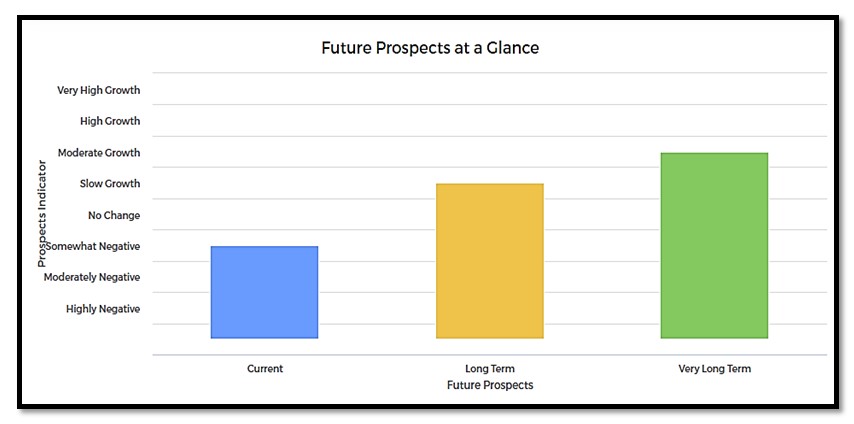
Somewhat Negative | Slow Growth | Moderate Growth |