
Draughtsman (Mechanical)
Entry Level Qualification
Class 12
Career Fields
Draughtsman & Operator
For Specially Abled


Career Entrance Exam
About Career
PARTICULARS | DESCRIPTION |
Name | Draughtsman (Mechanical) |
Purpose | Prepares Drawings of Machines, Plants, Mechanical Components |
Career Field | Draughtsman & Operator |
Required Entrance Exam | |
Average Salary | 100000 - 300000 Rs. Per Year |
Companies For You | Oil and Gas, Automobile, Construction & Many More |
Who is Eligible | Class 12th Pass |
As a Mechanical Draughtsman, you will be involved in creating and developing detailed drawings of various industrial machinery, engines, industrial plants, mechanical equipment and devices, mechanical tools, various mechanical parts of products, heavy engineering machinery, vehicles, etc.
Based on the overall layout and designs, sketches and specifications given by Mechanical Engineers, you will use Computer-Aided Design & Drafting (CADD) software to create and develop the mechanical drawings. Apart from the various mechanical goods mentioned above, you will develop the drawings of various mechanical components and parts used to construct, assemble, and install various mechanical goods. You will develop drawings of various sections of the goods and specify all dimensions.
Key Roles and Responsibilities:
As a Mechanical Draughtsman, you will be engaged with one or more of the following roles and responsibilities: -
1. Producing detailed2D drawings and 3D graphical models of mechanical goods as well as their components, parts, and sections using Computer-Aided Design & Drafting software like AutoCAD.
2. Reviewing rough sketches or drawings received from mechanical engineers.
3. Drawing freehand sketches, maps or drafting plans for systems, machines, tools, furniture, automobiles mechanical devices and their components etc.
4. Computing and applying mathematical formulas to develop drawings.
5. Explaining engineering drawings or related technical descriptions.
6. Helping to estimate the technical resources required for different projects.
7. Preparing official documents related to various projects.
8. Making cost estimates as per the drawings for different projects.
9. Supervising junior drafters, technicians, and technologists.
Career Entry Pathway
Class 10 all subjects as per scheme of studies - NSQF Level 4 Certificate for ‘Draughtsman – Mechanical’ or similar courses
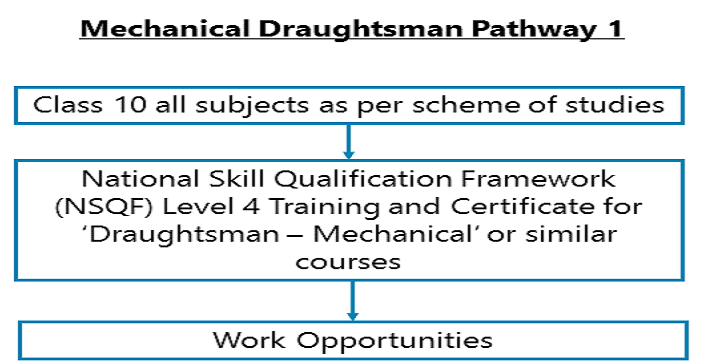
After Class 10, you can obtain a National Skill Qualification Framework (NSQF) Level 4 Training and Certificate for ‘Draughtsman – Mechanical’ or similar courses. The total number of training hours is 500. You need to be at least 16 years old for this program.
Class 10 all subjects as per scheme of studies- NSQF Level 4 Certificate for ‘Draughtsman – Mechanical’ or similar courses– admission to 2nd year of Diploma in Mechanical Engineering
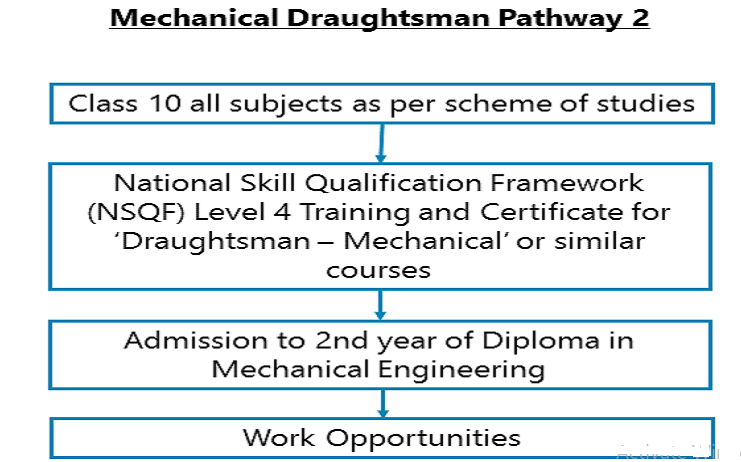
After Class 10, you can obtain a National Skill Qualification Framework (NSQF) Level 4 Training and Certificate for ‘Draughtsman – Mechanical’ or similar courses. The total number of training hours is 500. You need to be at least 16 years old for this program. Then you can get admission to 2nd year of Diploma in Mechanical Engineering through lateral entry route (direct entry).
Class 10 all subjects as per scheme of studies– training for ‘Draughtsman (Mechanical)’ at an ITI or similar institute
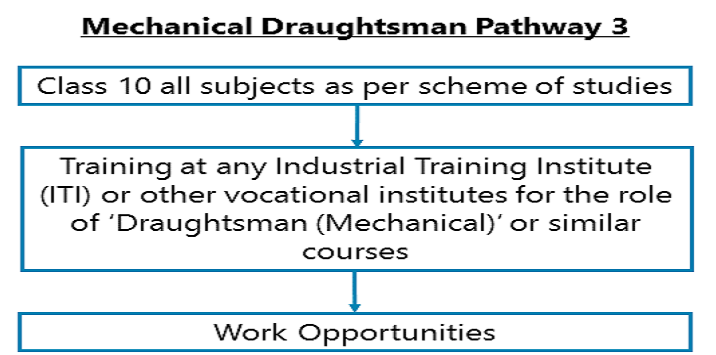
After Class 10, you can go for training at any Industrial Training Institute (ITI), National Skill Training Institute (NSTI), Regional Vocational Training Institute (RVTI), National Vocational Training Institute (NVTI), Industrial Training Center (ITC) or other vocational institutes for the role of ‘Draughtsman (Mechanical)’. This is a 2-year training course with 4 semesters (6 months each).
Class 10 all subjects as per scheme of studies –Diploma in Mechanical Engineering
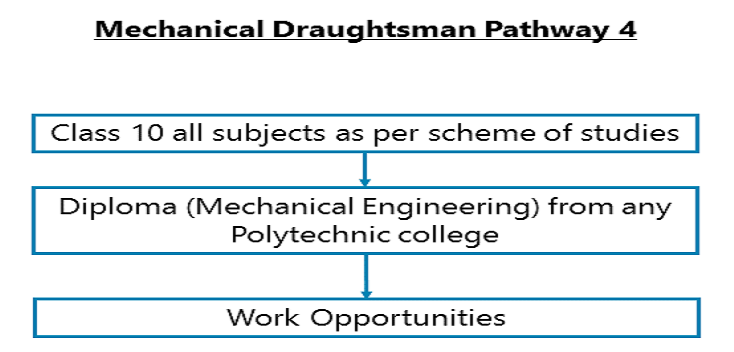
After Class 10, you can do a Diploma (Mechanical Engineering) from any Polytechnic college or ITI or a similar institute. Diploma (Mechanical Engineering) is a 3-year course.
Class 10 all subjects as per scheme of studies – NSQF Level 5 CTS Training in ‘Draughtsman-Mechanical’
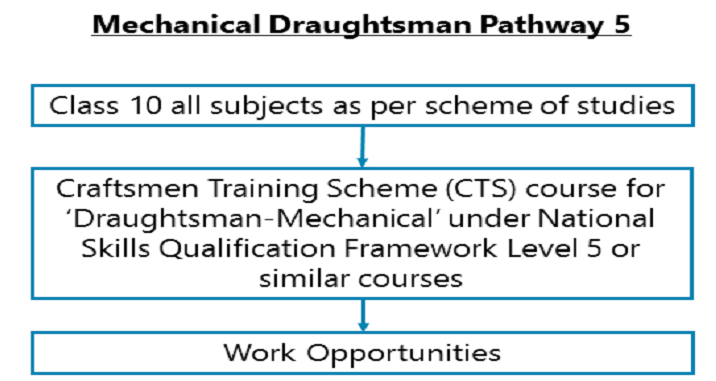
After Class 10, you can go for the Craftsmen Training Scheme (CTS) course for ‘Draughtsman-Mechanical’ under the National Skills Qualification Framework Level 5 or similar courses. This is a 2-year course with 4 semesters.
Class 10 all subjects as per scheme of studies – training for ‘Draughtsman (Mechanical)’ at an ITIor similar institute – obtain National Apprenticeship Certificate
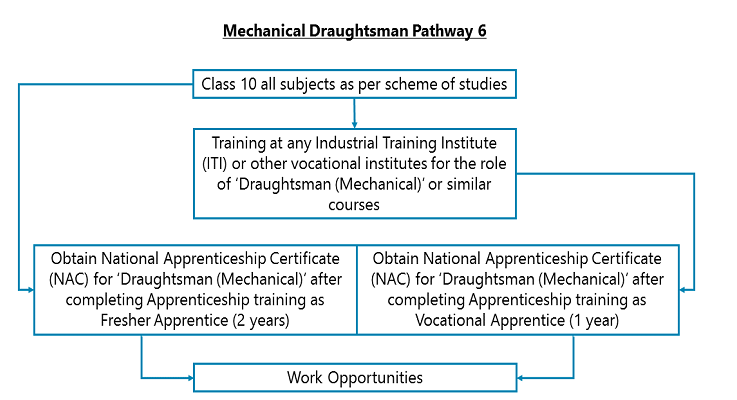
After Class 10, you can go for training at any Industrial Training Institute (ITI), National Skill Training Institute (NSTI), Regional Vocational Training Institute (RVTI), National Vocational Training Institute (NVTI), Industrial Training Center (ITC) or other vocational institutes for the role of ‘Draughtsman (Mechanical)’. This is a 2-year training course with 4 semesters (6 months each). Then you can obtain National Apprenticeship Certificate (NAC) for ‘Draughtsman (Mechanical)’after completing Apprenticeship training. You can join the Apprenticeship program after passing Class 10 also. Apprenticeship training is of the following durations. After you complete: Class 10 with any subjects, Science and Mathematics (as a Fresher apprentice): 2 years of Basic training (6 months) and Practical training (18 months). ITI course (as Vocational Apprentice): Only Practical training (12 months).
Required Qualification & Competencies
After Class 10:
You can do any of the following:
1. National Skill Qualification Framework (NSQF) Certificate and Training.
2. Go for a Diploma in Mechanical Engineering.
3. Take vocational training at an ITI (or similar institute).
4. Craftsmen Training Scheme (CTS) Course.
5. National Apprenticeship Certificate (NAC) after apprenticeship training.
Various private/public vocational training establishments across India offer courses on ‘Mechanical Draughtsman’ or related disciplines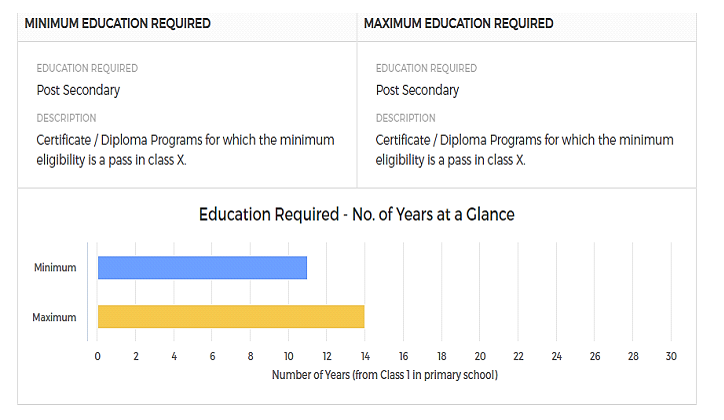
1. You should have interests for Realistic Occupations. Realistic occupations involve more practical and hands-on activities than paperwork or office work. Realistic occupations often involve physical activities for getting things done using various tools and equipment.
2. You should have interests for Conventional Occupations. Conventional occupations involve repetitive and routine tasks as well as fixed processes or procedures for getting things done. These occupations involve working more with data, systems, and procedures and less with ideas or creativity.
3. You should have interests for Investigative Occupations. Investigative occupations involve working with ideas and quite a lot of thinking, often abstract or conceptual thinking. These involve learning about facts and figures; involve the use of data analysis, assessment of situations, decision making and problem-solving.
4. You should have knowledge of Technical and Engineering Design - Knowledge of various techniques, methods, specifications and tools for creating, developing and laying out designs of various machines, equipment, devices, manufacturing plants, structures, systems, and processes. This includes developing blueprints, drawing, and models.
5. Competency in applications like AutoCAD, Autodesk REVIT, Tekla Modeling Software etc.
6. You should have knowledge of Mathematics - arithmetic, algebra, geometry, and other mathematical disciplines and their applications.
7. You should have knowledge of English Language - English grammar, words, spelling, sentence construction, using English to communicate with others, reading in English, etc.
8. You should have Active Listening Skills - Giving full attention to what other people are saying, understanding the points being made by others, asking questions, etc.
9. You should have Critical Thinking Skills - analysis of complex situations, using logic and reasoning to understand the situations and take appropriate actions or make interpretations and inferences.
10. You should have Problem Solving Skills - analysis and understanding of problems, evaluating various options to solve the problems and using the best option to solve the problems.
11. You should have Active Learning Skills - Focused and continuous learning from various sources of information, observation and otherwise for application in getting work done.
12. You should have Fluency of Ideas – The ability to come up with a number of ideas about a topic (the number of ideas is important, not their quality, correctness, or creativity).
13. You should have Mechanical Reasoning Ability – apply basic physical principles and theories to understand how mechanical objects such as tools and machinery works and the ability to understand the rules or laws governing the work of machinery, tools, and bodies in motion.
14. You should have Problem Sensitivity – The ability to tell when something is wrong or is likely to go wrong. It does not involve solving the problem, only recognizing there is a problem.
15. You should have Active learning skills –efficiently understanding any new information for future use.
16. You are always or mostly careful about your actions and behaviour.
17. You are practical always or in most situations.
18. You are always or mostly disciplined in your action and behaviour.
19. You are always or mostly serious about your actions and behaviour.
20. You are always or mostly organized in your day-to-day life and activities.
Career - Job Opportunities & Profiles
After your Training/Certificate Courses, you can get many jobs as Trade Apprentices, Mechanical Draughtsman or AutoCAD Draughtsman, etc.
These are some of the industries that will require your services:
1. Industrial Products / Heavy Machinery
2. Construction / Engineering / Cement / Metals
3. Automobile / Auto Ancillary / Auto Components
4. Oil and Gas / Energy / Power / Infrastructure
5. Government / Defence / Railways
You can certainly grow through job roles like the following as you progress through your career:
1. Master Draughtsman
2. Chief Draughtsman
3. Senior Draughtsman
4. On-site Supervisor
5. Head Surveyor
6. Assistant Architect
7. Divisional Head Tracer
8. Circle Head Draftsmen
You can also pursue the Crafts Instructor Training Scheme (CITS) for becoming an instructor in any ITI or similar institute and become Senior Faculty/Lecturer in the future.
Salary Offered
1. Salaries vary according to job profiles and the kind of facilities you get to work at.
2. In the entry-level jobs: You may expect to get about Rs.7,500.00 – Rs.18,000.00 per month.
3. Salaries increase with your work experience and as you get promoted.
4. In the mid-level jobs, with 6-12 years of work experience, you may expect to get about Rs.14, 000.00 – Rs.40, 000.00 per month.
5. In the senior level jobs, with 12-15 years of work experience, you may expect to get about Rs. 25,000.00 – Rs.60, 000.00 per month or even more.
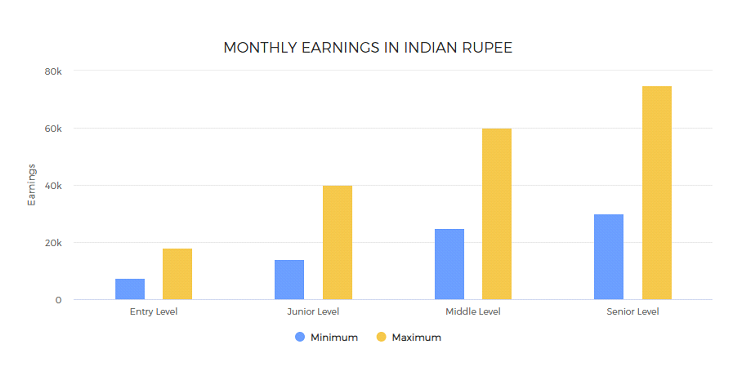
MONTHLY EARNINGS IN INDIAN RUPEE
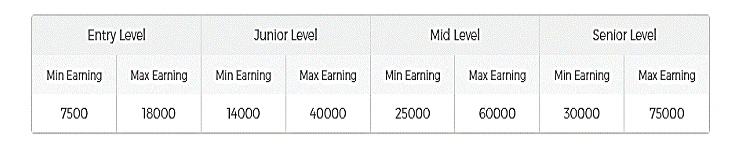
1. Entry level: 0 - 2 years of work experience
2. Junior Level: From 1 to 12 years of work experience
3. Mid Level: From 5 to 20+ years of work experience
4. Senior Level: From 10 to 25+ years of work experience (there could be exceptions in some high-end technical, financial, engineering, creative, management, sports, and other careers; also in the near future, people will reach these levels much faster in many careers and in some careers, these levels will have no meaning as those careers will be completely tech skill driven such as even now, there is almost no level in a Cyber Security Expert’s job).
Work Activities
1. Using computers for work - Using computers for day-to-day office work; using computer software for various applications in day-to-day professional work; entering data and process information; for writing.
2. Drawing, drafting, laying out and specifying objects, equipment, devices, tools, and systems - Creating and developing designs, drawings, layouts and specifications about how to construct, manufacture, assemble, build, use, and maintain various equipment, devices, tools, and systems.
3. Getting Information and learning - Observing, hearing, reading, using computers, or otherwise obtaining information and learning from it.
4. Processing information - Searching, compiling, tabulating, calculating, auditing, verifying or otherwise dealing with information processing including data entry, transcription, recording, storing and maintaining databases.
5. Communicating with co-workers and others- Communicating with people in writing, verbally or otherwise inside your workplace and various other people who have professional relationships with your place of work including vendors, government officials, etc. or with people at large.
6. Handling administrative activities - Handling various administrative tasks and managing day-to-day operations.
7. Analysing and interpreting data and information - Analysis of data and information to find facts, trends, reasons behind situations, etc.; interpretation of data to aid in decision making.
Future Prospects
The future for this career pathway looks satisfactory. Capital Goods Industry turnover is forecasted to reach 115 billion US Dollars mark by 2025. Engineering Research and Development (ER&D) market in India is forecasted to touch 42 billion US Dollars mark from 28 billion US Dollars by FY2022. Construction Equipment sales are expected to reach an annual mark of more than 1, 10,000 units by 2022. The Construction Equipment Industry market size is predicted to grow to 5 billion US Dollars by FY2020 from the current size of around 4 billion US Dollars.
Engineering exports are expected to reach 80 billion US Dollars in FY 2019 from the current worth of around 46 billion US Dollars. Machine tools production is expected to reach 1.40 billion US Dollars by the end of 2019 from 1.13 billion US Dollars in 2018. In sectors like Infrastructure, Mining, Power, Oil and Gas, Steel, Automotive, Refinery, Consumer Durables, futuristic capacity creation is demanding more skilled labour in the Engineering arena. Creation of more special economic zones (SEZs) and Delhi Mumbai Industrial Corridor is further bolstering this demand.
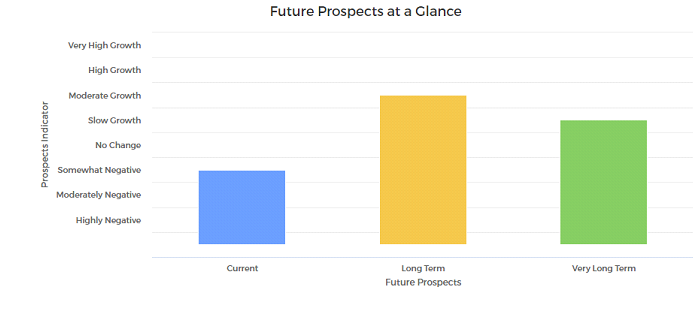
FUTURE PROSPECTS AT A GLANCE
