


Network Administrator
Entry Level Qualification
Class 12
Career Fields
Information Technology & Computer Science
For Specially Abled


Career Entrance Exam
About Career
As a Network Administrator, your primary responsibility will be to manage, oversee, and maintain an organization’s computer network and ensure that all the computer networks are running smoothly. Your area of expertise will generally include local area networks (LANs), wide area networks (WANs), Virtual Private Networks, (VPN), and Intranets, to name a few. You will have to organize, install, and provide support for all these systems.
Any organization/company that uses multiple computer systems or software platforms needs a Network Administrator to efficiently coordinate, integrate, and connect different computer systems while simultaneously monitoring the communication systems to ensure that data/information flows freely and smoothly within the organization. Network Administrators are also sometimes known as Systems Administrator or LAN Administrator.
Key roles and responsibilities:
1. To design, develop, install, troubleshoot, repair and maintain all kinds of computer network systems including LAN, VPN, cloud-based systems as well as firewalls, routers, switches, and other network interfaces.
2. To offer technical support for a multi-site enterprise level WAN, including planning, implementation/expansion, maintenance, and troubleshooting functions.
3. To prepare and maintain documentation of network configurations and cable layouts.
4. To design, deploy, and administer the Wireless Infrastructure and supporting systems.
5. To analyze and monitor server security and make recommendations or fix security holes, if any.
6. To research and suggest innovative approaches/solutions for performing system administration tasks.
7. To offer hardware and OS support for corporate and field computer systems environment, UNIX, Linux, Windows, etc.
8. To develop actionable strategies for installing and combining new server hardware and applications.
9. To offer support for third-party computer applications and maintain proper connectivity and security of the network.
10. To address and resolve all kinds of problems/queries reported by the end user/client.
To manage the telecommunication needs of the organization.
11. To train team members on the appropriate use of new hardware or software or other systems.
PARTICULARS | DESCRIPTION |
Name | Network Administrator |
Purpose | Analyze and Monitor Server Security |
Career Field | Information Technology & Computer Science |
Required Entrance Exam | CUET UG, CUET PG, JEE MAIN BE/BTECH, WBJEE |
Average Salary | 300000 - 600000 Rs. Per Year |
Companies For You | Telecom Hardware Manufacturing Companies, Telecom Management Companies & Many More |
Who is Eligible | Any One |
Career Entry Pathway
Class 10 all subjects as per scheme of studies - Class 11-12 Physics, Chemistry and Mathematics along with any other subject as per scheme of studies - B.Tech (Computer Engineering/Electrical Engineering/Electronics Engineering/Electronics and Communication Engineering/Telecommunication Engineering/Network Engineering/Computer Networks Engineering) - M.Tech(Computer Engineering/Electrical Engineering/Electronics Engineering/Electronics and Communication Engineering/Telecommunication Engineering/Network Engineering/Computer Networks Engineering)
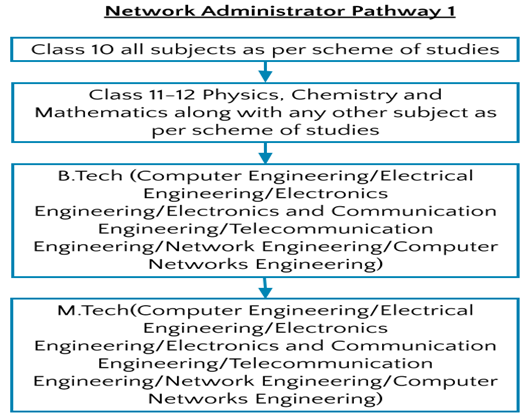
After Class 11-12 Physics, Chemistry and Mathematics along with any other subject as per scheme of studies. Then, you can pursue your graduation with a B.E. or B.Tech degree in Engineering or a B.Tech degree in Computer Engineering / Electrical Engineering / Electronics Engineering / Electronics and Communication Engineering / Telecommunication Engineering / Network Engineering / Computer Networks Engineering, followed by an M.E. or M.Tech in the same specializations. However, you may get a good job even without an M.E. or M.Tech.
Required Qualification & Competencies
Undergraduate studies after school:
You can complete your graduation with a B.E. or B.Tech degree in Computer Engineering / Electrical Engineering / Electronics Engineering / Electronics and Communication Engineering / Telecommunication Engineering / Network Engineering / Computer Networks Engineering. Then you can apply for entry-level jobs.
Post Graduate studies:
For postgraduate level studies in this field, you can opt for an M.E. or M.Tech in Computer Engineering / Electrical Engineering/ Electronics Engineering / Electronics and Communication Engineering / Telecommunication Engineering / Network Engineering / Computer Networks Engineering.
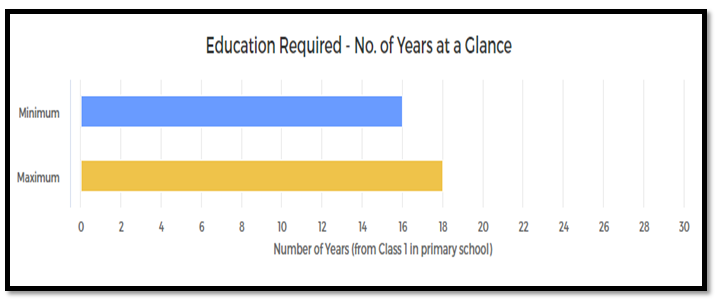
MINIMUM EDUCATION REQUIRED | MAXIMUM EDUCATION REQUIRED |
Under Graduate Undergraduate Degree / Honours Diploma / Graduate Diploma (equivalent to a Degree) Programs for which the minimum eligibility is a pass in Higher Secondary / Class XII School Leaving examination. | Post Graduate Postgraduate Degree / Diploma / Certificate Programs for which the minimum eligibility is a pass in Graduation / equivalent Diploma program like Honours Diploma or Graduate Diploma. |
COMPETENCIES REQUIRED
1. Investigative: You should have interests for Investigative Occupations. Investigative occupations involve working with ideas and quite a lot of thinking, often abstract or conceptual thinking. These involve learning about facts and figures; involve the use of data analysis, assessment of situations, decision making and problem-solving.
2. Realistic: You should have interests for Realistic Occupations. Realistic occupations involve more practical and hands-on activities than paperwork or office work. Realistic occupations often involve physical activities for getting things done using various tools and equipment.
3. Conventional: You should have interests for Conventional Occupations. Conventional occupations involve repetitive and routine tasks as well as fixed processes or procedures for getting things done. These occupations involve working more with data, systems, and procedures and less with ideas or creativity.
Personality traits:
1. You are always or mostly organized in your day-to-day life and activities.
2. You are always or mostly careful about your actions and behavior.
3. You are always calm or generally remain calm in most situations.
4. You can always act independently or could do so in most situations.
Skills:
1. Active Listening: Giving full attention to what other people are saying, understanding the points being made by others, asking questions, etc.
2. Critical Thinking: Skills in the analysis of complex situations, using logic and reasoning to understand the situations and take appropriate actions or make interpretations and inferences.
3. Problem Solving: Skills in analysis and understanding of problems, evaluating various options to solve the problems and using the best option to solve the problems.
4. Judgment and Decision Making: Skills in considering the pros and cons of various decision alternatives; considering costs and benefits; taking appropriate and suitable decisions.
5. Troubleshooting: Skills in determining causes of operating errors and deciding what to do about it.
6. Systems Evaluation: Skills in identifying measures or indicators of system performance and the actions needed to improve or correct performance, relative to the goals of the system.
7. Systems Analysis: Skills in determining how a system should work and how changes in conditions, operations, or the environment will affect outcomes.
8. Time Management: Skills in prioritizing work, managing time effectively.
Knowledge:
1. English Language: Knowledge about English grammar, words, spelling, sentence construction, using English to communicate with others, reading in English, etc.
2. Telecommunication and Networking: Knowledge about telecommunication network, telecommunication technologies, network management and operations of various equipment and systems for transmission and broadcasting.
3. Mathematics: Knowledge of arithmetic, algebra, geometry, calculus, trigonometry, statistics, and other mathematical disciplines and their applications.
4. Computers: Knowledge of computer hardware and software, computer programming, computer networks, computer, and mobile applications.
5. Customer Service: Knowledge about how to provide customer services. This includes understanding customer needs, helping customers to use products and services, answering customer queries, handling customer complaints and grievances, and evaluating customer satisfaction.
Career - Job Opportunities & Profiles
After you’ve completed your graduation / post-graduation in any one of the above-mentioned specializations, you can find numerous job opportunities as a Trainee Engineer / Network Engineering Trainee / Trainee Communication Engineer in Telecom companies, Telecom hardware manufacturing companies, Telecom management companies, Broadcasting companies, IT software and services companies, Data Centers, and for that matter, any other large-scale company (in any industry) having a separate networking department.
Also, you can find network administration and management jobs in the Indian Defence wings and the Railway sector through various competitive examinations.
Work Environment
As a Network Administrator, you will be essentially working in comfortable settings of an office environment. You’ll work in close collaboration with technicians, webmasters, and other team members. Typically, you will have to work around 9-10 hours every day, although sometimes you might be required to work overtime to meet strict deadlines.
SPECIALISATION TRACKS IN THIS CAREER
Telecommunication Network Administrator
Telecommunications Network Administrators are specialized data communications analysts who work in close collaboration with other computer scientists and network systems analysts to improve the quality and efficiency of various network systems. They handle, manage, and maintain equipment and networks that provide interactions between data and voice communications including telephone, computer, video conferencing, and voicemail systems.
Enterprise Network Administrator
Enterprise Network Administrators are responsible for managing existing solutions to solve business needs by leveraging third-party apps and technologies with the help of tools like SSIS, Microsoft SQL, and PowerShell. They also assist in the implementation, documentation, and maintenance of solutions as and when required.
Data & Information Security/Cyber Security Expert
Cyber Security Experts are professionals are responsible for developing an organization's computer security standards, installing software programs to protect company data, analyzing current systems for vulnerabilities, and monitor computer networks for potential security breaches. They focus on enhancing and strengthening the digital privacy measures that are applied to prevent unauthorized access to computers, databases and websites.
CAREER GROWTH
At the beginning of your career, you can bag entry-level roles such as Trainee Engineer or Network Engineering Trainee or Trainee Communication Engineer.
After you’ve gained nearly 5-7 years of experience, you can get promoted to roles like Assistant Engineer/Associate Engineer. And then, in about 10-15 years’ time, you can upgrade to senior-level roles like that of the Network Administrator/Team Lead/Lead Network Engineer/ etc.
After 15-20 years of service, you can upgrade to senior management and administrative roles such as Chief Network Administrator / Head of Networks / Head of Network Engineering / Vice President, etc.
Salary Offered
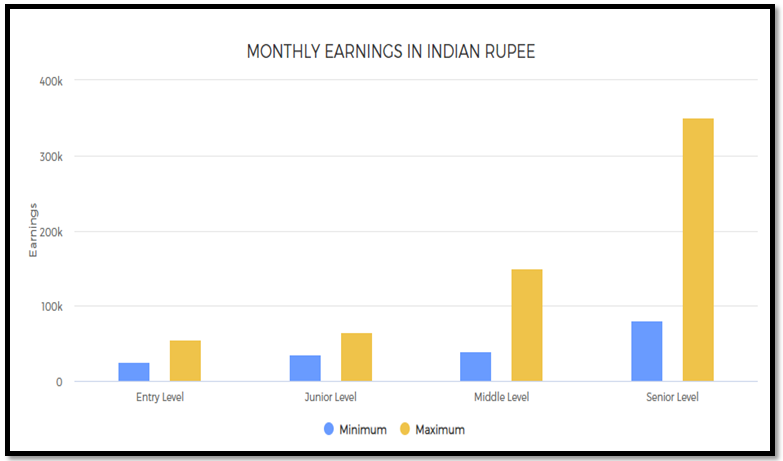
1. In entry-level, you can expect a monthly salary package of around Rs. 25,000 - 55,000 or more per month.
2. As you gain about 6-10 years of experience and move on to mid-level roles in the field, your average monthly salary will be anywhere around Rs. 35,000 –1,50,000 or more per month.
3. For senior-level job positions (with 12-20 years of experience), the salary package is much higher and ranges anywhere between Rs. 80,000 - 350,000 or more per month.
MONTHLY EARNINGS IN INDIAN RUPEE
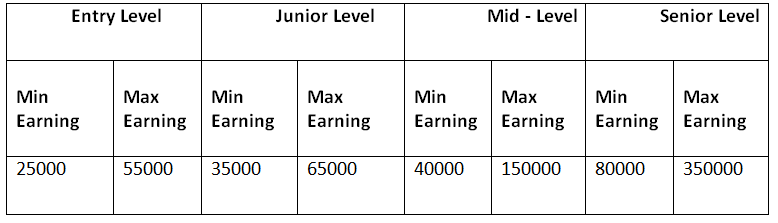
1. Entry level: 0 - 2 years of work experience
2. Junior Level: From 1 to 12 years of work experience
3. Mid-Level: From 5 to 20+ years of work experience
4. Senior Level: From 10 to 25+ years of work experience (there could be exceptions in some high-end technical, financial, engineering, creative, management, sports, and other careers; also in the near future, people will reach these levels much faster in many careers and in some careers, these levels will have no meaning as those careers will be completely tech skill driven such as even now, there is almost no level in a Cyber Security Expert’s job)
Work Activities
1. Working with computers, programming and performing technical tasks: Using computers and computer systems, both hardware and software for programming, developing software and/or hardware, developing computer applications, systems, and networks; developing mobile applications.
2. Decision making and problem-solving: Analysis of data and information; evaluation of alternative decisions and results of decisions; taking the right decisions and solving problems.
3. Getting Information and learning: Observing, hearing, reading, using computers, or otherwise obtaining information and learning from it.
4. Information processing: Searching, compiling, tabulating, calculating, auditing, verifying or otherwise dealing with information processing including data entry, transcription, recording, storing and maintaining databases.
5. Analysis and interpretation of data and information: Analysis of data and information to find facts, trends, reasons behind situations, etc.; interpretation of data to aid in decision making.
6. Communicating with co-workers and others: Communicating with people in writing, verbally or otherwise inside your workplace and various other people who have professional relationships with your place of work including vendors, government officials, etc. or with people at large.
7. Operating machines, equipment, devices, systems and processes.
8. Scheduling tasks: Scheduling project timelines, tasks and activities.
Future Prospects
According to the latest IBEF (Indian Brand Equity Foundation) report, India’s GDP is estimated to have increased by 6.6% and is further projected to reach 7.3% . With over 4,750 technology startups, India holds the position of being the third largest startup base in the world. The Indian IT-BPM sector expanded at a CAGR of 11.14%, reaching US$ 155 billion in FY17 from US$ 74 billion in FY, which exceeds the global IT-BPM growth by nearly three times. The Indian IT sector employs around 3.9 million people and in FY alone, over 1,70,000 new employees joined the sector. Furthermore, India's labor force is predicted to touch 160-170 million. These stats show that there will be plenty of employment opportunities for Network Administrators in the upcoming future.

FUTURE PROSPECTS AT A GLANCE
