

Urology/Nephrology Technologist
Entry Level Qualification
Class 12
Career Fields
Allied & Para Medical Science
For Specially Abled


Career Entrance Exam
NEET UG, NEET PG, JIPMER MSC/MPH, AIIMS MSC, AIIMS BSC, AIIMS PG INICET
About Career
PARTICULARS | DESCRIPTION |
Name | Urology/Nephrology Technologist |
Purpose | Diagnostic Testing |
Career Field | Allied & Para Medical Science |
Required Entrance Exam | NEET UG, NEET PG, JIPMER MSC/MPH, AIIMS MSC, AIIMS BSC, AIIMS PG INICET |
Average Salary | 150000 - 200000 Rs. Per Year |
Companies For You | Indian Spinal Injuries Centre, Human Care Medical Charitable Trust & Many More |
Who is Eligible | Class 12th Pass |
Urology/ Nephrology Technologists are specialized healthcare professionals who manage and operate the machines used in the diagnosis and treatment of urinary/ nephrological/ renal ailments and related disorders/clinical conditions. This will also include serving patients requiring transplants and assessment of donors for clinical transplantation, for example, for transplanting kidneys.
What Urology/Nephrology Technologists do
1. Urology/ Nephrology Technologists assist surgeons, physicians, and nurses in conducting invasive and non-invasive diagnostic tests or operative procedures; preparing patients for the testing processes or surgery, and other associated tasks.
2. They are responsible for selecting, assembling, cleaning, disinfecting, setting up as well as testing laboratory equipment and machines as well as making minor repairs to ensure proper operation and that they are functioning according to specifications.
3. They have specialized patient-appropriate interpersonal skills to explain testing procedures to the patient and obtain her cooperation for the best performance of these procedures. They may also employ sufficient knowledge about how kidney disease or dysfunction can affect other parts of our body.
Key Roles and Responsibilities
1. You will take complete histories directly from patients or medical records, and record patient identification, and/or prior test results.
2. You will explain renal testing procedures to a patient and obtain her cooperation for the best performance of these procedures. You will also check the patient’s special needs if any.
3. You will conduct chemical analyses of body fluids, such as blood or urine, using a microscope or automatic analyzer to detect abnormalities or diseases.
4. You will prepare standard volumetric solutions or reagents to be combined with samples, following standardized formulas or experimental procedures.
5. You will deliver & perform dialysis therapy according to the supervising physician’s prescribed dialysis care regimen for a patient. This will include tasks involving patient care during the therapy such as monitoring the emotional, physical, &physiological condition of the patient, and ensuring the stability of the patient through proper techniques.
6. You will take & record the patient's pre-dialysis weight, temperature, blood pressure, pulse rate, and respiration rate.
7. You will mix dialyzing solutions according to the formula, prime the dialyzer with saline to prepare the machine for use, and set up & operate the dialysis machine.
8. You will write preliminary technical reports with assistance and fill statutory and equipment databases with pertinent patient & test information, findings, or data.
9. You will analyze the results of tests or experiments to ensure conformity to specifications, using special mechanical or electrical devices.
10. You will report to a Urologist/ Nephrologist to determine a final diagnosis and treatment process when abnormalities are found.
11. You will be involved in selecting, assembling, cleaning, disinfecting, setting up as well as testing laboratory equipment and machines as well as making minor repairs to ensure proper operation and that they are functioning according to specifications.
12. You will demonstrate positive patient-appropriate interpersonal skills with patients, physician staff, and other hospital/clinic staff members.
13. You will acquire specialized skills to perform more difficult procedures and other nephron-diagnostic procedures including intraoperative monitoring, testing, computer setup, and the clipping, pruning, & archiving of data.
14. You will continue education by participating in or through conferences & technical meetings, journal workshops, seminars, and site visits. You may as well participate in and take on individual research projects.
Career Entry Pathway
Class 10 all subjects as per the scheme of studies – Class 11-12 Physics, Chemistry, and Biology along with any other subject as per the scheme of studies - B Sc in Urology Technology/ Dialysis Technology/ Renal Dialysis Technology.
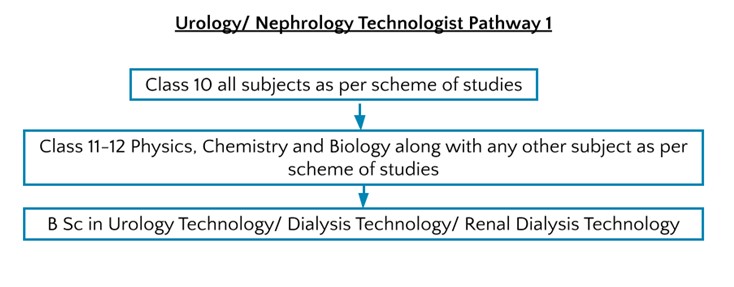
After completing Class 11-12 Physics, Chemistry, and Biology along with any other subject as per the scheme of studies, you may go for a B Sc in Urology Technology/ Dialysis Technology/ Renal Dialysis Technology or similar programs in related disciplines.
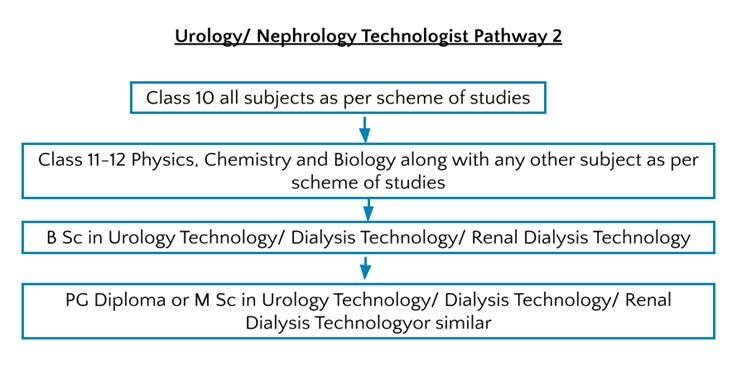
After completing Class 11-12 Physics, Chemistry, and Biology along with any other subject as per the scheme of studies, you may go for a B Sc in Urology Technology/ Dialysis Technology/ Renal Dialysis Technology or similar programs in related disciplines. Then you may go for a PG Diploma or M Sc in Urology Technology/ Dialysis Technology/ Renal Dialysis Technology or similar. If you go for an M Sc, you will have the option to continue further and complete your doctoral studies (Ph.D.). However, with a PG Diploma after graduation, a subsequent PhD is not possible.
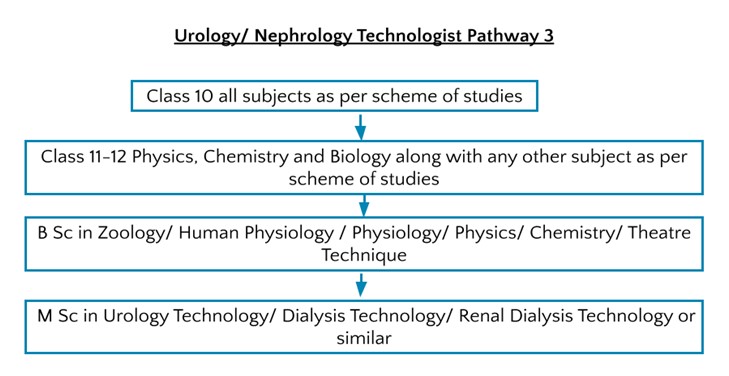
After completing Class 11-12 Physics, Chemistry, and Biology along with any other subject as per the scheme of studies, you may go for a B Sc in Zoology/ Human Physiology / Physiology/ Physics/ Chemistry/ Theatre Technique. Then go for an M Sc in Urology Technology/ Dialysis Technology/ Renal Dialysis Technology or similar. This is only possible in select colleges and it is advisable to complete a Diploma course in this discipline before opting for M Sc specialization.
Required Qualification & Competencies
After Class 11-12, you may pursue:
1. B.Sc. in Urology Technology/ Dialysis Technology/ Renal Dialysis Technology or similar.
2. Bachelor’s in Zoology/ Human Physiology / Pharmaceutical Sciences/ Physiology/ Physics/ Chemistry/ Theatre Technique.
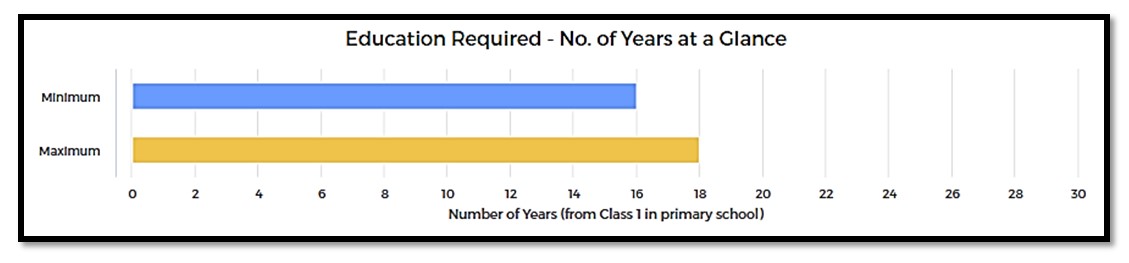
MINIMUM EDUCATION REQUIRED | MAXIMUM EDUCATION REQUIRED |
Under Graduate Undergraduate Degree / Honours Diploma / Graduate Diploma (equivalent to a Degree) Programs for which the minimum eligibility is a pass in Higher Secondary / Class XII School Leaving examination. | Post Graduate Postgraduate Degree / Diploma / Certificate Programs for which the minimum eligibility is a pass in Graduation / equivalent Diploma program like Honours Diploma or Graduate Diploma. |
Competencies Required
Interest
1. Enterprising: You should have an interest in Enterprising Occupations. Enterprising occupations involve taking initiative, initiating actions, and planning to achieve goals, often business goals. These involve gathering resources and leading people to get things done. These require decision-making, risk-taking, and action orientation.
2. Realistic: You should have an interest in Realistic Occupations. Realistic occupations involve more practical and hands-on activities than paperwork or office work. Realistic occupations often involve physical activities for getting things done using various tools and equipment.
3. Conventional: You should have interests in Conventional Occupations. Conventional occupations involve repetitive and routine tasks as well as fixed processes or procedures for getting things done. These occupations involve working more with data, systems, and procedures and less with ideas or creativity.
Knowledge
1. Biological Sciences: Knowledge of plants and animals, their anatomical structure, cell structure, tissues, physiological functions, evolution, and all other related aspects.
2. Healthcare Science and Services: Knowledge of different fields that are related to offering various types of healthcare services to people; assisting physicians and surgeons to carry out diagnosis, treatment, and prevention of human diseases, ailments, and disorders. This includes knowledge of different practices apart from medicine which are used to treat and prevent human diseases or to provide holistic healthcare and wellness. This also includes knowledge about drugs and medicines.
Skills
1. Active Listening: Giving full attention to what other people are saying, understanding the points being made by others, asking questions, etc.
2. Coordination: Skills in working together with other people to get things done.
3. Critical Thinking: Skills in the analysis of complex situations, using logic and reasoning to understand the situations and take appropriate actions or make interpretations and inferences.
4. Judgment and Decision Making: Skills in considering the pros and cons of various decision alternatives; considering costs and benefits; and making appropriate and suitable decisions.
5. Problem Solving: Skills in analysis and understanding of problems, evaluating various options to solve the problems, and using the best option to solve the problems.
6. Technical: Skills in using various technologies and technical methods to get things done or solve problems.
7. Time Management: Skills in prioritizing work, and managing time effectively.
8. Troubleshooting: Skills in determining causes of operating errors and deciding what to do about it
Abilities
1. Abstract Reasoning: The ability to understand ideas that are not expressed in words or numbers; the ability to understand concepts that are not clearly expressed verbally or otherwise.
2. Deductive Reasoning: The ability to apply general rules and common logic to specific problems to produce answers that are logical and make sense. For example, understanding the reasons behind an event or a situation using general rules and common logic
3. Inductive Reasoning: The ability to combine pieces of information from various sources, concepts, and theories to form general rules or conclusions. For example, analyzing various events or situations to come out with a set of rules or conclusions
4. Inter-Personal: The ability to build and maintain good relationships with others at workplaces and elsewhere.
5. Oral Comprehension: The ability to listen to and understand information and ideas presented through spoken words and sentences.
6. Oral Expression: The ability to communicate information and ideas in speaking so others will understand.
7. Problem Sensitivity: The ability to tell when something is wrong or is likely to go wrong. It does not involve solving the problem, only recognizing there is a problem.
8. Verbal Reasoning: The ability to think and reason with words; the ability to reason out ideas expressed in words.
Personality
1. You are always or mostly organized in your day-to-day life and activities.
2. You are always calm or generally remain calm in most situations.
3. You always feel secure in your surroundings and most situations.
4. You are a soft-hearted person sometimes.
5. You trust others sometimes but not always.
6. You are helpful to others sometimes.
7. You act independently sometimes but do not do so at some other times.
8. You are friendly and outgoing sometimes, but not always. You prefer the company of people sometimes but not always.
9. You are always practical in most situations.
Career - Job Opportunities & Profiles
After completing a Bachelor’s or Master’s, you may find work in a hospital or imaging units/ diagnostic & interventional labs as well as public/private medical colleges and training hospitals.
You may find work in:
1. In multi-specialty government and private hospitals where urologic care services are offered
2. In super-specialty or dedicated hospitals that treat urologic or renal diseases like BLK Super Speciality Hospital, Care Hospital, Artemis, Adiva, Bhagwati Hospital, MGS Super Specialty Hospital, R G Urology & Laparoscopy Hospital, etc.
3. In nursing homes and health institutes that treat kidney or urologic and related diseases.
4. In institutes, diagnostic centers, and healthcare trusts that provide urologic care services Goyal Hospital & Urology Centre, Indian Spinal Injuries Centre, Human Care Medical Charitable Trust, etc.
Career Growth
After having completed the required education & training you would move upwards along roles like:
Urology/ Nephrology Technician – Assistant Urology/ Nephrology Technician – Urology/ Nephrology Technologist – Senior Urology/ Nephrology Technologist
Salary Offered
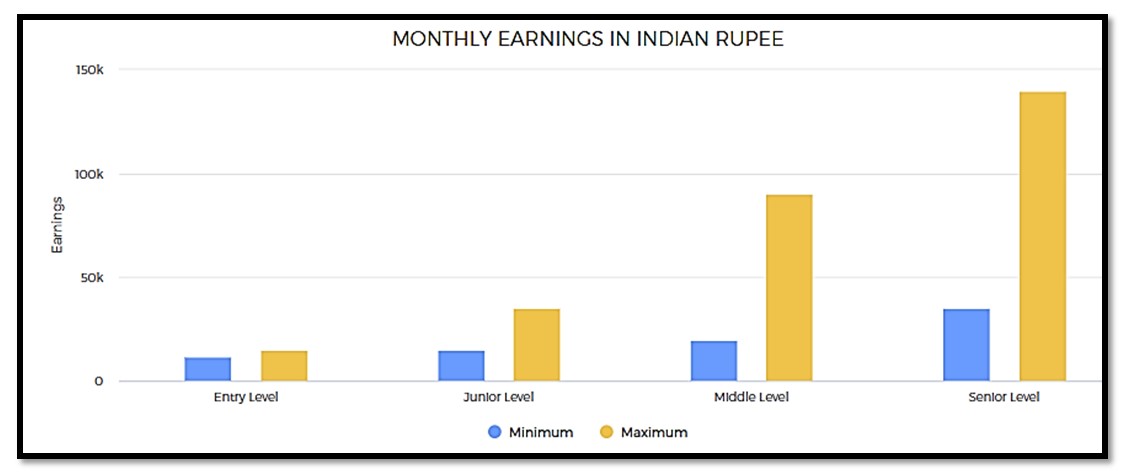
1. As a Trainee or Technician at Entry level, you may earn around Rs. 12,000 to Rs. 15,000 per month.
2. At Junior-level with an experience of 1- 4 years you may earn around Rs. 15,000 – 35,000 per month or more.
3. At Mid-level with an experience of 5-12 years you may earn around Rs. 20,000 – 90,000 per month or more.
4. At Senior-level with an experience of 12-20 years you may earn around Rs. 35,000 – 1,40,000 per month or more.
5. Salaries are higher at government hospitals.
Monthly Earnings In Indian Rupee
Entry Level | Junior Level | Mid Level | Senior Level | ||||
Min Earning | Max Earning | Min Earning | Max Earning | Min Earning | Max Earning | Min Earning | Max Earning |
12000 | 15000 | 15000 | 35000 | 20000 | 90000 | 35000 | 140000 |
1. Entry level: 0 - 2 years of work experience
2. Junior Level: From 1 to 12 years of work experience
3. Mid Level: From 5 to 20+ years of work experience
4. Senior Level: From 10 to 25+ years of work experience (there could be exceptions in some high-end technical, financial, engineering, creative, management, sports, and other careers; also shortly, people will reach these levels much faster in many careers and some careers, these levels will have no meaning as those careers will be completely tech skill driven such as even now, there is almost no level in a Cyber Security Expert’s job)
Work Activities
1. Addressing grievances and resolving conflicts: Handling complaints and grievances to resolve; resolving conflicts among co-workers or others at the workplace or outside of your work.
2. Assisting and caring for people: Assisting people in availing of services; taking care of people in different situations; offering help and services to others.
3. Providing advice and consultation to others: Giving advice or consultation to others about various issues, conceptual matters, know-how, scientific matters, products, or services.
4. Analyzing and interpreting data and information: Analysis of data and information to find facts, trends, reasons behind situations, etc.; interpretation of data to aid in decision-making.
5. Communicating with co-workers and others: Communicating with people in writing, verbally or otherwise inside your workplace and various other people who have professional relationships with your place of work including vendors, government officials, etc., or with people at large
6. Decision-making and problem-solving: Analysis of data and information; evaluation of alternative decisions and results of decisions; making the right decisions and solving problems.
7. Developing and maintaining interpersonal relationships: Developing professional relationships with co-workers and others outside organizations and maintaining good relationships.
8. Getting Information and learning: Observing, hearing, reading, using computers, or otherwise obtaining information and learning from it.
9. Handling administrative activities: Handling various administrative tasks and managing day-to-day operations.
10. Inspecting equipment, systems, structures, and materials: Inspecting equipment, systems, structures, and materials to ascertain quality, performance, defects, causes of errors, etc.
11. Inspecting situations, events, and people: Inspecting situations, events, and people to understand the reasons and causes for the situation or events to happen; inspecting people to understand reasons behind their behavior and actions.
12. Managing and supervising: Managing and supervising the work of others; setting goals; giving instructions; monitoring work performance, etc.
13. Updating and using relevant knowledge: Keeping updated with the latest knowledge relevant to your fields of work and use of the relevant knowledge in getting things done.
14. Using computers for work: Using computers for day-to-day office work; using computer software for various applications in day-to-day professional work; entering data and processing information; for writing.
15. Working in a team: Working in a team of people; developing a team; and maintaining professional relationships among team members.
Future Prospects
1. The healthcare sector in India is one of the fastest growing sectors and will reach an estimate of around USD 280 billion. India has also become a top destination for high-end diagnostic services and is attracting several capital advancements for advanced diagnostic facilities.
2. By 2025, medical spending in India is expected to grow by almost 9 to 12% making India one of the world’s top ten in this zone.
3. Many private and government hospitals have adopted high-end technological services catering to the rising demands. Therefore, a career in this allied healthcare sector would witness immense demand in the upcoming years.
Future Prospects At A Glance
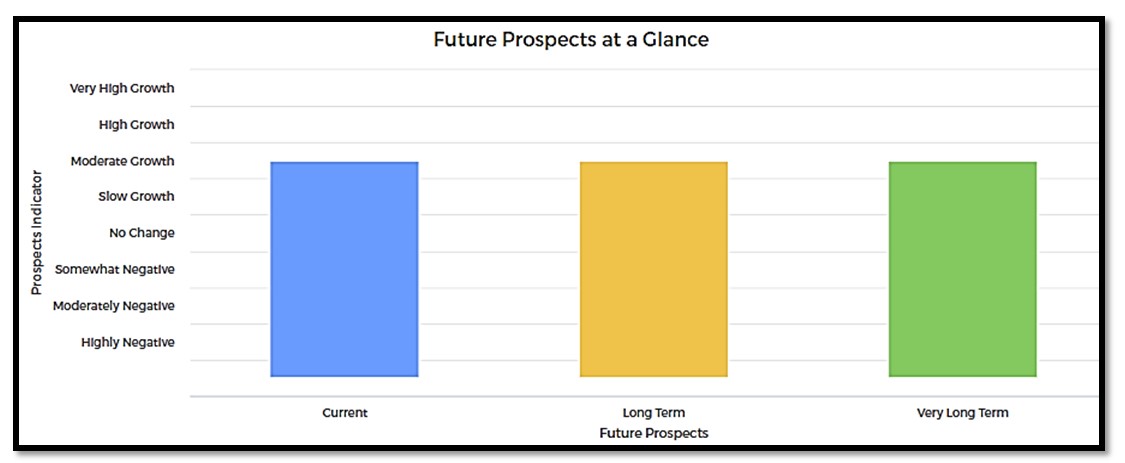
Current (0-1 year) | Long Term (2-5 years) | Very Long Term (6-10 years) |
Moderate Growth | Moderate Growth | Moderate Growth |


