

Airline Cargo Assistant/ Airline Baggage Handler
Entry Level Qualification
Class 10
Career Fields
Hospitality, Tourism & Transport Services
For Specially Abled


Career Entrance Exam
About Career
PARTICULARS | DESCRIPTION |
Name | Airline Cargo Assistant/ Airline Baggage Handler |
Purpose | Baggage Management |
Career Field | Hospitality, Tourism & Transport Services |
Required Entrance Exam | No Entrance Exam |
Average Salary | 150000 - 200000 Rs. Per Year |
Companies For You | ABX Air, Aerologic, DHL & Many More |
Who is Eligible | Class 10th Pass |
The airlines which are mainly dedicated to transport cargo (also known as Airline Cargo or Airfreight Cargo) by air are known as Cargo Airlines. However, many passenger airlines also have divisions or subsidiaries for transporting air cargo.
As an Airline Cargo Assistant, you will be working in the logistic and warehousing department of an airline company – where the items or packages are stored for transportation purposes. You will be responsible for storing the items or packages and shipping them across the country and around the world with the help of commercial and private services. You will be responsible for the smooth handling of cargo throughout the cargo operation by performing various multi-skilled roles with the help of various provided resources. You will not only be performing the task of transporting the cargo but also responsible for cargo handling, performing documentation tasks, customer services, delivery tasks, build-up, equipment operation, and transportation tasks.
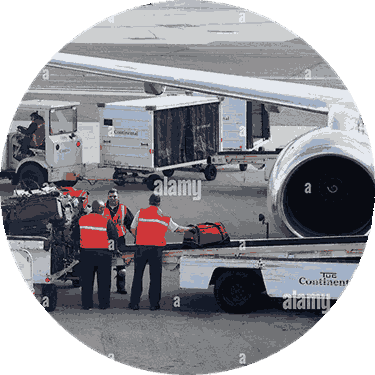
As an Airline Baggage Handler, you will be responsible for preparing baggage, cargo, and mail that needs to be transported to a passenger aircraft. You will be using various baggage lifting equipment and a baggage truck, and sometimes you might operate a conveyor belt, while loading, unloading or transporting the baggage or cargo package. You will be responsible for quick and safe loading, unloading, or transporting the cargo or passenger packages or baggage at an airport. You will be required to load the luggage or baggage at the correct carousel (a device that delivers the checked baggage) at the baggage claim area of the airport or their final destination.
As an Airline Baggage Handler, you will be handling various job responsibilities also apart from baggage handling. Some of them are as follows:
1. Operations (load controller) Agent: There is a set limit to how much a loaded aircraft (in addition to the cargo, passenger and fuel load) can weight for maintaining the balance and ensuring the safe operation of the aircraft. You will be involved in controlling the load, load distribution, calculation for ensuring the intended flight operates with the safety envelops as per the prescribed standards or limits.
2. Warehouse agent: Where all the inbound and outbound air freights are processed, are known as air freight warehouses – which are usually separate from the passenger terminals. They are located on or adjacent to the airport. You will be performing the build-up and breakdown of the cargo or baggage safely within the assigned timeframes.
3. Crew Chief: You will be responsible for ensuring that the aircraft has been loaded by following the specifications provided by the load controller or agent. You will be reporting to the management about any discrepancies or issues.
4. Ramp Agent: The Ramp agent is typically responsible for the loading of cargo or baggage. You will also be involved in the coordination process of the aircraft, i.e., coordinating information and turnaround (arrival and departure) of an aircraft for loading or unloading of the cargo.
5. Transfer Agent: Transfer agents are one who operates the vehicle which is used for transferring the baggage from the baggage room to the aircraft or the other place. They are also known as Runner.
6. Inbound Runner: Inbound runner works as an in-charge of baggage delivery from an inbound aircraft to the baggage claim room or carousel.
7. Mail/Freight Agent: You will be responsible for scanning each package or baggage and then delivering them to the correct or proper aircraft.
8. Bag Room Agent: As a bag room agent you will be responsible for sorting the bags or cargos into the carts. Baggage or cargo is delivered by the help of a conveyor belt (belts which help in moving bulk baggage or cargos) to the bag room.
Key Roles And Responsibilities
As an Airline CargoAssistant, you will be engaged in all or some of the following key roles and responsibilities:
1. You will be planning the loading of the cargo or baggage into the ULD’s (Unit Load Devices) or bulks for the carriage on the assigned aircraft, according to the priorities given for achieving optimum utilization of capacity.
2. You will be required to check that the cargo or the baggage is loaded as per the specified executed load plan, including checking the weight of baggage.
3. You will be required to inspect and validate all the relevant documents and also keep a count of goods at every point of – delivery, acceptance, and breakdown.
4. You will be required to receive a confirmation from the customer that the goods have been received, and they were dispatched or stored in accordance with the standard procedures.
5. You will be required to perform manual and automated data input for ensuring that the data updates into relevant cargo record is done accurately and is verified/completed within time standards.
6. You will be required to ensure that the safety of the aircraft is not compromised and the product quality standards are maintained while keeping a high degree of customer service, attentiveness, speed, and control on error rates.
Career Entry Pathway
Class 10 all subjects as per scheme of studies – NSQF Level 3 Qualification in Airline Cargo Assistant – loading and unloading
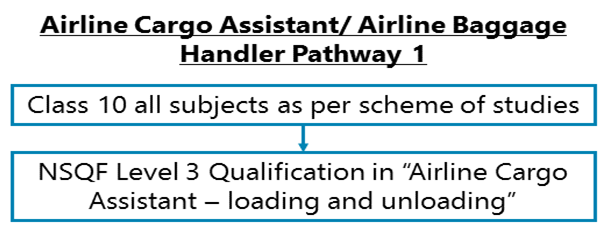
After completing Class 10, you can pursue National Skill Qualifications Framework (NSQF) Level 3 certificate for ‘Airline Cargo Assistant – loading and unloading’ or similar courses. The total number of training hours is 240 hours. If you have completed training under Aviation Security, then also you may obtain NSQF Level 3 qualification. However, this training is not compulsory. You need to be 18 years of age for pursuing this certificate.
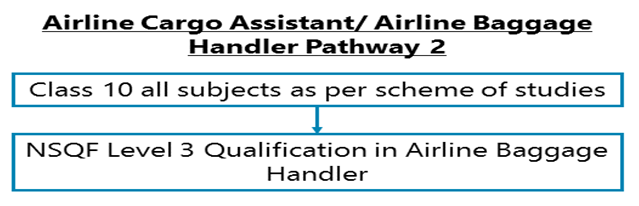
After completing Class 10, you can pursue National Skill Qualifications Framework (NSQF) Level 3 certificate for ‘Airline Baggage Handler’ or similar courses. The total number of training hours is 240 hours. If you have completed training under Aviation Security, then also you may obtain NSQF Level 3 qualification. However, this training is not compulsory. You need to be 18 years of age for pursuing this certificate.
Required Qualification & Competencies
After completing Class 10, you may obtain:
1. NSQF Level 3 Qualification in Airline Cargo Assistant – loading and unloading,
2. NSQF Level 3 Qualification in Airline Baggage Handler.
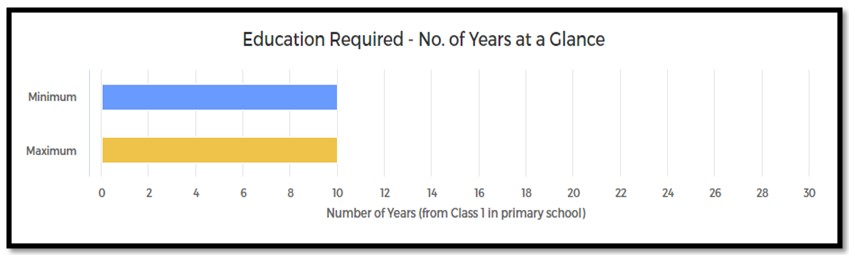
MINIMUM EDUCATION REQUIRED | MAXIMUM EDUCATION REQUIRED |
Post-Secondary Certificate / Diploma Programs for which the minimum eligibility is a pass in class X. | Post-Secondary Certificate / Diploma Programs for which the minimum eligibility is a pass in class X. |
Competencies Required
Interests
1. Enterprising: You should have interests for Enterprising Occupations. Enterprising occupations involve taking initiatives, initiating actions, and planning to achieve goals, often business goals. These involve gathering resources and leading people to get things done. These require decision making, risk-taking, and action orientation.
2. Realistic: You should have interests for Realistic Occupations. Realistic occupations involve more practical and hands-on activities than paperwork or office work. Realistic occupations often involve physical activities for getting things done using various tools and equipment.
Knowledge
1. Customer Service: Knowledge about how to provide customer services. This includes understanding customer needs, helping customers to use products and services, answering customer queries, handling customer complaints and grievances, and evaluating customer satisfaction.
2. Transportation: Knowledge of principles and methods for moving people or goods by air, rail, sea, river, or road, or otherwise, including the relative costs and benefits.
Skills
1. Critical Thinking: Skills in analysis of complex situations, using of logic and reasoning to understand the situations and take appropriate actions or make interpretations and inferences.
2. Active Listening: Giving full attention to what other people are saying, understanding the points being made by others, asking questions, etc.
3. Time Management: Skills in prioritizing work, managing time effectively.
4. Coordination: Skills in working together with other people to get things done.
5. Judgment and Decision Making: Skills in considering pros and cons of various decision alternatives; considering costs and benefits; taking appropriate and suitable decisions.
Abilities
1. Oral Comprehension: The ability to listen to and understand information and ideas presented through spoken words and sentences.
2. Oral Expression: The ability to communicate information and ideas in speaking so others will understand.
3. Far Vision: The ability to see details at a distance.
4. Manual Dexterity: The ability to quickly move your hand, your hand together with your arm, or your two hands to grasp, manipulate, or assemble objects.
5. Selective Attention: The ability to concentrate on a task over a long period of time without being distracted.
6. Speech and Language Recognition: The ability to identify and understand the speech and language of another person.
Personality
1. You are always or mostly organized in your day-to-day life and activities.
2. You are always or mostly a soft-hearted person.
3. You are always or mostly helpful to others.
4. You are somewhat disciplined in your action and behavior.
5. You are friendly and outgoing sometimes, but not always. You prefer the company of people sometimes but not always.
6. You are caring, supportive, sympathetic and kind to others sometimes.
Career - Job Opportunities & Profiles
You may get an entry-level job opportunity as a Trainee and later on can grow (as an Assistant and then as a supervisor) within the organization, in various all-cargo airline companies or in some cargo subsidiary companies.
Some largest all-cargo airline companies are: ABX Air, Aerologic, AirBridge Cargo, Airest, CargoLogicAir, Cargolux, DHL, FedEx Express, Kalitta Air, Martinair, etc.




Some cargo subsidiary companies (cargo divisions of passenger airlines) are as follows:
1. Aeroflot-Cargo
2. Air Canada Cargo
3. MASkargo
4. Qatar Airways Cargo
5. RAM Cargo
6. Royal Jordanian Cargo
7. Saudi Arabian Airlines Cargo
8. Shanghai Airlines Cargo
9. Singapore Airlines Cargo
10. South African Airways Cargo
On the other hand, if you looking for a job opportunity as an Airline Baggage handler, then you may find various job opportunities such as Operations (Load Control) Agent, Warehouse Agent, Crew Chief, Ramp Agent, Transfer Agent, Inbound Runner, Mail/Freight Agent, Bag Room Agent, Station Agent, etc.
Specialisation Tracks In This Career
1. Airline Baggage Handler
An Airline Baggage Handler is involved in preparing baggage, cargo, and mail that needs to be transported to an Aircraft. You will be responsible for receiving of loads from the aircraft, interpreting baggage tags, and labeling information tags.
2. Airline Cargo Handler
You will be responsible for ensuring the smooth handling of the cargo throughout Cargo or Ramp operations. You will be performing multi-skilled roles effectively while utilizing the resources provided to you.
Career Growth
With Airline Cargo Assistant or Airline Baggage Handler career you may find limited job opportunities. After gaining certain experience you may move from a trainee position to an assistant and then become a supervisor.
Salary Offered
1. Salaries vary according to job profiles and the kind of facilities you get to work at.
2. In entry-level jobs: You may expect to get about Rs. 10,000 – Rs. 15,000 per month.
3. Salaries increase with your work experience and as you get promoted.
4. In junior-level roles, you can expect to earn about Rs. 12,000 - Rs. 20,000 or more per month.
5. In mid-level jobs, with 6-12 years of work experience, you may expect to get about Rs. 18,000 – Rs.25,000 per month or more.
6. In senior-level jobs, with 12-15 years of work experience, you may expect to get about Rs. 28,000 – Rs. 40,000 per month or even more.
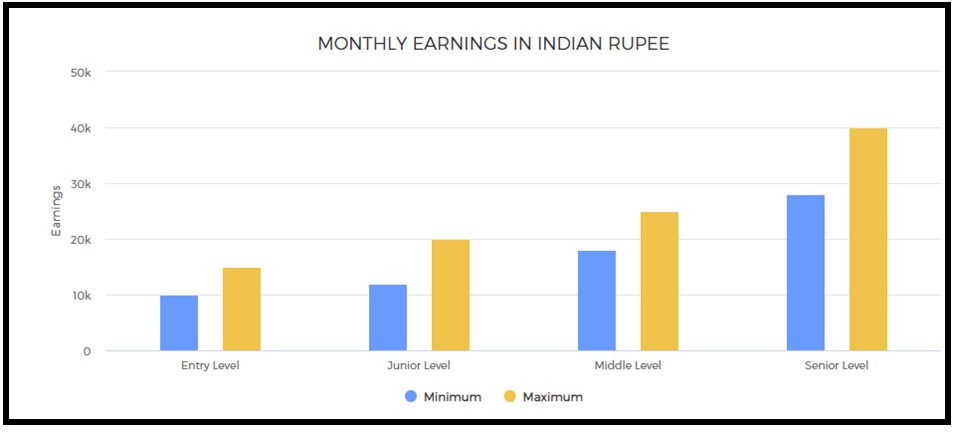
Monthly Earnings In Indian Rupee
Entry Level | Junior Level | Mid-Level | Senior Level | ||||
Min Earning | Max Earning | Min Earning | Max Earning | Min Earning | Max Earning | Min Earning | Max Earning |
10000 | 15000 | 12000 | 20000 | 18000 | 25000 | 28000 | 40000 |
1. Entry level: 0 - 2 years of work experience.
2. Junior Level: From 1 to 12 years of work experience.
3. Mid-Level: From 5 to 20+ years of work experience.
4. Senior Level: From 10 to 25+ years of work experience (there could be exceptions in some high-end technical, financial, engineering, creative, management, sports, and other careers; also shortly, people will reach these levels much faster in many careers and in some careers, these levels will have no meaning as those careers will be completely tech skill driven such as even now, there is almost no level in a Cyber Security Expert’s job).
Work Activities
As an Airline Cargo Assistant, you will be involved in the following work activities:
1. Getting Information and learning: Observing, hearing, reading, using computers, or otherwise obtaining information and learning from it.
2. Communicating with co-workers and others: Communicating with people in writing, verbally or otherwise inside your workplace and various other people who have professional relationships with your place of work including vendors, government officials, etc. or with people at large.
3. Decision making and problem-solving: Analysis of data and information; evaluation of alternative decisions and results of decisions; taking the right decisions and solving problems.
4. Performing physical activities: Performing physical activities that require use of your arms and legs and moving your whole body, such as lifting, balancing, walking, stooping, and handling of materials.
5. Updating and using relevant knowledge: Keeping updated with the latest knowledge relevant to your fields of work and use of the relevant knowledge in getting things done.
6. Handling and moving objects and materials: Using hands or otherwise use physical strength to handle and move objects and materials; manoeuvre, install, lift, place, manipulate, etc.
7. Identifying objects, actions, and events: Identifying various characteristics of objects; observing and understanding actions and events; understanding changes in actions and events.
8. Operating vehicles, mechanized devices, or other movable devices: Running, manoeuvring, navigating, or driving vehicles or mechanized equipment, such as forklifts, passenger vehicles, aircraft, or watercraft.
9. Organizing, planning and prioritizing tasks: Planning and organizing tasks in order to achieve work goals; prioritizing tasks to achieve goals and making the best use of the time available.
10. Inspecting equipment, systems, structures, and materials: Inspecting equipment, systems, structures, and materials to ascertain quality, performance, defects, causes of errors, etc.
11. Working in a team: Working in a team of people; developing team; maintaining professional relationships among team members.
Future Prospects
1. India’s aviation industry depicts a high-growth trajectory and all thanks to the rapid economic growth and high demand across the civil, defense and space segments. According to the IBEF (Indian Brand Equity Foundation) reports, by 2026, the Indian government will be investing nearly US$ 1.83 billion for the development of airport infrastructure along with aviation navigation services.
2. Similarly, as per a report of DGCA Directorate General of Civil Aviation, which is the regulatory body governing the safety aspects of civil aviation in India, the Air Passenger Traffic in India, both domestic and international witnessed a positive growth compared to the domestic passenger traffic registered a Compound Annual Growth Rate (CAGR) while the international passenger traffic grew. The high growth of 18.86 % in the total domestic passengers is mainly due to the high growth in passengers carried by Air India, IndiGo, SpiceJet, Vistara, Air Asia and Go Air.
3. These statistics establish the fact that there will be a significant rise in the demand for various skilled professionals both in India as well as overseas in the field of Airline Industry. The demand for Airline Cargo Assistants or for Airline Baggage Handlers will also increase in the future.
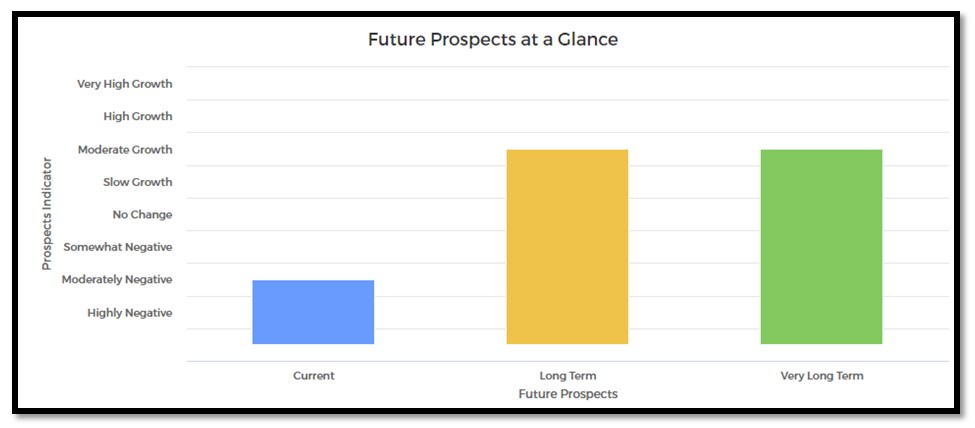
Future Prospects At A Glance
Current (0-1 year) | Long Term (2-5 year) | Very Long Term (6-10 years) |
Moderately Negative | Moderate Growth | Moderate Growth |
1. Entry level: 0 - 2 years of work experience.
2. Junior Level: From 1 to 12 years of work experience.
3. Mid-Level: From 5 to 20+ years of work experience.
4. Senior Level: From 10 to 25+ years of work experience (there could be exceptions in some high-end technical, financial, engineering, creative, management, sports, and other careers; also in the near future, people will reach these levels much faster in many careers and in some careers, these levels will have no meaning as those careers will be completely tech skill driven such as even now, there is almost no level in a Cyber Security Expert’s job).