

Petroleum and Petrochemical Engineer
Entry Level Qualification
Class 12
Career Fields
Engineering & Technology
For Specially Abled


Career Entrance Exam
JEE MAIN BE/BTECH, JEE ADVANCED, BITSAT UG, VITEEE BE/BTECH, VITEEE ME/MTECH, TANCET MTECH/MARCH, MHTCET
About Career
A Petroleum Engineer is involved in most of the stages of oil and natural gas field extraction. As a petroleum engineer, you are expected to know about the equipment used for extracting crude oil in a safe and economical manner, the way it needs to be processed and also the way in which the inflow and outflow take place.
A Petroleum Engineer is generally involved in designing and developing different methods to extract gas and oil from deposits under the Earth. They must also check the structural integrity and also develop safety policies for both the refineries and the workers working in it.
On the other hand, a Petrochemical Engineer is involved in refining the crude oil and producing an end-product. Petrochemical Engineers should be able to break down oil or natural gas into its base components and then, they will be able to reconstruct it into specific types of oil products such as auto fuel, as well as polymers, plastics and other compounds found in our everyday products.
Key roles and responsibilities:
Every Petrochemical Engineer has to learn these basic tasks which include:
1. Applying Chemical engineering principals like vapor-liquid equilibria, heat transfer and thermodynamics in the process design
2. Performing various design calculations using the known standard simulation programs
3. Using different relief calculation methodologies while complying with the industry codes and standards which is applicable to pressure relief design.
4. Developing relief load calculations, relief load calculations and relief valve data sheets.
5. Develop all the different process engineering deliverables like Heat and Material Balances, PFD’s, Utility Summaries, Equipment Datasheets, and other process deliverables required for the facility design.
6. Designing the equipment for safe extraction of oil and gas from both onshore and offshore reserves.
7. Developing proper plans to drill and recover oil and gas from reserves.
8. Inspecting and determining whether the installations in gas wells or oil wells have been properly done according to the set guidelines.
9. Developing proper ways to inject chemicals, water, or gases into the reserve to force out more oil.
10. Selecting the correct equipment and size for proper extraction.
11. Evaluating whether the oilfield equipment that is installed, is operating properly and is maintained or not.
12. Reviewing deliverables from licensors and other disciplines and suppliers during the final execution of the project.
13. Interpreting the information on drilling and testing and conveying the same to other personnel.
14. Checking and evaluating the production of wells and this is done through testings, surveys or analyses.
15. Conferring with engineering and technical personnel to find out resolve issues or engage in testing or research.
16. Identify issues in the design work and clarifying areas of complexity.
Career Entry Pathway
Class 10 all subjects as per scheme of studies – Class 11-12 Physics, Chemistry, and Mathematics along with any other subject as per scheme of studies - UG (B.Tech/BE in Petroleum or Petrochemical Engineering)
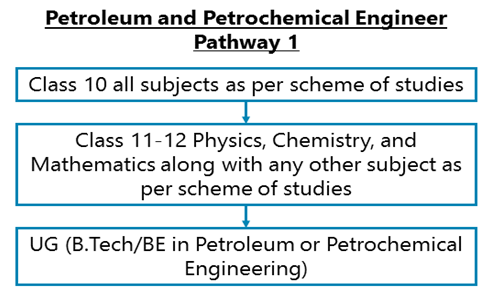
Once you’ve completed Class 11-12 Physics, Chemistry, and Mathematics along with any other subject as per scheme of studies. You can then pursue B.Tech/BE in Petroleum or Petrochemical Engineering.
Class 10 all subjects as per scheme of studies – Class 11-12 Physics, Chemistry, and Mathematics along with any other subject as per scheme of studies - UG (B.Tech/BE in Chemical Engineering)
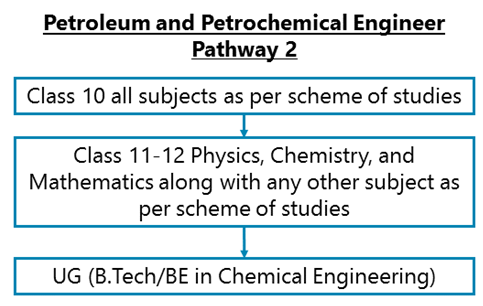
Once you’ve completed Class 11-12 Physics, Chemistry, and Mathematics along with any other subject as per scheme of studies. You can then pursue B.Tech/BE in Chemical Engineering.
Class 10 all subjects as per scheme of studies – Class 11-12 Physics, Chemistry, and Mathematics along with any other subject as per scheme of studies - UG (B.Tech in Chemical/Petrochemical/Petroleum Engineering)- PG (M.Tech in Petrochemical/Petroleum Engineering Engineering)
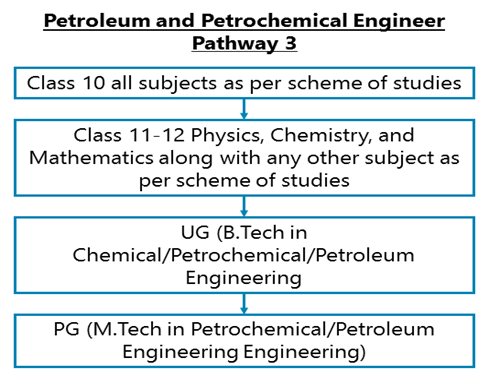
Once you’ve completed Class 11-12 Physics, Chemistry, and Mathematics along with any other subject as per scheme of studies. You can then pursue B.Tech in Chemical/Petrochemical/Petroleum Engineering. Then, you can move on to postgraduate degrees like M.Tech in Petrochemical/Petroleum Engineering Engineering.
Class 10 all subjects as per scheme of studies – Class 11-12 Physics, Chemistry, and Mathematics along with any other subject as per scheme of studies - UG (B.Tech in Chemical/Petrochemical/Petroleum Engineering) - PG (M.Tech in Petrochemical/Petroleum/Chemical Engineering Engineering)-Ph.D In Petroleum/Petrochemical Engineering
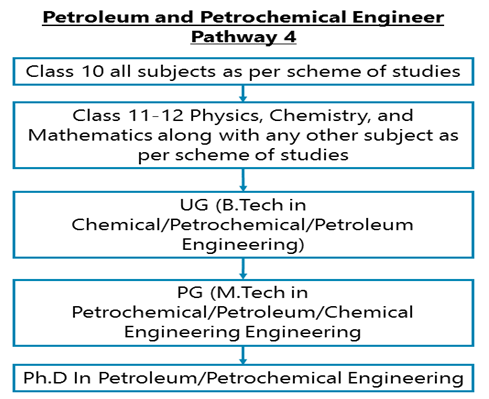
Once you’ve completed Class 11-12 Physics, Chemistry, and Mathematics along with any other subject as per scheme of studies. You can then pursue B.Tech in Chemical/Petrochemical/Petroleum Engineering. Then, you can move on to postgraduate degrees like M.Tech in Petrochemical/Petroleum/Chemical Engineering Engineering. After that, you can go for a doctoral degree like Ph.D In Petroleum/Petrochemical Engineering.
Required Qualification & Competencies
Undergraduate studies after school:
It is necessary to have a bachelor’s degree to become a successful Petroleum Engineer. A 4- years B.Tech / B.E. in Petroleum or Petrochemical Engineering will make you eligible for positions of a Graduate Engineering Trainee.
You can also opt for B.Tech. / B.E. in Chemical Engineering. This will get you an entry level job.
Post Graduate studies:
For specialized knowledge of Petroleum Engineering, you need to have an M.Tech in Petrochemical / Petroleum Engineering. This will open up a lot of opportunities for you in the petroleum industry.
Doctoral Studies:
A Doctorate Degree in Petroleum Engineering is the highest degree in the field of study. It is necessary to have an M.Tech in Petrochemical / Petroleum/ C hemical Engineering before you can go for a Doctorate degree in Petroleum / Petrochemical Engineering. This is open up high-grossing opportunities in the field and also, open up opportunities to go for a position as a Research scientist or a professor.
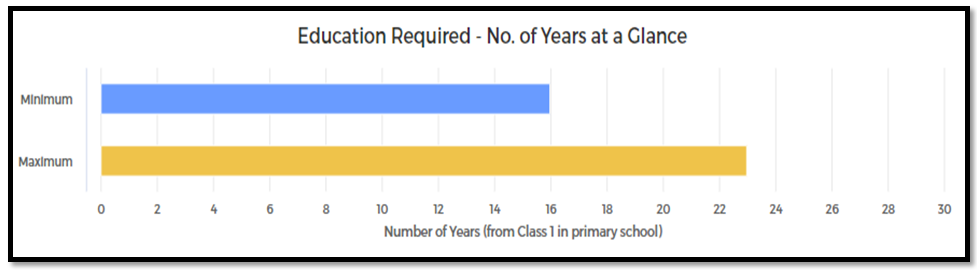
MINIMUM EDUCATION REQUIRED | MAXIMUM EDUCATION REQUIRED |
Under Graduate | Doctoral |
COMPETENCIES REQUIRED
Interests
1. Investigative: You should have interests for Investigative Occupations. Investigative occupations involve working with ideas and quite a lot of thinking, often abstract or conceptual thinking. These involve learning about facts and figures; involve use of data analysis, assessment of situations, decision making and problem solving.
2. Realistic: You should have interests for Realistic Occupations. Realistic occupations involve more practical and hands-on activities than paperwork or office work. Realistic occupations often involve physical activities for getting things done using various tools and equipment.
3. Conventional: You should have interests for Conventional Occupations. Conventional occupations involve repetitive and routine tasks as well as fixed processes or procedures for getting things done. These occupations involve working more with data, systems, and procedures and less with ideas or creativity.
Knowledge
Engineering and Technology: Knowledge of various applications of one or more branches of Engineering Science & Technology to manufacture and produce various goods or construct or erect various structures. This include knowledge about design, development, prototype testing, manufacturing, construction, installation, repair and maintenance.
Skills
1. Active Learning: Focused and continuous learning from various sources of information, observation and otherwise for application in getting work done.
2. Communication in English: Skills in communicating effectively in writing as well as verbally with others in English language.
3. Coordination: Skills in working together with other people to get things done.
4. Process and Operation Controlling: Skills in controlling processes and operations of various machines, equipment, devices and systems using different types electrical and electronic control instruments and systems.
5. Problem Solving: Skills in analysis and understanding of problems, evaluating various options to solve the problems and using the best option to solve the problems.
6. Technical: Skills in using various technologies and technical methods to get things done or solve problems.
7. Troubleshooting: Skills in determining causes of operating errors and deciding what to do about it.
8. Supervising: Skills in Supervising and monitoring performance of others, businesses, and different projects.
Abilities
1. Abstract Reasoning: The ability to understand ideas which are not expressed in words or numbers; the ability to understand concepts which are not clearly expressed verbally or otherwise.
2. Deductive Reasoning: The ability to apply general rules and common logic to specific problems to produce answers that are logical and make sense. For example, understanding the reasons behind an event or a situation using general rules and common logic.
3. Inductive Reasoning: The ability to combine pieces of information from various sources, concepts, and theories to form general rules or conclusions. For example, analysing various events or situations to come out with a set of rules or conclusions.
4. Inter-Personal: The ability to build and maintain good relationships with others at workplaces and elsewhere.
5. Mechanical Reasoning: The ability to apply basic physical principles and theories to understand how mechanical objects such as tools and machinery works and the ability to understand the rules or laws governing the work of machinery, tools and bodies in motion.
6. Numerical Reasoning: The ability to add, subtract, multiply, divide, and perform other basic numerical calculations correctly.
7. Spatial Ability: The ability to visualise three dimensional objects by looking at the objects in paper or visualise objects mentally in three dimensions.
8. Verbal Reasoning: The ability to think and reason with words; the ability to reason out ideas expressed in words.
Personality
1. You are always or mostly organised in your day-to-day life and activities.
2. You always feel secure in your surroundings and in most situations.
3. You are imaginative sometimes.
4. You prefer to experience new things and have new experiences sometimes.
5. You act independently sometimes but do not do so in some other times.
6. You are friendly and outgoing sometimes, but not always. You prefer company of people sometimes but not always.
7. You are always practical or in most situations.
Career - Job Opportunities & Profiles
1. When you complete your undergraduate degree, you can start your career as a Graduate Entry Trainee (GET) or a similar position in Oil and Gas Companies like Oil and Natural Gas Corporation, Hindustan Petroleum Corporation Limited, Bharat Petroleum Corporation, Oil India Limited, etc.



2. After your post-graduation, you can start your career as an Assistant Engineer.
3. For Ph.D. holders, you will be able to start off as a Research Scientist / Research Engineer.
Working Environment
As a Petroleum engineer, you either work in offices or at well or drilling sites. It might be necessary for you to travel and visit these sites as well as meet and supervise other engineers, oilfield workers, and customers. Since oil and gas companies maintain operations in several parts of the world, petroleum engineers might have to travel to other countries as well. As for the working hours, generally, petroleum engineers need to work for 40 hours a week. However, every 1 out of 3 persons is expected to work overtime, which includes traveling.
SPECIALISATION TRACKS IN THIS CAREER
1. Petroleum Upstream Engineer
Petroleum Upstream Engineers are focussed on the exploration and production of gas and oil from the oil and gas wells. As a petroleum Upstream engineer, you will be expected to explore different gas and oil reserves and help in the extraction of crude oil.
2. Petroleum Downstream Engineer
Petroleum Downstream Engineering refers to the practical techniques used to process the extracted crude oil so as to refine it and develop it into different end products. As a petrochemical engineer, you will be expected to know the ways to refine crude oil into different kinds of fuel, estimate necessary costs and also engage in budgeting.
3. Reservoir Engineer
Reservoir engineering is related to the assessment of gas and oil deposits and estimation of the reservoir present in these places. As a reservoir engineer, you will learn the different tools necessary for surveillance and analyses of different reservoir and the capacity they can hold. involves the assessment of oil and gas deposits, preferably focusing on the estimation part of the reservoirs. It includes surveillance engineers, production engineers, simulation engineers and geothermal engineers
4. Drilling Engineer
Drilling engineers monitor the drilling processes and make sure that it is the most safe and economic way of drilling. As a drilling engineer, you can work in close association with geologists, service contractors, compliance personnel, and technical specialists. Drilling engineers can work either in office or on offshore sites.
CAREER GROWTH
1. At first, junior petroleum engineers need to work under the supervision of senior engineers after their B.Tech. In the major companies, they will be employed as a Graduate Engineering Trainee where they will receive formal training.
2. With 2-3 years of experience and after doing a post-graduate degree, they can handle difficult projects as Assistant Engineer.
Eventually, with 8-12 years of experience, you can grow into the role of a or Senior Engineer and hand independent projects and supervise your team of engineers and technicians.
3. With about 15-20 years of experience, you can work as a Chief Engineer/Principal Engineer/Vice President or similar position/
You can also move into technical specialties like field engineer, project engineer, etc. Plus, petroleum engineers might enter into sales and use their engineering background to provide technical support.
Salary Offered
1. At the beginning of your career as a Graduate Engineering Trainee, you will be earning about Rs. 60,000-90,000 per month.
2. After 2-3 years of experience and after getting your post-graduate degree, you will be getting about Rs. 80,000-1,10,000 per month.
3. When you acquire about 8-12 years of experience and become a Senior Engineer, you can earn about Rs. 1,70,000-5,00,000 or even more per month.
4. At the senior level, when you have about 15-20 years of experience and are working as a Chief Engineer/Principal Engineer/Vice President or similar position, you can get about Rs. 2,50,000-12,00,000 or more per month.
5. The higher salaries mentioned above are offered by companies which are located in the Middle Eastern companies or abroad in other countries.
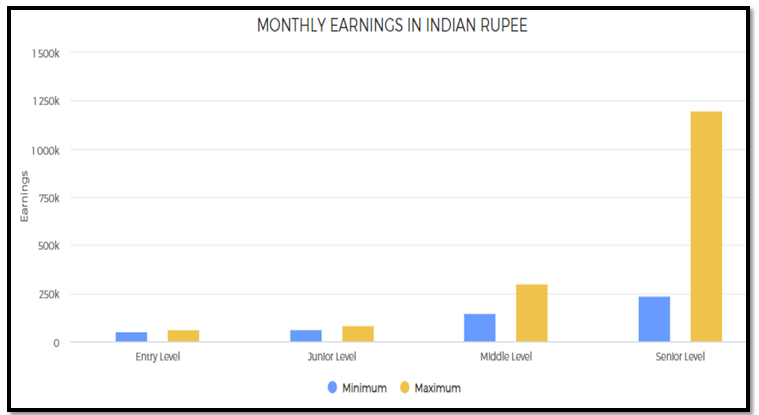
MONTHLY EARNINGS IN INDIAN RUPEE

1. Entry level: 0 - 2 years of work experience
2. Junior Level: From 1 to 12 years of work experience
3. Mid Level: From 5 to 20+ years of work experience
4. Senior Level: From 10 to 25+ years of work experience (there could be exceptions in some high-end technical, financial, engineering, creative, management, sports, and other careers; also in the near future, people will reach these levels much faster in many careers and in some careers, these levels will have no meaning as those careers will be completely tech skill driven such as even now, there is almost no level in a Cyber Security Expert’s job)
Work Activities
As a Petroleum and Petrochemical Engineer, you will have to know the basics of all the filling materials, hydraulics mechanisms, and how fluid flow works. You also have to analytical and capable of logical and inductive reasoning. There are certain core skills that a petroleum engineer should master:
1. Providing information to supervisors, colleagues, and subordinates in a written or verbal manner to help in establishing transparency
2. Inspecting structure and materials to identify defects and researching into corrective measures
3. Using computer and computer systems to enter data and process information.
4. Think outside the box. A creative mindset and innovative approach to things are much appreciated.
5. Establishing long-range objectives and then planning and specifying the kind of actions necessary to achieve the objectives.
Future Prospects
The petroleum industry is the backbone of several other industries which includes textiles, healthcare, agriculture, etc. As of now, the petrochemical industry contributes about 30 percent of raw material to the chemical industry which is expected to reach $250 billion. The petrochemical industry itself is expected to get to $100 billion at a compound annual growth rate of 14%. The three major public sector oil companies, Hindustan Petroleum Corp. Ltd, Bharat Petroleum Corp Ltd, and Indian Oil Corp Ltd had also built one of the world’s largest integrated refinery complex in Maharashtra. The government has also finalized a 55 million tonne refinery expansion at the existing refineries and a new unit is planned at Barmer, Rajasthan. So, there is a growth potential in the petrochemical industry which will result in an increase in the demand of petroleum engineers.

FUTURE PROSPECTS AT A GLANCE
