
Materials Scientist / Engineer
Entry Level Qualification
Class Graduate
Career Fields
Engineering & Technology
For Specially Abled


Career Entrance Exam
About Career
PARTICULARS | DESCRIPTION |
Name | Materials Scientist / Engineer |
Purpose | Explore Materials' Scientific Fundamentals |
Career Field | Engineering & Technology |
Required Entrance Exam | JEE MAIN BE/BTECH, JEE ADVANCED, GATE |
Average Salary | 300000 - 400000 Rs. Per Year |
Companies For You | Tata Steel, Essar Steel, Indian Steel Authority & Many More |
Who is Eligible | Graduate |
Material scientist and engineers work on developing new products, materials with better durability, and usefulness. While they have a similar profile, they are still different in a few senses:
Material Scientists generally research about how materials at the atomic level behave and find different ways in which they interact. They mostly focus on developing new material. They use the chemical and physical compositions of materials and alter them to come up with new materials that might be stronger, durable, lighter, more resistive to heat, etc.
Materials engineers mostly use new material products by a scientist in the industry. They test, develop and create a range of products like new body for aircraft, computer chips, electric boards, semiconductors, cloth, etc. They study the properties of metals, ceramics, plastics, etc. to produce new efficient products.
Material Science & engineering is a highly prospective field especially for people who love futuristic technology. If you are one of them, you will love it as you will be working on developing new kinds of material, improving current products or inventing new products with these new kinds of materials. Some of the materials being developed presently are Nanotubes, graphene, carbon tubes nanocrystals, biomaterials (polymers, bio ceramics, etc. that are used to interact with biological systems), superconductors, semiconductors, etc.
Key roles and responsibilities
As a Material Scientist/ Engineer, you might be having different roles and responsibilities depending on the profile and specialisation. Some of them are:
Material Scientist:
1. You will plan and carry out projects related to the development of new products and testing methods.
2. You will instruct junior scientists/ technicians/ engineers/ colleagues on proper chemical processing and testing procedures, including ingredients, mixing times, and operating temperatures.
3. You will prepare solutions, compounds, and reagents used in laboratory procedures for material testing.
4. You will analyse substances to determine their composition and concentration of different compounds.
5. You will do tests on materials to check the quality standards have been followed or not.
6. You will write technical reports related to your methods and findings.
7. You will present your research and findings with scientists, engineers, government and public.
8. You will solve problems through discovery, development and deployment of high performing new material.
9. You will build new materials to execute regular awareness of new trends in the world.
10. You will continue and expand existing programs in support of technical innovation and business strategies.
Material Engineer:
1. You will work to develop new products, materials.
2. You will plan and evaluate new projects, new products in consultation with other engineers.
3. You will create a proposal and develop its budget, associated labour cost and perform other managerial tasks around it.
4. You will supervise the work of other team member working on the development of new products.
5. You will monitor and test the working conditions of new material and evaluate how do they deteriorate.
6. You will work to find the causes of material failure and how can these failures be overcome.
7. You will work to find the environmental impact due to the material or product.
Career Entry Pathway
Class 10 all subjects as per scheme of studies – Class 11-12 Physics, Chemistry, and Mathematics along with any other subject as per scheme of studies – UG in (B.S.) Material Science / Materials & Metallurgy / Metallurgy / similar field – PG (M.S.) in Material Science / Materials & Metallurgy / Metallurgy / similar field
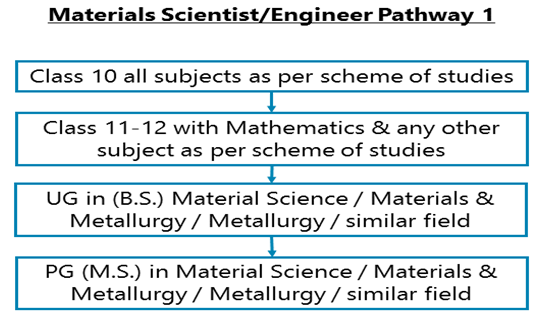
After your Class 11-12 Physics, Chemistry, and Mathematics along with any other subject as per scheme of studies and then study for a science undergraduate degree in Material Science / Materials & Metallurgy / Metallurgy / similar field followed by a science master’s degree in Material Science / Materials & Metallurgy / Metallurgy / similar field. Most of these B.S. and M.S. courses are available in the US Universities and few other foreign Universities only.
Class 10 all subjects as per scheme of studies – Class 11-12 Physics, Chemistry, and Mathematics along with any other subject as per scheme of studies – UG in (B.S.) Material Science / Materials & Metallurgy / Metallurgy / similar field – PG in (M.S.) Material Science / Materials & Metallurgy / Metallurgy / similar field – Ph.D. in Material Science / Materials & Metallurgy / Metallurgy / similar field
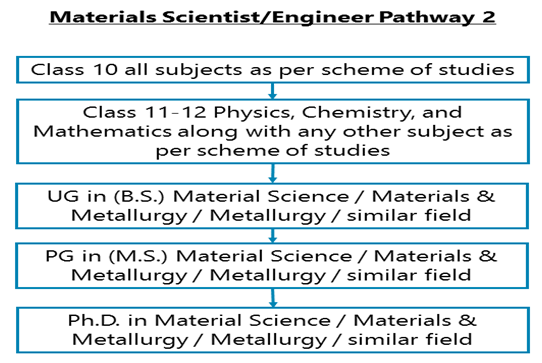
After your Class 11-12 Physics, Chemistry, and Mathematics along with any other subject as per scheme of studies and then study for a science undergraduate degree in Material Science / Materials & Metallurgy / Metallurgy / similar field followed by a science master’s degree in Material Science / Materials & Metallurgy / Metallurgy / similar field and then Ph.D. in in Material Science / Materials & Metallurgy / Metallurgy / similar field.
Class 10 all subjects as per scheme of studies – Class 11-12 Physics, Chemistry, and Mathematics along with any other subject as per scheme of studies – UG in (B.E./ B.Tech.) Material Science & Engineering / Metallurgical & Material Engineering / similar field
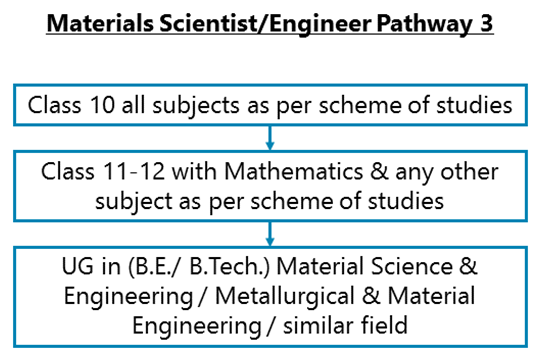
After your Class 11-12 Physics, Chemistry, and Mathematics along with any other subject as per scheme of studies in your higher secondary school and then study for an undergraduate engineering degree in Material Science & Engineering / Metallurgical & Material Engineering / similar field.
Class 10 all subjects as per scheme of studies – Class 11-12 Physics, Chemistry, and Mathematics along with any other subject as per scheme of studies – UG in (B.E./ B.Tech.) Material Science & Engineering / Metallurgical & Material Engineering/ Metallurgical Engineering / similar field – PG in (M.E. / M.Tech.) Metallurgical & Material & Engineering / Metallurgical Engineering / similar field
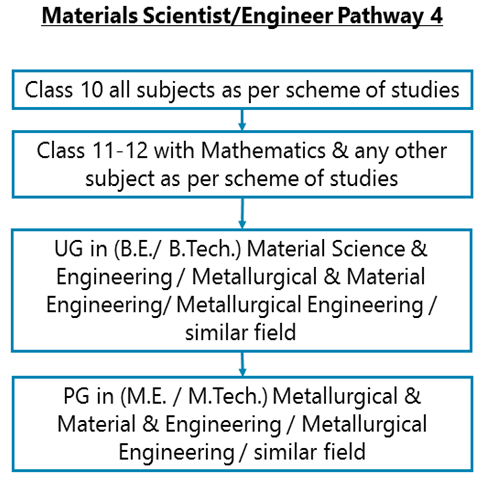
After your Class 11-12 Physics, Chemistry, and Mathematics along with any other subject as per scheme of studies in your higher secondary school and then study for an engineering undergraduate degree in Material Science & Engineering / Metallurgical & Material Engineering / Metallurgical Engineering/ similar field followed by an engineering master’s degree in Metallurgical & Material & Engineering/ Metallurgical Engineering / similar field.
Class 10 all subjects as per scheme of studies – Class 11-12 Physics, Chemistry, and Mathematics along with any other subject as per scheme of studies – UG in (B.E./ B.Tech.) Material Science & Engineering / Metallurgical & Material Engineering / Metallurgical Engineering/ similar field – PG (M.E./ M.Tech.) in Metallurgical & Material & Engineering / Metallurgical Engineering – Ph.D. in Metallurgical & Material & Engineering / Material Science / Materials & Metallurgy / Metallurgy / similar field
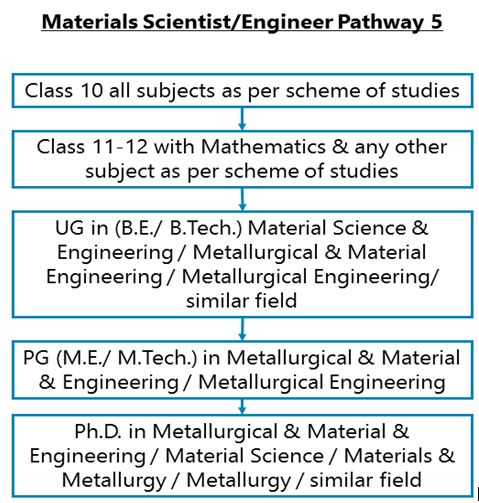
After your Class 11-12 Physics, Chemistry, and Mathematics along with any other subject as per scheme of studies in your higher secondary school and then study for an undergraduate degree in Material Science & Engineering / Metallurgical & Material Engineering / Metallurgical Engineering / similar field followed by a master’s degree in Metallurgical & Material & Engineering/ Metallurgical Engineering/ similar field. Further, you can take Metallurgical & Material & Engineering / Material Science / Materials & Metallurgy / Metallurgy / similar field in Ph.D. and complete the doctoral degree.
Class 10 all subjects as per scheme of studies – Class 11-12 Physics, Chemistry, and Mathematics along with any other subject as per scheme of studies – UG in (B.E. / B.Tech.) Material Science & Engineering / Metallurgical & Material Engineering / Metallurgical Engineering/ similar field – Integrated Ph.D. in Material Science & Engineering / Material Science / Materials & Metallurgy / Metallurgy / similar field
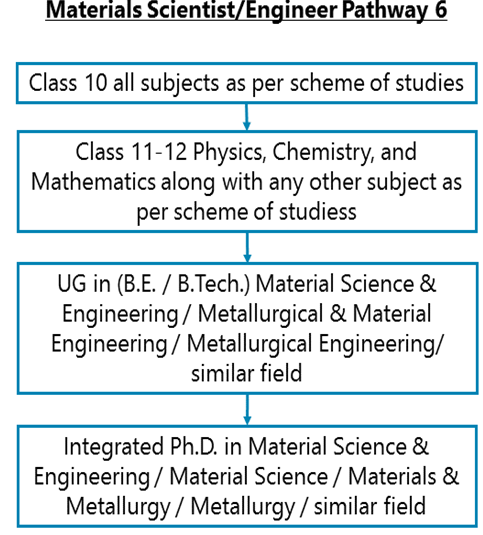
After your Class 11-12 Physics, Chemistry, and Mathematics along with any other subject as per scheme of studies in your higher secondary school and then study for an undergraduate degree in Material Science & Engineering / Metallurgical & Material Engineering / Metallurgical Engineering/ similar field. Following the B.E./B.Tech. degree, you can study for Integrated Ph.D. in Material Science & Engineering / Material Science / Materials & Metallurgy / Metallurgy / similar field.
Class 10 all subjects as per scheme of studies – Class 11-12 Physics, Chemistry, and Mathematics along with any other subject as per scheme of studies – UG in (B.S.) Material Science / Materials & Metallurgy / Metallurgy / similar field – PG (M.S.) in Material Science / Materials & Metallurgy / Metallurgy / similar field – M.E./M.Tech. in Metallurgical & Material & Engineering/ Metallurgical Engineering/ similar field
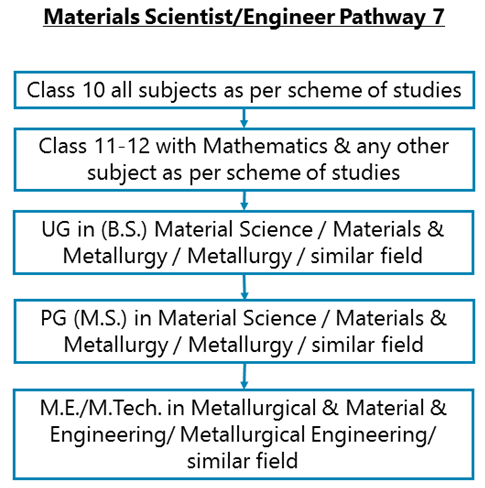
After your Class 11-12 Physics, Chemistry, and Mathematics along with any other subject as per scheme of studies and then study for a science undergraduate degree in Material Science / Materials & Metallurgy / Metallurgy / similar field followed by a science master’s degree in Material Science / Materials & Metallurgy / Metallurgy / similar field. Following the M.S. degree, you can take an M.Tech. Degree in Metallurgical & Material & Engineering/ Metallurgical Engineering/ similar field.
Class 10 all subjects as per scheme of studies – Class 11-12 Physics, Chemistry, and Mathematics along with any other subject as per scheme of studies – UG in (B.S.) Material Science / Materials & Metallurgy / Metallurgy / similar field – PG in (M.S.) Material Science / Materials & Metallurgy / Metallurgy / similar field – M.E./M.Tech. in Metallurgical & Material & Engineering / Metallurgical Engineering – Ph.D. in Material Science / Materials & Metallurgy / Metallurgy / similar field
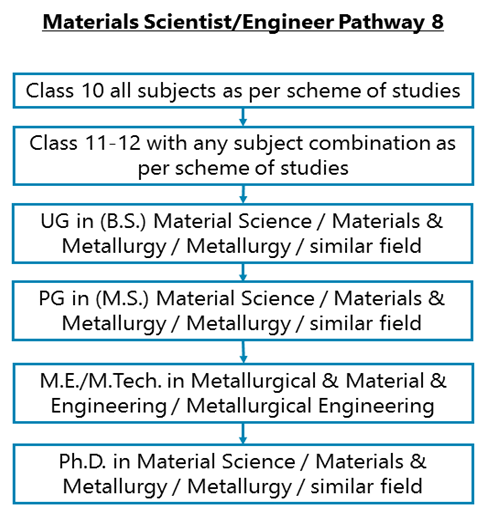
After your Class 11-12 Physics, Chemistry, and Mathematics along with any other subject as per scheme of studies and then study for a science undergraduate degree in Material Science / Materials & Metallurgy / Metallurgy / similar field followed by a science master’s degree in Material Science / Materials & Metallurgy / Metallurgy / similar field and then M.E./M.Tech. in Metallurgical & Material & Engineering/ Metallurgical Engineering/ similar field followed by a Ph.D. in in Material Science / Materials & Metallurgy / Metallurgy / similar field.
Required Qualification & Competencies
Undergraduate studies after school:
1. To become a Material Scientist/ Engineer you can take the following two paths:
2. You can study Material Science / Materials & Metallurgy / Metallurgy / similar field along with any other subject at the graduation level in B.Sc.
3. Alternatively, you can choose B.E. or B.Tech. in Material Science & Engineering / Metallurgical & Material Engineering / similar field.
Post Graduate studies:
1. If you have completed a course in B.S. in Material Science, then you can take Material Science at the Post Graduate level in M.S. with specialisation in Biomaterials, Chemical Metallurgy, Metallurgy, Physical Metallurgy, Steel Technology, Ceramics & Composites, Corrosion Science, etc.
2. If you have completed Material Science & Engineering in graduation, then you can take M.E. or M.Tech. in Biomaterials, Chemical Metallurgy, Engineering & Process Metallurgy, Metallurgical Engineering, Mineral Engineering, Mining Engineering, Physical Metallurgy, Steel Technology, Ceramics & Composites, Metallurgical Process Engineering, Material Science, Process Engineering and Corrosion Science.
Doctoral studies:
You can take a Ph.D. in Material Science / Materials & Metallurgy / Metallurgy / similar field after post-graduation.
MINIMUM EDUCATION REQUIRED | MAXIMUM EDUCATION REQUIRED |
Under Graduate | Post-Doctoral |

COMPETENCIES REQUIRED
You should have the following occupational interests:
1. Investigative - You should have interests for Investigative Occupations. Investigative occupations involve working with ideas and quite a lot of thinking, often abstract or conceptual thinking. These involve learning about facts and figures; involve the use of data analysis, assessment of situations, decision making and problem-solving.
2. Realistic - You should have interests for Realistic Occupations. Realistic occupations involve more practical and hands-on activities than paperwork or office work. Realistic occupations often involve physical activities for getting things done using various tools and equipment.
3. Conventional - You should have interests for Conventional Occupations. Conventional occupations involve repetitive and routine tasks as well as fixed processes or procedures for getting things done. These occupations involve working more with data, systems, and procedures and less with ideas or creativity.
Following personality attributes are required:
1. You are always or mostly care about your actions and behaviour.
2. You are always or mostly disciplined in your action and behaviour.
3. You don't trust others easily.
4. You are always calm or generally remain calm in most situations.
5..You are always practical or in most situations.
You should have the following skills and knowledge:
1. Communication skills - You should possess excellent communication skills, as you may have to work on project teams with various departments.
2. Active Listening - Giving full attention to what other people are saying, understanding the points being made by others, asking questions, etc.
3. Critical Thinking - Skills in the analysis of complex situations, using logic and reasoning to understand the situations and take appropriate actions or make interpretations and inferences.
4. Writing - Skills in communicating effectively in writing as appropriate for the needs of the readers.
5. Reading Comprehension - Skills in understanding written sentences and paragraphs in work related documents.
6. Chemistry - Knowledge of relevant equipment, policies, procedures, and strategies to maintain law and order situations, providing state or national security for protecting geographical territories, marine territories and sky from potential enemy attacks and protecting people and properties.
You should have the following aptitudes and abilities:
1. Near Vision - The ability to see details at close range (within a few feet of the observer).
2. Oral Comprehension - The ability to listen to and understand information and ideas presented through spoken words and sentences.
3. Inductive Reasoning - The ability to combine pieces of information from various sources, concepts, and theories to form general rules or conclusions. For example, analysing various events or situations to come out with a set of rules or conclusions.
4. Deductive Reasoning - The ability to apply general rules and common logic to specific problems to produce answers that are logical and make sense. For example, understanding the reasons behind an event or a situation using general rules and common logic.
5. The flexibility of Closure - The ability to identify or detect a pattern (a figure, object, word, or sound) that is hidden among other distracting materials.
Career - Job Opportunities & Profiles
1. If you are into teaching, then you may join college or university at the profile of an assistant professor.
2. If you are into doctoral research, then you can join a research institute at the role of research associate.
3. If you are into scientific research, then you can join as a government Scientist with Grade “C.”
4. In private organisations, R&D centres and companies you may join as a research associate / Assistant Engineer / Assistant officer.
You will find job opportunities at the following facilities:
1. National Council for Cement & Building Material
2. Professor at colleges and universities.
3. Electrical companies like General Electric Company, Kennametal, etc.
4. Metal Manufacturing companies like Tata Steel, Essar Steel, Indian Steel Authority, etc.



5. Research and Scientific laboratories like DRDO, ISRO, Vikram Sarabhai Space Centre, etc.
6. Engineering workshops
7. Fabrication units and industries
8. Oil & Petroleum Exploration companies like Shell, Essar Oil, Reliance Industries, etc.
9. Computer Hardware and Chip manufacturing companies like Intel, ASUS, HP, Lenovo, Apple, etc.



Work Environment
Material scientist mostly works in laboratory and offices where they conduct experiments and examine their results. Few of them also works in the industry and thus overview the production process. Working in an industrial setup is different as it may be noisy, challenging, etc.
Material Engineers mostly work in offices where they work on the designing of products. They mostly use computers and software for designing. Sometime the work may lead to overtime. They need to coordinate with several other engineers and scientists.
SPECIALISATION TRACKS IN THIS CAREER
1. Ceramics & Composites Technologist
Ceramics & Composites Technologists specialise in producing new products and materials out of ceramics composites. Composites are materials made of two different kinds of materials which when mixed have properties different from constituent materials. These technologist work on building new building materials, car bodies, space crafts, engineered wood, etc.
2. Materials Processing Engineer
Materials Processing Engineers specialise in designing, operating, controlling, optimising industrial processes. They work in also most all kind of manufacturing industries to increase the production of the organisation manufacturing process.
3. Corrosion Scientist/ Engineer
Corrosion Engineer specialises in stopping the process of corrosion. Corrosion is a process through which metals slows reacts to form much stable form like Iron becomes rust. They use physical and chemical processes, resources to design materials from getting corrosion.
4. Chemical Metallurgical Engineer
Chemical Metallurgical Engineers specialise in extracting metals from ores, mines and understanding their chemical behaviour.
5. Metallurgical Engineer
Metallurgical Engineers specialise in production and development of metals and developing products from it for industrial usage.
6. Physical Metallurgical Engineer
Physical Metallurgical Engineers specialise in studying the physical behaviour of metals, ores etc. and development of alloys.
CAREER GROWTH
1. If you start your career as an assistant engineer in private organisation, industry, then you will be promoted to Project Engineer and then Senior Engineer and finally head of R&D.
2. If you start your career as a research associate in private industry, then you will be promoted to Junior research scientist, then Material Scientist and then Senior Material Scientist.
3. The career growth in university and college states from Assistant Professor and then Associate Professor, Professor and Professor Emeritus. Professors can also get administrative positions such as Director/Dean/Vice Chancellor, etc
4. If you are hired as a research associate, then you will go on to become a Doctoral Research Fellow, then Post-Doctoral Research Fellow and then Scientist in Progressive Grades.
5. Research laboratories will hire you as a scientist/scientist officer with the lowest grade and the grade changes from low to high. In India, grades are “Scientist “C” as the joining level and then D, E, F, G, H and finally DS. A senior level scientist can also get into administrative positions like Principal Scientist, Assistant Director, Deputy Director, Director, etc.
Salary Offered
1. At the entry level, you can join as a research associate with a basic salary of 25,000 INR* to 30,000 INR. As a doctoral research fellow (junior research fellow) you would be earning around 35,000 INR to 38,000 INR per month. At the entry level, as a Scientist (grade C) you would be earning around 80,000 to 100,000 INR per month. As an assistant professor, you would be earning anything between 65,000 INR to 70,000 INR per month. As an Assistant Engineer/ Research associate in private organizations, you would be earning anything between 30,000 INR to 50,000 INR per month.
2. At the junior level with a work experience of 2-6 years, you would be earning anything between 50,000 INR to 1,80,000 INR per month.
3. At the middle level with an experience of 10-12 years, you would be earning anything between 1,40,000 to 1,90,000 INR per month as a scientist and 1,20,000 INR to 1,60,000 INR as a professor and 1,20,000 INR to 2,40,000 INR as an engineer.
4. At the senior level of over 15 years of work experience, you would be earning anything between 1,60,000 to 2,00,000 INR per month as a professor and 2,10,000 to 2,50,000 INR per month as a Scientist. As an Engineer, you would be earning anything between 2,00,000 to 8,00,000 or even more INR per month.
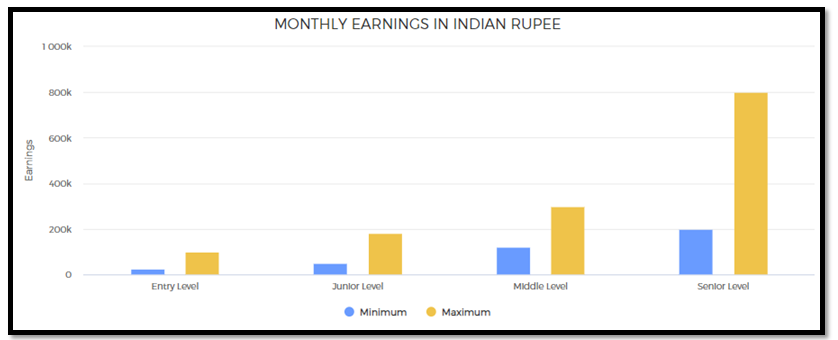
MONTHLY EARNINGS IN INDIAN RUPEE

1. Entry level: 0 - 2 years of work experience
2. Junior Level: From 1 to 12 years of work experience
3. Mid Level: From 5 to 20+ years of work experience
4. Senior Level: From 10 to 25+ years of work experience (there could be exceptions in some high-end technical, financial, engineering, creative, management, sports, and other careers; also in the near future, people will reach these levels much faster in many careers and in some careers, these levels will have no meaning as those careers will be completely tech skill driven such as even now, there is almost no level in a Cyber Security Expert’s job).
Work Activities
As a Material Scientist, you would be required to do the following work activities regularly:
1. Getting information & learning - Observing, hearing, reading, using computers, or otherwise obtaining information and learning from it.
2. Analysis and interpretation of data and information - Analysis of data and information to find facts, trends, reasons behind situations, etc.; interpretation of data to aid in decision making.
3. Updating and using relevant knowledge - Keeping updated with the latest knowledge relevant to your fields of work and use of the relevant knowledge in getting things done.
4. Using Computer for work - Using computers for day-to-day office work; using computer software for various applications in day-to-day professional work; entering data and process information; for writing.
5. Creative thinking - Developing new ideas, concepts, innovative solutions to problems, newer ways of getting things done, designing products and services, creating work of art and craft, etc.
6. Inspecting equipment, systems, structures, and materials - Inspecting equipment, systems, structures, and materials to ascertain quality, performance, defects, causes of errors, etc.
Future Prospects
Materials Engineers have a career opportunity in various fields. They are in demand in mining and mineral processing industries, computer, laptops, and chips manufacturing industries, semi-conductor industries, bio-material industry, etc.
According to the report by ibef.org, the Indian mining industry is expected to grow rapidly with steel production likely to double by 2031. With 100% FDI investment allowed in the industry, International originations too are coming to India. Thus, the mining and exploration prospects for Material scientist & Material Engineers are growing in India.
Many futuristic industries demand Material Scientist. Thus, in a world with more integrated science and technology, Material Scientist and Engineers would be in high demand. Think of a world where Heart made of the biomaterial is normal. So many heart patients would find new life. Similarly, bio-materials for a different part of the body will become normal in this futuristic world. All thanks to Material Scientist and Engineers. Through Nanomaterials, the majority of new products and technologies will be invented. These products and technologies again rely on the shoulder of Material Scientists and Engineers. Thus, it can be safely concluded, that this is one of the most aspiring careers in the coming future.
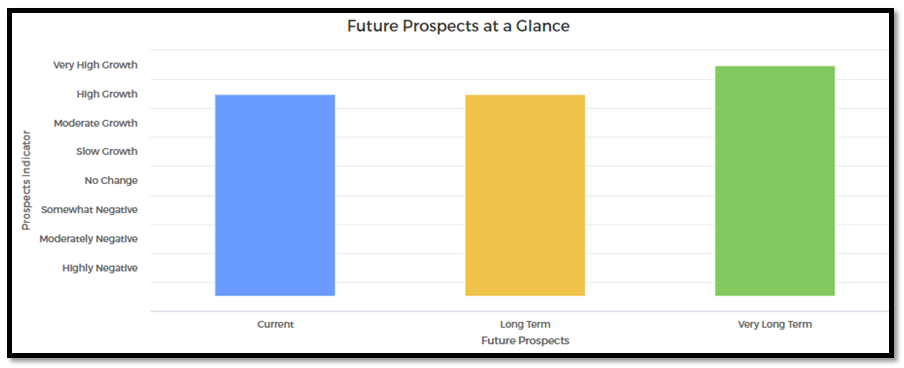
FUTURE PROSPECTS AT A GLANCE
