

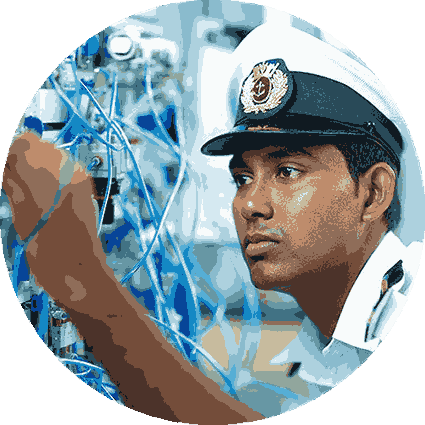
Marine Engineer
Entry Level Qualification
Class Graduate
Career Fields
Engineering & Technology
For Specially Abled


Career Entrance Exam
About Career
As a Marine Engineer, you will work onboard of large marine vessels such as cargo carriers, passenger carriers (ships are often referred to as carriers), cruise liners (luxury passenger ships), oil and CNG tankers, as well as military ships such as aircraft carriers, frigates, and submarines).
Onboard of a ship, you will be responsible for making sure that all the mechanical, electrical and electronic systems of the ship work smoothly without any fault or problem. Mechanical systems include the engine and its components, navigation systems, propulsion system, etc; electrical systems include the power plant, electrical wiring, switching, air-conditioning, ventilation and heating systems, etc; electronic systems include various control panels for operating and piloting the shop, communication equipment, and systems, etc.
You may also find work opportunities offshore after a few years of experience as an onboard Marine Engineer. In offshore work, you will be involved in design, development, construction, installation, repair, and maintenance of the various mechanical, electrical and electronic equipment and systems of marine vessels. You will oversee the installation and inspection of the various mechanical, electrical, and electronic equipment and systems.
Key roles and responsibilities:
1. To assist Marine Operations and Vessel Assurance teams in the installation process of new equipment or machinery on marine vessels or in the repair and maintenance of older systems.
2. Assist in the installation and supervise and track any changes in the equipment or systems of marine vessels, ensure that they adhere to marine regulations, and notify relevant party about the changes.
3. To ensure that all marine engineering systems are functioning efficiently.
4. Operate, maintain and oversee machinery, engineering equipment, and other systems of a marine vessel.
5. Maintain accurate records of engineering department activities (expense records, equipment maintenance, and repair, acquiring costs, etc.)
6. Supervise engine room watch when the vessel is underway.
7. Inspecting marine equipment and machinery, identify issues and handle repair and maintenance operations.
8. Liaising with onshore personnel, captains, and crew members to ensure that the vessels operate efficiently and to their optimal potential.
9. Supervising junior engineers/crew members and train them for routine and emergency duties.
PARTICULARS | DESCRIPTION |
Name | Marine Engineer |
Purpose | Inspecting Marine Equipment And Machinery |
Career Field | Engineering & Technology |
Required Entrance Exam | JEE MAIN BE/BTECH, JEE ADVANCED, GATE |
Average Salary | 5,00,000 - 10,00,000 Rs. Per Year |
Companies For You | Maersk Line, Carnival Corporation & plc, Royal Dutch Shell & Many More |
Who is Eligible | Graduate |
Career Entry Pathway
Class 10 all subjects as per scheme of studies – Class 11-12 Physics, Chemistry, and Mathematics along with any other subject as per scheme of studies - Diploma in Marine Engineering
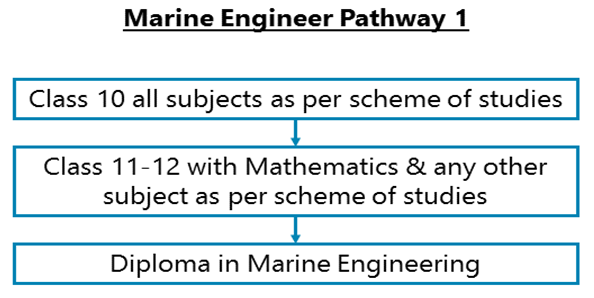
Once you’ve completed your secondary level studies, you need to complete Class 11-12 Physics, Chemistry, and Mathematics along with any other subject as per scheme of studies. Following this, you can take up a Diploma course in Marine Engineering.
Class 10 all subjects as per scheme of studies – Class 11-12 Physics, Chemistry, and Mathematics along with any other subject as per scheme of studies - UG (Bachelor in Mechanical Engineering) - Trainee Marine Engineering course
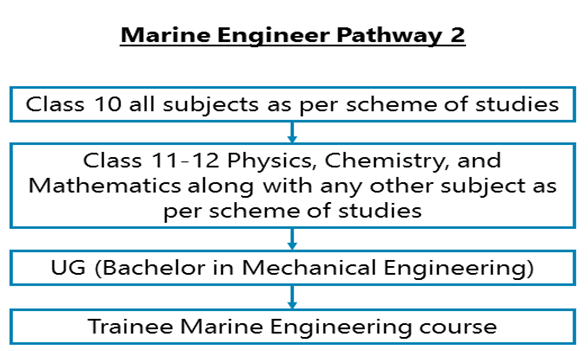
After completing your secondary level studies, you can pursue Class 11-12 Physics, Chemistry, and Mathematics along with any other subject as per scheme of studies. Then you can graduate with a Bachelor's degree in Mechanical Engineering and follow it up with a one/two-year Trainee Marine Engineering course.
Class 10 all subjects as per scheme of studies – Class 11-12 Physics, Chemistry, and Mathematics along with any other subject as per scheme of studies - UG (Bachelor of Marine Engineering)
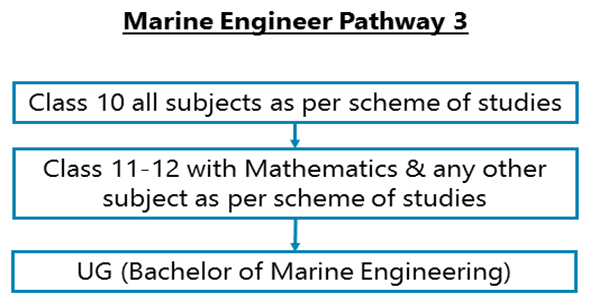
After completing your secondary level studies, you can pursue Class 11-12 Physics, Chemistry, and Mathematics along with any other subject as per scheme of studies. For further studies, you can opt for graduating with a bachelor's degree in Marine Engineering.
Class 10 all subjects as per scheme of studies – Class 11-12 Physics, Chemistry, and Mathematics along with any other subject as per scheme of studies - UG (Bachelor of Naval Architecture and Ocean Engineering)
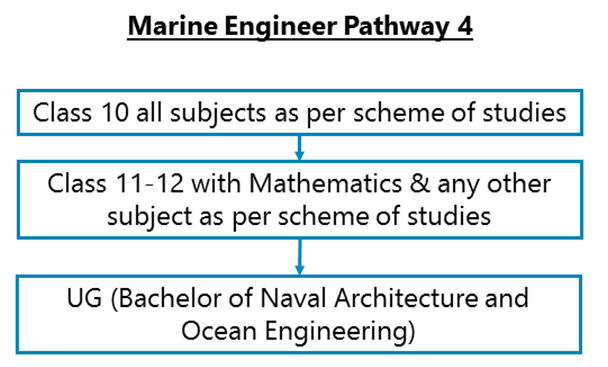
After completing your secondary level studies, you can pursue Class 11-12 Physics, Chemistry, and Mathematics along with any other subject as per scheme of studies. Then you can graduate with a Bachelor’s degree in Naval Architecture and Ocean Engineering.
Class 10 all subjects as per scheme of studies – Class 11-12 Physics, Chemistry, and Mathematics along with any other subject as per scheme of studies - UG (Bachelor of Naval Architecture and Ship Building)
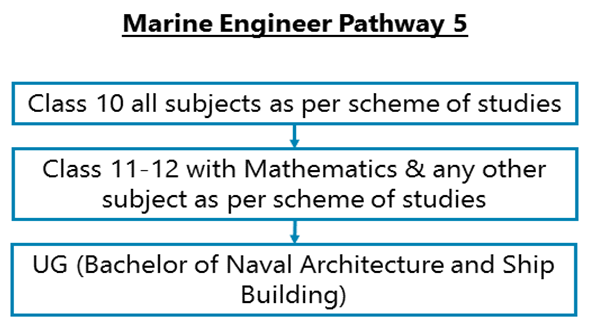
Once you’ve completed your secondary level studies, you need to complete Class 11-12 Physics, Chemistry, and Mathematics along with any other subject as per scheme of studies. After this, you can graduate with a Bachelor’s degree in Naval Architecture and Ship Building.
Required Qualification & Competencies
Undergraduate studies after school:
A career in Marine Engineering requires a strong foundational background in Science. Usually, all entry-level Marine Engineering jobs (Marine Technician, Marine Draftsman, Junior Marine Engineer, etc.) in the field require a candidate to have a minimum of a Diploma in Marine/Mechanical Engineering or Naval Architecture. All other Officer level jobs required a degree in Marine/Mechanical Engineering.
Post Graduate studies:
If you wish to bag more challenging and high-paying roles in the field of Marine Engineering such as Chief Marine Engineer, Senior Naval Architect, etc., you must have a postgraduate degree in Marine Engineering or Naval Architecture.
Doctoral Studies:
Aspirants who seek to get into the research and development wing of Marine Engineering can pursue doctoral studies in Marine Engineering or Naval Architecture.
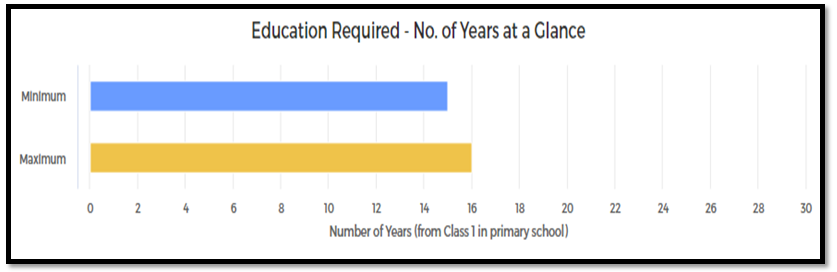
MINIMUM EDUCATION REQUIRED | MAXIMUM EDUCATION REQUIRED |
Post Higher Secondary | Under Graduate |
COMPETENCIES REQUIRED
Occupational Interests:
1. Investigative - Investigative operations involve working with fresh ideas and engage in productive thinking.
2. Realistic - A professional must have a realistic and practical approach to problems.
Personality traits:
1. You are always or mostly organized in your day-to-day life and activities.
2. You are not a soft-hearted person.
3. You are always calm or generally remain calm in most situations.
4. You are always practical or in most situations.
5. You act independently sometimes but do not do so in some other times.
6. You are always friendly and outgoing; you love to be in the company of people always or most of the times.
Skills:
1. Active Learning: Focused and continuous learning from various sources of information, observation and otherwise for application in getting work done.
2. Active Listening: Giving full attention to what other people are saying, understanding the points being made by others, asking questions, etc.
3. Critical Thinking: Skills in the analysis of complex situations, using logic and reasoning to understand the situations and take appropriate actions or make interpretations and inferences.
4. Problem Solving: Skills in analysis and understanding of problems, evaluating various options to solve the problems and using the best option to solve the problems.
5. Managing Material Resources: Skills in sourcing, buying, storing, and use of appropriate raw materials, machines, equipment, and devices for various purposes such as industrial manufacturing, building construction, etc.
6. Quality Control Analysis: Skills in conducting tests and inspections of products, services, or processes to evaluate quality or performance.
7. Process and Operation Controlling: Skills in controlling processes and operations of various machines, equipment, devices and systems using different types of electrical and electronic control instruments and systems.
8. Machine Repair and Maintenance: Skills in performing repair and maintenance of different machines, equipment, and devices
Knowledge:
1. Mechanical Engineering & Technology: Knowledge of Mechanical Engineering & Technologies which include design, development, testing, manufacturing, installation, operations, repair and maintenance of different machinery, devices, equipment, and tools.
2. Mathematics: Knowledge of arithmetic, algebra, geometry, calculus, trigonometry, statistics, and other mathematical disciplines and their applications.
3. Public Safety and Security: Knowledge of relevant equipment, policies, procedures, and strategies to maintain law and order situations, providing state or national security for protecting geographical territories, marine territories and sky from potential enemy attacks and protecting people and properties.
4. Transportation: Knowledge of principles and methods for moving people or goods by air, rail, sea, river, or road, or otherwise, including the relative costs and benefits.
Abilities:
1. Manual Dexterity: The ability to quickly move your hand, your hand together with your arm, or your two hands to grasp, manipulate, or assemble objects.
2. Deductive Reasoning: The ability to apply general rules and common logic to specific problems to produce answers that are logical and make sense. For example, understanding the reasons behind an event or a situation using general rules and common logic.
3. Problem Sensitivity: The ability to tell when something is wrong or is likely to go wrong. It does not involve solving the problem, only recognizing there is a problem.
4. Physical Stamina: The ability to exert yourself physically over long periods of time without getting winded or out of breath.
5. Mathematical Reasoning: The ability to choose the right mathematical methods or formulas to solve a problem.
6. Visualization: The ability to imagine how something will look after it is moved around or when its parts are moved or rearranged.
Career - Job Opportunities & Profiles
To bag entry-level Marine Engineering jobs, a Bachelor/Master’s degree in Marine Engineering/Mechanical Engineering will suffice. Usually, the onboard entry-level positions in this field are that of a Fifth Engineer or a Graduate Engineer Cadet. As a fresh graduate in Marine Engineering/Mechanical Engineering, you can get jobs in shipping companies, shipbuilding firms, shipyards, etc.
Work Environment
Most Marine Engineers work onboard a large marine vessel such as a cargo carrier, oil tanker, and luxury cruise liner. When they are on duty they sail with the ships and work in shifts to ensure that all mechanical, electrical and electronic systems of the ships work smoothly. They often have to do things hands-on and spend time in the engine compartment which is hot and stuffy. They stay in their living quarters on board. Although they work in shifts of 8-12 hours, they often have to be on guard for the most part of the day. There are a lot of facilities for the Marine Engineers and other officers onboard such as dining room, recreation room, indoor games room etc. and they can also access internet onboard.
SPECIALISATION TRACKS IN THIS CAREER
1. Naval Architect
Naval architects are professionals who are primarily concerned with the design of ships and other maritime vessels. They study design proposals and plans to determine the basic characteristics and specifications of a ship like the size, weight, height, and speed. It is only after this research part that they can draw up the overall design and plan of a vessel.
2. Ocean Engineer
Ocean engineers work in close collaboration with oceanographers, marine biologists, geologists, and geophysicists. Using a combination of mechanical, civil, electrical, and general engineering principles, their primary task is to design and develop advanced equipment and tools that can help further the study of oceanography and marine biology.
3. Offshore Engineer
Offshore Engineers specialize in civil engineering for offshore environments. They design and construct both fixed and floating marine structures including offshore rigs, offshore wind farms, etc. They also design offshore installations and drilling equipment and supervise offshore drilling activities.
4. Mechanical Engineer (Marine)
Mechanical Engineers (Marine) are shore-based engineers possessing extensive knowledge of mechanical design and analysis experience associated with mechanical or marine systems. They perform functions such as designing the principal propulsion plant, overseeing the powering and mechanization aspects of the ship functions such as steering, anchoring, cargo handling, heating/air conditioning, interior and exterior communication, and other requirements.
CAREER GROWTH
All Marine Engineers begin their career working onboard of ships. And for Marine Engineers there is a standard career progression route:
1. Marine Engineer Cadet or Fifth Engineer (on joining)
2. Fourth Engineer
3. Third Engineer
4. Second Engineer
5. Chief Engineer
Career progression essentially depends upon the number of years of sailing (working onboard of a marine vessel) experience and also successful completion of various professional development training programs. Usually, Marine Engineers sail for a few months and then stay on left offshore. During this time, they can take up various training programs. After the leave period is over, they set sail again for a few months. This cycle continues until they desire to leave onboard jobs and take up offshore positions.
Salary Offered
1. In the beginning of your career as a Graduate Engineer Cadet onboard a ship, you will earn about Rs. 40,000-75,000 a month including various allowances.
2. As a Fourth Engineer, you will earn about Rs. 1.5 to 2.5 lac per month.
3. As a Third Engineer, you will earn about Rs. 2.75 - 3.5 lac or even more per month.
4. As a Second Engineer, you will earn about Rs. 3.5 - 5 lac per month.
5. As a Chief Engineer, you will earn Rs. 5 - 7.5 lac per month.
6. If you work with foreign shipping companies, you may earn much more in US Dollars.
7. Remember that you will receive the salaries only when you are sailing onboard.Salaries for onshore Engineers varies widely depending upon where they are working. In mid to senior level, onshore Marine Engineers can earn about Rs. 2 lac - 5 lac or more per month.
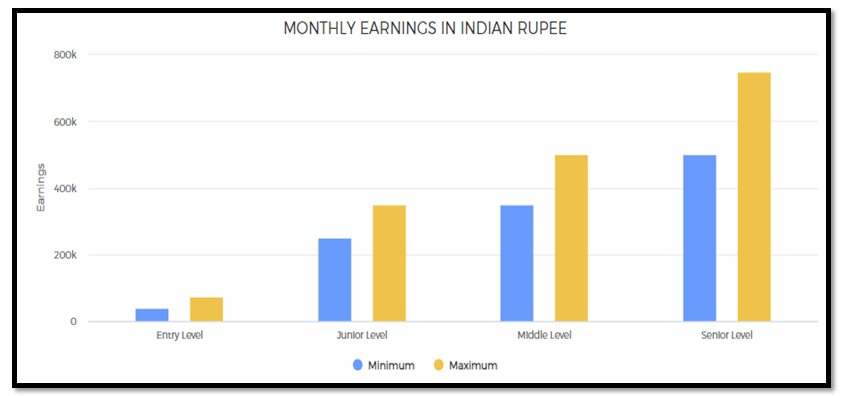
MONTHLY EARNINGS IN INDIAN RUPEE

1. Entry level: 0 - 2 years of work experience
2. Junior Level: From 1 to 12 years of work experience
3. Mid Level: From 5 to 20+ years of work experience
4. Senior Level: From 10 to 25+ years of work experience (there could be exceptions in some high-end technical, financial, engineering, creative, management, sports, and other careers; also in the near future, people will reach these levels much faster in many careers and in some careers, these levels will have no meaning as those careers will be completely tech skill driven such as even now, there is almost no level in a Cyber Security Expert’s job).
Work Activities
1. Analysing and interpreting data and information: Analysis of data and information to find facts, trends, reasons behind situations, etc.; interpretation of data to aid in decision making.
2. Calculating and computing: Calculating or computing using various mathematical formulas and functions using computers or otherwise; doing financial or commercial calculations or computations.
3. Communicating with co-workers and others: Communicating with people in writing, verbally or otherwise inside your workplace, and various other people who have professional relationships with your place of work including vendors, government officials, etc. or with people at large.
4. Decision making and problem solving: Analysis of data and information; evaluation of alternative decisions and results of decisions; taking the right decisions and solving problems.
5. Estimating quantity, cost, time, and resources: Estimating sizes, volumes, distance, and quantity; estimating and determining time, costs, and resources; estimating materials required to perform a task.
6. Getting Information and learning: Observing, hearing, reading, using computers, or otherwise obtaining information and learning from it.
7. Inspecting equipment, systems, structures, and materials: Inspecting equipment, systems, structures, and materials to ascertain quality, performance, defects, causes of errors, etc.
8. Leading: Inspiring and motivating co-workers to work to achieve specific goals; enabling and facilitating others to perform tasks effectively; addressing issues and solving problems in order to help people perform well.
9. Managing and supervising: Manging and supervising work of others; setting goals; giving instructions; monitoring work performance, etc.
10. Organising, planning, and prioritising tasks: Planning and organising tasks in order to achieve work goals; prioritising tasks to achieve goals and making the best use of the time available.
11. Scheduling tasks: Scheduling project timelines, tasks and activities.
12. Updating and using relevant knowledge: Keeping updated with the latest knowledge relevant to your fields of work and use of the relevant knowledge in getting things done.
13. Using computers for work: Using computers for day-to-day office work; using computer software for various applications in day-to-day professional work; entering data and process information; for writing.
14. Working in a team: Working in a team of people; developing team; maintaining professional relationships among team members.
Future Prospects
According to the latest IBEF (India Brand Equity Foundation) report, the cargo traffic at the major ports in India scaled up to 679.36 million tonnes (MT), displaying growth of 4.77% over the same period last year. Cargo traffic has increased by 4.83% year-on-year to 461.22 million tonnes. Since Indian ports handle nearly 95% of trade burden of the country, the growth in the trade has further boosted the country’s cargo traffic. The capacity at major Indian ports was reported to have peaked at 1,451 million tonnes. These figures indicate that the prospects of a career in Marine Engineering is moderately bright
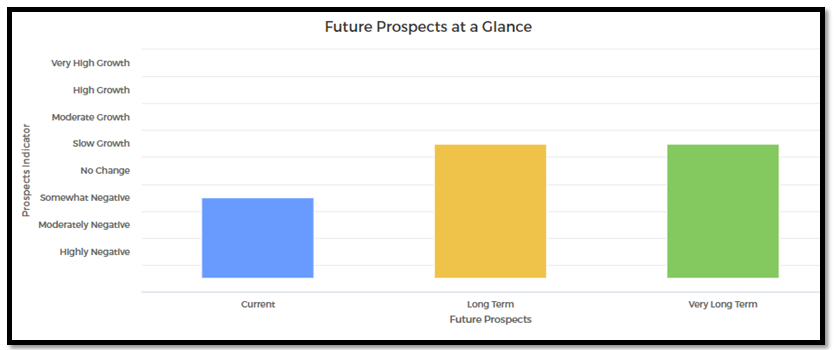
FUTURE PROSPECTS AT A GLANCE
