

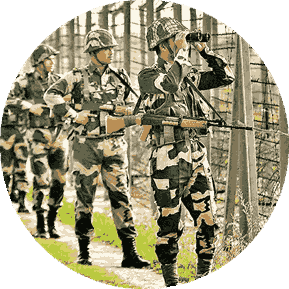
Border Security Force
Entry Level Qualification
Class 12
Career Fields
Government & Defense Services
For Specially Abled

Career Entrance Exam
About Career
PARTICULARS | DESCRIPTION |
Name | Border Security Force |
Purpose | Controlling & Monitoring Illegal Activities |
Career Field | Medical Services |
Required Entrance Exam | SSC CAPF |
Average Salary | 500000 - 600000 Rs. Per Year |
Companies For You | Assistant Commandant, Medical Officer, Junior Maintenance Officer & Many More |
Who is Eligible | Class 12th Pass |
Border Security forces generally have two different kinds of jobs, based on the situation of the country. During peacetime you will ensure the security of the borders of India and prevent transborder crimes, smuggling, infiltration, unauthorized entry into or exit from the territory of India. You will also collect transborder intelligence and provide disaster relief. Sometimes, you might have to help the local police in maintaining law and order.
During wartime, you will have a lot of intensive jobs. You will hold ground in certain sectors. You will have to guard prisoners of war and assist in the control of refugees. Also, you may be given the important duty of anti-infiltration in specific areas. You will be also acting as Guide to Army personnel in border areas. Often, you will be performing special intelligence tasks or raids.
Key Roles And Responsibilities :
1. Develop strategies, plans, and conduct operations.
2. Assessing and evaluating situations to devise the best maneuver or routine.
3. Conducting drills and on-the-job training to ensure that the troops remain in a state of constant vigil and preparedness.
4. Organize and stimulate an intelligence network for operational efficiency.
5. Ensuring that arms and ammunition are properly stocked and maintained.
6. Manage personnel, redress grievances and administer the office.
7. Planning, coordinating and supervising the installation, operation, and maintenance of the battalion radio and internal communication systems.
8. Planning for and supervising the installation and maintenance of equipment like telephones, facsimile, and data terminals.
9. Exercise disciplinary measures.
10. Keep records, store and manage data and write legends.
11. Interacting with local authorities such as Police and local administration to enhance operational capabilities.
12. Obtaining support from local administration regarding operation support, logistics, and other administrative needs.
13. Provide medical assistance to personnel and attend to their physical well being.
14. Planning air surveillance and security missions as well as piloting and maintaining aircraft.
15. Purchase equipment according to budget specifications, and manage inventory.
Career Entry Pathway
Class 10 all subjects as per scheme of studies - Class 11-12 with any subject as per scheme of studies- Bachelor’s in any stream- CAPF-AC exam- Officer Training
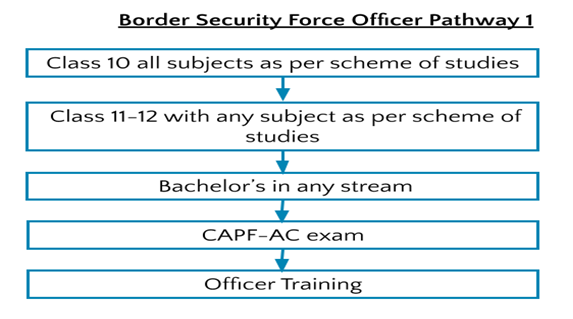
After completing Class 11-12 with any subject as per scheme of studies, you can go for graduation in any discipline. Then, you can appear for the CAPF-AC examination under UPSC for recruitment to Assistant Commandant post which is a DAGO (Directly Appointed Gazetted Officer). After clearing the exam, a rigorous medical examination is conducted, passing which is mandatory.
Class 10 all subjects as per scheme of studies - Class 11-12 with any subject as per scheme of studies- Bachelor’s in any stream- UPSC IPS exam- Deputation in Central Paramilitary Forces
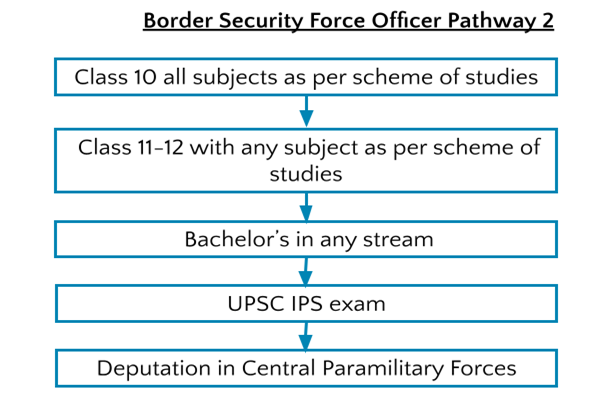
After completing Class 11-12 with any subject as per scheme of studies, you can go for graduation in any discipline. Then, you can appear for the CAPF-AC examination under UPSC for recruitment to Assistant Commandant post which is a DAGO (Directly Appointed Gazetted Officer). After clearing the exam, a rigorous medical examination is conducted, passing which is mandatory.
Class 10 all subjects as per scheme of studies -Class 11-12 Physics, Chemistry and Mathematics along with any other subject as per scheme of studies- UG (B.Sc in Physics/Maths/Chemistry/BTech (Electrical Engineering)- CAPF-AC exam-Battalion Signal Officer Course
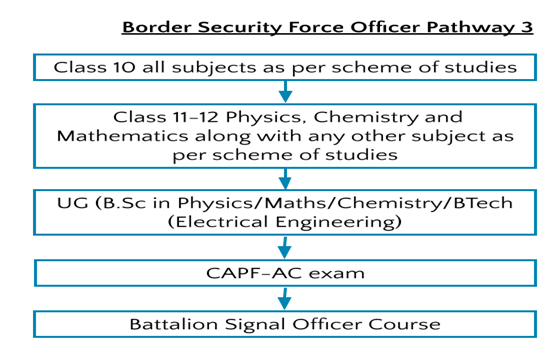
After Class 11-12 Physics, Chemistry and Mathematics along with any other subject as per scheme of studies, you can go for B.Sc in (Physics/Maths/Chemistry)/BTech (Electrical Engineering). Then, you can appear for the CAPF-AC exam and after clearing the exam and passing the medical you can enroll in the Battalion Signal Officer course to join as an Assistant Commandant (Technical).
Class 10 all subjects as per scheme of studies -Class 11-12 Physics, Chemistry and Mathematics along with any other subject as per scheme of studies- UG (B.Tech in Mechanical Engineering/any stream)-Walk In an interview for Junior Maintenance Engineer/Junior Logistics Officer
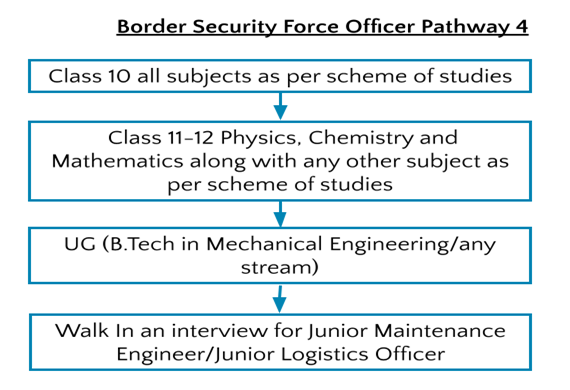
After Class 11-12 Physics, Chemistry and Mathematics along with any other subject as per scheme of studies, you can opt for graduation in maintenance/mechanical engineering/any other stream. Then, you can walk in for a recruitment interview and medical as a Junior Maintenance Engineer/Junior Logistics Officer.
Required Qualification & Competencies
Undergraduate Studies
After completing your graduation from any discipline, you can appear for the CAPF-AC (Central Armed Police Forces Assistant Commandant) exam and then, enter into Officer Training. You can also sit for your UPSC IPS exam, and then gain experience and enter as a Deputation in Central Paramilitary Forces. From there, you can take up senior positions in BSF. If you complete your graduation in B.Sc in Physics, Maths, Chemistry or BTech (Electrical Engineering), you can sit for CAPF-AC exam, and then enroll yourself in Battalion Signal Officer Course. If you have a B.Tech in Mechanical Engineering, then you can go for a walk-in interview as a Junior Maintenance Engineer. Graduation in any other stream can make you eligible to go for a walk-in Interview for the position of Junior Logistics Officer.
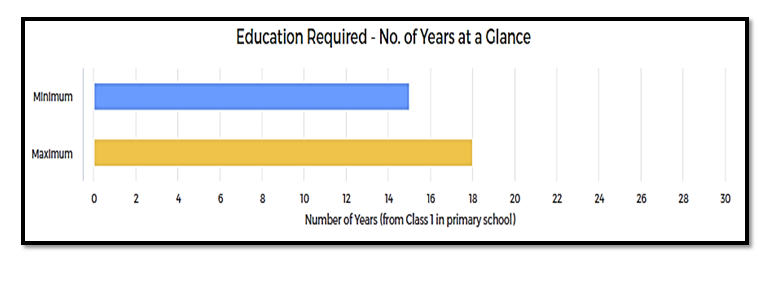
| MINIMUM EDUCATION REQUIRED | MAXIMUM EDUCATION REQUIRED |
Under Graduate Undergraduate Degree / Honours Diploma / Graduate Diploma (equivalent to a Degree) Programs for which the minimum eligibility is a pass in Higher Secondary / Class XII School Leaving examination. | Post Graduate Postgraduate Degree / Diploma / Certificate Programs for which the minimum eligibility is a pass in Graduation / equivalent Diploma program like Honours Diploma or Graduate Diploma. |
Competencies Required
Interests
1. Enterprising: You should have interests for Enterprising Occupations. Enterprising occupations involve taking initiatives, initiating actions, and planning to achieve goals, often business goals. These involve gathering resources and leading people to get things done. These require decision making, risk taking and action orientation.
2. Realistic: You should have interests for Realistic Occupations. Realistic occupations involve more practical and hands-on activities than paperwork or office work. Realistic occupations often involve physical activities for getting things done using various tools and equipment.
3. Investigative: You should have interests for Investigative Occupations. Investigative occupations involve working with ideas and quite a lot of thinking, often abstract or conceptual thinking. These involve learning about facts and figures; involve use of data analysis, assessment of situations, decision making and problem solving.
Knowledge
1. English Language: Knowledge about English grammar, words, spelling, sentence construction, using English to communicate with others, reading in English, etc.
2. Public Safety and Security: Knowledge of relevant equipment, policies, procedures, and strategies to maintain law and order situations, providing state or national security for protecting geographical territories, marine territories and sky from potential enemy attacks and protecting people and properties.
Skills
1. Active Learning: Focused and continuous learning from various sources of information, observation and otherwise for application in getting work done.
2. Active Listening: Giving full attention to what other people are saying, understanding the points being made by others, asking questions, etc.
3. Coordination: Skills in working together with other people to get things done.
4. Critical Thinking: Skills in analysis of complex situations, using of logic and reasoning to understand the situations and take appropriate actions or make interpretations and inferences.
5. Judgment and Decision Making: Skills in considering pros and cons of various decision alternatives; considering costs and benefits; taking appropriate and suitable decisions.
6. Managing Human Resources: Skills in motivating, developing, and leading people as they work, identifying the best people for the job.
7. Problem Solving: Skills in analysis and understanding of problems, evaluating various options to solve the problems and using the best option to solve the problems.
8. Persuasion: Skills in persuading others to change their minds or behaviour.
9. Supervising: Skills in Supervising and monitoring performance of others, businesses, and different projects.
Abilities
1. Abstract Reasoning: The ability to understand ideas which are not expressed in words or numbers; the ability to understand concepts which are not clearly expressed verbally or otherwise.
2. Articulation: The ability to speak clearly so others can understand you.
3. Auditory Attention: The ability to focus on a single source of sound in the presence of other distracting sounds.
4. Bodily-Kinesthetic Intelligence: The ability to coordinate the movement of your arms, legs, and bodily motion; the ability to keep or regain your body balance when in an unstable position; the ability to quickly and repeatedly bend, stretch, twist, or reach out with your body, hands, arms, fingers, or legs.
5. Deductive Reasoning: The ability to apply general rules and common logic to specific problems to produce answers that are logical and make sense. For example, understanding the reasons behind an event or a situation using general rules and common logic.
6. Emotional Intelligence: The ability to understand your own and others' emotions and feelings; empathy for others; adjusting your behaviour or self-control and self-regulation according to others' emptions and situations.
7. Far Vision: The ability to see details at a distance.
8. Hearing Sensitivity: The ability to detect or tell the differences between sounds that vary in pitch and loudness.
9. Manual Dexterity: The ability to quickly move your hand, your hand together with your arm, or your two hands to grasp, manipulate, or assemble objects.
10. Mental Stamina: The ability to sustain prolonged mental effort.
11. Near Vision: The ability to see details at close range (within a few feet of the observer).
12. Problem Sensitivity: The ability to tell when something is wrong or is likely to go wrong. It does not involve solving the problem, only recognizing there is a problem.
13. Selective Attention: The ability to concentrate on a task over a long period of time without being distracted.
14. Spatial Orientation: The ability to know your location in relation to the environment or to know where other objects are in relation to you.
Personality
1. You are always or mostly organised in your day-to-day life and activities.
2. You are always or mostly careful about your actions and behaviour.
3. You are helpful to others sometimes.
4. You don't trust others easily.
5. You are always practical or in most situations.
Career - Job Opportunities & Profiles
Following are some of the entry-level jobs that BSF has to offer:
1. Assistant Commandant
2. Assistant Commandant (Battalion Signal Officer)
3. Medical Officer
4. Junior Logistics Officer
5. Junior Maintenance Officer
IPS officers can also get a post in BSF, After entering the Deputation in Central Paramilitary Forces, they can take up important leadership roles in BSF such as DIG, ADG, or similar posts.
Organizations that may hire you:
Border Security Force (BSF)
Work Environment
Working conditions may often range from harsh to hostile. May involve long idyllic periods of isolation with a sudden spurt of activity. Consequences of error may range from minor to fatal. The hierarchy structure and the instructions from superiors are strictly adhered to. May involve intrinsic physical activity. Use of armaments is involved. Desk jobs, too, involve high strategic activities and stress. Coping with stress is a necessity.
Spcilisation Tracks In This Career
1. BSF Officer (General Duty)
General Duty personnel are those who carry out the general on-the ground vigilance operations of BSF everyday such as the personnel involved in guarding borders, preventing transborder crimes, gathering intelligence, engaging in disaster relief, engaging in counter insurgency operations, maintaining law and order with the help of local police force and other activities.
2. BSF Officer (Technical Wing)
Personnel in this branch are responsible for managing equipment, telecommunication network, and are in charge of construction work.
3. BSF Officer (Medical Wing)
Personnel in this wing are responsible for providing medical assistance and personal care to the troops
4. BSF Officer General Duty (Water Wing)
Border Security Force (Water Wing) is one of the special units of the Border Security Force of India. It is responsible for patrolling riverine borders in North Bengal frontier, South Bengal frontier, Andaman Nicobar frontier, Tripura, Mizoram & Cachhar (TMC) Frontier, Jammu frontier, Punjab frontier and Gujarat frontier of the BSF. The Water Wing guards around 1399 km of a riverine boundary of India. its members are filled either by a deputation basis or from special batches of BSF personnel trained in NINI PATNA (National Inland Navigation Institute) Patna. "
5. BSF Officer General Duty (Air Wing)
"Border Security Force (Air Wing) is one of the special units of the Border Security Force of India. It is responsible for providing tactical support, utility support and vigilance support in air and boasts of aircrafts such as Hawker Siddeley HS 748 and HAL DHRUV"
6. Creek Crocodile Commando
Creek Crocodile Commando are the elite commando force of BSF. It is Rann of Kutch (an extensive salt marsh of western India and southeast Pakistan between the Gulf of Kutch and the Indus River delta. It was the scene of major border disputes in 1965 and 1971). Creek (Gujarat): In order to thwart the landing of terrorists
Career Growth
The growth prospect as a BSF officer is high, owing to the fact that there is a strict hierarchy and well defined upward trajectory to follow.
You might be working as an Assistant Commandant at first. You will then move up to become a Deputy Commandant after 6 years of experience. From Deputy Commandant, you can move up to 2nd-in-Command after 5 years of regular service. Then, you can move from 2nd-in-Command after 4 years of experience to Commandant. After an experience of 3 years of regular service as Commandant, you can move up to become an Additional DIG. Within 2 Years of experience as Additional DIG, you can be promoted to the position of DIG. You can go to the senior rank of IG after spending 4 years of service as DIG.
Salary Offered
1. Assistant Commandant up to the rank of Second-in-Command - Grade Pay + Basic Pay- Rs.46,800 to Rs.1,17,300 per month Grade Pay- Rs.19,800 to Rs.22,800
2. From Commandant up to the rank of Special Director General - Rs.1,12,200 to Rs.1,00,100 Grade Pay- Rs.26,100 to Rs.30,000
BSF Officers who are of the rank of Deputy General are paid according to the Apex Scale and the 7th Pay Commission has revised the Apex Scale increasing it to about Rs.2.4 lakh from the monthly salary of Rs. 80,000.
In addition to this, there are a whole array of perks and conveniences for the officers to avail.
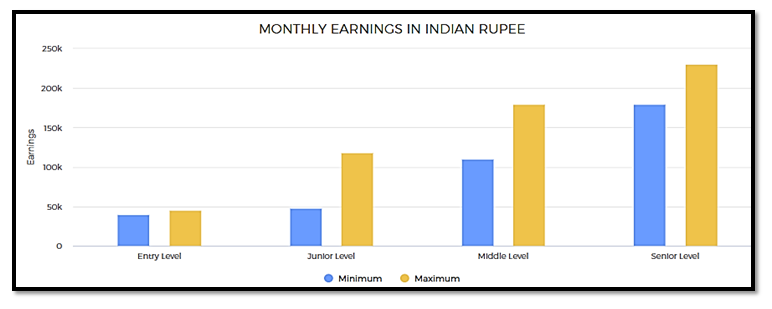
Monthly Earnings in Indian Rupees:
Entry Level | Junior Level | Mid Level | Senior Level | |||||
Min Earning | Max Earning | Min Earning | Max Earning | Min Earning | Max Earning | Min Earning | Max Earning | |
40000 | 45000 | 48000 | 118000 | 110000 | 180000 | 180000 | 230000 | |
1. Entry level: 0 - 2 years of work experience
2. Junior Level: From 1 to 12 years of work experience
3. Mid Level: From 5 to 20+ years of work experience
4. Senior Level: From 10 to 25+ years of work experience
Work Activities
1. Decision making and problem-solving: Analysis of data and information; evaluation of alternative decisions and results of decisions; taking the right decisions and solving problems.
2. Defending and protecting land, air, and sea: Providing defence to potential enemy attacks to land, air, and sea; securing and protecting people and geographical regions.
3. Developing and maintaining interpersonal relationships: Developing professional relationships with co-workers and others outside organizations and maintaining good relationships.
4. Exercising physically: Exercising physically using various methods, techniques, equipment, and devices; exercising using a fitness regime; running.
5. Getting Information and learning
6. Handling and moving objects and materials: Using hands or otherwise use physical strength to handle and move objects and materials; manoeuvre, install, lift, place, manipulate, etc.
7. Identifying objects, actions, and events: Identifying various characteristics of objects; observing and understanding actions and events; understanding changes in actions and events.
8. Inspecting equipment, systems, structures, and materials: Inspecting equipment, systems, structures, and materials to ascertain quality, performance, defects, causes of errors, etc.
9. Inspecting situations, events, and people: Inspecting situations, events, and people to understand the reasons and causes for the situation or events to happen; inspecting people to understand reasons behind their behaviour and actions.
10. Operating vehicles, mechanized devices, or other movable devices: Running, manoeuvring, navigating, or driving vehicles or mechanized equipment, such as forklifts, passenger vehicles, aircraft, or watercraft.
11. Performing physical activities: Performing physical activities that require the use of your arms and legs and moving your whole body, such as climbing, lifting, balancing, walking, stooping, and handling of materials.
12. Securing and protecting: Providing security and protection to people and facilities.
Future Prospects
The BSF has grown exponentially from a few battalions in 1965, to 186 battalions with a sanctioned strength of 257,363 personnel including an expanding air wing, marine wing, artillery regiments, and commando units, and there are no signs of its ability and strength being rolled back upon. It will continue to dish out vacancies per year at the same rate. It currently stands as the world's largest border guarding force. BSF has been termed as the First Line of Defence of Indian Territories.
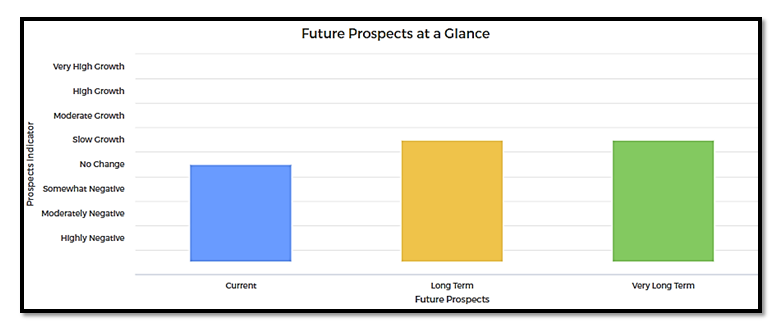
Future Prospects At a Glance
Current (0-1 year) | Long Term (2-5 year) | Very Long Term (6-10 years) |
No Change | Slow Growth | Slow Growth |