
Electronics and Telecommunication Engineer
Entry Level Qualification
Class 12
Career Fields
Engineering & Technology
For Specially Abled


Career Entrance Exam
COMEDK, JEE MAIN BE/BTECH, JEE ADVANCED, GATE, BITSAT UG, VITEEE BE/BTECH, SRMJEEE BE/BTECH
About Career
Electronics and Telecommunications Engineer is a specialist who creates communication system, equipment and process to transmit information across channels like mobile, co-axial cables, optical fibres, telephones, transmitters, etc. Electronics and Telecommunication Engineers study and apply various principles related to the designing of telecommunication equipment.
As a telecommunication engineer, you will conceptualise, design, test and oversee the manufacturing of communication and broadcast system including prototypes, integrated circuit, semiconductor devices, signals, analogue circuits, etc. You might work for commercial, industrial, military, medical or scientific companies.
While some of you will be working in the manufacturing sector where the focus will be to manage the production of a telecommunication system, manages quality control and test products before rolling them to the market. Some of you will work in the research sector, where you will work to develop new systems, improve the existing systems.
Key roles and responsibilities
As an Electronics & Telecommunication Engineer, depending on your field of specialisation, you would have the following roles and responsibilities:
1. You need to keep pace with the industrial practices and emerging telecommunication technology by following the current trend, talking with colleagues, participating in learning programmes and workshops, or participating in conferences.
2. You will consult all stakeholders including customers, users, admins and engineers to determine technical and business requirement for any proposed telecommunication system.
3. You will determine the cost of the project, material and equipment.
4. You will prepare sketches and designs for construction, relocation, installation of equipment, facilities, products or systems.
5. You will prepare documentation containing al confidential descriptions and specification of hardware and software, product development, schedules, production costs, and information about product performances.
6. You will evaluate project work to ensure effectiveness, technical requirement, compatibility etc.
7. You will analyse telecommunication systems requirement, capacity, cost, or customer needs to determine project feasibility.
8. You will design and manufacture telecommunication components, software, products, etc for commercial, medical, military or scientific applications.
9. You will understand the need of customers and determine total requirements, capacity the cost of developing a telecommunication system.
10. You will be required to maintain testing procedures for new telecommunication component and equipment.
11. You will evaluate a system and recommend any changes in the design or working condition.
12. You will do necessary tests to ensure safety standards are met for equipment.
Career Entry Pathway
Class 10 all subjects as per scheme of studies – Class 11-12 Physics, Chemistry, and Mathematics along with any other subject as per scheme of studies – UG in Electronics & Telecommunication Engineering
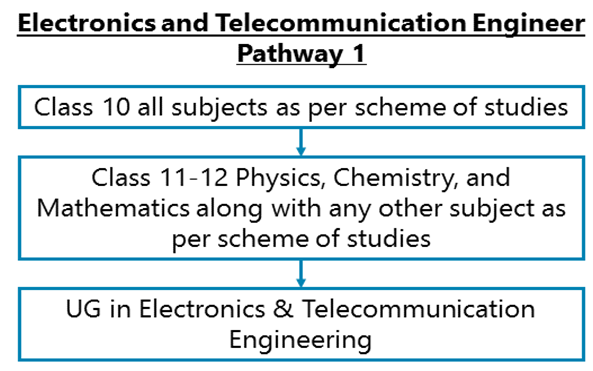
After your Class 11-12 Physics, Chemistry, and Mathematics along with any other subject as per scheme of studies in your higher secondary school and then study for an undergraduate degree in Electronics & Telecommunication Engineering.
Class 10 all subjects as per scheme of studies – Class 11-12 Physics, Chemistry, and Mathematics along with any other subject as per scheme of studies – UG in Electronics Engineering / Electrical Engineering / Electrical & Telecommunication Engineering / Electrical & Electronics Engineering / similar field – PG in Electronics & Telecommunication Engineering
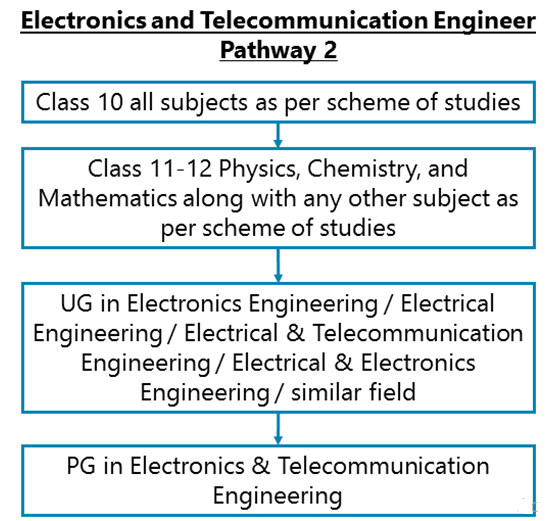
After your Class 11-12 Physics, Chemistry, and Mathematics along with any other subject as per scheme of studies in your higher secondary school and then study for an undergraduate degree in Electronics Engineering/ Electrical Engineering / Electrical & Telecommunication Engineering / Electrical & Electronics Engineering / similar field followed by a master’s degree in Electronics & Telecommunication Engineering.
Class 10 all subjects as per scheme of studies – Class 11-12 Physics, Chemistry, and Mathematics along with any other subject as per scheme of studies – UG in Electronics Engineering Electrical Engineering / Electrical & Telecommunication Engineering / Electrical & Electronics Engineering / similar field – PG in Electronics & Telecommunication Engineering – Ph.D. in Electronics & Telecommunication Engineering
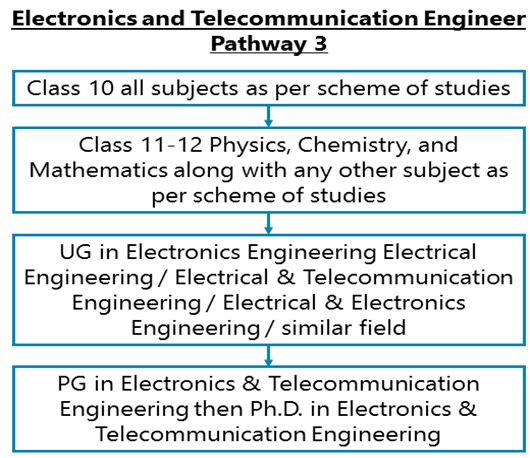
After your Class 11-12 Physics, Chemistry, and Mathematics along with any other subject as per scheme of studies in your higher secondary school and then study for an undergraduate degree in Electronics Engineering/ Electrical Engineering / Electrical & Telecommunication Engineering / Electrical & Electronics Engineering / similar field followed by a post-graduate degree in Electronics & Telecommunication Engineering. Further, you can take Electronics & Telecommunication Engineering in Ph.D. and complete the doctoral degree.
Class 10 all subjects as per scheme of studies – Diploma in Electronics Engineering – UG in Electronics & Telecommunication Engineering
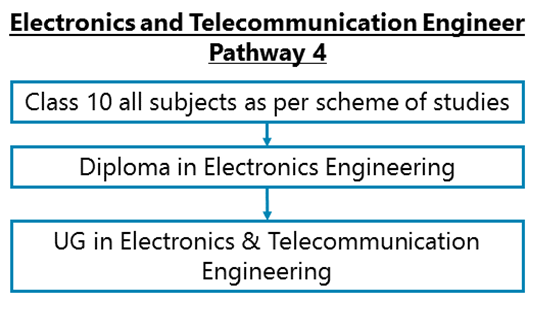
After your Class 10 all subjects as per scheme of studies, you can study Diploma in Electronics Engineering and then study for a lateral (from 2nd year) undergraduate degree in Electronics & Telecommunication Engineering.
Class 10 all subjects as per scheme of studies – Class 11-12 Physics, Chemistry, and Mathematics along with any other subject as per scheme of studies – Undergraduate Degree in Electronics & Telecommunication Engineering – Dual Degree in Electronics & Telecommunication Engineering
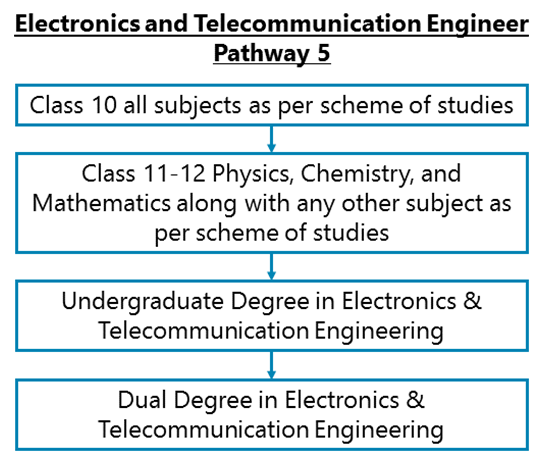
After your Class 10 all subjects as per scheme of studies – Class 11-12 Physics, Chemistry, and Mathematics along with any other subject as per scheme of studies in your higher secondary school and then study for a undergraduate degree Electronics & Telecommunication Engineering. Further, you can study Dual Degree in Electronics & Telecommunication Engineering and complete the doctoral degree.
Required Qualification & Competencies
To become an Electronics & Telecommunication Engineer, you can do a Bachelor degree in any one of the following fields or in a related field:
1. Communication Engineering
2. Electrical and Electronics Engineering
3. Electronics & Communication Engineering
4. Electronics Engineering
5. Telecommunication Engineering
Thereafter you may opt to do a Master’s degree in any one of the following fields or in a related field:
1. Communication Engineering
2. Digital Electronics
3. Electrical and Electronics Engineering
4. Electrical Signal Processing & Systems
5. Electronics & Communication Engineering
6. Electronics Engineering
7. Embedded Systems and VLSI Design
8. Microelectronics
9. Microwave Engineering & Technologies
10. Optoelectronics
11. Telecommunication Engineering
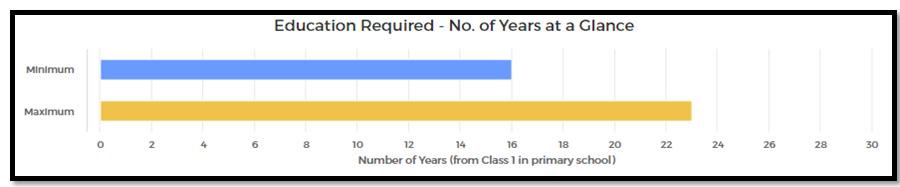
MINIMUM EDUCATION REQUIRED | MAXIMUM EDUCATION REQUIRED |
Under Graduate | Doctoral |
COMPETENCIES REQUIRED
Occupational Interests
1. Investigative: You should have interests for Investigative Occupations. Investigative occupations involve working with ideas and quite a lot of thinking, often abstract or conceptual thinking. These involve learning about facts and figures; involve use of data analysis, assessment of situations, decision making and problem solving.
2. Realistic: You should have interests for Realistic Occupations. Realistic occupations involve more practical and hands-on activities than paperwork or office work. Realistic occupations often involve physical activities for getting things done using various tools and equipment.
3. Conventional: You should have interests for Conventional Occupations. Conventional occupations involve repetitive and routine tasks as well as fixed processes or procedures for getting things done. These occupations involve working more with data, systems, and procedures and less with ideas or creativity.
Abilities
1. Abstract Reasoning: The ability to understand ideas which are not expressed in words or numbers; the ability to understand concepts which are not clearly expressed verbally or otherwise.
2. Deductive Reasoning: The ability to apply general rules and common logic to specific problems to produce answers that are logical and make sense. For example, understanding the reasons behind an event or a situation using general rules and common logic.
3. Inductive Reasoning: The ability to combine pieces of information from various sources, concepts, and theories to form general rules or conclusions. For example, analysing various events or situations to come out with a set of rules or conclusions.
4. Inter-Personal: The ability to build and maintain good relationships with others at workplaces and elsewhere.
5. Mathematical Reasoning: The ability to choose the right mathematical methods or formulas to solve a problem.
6. Mechanical Reasoning: The ability to apply basic physical principles and theories to understand how mechanical objects such as tools and machinery works and the ability to understand the rules or laws governing the work of machinery, tools and bodies in motion.
7. Numerical Reasoning: The ability to add, subtract, multiply, divide, and perform other basic numerical calculations correctly.
8. Spatial Ability: The ability to visualise three dimensional objects by looking at the objects in paper or visualise objects mentally in three dimensions.
9. Speed of Closure: The ability to quickly make sense of, combine, and organize information into meaningful patterns.
10. Verbal Reasoning: The ability to think and reason with words; the ability to reason out ideas expressed in words.
11. Written Comprehension: The ability to read and understand information and ideas presented in writing.
Knowledge
1. Engineering and Technology: Knowledge of various applications of one or more branches of Engineering Science & Technology to manufacture and produce various goods or construct or erect various structures. This include knowledge about design, development, prototype testing, manufacturing, construction, installation, repair and maintenance.
Mathematics: Knowledge of arithmetic, algebra, geometry, calculus, trigonometry, statistics, and other mathematical disciplines and their applications.
2. Physical Science: Knowledge of physical principles, laws, their interrelationships, and applications to understand fluid, material, earth, ocean, atmosphere, and space dynamics, as well as mechanical, electrical, atomic and sub- atomic structures, properties and processes.
3. Production and Processing: Knowledge of raw materials, production machinery, production systems, production processes, quality control, and other techniques for manufacturing or construction and distribution of goods.
4. Technical and Engineering Design: Knowledge of various techniques, methods, specifications and tools for creating, developing and laying out designs of various machines, equipment, devices, manufacturing plants, structures, systems and processes. This includes developing blueprints, drawing and models.
Skills
1. Active Learning: Focused and continuous learning from various sources of information, observation and otherwise for application in getting work done.
2. Communication in English: Skills in communicating effectively in writing as well as verbally with others in English language.
3. Coordination: Skills in working together with other people to get things done.
4. Critical Thinking: Skills in analysis of complex situations, using of logic and reasoning to understand the situations and take appropriate actions or make interpretations and inferences.
5. Judgment and Decision Making: Skills in considering pros and cons of various decision alternatives; considering costs and benefits; taking appropriate and suitable decisions.
6. Operations and Process Analysis: Skills in analysis of operations and processes such as industrial manufacturing, chemical processing, etc. so as to device better and more efficient operational processes and systems.
7. Problem Solving: Skills in analysis and understanding of problems, evaluating various options to solve the problems and using the best option to solve the problems.
8. Process and Operation Controlling: Skills in controlling processes and operations of various machines, equipment, devices and systems using different types electrical and electronic control instruments and systems.
9. Reading Comprehension: Skills in understanding written sentences and paragraphs in work related documents.
10. Supervising: Skills in Supervising and monitoring performance of others, businesses, and different projects.
11. Technical: Skills in using various technologies and technical methods to get things done or solve problems.
12. Technical Design and Drawing: Skills in creating and developing designs and drawings for various structures, machines, equipment, and devices.
13. Troubleshooting: Skills in determining causes of operating errors and deciding what to do about it.
Personality
1. You are always or mostly organised in your day-to-day life and activities.
2. You always feel secure in your surroundings and in most situations.
3. You are imaginative sometimes.
4. You prefer to experience new things and have new experiences sometimes.
5. You act independently sometimes but do not do so in some other times.
6. You are friendly and outgoing sometimes, but not always.
7. You prefer company of people sometimes but not always.
8. You are always practical or in most situations.
Career - Job Opportunities & Profiles
1. If you are into the design side of the engineering career, then you may join as a design engineer/ Design engineer trainee.
2. If you are into production, then you may join as a production engineer trainee.
3. If you are into teaching, then you may join college or university at the profile of an assistant professor.
4. If you are into research, then you can join a research institute at the role of research associate. Some of you will join as a research engineer.
5. If you are into scientific research, then you can join as a Scientist with Grade “C”.
Different types of companies can offer you a job. Such as:
1. Government defence department like DRDO in India.
2. Space departments like ISRO
3. Institutes of scientific learning like IISc, IIA, RRI, TIFR, etc.
4. Electronics and Telecommunication Engineering department of all IITs and Engineering colleges.
5. Leading telecommunication equipment manufacturing companies Apple, Samsung, Motorola, Binatone, etc.



6. Leading telecommunication servicing providing companies like Airtel, Vodafone, Jio, BSNL.



Work Environment
As an Electronics and Telecommunication Engineer, you would mostly work in the manufacturing sector or research sector. In the manufacturing sector, you will be involved with the team and there will be work performance pressure when the deadlines will be near. Sometimes, you might have to overwork to meet certain deadlines. Some of you will be working in an office often engaged with laptops, computers and software while designing or evaluating designs. If you are into scientific research or working in a scientific institute, you will work in an intensive environment with work related to space, defence projects, etc.
CAREER GROWTH
1. If you are into the design side of the engineering career and joined as a design engineer/ Design engineer trainee and then become a design engineer. Soon, you would either become design engineering manager or design manager or project manager.
2. If you are into production and joined as a production engineer trainee. Soon, you would become a production engineer. You may be then promoted to production manager (Manufacturing) and then plant manager (manufacturing).
3. The career growth in university and college states from Assistant Professor and then Associate Professor, Professor and Professor Emeritus. Professors can also get administrative positions such as Director/Dean/Vice Chancellor, etc
4. Research laboratories will hire you as a scientist/scientist officer with the lowest grade and the grade changes from low to high. In India, grades are “Scientist “C” as the joining level and then D, E, F, G, H, etc. A senior-level scientist can also get into administrative positions like Principal Scientist, Assistant Director, Deputy Director, Director, etc.
Salary Offered
1. At the entry level, as a Scientist (grade C) you would be earning around Rs. 80,000 to 100,000 per month. As an assistant professor, you would be earning anything between Rs. 65,000 to 70,000 per month. As a production engineer, design engineer, etc., you would be earning anything between Rs. 25,000 to 2,00,000 per month.
2. At the junior level with a work experience of 2-6 years, you would be earning anything between Rs. 50,000 to 2,50,000 per month.
3. At the middle level with an experience of 10-12 years, you would be earning anything between Rs. 1,40,000 to 1,90,000 per month as a scientist and Rs. 1,20,000 to 1,60,000 as a professor and as a production engineer, design engineer, etc. Rs. 1,00,000 to 4,00,000 per month.
4. At the senior level of over 15 years of work experience, you would be earning anything between Rs. 1,60,000 to 2,00,000 per month as a professor and Rs. 2,10,000 to 2,50,000 per month as a Scientist. As a production engineer, design engineer etc., you would be earning anything between Rs. 1,20,000 to 10,00,000 per month.
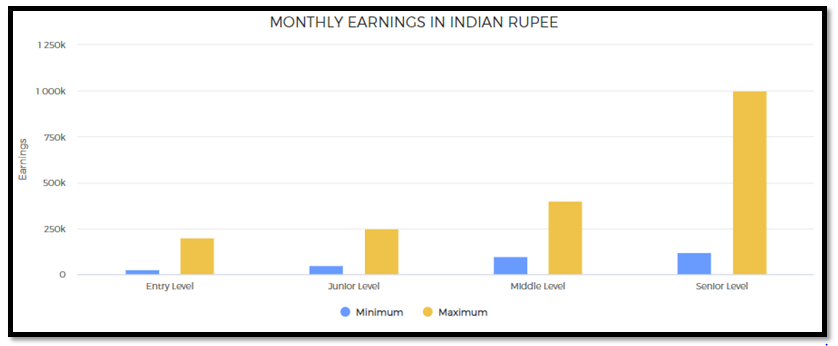
MONTHLY EARNINGS IN INDIAN RUPEE

1. Entry level: 0 - 2 years of work experience
2. Junior Level: From 1 to 12 years of work experience
3. Mid Level: From 5 to 20+ years of work experience
4. Senior Level: From 10 to 25+ years of work experience (there could be exceptions in some high-end technical, financial, engineering, creative, management, sports, and other careers; also in the near future, people will reach these levels much faster in many careers and in some careers, these levels will have no meaning as those careers will be completely tech skill driven such as even now, there is almost no level in a Cyber Security Expert’s job).
Work Activities
1. Analysing and interpreting data and information: Analysis of data and information to find facts, trends, reasons behind situations, etc.; interpretation of data to aid in decision making.
2. Calculating and computing: Calculating or computing using various mathematical formula and functions using computers or otherwise; doing financial or commercial calculations or computations.
3. Communicating with co-workers and others: Communicating with people in writing, verbally or otherwise inside your workplace and various other people who have professional relationships with your place of work including vendors, government officials, etc. or with people at large.
4. Decision making and problem solving: Analysis of data and information; evaluation of alternative decisions and results of decisions; taking the right decisions and solving problems.
5. Drawing, drafting, laying out and specifying objects, equipment, devices, tools, and systems: Creating and developing designs, drawings, layouts and specifications about how to construct, manufacture, assemble, build, use, and maintain various equipment, devices, tools and systems.
6. Estimating quantity, cost, time and resources: Estimating sizes, volumes, distance, and quantity; estimating and determining time, costs, and resources; estimating materials required to perform a task.
7. Getting Information and learning: Observing, hearing, reading, using computers, or otherwise obtaining information and learning from it.
8. Inspecting equipment, systems, structures, and materials: Inspecting equipment, systems, structures, and materials to ascertain quality, performance, defects, causes of errors, etc.
9. Leading: Inspiring and motivating co-workers to work to achieve specific goals; enabling and facilitating others to perform tasks effectively; addressing issues and solving problems in order to help people perform well.
10. Managing and supervising: Manging and supervising work of others; setting goals; giving instructions; monitoring work performance, etc.
11. Organising, planning and prioritising tasks: Planning and organising tasks in order to achieve work goals; prioritising tasks to achieve goals and making the best use of the time available.
12. Scheduling tasks: Scheduling project timelines, tasks and activities.
13. Updating and using relevant knowledge: Keeping updated with the latest knowledge relevant to your fields of work and use of the relevant knowledge in getting things done.
14. Using computers for work: Using computers for day-to-day office work; using computer software for various applications in day-to-day professional work; entering data and process information; for writing.
15. Working in a team: Working in a team of people; developing team; maintaining professional relationships among team members.
Future Prospects
India is the 3rd largest telecommunication market in the world after China with over 1.2 billion telephone subscribers. The telecommunication market is divided into wireline, wireless and internet services. Over 98.2% of the subscribers’ base comes from the wireless sector. In 2018, wireless subscribers base increased by 19.61%. However, with its reaching peak, it might start slowing down in the coming years. But there is still grow for hardware manufacturers. As recently Samsung established its one of the biggest manufacturing plants in Noida. Similarly, Apple is also shifting its manufacturing base in India. Internet services are expected to grow at a similar pace in future. Presently over 600 million people are connected with the internet. Although these numbers indicate that there should be a large number of opportunities for Electronics and Telecommunication Engineers but because of various reasons, the telecommunication industry has been slowing down in India over the last few years. However, if electronics manufacturing shifts part of its base from China to India, then the industry may see a bright prospect.
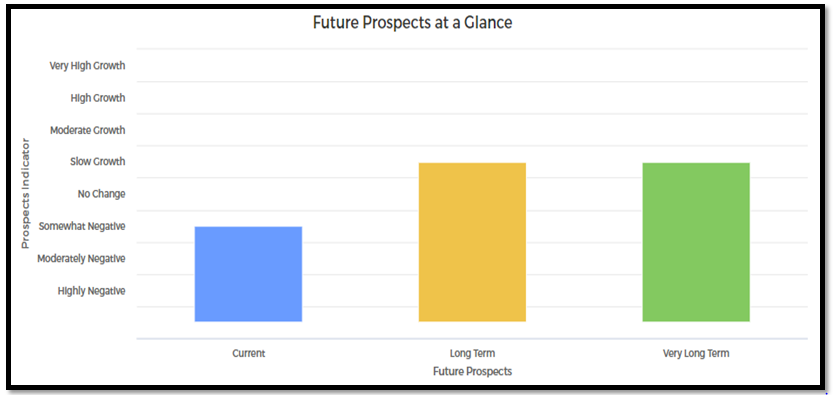
FUTURE PROSPECTS AT A GLANCE
