

Building Engineer
Entry Level Qualification
Class Graduate
Career Fields
Engineering & Technology
For Specially Abled


Career Entrance Exam
About Career
PARTICULARS | DESCRIPTION |
Name | Building Engineer |
Purpose | Inspect Project Sites |
Career Field | Engineering & Technology |
Required Entrance Exam | JEE MAIN BE/BTECH, JEE ADVANCED, GATE |
Average Salary | 5,00,000 - 12,00,000 Rs. Per Year |
Companies For You | Lodha Group, Leslie E. Robertson Associates, JW Consultants & Many More |
Who is Eligible | Class 12th Pass |
Building Engineers are involved in the planning, functional design, erection, operation & management of facilities, specifically high-rise buildings, tall towers, skyscrapers, including both commercial and residential spaces.
They participate right from the design & conceptualization phase coordinating with Structural, Civil, Geotechnical, Electrical and Mechanical Engineers for safe and effective execution of a newly sanctioned building design to supervising all functional aspects of the building when it is in operation.
Building Engineers are involved in the technical aspects of construction projects. They also have to troubleshoot on-site problems & analyze plans. They have to ensure that all necessary design instructions flow smoothly from design to construction.
They utilize a mixture of construction knowledge and engineering principles to analyze reports, help design structures, and manage contracts & budgets. They also create construction schedules and keep engineering schematics &construction sites in compliance with applicable laws and building codes.
A building code is a set of norms that govern the construction of buildings for safe and orderly development of buildings. There are the Indian, American, European and British Standards as well as other regional building codes.
Building Engineers may also sometimes oversee sub-contractor activities and contract preparation instead of focusing on structural engineering. They also report progress to stakeholders (developers, engineering companies involved etc.), coordinate with subcontractors, and keep expenses within budget as resource allocation may also be one of their responsibilities.
Now, understand that,
In a high-rise building construction project, separate engineering companies are involved in handling different aspects and different infrastructure/ production-related activities of a single project.
For example, to build a single tall building such as the likes of World One, 360 West Tower, Palais Royale, Brys Buzz, North Eye, Supernova Spirain India or if we go international, Burj Khalifa, Taipei 101 or Petronas Twin Towers etc., the main owners or developing group of companies look forward to design architects, structural design engineers, peer review engineering companies, project management companies, main/ ancillary contractors, wind consultants, energy consultants/ licensing consultancies, materials suppliers, geotechnical engineering companies, building code consultants, façade maintenance companies, interior & landscape designers, engineering consultants for lighting & vertical transportation (elevator), MEP engineers (mechanical, electrical, plumbing), etc.
All these individual entities/ companies have to work in harmony to raise such signature designs from ground-up. These iconic skyscrapers which outline the skyline of a city and the generated skyline is specific to every global sustainable city in the world today. The best skylines today can be found in Chicago, Sydney, Dubai, Vancouver and Shanghai.
Mumbai in India is emerging to be such a key world city with a modern-day skyline absent in any other Indian city. Establishing an iconic skyline presence of a city characterized by unprecedented height is one of the major strategic objectives of any government today.
Before and while a construction project is underway, a Building Engineer may be involved in a broad range of activities including:
1. Association with architects or other professionals during conceptualization to ensure an optimal design solution
2. Design Development
3. Detailed Design
4. Detailed Structural Drawings
5. Structural Specifications
6. Management of Projects
While a project is nearing completion or is completed and awaiting inception, a Building Engineer may also be involved in
7. Quality assurance
8. Risk Assessment – Safety Standards & Structural Integrity
9. Structural repair, rehabilitation & retrofitting
What after a high-rise is built?
Building Engineers are also entrusted with the responsibilities of smooth execution of all operations inside the facility and to determine all the physical needs of the buildings including the heating ventilation systems, the lifting systems (escalator/elevators), other electrical units/assemblies, heating boilers, alarm systems, key card security systems, swimming pool infrastructures, closed-circuit TV systems, etc.
To ensure this, they have to be well informed & have expert knowledge of the entire construction blueprint of the building and necessarily coordinate with other engineers and specialists to resolve issues whenever one arises. However, they must have the ability to make at least minor repairs to heating, cooling & ventilation equipment, as well as electrical features such as wall outlets and light fixtures. Typically, their responsibilities encompass maintaining virtually all physical aspects of a building, from the structure to heating & cooling equipment to electrical infrastructure.
‘Green Buildings’ of today
Now, one extremely important aspect of today’s real estate industry is the retrofitting of existing structures (green buildings). Green retrofits(‘retro’ literally means backward) are any kind of upgrade at an existing building that is wholly or partially occupied to improve energy & environmental performance, reduce water use, and enhance the comfort & quality of the space in terms of natural light, air quality, & noise.
This needs in-depth knowledge of current & historic construction materials for restoration projects. This involves addressing questions like how the structure was originally designed & built, reviewing repairs made over the life of the structure, analyzing/designing replacements to simulate obsolete construction materials, and developing repairs to restore the structure.
Many buildings standing tall today have reached the end of their planned service life, &facing deterioration in the form of steel corrosion, concrete cracking and spalling (flaking, cracking, peeling, crumbling or chipping of concrete). In addition, many of these structures were built to carry loads that are significantly smaller than the current needs.
Retrofitting can be done for implementing effective & economical repair and strengthening as well as to improve energy efficiency. Strengthening is to ensure that the building will be less costly to operate, will increase in value, last longer, and contribute to a better, healthier, more comfortable environment for people to live & work achieved through improving indoor environmental quality, decreasing moisture penetration and other means.
Additionally, buildings consume a significant amount of energy particularly for heating and cooling. For obvious reasons, existing buildings comprise the largest segment of the built environment and it is important to initiate energy conservation retrofits to reduce energy consumption and the cost of heating, cooling, and lighting buildings.
Interestingly, retrofitting an existing building can also be more cost-effective than building a new facility so land developers or large real estate companies are at times looking at this as an alternative.
Key Roles and Responsibilities
As a Building Engineer, you will be engaged with one or more of the following roles and responsibilities:
1. You will apply technology and scientific principles to the planning, functional design, erection, operation & management of facilities, specifically high-rise buildings, tall towers, skyscrapers, concerning different modes of construction such as modular, top-down, bottom-up, etc. considering various aspects such as efficient construction of foundations, various soil conditions, complex mechanized technologies, concrete-laying complexes, new generation machines, delivery&lifting of concrete mixes, proper employment of transporting and auxiliary equipment, etc.
2. You will draw engineering schematics, sketches, plans or specifications for preparing new designs or parts of designs, for commercial/ residential spaces.
3. You will inspect project sites to monitor progress & ensure conformance to design specifications and safety or sanitation standards.
4. You will measure dimensions and verify level, alignment, or elevation of structures or fixtures to ensure compliance with building plans and codes.
5. You will review & interpret plans, blueprints, site layouts, specifications, or construction methods to ensure compliance to legal requirements and safety regulations.
6. You will examine lifting or conveying devices, such as escalators, elevators, hoists, moving sidewalks, inclined railways, to ensure safety and proper functioning.
7. You will identify environmental risks and develop risk management strategies for various projects.
8. You will generate documentation and prepare administrative, technical, or statistical reports containing distinct technical information about planning, confidential descriptions or specifications for labor or materials, project budgets, schedules, or information about performance weaknesses or other details.
9. You will provide technical advice to industrial/ managerial personnel regarding design, construction, program modifications, or structural repairs.
10. You will prepare/ present public reports on topics such as environmental impact statements, deeds, bid proposals, property, or descriptions.
11. You will confer with owners, or authorities to explain regulations or recommend remedial action; train, direct, or supervise other construction inspectors; issue permits for construction, relocation, demolition, or occupancy and approve parts of building plans that meet required specifications.
12. You will administer maintenance &coordinate repair services for apartments, workplaces and healthcare facilities including office buildings, apartment complexes, hospitals, churches, hotels and manufacturing facilities looking into all physical aspects of a building, from the structure to heating and cooling equipment to electrical infrastructure.
Career Entry Pathway
Class 10 all subject as per scheme of studies - Class 11-12 Physics, Chemistry, Mathematics along with any other subject as per scheme of studies- BE/ B Tech/ B Eng. in Civil or Structural Engineering or similar
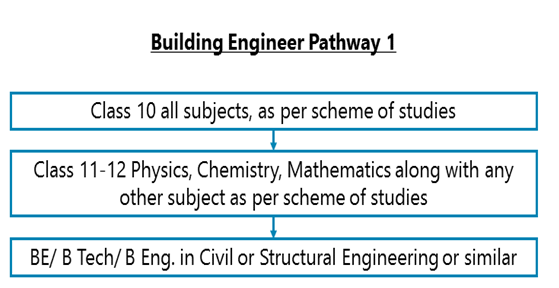
After completing Class 11-12 Physics, Chemistry, Mathematics along with any other subject as per scheme of studies, go for BE/ B Tech/ B Eng. in Civil or Structural Engineering or similar.
Class 10 all subject as per scheme of studies – Diploma in Civil Engineering – lateral entry 2nd year B Tech/ BE in Civil Engineering/ Structural Engineering or similar
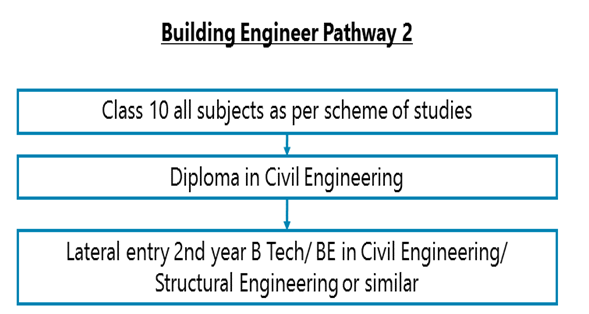
After completing Class 10 all subjects as per scheme of studies, you can go for a Diploma in Civil Engineering or similar engineering discipline from any Polytechnic college and then take direct lateral entry into 2nd year of B Tech/ BE in Civil Engineering/ Structural Engineering.
Class 10 all subject as per scheme of studies - Class 11-12 Physics, Chemistry, Mathematics along with any other subject as per scheme of studies – AMIE in Civil Engineering – M Tech/ ME in Civil or Structural Engineering or similar
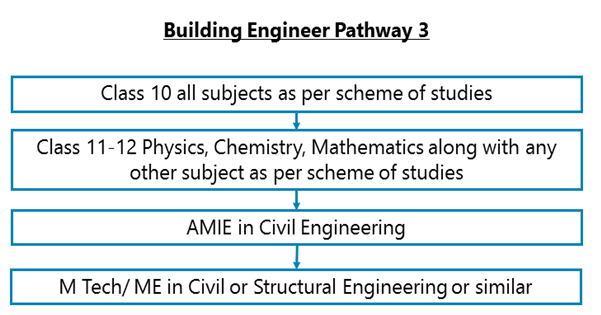
After completing Class 11-12 Physics, Chemistry, Mathematics along with any other subject as per scheme of studies, go for AMIE qualification in Civil Engineering. Then enroll into M Tech/ ME program in Civil or Structural Engineering. AMIE (Associate Member of Institution of Engineers) is a B. Tech level examination in engineering,for non-formal engineering education,conducted by Institution of Engineers of India (IEI), the largest multidisciplinary body of engineers in the country, and is recognized as equivalent to B.E/B.Tech.
Class 10 all subject as per scheme of studies - Class 11-12 Physics, Chemistry, Mathematics along with any other subject as per scheme of studies - BE/ B Tech in Civil Engineering or Structural Engineering or Materials Engineering or similar – ME / M Tech/ M Eng.
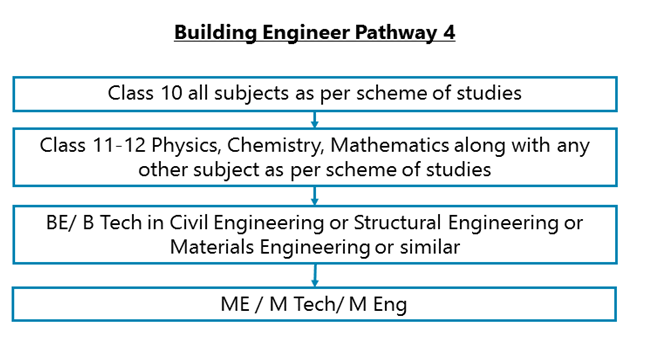
After completing Class 11-12 Physics, Chemistry, Mathematics along with any other subject as per scheme of studies, you can go for BE/ B Tech in Civil Engineering or Structural Engineering or similar. Then go for ME / M Tech/ M Eng. in ‘Civil/ Structural Engineering’, ‘Construction Technology & Management’, ‘Construction Engineering & Management’, ‘Building Science & Construction Management’, ‘Building Technology & Construction Management’, ‘Green Building Engineering’, ‘Building Science & Technology’, ‘Building Energy Performance’ or similar.
Class 10 all subjects as per scheme of studies - Class 11-12 Physics, Chemistry, Mathematics along with any other subject as per scheme of studies - BE/ B Tech in Civil Engineering or Structural Engineering or similar - ME / M Tech/ M Eng. in ‘Civil/ Structural Engineering’, ‘Construction Technology & Management’, ‘Construction Engineering & Management’, ‘Building Science & Construction Management’, ‘Building Technology & Construction Management’, ‘Green Building Engineering’, ‘Building Science & Technology’, ‘Building Energy Performance’ or similar.
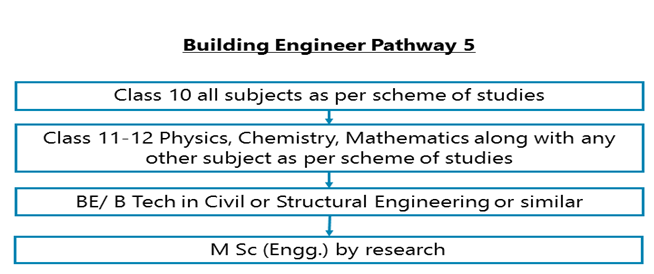
After completing Class 11-12 Physics, Chemistry, Mathematics along with any other subject as per scheme of studies, you can go for BE/ B Tech in Civil or Structural Engineering or similar. Thereafter go or a Master of Science in Engineering by research offered by various colleges across the country.
Class 10 all subjects as per scheme of studies - Class 11-12 Physics, Chemistry, Mathematics along with any other subject as per scheme of studies - BE/ B Tech in Civil or Structural Engineering or similar – 2 year Post Graduate Programme / 2 year M Sc
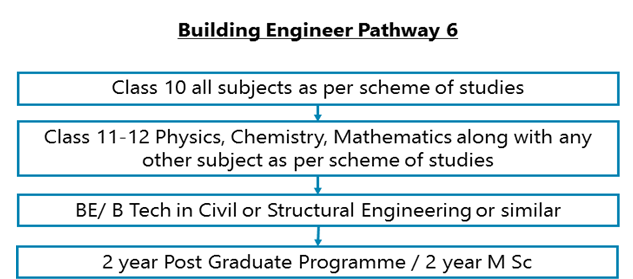
After completing Class 11-12 Physics, Chemistry, Mathematics along with any other subject as per scheme of studies, go for BE/ B Tech in Civil or Structural Engineering or similar. Then pursue 2 year Post Graduate Programme in ‘Advanced Construction Management’, ‘Contemporary Smart City Development & Management’, ‘Project Engineering & Management’ or similar. You can also instead pursue a 2 year M Sc in Green Buildings.
Class 10 all subjects as per scheme of studies - Class 11-12 Physics, Chemistry, Mathematics along with any other subject as per scheme of studies - BE/ B Tech in Civil or Structural Engineering or similar - PG
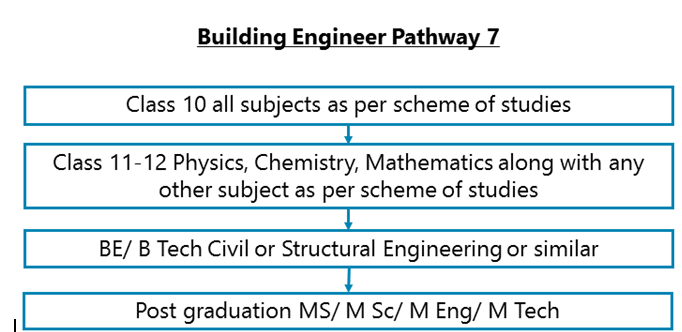
After completing Class 11-12 Physics, Chemistry, Mathematics along with any other subject as per scheme of studies, you can go for BE/ B Tech Civil or Structural Engineering or similar. Then go for MS in IT in Building Science by Research/ M Eng Architectural Engineering/ Master in Building Engineering & Management/ M Sc in Modern Building Design or similar/ MS in Sustainable Design & Construction/ M.Tech in Engineering Materials/ M.Tech in Stress and Vibration Analysis/ M.Tech in Geoinformatics.
Class 10 all subjects as per scheme of studies - Class 11-12 Physics, Chemistry, Mathematics along with any other subject as per scheme of studies - BE/ B Tech Civil or Structural Engineering or similar - MS in IT in Building Science by Research/ M Eng Architectural Engineering/ Master in Building Engineering & Management/ M Sc in Modern Building Design or similar/ MS in Sustainable Design & Construction/ M.Tech in Engineering Materials/ M.Tech in Stress and Vibration Analysis/ M.Tech in Geoinformatics.
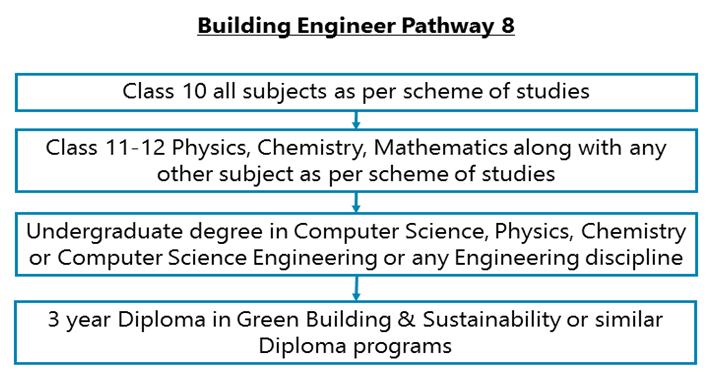
After completing Class 11-12 Physics, Chemistry, Mathematics and/ or Computer Science along with any other subject as per scheme of studies, you can go for an Undergraduate degree in Computer Science, Physics, Chemistry or Computer Science Engineering or any Engineering discipline. Thereafter, you can go for a 3 year Diploma in Green Building & Sustainability or similar Diploma programs.
Class 10 all subjects as per scheme of studies - Class 11-12 Physics, Chemistry, Mathematics along with any other subject as per scheme of studies – Undergraduate degree in Physics, Chemistry, Mathematics– GATE Exam – M Tech in Civil Engineering/Construction Engineering or similar
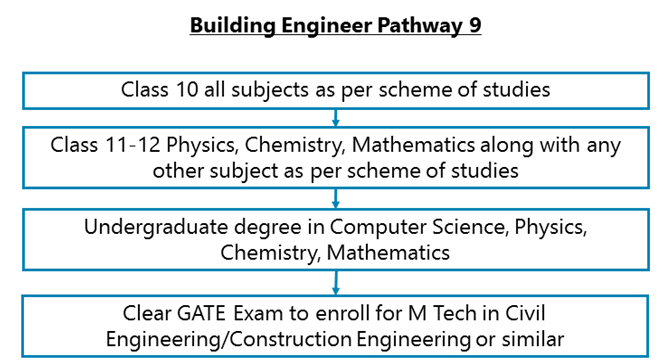
After completing Class 11-12 Physics, Chemistry, Mathematics and/ or Computer Science along with any other subject as per scheme of studies, you can go for an Undergraduate degree in Physics, Chemistry, Mathematics. Thereafter, you can clear GATE Exam to enroll for M Tech in Civil Engineering/Construction Engineering/Structural Engineering/ Geotechnical Engineering/ or similar programs.
Class 10 all subjects subject as per scheme of studies - Class 11-12 Physics, Chemistry, Mathematics along with any other subject as per scheme of studies - UG in Computer Science, Physics, Chemistry, Mathematics - GATE Exam - M Tech in Civil Engineering/Construction Engineering/Structural Engineering/ Geotechnical Engineering/ Geoinformatics or similar programs.
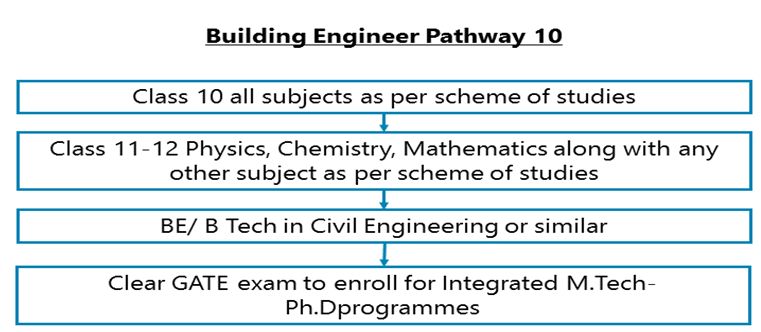
After completing Class 11-12 Physics, Chemistry, Mathematics along with any other subject as per scheme of studies, you can go for BE/ B Tech Civil or Structural Engineering or similar. Then clear NET Engineering or GATE exam to enroll for Integrated M.Tech-Ph.D programme.
Class 10 all subjects as per scheme of studies - Class 11-12 Physics, Chemistry, Mathematics - BE/ B Tech in Civil Engineering or similar – ME/ M Tech in Civil Engineering / Construction Engineering/ Structural Engineering or similar – PhD
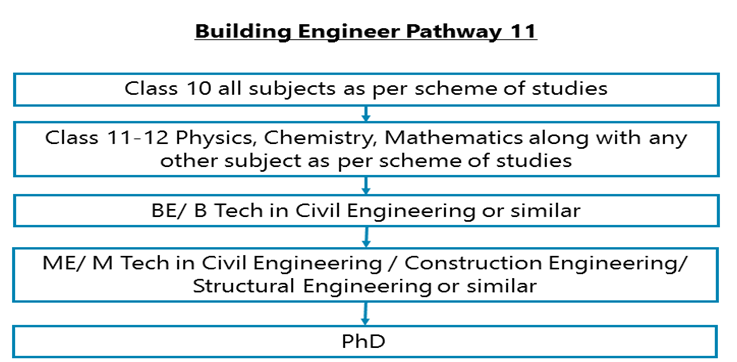
After Class 11-12 Physics, Chemistry, Mathematics along with any other subject as per scheme of studies then BE/ B Tech in Civil Engineering or similar then ME/ M Tech in Civil Engineering / Construction Engineering/ Structural Engineering or similar then PhD
Class 10 all subjects, as per scheme of studies - Class 11-12 Physics, Chemistry, Mathematics along with any other subject as per scheme of studies - B Arch – Master in Building Engineering& Management/ MS in IT in Building Science by Research – PhD in Energy Efficiency or similar areas
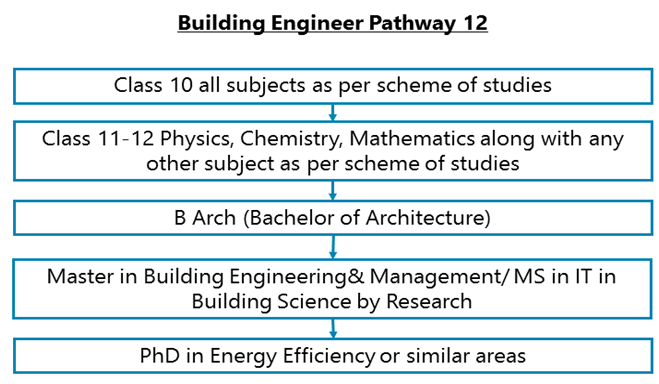
After Class 11-12 Physics, Chemistry, Mathematics along with any other subject as per scheme of studies then B Arch then Master in Building Engineering& Management/ MS in IT in Building Science by Research then PhD in Energy Efficiency or similar areas.
Required Qualification & Competencies
To get into this field, you will need to pass Class 10 examination with all subjects as per scheme of studies. Then you must complete Class 11-12 with Physics, Chemistry, and Mathematics along with any other subject as per scheme of studies.
Then you can do aBachelor degree/ AMIE in Civil Engineering, or Structural Engineering or Construction Engineering or any cognate Engineering discipline.
If you are not from an Engineering background during your graduation, you will have to clear GATE exam at any cost to get an entry into M Tech programs in Structural Engineering or related disciplines.
You have to specialize either at the post graduation or Doctoral level in various related disciplines related to Civil Engineering such as Structural/ Geotechnical/ Geoinformatics/ Environmental/ Construction Engineering, Green Buildings, Building Construction & Technology, Built Environment (Construction Management) etc. after your graduation in Civil Engineering, because no college / institution offers direct Bachelor degree or Master degree programs in ‘Building Engineering’.
You can study for a Bachelor’s / Master’s / Doctoral degree in any of the following fields (Note that all these fields may not offer you a degree at all three levels, that is in Bachelor’s, Master’s and Doctoral. Some fields may offer a degree only at the Master’s or at the Doctoral level):
1. Civil Engineering
2. Concrete Technologies
3. Construction Engineering and Technologies
4. Infrastructure Engineering
5. Municipal and Urban Engineering
6. Structural Engineering (Civil)
7. Surveying (Civil)
8. Building Engineering & Management
9. Built Environment Design
10. Sustainable Building Design
11. Green Building Engineering
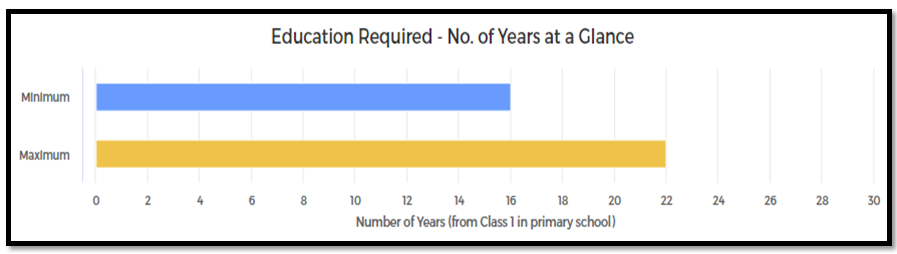
MINIMUM EDUCATION REQUIRED | MAXIMUM EDUCATION REQUIRED |
Under Graduate | Doctoral |
COMPETENCIES REQUIRED
Interests
1. You should have interests for Investigative Occupations. Investigative occupations involve working with ideas and quite a lot of thinking, often abstract or conceptual thinking. These involve learning about facts and figures; involve use of data analysis, assessment of situations, decision making and problem solving.
2. You should have interests for Realistic Occupations. Realistic occupations involve more practical and hands-on activities than paperwork or office work. Realistic occupations often involve physical activities for getting things done using various tools and equipment.
3. You should have interests for Enterprising Occupations. You should have interests for Enterprising Occupations. Enterprising occupations involve taking initiatives, initiating actions, and planning to achieve goals, often business goals. These involve gathering resources and leading people to get things done. These require decision making, risk taking and action orientation.
Knowledge
1. You should have knowledge of Civil construction - Knowledge of materials, methods, and the tools involved in the construction or repair of structures such as high-rise buildings, tall towers, skyscrapers, etc.
2. You should have knowledge of Engineering and Technology - Knowledge of various applications of the Civil branch of Engineering Science & Technology to manufacture and produce various goods or constructor erect various structures. This includes knowledge about design, development, prototype testing, manufacturing, construction, installation, repair, and maintenance.
3. You should have knowledge of Technical and Engineering Design - Knowledge of various techniques, methods, specifications and tools for creating, developing and laying out designs of various structures, systems, equipment, devices, and processes. This includes developing blueprints, drawings, and models.
4. You should have knowledge of Physical Science - Knowledge of physical principles, laws, their interrelationships, and applications to understand mechanical, electrical, atomic structures, properties, and processes.
5. You should have knowledge of Computers–for using computers for various technical and academic purposes.
6. You should have knowledge of pre-processor tools like ANSA/Hypermeshetc; analytical or scientific software such as HEC-HMS; Minitab, The MathWorks MATLAB, Trimble Geomatics Office; or map creation software such as ESRI ArcVie or Trimble Digital Fieldbook; CAD software such as Arc Second PocketCAD; Autodesk AutoCAD, Dassault SystemesSOLIDWORKSetc.
Skills
1. You should have Systems Analysis Skills - determining how a system should work and how changes in conditions, operations, or the environment will affect outcomes.
2. You should have Technical Skills - using various technologies and technical methods to get things done or solve problems.
3. You should have Systems Evaluation Skills - identifying measures or indicators of system performance and the actions needed to improve or correct performance, relative to the goals of the system.
4. You should have technical Design and Drawing Skills - creating and developing designs and drawings for various structures, machines, equipment, and devices.
5. You should have Quality Control Analysis Skills - conducting tests and inspections of products, services, or processes to evaluate quality or performance.
6. You should have Critical Thinking skills- Skills in the analysis of complex situations, using logic and reasoning to understand the situations and take appropriate actions or make interpretations and inferences.
7. You should have Judgment and Decision Making Skills - considering pros and cons of various decision alternatives; considering costs and benefits; taking appropriate and suitable decisions.
8. You should have Problem Solving Skills - Skills in analysis and understanding of problems, evaluating various options to solve the problems and using the best option to solve the problems.
Ability
1. You should have Deductive Reasoning Ability - apply general rules and common logic to specific problems to produce answers that are logical and make sense. For example, understanding the reasons behind an event or a situation using general rules and common logic.
2. You should have Problem Sensitivity - The ability to tell when something is wrong or is likely to go wrong. It does not involve solving the problem, only recognizing there is a problem.
3. You should have Inductive Reasoning Ability - The ability to combine pieces of information from various sources, concepts, and theories to form general rules or conclusions. For example, analyzing various events or situations to come out with a set of rules or conclusions.
4. You should have Oral Comprehension Ability - listen to and understand information and ideas presented through spoken words and sentences.
5. You should have Oral Expression Ability - communicate information and ideas in speaking so others will understand.
Personality Traits
1. You are always imaginative or in most situations.
2. You are always or mostly careful about your actions and behavior.
3. You are always or mostly disciplined in your action and behavior.
4. You are always calm or generally remain calm in most situations.
5. You can always act independently or could do so in most situations.
6. You always prefer to experience new things and have new experiences, or you mostly do.
Career - Job Opportunities & Profiles
Building Engineers have a wide scope for placements in multi-national companies, government organizations, such as public works department, land development authorities, planning &policy departments, educational institutions, and research organizations. Moreover, there is ample scope for entrepreneurship too.
A Building Engineer works:
In individual capacity as an Independent Consultant,
Or
In employment with
1. Central/State government
2. Public sector undertaking
3. Consulting organization
4. Contracting organization
5.Privately held enterprises/ firms/ businesses
At the beginning of your career, you can get a job as an Engineering Intern / Graduate Engineer Trainee/ Extern (after completion of your Bachelor’s degree in Engineering) and then proceed to these work roles in an industry or business segment.
After your Master’s degree, you may surpass internships and traineeships to directly get your first job as a:
1. Building Engineer
2. BIM Engineer (Building Information Modeling)
3. Project Design Engineer
4. Commercial High Rise Building Design Engineer
5. Construction Project Engineer
6. Preventive Maintenance Engineer
7. Assistant Building engineer
8. Engineer – Property/ Facility Management
9. Construction and Building Inspector
10. Building Code Administrator
11. Energy Auditor
12. Environment & Sustainable Design Consultant (ESD)
13. Engineering Consultant
14. Software (BIM) Modeller& Simulation Specialist
15. Smart Systems Officer (Building Automation)
16. Notable Engineering Companies – Lodha Group, Leslie E. Robertson Associates, JW Consultants, Aditya Birla Group, Larsen & Toubro, Aecom Singapore Pvt. Ltd, Sterling & Wilson, Colliers International (India), TATA Projects Ltd., Samsung C&T, ARUP (Ove Arup & Partners International Ltd.), Structural Technologies, Strabag AG, Gruner Ltd, Lockheed Martin Corporation, Northrop Grumman, Jacobs etc.





17. You may work with engineering technology groups of companies, contracting companies or developers.
18. You may work with structural design consultancies involved in developing projects, managing projects or providing peer reviews for large cap projects.
19. You may work with façade maintenance companies and consultancies such as FACET Facade Design & Engineering Consultancy, Lerch Bates, or many geotechnical engineering companies as well like Langan Engineering etc.
20. You may work with building code administrators or consulting companies such as Code Consultants, Inc., Clair Company etc. A building code is a set of norms that govern construction of buildings for safe and orderly development of buildings.
21. You may also work with materials supplying companies (materials to be used for different segments including formwork, cladding, elevators) such as Meva Formwork Systems, DuPont, CoxGomyl, Sematic S.r.l. etc.



22. You may work with hotel groups or property management firms for apartment or high-rise maintenance in charge of all possible corrective & preventive actions to be undertaken to keep the operations & functioning of a building in place.
23. You may work with engineering firms which conduct retrofitting of existing buildings to convert them to green buildings. This is a highly lucrative business and numerous firms are working in this space with abundant job opportunities and a sustainable demand for green building professionals.
CAREER GROWTH
If you join as a Graduate Engineer Intern/Trainee/ Extern, then after completion of your training, you will be positioned as Building Design Engineer / Research Engineer / Stability & Control Engineer / Structural Analysis Engineer/ Staff Research & Development Engineer or similar positions. However, if you join after your Master’s degree, you can directly get a job as any one of these positions.
The next level of promotion will be to Senior Engineer level as a Senior Construction Engineer/Engineer - Structural Senior Associate/ Senior Design Engineer / Structural Dynamics Engineer Senior Specialist/ Senior Project Engineer / Senior Structural Analysis Engineer/ Engineer - Structural Leadorsimilar.
After 7+ years of experience, you can expect to become a Structural Engineering Project Manager/ Lead Structural Analysis Engineer/ Structural Analysis Section Manager and after 12-15 years of experience, a Principal Engineer / Or Chief Engineer / or principal Lead Engineer.
Then after 15-20 years of experience, you may grow as assistant Director of Public Works/ Vice President-Plant Operations/ Director of Facilities Operations/ Director of Engineering/ Senior Engineering Director/ Structural Department Director/ Director of R&D Engineering - Pastured Housing/Executive Director / Chief Executive Officer.
Salary Offered
1. At the entry-level jobs, after your post-graduation depending upon the institution where you are graduating from, you may expect to get about Rs. 40,000 – 1,00,000 or even more a month. In junior level jobs (after 4-5 years of post-graduation), you can make about Rs. 60,000 – 1,50,000 or more per month.
2. In mid-level engineering jobs in India (after 8-10 years of post-graduation), you can expect to earn about Rs. 70,000 – 3,00,000 or even more a month.
3. In senior-level engineering jobs in India (after 15 years of post-graduation), you can expect to earn about Rs. 1,50,000 – 5,00,000 or even more a month.
Global (US)
1. At the entry-level jobs, after your Master's degree depending upon the institution where you are graduating from, you may expect to get about USD 3,000 – 6,000 or even more a month. You may get these jobs right after your bachelor degree in Civil Engineering provided you have 3-4 years of relevant engineering experience.
2. After 4-5 years of work experience, you may expect to earn around USD 4,500 to USD8,000 a month or more depending on your job location and roles.
3. In mid-level engineering jobs (after 8-10 years of post-graduation), you can expect to earn about USD 5500 – 8500 or even more a month.
4. In senior-level engineering jobs (after 15 years of post-graduation), you can expect to earn about USD 8,000 – 10,000 or even more a month. Senior corporate leaders such as the roles like Vice President-Land Development Division or Director of Facilities Operations get much more than this; their total remuneration including performance bonuses could be as high as 2 million dollars a year.
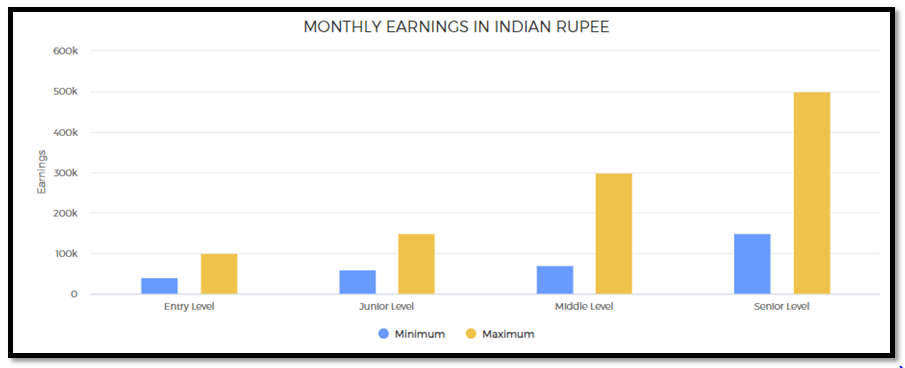
MONTHLY EARNINGS IN INDIAN RUPEE

1. Entry level: 0 - 2 years of work experience
2. Junior Level: From 1 to 12 years of work experience
3. Mid Level: From 5 to 20+ years of work experience
4. Senior Level: From 10 to 25+ years of work experience (there could be exceptions in some high-end technical, financial, engineering, creative, management, sports, and other careers; also in the near future, people will reach these levels much faster in many careers and in some careers, these levels will have no meaning as those careers will be completely tech skill driven such as even now, there is almost no level in a Cyber Security Expert’s job).
Work Activities
1. Analyzing and interpreting data and information - Analysis of data and information to find facts, trends, reasons behind situations, etc.; interpretation of data to aid in decision making.
2. Assessing and evaluating quality - Assessing and evaluating the quality of materials, systems, processes, products, services, etc.
3. Creative thinking - Developing new ideas, concepts, innovative solutions to problems, newer ways of getting things done, designing products and services, creating work of art and craft, etc.
4. Drawing, drafting, laying out and specifying objects, equipment, devices, tools, and systems - Creating and developing designs, drawings, layouts and specifications about how to construct, manufacture, assemble, build, use, and maintain various equipment, devices, tools, and systems.
5. Fabricating, assembling, and constructing equipment, devices, and products - Fabricating, assembling, constructing or otherwise manufacturing products, equipment, devices, and tools; testing and calibrating products, equipment, devices, tools, and systems.
6. Getting Information and learning - Observing, hearing, reading, using computers, or otherwise obtaining information and learning from it.
7. Inspecting equipment, systems, structures, and materials - Inspecting equipment, systems, structures, and materials to ascertain quality, performance, defects, causes of errors, etc.
8. Making decisions and solving problems - Analysis of data and information; evaluation of alternative decisions and results of decisions; taking the right decisions and solving problems.
9. Monitoring processes, systems, and performance - Observing and recording information on various criteria to monitor mechanical, electronics, electrical and other processes and systems; monitoring progress of projects and tasks.
10. Organizing, planning and prioritizing tasks - Planning and organizing tasks in order to achieve work goals; prioritizing tasks to achieve goals and making the best use of the time available.
11. Processing Information - Compiling, tabulating, calculating, auditing, verifying or otherwise dealing with information processing including data entry, transcription, recording, storing and maintaining databases.
12. Strategic planning - Developing visions and goals, developing strategies and action plans for achieving visions and goals.
13. Updating and using relevant knowledge - Keeping updated with the latest knowledge relevant to your fields of work and use of the relevant knowledge in getting things done.
14. Using computers for work - Using computers for day-to-day office work; using computer software for various applications in day-to-day professional work; entering data and process information; for writing.
15. Working in a team - Working in a team of people; developing team; maintaining professional relationships among team members.
Future Prospects
The future of this pathway seems particularly bright and illuminated as the industry statistics are very encouraging.
According to World Bank records, 54% of the population resides in urban areas globally and by 2045 this number is slated to increase 1.5 times with 6 billion people living in cities. Since lateral growth of residential/ commercial area is increasingly becoming slowed and obstructed, the only option that it leaves behind is terminal/ vertical growth which means higher towers and taller buildings.
The total contribution of the real estate sector in India’s GDP in 2025 is likely to reach around 13%. In addition, India is expected to become the 3rd largest construction market in the world by 2020, with the real estate sector expected to reach a size of USD 180 billion.
Demand for residential properties has surged due to increased urbanization and rising household income and major cities with good communication & transportation systems continue to attract domestic & foreign direct investment further driving the urban growth in such regions.
The Facade Systems Market is expected to grow from USD 272.7 billion in 2018 to USD 397.2 billion by 2023, at a rate of 7.8% compounded annually during 2017-2023.
The Exterior Wall Systems Market size will grow from USD 186.02 billion in 2017 to USD 278.82 billion by 2022, at a rate of 8.43% compounded annually.
The Glass Curtain Wall Market is projected to grow from USD 44.5 billion in 2018 to USD 73.4 billion by 2023, at a rate of 10.5% compounded annually during 2017-2023. The rise in demand for commercial buildings is driving the overall growth of this market across the globe.
The global demand for the Dry Concrete Market was valued at ~ USD 59.15 billion in 2018 and is expected to generate revenue of ~ USD 101.37 billion by end of 2025, growing at a rate of around 8.0% compounded annually between 2019 and 2025.
The 3D Concrete Printing Market is estimated at USD 1.2 million in 2018 and is anticipated to reach USD 1,480.5 million by 2023, at a rate of 317.3% compounded annually. The rise in demand for affordable housing and architectural flexibility, especially green technology, drive the growth of this market.
The Geotechnical Instrumentation and Monitoring Market is expected to grow from USD 3.3 billion in 2019 to USD 5.0 billion by 2024, growing at a rate of 9.0% compounded annually.
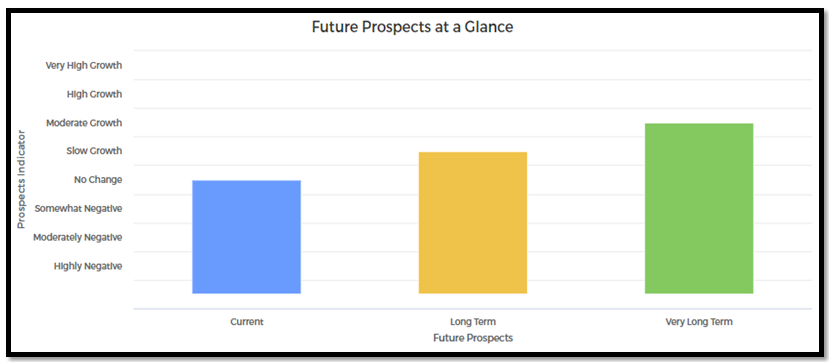
FUTURE PROSPECTS AT A GLANCE
