


Accountant
Entry Level Qualification
Class 12
Career Fields
Banking & Finance
For Specially Abled


Career Entrance Exam
NMIMS NPAT, IPU CET UG, IBPS CLERK, IBPS PO, SBI CLERK, SBI PO
About Career
PARTICULARS | DESCRIPTION |
Name | Accountant |
Purpose | Analysing Accounting Records |
Career Field | Banking & Finance |
Required Entrance Exam | NMIMS NPAT, IPU CET UG, IBPS CLERK, IBPS PO, SBI CLERK, SBI PO |
Average Salary | 100000 - 300000 Rs. Per Year |
Companies For You | KPMG, Deloitte, Ernst & Young & Many More |
Who is Eligible | Class 12th Pass |
An Accountant is a professional who maintains all records of commercial and financial transactions of an organisation or an individual. Commercial transactions involve exchange of goods and services such as sale or purchase of stationary, food items, machinery, furniture, land, buildings, insurance services, transportation services, healthcare services, etc. Accountants keep records of how much quantity or units are being sold or purchased.
Accountants keep track of and maintain records of the exchange of money that take place when goods and services are bought or sold. They maintain records of sales proceeds which are earned and also keep records of expenses. They keep records of assets (such as land, buildings, furniture, fixed deposits, shares, etc.) as well as that of liabilities (such as billed expenses for which the payment hasn’t been made yet, loans, etc.). Accountants also keep records of taxes and interests to be paid.
Accountants prepare invoices for payments to be received; prepare and give receipts against payments; prepare vouchers and other remittances for payments made. They ensure that all taxes and interests are paid in time.
Accountants maintain records in various types of books of accounts such as ledger, cash book, etc. Based on these records of financial transactions, they prepare various types of financial statements such as profit & loss statement, balance sheet, cash flow statement, etc. They also take part in cost estimation and budget as well as financial analysis to find out the financial situations in an organisation.
Accountants mostly use computers and various accounting software for carrying out their tasks.
Key Role And Responsibilities
1. As an Accountant, you will be involved in following key roles and responsibilities:
2. As an Accountant, you would be involved in developing, maintaining, and analysing budgets, preparing periodic report. For example cash memos are prepared to record the sales and purchases, invoices/receipts are prepared to record the credit transactions of the sales and purchases made, whereas pay in slips, vouchers, cheques, debit and credit notes are prepared for payment purposes.
3. As an Accountant you would be preparing, examining, or analysing accounting records, financial statements such as balance sheet, income statements, and cash flow statements. You would also examine financial reports to assess accuracy, completeness, and conformance to reporting and procedural standards.
4. As an Accountant you would be reviewing accounts for discrepancies and reconcile differences. For example you would be reviewing books of accounts like journals- Purchase Day Book, Sales Day Book, Return Inward Book, Return Outward Book, General Journal; and ledgers- cash books, general ledger, debtor ledger, creditor ledger etc.
5. As an Accountant you would also be analysing business operations, trends, costs, revenues, financial commitments, and obligations to project future revenues and expenses or to provide advice.
6. As an Accountant you would be adjusting entries of the statements at the end of the period such as deferrals, accruals, tax adjustments and omitted transaction adjustments.
7. As an Accountant you would be developing, implementing, modifying, and documenting- recordkeeping and accounting systems, making use of current computer technology.
8. As an Accountant you would be advising management about issues such as resource utilization, tax strategies, and the assumptions underlying budget forecasts.
9. As an Accountant you would advise clients in areas such as compensation, employee health care benefits, the design of accounting or data processing systems, or long-range tax or estate plans.
Career Entry Pathway
Class 10 all subjects as per the scheme of studies - Class 11-12 with any subject combination as per the scheme of studies preferably with Accountancy, Finance, Business Studies, etc. – Diploma in Accounting / Tally / Similar courses.
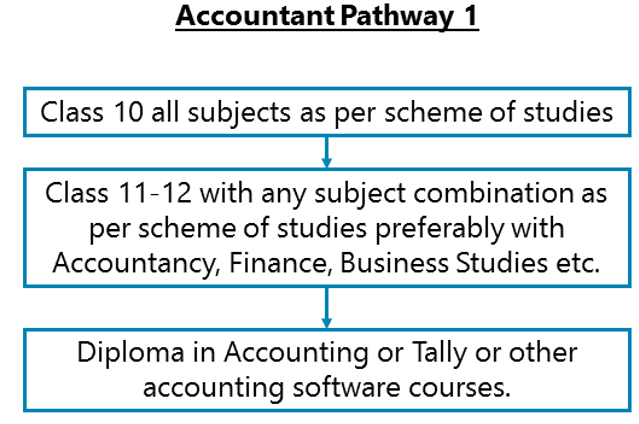
After completing Class 11-12 with any subject combination as per scheme of studies preferably with Accountancy, Finance, Business Studies etc., you can go for a diploma in Accounting or Tally or other accounting software courses.
Class 10 all subjects as per scheme of studies - Class 11-12 with any subject combination as per scheme of studies preferably with Accountancy, Finance, Business Studies etc. – B.Com.
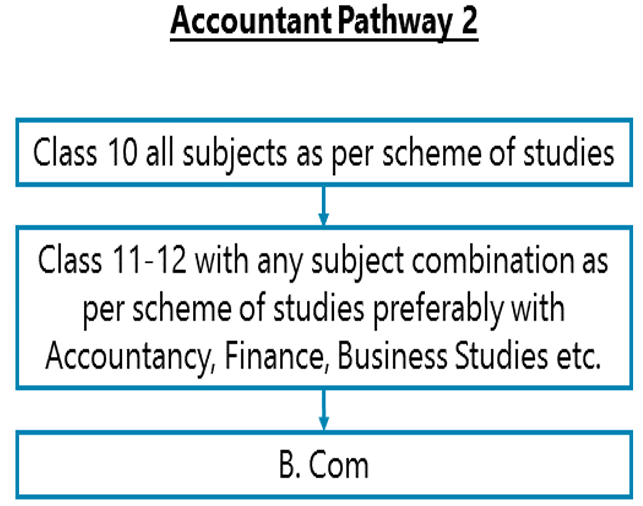
After having completed Class 11-12 with any subject combination as per scheme of studies preferably with Accountancy, Finance, Business Studies etc.. You can go for a bachelor’s degree in Commerce (B. Com) after your studies.
Class 10 all subjects as per scheme of studies - Class 11-12 with any subject combination as per scheme of studies preferably with Accountancy, Finance, Business Studies etc. – B.B.A. with Finance & Accounts/ or similar courses
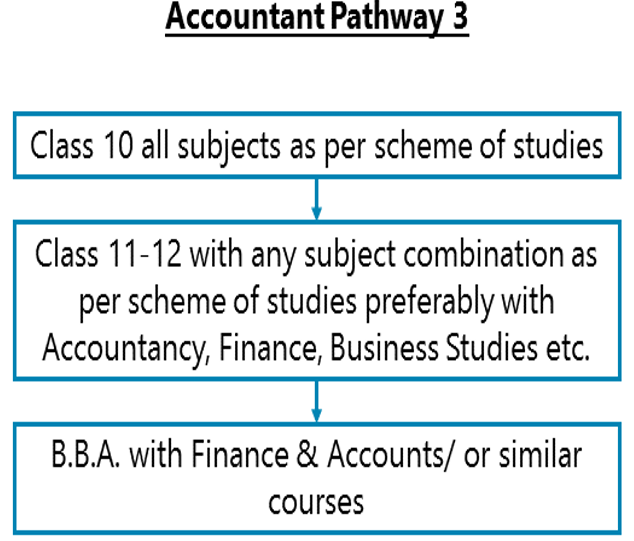
After completing Class 11-12 with any subject combination as per scheme of studies preferably with Accountancy, Finance, Business Studies etc., go for a B.B.A. with Finance & Accounts/ or similar courses.
Class 10 all subjects as per scheme of studies - Class 11-12 with any subject combination as per scheme of studies preferably with Accountancy, Finance, Business Studies etc. – B.Com. or B.B.A. with Finance and Accounts or B.B.A. with Finance – M.Com. / M.S. Accounting / similar other courses
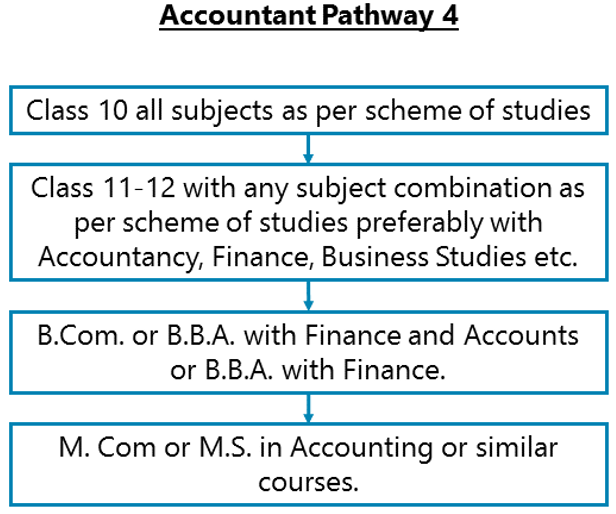
After completing Class 11-12 with any subject combination as per scheme of studies preferably with Accountancy, Finance, Business Studies etc., you can go for graduation in either B.Com. or B.B.A. with Finance and Accounts or B.B.A. with Finance. After having completed your graduation, you can pursue post-graduation in M. Com or M.S. in Accounting or similar courses.
Required Qualification & Competencies
After having completed class 10 and class 11-12, a diploma or certificate course in Accounting or Tally software could give you a start. However, doing a graduation in B.Com. or a B.B.A. in Accounting or a B.B.A. in Finance & Accounting or in a similar course will be a better option. In any case, knowledge of accounting software like Tally is essential. After having completed your graduation, if you wish to study further, you can go for a Master’s degree in M.Com. or M.S. in Accounting or similar courses.
UGC has recently recognised the CA/CS/ICWA Qualifications as equivalent to Postgraduate Degree.
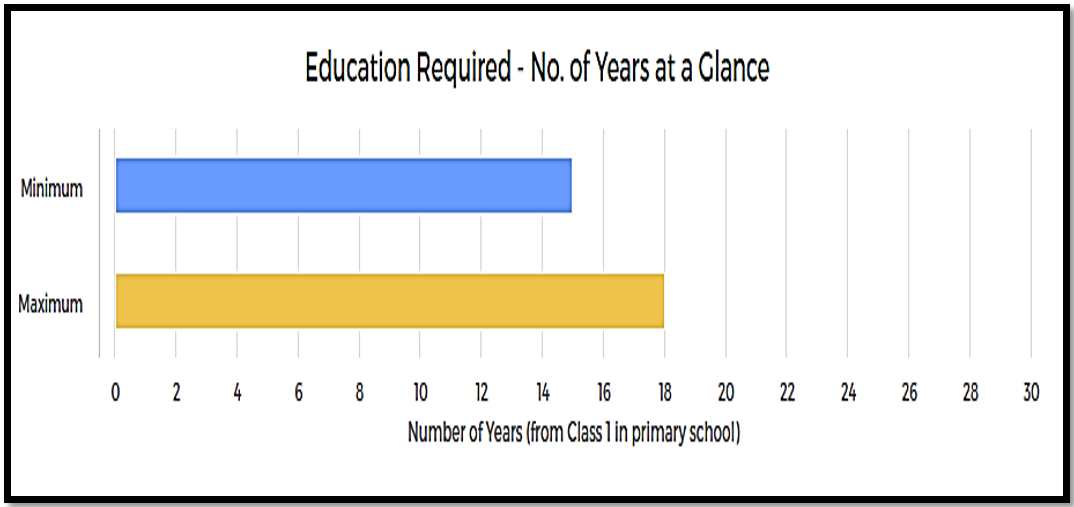
MINIMUM EDUCATION REQUIRED | MAXIMUM EDUCATION REQUIRED |
Undergraduate Degree / Honours Diploma / Graduate Diploma (equivalent to a Degree) Programs for which the minimum eligibility is a pass in Higher Secondary / Class XII School Leaving examination. | Post Graduate Postgraduate Degree / Diploma / Certificate Programs for which the minimum eligibility is a pass in Graduation / equivalent Diploma program like Honours Diploma or Graduate Diploma. |
Comprtrncies Required
Interests
Enterprising: You should have interests for Enterprising Occupations. Enterprising occupations involve taking initiatives, initiating actions, and planning to achieve goals, often business goals. These involve gathering resources and leading people to get things done. These require decision making, risk taking and action orientation.
Conventional: You should have interests for Conventional Occupations. Conventional occupations involve repetitive and routine tasks as well as fixed processes or procedures for getting things done. These occupations involve working more with data, systems, and procedures and less with ideas or creativity.
Abilities
Deductive Reasoning- The ability to apply general rules and common logic to specific problems to produce answers that are logical and make sense. For example, understanding the reasons behind an event or a situation using general rules and common logic.
Flexibility of Closure- The ability to identify or detect a pattern (a figure, object, word, or sound) that is hidden among other distracting materials.
Information Ordering- The ability to arrange things or actions in a certain order or pattern according to a specific rule or set of rules (e.g., patterns of numbers, letters, words, pictures, mathematical operations).
Inter-Personal-The ability to build and maintain good relationships with others at workplaces and elsewhere.
Problem Sensitivity- The ability to tell when something is wrong or is likely to go wrong. It does not involve solving the problem, only recognizing there is a problem.
Selective Attention- The ability to concentrate on a task over a long period of time without being distracted.
Speed of Closure- The ability to quickly make sense of, combine, and organize information into meaningful patterns.
Verbal Reasoning- The ability to think and reason with words; the ability to reason out ideas expressed in words.
Written Comprehension- The ability to read and understand information and ideas presented in writing.
Written Expression- The ability to communicate information and ideas in writing so others will understand.
Knowledge
Accounting — Knowledge of economic and accounting principles and practices, the financial markets, banking and the analysis and reporting of financial data.
Skills
Active Learning: Focused and continuous learning from various sources of information, observation and otherwise for application in getting work done.
Coordination: Skills in working together with other people to get things done.
Critical Thinking: Skills in analysis of complex situations, using of logic and reasoning to understand the situations and take appropriate actions or make interpretations and inferences.
Judgment and Decision Making: Skills in considering pros and cons of various decision alternatives; considering costs and benefits; taking appropriate and suitable decisions.
Managing Financial Resources: Skills in determining how money should be spent to get the work done, and accounting for these expenditures.
Negotiation: Skills in bringing others together and trying to reconcile differences.
Persuasion: Skills in persuading others to change their minds or behaviour.
Problem Solving: Skills in analysis and understanding of problems, evaluating various options to solve the problems and using the best option to solve the problems.
Reading Comprehension: Skills in understanding written sentences and paragraphs in work related documents.
Service Orientation: Skills in or keen interest to help and assist people.
Time Management: Skills in prioritizing work, managing time effectively.
Career - Job Opportunities & Profiles
At the entry level, you will work under the supervision of the middle level accounting professionals After having a Bachelor's degree in Commerce/ Accountancy / Similar course, you can get a job in the accounts department in the following or similar positions:
1. Accounts Trainee
2. Junior Accountant
3. Accounts Assistant
4. Tally Professional (if you have obtained a Certificate in Tally after your Class 11-12)
5. Bookkeeping clerk
Career Growth
As an Entry-level accountant, you will join as Accounts trainee or Junior Accountant and further with experience, you will move to the position of a Senior Accountant. As you gain more experience and expertise you will become the Head of a section of the Accounting department if you are in a large company or the Chief Accountant if you are in a small or medium sized company. In a large company, you may progress as: Accounts Trainee - Junior Accountant - Senior Accountant - Assistant General Manager - Deputy General Manager - General Manager - Vice Presiden. Small and mid-sized firms may make you progress as: Accounts Trainee - Junior Accountant - Senior Accountant - Chief Accountant.
Salary Offered
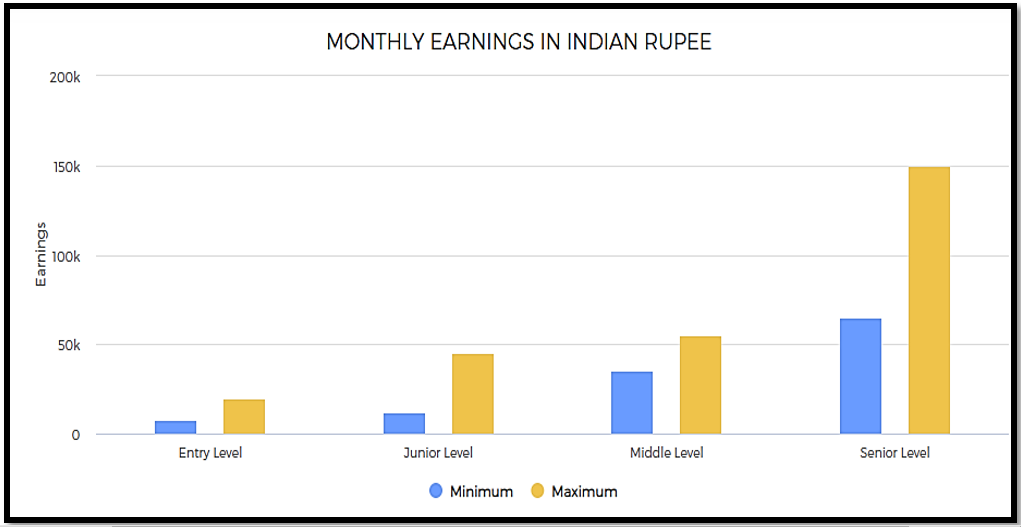
1. At Entry-level you may earn around, Rs. 8,000 – Rs. 20,000 per month.
2. For a Junior Level Accountant with an experience of 2-8 years, you may earn around Rs. 12, 000 – Rs. 45,000 or more per month.
3. Mid-Level Accountant with an experience of 8-15 years, you may earn around Rs. 35,000 – Rs. 55,000 or more per month.
4. Senior Level Accountant with an experience of 15-20 years, you may earn around Rs. 65,000 – Rs. 1, 50,000 or more per month.
Monthly Earnings In indian Rupee
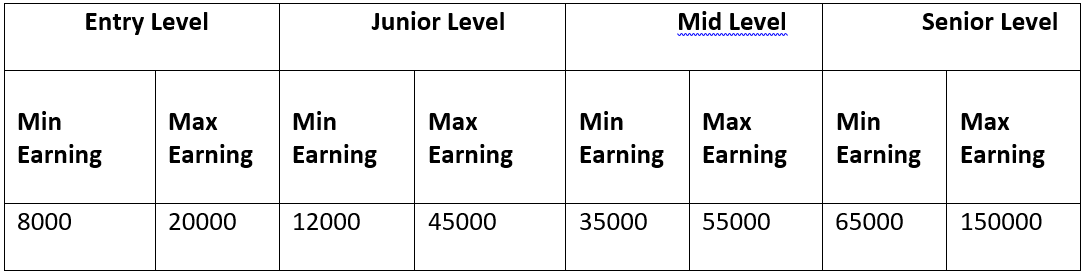
1. Entry level: 0 - 2 years of work experience
2. Junior Level: From 1 to 12 years of work experience
3. Mid-Level: From 5 to 20+ years of work experience
4. Senior Level: From 10 to 25+ years of work experience (there could be exceptions in some high-end technical, financial, engineering, creative, management, sports, and other careers; also in the near future, people will reach these levels much faster in many careers and in some careers, these levels will have no meaning as those careers will be completely tech skill driven such as even now, there is almost no level in a Cyber Security Expert’s job).
Work Activities
1. Getting Information- Observing, receiving, and otherwise obtaining information from all relevant sources.
2. Communicating with Supervisors, Peers, or Subordinates- Providing information to supervisors, co-workers, and subordinates by telephone, in written form, e-mail, or in person.
3. Documenting/Recording Information- Entering, transcribing, recording, storing, or maintaining information in written or electronic/magnetic form.
4. Establishing and Maintaining Interpersonal Relationships- Developing constructive and cooperative working relationships with others and maintaining them over time.
5. Processing Information- Compiling, coding, categorizing, calculating, tabulating, auditing, or verifying information or data.
6. Evaluating Information to Determine Compliance with Standards- Using relevant information and individual judgment to determine whether events or processes comply with laws, regulations, or standards.
7. Analysing Data or Information- Identifying the underlying principles, reasons, or facts of information by breaking down information or data into separate parts.
8. Making Decisions and Solving Problems- Analysing information and evaluating results to choose the best solution and solve problems.
9. Communicating with Persons outside Organization- Communicating with people outside the organization, representing the organization to customers, the public, government, and other external sources. This information can be exchanged in person, in writing, or by telephone or e-mail.
10. Interpreting the Meaning of Information for Others- Translating or explaining what information means and how it can be used.
11. Monitoring and Controlling Resources- Monitoring and controlling resources and overseeing the spending of money.
Future Prospects
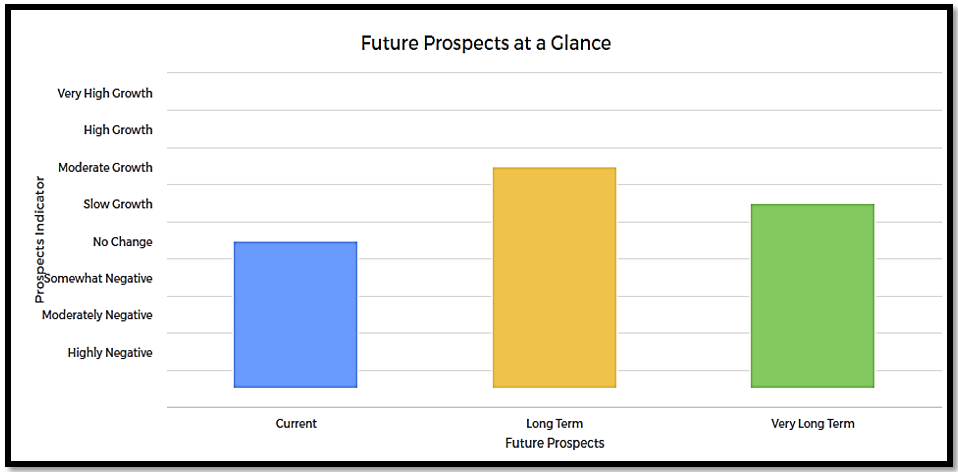
Advancements in information technology are transforming the role of Accountants. A lot of the basic accounting tasks can be done in accounting software quite easily. Persons with basic knowledge in Accounting can operate the software. Besides, the availability of complete accounting software on the cloud (as SaaS or software as service model - which means one can do the entire accounting online and pay on a monthly basis to the software company) has made many accounting jobs redundant. But in any case, accounting processes in large scale businesses as well as business taxation and the complexity of it still mandate recruitment of Accountants. So the overall prospects of this career is slow to moderate. In the very long term (over 10-15 years), however, number of recruitment of Accountants will slow down.
Future Prospects At A Glance
Current (0-1 year) | Long Term (2-5 year) | Very Long Term (6-10 years) |
No Change | Moderate Growth | Slow Growth |


