

Artificial Intelligence Engineer/AI Expert
Entry Level Qualification
Class 12
Career Fields
Engineering & Technology
For Specially Abled


Career Entrance Exam
JEE MAIN BE/BTECH, JEE ADVANCED, GATE, BITSAT UG, VITEEE BE/BTECH, SRMJEEE BE/BTECH
About Career
Artificial Intelligence (AI) let machines (mostly computer systems or other machines embedded with computer programs) do things or perform tasks that require human intelligence such as:
1. Recognition of speech and communicating, answering questions, giving insights, reacting to human emotions, etc.
2. Search for information and convey the search results; analyse information to recommend possible decision options and also recommend the best possible course of action in a given situation.
3. Recognize images, view objects and scenes, etc. and make inferences from observation.
4. Switch on / switch off as well as control operations of a machine, equipment, or device.
5. High tech Artificial Intelligence can assimilate knowledge from various sources like humans do, learn from experience of conversations with humans, understand human emotional reactions, and then make decisions on the basis of learning and experience.
In the near and not-so-distant future Artificial Intelligence will be able to handle complex human tasks such as writing a computer code, writing a poem or a song, compose a novel, operate a car, operate a spacecraft, carry out a medical surgery on a human/animal body, read a book and explain the underlying meaning, teach a student, and so on – the possibilities are enormous and some of the examples above are already in the making such as driver less cars.
Siri, Google Assistant, Alexa, Viv and other similar systems are driven by AI
If you are using an Apple phone you must already be using Siri. Siri is an AI driven personal assistant or intelligent agent which helps you to organize your daily tasks, remind you about your schedules, find the theatre where the movie you want to see is being screened and help you to book a ticket, find the restaurant you want to go for dinner and help you make the reservations, help you navigate from one place to another, and so on.Siri can even carry on some basic conversation.
Google Assistant on your android phone also do a lot although may not be doing all the tasks that Siri can do. However, Google has already launched Google Duplex which can carry out a lot of complex tasks such as calling a restaurant and make the reservations.
Alexa comes into various Amazon systems like Amazon Echo Dot. Alexa works as your personal assistant and work like Siri to a large extent. Alexa (called Alexa Hunches) can now guess what you might be thinking of – or what you've forgotten! Alexa keeps a record of what it hears every time. Viv is a new Apple AI system like Siri but it uses different algorithm which can perform much more complex tasks than Siri. Viv is still under development though.
IPSoft’s Amelia, IBM’s Watson, and similar other AI systems for enterprises
Amelia, a virtual agent deployed by many enterprises, is an advanced AI driven system which can observe, listen to, learn, understands, make inferences, and converse with people to solve their queries. Amelia is in the class of a cognitive agent, which is an intelligent system capable of cognition or ‘learning’. Many companies deploy Amelia as a Customer Service/ Support Agent, IT Operations Support Assistant, and similar other roles. Amelia has been developed IPSoft.
IBM’s Watson is an AI System which can perform a lot of basic and complex organizational tasks to reduce chances of human error and improve efficiency. Watson could be deployed as a Customer Service / Support Agent; it could be deployed as a conversational interface for any basic organizational tasks such as those of a secretary; Watson can analyse complex and large amont of data to discover patterns, trends, and help an organisation’s managers take decisions; Watson can recommend possible courses of actions too. Watson has applications across a range of industries – from media and advertising to healthcare and financial services.
Sounds exciting, isn’t it?
Over the years, AI research and development will keep on churning out more human like features in AI driven computer and other systems.
AI Experts at Toyota Research Institute are building crash-proof cars that can prevent accidents irrespective of the actions of the driver as well as smaller and more powerful batteries & fuel cells that will run longer using AI (Artificial Intelligence)/ ML (Machine Learning) technologies.
It you think a little ahead of time, consider a robotic assistant of a clinical psychiatrist or a device performing live surgeries without the intervention of a human surgeon. During the development phase, all of these will need the master expertise of an AI researcher and developer.
What will you do as an AI Engineer / AI Expert?
Build architecture, write algorithm, and write codes for AI systems
You will build system architecture, write algorithm, and write codes (called computer programs) to build intelligent systems which can perform various tasks that a human can do. System architecture defines how a system will work and what kind of hardware and software will be required. An algorithm is a set of rules or processes for computation (or calculation). An algorithm is like an elaborate and complex formula or step-by-step process for solving a problem or make a computer perform a specific task.
Research and develop futuristic AI Systems
You will work to research and develop Futuristic AI Systems which can perceive (e.g., understanding a scene, 3D vision, tracking, listening), predict (e.g., handling uncertainty, predicting human behavior, forecasting future situations), plan (e.g., understanding and reacting to human intent and plan actions according to that), learn (e.g., self-supervised learning, imitation learning, active learning, multi-task learning, adaptation to situations), reason (analyse data and situations using knowledge and experience, understand pros and cons of actions, etc.) and talk effectively with a human.
Build prototype, deploy, test, debug, and eliminate error to improve AI systems
You will build prototype of AI Systems that you research and develop; you will deploy the system into some applications in industries or in day-to-day life; you will test performance of the system and eliminate bugs or errors for performance improvement.
Invent and model AI solutions for problems and applications
You will invent new AI technologies, new applications of existing technologies, AI platforms and tools. You will build new applications in AI technologies such as cognitive computing, neural engineering, machine learning, deep learning, reinforcement learning, natural language processing, computer vision, and optimization.
You will build machine learning models (models represent a process as to how machines can ‘learn’ to perform a task) to solve a real life problem or for developing a real life application using complex mathematical theories such as Linear Algebra, Markov Modelling, Decision Tree Analysis, Bayesian Networks, etc.
You will write codes to develop artificial neural networks (which work like the neuron networks in human nervous systems); develop computational methods using parallel and distributing computing (using these, a very large amount data could be processed in a little time).
Key Roles and Responsibilities
1. Research on AI topics and build prototype on identified areas.
2. Design experiments for testing hypotheses for AI technology or solution development.
3. Suggesting cutting edge solution to solve AI related problems.
4. Devise data-driven models of human behavior.
5. Develop Machine learning model.
6. Develop deep learning architecture and algorithm; neural engineering architecture and algorithm; natural language processing algorithm; and algorithm using other AI technologies.
7. Develop logic and rules for data mining.
8. Write codes (computer programs) to build AI systems.
9. Build and deploy prototype AI solutions to demonstrate ideas and prove concepts.
10. Research, develop, and optimize AI applications.
11. Perform research to advance the science and technology of intelligent machines.
12. Perform research that enables learning the semantics of data (images, video, text, audio, and other modalities).
13. Apply knowledge of relevant research domains along with expert coding skills to platform and framework development projects.
14. Design machine learning systems.
15. Research and implement appropriate Machine Learning algorithms and tools.
16. Develop machine learning applications according to Requirements.
17. Select appropriate datasets and data representation methods.
18. Run machine learning tests and experiments.
19. Perform statistical analysis and fine-tuning using test results.
Career Entry Pathway
Class 10 all subjects as per scheme of studies – Class 11-12 Physics, Chemistry, Mathematics along with any other subject as per scheme of studies – Undergraduate degree in Computer Science & Engineering/ Software Engineering/ Electrical Engineering/ Electronics Engineering/ Robotics/ Avionics /Information or Data Engineering/ Similar
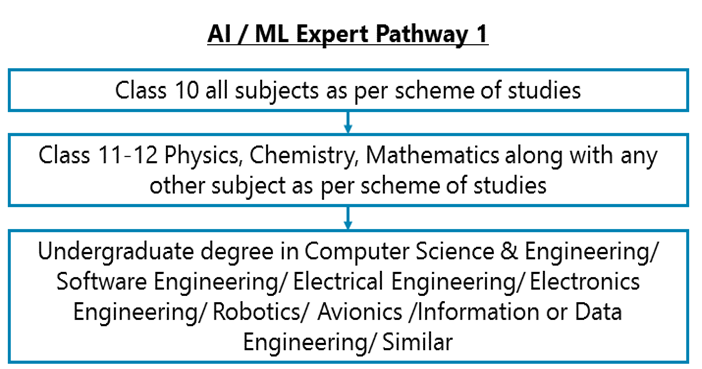
After completing Class 11-12 Physics, Chemistry, Mathematics along with any other subject as per scheme of studies, you can do a Bachelor’s degree in Computer Science / Computer Science & Engineering / Artificial Intelligence/ AL & ML/ Electrical Engineering / Electronics Engineering/ Electrical & Electronics Engineering / Electronics & Communication Engineering / Robotics/ Information Science & Engineering / Data Engineering / similar other field. After your Engineering degree, if you are from a premier Engineering institute, you may get a work opportunity in AI. Otherwise, you may work in software engineering for 2-5 years to get a good break in AI programming and development.
Class 10 all subjects as per scheme of studies – Class 11-12 Physics, Chemistry, Mathematics along with any other subject as per scheme of studies – Undergraduate degree in Computer Science & Engineering/ Software Engineering/ Electrical Engineering/ Electronics Engineering/ Artificial Intelligence/ AI & ML/ Robotics/ Avionics /Similar– Master degree in Computer Science & Engineering / Artificial Intelligence/ Machine Learning/ Robotics / Electronics/ Electronics & Communication Engineering / Data Science/ Data Engineering / Avionics / Information Science & Engineering / Electrical Signal Processing / Computer Networking / similar field
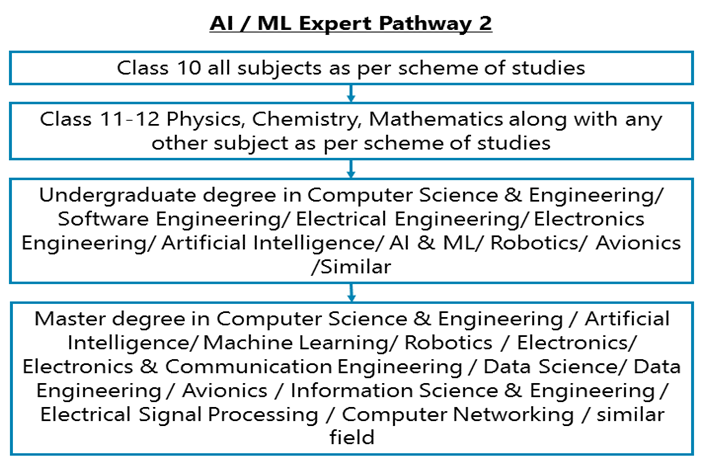
After completing Class 11-12 Physics, Chemistry, Mathematics along with any other subject as per scheme of studies,you can do a Bachelor’s degree in Computer Science / Computer Science & Engineering / Electrical Engineering / Electronics Engineering/ Electrical & Electronics Engineering / Electronics & Communication Engineering / Robotics/ Information Science & Engineering / Data Engineering / similar other field. After your Engineering bachelor’s degree, you can do a Master’s degree in Computer Science & Engineering / Artificial Intelligence/ Machine Learning/ Robotics / Electronics/ Electronics & Communication Engineering / Data Science/ Data Engineering / Information Science & Engineering / Electrical Signal Processing / Computer Networking / similar field.
Class 10 all subjects as per scheme of studies – Class 11-12 Physics, Chemistry, Mathematics along with any other subject as per scheme of studies – Undergraduate degree in Computer Science & Engineering/ Software Engineering/ Electrical Engineering/ Electronics Engineering/ Robotics/Avionics / Artificial Intelligence/ AI & ML/ Similar– Master degree in Computer Science & Engineering / Artificial Intelligence/ Machine Learning/ Robotics / Avionics / Electronics/ Electronics & Communication Engineering / Data Science/ Data Engineering / Information Science & Engineering / Electrical Signal Processing / Computer Networking / similar field – Ph.D. in Computer Science / Computer Engineering / Artificial Intelligence/ Machine Learning/ Robotics/ Avionics Information Science & Engineering / Data Engineering / Data Science/ Similar field
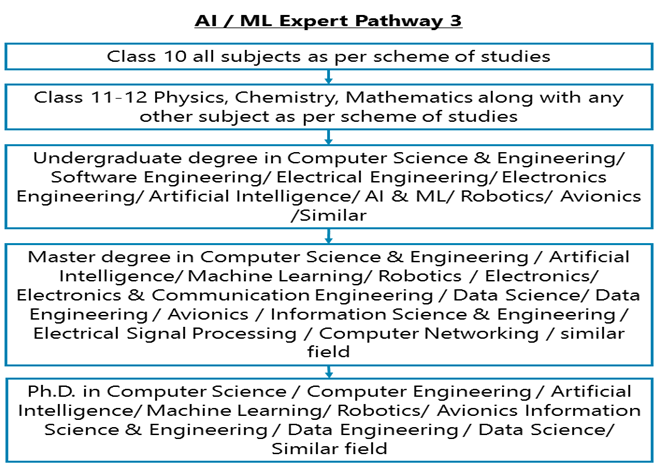
After completing Class 11-12 Physics, Chemistry, Mathematics along with any other subject as per scheme of studies,you can do a Bachelor’s degree in Computer Science / Computer Science & Engineering / Electrical Engineering / Electronics Engineering/ Electrical & Electronics Engineering / Electronics & Communication Engineering / Robotics/ Avionics /Information Science & Engineering / Data Engineering / similar other field. After your Engineering bachelor’s degree, you can do a Master’s degree in Computer Science & Engineering / Artificial Intelligence/ Machine Learning/ Robotics /Avionics /Electronics/ Electronics & Communication Engineering / Data Science/ Data Engineering / Information Science & Engineering / Electrical Signal Processing / Computer Networking / similar field. Then you can do a Ph.D. in Computer Science / Computer Engineering / Computational Science/ Advanced Computing / Computer Vision/ Cognitive Computing/ Artificial Intelligence/ Machine Learning/ Robotics/ Avionics /Information Science & Engineering / Data Engineering / Data Science/ Neural Engineering/Quantum Computing/ Similar field. A Ph.D. can help you to get opportunities in high tech research and development work in AI.
Class 10 all subjects as per scheme of studies – Class 11-12 Physics, Chemistry, Mathematics along with any other subject as per scheme of studies – Undergraduate degree in CSE / Electronics and Electrical Engineeringor similar – PG Diploma in ‘Artificial Intelligence’or similar
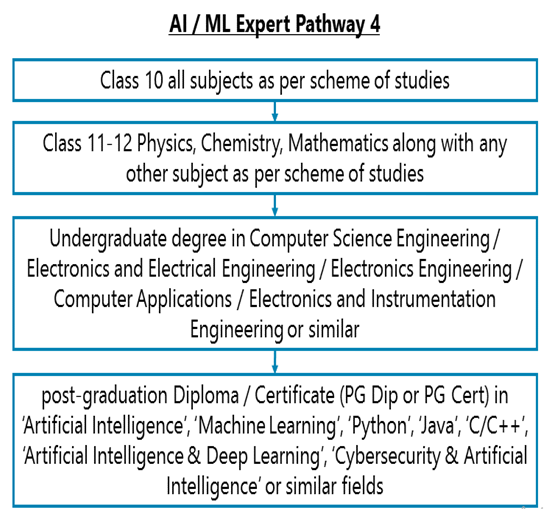
After completing Class 11-12 Physics, Chemistry, Mathematics along with any other subject as per scheme of studies, you can finish your graduation in Computer Science Engineering / Electronics and Electrical Engineering / Electronics Engineering / Computer Applications / Electronics and Instrumentation Engineering or similar. Then you can go for a post-graduation Diploma / Certificate (PG Dip or PG Cert) in ‘Artificial Intelligence’, ‘Machine Learning’, ‘Python’, ‘Java’, ‘C/C++’, ‘Artificial Intelligence & Deep Learning’, ‘Cybersecurity & Artificial Intelligence’ or similar fields.
Class 10 all subjects as per scheme of studies – Class 11-12 Mathematics along with any other subject as per scheme of studies – Bachelor degree in Mathematics / Statistics/ Computer Science/ Data Science/ Similar field – Master degree in Mathematics/ Statistics/ Computer Science/ Data Science/ similar field
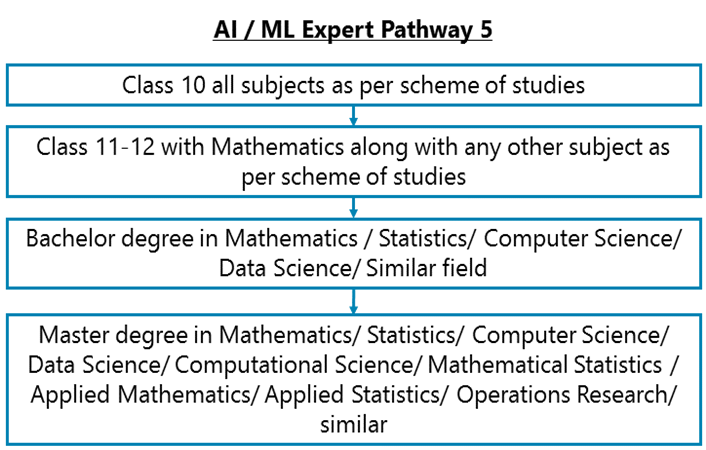
After your Class 11-12 with Mathematics along with any other subject as per scheme of studies, you can do a Bachelor’s degree Mathematics / Statistics/ Computer Science/ Data Science/ Similar field. Then you can do a Master degree in Mathematics/ Statistics/ Computer Science/ Data Science/ Computational Science/ Mathematical Statistics / Applied Mathematics/ Applied Statistics/ Operations Research/ similar field to get an opportunity work in the field of AI.
Class 10 all subjects as per scheme of studies – Class 11-12 with Mathematics along with any other subject as per scheme of studies – Bachelor degree in Mathematics / Statistics/ Computer Science/ Data Science/ Similar field – Master degree in Mathematics/ Statistics/ Computer Science/ Data Science/ similar field – Ph.D. in Mathematics/ Statistics/ Computer Science/ Computational Science/ Data Science/ Artificial Intelligence/ Machine Learning/ Cognitive Computing/ similar field
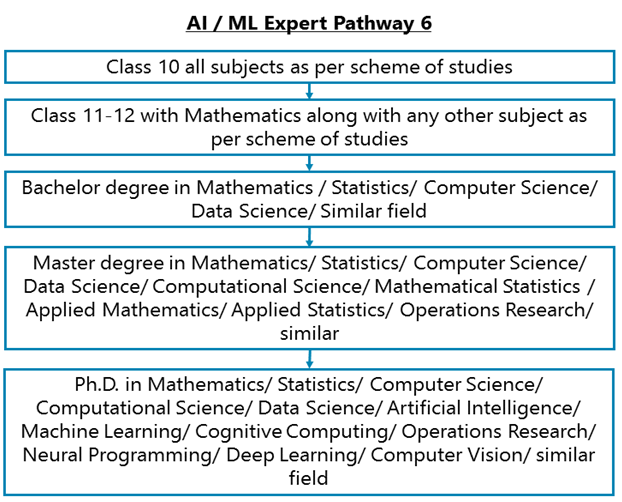
After your Class 11-12 with Mathematics along with any other subject as per scheme of studies, you can do a Bachelor’s degree Mathematics / Statistics/ Computer Science/ Data Science/ Similar field. Then you can do a Master degree in Mathematics/ Statistics/ Computer Science/ Data Science/ Computational Science/ Mathematical Statistics / Operations Research / Applied Mathematics/ Applied Statistics/ similar field. After your Master’s degree, you can do a Ph.D. in Mathematics/ Statistics/ Computer Science/ Computational Science/ Data Science/ Artificial Intelligence/ Machine Learning/ Cognitive Computing/ Operations Research/ Neural Programming/ Deep Learning/ Computer Vision/ similar field. You can get a good opportunity then. Or, you can even complete a Post-Doctoral Fellowship/ Internship after Ph.D. before you opt for a full-time opportunity in the field of AI.
Class 10 all subjects as per scheme of studies – Class 11-12 Physics, Chemistry, Mathematics along with any other subject as per scheme of studies – Undergraduate degree in Physics / Physical Sciences–Post Graduate degree in Physics/ Applied Physics/ Computational Physics/ Computational Sciences/ Data Science/ similar field – Doctoral Studies in Computational Science/ Advanced Computing/ Quantum Computing/ Data Science/ Artificial Intelligence/ Machine Learning/ similar
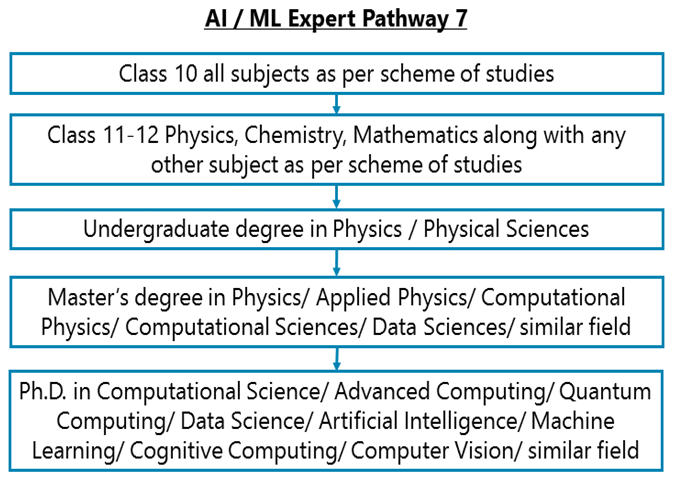
After completing Class 11-12 Physics, Chemistry, Mathematics along with any other subject as per scheme of studies, you can go for a bachelor’s degree course in Physics / Physical Sciences. Then you can a Master’s degree in Physics/ Applied Physics/ Computational Physics/ Computational Sciences/ Data Sciences/ similar field. Thereafter, you can do a Ph.D. in Computational Science/ Advanced Computing/ Quantum Computing/ Data Science/ Artificial Intelligence/ Machine Learning/ Cognitive Computing/ Computer Vision/ similar field. You may even do well if you opt for an internship / Post-Doctoral Fellowship after your Ph.D. before you look out for a full-time work opportunity.
Class 10 all subjects as per scheme of studies – Class 11-12 Physics, Chemistry, along with Mathematics or Biology & any other subject as per scheme of studies – Bachelor degree in Biosciences/ Life Sciences/ Zoology/ Physiology/ Bioengineering/ similar – Master’s degree in Biosciences/ Life Sciences/ Bioengineering/ Cognitive Science/ Similar inter-disciplinary field – Ph.D. in Neuroscience/ Neurobiology/ Computational Neuroscience/ Cognitive Science/ similar field
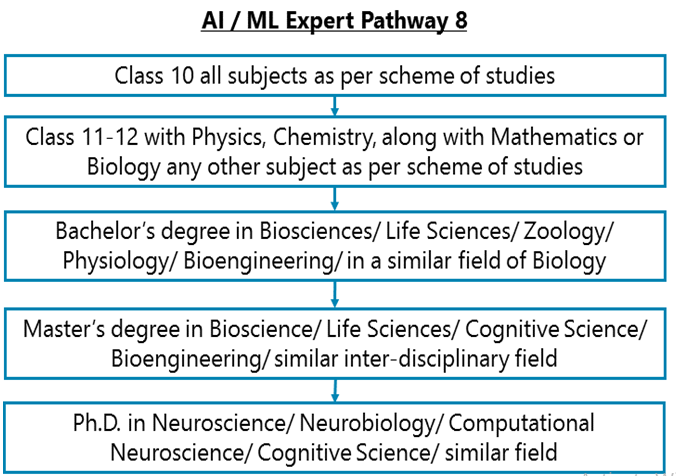
You can do your Class 11-12 Physics, Chemistry, along with Mathematics or Biology any other subject as per scheme of studies. Then you can first do a Bachelor’s degree in Biosciences/ Life Sciences/ Zoology/ Physiology/ Bioengineering/ in a similar field of Biology, better in an inter-disciplinary program in Biological Sciences. Then you can do a Master’s degree in Bioscience/ Life Sciences/ Cognitive Science/ Bioengineering/ similar inter-disciplinary field. Thereafter, you can proceed to do a Ph.D. in Neuroscience/ Neurobiology/ Computational Neuroscience/ Cognitive Science/ similar field to get an opportunity to work in the field of AI. But it will be better if you do an internship/ Post – Doctoral Fellowship first before you look for a full-time work opportunity.
Class 10 all subjects as per scheme of studies – Class 11-12 with Psychology along with any other subject as per scheme of studies – Bachelor degree in Psychology/ Applied Psychology – Master’s degree in Psychology/ Applied Psychology/ Experimental Psychology/ Cognitive Science/ Similar inter-disciplinary field – Ph.D. in Applied Psychology/ Cognitive Science/ similar field
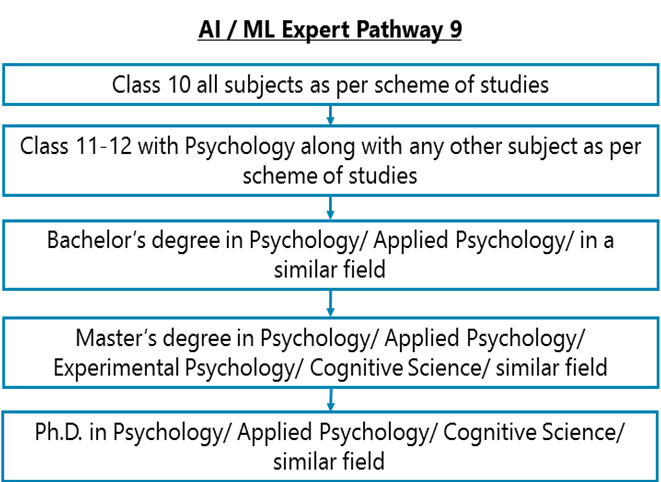
You can do your Class 11-12 with Psychology along with any other subject as per scheme of studies. Then you can first do a Bachelor’s degree in Psychology/ Applied Psychology/ in a similar field. Then you can do a Master’s degree in Psychology/ Applied Psychology/ Experimental Psychology/ Cognitive Science/ similar field. Thereafter, you can proceed to do a Ph.D. in Psychology/ Applied Psychology/ Cognitive Science/ similar field to get an opportunity to work in the field of AI. But it will be better if you do an internship/ Post – Doctoral Fellowship first before you look for a full-time work opportunity.
Class 10 all subjects as per scheme of studies – Class 11-12 with Mathematics along with any other subject as per scheme of studies – Bachelor degree in a Language/ Linguistics – Master’s degree in Linguistics/ Applied Linguistics/ Computational Linguistics/ Similar field – Ph.D. in Applied Linguistics/ Computational Linguistics/ similar field
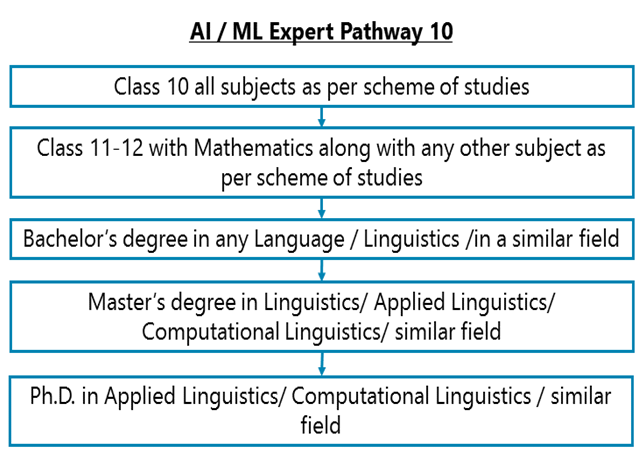
You can do your Class 11-12 with Mathematics along with any other subject as per scheme of studies. Then you can first do a Bachelor’s degree in any Language / Linguistics /in a similar field. Then you can do a Master’s degree in Linguistics/ Applied Linguistics/ Computational Linguistics/ similar field. Thereafter, you can proceed to do a Ph.D. in Applied Linguistics/ Computational Linguistics / similar field to get an opportunity to work in the field of AI. But it will be better if you do an internship/ Post – Doctoral Fellowship first before you look for a full-time work opportunity.
Required Qualification & Competencies
To get into this field, you will need to pass Class 10 examination with all subjects as per scheme of studies. Then you must complete Class 11-12 with Physics, Chemistry, and Mathematics / with Physics, Chemistry, and Biology / with Physics, Chemistry, Mathematics, & Biology along with any other subject like Psychology as per scheme of studies and above pathways.
Then depending upon your educational background in Class 11-12, you can do a Bachelor’s / Bachelor’s and Master’s/ Bachelor’s, Master’s, and Doctoral degree in any of the following academic fields. Remember that all these fields may not be available in all the three levels, that, in Bachelor’s, Master’s, and Doctoral. Also remember that a few of these fields might be available to you after your Bachelor’s degree in a field of Physical/ Biological/ Engineering Sciences.
1. Advanced Computing
2. AI & Deep Learning
3. Applied Artificial Intelligence
4. Applied Mathematics
5. Applied Statistics
6. Artificial Intelligence
7. Artificial Intelligence & Machine Learning
8. Bioelectrical Engineering
9. Bioelectronics Engineering
10. Bioengineering
11. Biosciences
12. Cloud Computing
13. Cognitive Sciences
14. Communication and Computer Engineering
15. Computational Mathematics
16. Computational Neuroscience
17. Computational Sciences
18. Computational Sciences & Engineering
19. Computer Networks
20. Computer Networks & Information Security
21. Computer Science
22. Computer Science & Engineering
23. Computer Vision
24. Cybersecurity & Artificial Intelligence
25. Data Science
26. Data Science & Artificial Intelligence
27. Data Science & Engineering
28. Distributed & Parallel Computing
29. Electrical and Computer Engineering
30. Electrical Engineering
31. Electronics & Communication Engineering
32. Electronics and Computer Engineering
33. Electronics Engineering
34. Embedded Systems and VLSI Design
35. High Performance Computing and Cloud Technologies
36. Human-Centered Big Data & Artificial Intelligence
37. Information Science & Engineering
38. Internet of Things
39. Life Science
40. Machine Learning
41. Machine Learning and Autonomous Systems
42. Machine Learning and Machine Intelligence
43. Mathematical Statistics
44. Mathematics
45. Mathematics and Computer Science
46. Mathematics and Statistics
47. Neurobiology
48. Neuroscience & Neurobiology
49. Operations Research
50. Programming and Software Engineering
51. Psychology and Neuroscience
52. Quantum Computing
53. Robotics
54. Statistics
55. Statistics and Computer Science
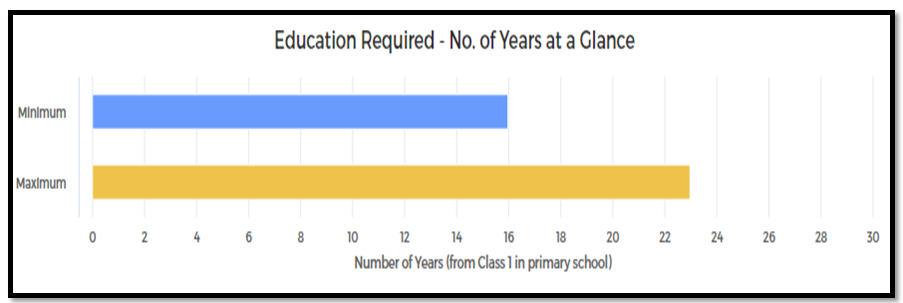
MINIMUM EDUCATION REQUIRED | MINIMUM EDUCATION REQUIRED |
Under Graduate | Post-Doctoral |
COMPETENCIES REQUIRED
Occupational Interests
1. You should have interests for Investigative Occupations. Investigative occupations involve working with ideas and quite a lot of thinking, often abstract or conceptual thinking. These involve learning about facts and figures; involve use of data analysis, assessment of situations, decision making and problem solving.
2. You should have interests for Realistic Occupations. Realistic occupations involve more practical and hands-on activities than paperwork or office work. Realistic occupations often involve physical activities for getting things done using various tools and equipment.
3. You should have interests for Enterprising Occupations. You should have interests for Enterprising Occupations. Enterprising occupations involve taking initiatives, initiating actions, and planning to achieve goals, often business goals. These involve gathering resources and leading people to get things done. These require decision making, risk taking and action orientation.
Knowledge
1. Fundamentals of AI, Machine Learning, Deep Learning, Data Mining, Predictive Modelling, Natural Language Processing, Understanding, and Generation (NLP & NLU & NLG)
2. AI capabilities - including chatbots, NLP, Recommender Engines, Image/Video analytics, among others.
3. Knowledge ofLinear Algebra, Optimization, Statistics, and Algorithms.
4. Knowledge of Statistical methods; Machine Learning techniques and Algorithm such as - Neural networks, SVM, Random forests, Bagging, Gradient boosting machines (GBM), k-means++, Deep learning, Reinforcement learning, Regression, Decision Trees, Markov Decision process, etc.
5. Engineering and Technology - various applications of Software Engineering; this includes knowledge about design, development, prototype testing, installation and maintenance.
Skills
1. Programming skills in C, C++, Python, Java, Julia, Scala, Lua, etc.
2. Data analysis using any one of R, MATLAB, etc.
3. Data processing skills using SQL, PySpark, Hadoop, noSQL, etc.
4. High Scale distributed RDBMS like SQL Server, RedShift, Teradata, Netezza, Greenplum, Aster Data, Vertica, etc.
5. AI Frameworks and tools such as – Microsoft BOT, scikit-learn, XGBoost, Pytorch, TensorFlow, Caffe, Theano, Keras, Spacy, H2O, etc.
6. Software development environment such as Agile and Scrum
7. Cloud technologies and infrastructure such as - Google, AWS, MS-Azure, Cloudera, EC2
8. You should have Critical Thinking skills- Skills in the analysis of complex situations, using logic and reasoning to understand the situations and take appropriate actions or make interpretations and inferences.
9. You should have Reading Comprehension Skills - Skills in understanding written sentences and paragraphs in work related documents.
10. You should have Judgment and Decision Making Skills - considering pros and cons of various decision alternatives; considering costs and benefits; taking appropriate and suitable decisions.
11. You should have Problem Solving Skills - Skills in analysis and understanding of problems, evaluating various options to solve the problems and using the best option to solve the problems.
Abilities
1. Abstract Reasoning: The ability to understand ideas which are not expressed in words or numbers; the ability to understand concepts which are not clearly expressed verbally or otherwise.
2. You should have Deductive Reasoning Ability - apply general rules and common logic to specific problems to produce answers that are logical and make sense. For example, understanding the reasons behind an event or a situation using general rules and common logic.
3. You should have Inductive Reasoning Ability - The ability to combine pieces of information from various sources, concepts, and theories to form general rules or conclusions. For example, analyzing various events or situations to come out with a set of rules or conclusions.
4. Mathematical Reasoning: The ability to choose the right mathematical methods or formulas to solve a problem.
5. Numerical Reasoning: The ability to add, subtract, multiply, divide, and perform other basic numerical calculations correctly.
Personality
1. You are always or mostly organised in your day-to-day life and activities.
2. You always feel secure in your surroundings and in most situations.
3. You are imaginative sometimes.
4. You prefer to experience new things and have new experiences sometimes.
5. You act independently sometimes but do not do so in some other times.
6. You are friendly and outgoing sometimes, but not always. You prefer company of people sometimes but not always.
7. You are always practical or in most situations.
Career - Job Opportunities & Profiles
If you want to get a good opportunity in Artificial Intelligence after your Bachelor's degree, then you need to pass out with an Engineering degree from a premier Engineering institution. Or else, you can work in software engineering and development for a few years (say, about 4-5 years). You may then attempt to find an internship also before you look out for a full-time opportunity.
After your Master’s degree in a suitable field, you can get a good start. But in this case also, doing an internship first will help you to land up in a good job in AI.
If you plan to do a Doctoral degree first, it could be a really good idea as a Ph.D. can open up great research opportunities for you.
In most cases, at the beginning of your career, depending upon your educational qualifications as well as skills, you will start off in any one of the following or similar positions:
1. AI Engineer
2. AI/ML Engineer
3. Computational Neuroscientist
4. Computational Scientist
5. Data Scientist
6. Data Scientist (AI)
7. Engineer (Machine Learning)
8. Machine Learning Engineer
9. Research & Development Engineer
10. Research Engineer
11. Research Scientist
12. Software Development Engineer – AI
13. Software Engineer (AI/ML)
You may also get opportunities in research and teaching in some of the top universities in the world. But to get an opportunity there, you must complete your MS and Ph.D. from one of the top Universities in the world teaching Computer Science and related subjects.
In a University, after your Ph.D., you may get an opportunity as a:
1. Research Associate
2. Post-Doctoral Fellow
3. Assistant Professor/ Similar position
Various types of companies may recruit you:
1. Internet and IT giants such as IBM, Google, Microsoft, Facebook, Amazon Services Inc., Tencent, Twitter, etc.






2. Other IT companies focused on software engineering in the field of AI such as IPSoft, OpenAI, AlphaSense, AIBrain, CloudMinds, Deepmind, H20, Iris AI, Active.ai, etc.
3. Companies which design and develop various microprocessors/ electronic systems / devices / applications, advanced semiconductor technologies for industrial clients or for bulk consumption such as Apple Inc., Intel, Nvidia, Qualcomm, Cisco, Samsung Electronics, Siemens, Intel, Verizon, Ericsson, Oracle, SAP, IMEC, Nokia, Symantec, etc.





4. Automotive and transportation systems manufacturers (some of these are suppliers of automotive technology for the biggest car manufacturers in the world) including aerial flight systems such as Toyota, Tesla, Volvo, Autonodyne, Xevo, Nuance Automotive, Hyundai etc.


5. Space research and administration organisations such as NASA, ISRO, etc.

6. Fin Tech - Companies which are into the BFSI industry such as insurers, consultancies, financial institutions, investment banking companies or others like Kasisto, Tesorio, Splunk, YotaScale Inc, Zestfinance, Scienaptic Systems, Underwrite.Ai, Kensho etc.
7. Health Tech – companies such as MetaMind involved in deep learning networks, image recognition, text analysis, machines / systems / devices to cater to the healthcare sector.
8. Technology / research divisions of Deloitte, Goldman-Sachs, JP Morgan Chase.



Some of the top universities in the world working in the area of AI are:
1. California Institute of Technology
2. Carnegie Mellon University
3. Columbia University
4. Cornell University
4. Georgia Institute of Technology
5. Harvard University
6. IIT Delhi
7. IIT Bombay
8. IIT Kharagpur
9. IIT Kanpur
10. IIT Madras
11. IIT Patna
12. IIT BHU
13. IIT Hyderabad
14. IIIT Hyderabad
15. IIT Jodhpur
16. Johns Hopkins
17. MIT
18. Nanyang Technological University
19. Stanford University
20. University of California Los Angeles
21. University of California, Berkeley
22. University of Illinois Urbana Champaign
23. University of Pennsylvania
24. University of Southern California
25. University of Texas at Austin
26. University of Washington Seattle
27. Yale University
SPECIALISATION TRACKS IN THIS CAREER
1. Machine Learning Engineer / Expert
AI is the technology and ML is one of the many techniques to bring about this technology. Machine Learning is a current application of AI based around the idea that machines when given access to data, can learn for themselves. ML Experts can make computers capable of reading text and deciding whether the person who wrote the text is complaining or congratulating; then listening to a piece of music, understanding whether it is likely to make someone happy or sad, and finding other pieces of music to match the mood; even composing their own music expressing the same themes which they know is likely to be appreciated! ML experts can help machines understand the vast nuances of human languages too, and to learn how to respond in a way we can comprehend.
2. AI Expert (Natural Language Processing – NLP and Speech Recognition)
This is a subset of AI. NLP and Speech Processing experts write codes to enable computers to communicate with people using everyday language. They deal with the conversion of information from the computer database into readable human language and vice versa. Speech Recognition involves phonetics and word recognition (the way humans of different nationalities speak a language or the same language with distinct dialects).
3. AI Expert (Deep Learning)
Deep learning is powerful because it makes hard things easy for machines!DL Experts work towards making a machine/computing device excel at identifying patterns in unstructured data. For example, a cluster of 16000 computers has been successfully trained by DL Experts to recognize a cat based on 10 million digital images (unstructured data) taken from YouTube videos! This may be an easy task for a human brain but such a task of ‘learning from experience’ is too tough for a computer!
4. AI Expert (Cognitive Computing)
How humans approach problem solving is the primary focus of this sub-field of AI. Siri, Google Assistant, Cortana, and Alexa are few of the best illustrations of exemplary contributions of AI Experts specializing in Cognitive Computing, all with a common goal of simulating human thought processes in a computerized model. Similarly, IBM's cognitive computer system, Watson (development team led by principal investigator David Ferrucci) could help in lung cancer treatment in NY. Today around 80% of nurses working with Watson follow its guidance.
5. AI Expert (Avionics AI)
The ultimate motives of AI Experts practicing in the field of Avionics is to bridge the gap between the pilot driver and the control systems in an operating air vehicle or enhance functionalities of the controlling systems in an unmanned aerial vehicle (UAV) such as satellite systems or space rotors etc.which are not physically driven by humans. AI Avionics Experts design intelligent systems which can process information from multiple sensors & sources and present it to the pilot enabling her to make an informed decision while on a flight or take critical decisions in the absence of a human driver. Futuristically, this wave can potentially even remove the need for a pilot in the future.
6. AI Expert (Predictive APIs)
This is also a sub-branch of AI. Prediction is to guess the future before it happens. Prediction in technical terms is analyzing a set of data and find out whether something is going to happen or not and this is what AI Prediction Interface Engineers do. For example, weather widgets on your phone specially written by AI Prediction Application Expert teams can predict future temperature from a set of data of the last 10 or more years. Similarly, AI Application Program InterfaceExperts specializing in the field of Prediction Interfacing have composed the Google Prediction API tries to guess what your next words in an email can be, or whether you want to attach a file to your mail when you have written the word attachment but have forgotten to finally attach it.
7. AI Expert (Visual Computing and Image Recognition / Computer Vision)
AI Experts practicing in this sub-domain deal with how computers can be made to gain high-level understanding from digital images or videos. In most computer applications earlier, they were pre-programmed to solve a particular task, but AI Experts are now building methods based on learning which are today becoming increasingly common. This field can be considered as a sub-branch of ‘Deep Learning’ too. Some AI Researchers are today focusing on healthcare by enabling a computer to assess a few photographic data to diagnose a patient such as detecting the presence of tumors or measuring organ dimensions etc. Some more AI Expert Teams are concentrating on application areas in manufacturing: quality control via “seeing” details of final products for automatically inspecting in order to find defects. In defense, a major field of application will be missile guidance or framing the path to be followed by a fired missile.
8. AI Expert (Robotics, Gesture and Motion Control)
This is a vast field that reigns in AI Experts along with Mechanical and Electronics Engineers where they together train robotic devices to display motion in a specific manner or execute tasks that require movements in different directions or produce an action that is governed by specific inputs from a human user. Some AI Experts today are focusing on writing codes to enable intelligent robots to mimic a human by capturing image data such as following the dance steps of a human and imitating them etc. This branch will also include AI Experts and Mechatronics Engineers collaborating to build medical prosthetics like an electronic arm/leg that can follow instructions from the brain without any text or voice input from the human user. These are also examples of ‘smart’ wearable devices.
CAREER GROWTH
At the beginning of your career after your Master’s or Ph.D. (in some cases, after your Bachelor’s degree), you will be placed in positions such as AI Engineer, AI/ML Engineer, Data Scientist, Data Scientist (AI), Engineer (Machine Learning), Research & Development Engineer, Research Engineer, Research Scientist, Software Development Engineer – AI, Software Engineer (AI/ML) or in similar positions.
You will progress as:
Senior Engineer/ Senior Scientist/ Senior R&D Engineer/ Senior Research Scientist – Lead Engineer / Principal Scientist – Principal Engineer / Principal Scientist – Director – Vice President – President / Chief Engineering Officer / Chief Scientific Officer
In a University, after your Ph.D., you may get an opportunity as aResearch Associate, Post-Doctoral Fellow, or as an Assistant Professor/ Similar position.
If you are in teaching position, you will progress as:
Assistant Professor – Associate Professor – Professor – Dean/ Director or in similar positions.
Salary Offered
1. After your Bachelor’s degree, you may expect to make about Rs. 50,000 – 1,20,000 or even more a month. Higher salaries are paid to graduates from premier engineering institutions.
2. At the entry level jobs, after your Master’s degree, depending upon the institution where you are graduating from and your skills, you may expect to get about Rs. 70,000 – 1,50,000 or even more a month. In junior level jobs (after 4-5 years of experience), you can make about Rs. 80,000 – 2,50,000 or more per month.
3. In mid-level jobs in India (after having 8-12 years of experience), you can expect to earn about Rs. 1,50,000 – 4,00,000 or even more a month.
4. In senior-leveljobs in India (after having 15 or more years of experience), you can expect to earn about Rs. 2,50,000 – 8,00,000 or even more a month.
Global (US)
1. Remember that, if you are not a US citizen, getting a job in USA after a bachelor’s degree will be a rare case. However, after your postgraduation (Master’s or Ph.D.), you may look forward to it, if you do well in your course. The chances of getting a job after graduate courses increase with the reputation of the university from where you graduate.
2. At the entry level jobs, after your postgraduation (Master’s or Ph.D.) degree, you may expect to get about USD 5,000 – 7,000 or even more a month. In junior level jobs (after 4-5 years of experience), you can make about USD 6,000 – 8,000 or more per month.
3. In mid-level jobs (after having 8-12 years of experience), you can expect to earn about USD 7,000 – 12,500 or even more a month.
4. In senior-leveljobs (after having 15 or more years of experience), you can expect to earn about USD10,000 – 18,000 or even more a month. Senior corporate leaders get much more than this; their total remuneration including performance bonuses could be as high as half a million or even a few million dollars a year.
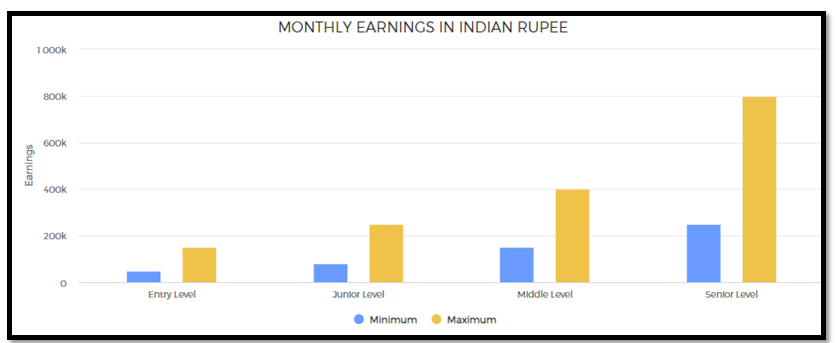
MONTHLY EARNINGS IN INDIAN RUPEE

1. Entry level: 0 - 2 years of work experience
2. Junior Level: From 1 to 12 years of work experience
3. Mid Level: From 5 to 20+ years of work experience
4. Senior Level: From 10 to 25+ years of work experience (there could be exceptions in some high-end technical, financial, engineering, creative, management, sports, and other careers; also in the near future, people will reach these levels much faster in many careers and in some careers, these levels will have no meaning as those careers will be completely tech skill driven such as even now, there is almost no level in a Cyber Security Expert’s job).
Work Activities
1. Analysing and interpreting data and information - Analysis of data and information to find facts, trends, reasons behind situations, etc.; interpretation of data to aid in decision making.
2. Computing - Computing using various computer software applications; writing algorithm for various computer and mobile applications; using software applications for scientific and technical work.
3. Creative thinking - Developing new ideas, concepts, innovative solutions to problems, newer ways of getting things done, designing products and services, creating work of art and craft, etc.
4. Getting Information and learning - Observing, hearing, reading, using computers, or otherwise obtaining information and learning from it.
5. Making decisions and solving problems - Analysis of data and information; evaluation of alternative decisions and results of decisions; taking the right decisions and solving problems.
6. Organising, planning and prioritizing tasks - Planning and organising tasks in order to achieve work goals; prioritizing tasks to achieve goals and making the best use of the time available.
7. Processing information - Compiling, tabulating, calculating, auditing, verifying or otherwise dealing with information processing including data entry, transcription, recording, storing and maintaining databases.
8. Strategic planning - Developing visions and goals, developing strategies and action plans for achieving visions and goals.
9. Updating and using relevant knowledge - Keeping updated with the latest knowledge relevant to your fields of work and use of the relevant knowledge in getting things done.
10. Using computers for work - Using computers for day-to-day office work; using computer software for various applications in day-to-day professional work; entering data and process information; for writing.
11. Working in a team - Working in a team of people; developing team; maintaining professional
12. Working with computers, programming and performing technical tasks - Using computers and computer systems, both hardware and software for programming, developing software and / or hardware, developing computer applications, systems, and networks; developing mobile applications.
Future Prospects
The future of this pathway looks bright and this industry is poised to grow strong in the upcoming years. Some of the prominent key growth factors that the market seems witnessing include increasing number of end users, growing research & development activities, raising usage of smart wearables / devices, widespread industrial automation.
The Global AI market accounted for $15.70 billion in 2017 and is expected to reach $300.26 billion by 2026 growing at a rate of 38.8% compounded annually during 2017-2026.
The global demand for AI & Robotics systems is anticipated to be driven by the massive investments made by countries such as China, US, Russia, Israel in the development of next generation systems and the large scale procurement of such products by countries like Saudi Arabia, Japan, India, and South Korea.
The Global Defense AI & Robotics, is valued at US$ 39.22 billion in 2018, is projected to grow at a rate of 5.04% compounded annually, to value US$ 61 billion by 2027. The cumulative market for global expenditure in this segment is valued at US$ 487 billion over 2018 to 2027.
The United States is the largest spender in the domain with China, Russia, Japan, India, Saudi Arabia, and South Korea anticipated accounting for the bulk of spending.
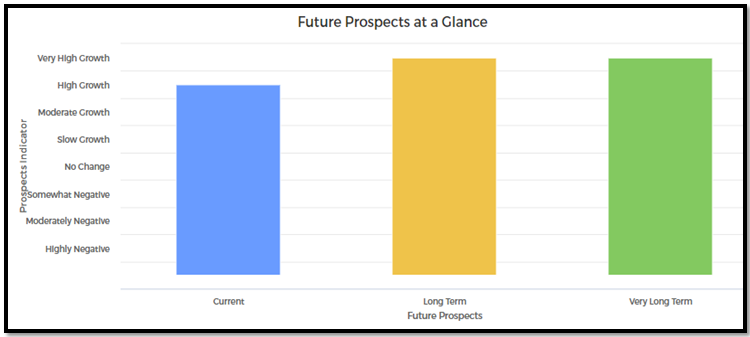
FUTURE PROSPECTS AT A GLANCE



