


Sports Psychologist
Entry Level Qualification
Class 10
Career Fields
Sports & Fitness
For Specially Abled


About Career
PARTICULARS | DESCRIPTION |
Name | Sports Psychologist |
Purpose | Helps Sportspersons And Athletes |
Career Field | Sports & Fitness |
Required Entrance Exam | NEET UG, NEET PG, NEET SS |
Average Salary | 150000 - 300000 Rs. Per Year |
Companies For You | Sport Psychology Solutions, Elite Performance Psychology, Athlete Mental Edge & Many More |
Who is Eligible | Class 12th Pass |
A Sports Psychologist helps sportspersons and athletes to overcome their sports-related mental issues (such as fear, dissatisfaction deperation, frustration, etc.) and teach mental skills to enhance their performance. You will evaluate the psychological factors that are associated with sports, exercise and other physical activities. You will study the behavior of a sportsperson and understand how physical activities have affected their health and development.
As a Sports Psychologist, you can be either a Clinical Sports Psychologist or an Applied Sports Psychologist. As a Clinical Sports Psychologist, you help in performance related issues such as anxiety, injuries etc. while as an applied sports psychologist you work as an instructor with the sports team to build their mental conditioning. You assist them with the sports-related mental and physical disorders by identifying their psychological, cognitive and emotional behavioral patterns. You work with sports of all kind and athletes of all kind from professional to Olympians. A Sports Psychologist helps in the training of an athlete by providing various therapies to improve their performance and efficiency. Though some Sports Psychologists use the principles of sports psychology to work with a non-sports related person to enhance their lives and well-being.
Key roles and responsibilities
1. You will help an athlete to improve their confidence, focus and motivational power to enhance their performance.
2. You will provide various therapies and tests to make them mentally prepare for the competition.
3. Sometimes an injury becomes the reason for an athlete’s mental and emotional problem. Thus, you will help them to recover from the injuries to build their strength.
4. As a sports psychologist, you will prepare the daily routine and exercise schedule to help in athletes’ training work.
5. You shall assist sports persons in how should they use their mental and physical skills in their profession.
6. You will conduct research on an athlete’s behavioral pattern and their physical, emotional and mental attributes to develop your knowledge.
7. You shall help athletes to cope up with stress and pressure on and off the field and mentally heal them from the fear of failure and fear to perform.
8. As a sports psychologist, you will encourage and motivate an athlete to develop a team spirit among all the team members.
9. You will help an athlete in recognizing their strength and weakness that can affect their performance.
10. You will make athletes understand the principles of learning and performing.
Career Entry Pathway
Class 10 all subjects as per scheme of studies –Class 11-12 with any subject as per scheme of studies – UG in Psychology / Behavioral Psychology / similar subject – PG in Exercise/ Sports Psychology
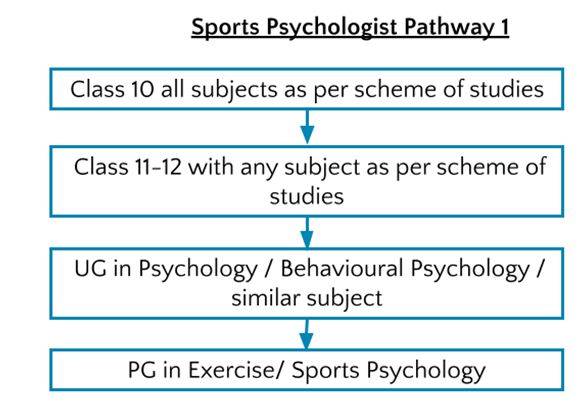
Class 11-12 with any subject as per scheme of studies and then study for an undergraduate degree in Psychology similar subject (Honors or specialization is an advantage) followed by a master’s degree in Exercise/ Sports Psychology.
Class 10 all subjects as per scheme of studies – Class 11-12 with any subject as per scheme of studies – UG in Psychology / Behavioral Psychology / similar subject – PG in Sports/Exercise Psychology – M.Phil. in Exercise/ Sports Psychology
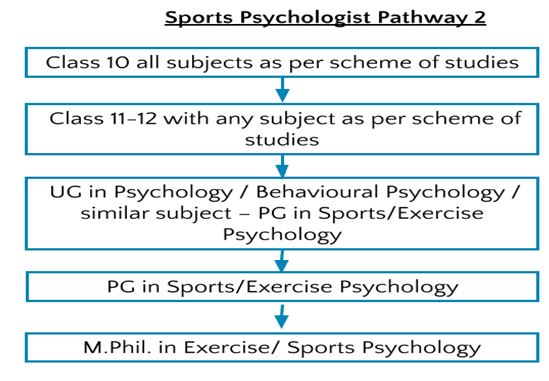
Class 11-12 with any subject as per scheme of studies and then study for an undergraduate degree in Psychology/ similar subject (Honours or specialisation is an advantage) followed by a master’s degree in Exercise/ Sports Psychology. Now you can opt for M.Phil. in Exercise/ Sports Psychology.
Class 10 all subjects as per scheme of studies – Class 11-12 with any subject as per scheme of studies – UG in Psychology / Clinical Psychology / similar subject – PG in Exercise/ Sports Psychology – PhD in Exercise/ Sports Psychology
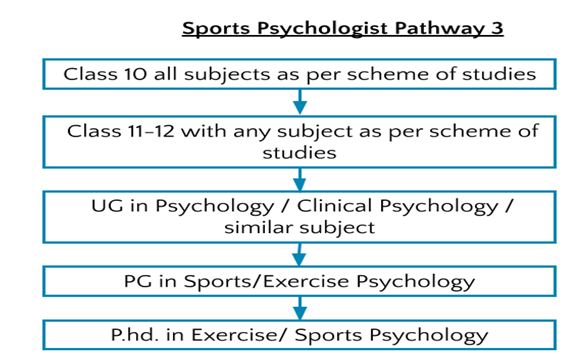
Class 11-12 with any subject as per scheme of studies and then study for an undergraduate degree in Psychology/ similar subject (Honors or specialization is an advantage) followed by a master’s degree in Exercise/ Sports Psychology. After the Master’s, you may proceed to study for a Ph.D. in Exercise/ Sports Psychology.
Required Qualification & Competencies
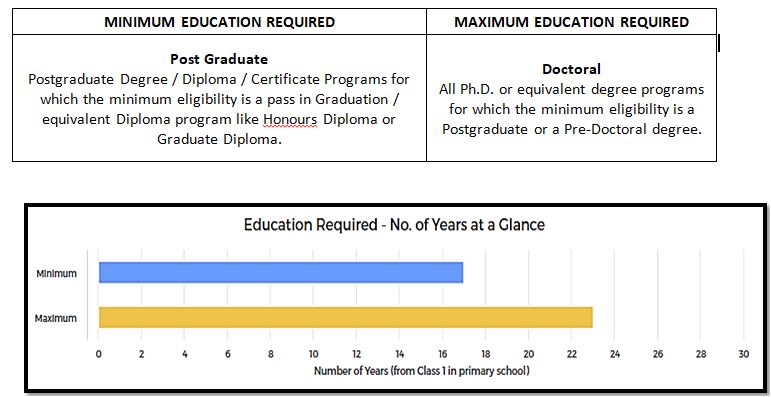
To become a Sports Psychologist, you must do a Bachelor’s degree in Psychology and then a Master’s degree in any one of the following fields:
1. Clinical Psychology
2. Psychology
3. Sports Psychology
COMPETENCIES REQUIRED
Interests
Investigative: You should have interests for Investigative Occupations. Investigative occupations involve working with ideas and quite a lot of thinking, often abstract or conceptual thinking. These involve learning about facts and figures; involve use of data analysis, assessment of situations, decision making and problem solving.
Social: You should have interests for Social Occupations. Social occupations involve helping or assisting others; these involve working with and communicating with people to provide various services; these may involve educating and advising others.
Artistic: You should have interests for Artistic Occupations. Artistic occupations mostly involve working with creative ideas, art and designs. These occupations involve abstract or conceptual thinking, creative self-expression and often do not follow any set processes or rules for getting things done.
Abilities
Abstract Reasoning: The ability to understand ideas which are not expressed in words or numbers; the ability to understand concepts which are not clearly expressed verbally or otherwise.
Deductive Reasoning: The ability to apply general rules and common logic to specific problems to produce answers that are logical and make sense. For example, understanding the reasons behind an event or a situation using general rules and common logic.
Emotional Intelligence: The ability to understand your own and others' emotions and feelings; empathy for others; adjusting your behavior or self-control and self-regulation according to others' emptions and situations.
Inductive Reasoning: The ability to combine pieces of information from various sources, concepts, and theories to form general rules or conclusions. For example, analysing various events or situations to come out with a set of rules or conclusions.
Inter-Personal: The ability to build and maintain good relationships with others at workplaces and elsewhere.
Intrapersonal: The ability to clearly understand your strengths and weaknesses, what your capabilities are, what you can do and cannot do, what you like and dislike.
Oral Comprehension: The ability to listen to and understand information and ideas presented through spoken words and sentences.
Oral Expression: The ability to communicate information and ideas in speaking so others will understand.
Problem Sensitivity: The ability to tell when something is wrong or is likely to go wrong. It does not involve solving the problem, only recognizing there is a problem.
Verbal Reasoning: The ability to think and reason with words; the ability to reason out ideas expressed in words.
Written Comprehension: The ability to read and understand information and ideas presented in writing.
Written Expression: The ability to communicate information and ideas in writing so others will understand.
Knowledge
Counseling: Knowledge of how to assess, evaluate and otherwise understand human behavior, personality, abilities, skills, knowledge, motivation, attitudes, values etc. and offer guidance and advices to people in order to help them deal with mental challenges and crisis as well as for deciding future courses of actions to make people happy.
Psychology: Knowledge of why and how humans behave the ways they behave. This includes understanding of mental processes and Knowledge of perception, beliefs, motives, attitudes, personality, values, interests, learning styles and abilities as well as methods to do research and understand causes of behavioral disorders and treating them.
Therapy: Knowledge of the principles, methods, and procedures for diagnosis, treatment, and rehabilitation of physical and mental dysfunctions or disorders in humans.
Skills
Active Learning: Focused and continuous learning from various sources of information, observation and otherwise for application in getting work done.
Active Listening: Giving full attention to what other people are saying, understanding the points being made by others, asking questions, etc.
Communication in English: Skills in communicating effectively in writing as well as verbally with others in English language or Communication in Vernacular Languages Skills in communicating effectively in writing as well as verbally with others in a local or indigenous language such as Hindi, Tamil, Telugu, Gujarati, Bengali, Assamese, etc.
Critical Thinking: Skills in analysis of complex situations, using of logic and reasoning to understand the situations and take appropriate actions or make interpretations and inferences.
Judgment and Decision Making: Skills in considering pros and cons of various decision alternatives; considering costs and benefits; taking appropriate and suitable decisions.
Problem Solving: Skills in analysis and understanding of problems, evaluating various options to solve the problems and using the best option to solve the problems.
Reading Comprehension: Skills in understanding written sentences and paragraphs in work related documents.
Service Orientation: Skills in or keen interest to help and assist people.
Writing: Skills in communicating effectively in writing as appropriate for the needs of the readers.
Personality
1. You are always or mostly a soft-hearted person.
2. You always or mostly trust others.
3. You are always or mostly helpful to others.
4. You are always calm or generally remain calm in most situations.
5. You are always or mostly caring, supportive, sympathetic and kind to others.
Career - Job Opportunities & Profiles
1. There are two major career opportunities for you, i.e., as a sports psychologist or as a clinical sports psychologist working at rehabilitation centres.
2. Sports teams will hire you as a Sports Psychologist.
3. After you Ph.D., you will get opportunities as a clinical sports psychologist.
4. You can start a private practice as a counselor to help both sports and non-sports person provided you have obtained the license to practice as a psychologist.
Work environment
A sports psychologist usually works with athletes, teams and sports department as a consultant or counsellor normally at business hours, through sports psychologists work with professional ones work full time with them. On the academic side, if you choose to teach sports psychology, you mainly work for fixed hours and spend more time conducting research work. Sports psychologists who do private practice in clinics may set their own schedule based on their client’s need. Sometimes you may have to travel to different places as athletes compete in different competitions.
SPECIALISATION TRACKS IN THIS CAREER
Sports surgeons
Sports surgeons specialize in the diagnosis of athletes’ diseases and perform surgeries for cure and prevention of the diseases and ailments which require surgical treatment. As a surgeon, you will perform surgery on a particular diseased part or organ of the human body. Before surgery, you will review the history of the sportsperson, carry out diagnostic procedures, find out about any allergies, and determine if they can be treated with surgery in the present condition.
CAREER GROWTH
1. If you are hired as a research associate, then you will go on to become a Doctoral Research Fellow, then Post-Doctoral Research Fellow and then Scientist in Progressive Grades.
2. After 5-12 years of experience, an assistant sports psychologist will become senior sports psychologist and then consultant psychologist and then even sports manager.
3. If you are hired in a sports and wellness industry as a sports executive or training consultant, then after 15-20 years you will become Head of the sports department.
Salary Offered
1. At the entry level, when you start your career as an assistant sports psychologist, you would be gaining around Rs. 10,000 to 25,000 per month. However, if you are hired in a reputed firm you can expect your earning around Rs. 25,000 to 1,00,000 per month. If you join any premium sports club, you might even be earning over Rs. 1,00,000 per month.
2. After 1-6 years of experience, you would be earning between around Rs. 20,000 to 2,00,000 per month.
3. At mid-level, when you would gain experience of 6-12 years, you would earn between Rs. 40,000 to 3,00,000 per month.
4. At the senior level, after gaining an experience of over 12 years, you can expect your earning around Rs. 1,00,000 to 5,00,000 per month.
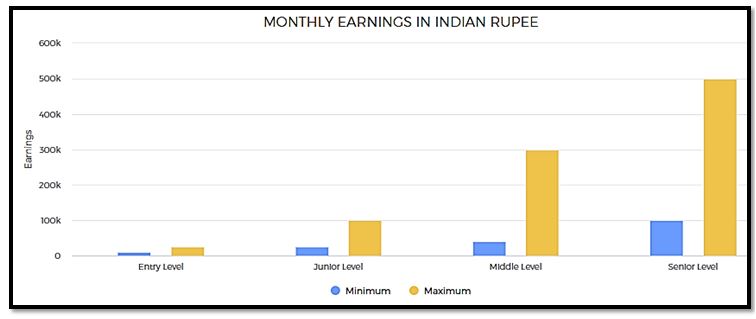
MONTHLY EARNINGS IN INDIAN RUPEES
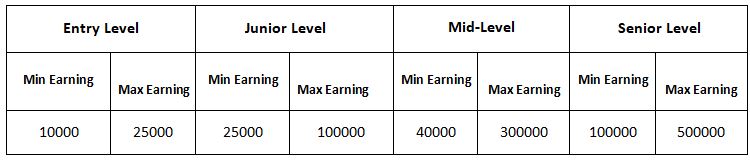
1. Entry level: 0 - 2 years of work experience
2. Junior Level: From 1 to 12 years of work experience
3. Mid Level: From 5 to 20+ years of work experience
4. Senior Level: From 10 to 25+ years of work experience (there could be exceptions in some high-end technical, financial, engineering, creative, management, sports, and other careers; also in the near future, people will reach these levels much faster in many careers and in some careers, these levels will have no meaning as those careers will be completely tech skill driven such as even now, there is almost no level in a Cyber Security Expert’s job)
Work Activities
Analyzing and interpreting data and information: Analysis of data and information to find facts, trends, reasons behind situations, etc.; interpretation of data to aid in decision making.
Assisting and caring for people: Assisting people in availing of services; taking care of people in different situations; offering help and services to others.
Communicating with co-workers and others: Communicating with people in writing, verbally or otherwise inside your workplace and various other people who have professional relationships with your place of work including vendors, government officials, etc. or with people at large.
Decision making and problem solving: Analysis of data and information; evaluation of alternative decisions and results of decisions; taking the right decisions and solving problems.
Getting Information and learning: Observing, hearing, reading, using computers, or otherwise obtaining information and learning from it.
Inspecting situations, events, and people: Inspecting situations, events and people to understand the reasons and causes for the situation or events to happen; inspecting people to understand reasons behind their behavior and actions.
Providing advices and consultation to others: Giving advices or consultation to others about various issues, conceptual matters, know-hows, scientific matters, products or services.
Updating and using relevant knowledge: Keeping updated with the latest knowledge relevant to your fields of work and use of the relevant knowledge in getting things done.
Using computers for work: Using computers for day-to-day office work; using computer software for various applications in day-to-day professional work; entering data and process information; for writing.
Working directly with people: Working directly with people to offer them products and services, providing assistance, etc.
Working in a team: Working in a team of people; developing team; maintaining professional relationships among team members.
Future Prospects
Indian Sports Industry has seen growth in the last 10 years thanks to the rise of league culture. Be its IPL for cricket, Indian Super League for football or Pro Kabaddi League for Kabaddi, each one of them has grown, increased fan base and provided opportunities to many more apart from the sportsperson. In 2016, IPL had 360+ million unique viewers. Similarly, ISL and Pro Kabaddi League had over 200+ millions of unique viewers. These influxes of viewers represent the success of such leagues which means more and more professional sportsmen are prone to injuries, form related issues, etc. Thus, sports psychologists demand is on the rise. Apart from the league, with khelo India, focus on Olympic Sports have also intensified. With more individual players coming under the wings of Khelo India, more future stars are being given a platform.
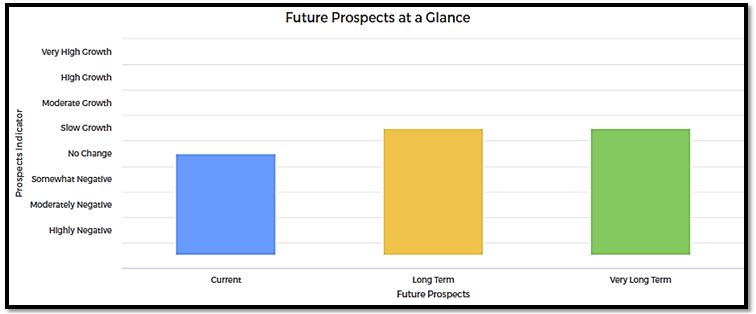
FUTURE PROSPECTS AT A GLANCE



