

Chemical Engineer (Diploma)
Entry Level Qualification
Class 10
Career Fields
Engineering & Technology
For Specially Abled


Career Entrance Exam
About Career
PARTICULARS | DESCRIPTION |
Name | Chemical Engineer (Diploma) |
Purpose | Develop And Design Chemical Manufacturing Processes |
Career Field | Engineering & Technology |
Required Entrance Exam | JEE MAIN BE/BTECH, BITSAT UG, VITEEE BE/BTECH |
Average Salary | 150000 - 300000 Rs. Per Year |
Companies For You | Deodorants, Detergents, Toothpaste, Cold Drinks & Many More |
Who is Eligible | Class 10th Pass |
As a Chemical Engineer after your Diploma, you will be assisting senior Chemical Engineers in creating and manufacturing materials and products that are part of our daily lives including plastic, paper, deodorants, detergents, toothpaste, cold drinks, etc.
Mainly, chemical engineering deals with converting certain methods that are invented or discovered in laboratories, into industrial manufacturing processes for products like petrochemicals (petrol, diesel), paints, food items, medicines, ultra-strong fibers, fabrics, and adhesives etc.
You will be involved in selecting raw materials and equipment that are required to produce a product industrially in big factories or units. They should be done in a way so as to maximize safety and profitability for your company and minimize production costs. Chemical engineers are required in almost every segment of the manufacturing industry.
Most of your knowledge should be derived from real-world applications during your internships, industrial training, practical classes or while doing a job. Chemical engineers generally work in chemical plants, at refineries, industrial plants where they monitor or direct particular operations or solve onsite problems.
As a Chemical Engineer, you may have to work with other mechanics and supporting technicians as part of a team. Chemical engineers are often exposed to health hazards, so, you will have to wear safety equipment and follow proper safety guidelines during work. You may have to work full time which is about 40 hours per week.
Key Roles and Responsibilities:
As a Chemical Engineer, you will be engaged with one or more of the following roles and responsibilities: -
1. You will be assisting senior engineers in conducting research for developing new, effective and improved chemical manufacturing methods and processes.
2. You will be working with and handling reagents, test tubes, and other laboratory-based equipment.
3. You will be helping senior engineers in developing processes for separating components of gases or liquids or generating electrical currents, by using controlled chemical processes.
4. You will be assisting supervising engineers in performing tests and monitoring performances of processes throughout the stages of production for determining any changes in density, specific gravity, temperature, and pressure.
5. You will be helping senior engineers with designing, running, testing and upgrading processes and monitoring as well as analysing data from experiments.
6. You will be assisting senior engineers in preparing estimates of production costs and progress reports of products lined for manufacture.
7. You will be working with senior engineers in the evaluation of chemical equipment and processes for identifying how to optimize performance or ensure compliance with environmental and safety regulations.
8. You will be helping in supervising the work of other junior technicians.
Career Entry Pathway
Class 10 all subjects as per scheme of studies - Diploma in Chemical Engineering
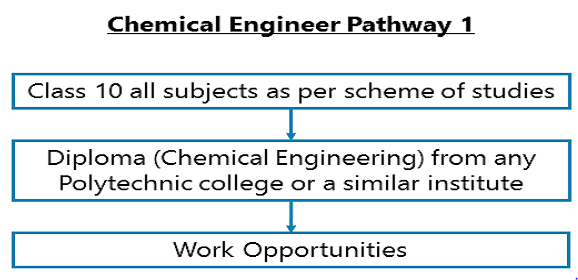
After Class 10, you can do a Diploma in Chemical Engineering from any Polytechnic college or a similar institute. Diploma in Chemical Engineering is a 3-year course.
Class 10 all subjects as per scheme of studies - training for ‘Chemical Engineering & Technologies’ or similar trades at an ITI or similar institute – admission to 2nd year of Diploma in ‘Chemical Engineering’
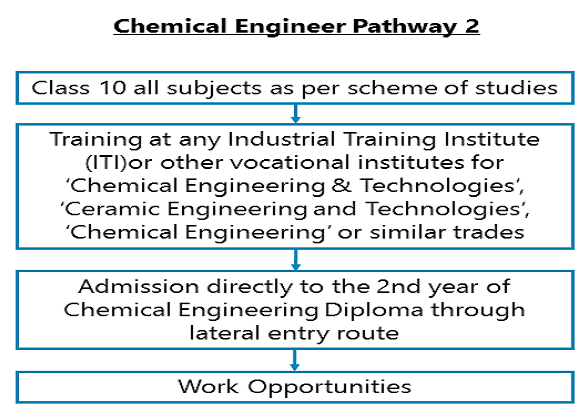
After Class 10, you can go for training at any Industrial Training Institute (ITI), National Skill Training Institute (NSTI), Regional Vocational Training Institute (RVTI), National Vocational Training Institute (NVTI), Industrial Training Center (ITC) or other vocational institutes for ‘Chemical Engineering & Technologies’, ‘Ceramic Engineering and Technologies’, ‘Chemical Engineering’ or similar trades. You will sit for All India Trade Test (AITT) to get a National Trade Certificate (NTC) after this course. This exam is held twice a year in the months of February and July. Minimum duration of the ITI training has to be 2 years. Then you can be admitted directly to the 2nd year of Chemical Engineering Diploma in Polytechnic colleges or similar institutions through lateral entry route.
Required Qualification & Competencies
After completing Class 10, you need to go for a Diploma course in Chemical Engineering from any Polytechnic college or similar institutions located at a number of cities and towns across the country. These Diploma courses are output-oriented technical skill training programs with the objective of turning a student or non-worker to a professional.
After your Diploma, you have an option to undergo National Employability Enhancement Mission (NEEM) training in the field of ‘Chemicals and Pharmaceuticals’, ‘Food Processing’, ‘FMCG, Consumer Durables Goods’ or any other designated trade with any Society / Trust / Company registered as a NEEM facilitator and approved by AICTE (All India Council of Technical Education).
This on-the-job (OJT) training may be for 3 to 36 months and is completely decided by the company imparting the training. However, you may or may not be retained as a permanent employee after the training. This training contract is not a guarantee of employment but enables an individual to find numerous work opportunities in future.

COMPETENCIES REQUIRED
1. You should have interests for Realistic Occupations. Realistic occupations involve more practical and hands-on activities than paperwork or office work. Realistic occupations often involve physical activities for getting things done using various tools and equipment.
2. You should have interests for Conventional Occupations. Conventional occupations involve repetitive and routine tasks as well as fixed processes or procedures for getting things done. These occupations involve working more with data, systems, and procedures and less with ideas or creativity.
3. You should have interests for Investigative Occupations. Investigative occupations involve working with ideas and quite a lot of thinking, often abstract or conceptual thinking. These involve learning about facts and figures; involve the use of data analysis, assessment of situations, decision making and problem-solving.
4. You should have knowledge of Technical and Engineering Design - Knowledge of various techniques, methods, specifications and tools for creating, developing and laying out designs of various machines, equipment, devices, manufacturing plants, structures, systems and processes. This includes developing blueprints, drawing and models.
5. You should have knowledge of Mathematics - Knowledge of arithmetic, algebra, geometry, and other mathematical disciplines and their applications.
6. You should have Active Listening Skills - Giving full attention to what other people are saying, understanding the points being made by others, asking questions, etc.
7. You should have Critical Thinking Skills - analysis of complex situations, using logic and reasoning to understand the situations and take appropriate actions or make interpretations and inferences.
8. You should have Problem Solving Skills - analysis and understanding of problems, evaluating various options to solve the problems and using the best option to solve the problems.
9. You should have Active Learning Skills - Focused and continuous learning from various sources of information, observation and otherwise for application in getting work done.
10. You should have Mathematical Reasoning Ability - to choose the right mathematical methods or formulas to solve a problem.
11. You are always or mostly careful about your actions and behavior.
12. You are practical always or in most situations.
13. You are always or mostly disciplined in your action and behavior.
14. You are always or mostly organized in your day-to-day life and activities.
Career - Job Opportunities & Profiles
You can find work opportunities in almost every industry affecting the production of almost every material that is manufactured on an industrial scale including plastic, paper, deodorants, detergents, toothpaste, cold drinks, petrochemicals (petrol, diesel), cement (and other construction materials), paints, food items, medicines / drugs, artificial fibers, fabrics, and adhesives etc. as:
1. Trainee Chemical Engineer
2. Diploma Chemical Engineer
SPECIALISATION TRACKS IN THIS CAREER
1. Analytical Chemist
Analytical Chemists are involved in investigating the chemical nature of substances through various experiments and handle a variety of testing chemicals as well as analytical techniques / instruments, for e.g. during drug formulation and development processes, forensic analyses, toxicology studies etc.
2. Energy Engineer
Energy Engineers are involved in the process of production of energy (extraction of oil and gas that can be used to produce fire) through natural resources, including hydro, wind, biofuels and solar power.
3. Chemical Engineer (Environmental Engineering)
Environmental Engineers trained in the discipline of chemical engineering find technology-based solutions to complex problems like climate change, population growth, drought, deforestation, urbanization etc.
4. Product / Process Development - Manufacturing Engineer
The core techniques of Manufacturing Engineering apply to all industries so Product / Process Development Engineers work in various sectors including biotechnology, food and beverages, oil, pharmaceuticals, plastics etc.
5. Nuclear Engineer
Nuclear Engineers are involved in building or running nuclear power stations including associated activities like industrial research and commercial development in the field of nuclear science. Chemical, mechanical and electrical engineers can all find work in the nuclear industry.
6. Petroleum Engineer
Petroleum Engineers involved in nearly all of the stages of evaluation, development and production in oil and gas fields.
CAREER GROWTH
You can certainly grow through job roles like Senior Chemical Engineer, Senior Project Engineer, Contracts Manager, Project Manager, Production Line Supervisor etc.
Salary Offered
1. In the entry-level jobs: You may expect to get about Rs. 12,000.00 –20,000.00 per month.
2. Salaries increase with your work experience and as you get promoted.
3. With 6-12 years of work experience, you may expect to get about Rs. 15, 000.00 – 40,000.00 per month.
4. With 12-15 years of work experience, you may expect to get about Rs. 25, 000.00 – 70,000.00 per month.
5. There is a lot of demand for trained Chemical Engineers abroad, mostly in Canada, Germany, Singapore, Middle Eastern and African countries. After having 5-8 years of experience, as a Chemical Engineer, you can earn about Rs. 1, 20, 000 – 1,50,000 or more per month. In these jobs, after having, 10-15 years of experience, you can earn about Rs. 2, 50, 000 – 3, 50, 000 or even more per month.
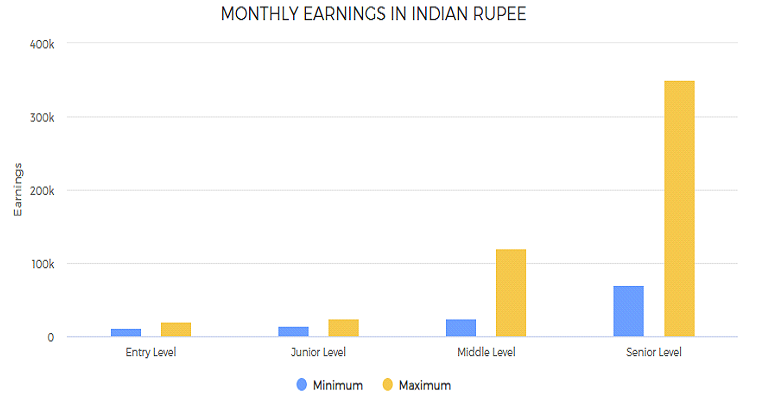
MONTHLY EARNINGS IN INDIAN RUPEE

1. Entry level: 0 - 2 years of work experience
2. Junior Level: From 1 to 12 years of work experience
3. Mid-Level: From 5 to 20+ years of work experience
4. Senior Level: From 10 to 25+ years of work experience (there could be exceptions in some high-end technical, financial, engineering, creative, management, sports, and other careers; also in the near future, people will reach these levels much faster in many careers and in some careers, these levels will have no meaning as those careers will be completely tech skill driven such as even now, there is almost no level in a Cyber Security Expert’s job).
Work Activities
1. Inspecting equipment, systems, structures, and materials - Inspecting equipment, systems, structures, and materials to ascertain quality, performance, defects, causes of errors, etc.
2. Identifying objects, actions, and events - Identifying various characteristics of objects; observing and understanding actions and events; understanding changes in actions and events.
3. Using computers for work - Using computer software for various applications in day-to-day professional work; entering data and process information; for writing; drafting specific technical information using simple tools/computer software –providing detailed instructions or drawings for others to refer to.
4. Making decisions and solving problems - Analysis of data and information; evaluation of alternative decisions and results of decisions; taking the right decisions and solving problems.
5. Getting Information and learning - Observing, hearing, reading, using computers, or otherwise obtaining information and learning from it.
6. Monitoring use of resources - Monitoring and controlling use of resources and materials as well as spending of money.
7. Organising, planning and prioritising tasks - Planning and organising tasks in order to achieve work goals; prioritising tasks to achieve goals and making the best use of the time available.
8. Processing information - Searching, compiling, tabulating, calculating, auditing, verifying or otherwise dealing with information processing including data entry, transcription, recording, storing and maintaining databases.
9. Analysing and interpreting data and information - Analysis of data and information to find facts, trends, reasons behind situations, etc.; interpretation of data to aid in decision making.
10. Updating and using relevant knowledge - Keeping updated with the latest knowledge relevant to your fields of work and use of the relevant knowledge in getting things done.
11. Communicating with co-workers and others - Communicating with people in writing, verbally or otherwise inside your workplace and various other people who have professional relationships with your place of work including vendors, government officials, etc. or with people at large.
12. Working in a team - Working in a team of people; developing team; maintaining professional relationships among team members.
Future Prospects
You can expect a bright future in this field as the industry growth prospects are encouraging. There will be a 9% growth every year of the chemical industries in India. Reports say that it is about to touch the 214 billion US Dollars mark in 2019. The growth is significant, but there is a lot of competition in this field. As chemistry is used in most industries like pharmaceuticals, petroleum and energy, the future trajectory of this pathway looks like rising steadily.
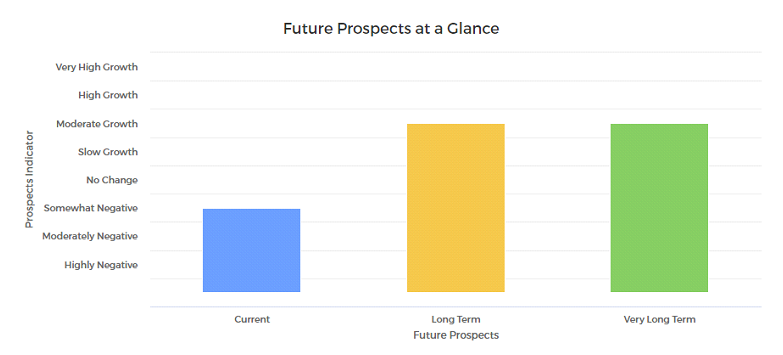
FUTURE PROSPECTS AT A GLANCE



