
Aircraft Maintenance Engineer
Entry Level Qualification
Class 12
Career Fields
Engineering & Technology
For Specially Abled


Career Entrance Exam
About Career
PARTICULARS | DESCRIPTION |
Name | Aircraft Maintenance Engineer |
Purpose | Inspection of Aircraft Components |
Career Field | Engineering & Technology |
Required Entrance Exam | No Entrance Exam |
Average Salary | 5,00,000 - 10,00,000 Rs. Per Year |
Companies For You | Air India, Emirates, Singapore Airlines & Many More |
Who is Eligible | Class 12th Pass |
As an Aircraft Maintenance Engineer (AME), you will be involved in performing scheduled maintenance, repair, overhaul, modification, day to day troubleshooting and other ancillary fitting work of various types of aircrafts such as propeller aircraft (like an ATR company’s turboprop planes), jet aircraft (like a Boeing, Airbus), and rotorcraft (such as a helicopter). You will also be involved in the inspection, diagnosis of technical snags, identification of probable technical problems and testing processes.
An Aircraft Maintenance Engineer (AME) works under a license from the Directorate General of Civil Aviation in India. Only licensed Aircraft Maintenance Engineers are responsible for carrying out servicing and maintenance work. Licensed Aircraft Maintenance Engineers can work in a team of various types of technicians but only they can sign an aircraft fitness certificate called Flight Releasing Certificate (FRC). Without an FRC, a flight cannot take-off.
Key Roles and Responsibilities
As an Aircraft Maintenance Engineer, you will have the following roles and responsibilities:
1. Inspection of aircraft components such as landing gear, hydraulic systems, electrical systems, and other problems.
2. Conducting special inspections as per the regulations, on a regular basis.
3. Preparing and maintaining repair logs as well as to document all the corrective aircraft maintenance.
4. Implementing modifications in aircraft structures, systems or components, following the standards.
5. Obtaining and checking oil and fuel samples to meet pollution check standards.
6. Inspection, removal, and re-installation of in-flight refueling stores and other fuel tanks.
7. Inspection and repair of corrosion, distortion, and invisible cracks in the fuselage, wings, using inspection and repair tools.
8. Assisting other engineers to complete final assembly of aircraft, helicopters, airlines, etc. and execute flight test.
9. Routine inspection for giving the sign-off and issue Flight Releasing Certificate.
Career Entry Pathway
Class 10 all subjects as per scheme of studies – Class 11-12 Physics, Chemistry, and Mathematics along with any other subject as per scheme of studies – Obtain a Diploma or Certificate in Aircraft Maintenance Engineer in Avionics or Mechanical (Airplane/Aircraft) or other similar fields – Apply for DCGA Exam for BAMEC and AME License
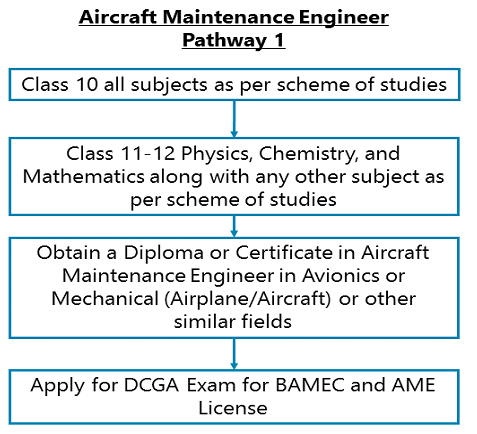
After class 12, you may obtain a Diploma or Certificate in Aircraft Maintenance Engineer in Avionics or Mechanical (Airplane/Aircraft) or other similar fields from any institute or vocational training institute. The Diploma program is of 3 years of duration and the certificate course is of 3 years of duration. After the course, you have to pass an exam conducted by DGCA (Director General of Civil Aviation). After clearing the exam the candidates will get a Basic Maintenance Engineer's Certificate (BAMEC) and Aircraft Maintenance Engineer's (AW) License issued by DGCA.
Class 10 all subjects as per scheme of studies – Class 11-12 Physics, Chemistry, and Mathematics along with any other subject as per scheme of studies – B.Sc. or B.E or B.Sc. (Hons.) in Aircraft Maintenance Engineering from a DGCA recognized institute - Apply for DCGA Exam for BAMEC and AME License
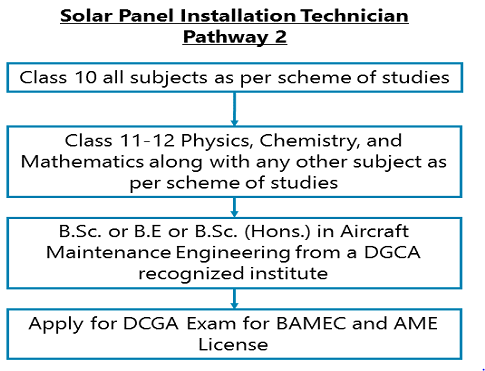
After class 12, you may apply for B.Sc. or B.E or B.Sc. (Hons.) in Aircraft Maintenance Engineering from a DGCA recognized institute. The course duration is 3 to 4 years of duration. After the course, you have to pass an exam conducted by DGCA (Director General of Civil Aviation). After clearing the exam the candidates will get a Basic Maintenance Engineer's Certificate (BAMEC) and Aircraft Maintenance Engineer's (AW) License issued by DGCA.
Required Qualification & Competencies
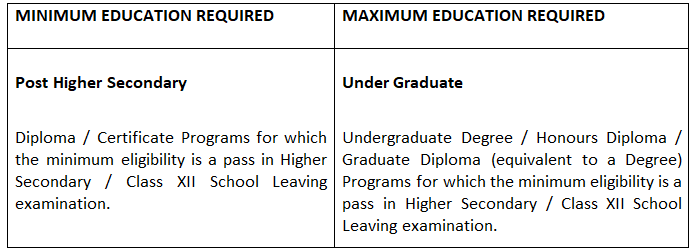
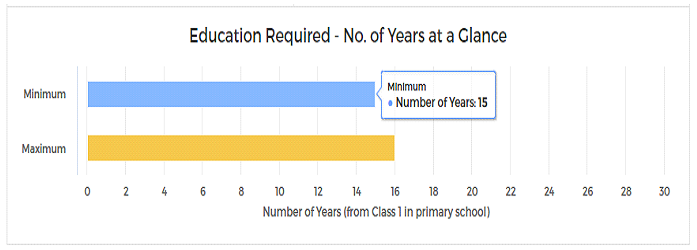
After completing class 12, you can apply for a:
1. Diploma or Certificate in Aircraft Maintenance Engineer in Avionics or Mechanical (Airplane/Aircraft) or other similar fields
2. B.Sc. or B.E or B.Sc. (Hons.) in Aircraft Maintenance Engineering from a DGCA (Directorate General of Civil Aviation, Government of India) recognized institute
And after completing any of the above-mentioned courses you can apply for the Basic Maintenance Engineer's Certificate (BAMEC) and Aircraft Maintenance Engineer's (AW) License issued by DGCA.
BAMEC is a basic certificate, which doesn’t entitle the candidate (the certificate holder) any specific certification privileges. It is without a type-rating certificate. The holder of BAMEC can have certain certification work if he or she has completed some specific training and oral-cum-practical test. It is very necessary to acquire this certificate to obtain a type-rated AME License for doing inspection and certification of aircraft, engines or systems.
Following are the categories of BAMEC issued by DGCA:
LA - Light Aeroplane
HA- Heavy Aeroplane
RA - Rotary wing aircraft (helicopters)
PE - Piston Engines
JE - Jet Engines
ES - Electrical System
IS - Instrument System
RN - Radio Navigation System
Following are the categories of BAMEC issued by DGCA:
Category A
Light Aeroplanes (below 5,700 kg all-up weight)
Heavy Aeroplanes(5,700 kg all-up weight & above)
Rotary Wing Aircraft (helicopters) with 3000 kg all up and above
Gliders
Category B
Overhaul of aeroplanes
Overhaul of gliders
Category C
Piston engines
Jet engines
Category A&C
Helicopters with all up weight below 3000 kg
Category D
Overhaul of Piston engines
Category E
Electrical System of Heavy Aircraft
Category I
Instrument System of Heavy Aircraft
Category R
Radio Navigation System
Category V
Avionics System of sophisticated aircraft
Category X
Overhaul of Auto Pilot (Light Aircraft)
Overhaul of Electrical Equipment (Light Aircraft) Overhaul of Instruments (Light Aircraft)
Overhaul of Radio Equipment (Light Aircraft)
Overhaul of Variable Pitch Propellers (Light Aeroplanes)
COMPETENCIES REQUIRED
Interests
1. Realistic: You should have interests for Realistic Occupations. Realistic occupations involve more practical and hands-on activities than paperwork or office work. Realistic occupations often involve physical activities for getting things done using various tools and equipment.
2. Conventional: You should have interests for Conventional Occupations. Conventional occupations involve repetitive and routine tasks as well as fixed processes or procedures for getting things done. These occupations involve working more with data, systems, and procedures and less with ideas or creativity.
Abilities
1. Control Precision: The ability to quickly and repeatedly adjust the controls of a machine or a vehicle to exact positions.
2. Finger Dexterity: The ability to make precisely coordinated movements of the fingers of one or both hands to grasp, manipulate, or assemble very small objects.
3.Problem Sensitivity: The ability to tell when something is wrong or is likely to go wrong. It does not involve solving the problem, only recognizing there is a problem.
4. Arm-Hand Steadiness: The ability to keep your hand and arm steady while moving your arm or while holding your arm and hand in one position.
5. Near Vision: The ability to see details at close range (within a few feet of the observer).
6. Deductive Reasoning: The ability to apply general rules and common logic to specific problems to produce answers that are logical and make sense. For example, understanding the reasons behind an event or a situation using general rules and common logic.
7. Hand-Eye Coordination: The ability to make quick and precise hand movements as per visual observations and understanding (that is, what you see and comprehend).
8. Inductive Reasoning: The ability to combine pieces of information from various sources, concepts, and theories to form general rules or conclusions. For example, analysing various events or situations to come out with a set of rules or conclusions.
9. Mechanical Reasoning: The ability to apply basic physical principles and theories to understand how mechanical objects such as tools and machinery works and the ability to understand the rules or laws governing the work of machinery, tools and bodies in motion.
10. Physical Stamina: The ability to exert yourself physically over long periods of time without getting winded or out of breath.
Knowledge
1. Mechanical Engineering & Technology: Knowledge of Mechanical Engineering & Technologies which include design, development, testing, manufacturing, installation, operations, repair and maintenance of different machinery, devices, equipment and tools.
2. Engineering and Technology: Knowledge of various applications of one or more branches of Engineering Science & Technology to manufacture and produce various goods or construct or erect various structures. This include knowledge about design, development, prototype testing, manufacturing, construction, installation, repair and maintenance.
Skills
1. Electrical Instrument Repair and Maintenance: Skills in performing repair and maintenance of different electrical machines, engines, equipment, and devices.
2. Electronics Instrument Repair and Maintenance: Skills in performing repair and maintenance of different electronic machines, equipment, and devices.
3. Machine Repair and Maintenance: Skills in performing repair and maintenance of different machines, equipment, and devices.
4. Operating: Skills in operating various machines, equipment, devices and systems.
5. Process and Operation Controlling: Skills in controlling processes and operations of various machines, equipment, devices and systems using different types electrical and electronic control instruments and systems.
6. Troubleshooting: Skills in determining causes of operating errors and deciding what to do about it.
7. Problem Solving: Skills in analysis and understanding of problems, evaluating various options to solve the problems and using the best option to solve the problems.
8. Quality Control Analysis: Skills in conducting tests and inspections of products, services, or processes to evaluate quality or performance.
Personality
1. You are always or mostly organized in your day-to-day life and activities.
2. You are always or mostly disciplined in your action and behaviour.
3. You always prefer to experience new things and have new experiences or you mostly do.
4. You are always imaginative or in most situations.
5. You remain calm in difficult situations sometimes but some other times you are anxious.
6. You are caring, supportive, sympathetic and kind to others sometimes.
Career - Job Opportunities & Profiles
You may get an entry-level job opportunity as a Trainee and later on can grow within the organization, after obtaining AME and Aircraft Maintenance Engineer's (AW) Licensor, in various public and private sector organizations such as:
1. Airline companies such as Air India, Emirates, Singapore Airlines, and Indigo.



2. Logistics Companies such as Deccan Cargo and Express Logistics Pvt. Ltd., AVV Sky Shuttle Pvt. Ltd., Air Works India Engineering


Private Limited
Government and defense organizations such as Defence Research and Development Laboratories (DRDO), Indian Space Research Organization (ISRO), Civil Aviation Department, Airport Authority of India, etc.
Work Environment
As an Aircraft Maintenance Engineer, you will be working for around 35 to 40 hours a week. However, sometimes you might have to work for longer hours to finish the work. You will be performing your duty from an indoor office, engineering lab, factory or aircraft hangar or you can even work at testing sites where working prototypes of aircraft and weapon systems are tested.
CAREER GROWTH
You can start your career in Aircraft Maintenance Engineering with job positions such as Trainee Aircraft Maintenance Engineer, Service or Repair Engineer, Aircraft Technician, and can grow as a Mechanical Instructor - Aircraft Maintenance, Instructor – Avionics, Junior Aircraft Maintenance Engineer, Senior Aircraft Maintenance Engineer, Group Leader - Maintenance Services, Director/associate - Lease Management - Aircraft Maintenance Services, Licensed Aircraft Engineer, etc.
Salary Offered
1. In entry-level roles, you may expect to earn about Rs. 40,000 - 80,000 or even more per month.
2. In junior level roles, you can expect to earn about Rs. 60,000 - 1, 00,000 or more per month.
3. In mid-level roles, you can earn about Rs. 1,10,000 - 2,50,000 or even more per month.
4. In senior-level roles, you can earn about Rs. 2,20,000 - 4,50,000 or even more per month.
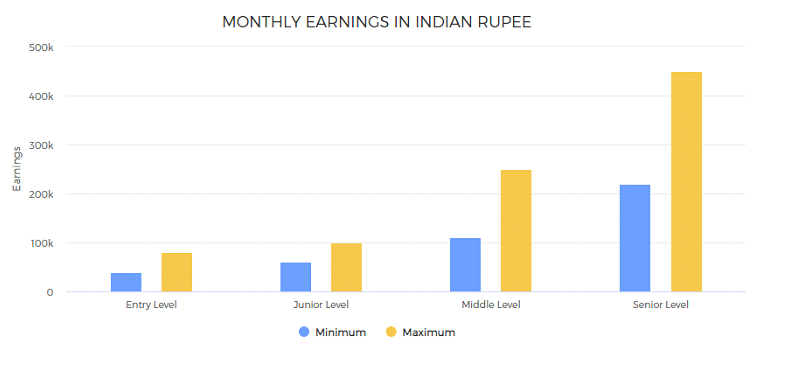
MONTHLY EARNINGS IN INDIAN RUPEE

1. Entry level: 0 - 2 years of work experience
2. Junior Level: From 1 to 12 years of work experience
3. Mid-Level: From 5 to 20+ years of work experience
4. Senior Level: From 10 to 25+ years of work experience (there could be exceptions in some high-end technical, financial, engineering, creative, management, sports, and other careers; also in the near future, people will reach these levels much faster in many careers and in some careers, these levels will have no meaning as those careers will be completely tech skill driven such as even now, there is almost no level in a Cyber Security Expert’s job).
Work Activities
As an Aircraft Maintenance Engineer, you will be involved in the following work activities:
1. Getting Information and learning: Observing, hearing, reading, using computers, or otherwise obtaining information and learning from it.
2. Handling and moving objects and materials: Using hands or otherwise use physical strength to handle and move objects and materials; manoeuvre, install, lift, place, manipulate, etc.
3. Identifying objects, actions, and events: Identifying various characteristics of objects; observing and understanding actions and events; understanding changes in actions and events.
4. Inspecting equipment, systems, structures, and materials: Inspecting equipment, systems, structures, and materials to ascertain quality, performance, defects, causes of errors, etc.
5. Assessing and evaluating quality: Assessing and evaluating the quality of materials, systems, processes, products, services, etc.
6. Installing, repairing and maintaining equipment, devices, and products: Installing, servicing, repairing, and maintaining equipment, devices, and products for usages.
7. Monitoring processes, systems, and performance: Observing and recording information on various criteria to monitor mechanical, electronic, electrical and other processes and systems; monitoring the progress of projects and tasks.
8. Operating machines, equipment, devices, systems and processes: Using various methods and techniques to operate machines, equipment, devices, systems, and processes in industrial and other settings.
9. Drawing, drafting, laying out and specifying objects, equipment, devices, tools, and systems: Creating and developing designs, drawings, layouts and specifications about how to construct, manufacture, assemble, build, use, and maintain various equipment, devices, tools, and systems.
10. Updating and using relevant knowledge: Keeping updated with the latest knowledge relevant to your fields of work and use of the relevant knowledge in getting things done.
11. Working in a team: Working in a team of people; developing a team; maintaining professional relationships among team members.
Future Prospects
India’s aviation industry depicts a high-growth trajectory, thanks to the rapid economic growth and high demand across the civil, defense and space segments. According to the IBEF (Indian Brand Equity Foundation) reports, by 2026, the Indian government will be investing nearly US$ 1.83 billion for the development of airport infrastructure along with aviation navigation services. These statistics establish the fact that there will be a significant rise in the demand for skilled professionals both in India as well as overseas in the field of Aeronautical / Aerospace Industry which will directly increase the demand for aircraft maintenance engineers.
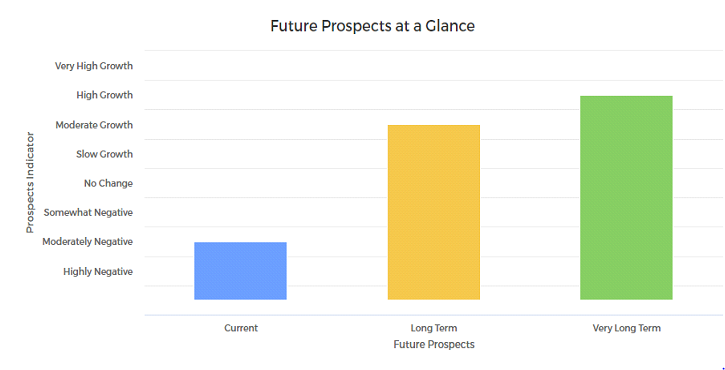
FUTURE PROSPECTS AT A GLANCE



