


Audiologist
Entry Level Qualification
Class 12
Career Fields
Medical Services
For Specially Abled


About Career
PARTICULARS | DESCRIPTION |
Name | Audiologist |
Purpose | Diagnose, Manage, And Treat Hearing |
Career Field | Medical Services |
Required Entrance Exam | NEET UG, AIIMS MSC |
Average Salary | 150000 - 400000 Rs. Per Year |
Companies For You | AIIMS, Railway hospitals, private hospitals & Many More |
Who is Eligible | Class 12th Pass |
Audiologists and Speech Therapists are the healthcare specialists who use audiometers, computers, and other devices to test patients’ hearing ability and ear balance. Audiologists and Speech therapists work to find the extent of hearing damage and find the cause for the same. They also measure the level of loudness at which a person starts hearing and also determine if a person can distinguish between sound and speech.
As an audiologist and speech therapist, you will also evaluate the psychological information and measure the impact of hearing loss on the patient. You will clean the wax out of the ear canal, fit hearing aids, and work with medical physicians to fit cochlear implants in the patient’s ear. You will also assist patients in other ways to compensate for hearing loss like lip reading. You will also assist patients suffering from vertigo or any other balance problems. You will also specialize in the rehabilitation of tinnitus, hyperacusis, misophonic, auditory processing disorders, cochlear implant use and/or hearing aid use.
Key roles and responsibilities
As an audiologist, you will have different roles and responsibilities based on your speciality and super speciality. Following is the list of a few roles and responsibilities across the specialities:
1. As an audiologist, you shall be required to administer different kinds of hearing tests and examinations. You will also examine patients who have a balance or any ear related problem.
2. You will also diagnose and treat tinnitus to stop the problem of ringing in the ear.
3. You will collect information about the patient related to the type and degree of impairment, using specialized instruments and electronic equipment.
4. You will fit, and dispense hearing aids to patients.
5. You will also be assisting in repairing any damaged hearing devices.
6. You will be required to maintain records of each patient at all stages. This shall include initial and subsequent evaluation and treatment activities.
7. You will also evaluate the hearing and balance disorder and initiate the diagnosis and treatment accordingly.
8. You will administer treatment so that the patient meets his/ her goals.
9. You will counsel patients and their friends/ family members in different ways to listen and communicate. You will teach them methods like lip reading.
10. You will educate people on ways to prevent hearing loss.
Career Entry Pathway
Class 10 all subjects as per the scheme of studies – Class 11-12 Physics, Chemistry, Mathematics, and Biology along with any other subject as per the scheme of studies – UG in Audiology/ Audiology & Speech-Language Pathology/ Speech & Language Therapy/ similar field.
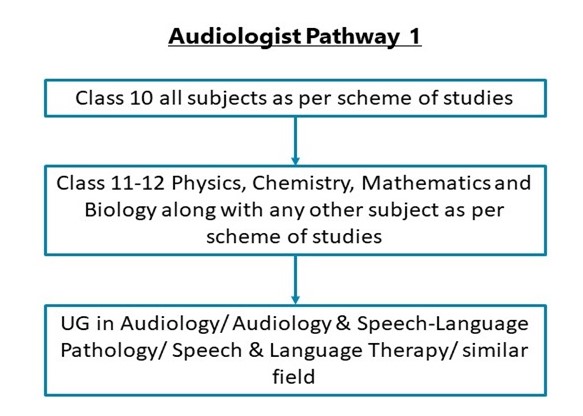
Once you’ve completed Class 10 all subjects as per the scheme of studies, you can pursue Class 11-12 Physics, Chemistry, Mathematics, and Biology along with any other subject as per the scheme of studies. Then study for an undergraduate degree in Audiology/ Audiology & Speech-Language Pathology/ Speech & Language Therapy/ similar field.
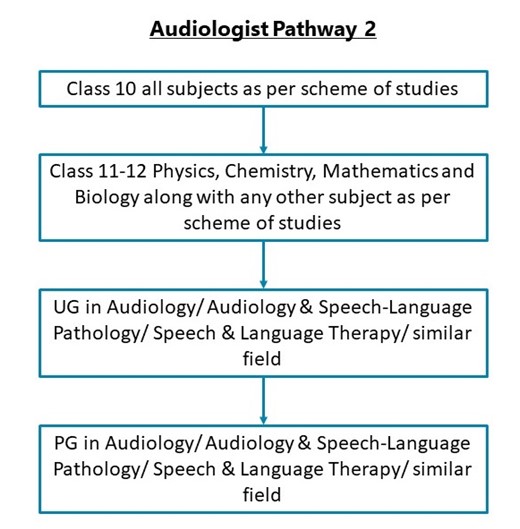
Once you’ve completed Class 10 all subjects as per the scheme of studies, you can pursue Class 11-12 Physics, Chemistry, Mathematics, and Biology along with any other subject as per the scheme of studies. Then study for an undergraduate degree in Audiology/ Audiology & Speech-Language Pathology/ Speech & Language Therapy/ similar field. Now you can opt for a postgraduate course in Audiology/ Audiology & Speech-Language Pathology/ Speech & Language Therapy/ similar field.
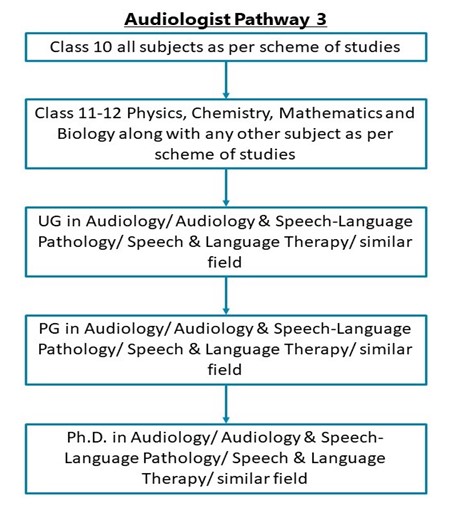
Once you’ve completed Class 10 all subjects as per the scheme of studies, you can pursue Class 11-12 Physics, Chemistry, Mathematics, and Biology along with any other subject as per the scheme of studies. Then study for an undergraduate degree in Audiology/ Audiology & Speech-Language Pathology/ Speech & Language Therapy/ similar field. Now you can apply for a postgraduate degree in Audiology/ Audiology & Speech-Language Pathology/ Speech & Language Therapy/ similar field. Once you finish your master’s degree, now you can further study for a PhD in Audiology/ Audiology & Speech-Language Pathology/ Speech & Language Therapy/ similar field.
Required Qualification & Competencies
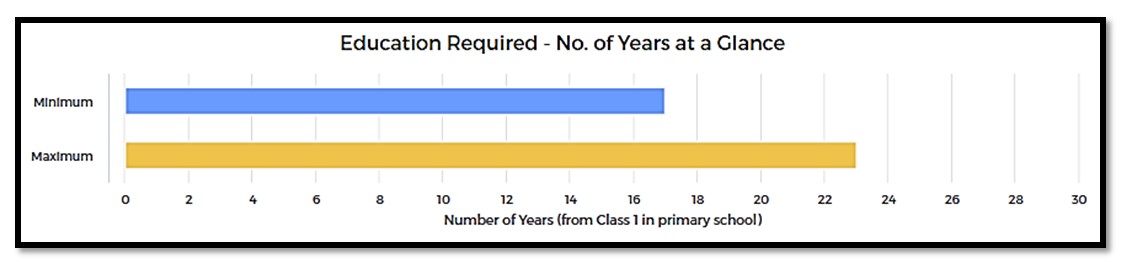
To become an Audiologist / Speech Language Therapist, you have to do an undergraduate degree in Audiology Speech Language Pathology (ASLP) or a similar field. You may also opt for a Master's degree in Audiology Speech Language Pathology (MSLP) after your Bachelor’s degree.
MINIMUM EDUCATION REQUIRED | MAXIMUM EDUCATION REQUIRED |
Under Graduate Undergraduate Degree / Honours Diploma / Graduate Diploma (equivalent to a Degree) Programs for which the minimum eligibility is a pass in Higher Secondary / Class XII School Leaving examination. | Doctoral All Ph.D. or equivalent degree programs for which the minimum eligibility is a Postgraduate or a Pre-Doctoral degree. |
Competencies Required
Interests
1. Social: You should have an interest in Social Occupations. Social occupations involve helping or assisting others; these involve working with and communicating with people to provide various services; these may involve educating and advising others.
2. Investigative: You should have an interest in Investigative Occupations. Investigative occupations involve working with ideas and quite a lot of thinking, often abstract or conceptual thinking. These involve learning about facts and figures; involve the use of data analysis, assessment of situations, decision making, and problem solving.
3. Conventional: You should have interests in Conventional Occupations. Conventional occupations involve repetitive and routine tasks as well as fixed processes or procedures for getting things done. These occupations involve working more with data, systems, and procedures and less with ideas or creativity.
Abilities
1. Abstract Reasoning: The ability to understand ideas that are not expressed in words or numbers; the ability to understand concepts that are not clearly expressed verbally or otherwise.
2. Deductive Reasoning: The ability to apply general rules and common logic to specific problems to produce answers that are logical and make sense. For example, understanding the reasons behind an event or a situation using general rules and common logic.
3. Emotional Intelligence: The ability to understand your own and others' emotions and feelings; empathy for others; adjusting your behavior or self-control and self-regulation according to others' emotions and situations.
4. Hand-Eye Coordination: The ability to make quick and precise hand movements as per visual observations and understanding (that is, what you see and comprehend).
5. Inter-Personal: The ability to build and maintain good relationships with others at workplaces and elsewhere.
6. Problem Sensitivity: The ability to tell when something is wrong or is likely to go wrong. It does not involve solving the problem, only recognizing there is a problem.
7. Selective Attention: The ability to concentrate on a task over a long period without being distracted.
8. Verbal Reasoning: The ability to think and reason with words; the ability to reason out ideas expressed in words.
9. Written Comprehension: The ability to read and understand information and ideas presented in writing.
Knowledge
1. Biological Sciences: Knowledge of plants and animals, their anatomical structure, cell structure, tissues, physiological functions, evolution, and all other related aspects.
2. English Language: Knowledge about English grammar, words, spelling, sentence construction, using English to communicate with others, reading in English, etc.
3. Healthcare Science and Services: Knowledge of different fields which are related to offering various types of healthcare services to people; assisting physicians and surgeons to carry out diagnosis, treatment, and prevention of human diseases, ailments, and disorders. This includes knowledge of different practices apart from medicine which are used to treat and prevent human diseases or to provide holistic healthcare and wellness. This also includes knowledge about drugs and medicines.
4. Personal Care Service: Knowledge of how to provide various assistance and services to others. This includes looking after the needs of individuals, understanding what they need, and providing all assistance at home or elsewhere.
Skills
1. Active Listening: Giving full attention to what other people are saying, understanding the points being made by others, asking questions, etc.
2. Coordination: Skills in working together with other people to get things done.
3. Critical Thinking: Skills in the analysis of complex situations, using logic and reasoning to understand the situations and take appropriate actions or make interpretations and inferences.
4. Judgment and Decision Making: Skills in considering the pros and cons of various decision alternatives; considering costs and benefits; and making appropriate and suitable decisions.
5. Problem Solving: Skills in analysis and understanding of problems, evaluating various options to solve the problems, and using the best option to solve the problems.
Personality
1. You are always or mostly organized in your day-to-day life and activities.
2. You are always or mostly a soft-hearted person.
3. You are always or mostly helpful to others.
4. You are always or mostly caring, supportive, sympathetic, and kind to others.
5. You remain calm in difficult situations sometimes but some other times you are anxious.
6. You act independently sometimes but do not do so at some other times.
7. You always or mostly prefer to stick within a routine or carry out routine and repetitive activities.
Career - Job Opportunities & Profiles
1. You can join a medical college like AIIMS, Railway hospitals, private hospitals, government hospitals etc. as an Audiologist.
2. You can join private clinics, ENT clinics, centers for the disabled, nursing care facilities, etc. as an Audiologist/ Speech Therapist.
3. You can join as a fellow and complete your fellowship.
4. You can join a military hospital at the rank of Captain.
5. You can also join a college/ University at the rank of Assistant Professor.
6. You can join hearing aid or cochlear implant industries as a Sales Manager/ Sales Representative/ Audio Distributor.
Work Environment
You would be required to spend most of your time in the clinic, hospitals, and healthcare. As an audiologist or Speech Therapist, you will be treating patients in normal working hours of 8-9 hours only. Most of your work will require listening to patients’ problems and issues. This is a job with an intense work environment that needs patience to listen. Sometimes, you may be asked or requested to visit patients at their place and this may even happen sometimes during odd night hours. As a therapist, you may have to be patient with your patients as they will have speech and hearing issues so they will be slow learners.
Specialisation Tracks In This Career
1. Audiologist
An audiologist is a medical expert who works on assisting the patient with hearing loss. As an audiologist, you will diagnose the problem and provide suitable recommendations including fixing hearing aids, recommending a physician for cochlear implants, or even teaching lip reading.
2. Speech Language Pathologist
Speech Language Pathologists assist patients with different kinds of communication problems like speech sounds, language, voice, etc. Thus, they specialize in communication disorders. They also treat patients with swallowing and voice issues.
Career Growth
1. My career growth in university and college started as an Assistant Professor and then as Associate Professor, Professor, and Professor Emeritus. Professors can also get administrative positions such as Director/Dean/Vice Chancellor, etc
2. If you join as an Audiologist with government hospitals, then you will go on to become Deputy Medical Superintendent then Additional Medical Superintendent, and then Medical Superintendent. You might also become the director of the Hospital.
3. If you join as an Audiologist/ Speech Therapist in private Clinics, then you may become a senior Audiologist/ Speech Therapist and then head of the department.
4. If you join as a Sales Manager, then you will become Senior Sales Manager, then Area Sales Manager then Regional Sales Manager, and finally Head of Sales.
5. If you join Army hospitals, then you will move up as per the army ranks starting from Captain (and its equivalent in the Navy and Air Force).
Salary Offered
1. At the entry-level, one joins as a Speech Therapist or an Audiologist and earns about Rs. 10,000 to 30,000 a month. As an assistant professor, you would earn around Rs. 50,000 to 60,000 per month. With experience, their salary increases.
2. At the junior level with a work experience of 5-6 years, you would be earning anything between Rs. 20,000 to 60,000 per month.
3. At the middle level with an experience of 8-12 years, you would be earning anything between Rs. 50,000 to 90,000 per month.
4. At the senior level of over 12 years of work experience, you would be earning anything between Rs. 1,20,000 to 2,00,000 per month or even more.
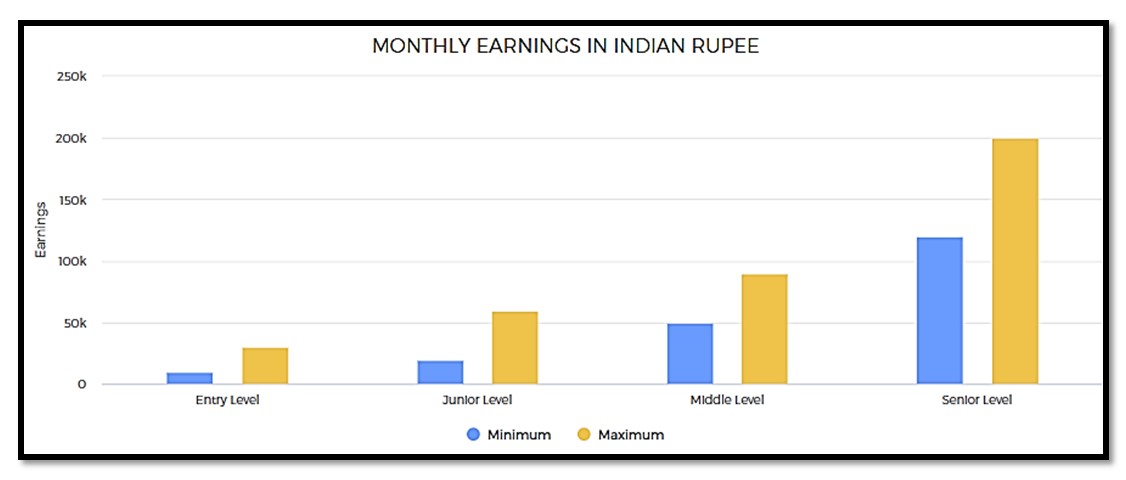
Monthly Earnings In Indian Rupee
Entry Level | Junior Level | Mid Level | Senior Level | ||||
Min Earning | Max Earning | Min Earning | Max Earning | Min Earning | Max Earning | Min Earning | Max Earning |
10000 | 30000 | 20000 | 60000 | 50000 | 90000 | 120000 | 200000 |
1. Entry level: 0 - 2 years of work experience
2. Junior Level: From 1 to 12 years of work experience
3. Mid-Level: From 5 to 20+ years of work experience
4. Senior Level: From 10 to 25+ years of work experience (there could be exceptions in some high-end technical, financial, engineering, creative, management, sports, and other careers; also shortly, people will reach these levels much faster in many careers and some careers, these levels will have no meaning as those careers will be completely tech skill driven such as even now, there is almost no level in a Cyber Security Expert’s job)
Work Activities
1. Analysing and interpreting data and information: Analysis of data and information to find facts, trends, reasons behind situations, etc.; interpretation of data to aid in decision-making.
2. Assisting and caring for people: Assisting people in availing of services; taking care of people in different situations; offering help and services to others.
3. Communicating with co-workers and others: Communicating with people in writing, verbally or otherwise inside your workplace and various other people who have professional relationships with your place of work including vendors, government officials, etc., or with people at large.
4. Decision-making and problem-solving: Analysis of data and information; evaluation of alternative decisions and results of decisions; taking the right decisions and solving problems.
5. Getting Information and learning: Observing, hearing, reading, using computers, or otherwise obtaining information and learning from it.
6. Identifying objects, actions, and events: Identifying various characteristics of objects; observing and understanding actions and events; understanding changes in actions and events.
7. Inspecting situations, events, and people: Inspecting situations, events, and people to understand the reasons and causes for the situation or events to happen; inspecting people to understand reasons behind their behavior and actions.
8. Providing advice and consultation to others: Giving advice or consultation to others about various issues, conceptual matters, know-how, scientific matters, products, or services.
9. Updating and using relevant knowledge: Keeping updated with the latest knowledge relevant to your fields of work and using the relevant knowledge in getting things done.
10. Using computers for work: Using computers for day-to-day office work; using computer software for various applications in day-to-day professional work; entering data and processing information; for writing.
11. Working directly with people: Working directly with people to offer them products and services, providing assistance, etc.
Future Prospects
Indian Medical industry is growing exponentially riding on strong demand due to rising incomes, greater health awareness, and an increase in access to insurance. It might grow to 373 Billion USD in 2024 as per a report by ibef.org. Also, with the introduction of Ayushman Bharat, Insurance and medical benefits are given by the Government of India, and more and more people will start using medical facilities. With rising income, medical insurance, and better education about health, the prospect of an audiologist/ speech therapist.
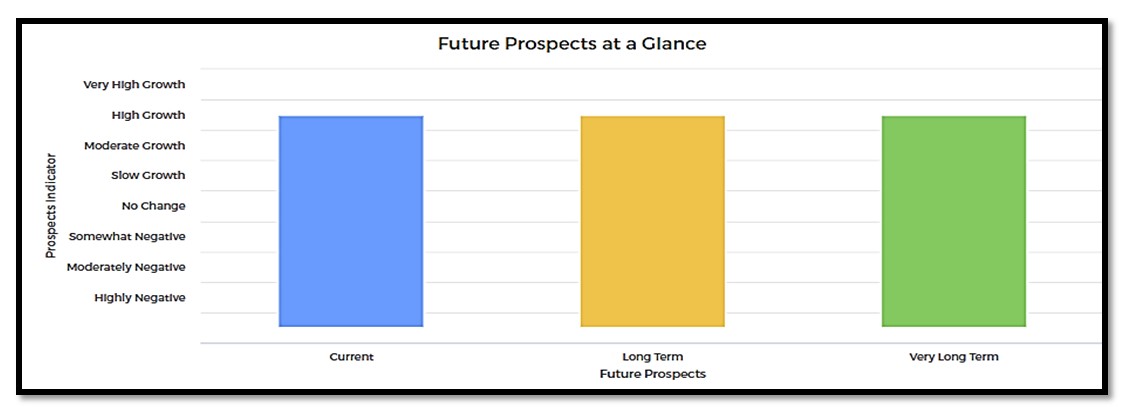
Future Prospects At A Glance
Current (0-1 year) | Long Term (2-5 years) | Very Long Term (6-10 years) |
High Growth | High Growth | High Growth |


