

Film Editor
Entry Level Qualification
Class 12
Career Fields
Mass Media, Journalism & Entertainment
For Specially Abled


Career Entrance Exam
About Career
Film Editors watch, select, cut, trim, and piece together film and video footage shot during the principal photography as well as add or mix visual/special effects (VFX/SFX), CGI (computer-generated imagery), 2D animation, 3D animation, motion graphics, 2D graphics, soundtracks (containing dialogues and other recorded sound, sound effects including Foley sound, background music, playback music, etc.), etc. to make a complete film or video that we watch.
PARTICULARS | DESCRIPTION |
Name | Film Editor |
Purpose | Assemble Footage of Television Shows, Documentaries, |
Career Field | Mass Media, Journalism & Entertainment |
Required Entrance Exam | No Entrance Exam |
Average Salary | 1,00,000 - 3,00,000 Rs. Per Year |
Companies For You | UTV Television, Zee Telefilms, Television Eighteen India & Many More |
Who is Eligible | Class 12th Pass |
Understanding Film Editing further
1. The principal photography of a film or video contains the raw image footage, which is shot to capture actors’ performance, scenery, ambiance, background, etc. either inside a studio or at a location. The principal photography may have footage which are not in a proper sequence to tell a meaningful story and part of which may not be relevant as far as the script of a movie or video is concerned or part of which does not fit the vision of the Director, or in some cases, the vision of the Producer and other crew.
2. This raw footage requires editing, that is cutting, trimming, splicing (joining or connecting), etc. to make a complete movie or video in which the shots are arranged in a proper sequence as per the script of the movie or video – so that the viewer can experience a meaningful narrative, that is, watch a good story.
3. So, here comes the Editor to start working after the production or shooting of the movie or video is completed. She does all these cutting, trimming, splicing (joining or connecting), etc. to create a meaningful narrative which is in line with the script of the movie or video and also in line with what the Director or often the Producer and the other leading crew members of the team wants.
Well, these days, there’s much more than cutting, trimming, and splicing in film editing
1. As you may be knowing, filmmaking today is not just about the principal photography led by the Cinematographer and the sound recordist’s work in recording live sound.
2. You know it, right? After all films like Baahubali, Ra. One, Krrish, Bajirao Mastani, Dawn of the Planet of Apes, Avenger: Age of Ultron, The Matrix and its sequels, Interstellar, Gravity, Ready Player One, Blade Runner 2049, etc. are not just photography right?
3. Right. So what goes in to make a film today is a whole lot of stuff – visual effects (VFX/SFX), CGI (computer-generated imagery, which is part of visual effects), 2D and 3D animation, 2D graphics, motion graphics, stock ambience images (the actors may perform in front of a green screen at a studio, but when you see that scene on a movie, you see they are performing on the London Bridge or on the street of Zurich! So here, the actors motion images are superimposed on a stock ambiance image of the London Bridge or a street in Zurich), and so on.
4. Then comes the entire soundtracks. Oh well, you may be knowing that in almost all cases, dialogues are not recorded while the actors perform. They do talk but then they also have to record again in dubbing studios. This is because, at studios or locations, if dialogues are recorded, ambiance sound could also come.
5. Then there are digital sound effects (sound designers create those), Foley sound effects, background score (or music), playback music (songs), etc. Foley sounds are various everyday sound effects reproduced at sound studio by Foley Artists – for example, breaking of glass, doors closing, sound of people running, sound of rain, and so on).
So, a Film Editor piece together all these to create a montage, which is meaningful and tells a story
1. So the Editor select, cut, trim, and splice the raw footage of a film or a video (obtained from principal photography) and put all the visual effects and sound effects to tell the story of a film or a video – as per the script and as per the vision of the Director or in some cases, the Producer’s or even other leading crew members’.
2. Film Editors are storytellers with a difference. They are involved in both the creative and technical part of the filmmaking. They play a significant role in the post-production process as they make the final motion picture into a structured sequence using several film editing techniques.
As a Film Editor, your main work begins when the production (or the principal photography) is completed although in many cases you are involved during pre-production and production stages as well
As a Film Editor, you will be involved in the post-production process of filmmaking; you would join, trim, and split video clips, refine shots and frames, create soundtracks, edit and mix soundtracks, etc. These days most editing is done digitally using specialized software which has made the work of film editors more innovative and challenging.
Look at some tools and technologies for Film Editors
1. So as Film Editor you would use these specialised editing software’s such as: Adobe Premiere Pro CC, Final Cut Pro X, Adobe Premiere Elements, Corel Video Studio Ultimate and other special effects editing software’s like: Autodesk Maya, Adobe After effects, Nuke, Mocha Pro, Adobe Creative Suite 4, Maxon Cinema 4D, and V-Ray etc. to control special effects such as animated transitions, picture-in-picture (PiP), Chroma-key and use filters to enhance colours or apply creative effects and distortions.
2. As a Film Editor, you would also be involved in creating or integrating digital visual effects to create or recreate settings, inanimate objects, animals or creatures that look realistic, but would be expensive, time-consuming or impossible to capture on film during the principal photography. There are several ways in which these Visual effects are usually integrated.
Some of these are explained in brief as follows:
1. Special effects: These are the added illusions or visual tricks used in the shooting of a scene. Earlier, special effects were divided into two categories: mechanical effects in which the effects were created by the use of mechanical props, animatronics, scenery, or atmospheric effects; and optical effects in which images or film frames were created using camera or optical printer. After the introduction of Computer Generated Imagery (CGI) these two broad categories have been coupled together to make CGI one of the latest special effects technologies.
2. CGI or Computer Generated Imagery is the use of computer graphics to create three-dimensional images and special effects in live-action and animated movies. After the basic graphics are created, the next step is to bring them to life. To make the graphics look real, a team of editors along with visual effects supervisor pay special attention to details such as texture, lighting, and color.
3. Motion Capture: Motion capture is the recording of the actions of actors and then animating digital character models in 2D or 3D computer animation. This animation data is mapped to a 3D model so that the computer-created model performs the same actions as the actor. These special effects feature ultimately result in the computer model which imitates the live-action movements of the actor. When this process includes face and fingers or captures subtle facial expressions of the actors then it is called Performance Capture. This has been extensively used in the film Avatar in which the characters’ facial expressions and movements were captured with utmost clarity by the computer-generated models.
4. 3DModelling: 3D modeling is the algorithmic representation of any surface of an object (living or non-living) in 3Dimensions via specialized software and the end product is therefore called a 3D model and is used extensively by the editors in pre-production process.
5. Compositing: Compositing is used to combine the visual elements from different sources into a one single image so as to create the impression that all those elements are part of the same scene. These days compositing is achieved through digital image manipulation for instance Chroma key compositing is a visual effects/post-production technique for compositing (layering) two images or videos together. The subject is placed in front of a blue/green screen as background and is then edited using computer software to achieve the fictional setting or location.
As a Film editor, you would integrate all the above special effects during the pre-production, production and post-production process with the help of VFX (visual effects) and SFX (special effects) experts. The addition of all these effects usually begins at the initial stages of pre-production and culminates in post-production.
6. Formats: A Film Editor not only focuses on the creative components of film editing but is also required to know how to use various devices which are capable of high-resolution video recording such as Go Pro cameras, DSLRs, and Super Chip cameras in various formats like MP4, MOV, WMV, and AVI, etc.
7. Video editing features: A Film Editor should also have a good deal of knowledge about the latest video editing features such as: Multicam Editing (which lets you switch among camera angles of the same scene shot with multiple video cameras), Motion Tracking (which lets you attach an object or effect to something moving in your video), and Advanced Color Grading, etc.
8. Computers: Film and video editing involve most computing-intensive activities for which the devices you are going to use should be able to handle and process 4k, 6k or 8k videos. Multimedia computers generally have better processors like Multi-core Intel i5/i7/i9 models (i9 is best), RAM ranging from 8GB to 32 GB RAM and higher-end graphics card which majorly depends on video editing software such as: Adobe Premiere Pro CC, Final Cut Pro X, Adobe Premiere Elements, Corel Video Studio Ultimate, and Light works, etc.
Process of Film Editing - Editor’s Cut, Director’s cut and the Final cut
As a Film Editor, you also would be performing a key role in the three most important phases in the editing domain: Editor’s Cut, Director’s cut and the Final cut. These three distinct phases are explained in brief below:
1. The Editor’s Cut- Editor’s cut is the first approval of what the final film will be i.e. it is the first draft of the final film. The director along with the cinematographer reviews the dailies (which are the raw and uncut footage shot each day) and the film editor cuts and edits the first draft to get a general idea of the story according to the director.
2. A Director’s Cut comes into action when the edited version of the film is approved by the director. It is the part of the edited film which is according to the director’s creative objective or purpose and usually involves a list of changes and improvements suggested by the distributors and other investors.
3. The Final Cut is the final most approved version of the film which would be released for public viewing and is usually a much shorter version of the film. Therefore the Filmmaker would make sure that the director’s objectives are achieved in the final cut.
Key Roles And Responsibilities
As a Film Editor you would be involved in the following key roles and responsibilities:
1. You would read the shooting script and meet with the director to understand his/her vision for the film, and edit raw footage content for producing film and video.
2. You would perform video and audio editing based on story sequence and continuity.
3. You would be involved in using the latest video editing software such as Avid Media Composer, Light, Adobe Premiere, After Effects, Final CutPro, Sony Vegas Pro, Da Vinci Resolve, iMovie, Filmora, Nero Standard, KineMaster, Coral Video Studio Ultimate, CyberLink Power Director 17 Ultra, and Pinnacle Studio 22, etc.
4. You would also be coordinating with the sound and visual effects editor (VFX expert) and would use the latest digital tools and software such as Autodesk Maya, Adobe After Effects, Nuke, Mocha Pro, Adobe Creative Suite 4, Maxon Cinema 4D, and V-Ray, etc.
5. You would work closely with producers and directors during production.
6. You would cut video sequences effectively to ensure the scenes are seamless and flow logically.
7. You would review the script to better understand the video production requirements.
8. You would be involved in inserting music, and several sound effects using software such as Adobe Audition, Logic Pro X, Audacity, FL Studio, etc.
9. You would prepare a logical storyboard by a combination of the most effective scenes using the latest software such as: Storyboard Pro, Canva, Power Production, Storyboarder, Prolost Boardo (for After Effects)
10. You would review all edited tapes to identify any issues and recommend changes as necessary.
11. You would discuss with directors and producers about video layouts and editing styles.
12. You would collaborate closely with others in audio and visual teams to create a continuous and complete story.
13. You would organize and assemble video segments to deliver a continuous and sequential story of a specified length.
14. You would develop post-production models for films.
15. You would also organize video screenings for directors and producers to get their feedback.
Career Entry Pathway
Class 10 all subjects as per scheme of studies –– Class 11-12 with any subject as per scheme of studies - Bachelors in any subject – PG Diploma in Cinema/ Film Studies/ Filmmaking/ Film & Television/ or in related field (with specialisation in Editing) – Work as an Assistant and gain a few years of experience in Film & Television industry – Become a Film Editor
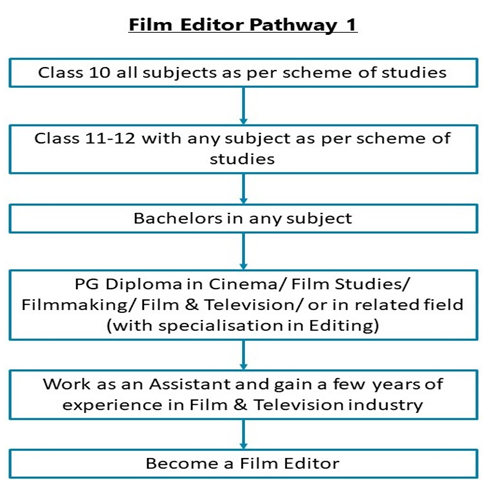
After completing Class 10 all subjects as per scheme of studies and Class 11-12 with any subject as per scheme of studies, you can go for a graduation in any subject. After graduation you can then pursue a Post-Graduate Diploma in Cinema/ Filmmaking/ Film & Television/ Film Studies or in a related field with specialisation in Editing. You can then start working as an Assistant and gain a few years of experience in Film & Television industry and then become a Film Editor.
Class 10 all subjects as per scheme of studies –– Class 11-12 with any subject as per scheme of studies – Bachelor’s degree in Filmmaking/ Film & Television/ Film Studies/ or in a related field (with specialisation in Editing/ Digital Editing) – Work as an Assistant and gain a few years of experience in Film & Television industry – Become a Film Editor
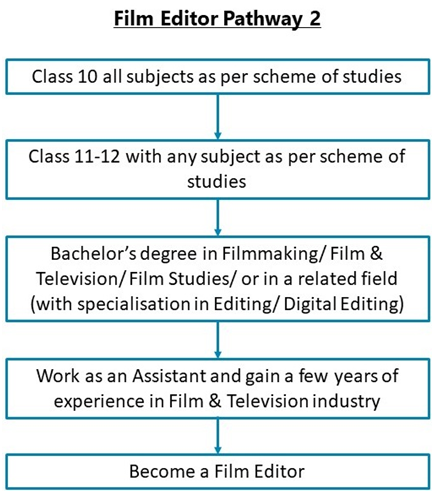
After completing Class 10 all subjects as per scheme of studies and Class 11-12 with any subject as per scheme of studies, you can go for a Bachelor’s degree in Filmmaking/ Film & Television/ Film Studies/ or in a related field (with specialisation in Editing/Digital Editing). After graduation you can then start working as an Assistant and gain a few years of experience and become a Film Editor.
Class 10 all subjects as per scheme of studies –– Class 11-12 with any subject as per scheme of studies – Bachelor’s degree in Mass Communication/ Mass Media/ Media Studies / Film Studies or similar course - Work as Assistant and gain a few years of experience in Film & Television industry – Become a Film Editor
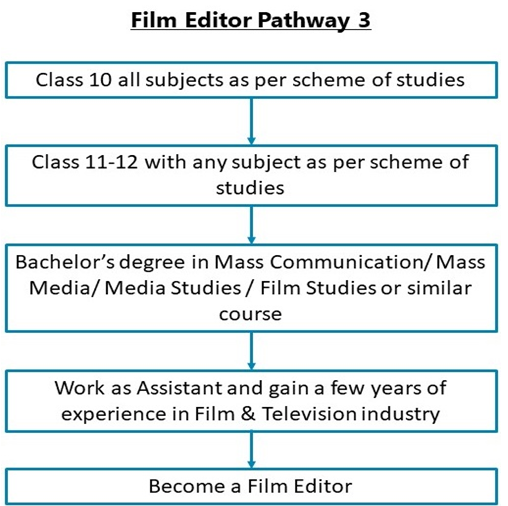
After completing Class 10 all subjects as per scheme of studies and Class 11-12 with any subject as per scheme of studies, you can go for a Bachelor’s degree in Mass Communication/ Mass Media/ Film Studies/ in a similar or related field. After graduation you can then start working as an Assistant and gain a few years of experience and become a Film Editor.
Class 10 all subjects as per scheme of studies –– Class 11-12 with any subject as per scheme of studies – Bachelor’s degree in Mass Communication/ Mass Media/ Media Studies / Film Studies or similar course – Master’s degree/ Post Graduate Diploma in Cinema / Film & Television/ Filmmaking/ Mass communication/ Film studies or in a related field (with Editing as a specialisation) - Work as an Assistant and gain a few years of experience in Film & Television industry – Become a Film Editor
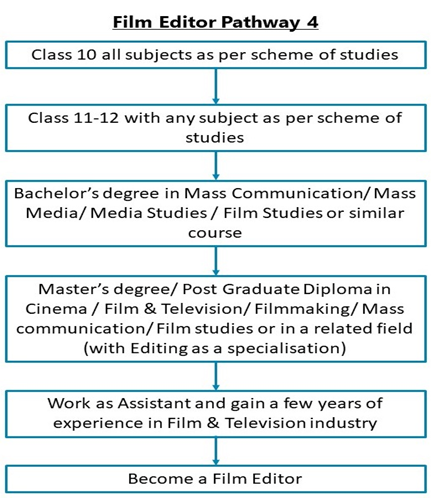
After completing Class 10 all subjects as per scheme of studies and Class 11-12 with any subject as per scheme of studies, you can go for a Bachelor’s degree in Mass Communication/ Mass Media/ Film Studies/ Filmmaking/ Media Studies / or in similar or related field. After graduation you can then pursue a Master’s degree or a Post-graduate diploma in Mass communication/ Mass Media/ Cinema/ Film studies/ Filmmaking or in a similar or related subject. Then you can start working as an Assistant for a few years in the Film & Television industry and become a Film Editor.
Class 10 all subjects as per scheme of studies –– Class 11-12 with any subject as per scheme of studies – Bachelor’s degree in Film Making/ Film & Television (with specialisation in Editing/Digital Editing) – PG Diploma in Film Making/ Film & Television (with specialisation in Editing) – Work as an Assistant and gain a few years of experience in Film & Television industry – Become a Film Editor
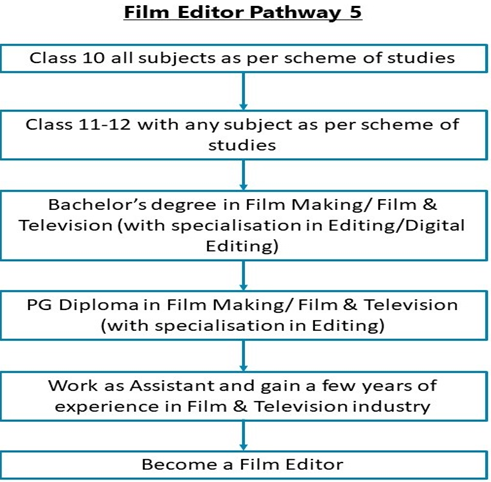
After completing Class 10 all subjects as per scheme of studies and Class 11-12 with any subject as per scheme of studies, you can go for a Bachelor’s degree in Filmmaking/ Film & Television (with specialisation in Editing/Digital Editing) or in a related field. After acquiring a graduation degree you may go for a Post Graduate diploma in Filmmaking /Film & Television (with specialisation in Editing). Then you must gain a few years of work experience as Assistant and become a Film Editor.
Required Qualification & Competencies
1. After completing Class 11-12 with any subject as per scheme of studies, you can go for a graduation in any subject. After graduation you can then pursue a Post-Graduate Diploma in Cinema/ Filmmaking/ Film Studies/ Film & Television or in a similar field with specialisation in Editing.
2. After completing Class 11-12 with any subject as per scheme of studies, you can go for a bachelor’s degree in Film Making/ Film & Television/ Film Studies (with specialisation in Editing/ Digital Editing).
3. After completing Class 11-12 with any subject as per scheme of studies, you can go for a bachelor’s degree in Mass Communication/ Mass Media/ Film Studies or in a similar field.
4. After completing Class 11-12 with any subject as per scheme of studies, you can go for a Bachelor’s degree in Mass Communication/ Mass Media/ Film Studies or similar field. In case you wish to go for further studies you can do a Master’s degree or a Post-Graduate diploma in Mass communication or in a related field.
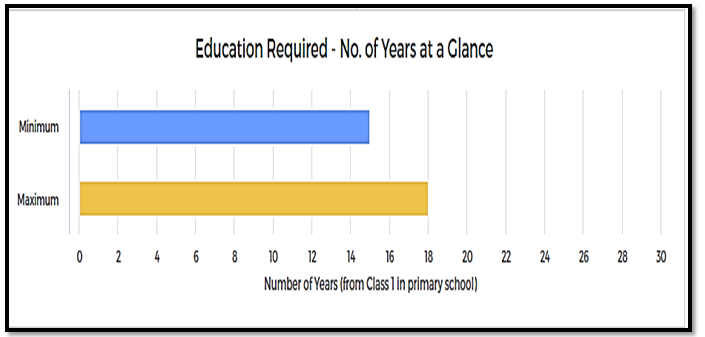
MINIMUM EDUCATION REQUIRED | MAXIMUM EDUCATION REQUIRED |
Under Graduate Undergraduate Degree / Honours Diploma / Graduate Diploma (equivalent to a Degree) Programs for which the minimum eligibility is a pass in Higher Secondary / Class XII School Leaving examination. | Post Graduate Postgraduate Degree / Diploma / Certificate Programs for which the minimum eligibility is a pass in Graduation / equivalent Diploma program like Honours Diploma or Graduate Diploma. |
Competencies Required
Interests
1. Artistic: You should have interests for Artistic Occupations. Artistic occupations mostly involve working with creative ideas, art and designs. These occupations involve abstract or conceptual thinking, creative self-expression and often do not follow any set processes or rules for getting things done.
2. Enterprising: You should have interests for Enterprising Occupations. Enterprising occupations involve taking initiatives, initiating actions, and planning to achieve goals, often business goals. These involve gathering resources and leading people to get things done. These require decision making, risk-taking, and action orientation.
3. Investigative: You should have interests for Investigative Occupations. Investigative occupations involve working with ideas and quite a lot of thinking, often abstract or conceptual thinking. These involve learning about facts and figures; involve use of data analysis, assessment of situations, decision making and problem-solving.
Knowledge
Communications and Media- Knowledge of how different media such as print, television, radio and social media works; how to produce content such as news, articles, audio-visual programs, etc. for different media. This includes various ways to inform and entertain people via print, audio, audio-visual and online media.
Skills
1. Active Listening: Giving full attention to what other people are saying, understanding the points being made by others, asking questions, etc.
2. Critical Thinking: Using logic and reasoning to identify the strengths and weaknesses of alternative solutions, conclusions or approaches to problems.
3. Animation and Special Effects Design Tools: Skills in using various graphic design tools such as Adobe Animate, Autodesk Maya, Autodesk 3D Max, Cinema 4D, etc.
4. Artistic and Visual Design: Skills in creating and developing designs which are visually appealing and attractive
5. Complex Problem Solving: Identifying complex problems and reviewing related information to develop and evaluate options and implement solutions
6. Speaking- Talking to others to convey information effectively.
7. Time Management- Managing one's own time and the time of others.
Abilities
1. Oral Comprehension: The ability to listen to and understand information and ideas presented through spoken words and sentences.
2. Information Ordering: The ability to arrange things or actions in a certain order or pattern according to a specific rule or set of rules (e.g., patterns of numbers, letters, words, pictures, mathematical operations).
3. Fluency of Ideas: The ability to come up with a number of ideas about a topic (the number of ideas is important, not their quality, correctness, or creativity).
4. Inductive Reasoning: The ability to combine pieces of information from various sources, concepts, and theories to form general rules or conclusions. For example, analysing various events or situations to come out with a set of rules or conclusions.
5. Originality: The ability to come up with unusual or innovative ideas about a given topic or situation, or to develop creative ways to solve a problem.
Personality
1. You are always imaginative or in most situations.
2. You always prefer to experience new things and have new experiences, or you mostly do.
3. You can always act independently or could do so in most situations.
4. You remain calm in difficult situations sometimes but some other times you are anxious.
Career - Job Opportunities & Profiles
1. After completing the required education in this particular field, you can start working as an Intern/ Trainee for at least one or two years. In a film production house, you will start as a second assistant editor/ member, editing team/ etc. where you will work as a member of the editing team for at least 3-5 years or even more. After working as Second Assistant Editor you will work as an Assistant editor for about 4-5 years or may even extend to working for 8-10 years in this role.
2. It takes years of work experience and reputation both in order to finally become an Editor and work independently as an Editor. You would have to gain ample experience prior to becoming an editor in any film production house.
3. Whereas, in TV production houses as well as commercial film making you can expect faster progress.
You can look for job opportunities in:
1. Film Production Houses such as: Reliance Big Entertainment, Yash Raj Films Pvt Ltd, Balaji Telefilms Ltd, Red Chillies Entertainment Pvt Ltd, Wizcraft International Entertainment, Dharma Productions, Muka Arts, and Illuminati Films among many others.






2. Television series and Web series production companies such as: Balaji Telefilms, Bennett, Coleman & Co. (The Times of India Group), UTV Television, Zee Telefilms, Television Eighteen India, Sony Entertainment Television, Dice Media, Buzzfeed, The Viral Fever, AIB, East India Comedy, Green Gold Animation, Hats Off Production, Big Synergy, Star India, and Endemol among many others. etc.






3.Television Commercial Production companies such as: Flying Saucer, Little Red Car Films, Nirvana Films, Corcoise Films, Equinox Films, MAD films etc.




On the other hand, if you want to start working independently you would need a lot of experience in this field. Therefore you can take up working on short-term contracts for post-production studios, television companies, web series, and documentaries. You must make a Portfolio which may help you in attracting exciting feature or short film editing projects or contracts. You might also get opportunities by working in other big or small budget films which include web series, documentaries and gain experience.
Career Growth
You will start as a Trainee or runner before working your way up to a position as an assistant editor and then finally as Editor. You can expect to work as an Assistant Editor for around 3-4 years before moving on to become a qualified editor. Since career progression in this industry varies accordingly therefore after years of experience you may want to become a Director and then a Producer.
Trainee/ Runner – Second Assistant Editor – First Assistant Editor – Post Production Supervisor – Film Editor/ Senior Film Editor
Trainee/ Runner – Second Assistant Editor – First Assistant Editor – Post Production Supervisor – Film Editor/ Senior Film Editor – Director – Producer
Salary Offered
By all probabilities, you will have to begin your career as a 2nd Assistant Editor or if you have notable experience before joining the profession, as a 1st Assistant Editor.
Earning as a 2nd Assistant Editor
1. As a 2nd Assistant, you may have to start with a low salary, which will just be enough to cover your basic expenses. However, there are associations for the crew which sets a minimum pay. Here are some examples as to how much you can make:
2. As a 2nd Assistant in a low budget regional movie, you could be paid about a lakh – so assuming that you get one movie a year, you will make 8/8.5K a month. A big-budget Bollywood / Tollywood movie will fetch you about 2 lakhs for the project. So in that case, you will earn an average of about Rs. 18,000 a month.
3. As a 2nd Assistant in a commercial film or other similar productions, you might be paid on an hourly basis. Assuming that you are getting work on at least 15 days in a month, you may make about Rs. 12-20,000 a month.
4. So, overall, assuming you take up several projects in a year, your average earning per month could be between Rs. 8,000 – 20,000 or even more a month.
Earning as a 1st Assistant Editor
1. A 1st Assistant in a big-budget Bollywood / Tollywood movie might be paid 5-6 lakh for the project. So, assuming that you are doing only 1 movie a year, you will be earning anything between Rs. 40,000-50,000 a month. But then you can do other projects too.
2. However, a 1st Assistant in a low budget regional movie might be paid 2-3 lakh for the project. So, assuming that you are doing only 1 movie a year, you will be earning anything between Rs. 18,000-25,000 a month. But then you can do other projects too.
3. So, overall, assuming you take up several projects in a year, your average earning per month could be between Rs. 20,000 – 50,000 or even more a month.
Earning as a senior member of an editing team
Experienced members of an editing team could be paid 12-30 lakh for a movie which is a big budget. Working in low budget movies, commercial films, and other projects may fetch you anything between 2 lakh – 5 lakhs. Assuming that you are taking up several projects in a year, you may in all make about Rs. 50,000 – 2, 50,000 a month.
Earning as an Editor (if in a team, then as the Head of the team)
1. An Editor of a low budget regional film can make a few 4-5 lakhs. So on an average 35/42,000 a month assuming she makes only one movie in a year. But it is obvious that she would make more from commercials films, web series, television shows, etc. In general, if you become known for good work among the film fraternity, you will be making not less than a lakh a month and about Rs. 20-25 lakh in a year on the higher side.
2. At the top end, famous Editors working for a big-budget Bollywood / Tollywood film may take 5-10 crore for a movie (they may also work on a basic pay plus profit sharing). Assuming they do only one movie in a year, they make an average monthly earning of about 42-84 lakhs. But as a matter of fact, famous Editors work in a team on quite a few commercial projects, web series, etc. So, in all, they may make even a few crores a month on an average.
3. So, overall, you will be making Rs. 1,00,000 – 42,00,000 or even more a month on an average (excluding the astronomical figure of one crore or more – which is obviously rarest of rare for a famous Editor).
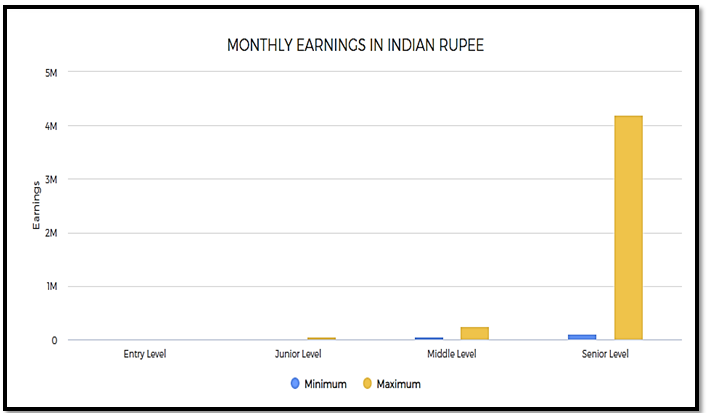
Monthly Earning In Indian Rupee
Entry Level | Junior Level | Mid Level | Senior Level | |||||
Min Earning | Max Earning | Min Earning | Max Earning | Min Earning | Max Earning | Min Earning | Max Earning | |
8000 | 20000 | 20000 | 50000 | 50000 | 250000 | 100000 | 4200000 | |
1. Entry level: 0 - 2 years of work experience
2. Junior Level: From 1 to 12 years of work experience
3. Mid-Level: From 5 to 20+ years of work experience
4. Senior Level: From 10 to 25+ years of work experience (there could be exceptions in some high-end technical, financial, engineering, creative, management, sports, and other careers; also in the near future, people will reach these levels much faster in many careers and in some careers, these levels will have no meaning as those careers will be completely tech skill driven such as even now, there is almost no level in a Cyber Security Expert’s job)
Work Activities
1. Communicating with co-workers and others: Communicating with people in writing, verbally or otherwise inside your workplace and various other people who have professional relationships with your place of work including vendors, government officials, etc. or with people at large.
2. Creative thinking: Developing new ideas, concepts, innovative solutions to problems, newer ways of getting things done, designing products and services, creating work of art and craft, etc.
3. Decision making and problem-solving: Analysis of data and information; evaluation of alternative decisions and results of decisions; taking the right decisions and solving problems.
4. Getting Information and learning: Observing, hearing, reading, using computers, or otherwise obtaining information and learning from it.
5. Updating and using relevant knowledge: Keeping updated with the latest knowledge relevant to your fields of work and use of the relevant knowledge in getting things done.
6. Using computers for work: Using computers for day-to-day office work; using computer software for various applications in day-to-day professional work; entering data and process information; for writing.
7. Working in a team: Working along with the entire film crew, coordinating with DoP and other camera operators, assisting audio editors and other crew members.
Future Prospects
The Indian Media and Entertainment (M&E) sector reached Rs1.67 trillion ($23.9 billion) in 2018, a growth of 13.4 percent, according to EY-FICCI report A billion screens of opportunity. As per the report, the M&E sector in India is expected to cross Rs2.35 trillion ($33.6 billion) by 2021, at a CAGR (Compounded Annual Growth Rate) of 11.6%. The sector will continue to grow at a rate faster than the GDP, reflecting the increasing economic growth. India has the second-highest number of internet users after China with 570 million internet subscribers growing at 13% annually. The report estimates that approximately 2.5 million consumers in India today are digital-only and is expected that this customer base will to grow to 5 million by 2021.
According to a report submitted by KPMG, the film industry in India is expected to grow at a CAGR of 7.3% driven by theatrical revenue from India and overseas. The Indian Box office has been performing remarkably well and is expecting two-fold success in the coming future. A career in the Film and media industry is expected to grow tremendously in the coming future.
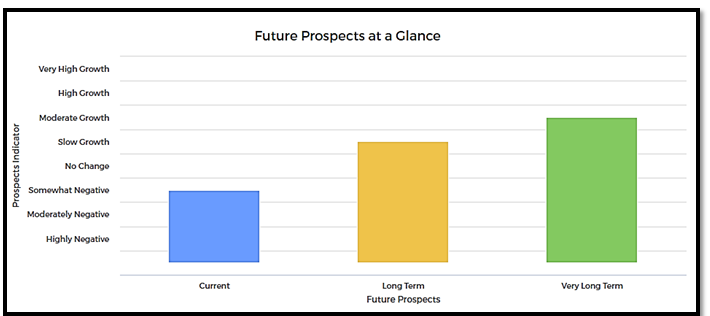
Future Prospects At A Glance
Current (0-1 year) | Long Term (2-5 year) | Very Long Term (6-10 years) |
Somewhat Negative | Slow Growth | Moderate Growth |


