
Theologian
Entry Level Qualification
Class 12
Career Fields
Humanities, Liberals Arts & Social Science
For Specially Abled


About Career
PARTICULARS | DESCRIPTION |
Name | Theologian |
Purpose | Study And Research About The Existence of God |
Career Field | Humanities, Liberals Arts & Social Science |
Required Entrance Exam | No Entrance Exam |
Average Salary | 150000 - 300000 Rs. Per Year |
Companies For You | Monk, Priest, Preacher, Lead Imam, & Many More |
Who is Eligible | Class 12th Pass |
1. As a Theologian you will study and research about the existence of God, God’s teaching as written in our religious literature like the Vedas, Upanishads, Quran, Bible,Agam Sutras, Granth Sahib, Tripitaka, Hebrew Bible, etc. and about the practices that lead to God. You may raise questions about the very existence of God and analyse the origin of the knowledge of God to answer the universal questions – does God exist? If so, where is he or she? Did he really appear in human incarnation like Lord Mahavira, The Buddha, Jesus Christ, and Prophet Muhammad?
2. You will study and research about the religious thoughts specific to a religion of your choice or about many religions. You will study about the philosophy behind religious thoughts and the existence of God; you will study and research about the individual and social behavior around the belief of God; you will study about the human societies in the past, their beliefs, faiths, religious practices and rituals.
3. You may critically analyse religious beliefs, rituals, and practices of a religion or many religions to come up with your own interpretation. You may trace the origin of human thoughts about God; you may analyse historical events as described in our religious books; you may research about various evidences in our ancient cave paintings, physical structures in South America, various artifacts of early civilizations.
As a Theologian, you may get involved in or work as:
1. A religious scholar and teacher - at a seminary (colleges set up by various religious orders such as Hindu sects, Catholic Churches, Islamic sects, etc. for teaching religion) or at a university which is involved in research and teaching of Theology.
2. A religious scholar – as a hermit or a sanyasi, as a monk of a religious organisation, or as an ordinary individual who hasn’t renounced worldly pleasures and hasn’t taken the vows of chastity, obedience, and abstinence from biological and materialistic pleasures. Although all religious orders do not prescribe chastity, obedience, and abstinence to be a monk, but most do.
3. As a Priest or a Pundit – as an individual (such as a Hindu priest) or as a monk of a religious order – you will conduct religious rituals and ceremonies at Mandirs, Churches, Masjids, synagogues, and at various other places of worship or at family homes. You may get involved in leading prayers at places of worships or at homes. You may get involved in delivering religious discourses to various gatherings of devotees.
Theologians today may practice and preach different ideas and concepts
1. Theologians today may practice and preach different ideas and concepts about the creator (or destroyer) of this universe according to the historical scriptures of different religions. They may also develop their own philosophies about such theories which may not even relate to a single creator or religion.
2. Theologians may examine the human experience of faith, and how different people, communities& cultures express it through rituals, traditions, beliefs, and practices. They may also choose to study about religion-independent concepts & philosophies and advocate their own interpretations of them.
Some Theologians may also examine the world's religions together and their impact on society
1. For example, Comparative Religion practitioners are concerned with the systematic comparison of the doctrines & practices of the world's religions. They study about cooperative, constructive, & positive interaction between people of different religious traditions.
2. They may also study about new religious movements that emerged in the nineteenth century. They have the complex job of thinking about and debating the existence or non-existence of the Supreme Creator (more commonly God) with respect to different faiths.
Have a look at someuniquetheories here!
1. Studying Theology means taking on challenging questions which may or may not be based on a certain religion. However, the study itself is part philosophy, part history, part anthropology, part literature, part history and also something entirely its own.
2. You may think study and preach about different philosophies (which are unrelated to any particular religion) like transhumanism, agnosticism, or eschatology. Tran humanism is a concept which advocates that our planet Earth will be occupied by transformed humans as highly sophisticated technologies appear. We will possibly have extended abilities which we can even choose to use, whenever, wherever.
3. Agnosticism is the belief that it's impossible for human beings to know anything about how the universe was created and if divine beings exist. Eschatology concerns itself with the final destiny of the soul & of humankind and that’s why it is also called the ‘science of last things’.
Key Roles and Responsibilities
You will be engaged in one or more of the following roles and responsibilities as well as other associated duties:
1. You will be studying & conducting research on a specific religion or religion-independent ideas or concepts in its entirety, based on the heritage of perennially valid philosophies of different parts of the world or develop your own philosophies.
2. You will instruct, educate, guide & supervise students or devotees pursuing the discipline of theology, divinity or related subjects, demonstrate ideas/ concepts to them, and elaborate on different philosophies drawing conclusions to help them understand difficult/ new theories.
3. You will examine the human experience of faith, how different people & cultures express it and study & interpret religious laws, doctrines, or traditions.
4. You will think about and debate the nature of the Supreme Creator (more commonly God) with respect to different faiths or with respect to a specific faith.
5. You will read, interpret and offer teachings based on religious texts like the Bible, Torah, Gita, Talmud or Quran or others.
6. You will organize & lead religious services, instruct people who seek conversion to a particular faith and administer religious rites / ordinances.
7. You will counsel individuals regarding interpersonal, health, spiritual or religious problems.
8. You will develop or direct study courses & religious education programs within congregations (a group of people assembled for religious worship) and clerisies (learned or literary people regarded as a social group).
9. You will attend workshops, academic seminars, or theological conferences to obtain ideas, information, or resources or to present posters and/ or research items.
Career Entry Pathway
Stay in a monastery as an eight-precepts ‘atthasila’ layperson for one or more months – train in monastic routines for about 6 months as a white robed ‘anagarika’ – request for ‘shraamanera’ (full alms mendicant) through ‘pabajja’ to be a ‘parivrajaka’– study monk rules (vinaya) and acquire basic skills such as chanting, making robes etc. at least for 1 year – become part of ‘bhikkhu’ or ‘bhikkhuni’ sangha through ‘upasampada’ ordination – supervision for new monks under senior teacher for at least 5 years
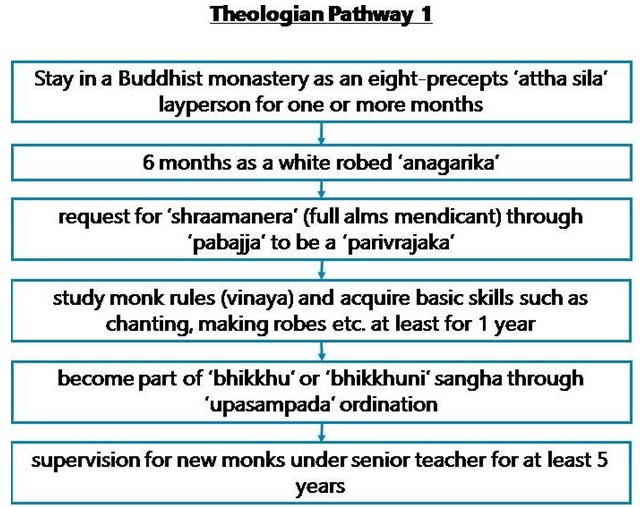
This pathway is for Monasticism among Buddhists. As a layperson (typically within 18-50 years of age, below 18 need parent’s permission) in genuine good physical & mental health (of any age without any prior knowledge or experience of the Buddhist faith and monasticism), you may be allowed to reside in a monastery (of your choice, but subject to acceptance by the sangha) and observe the eight-precepts ‘atthasila’ for 1 – 3 or more months depending on your progression determined by the sangha. Then you will have to train in monastic routines for about 6 months as a white robed ‘anagarika’ (homeless one). Then, if accepted by the sangha, you can request for ‘pabajja’ (going forward) for a ‘shramanera’ ordination to be a ‘parivrajaka’ (full alms mendicant& novice). There is a difference here observed by different monasteries. Not all bhikkhus or bhikkhunis have to maintain mendicancy. If you wish to be a Theravada monk, you will observe mendicancy throughout your life as you cannot touch gold or silver (these metals means currency) and you will be financially dependent. The other type is the Tibetan monk (this label is a type of classification and not restricted to the region only) who can even exchange their robes for the clothes of a lay person to go to a job and put their robes back on at the end of the work day. Theravada monks cannot disrobe as disrobing means loss of monasticism. You shall be a ‘shramanera’ for at least 1 year or more. Then you will be bestowed with the ‘upasampada’ ordination and be a bhikkhu (monk) or bhikkuni (nun). A newly ordained bhikkhu or bhikkhuni is supposed to be under observation of a senior lama (teacher) for at least a period of 5 years. Youmay stay in the monastic community during this period after becoming ordained. If this is not possible, you should at least stay near yourlama and follow his/her guidance for this period of time.
Self-preparation reading Biblical literature, rules, traditions etc - Work with the Vocation Director of a community - Aspirancy / Pre-Candidacy - Postulancy / Candidacy – Novitiate–First Vowsor Temporary vowsas a ‘Juniorate’ - Final Vows or Perpetual vows
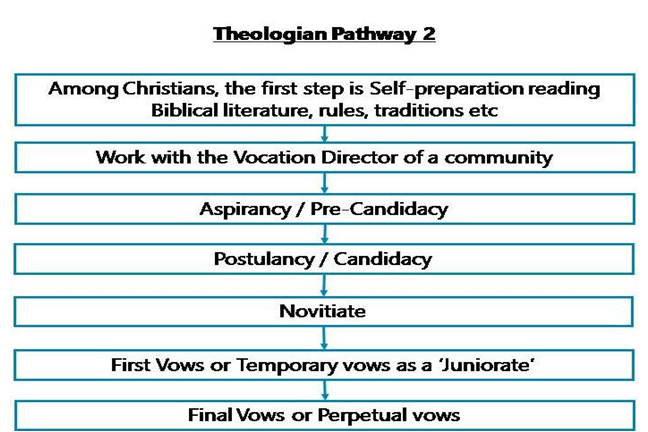
This pathway is for Monasticism among Christians. Typically, you must be within 18-40 years of age to opt for monasticism within the Christian community. A college degree or professional experience are not absolute prerequisites but are encouraged. The entire process can take as long as a decade (10 years) or more. During the self-preparation stage, you will have to pray, read scriptures, attend masses or prayer services, visit Catholic, Orthodox, Anglican, Lutheran, or Methodist communities and meet nuns before starting to work with the Vocation/ Spiritual Director of a community. Most communities or establishments have one appointed. The Director will lead you through all the formal steps of becoming a nun within the particular religious community of your choice. While you are relating with the Vocation Director, you are not under any obligation to stay with that community. During pre-candidacy and candidacy, the incumbent and the community members get to know each other. This stage may take 6 months to several years. During at last part of this time, the candidate/postulant lives in community. When you enter ‘novitiate’ you will be called a ‘sister’. This is usually for 1 year especially dedicated to prayer, vows, and religious life. An additional year may be added during which you will engage in ministry (common relational public service). The period for First Vows or Temporary vows extends for 1 to 3 years. During this time, you will engage in ministry and live in community. The period for Final Vows or Perpetual vows extends anytime between 3 to 9 years after temporary vows. The time may vary according to the tradition of the community. Perpetual vows are professed for life.
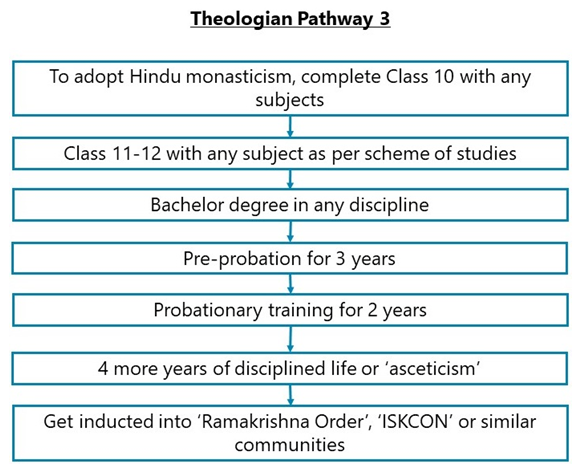
Class 10 all subjects as per scheme of studies - Class 11-12 with any subject as per scheme of studies – Bachelor degree in any discipline – Pre-probation for 3 years – Probationary training for 2 years - 4 more years of disciplined life or ‘asceticism’ – Get inducted into ‘Ramakrishna Order’, ‘ISKCON’ or similar communities
This pathway is for Monasticism among Christians. Typically, you must be within 18-40 years of age to opt for monasticism within the Christian community. A college degree or professional experience are not absolute prerequisites but are encouraged. The entire process can take as long as a decade (10 years) or more. During the self-preparation stage, you will have to pray, read scriptures, attend masses or prayer services, visit Catholic, Orthodox, Anglican, Lutheran, or Methodist communities and meet nuns before starting to work with the Vocation/ Spiritual Director of a community. Most communities or establishments have one appointed. The Director will lead you through all the formal steps of becoming a nun within the particular religious community of your choice. While you are relating with the Vocation Director, you are not under any obligation to stay with that community. During pre-candidacy and candidacy, the incumbent and the community members get to know each other. This stage may take 6 months to several years. During at last part of this time, the candidate/postulant lives in community. When you enter ‘novitiate’ you will be called a ‘sister’. This is usually for 1 year especially dedicated to prayer, vows, and religious life. An additional year may be added during which you will engage in ministry (common relational public service). The period for First Vows or Temporary vows extends for 1 to 3 years. During this time, you will engage in ministry and live in community. The period for Final Vows or Perpetual vows extends anytime between 3 to 9 years after temporary vows. The time may vary according to the tradition of the community. Perpetual vows are professed for life.
Class 10 all subjects as per scheme of studies - Class 11-12 with any subject as per scheme of studies – Bachelor degree in any discipline – Pre-probation for 3 years – Probationary training for 2 years - 4 more years of disciplined life or ‘asceticism’ – Get inducted into ‘Ramakrishna Order’, ‘ISKCON’ or similar communities
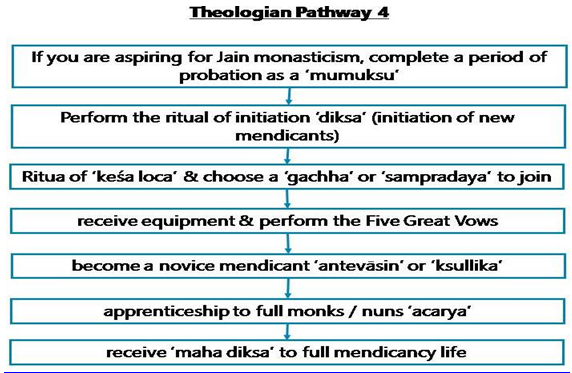
This pathway is for Monasticism among Jains. A lay or common jain (as early as 8 years – 18 years) in genuine good physical & mental health has to complete a period of probation (study holy writings, observe monastic rules etc.) as a ‘mumuksu’ before obtaining ‘diksa’ (initiation of new mendicants) following either of the Digambara or Śvetāmbara methodologies. Digambara nuns are called ‘āryikās’. ‘Diksa’ of a ‘dīkṣārthī’ (those aspiring to be initiated) is associated with the ritual of keśa-loca or pulling out of hair. Then you will have to choose a mendicant lineage or monastic order ‘gachha’ or ‘sampradaya’ to join. After joining, you will receive equipment broom, mouth-cloth, water pot etc. associated with your chosen ‘gachha’ or ‘sampradaya’. You will then have to perform the Five Great Vows ‘mahā-vrata’. Then you become a novice mendicant ‘antevāsin’ or ‘ksullika’ maintaining ‘vairagya’ or complete renunciation from worldly pleasures. All novices serve their apprenticeship to full monks / nuns ‘acarya’ in their ‘gachha’ or ‘sampradaya’. The period of novitiate differ in the various sects. Then you will have to receive ‘mahadiksa’ after which you will have to observe a life of full mendicancy as a ‘nirgrantha’ (bondless). The rituals & stipulations over the entire process from initiation to final ordination differ between boys and girls and between different sects and groups too.
1-2 years of Hifz or similar courses –1-2 years of Aliya Ula or similar courses - 8 years of Alim-fazil / Fazilat course / MahadSanviyaKhususi courses – Graduation in Arabic Literature, Hadith, Tafsir or similar – Master’s in Tafsir, Theology, Fiqh, Literature, Tajweed w Qira’at, Dawah or similar
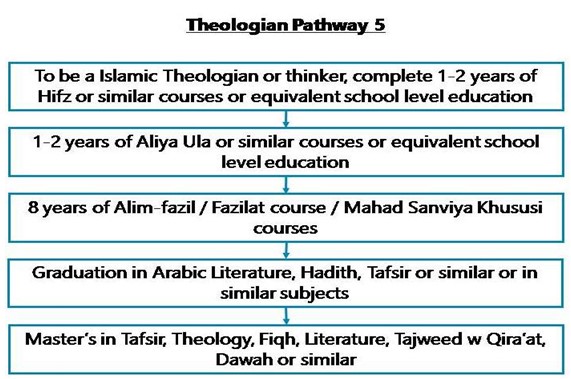
This pathway is specific to Islam. After completing 1-2 years of Hifz or similar courses from any madrasah (this is the primary level for children less than 11 years), then 1-2 years of Aliya Ula or similar courses and 8 years of Madrasah Alim-fazil / Fazilat course / MahadSanviya Alia Ula courses, you are eligible to study for graduate level programs in Arabic Literature, Hadith, Tafsir or similar. In some institutions, the Fazilat course itself is considered equivalent to graduation. Then you can go for Master’s in Tafsir, Theology, Fiqh, Literature, Tajweed w Qira’at, Dawah or similar. This pathway is strictly for those who wish to pursue the Madrasah system of education. Some of the reputed institutions are: Al JamiaTusSalafiah, DarulUloomDeoband, Darussalam Islamic University, DarulUloomNadwatulUlama etc. However, you can even take admission to a ‘jamia’ or university after you have passed Class 10 and Class 11-12 from the conventional system of education in India if you have learnt Urdu, Arabic at home simultaneously. A lot of students do this too. You can even pursue graduation in a university abroad like the Islamic University of Madeena etc. You can even pursue PhD in various specializations from universities like UmmulQura University of Makkah etc. If you are interested, you will be eligible to deliver general lectures and sermons in masjids etc. with sound knowledge of the scriptures even if you lack formal education from a Madrasah, or Jamia. The two main positions in a mosque are that of the Imam (delivers sermons) and Muazzin / Muadhhin (calls to prayer). You may be associated with the governing body or board (administrative activities) of a mosque too.
Class 10 all subjects as per scheme of studies - Class 11-12 with any subject as per scheme of studies– Bachelor’s in Philosophy/ Sociology/ Theology/ Divinity & Theology/ Psychology or BA in any discipline – MA in Anthropology of Religion/ Art & Religion/ Comparative Religion/ Buddhist Studies/ Sociology of Religion / Christian Spirituality/ Hindu Studies/ History of Christianity/ Islamic Studies/ Jain Studies/ Jewish Studies/ New Religious Movements/ Religion & Literature or similar
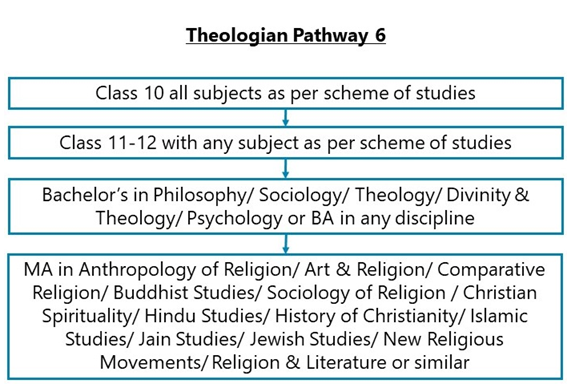
After completing Class 11-12 with any subject as per scheme of studies, go for a Bachelor’s in Philosophy/ Sociology/ Theology/ Divinity & Theology/ Psychology or similar subjects or Bachelor of Arts in any discipline. Then pursue MA in Anthropology of Religion/ Art & Religion/ Comparative Religion/ Buddhist Studies/ Sociology of Religion / Christian Spirituality/ Hindu Studies/ History of Christianity/ Islamic Studies/ Jain Studies/ Jewish Studies/ New Religious Movements/ Religion & Literature or similar. You may also go for your doctoral studies with or without your M Phil degree.
Class 10 all subjects as per scheme of studies - Class 11-12 with any subject as per scheme of studies– Bachelor’s in any discipline – BD (Bachelor of Divinity) – Master of Theology (M Th)/ Divinity (M Div) or similar
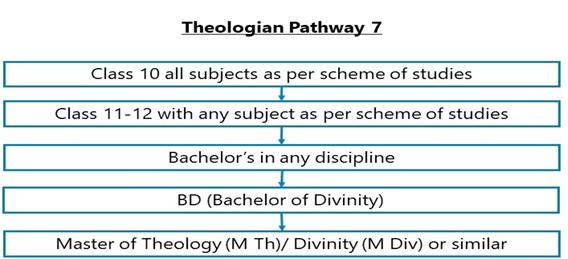
After completing Class 11-12 with any subject as per scheme of studies, you can go for a Bachelor’s in any discipline. Then you can go for a Bachelor of Divinity degree (BD or B Div) which is typically for 4 years. BD can only be done after graduation although it is a Bachelor level degree. Thereafter, go for a Master’s in Theology (M Th), or Master’s in Divinity (M Div) or similar. Then you may complete your doctorate studies with or without an M Phil degree.
Class 10 all subjects as per scheme of studies - Class 11-12 with any subject as per scheme of studies – Bachelor’s (B Th or BA) in Theology/ Theology & Religion/ Divinity & Theology or similar / Bachelor of Religious Education (BRE) / Graduate in Theology (G.Th.) or similar courses – Post Graduation in Theology (M Th) / Divinity (M Div) or similar subject
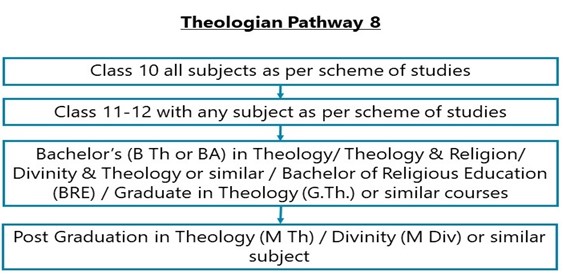
After completing Class 11-12 with any subject as per scheme of studies, go for a Bachelor’s (B Th or BA) in Theology/ Theology & Religion/ Divinity & Theology or similar / Bachelor of Religious Education (BRE) / Graduate in Theology (G.Th.) or similar courses. Then you may pursue Post Graduation in Theology (M Th) / Divinity (M Div) or similar subject.
Class 10 all subjects as per scheme of studies - Class 11-12 with any subject as per scheme of studies – Bachelor’s in Philosophy/ Theology/ Sociology or Joint BA+B Th or similar – Master’s in Philosophy / Theology (M Th) / Divinity (M Div) / Theology of Religious Life / Counseling & Spirituality/ Christian studies/ Christian Scriptures or similar
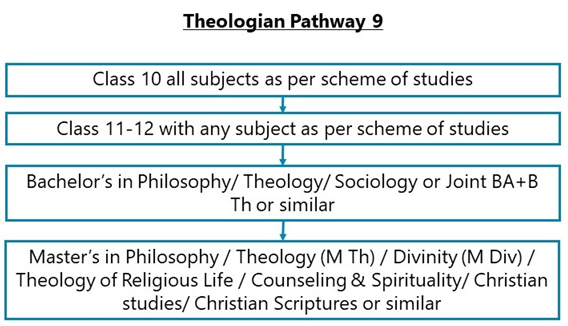
After completing Class 11-12 with any subject as per scheme of studies, go for a Bachelor’s in Philosophy/ Theology/ Sociology or Joint BA+B Th or similar programs. Then you may pursue a Master’s in Philosophy / Theology (M Th) / Divinity (M Div) / Theology of Religious Life / Counseling & Spirituality/ Christian studies/ Christian Scriptures or similar. You may also go for your doctoral studies with or without your M Phil degree.
Class 10 all subjects as per scheme of studies - Class 11-12 with any subject as per scheme of studies - BA in any discipline / B Th / Joint BA+BTh – Master of Divinity (M Div) or MA in Christian Ministry or similar subjects - M Phil & PhD (optional)
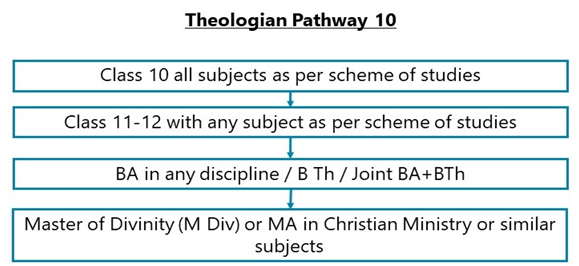
After completing Class 11-12 with any subject as per scheme of studies, you can go for a Bachelor’s in any discipline. Then go for BD or B Div(Bachelor of Divinity). Then you may pursue PG Diploma or Certificate courses in Theology/ Spirituality & Counseling/ Pastoral Counseling/ Women’s Studies/ Biblical Languages & Interpretation
Required Qualification & Competencies
If you wish to be a monk or a disciple within a specific community like the Christians, Jains, Buddhists, Hindus or the Mohammedans (Islam):
You will need no prior school or college level education. These are not absolute prerequisites anywhere in the world in any monastery or temple or masjid or church etc. Every community has their own learning pathways so you will have to choose one and proceed. However, you will have to understand the traditions and the requirements very well before opting for a life of monasticism or priesthood. You will have to especially be familiar with the respective scriptural texts and literature before offering yourself to such a life of asceticism.
If you wish to go through the formal education system to be a Theologian, these are the things you will have to bear in mind:
To get into this field, you need to complete Class 10 all subjects as per scheme of studies and then complete Class 11-12 with any subject as per scheme of studies.
After Class 11-12:
1. You can go for a Bachelor’s degree in any discipline
2. You can go for a Bachelor’s in Theology/ Theology & Religion/ Divinity & Theology or similar
3. You can go for Bachelor of Religious Education (BRE) / Graduate in Theology (G.Th.) or similar courses
4. You can go for Bachelor’s in Philosophy/ Theology/ Sociology or Joint BA+B Th
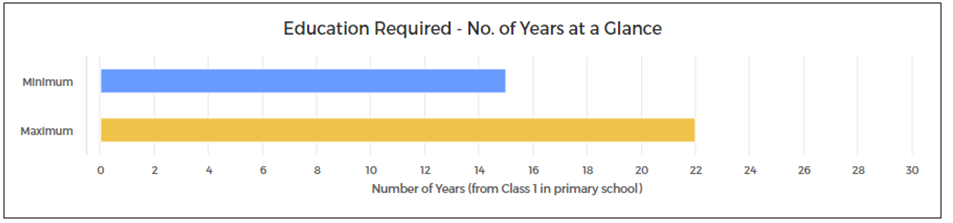
MINIMUM EDUCATION REQUIRED | MAXIMUM EDUCATION REQUIRED |
EDUCATION REQUIRED Under Graduate DESCRIPTION Undergraduate Degree / Honours Diploma / Graduate Diploma (equivalent to a Degree) Programs for which the minimum eligibility is a pass in Higher Secondary / Class XII School Leaving examination. | EDUCATION REQUIRED Doctoral DESCRIPTION All Ph.D. or equivalent degree programs for which the minimum eligibility is a Postgraduate or a Pre-Doctoral degree. |
Competencies Required
Interests
1. You should have interests for Social Occupations. Social occupations involve helping or assisting others; these involve working with and communicating with people to provide various services; these may involve educating and advising others.
2. You should have interests for Artistic Occupations. Artistic occupations mostly involve working with creative ideas, and art. These occupations involve abstract or conceptual thinking, creative self-expression and often do not follow any set processes or rules for getting things done.
3. You should have interests for Enterprising Occupations. Enterprising occupations involve taking initiatives, initiating actions, and planning to achieve goals. These involve gathering resources and leading people to get things done. These require decision making, risk taking and action orientation.
Knowledge
1. You should have knowledge of Philosophy and Theology - Knowledge of different philosophies and religions. This includes their philosophical principles, values, ethics, customs, practices, and their impact on human culture and civilization.
2. You should have knowledge of Social and Developmental Work - Knowledge about various principles, theories and processes to help underprivileged or disadvantageous people develop mentally, socially and economically as well as help them to get proper healthcare and other benefits. This includes helping underprivileged or disadvantageous people get education and employment.
Skills
1. You should have Reading Comprehension Skills - Skills in understanding written sentences and paragraphs in work related documents.
2. You should have Active Learning skills - Focused and continuous learning from various sources of information, observation and otherwise for application in getting work done.
3. You should have Instruction Skills - training others how to do something.
4. You should have Active Listening Skills - Giving full attention to what other people are saying, understanding the points being made by others, asking questions, etc.
5. You should have Critical Thinking skills- Skills in the analysis of complex situations, using logic and reasoning to understand the situations and take appropriate actions or make interpretations and inferences.
6. You should have Persuasion Skills- persuading others to change their minds or behaviour.
7. You should have Public Speaking skills - Talking effectively to a large group of people or an audience or addressing public at large in different settings such as conferences, seminars, meetings, etc.
8. You should have Service Orientation skills - Skills in or keen interest to help and assist people.
Ability
1. You should have Abstract Reasoning ability - The ability to understand ideas which are not expressed in words or numbers; the ability to understand concepts which are not clearly expressed verbally or otherwise.
2. You should have Articulation ability - The ability to speak clearly so others can understand you.
3. You should have Oral Comprehension Ability - listen to and understand information and ideas presented through spoken words and sentences.
4. You should have Oral Expression Ability - communicate information and ideas in speaking so others will understand.
5. You should have Deductive Reasoning Ability - apply general rules and common logic to specific problems to produce answers that are logical and make sense.
6. You should have Emotional Intelligence - The ability to understand your own and others' emotions and feelings; empathy for others; adjusting your behaviour or self-control and self-regulation according to others' emptions and situations.
7. You should have Existential Intelligence - The ability to understand various concepts related to human existence; the ability to relate to spirituality.
8. You should have Inductive Reasoning Ability - The ability to combine pieces of information from various sources, concepts, and theories to form general rules or conclusions. For example, analyzing various events or situations to come out with a set of rules or conclusions.
9. You should have Written Comprehension - The ability to read and understand information and ideas presented in writing.
10. You should have Written Expression - The ability to communicate information and ideas in writing so others will understand.
Personality Traits
1. You are always or mostly disciplined in your action and behaviour.
2. You can always act independently or could do so in most situations.
3. You are always or mostly careful about your actions and behaviour.
4. You are always or mostly a soft-hearted person.
5. You are always or mostly helpful to others.
6. You are always calm or generally remain calm in most situations.
Career - Job Opportunities & Profiles
1. While some students may pursue Theology to pursue ‘ordination’ in preparation for a career with religious learning seminaries / advocacy establishments / clerisies like a Church, Theological Societies, Temple, Darga as a Monk, Priest, Preacher, Lead Imam, Presbyter, Saint, or Reverend etc., some others simply pursue research and can simultaneously act as consultants to international societies and cross-cultural authoritative bodies while practicing as a teaching faculty in an academic institution.
2. Typically, in order to join higher ranks of a governing body of a reputed organization of any faith you would first need college education from a recognized theological school.
3. If you are a self-learnt individual lacking formal education, you can begin as a Devotee or a Member of any organization and slowly climb your way up the ladder into the higher ranks. This will be a much longer path, although.
4. You may also have your own spiritual pursuits seeking to unite with the power of singularity (the creator and the destroyer). You may as well begin your own private advisory services practicing Astrology / Numerology or similar professions.
5. Theology students may as well go on to work as journalists, politicians, novelists, columnists, media personalities, interior designers; the spectrum of possibilities is almost limitless. Many theology students go into further study, teaching or careers in a wide variety of fields.
6. If you can complete your M Phil or PhD, you may be invited for Lecturership at various private establishments but these opportunities are mostly for Theologians from the discipline of Biblical literature, Christian theology or related subjects. These are the most promising fields in the industry within the broad discipline of Theology. Please remember, you may not have to convert to the religion even if you want to pursue these as academic subjects.
Specialisation Tracks In This Career
1. Theologian (Comparative Religion)
This group of Theologians is concerned with the systematic comparison of the doctrines & practices of the world's religions. Such comparative study of religion yields a deeper understanding of the fundamental philosophical concerns of different religions and a more sophisticated understanding of human beliefs & practices regarding the sacred, numinous, spiritual, and divine. In this field, there exists a common geographical classification too such as Middle Eastern religions, Indian religions, East Asian religions, African religions, American religions etc.
2. Theologian (Agnosticism)
Agnostics neither believe nor disbelieve in a god or religious doctrine. They assert that it's impossible for human beings to know anything about how the universe was created and if divine beings exist – that the existence of God, of the divine or the supernatural is unknown or unknowable.
3. Theologian (Interfaith Dialogue, Interreligious Theology, Multiculturalism)
Theologians practicing in this branch of the discipline study cooperative, constructive, & positive interaction between people of different religious traditions (i.e., "faiths") and/or spiritual or humanistic beliefs. They promote understanding between different religions or beliefs to increase acceptance of others, rather than to synthesize new beliefs. This draws on more than one religious tradition, in principle and ideally on the whole history of religions. This encourages ‘cultural pluralism’ in which various ethnic groups collaborate with one another without having to sacrifice their particular identities.
4. Theologian (Biblical Literature & Christian Spirituality)
Theologians studying Biblical Literature & Christian Theology focus on deep inner unity of the biblical narrative concerning the relationships among God, human beings, and the world through time and culture(s). They use a range of analytical methods and critical approaches to the biblical corpus. They analyze the literature, history, culture, & Christianity as a religion pertinent to the interpretation of Old and New Testament texts of the Bible. They study the theological dimensions of the scriptures in Christian history and thought. These Theologians may be scholars in an academic role or an ascetic of a certain rank with any religious institution.
5. Theologian (Judaic Studies)
Theologians involved in Jewish or Judaic studies may study any aspect of Judaic traditions or history about their beliefs & philosophies or the rabbinic literature or about social cultures or the religion as a whole itself. They may study or conduct research on religious literature contained in the Torah, Tanakh, Mishnah, Gemara, Talmud or Midrash. As commonly believed, Judaism’s role is not to explain the nature of god but rather how god acts in our life and how he wants us to live.
6. Theologian (Hindu Spirituality Studies)
Hinduism is the undoubtedly the oldest living major religion and is sometimes referred to as the Sanātana Dharma, "the eternal tradition", or the "eternal way". Hindu Theologians study and conduct research about the gods/ goddesses of the Vedic pantheon, the creator, the sun, or heaven and earth, the release of the waters (in short, the organization of the universe) with respect to the early Hindu scriptures and literature including the Vedas, Upanishads. Some study about Vedic ritualism. The principal focus of Vedic literature is the ‘sacrifice’. By virtue of a ‘sacrifice’ a god is invited to partake of a meal shared by the sacrificer and his priest. Some Theologians also focus on the humanity and social doctrines within the realm of Vedic theology. There are numerous focal points when it comes to Hindu theology as the supporting literature is vast and complex.
7. Theologian (Jain Studies)
Jain Theologians concentrate on Jain philosophy, ethics, and living streams of religious experience based on non-harming. They explore Jain culture’s primary texts, doctrines, and their contemporary application. They may conduct research on diaspora Jainism, sacred & commentarial literature, pilgrimage, ritual, material culture, monastic traditions, Jainism & cultural exchange, Jainism & ecology, or Jainism & the natural sciences. They may study the Jain tradition in conversation with the other Dharma traditions (Hindu and Buddhist) in order to deepen understanding of their mutual illumination as well as the unique contributions of Jainism.
8. Theologian (New Religious Movements)
Theologians practicing in this sub-field study and qualitatively scrutinize organizational movements, religious ideas, and distinctive spiritualties that emerged in the nineteenth century. Some of their focal areas include metaphysical churches, Latter Day Saints, Bahá'í, occult & esoteric movements, non-traditional & alternative movements from the mid-20th century. They may concentrate on Western appropriations of Hinduism, Buddhism, Sikhism, Sufism; neo-paganism; New Age movements; human potential movements etc. They draw upon discipline like anthropology, sociology, literary studies, theology, history, and spirituality. They interpret New Religious Movements from many possible angles in studies of modern culture.
9. Theologian (Baha’ism)
Theologians in this sub-field are engaged in the advanced scholarly study of the Bahá’í Faith, its teachings, history, literature and its application to the needs of humanity. Bahá’í is also sometimes considered as a New Religious Movement by certain NRM Theologians. They study literary theory relating to this faith, about the laws & relationships governing the material world, human nature, and human relationships. Some specific areas of current research include understanding of the Bahá’í perspective of humankind on planet Earth, evolution and the Bahá’í teachings, spirituality in the field of medicine, the process of building a just society from the ground up, the plight & experience of indigenous peoples as well as aging & dementia according to Bahá’í scriptures.
10. Theologian (Practical Theology)
The work of Practical Theologians revolve around 4 key questions and tasks: What is going on? ; Why is this going on? ; What ought to be going on? and How might we respond? This field essentially comprises sub-areas like applied theology, pastoral psychology, spiritual formation, political theology, advocacy theology and the theories concerning the liberation of the oppressed in general, women, immigrants, children, and blacks. The ‘theology of relational care’, which concerns attending to the personal needs of others may also be studied by Practical Theologians.
11. Theologian (Islamic Philosophy & Theology)
Islamic Theologians engage in the interdisciplinary study, research, and teaching of Islam in its theological, historical, cultural, and comparative contexts, with a focus on Islamic texts in contemporary contexts. They may study and analyze the Islam as a lived tradition, and the global expressions of Muslim diversity, both past and present. Key research areas include Islam and Muslims in the West, secular modernity and religious formation, Islam and Muslims in interreligious contexts, and the public understanding of Islam and Muslims, especially through media and technology.
12. Theologian (Theology & Science)
The primary goal of Theologians in this sub-area is to promote creative mutual interaction between natural science and academic theology. They explore the implications of fields such as physics, cosmology, evolution, genetics, neuroscience, and astrobiology for constructive research in philosophical theology, systematic theology, and ethics. They monitor and critically assess debates & controversies arising in the broader field of Science and Religion. They may work in Buddhist Studies, Christian Theology, Hindu Theology, Jewish Studies, or Islamic Philosophy and Theology or any particular faith.
13. Theologian (Trans-humanism)
Theologians in this field study & analyze the ‘philosophical movement’ called transhumanism which implies the transformation of humans (homo sapiens-the current occupants of the planet) through the development of highly sophisticated technologies to greatly enhance human intellect and physiology. Transhumanist thinkers study the potential benefits and dangers of emerging technologies. They attest that such technologies could overcome fundamental human limitations as well as the ethical. They hypothesize that human beings may eventually be able to transform themselves into different beings (posthuman beings) with abilities greatly expanded.
Career Growth
There is no specific hierarchy in terms of designation when it comes to Theologians. Depending on what you are doing and where you are working, different chronologies may be applicable to you such as follows.
Religious or honorific titles differ with faiths but are universal and apply to the entire world. Every establishment or clerisy of a certain faith typically has its own framework of induction of an individual into the ranks of its governing structure or the foundation crew or into devoteeship.
If you begin working in a university department or a centre in research oriented or teaching roles, then your career progression could be as follows:
1. Research Associate (after your Master’s/ M Phil degree) – Doctoral Fellow (if you enroll for a doctoral degree) – Post-Doctoral Fellow / Assistant Professor / similar role (after your Ph.D.) – Associate Professor – Professor / Director of a centre or department – Senior Professor / Dean / President of a centre
2. The hierarchy of a Catholic Church consists of its cardinals, archbishops, bishops, priests, and deacons. All clergy, including deacons, priests, & bishops, may preach, teach, baptize, witness marriages, and conduct funeral liturgies.
3. In a typical Hindu scenario, you can become a monk/ swami (you will need a degree at least if you wish to start with Ramakrishna Mission or similar reputed movements and clerisies). If you wish to join as a General/ Initiated Devotee you will not need a degree.
4. Islamic clergy are said to resemble rabbis and not priests. Unlike Catholic priests they do not traditionally "serve as intermediaries between mankind and God". However, there is a hierarchy which is somewhat this: Ustaz, Ulema/Ulama, Sultan, Sheikh, Sharif, Sayyid, Rais, Rahimatullah, Qalandar, Pirani, Murshid, Mujaddid, Mullah.
5. Buddhist titles are Vajracharya, Bhikkhu, Bhikkhuni, Bodhisattva, Chakravartin, Dhammacari, Acharya, Shamarpa, Lama etc.
6. Judaism has TzadikimNistarim, Shaliah, Mohel, Mashpia, Kohen, Segan, Maggid, Illiu, Gadol, Choizer, Chief Rabbi, Rabbi. For example, YisroelBelsky was the Senior Rabbi of the Orthodox Union, and recognized world authority of Jewish law from 1938 to 2016. From 1926 to 2019 NissimKarelitz was the Israeli haredi leader.
7. Parsis have Mobad, Herbad, Dastur, VadaDastur etc.
Salary Offered
1. After a Master’s degree, stipend in India while doing PhD is about Rs. 35,000-38,000 a month in a university or research centre or as a Research Associate with a salary of about Rs. 15,000-20,000 a month.
2. After a PhD, stipend for Post-Doctoral Fellows in a research institution or university research centre is Rs. 40,000-45,000 a month.
3. In other organizations/companies mostly after a Ph.D. or after a Post-Doctoral Fellowship, salaries in India may vary between Rs. 50,000-1,20,000 a month or even more.
Academia
As per the Government prescribed salary scales at colleges and universities:
1. Assistant Professor Grade II: Rs 57700 to Rs 117200 per month
2. Assistant Professor Grade I: Rs 101500 to Rs 204700 per month
3. Associate Professor: Rs 139600 to Rs 211300 per month
4. Professor: Rs 144200 to Rs 224100 per month
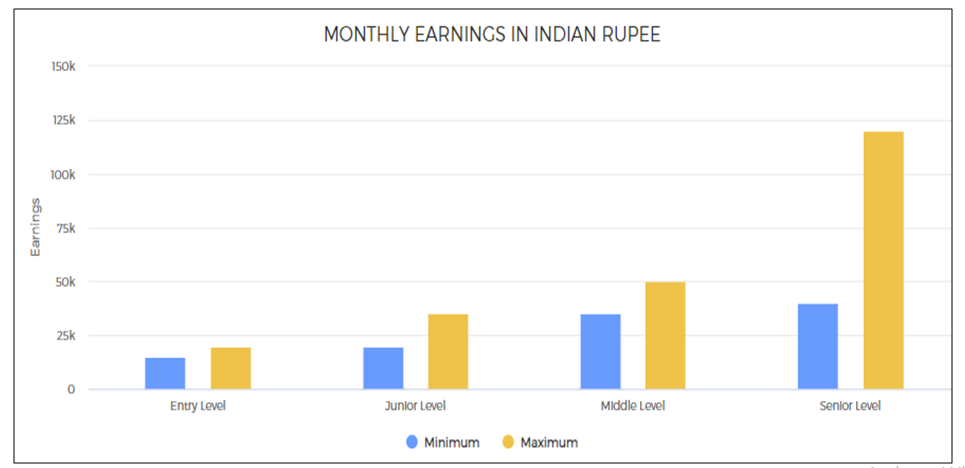
Monthly Earnings In Indian Rupee
Entry Level | Junior Level | Mid Level | Senior Level | ||||
Min Earning | Max Earning | Min Earning | Max Earning | Min Earning | Max Earning | Min Earning | Max Earning |
15000 | 20000 | 20000 | 35000 | 35000 | 50000 | 40000 | 120000 |
1. Entry level: 0 - 2 years of work experience
2. Junior Level: From 1 to 12 years of work experience
3. Mid Level: From 5 to 20+ years of work experience
4. Senior Level: From 10 to 25+ years of work experience (there could be exceptions in some high-end technical, financial, engineering, creative, management, sports, and other careers; also in the near future, people will reach these levels much faster in many careers and in some careers, these levels will have no meaning as those careers will be completely tech skill driven such as even now, there is almost no level in a Cyber Security Expert’s job)
Work Activities
1. Assisting and caring for people - Assisting people in availing of services; taking care of people in different situations; offering help and services to others.
2. Creative thinking - Developing new ideas, concepts, innovative solutions to problems, newer ways of getting things done, designing products and services, creating work of art and craft, etc.
3. Getting Information and learning - Observing, hearing, reading, using computers, or otherwise obtaining information and learning from it.
4. Identifying objects, actions, and events - Identifying various characteristics of objects; observing and understanding actions and events; understanding changes in actions and events
5. Inspecting situations, events, and people - Inspecting situations, events and people to understand the reasons and causes for the situation or events to happen; inspecting people to understand reasons behind their behavior and actions
6. Leading - Inspiring and motivating co-workers to work to achieve specific goals; enabling and facilitating others to perform tasks effectively; addressing issues and solving problems in order to help people perform well.
7. Providing advices and consultation to others - Giving advices or consultation to others about various issues, conceptual matters, or know-hows
8. Training and teaching - Understanding educational and training needs of others, developing training programs and educational programs, conducting training programs, teaching and instructing others
9. Translating and interpreting - Translating or interpreting information for other people which are written or spoken in languages that other people do not understand
10. Working directly with people - Working directly with people to offer them products and services, providing assistance, etc.
Future Prospects
1. We are in a very exciting time for Theology. Theologians from across the map are increasingly seeing the great 2000-year theological tradition as a creative contemporary asset. The increasing recognition of secularism and non-belief is strengthening theological confidence. There is a hunger to address the issues we face socially, politically, & economically with renewed theological rigor.
2. There remains a robust global interest in high-level academic theology, especially at the graduate level, which ultimately yields large numbers of cross-national students opting to do doctorates in Theology.
3. Theologians are also exerting themselves through powerful forms of writing to literature. Today more Theologians than at any other point in the past 50 years are writing systematic theologies. There is a need for creative, constructive, and experimental theological writing.
4. Younger scholars today, especially, across academic disciplines, are showing renewed interest in religion in general in particular: historians, cognitive scientists, philosophers, and scholars of literature and of art. Other disciplines are increasingly recognizing how valuable theological expertise is for understanding human culture and history — even human nature itself.
5. The urgent need of gradual transition would be in the current school systems where syllabuses inspire young people about the big philosophical questions, but universities need to be better at communicating the sheer richness & breadth of theology, especially its relationship to history, literature and the arts, sociology, and anthropology.
6. Modern learning platforms & technology advancements are also playing an increasingly significant role in the delivery of theological education today through Learning Management Systems (LMS). Students of theology can now use e-Portfolios for reflection on their learning throughout their time at a seminary, advocacy establishment or clerisy.
7. Such advancements ensure rapid and stable connections across the theological community around the globe and also help in inducting interested aspirants to become a Theologian or preach pluralistic interfaith dialogue in this traumatic era of global impoverishment.
Future Prospects At A Glance
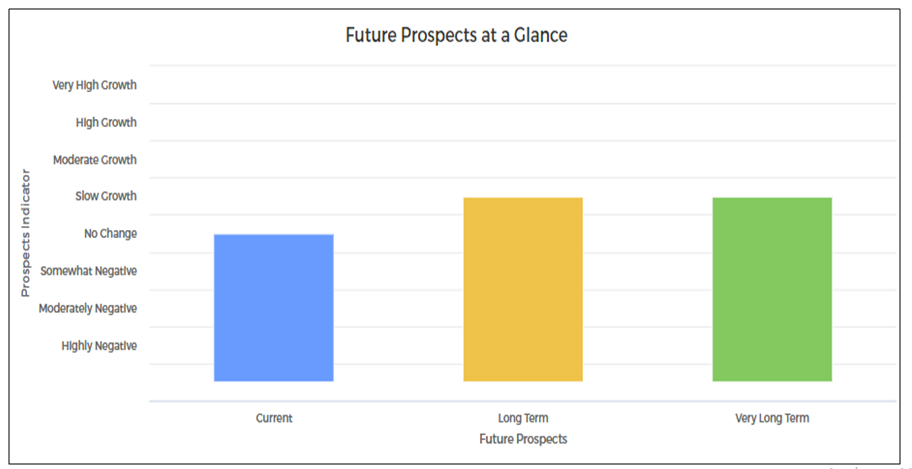
Current (0-1 year) | Long Term (2-5 year) | Very Long Term (6-10 years) |
No Change | Slow Growth | Slow Growth |


