


Office Assistant/Support Executive
Entry Level Qualification
Class 10
Career Fields
Business & Management
For Specially Abled


Career Entrance Exam
About Career
As an Office Assistant / Support Executive, you will be taking care of all sorts of routine and sundry office administration activities which enable others at an office to work smoothly without any problem as well as run all the errands for others at the office.
Your job will comprise of a wide range of routine office administration tasks such as storing and keeping office files organised, maintaining sundry office records, receiving bills and invoices, coordinating with accounts department for various payments, purchase office stationery and other stuff, coordinating dispatch of documents and other packages, drafting emails/messages, answering phone calls, scheduling appointments, receiving office guests, and assisting in the office pantry.
PARTICULARS | DESCRIPTION |
Name | Office Assistant/Support Executive |
Purpose | File And Update Records |
Career Field | Business & Management |
Required Entrance Exam | No Entrance Exam |
Average Salary | 60000 - 300000 Rs. Per Year |
Companies For You | Educational institutions, Hospitals and healthcare facilities & Many More |
Who is Eligible | Class 12th |
Key Roles & Responsibilities
1. Keep various office stationary, files, and office equipment organized and in order so as to help others work smoothly.
2. File and update records containing valid and accurate information.
3. Make appointments, plan meetings/events/conferences/luncheons and ensure that schedules are maintained.
4. Receive guests at the office and make them comfortable.
5. Perform clerical duties such as organizing office documents, taking memos, maintaining office supplies, photocopying and scanning office documents, etc.
6. Communicate and coordinate with all departments to ensure compliance.
7. Answer phone calls and respond to customer queries.
8. Type documents/drafts and prepare reports and presentations.
9. Oversee mail delivery, couriers, office packages, etc.
10. Make sure all office equipment such as computers, printers, scanners, photocopiers, AV presentation projectors, etc. are well maintained and are in operating condition whenever required.
11. Coordinating with all office equipment and supplies vendors and servicing people.
12. Coordinating with building facility managers and other support staff for the upkeep of all office facilities in proper condition (or in some cases, managing the facilities yourself).
13. Plan and arrange itineraries and executive correspondence.
14. Assisting in pantry services and maintaining all refreshment at the office.
Career Entry Pathway
Class 10 all subjects as per scheme of studies - ITI Certificate Course in Office Assistant/Similar course - work opportunity.
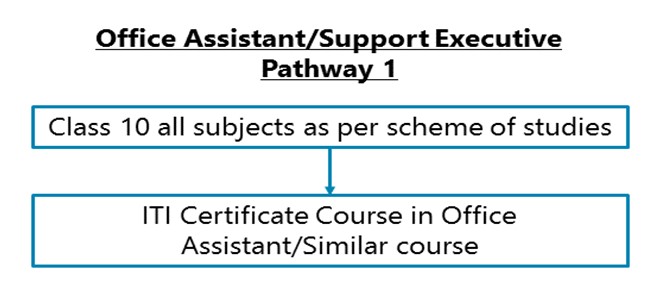
After Class 10, you can choose to do an ITI course in Office Assistant or any other similar course. Then you can get a job as an Office Assistant.
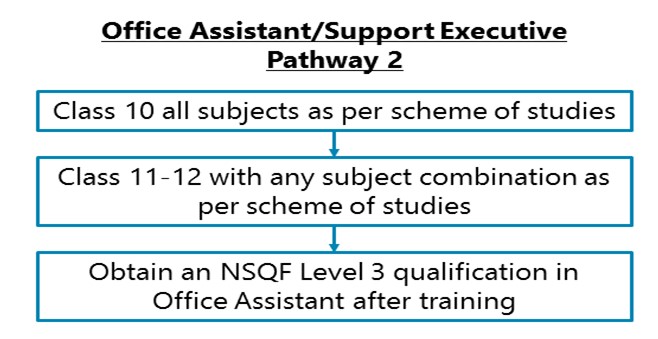
After Class 12, you can take up an Office Assistant training program to get an NSQF Level 3 qualification in Office Assistant.
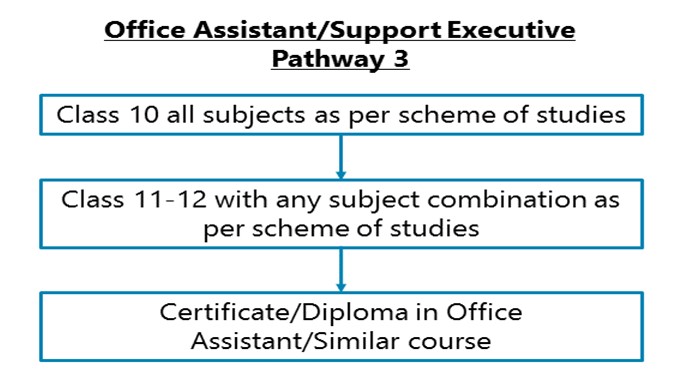
After Class 12, you can opt for a Certificate or Diploma course in Office Assistant or you can also opt for any other similar course.
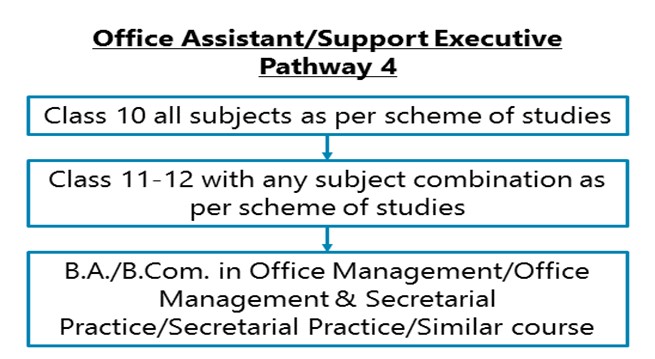
After Class 12, you can graduate with a B.A./B.Com. in Office Management/Office Management & Secretarial Practice/Secretarial Practice or any other similar course. Then you can get a job as an Office Assistant.
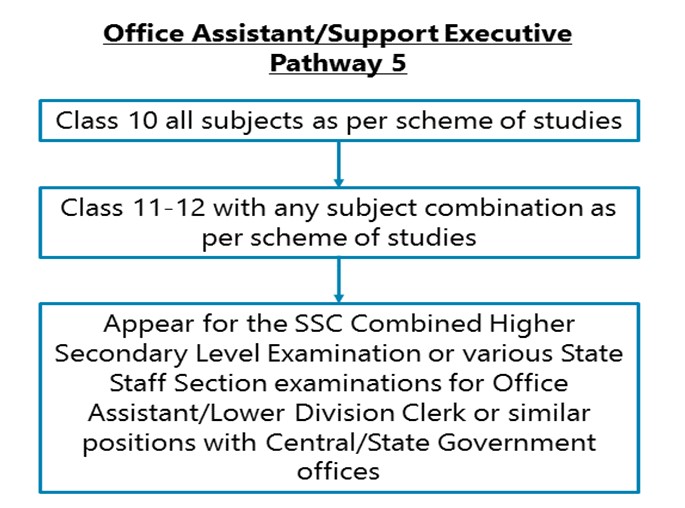
After Class 12, you can either sit for the SSC Combined Higher Secondary Level Examination or other State Staff Section examinations for Office Assistant/Lower Division Clerk or similar positions with Central/State Government offices or get a job directly.
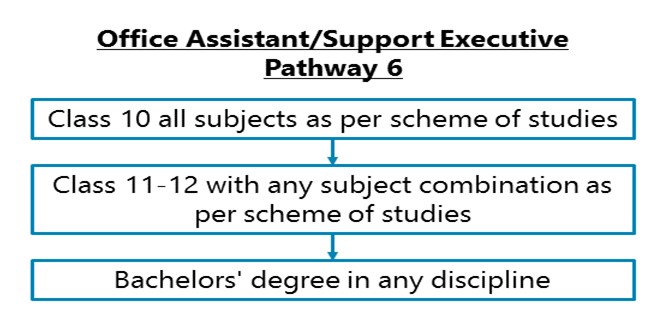
After Class 12, you can complete your graduation with a Bachelor’s degree in any subject of your choice and then get a job as an Office Assistant.
Required Qualification & Competencies
1. After your class 10, you can complete an ITI course in Office Assistant or do a similar course.
2. If you want to complete class 11-12, then you can take up a training course in Office Assistant or obtain a Diploma or complete a Bachelors' degree in Office Management/Secretarial Practice/Office Management & Secretarial Practice/Similar course.
3. You can also complete your graduation in any subject and get a job.
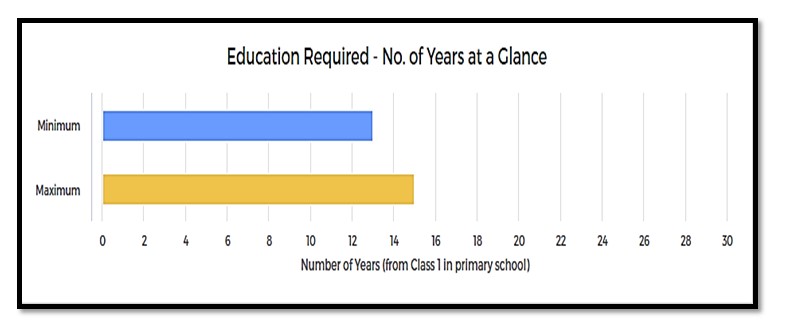
MINIMUM EDUCATION REQUIRED | MAXIMUM EDUCATION REQUIRED |
Post Higher Secondary Diploma / Certificate Programs for which the minimum eligibility is a pass in Higher Secondary / Class XII School Leaving examination. | Under Graduate Undergraduate Degree / Honours Diploma / Graduate Diploma (equivalent to a Degree) Programs for which the minimum eligibility is a pass in Higher Secondary / Class XII School Leaving examination. |
Competencies Required
Interests
1. Enterprising: You should have interests for Enterprising Occupations. Enterprising occupations involve taking initiatives, initiating actions, and planning to achieve goals, often business goals. These involve gathering resources and leading people to get things done. These require decision making, risk taking and action orientation.
2. Conventional: You should have interests for Conventional Occupations. Conventional occupations involve repetitive and routine tasks as well as fixed processes or procedures for getting things done. These occupations involve working more with data, systems, and procedures and less with ideas or creativity.
3. Social: You should have interests for Social Occupations. Social occupations involve helping or assisting others; these involve working with and communicating with people to provide various services; these may involve educating and advising others.
Abilities
1. Abstract Reasoning: The ability to understand ideas which are not expressed in words or numbers; the ability to understand concepts which are not clearly expressed verbally or otherwise.
2. Deductive Reasoning: The ability to apply general rules and common logic to specific problems to produce answers that are logical and make sense. For example, understanding the reasons behind an event or a situation using general rules and common logic.
3. Emotional Intelligence: The ability to understand you’re own and others' emotions and feelings; empathy for others; adjusting your behaviour or self-control and self-regulation according to others' emptions and situations.
4. Fluency of Ideas: The ability to come up with a number of ideas about a topic (the number of ideas is important, not their quality, correctness, or creativity).
5. Inter-Personal: The ability to build and maintain good relationships with others at workplaces and elsewhere.
6. Originality: The ability to come up with unusual or innovative ideas about a given topic or situation, or to develop creative ways to solve a problem.
7. Problem Sensitivity: The ability to tell when something is wrong or is likely to go wrong. It does not involve solving the problem, only recognizing there is a problem.
Knowledge
1. Business Management: Knowledge of managing a business which involves planning of what to do, organising resources and people, leading and supervising work activities of people, and monitoring performances of people as well as performance of business. This includes knowledge of marketing, finance, human resources management, operations management, etc.
2. Customer Service: Knowledge about how to provide customer services. This includes understanding customer needs, helping customers to use products and services, answering customer queries, handling customer complaints and grievances, and evaluating customer satisfaction.
Skills
1. Active Learning: Focused and continuous learning from various sources of information, observation and otherwise for application in getting work done.
2. Active Listening: Giving full attention to what other people are saying, understanding the points being made by others, asking questions, etc.
3. Coordination: Skills in working together with other people to get things done.
4. Critical Thinking: Skills in analysis of complex situations, using of logic and reasoning to understand the situations and take appropriate actions or make interpretations and inferences.
5. Judgment and Decision Making: Skills in considering pros and cons of various decision alternatives; considering costs and benefits; taking appropriate and suitable decisions.
6. Problem Solving: Skills in analysis and understanding of problems, evaluating various options to solve the problems and using the best option to solve the problems.
7. Reading Comprehension: Skills in understanding written sentences and paragraphs in work related documents.
8. Service Orientation: Skills in or keen interest to help and assist people.
Personality
1. You are always or mostly organised in your day-to-day life and activities.
2. You always feel secure in your surroundings and in most situations.
3. You are always self-satisfied or feel satisfied with your life in most situations.
4. You are a soft-hearted person sometimes.
5. You trust others sometimes but not always.
6. You are helpful to others sometimes.
7. You remain calm in difficult situations sometimes but some other times you are anxious.
Career - Job Opportunities & Profiles
The good thing about the job profile of an Office Assistant is that they are recruited by almost all organizations and institutions, both government or private. You can get a job as an Office Assistant in different organizations such as:
1. Central and State government departments and offices
2. Corporate and industrial organizations
3. Educational institutions
4. Hospitals and healthcare facilities
5. Other different types of organizations across all industries
Work Environment
As the name suggests, Office Assistants primarily work indoors, within office environments that are well lit and temperature controlled. The work of an Office Assistant is a full-time job which means that they spend nearly 8-9 hours in the office every day. Sometimes, the job may be in shifts, such as in hospitals, there may be more than one Office Assistant to cover day and night shifts separately.
Career Growth
1. In Government jobs, there are clear cut promotional paths. From a Lower Division Clerk you can become an Assistant or Upper Division Clerk, then a Division Clerk and finally a Section Officer.
2. In some other Government jobs, you from a Lower Selection Grade Staff, you can become a Supervisor, then a Senior Supervisor and finally the Chief Supervisor.
3. In private sector jobs, promotional opportunities are limited. But nevertheless, from an Office Assistant, you can become a Senior Office Assistant and then an Assistant Manager. You can also become a Manager over 12-15 years’ time.
Salary Offered
1. At the beginning of your career, you may earn anything between Rs. 5,000 - 26,000 a month. The higher salaries are for Government jobs.
2. With 4-8 years of experience, you can expect to earn about Rs. 10,000 - 35,000 a month.
3. With 12-15 years of experience, you can expect to earn about Rs. 15,000 - 60,000 a month.
4. With 15-20 years of experience, you can expect to earn about Rs. 25,000 - 90,000 or even more per month. The higher salaries are for Government jobs.
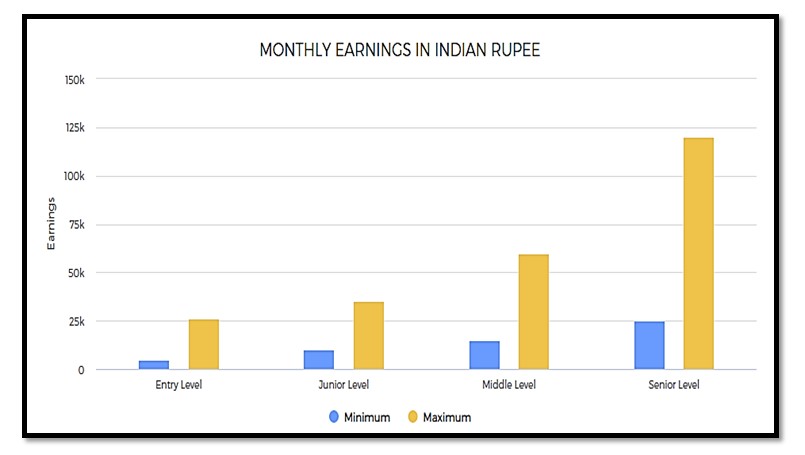
Monthly Earnings In Indian Rupee
Entry Level | Junior Level | Mid-Level | Senior Level | ||||
Min Earning | Max Earning | Min Earning | Max Earning | Min Earning | Max Earning | Min Earning | Max Earning |
5000 | 26000 | 10000 | 35000 | 15000 | 60000 | 25000 | 120000 |
1. Entry level: 0 - 2 years of work experience
2. Junior Level: From 1 to 12 years of work experience
3. Mid-Level: From 5 to 20+ years of work experience
4. Senior Level: From 10 to 25+ years of work experience (there could be exceptions in some high-end technical, financial, engineering, creative, management, sports, and other careers; also in the near future, people will reach these levels much faster in many careers and in some careers, these levels will have no meaning as those careers will be completely tech skill driven such as even now, there is almost no level in a Cyber Security Expert’s job)
Work Activities
1. Analyzing and interpreting data and information: Analysis of data and information to find facts, trends, reasons behind situations, etc.; interpretation of data to aid in decision making.
2. Communicating with co-workers and others: Communicating with people in writing, verbally or otherwise inside your workplace and various other people who have professional relationships with your place of work including vendors, government officials, etc. or with people at large.
3. Decision making and problem solving: Analysis of data and information; evaluation of alternative decisions and results of decisions; taking the right decisions and solving problems.
4. Developing and maintaining inter-personal relationships: Developing professional relationships with co-workers and others outside organisations and maintaining good relationships.
5. Getting Information and learning: Observing, hearing, reading, using computers, or otherwise obtaining information and learning from it.
6. Handling administrative activities: Handling various administrative tasks and managing day-to-day operations.
7. Managing and supervising: Managing and supervising work of others; setting goals; giving instructions; monitoring work performance, etc.
8. Organizing, planning and prioritizing tasks: Planning and organizing tasks in order to achieve work goals; prioritizing tasks to achieve goals and making the best use of the time available.
9. Updating and using relevant knowledge: Keeping updated with the latest knowledge relevant to your fields of work and use of the relevant knowledge in getting things done.
10. Using computers for work: Using computers for day-to-day office work; using computer software for various applications in day-to-day professional work; entering data and process information; for writing.
11. Working in a team: Working in a team of people; developing team; maintaining professional relationships among team members.
Future Prospects
According to the Economic Survey, the estimated growth rate of the Indian economy stood at 6.75%. These stats establish that as India’s economy continues to grow and thrive, employment opportunities will also increase across all sectors. New job openings will be created when professionals leave the occupation and hence, they will need to be replaced.
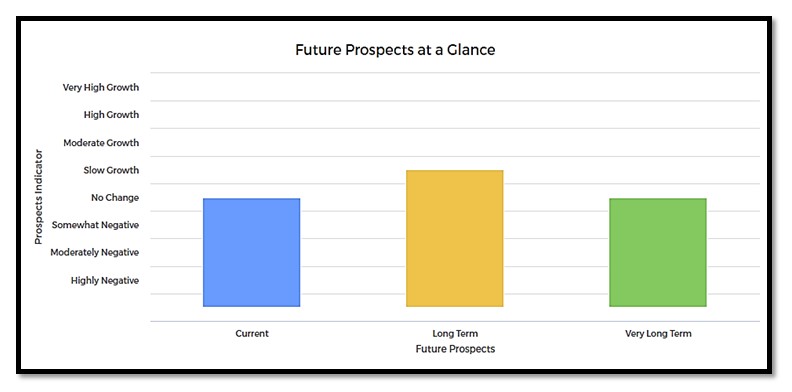
Future Prospects At A Glance
Current (0-1 year) | Long Term (2-5 year) | Very Long Term (6-10 years) |
No Change | Slow Growth | No Change |


