


Physiologist
Entry Level Qualification
Class 12
Career Fields
Medical Services
For Specially Abled


About Career
PARTICULARS | DESCRIPTION |
Name | Physiologist |
Purpose | Develop Treatments |
Career Field | Allied & Para Medical Science |
Required Entrance Exam | NEET UG, NEET PG, AIIMS PG INICET |
Average Salary | 1000000 - 1200000 Rs. Per Year |
Companies For You | National Institutes of Health (NIH), The Wellcome Trust & Many More |
Who is Eligible | Graduate |
1. The Physiologist is a scientist or physician who studies the functions of organs from the cellular level to organisms’ levels. As a Physiologist, you will study and research to understand and develop insights about how various types of cells, tissues, organs, and biochemical systems work in a human body or in the body of an animal or in plants or in microorganisms. The insights that Physiologists develop are valuable for various fields such as Medical Science, Veterinary Medicine, Zoology, Botany, Biotechnology, Plant Science, and Animal Science.
2. If you work in Medical Physiology, you will study and research to understand and develop insights about how diseases, injuries, or ailments affect living cells, tissues, organs, and biochemical systems in human beings. You may research and develop processes to diagnose various tests and procedures to enumerate how a disease, injury or ailment has affected the cells, tissues, and organs in a human body. You may also work in healthcare settings to help other Clinical Physicians diagnose the causes of diseases and the effects of medicines.
Key Roles And Responsibilities
As a Physiologist, depending on the profile, you will have several roles and responsibilities including the following:
Medical Physiology:
1. You will examine and perform test related to nuclear medicine, clinical neurophysiology, and radiology.
2. You will perform tests to check the functions of the heart, kidneys, blood vessels, lungs, gastrointestinal tracts, etc.
3. You will operate medical devices and instruments that are used to perform cardiopulmonary exercise tests.
4. You will monitor patients during cardiopulmonary diagnostic testing.
5. Based on the symptoms, you will prescribe medication/exercise to patients and also refer to a surgeon if needed.
6. You will analyse patients’ medical history to assess their risk during exercise.
7. You will provide emergency or other appropriate medical care to participants with symptoms or signs of physical distress.
8. You will measure functions of the patient’s body like digestion or breathing, etc.
9. You will report the equipment faults.
10. You will provide clinical supervision and training to new physiologists.
Human Physiology
1. You will study different roles of different body organs at the cellular level, molecular level and organ level.
2. You will conduct experiments on different organs at a different level to understand the physical and chemical functions of those organs.
3. You will understand the role of nutrition in different organs.
4. You will prepare technical reports and communicate the same with industry, government, and if needed with the general public.
5. You would write research papers, reports, and scholarly articles and explain the findings of such research.
Career Entry Pathway
Class 10 all subjects as per scheme of studies – Class 11-12 Physics, Chemistry, and Biology along with any other subject as per scheme of studies – UG in Medicine & Surgery – Speciality in Medical Physiology (M.D.)
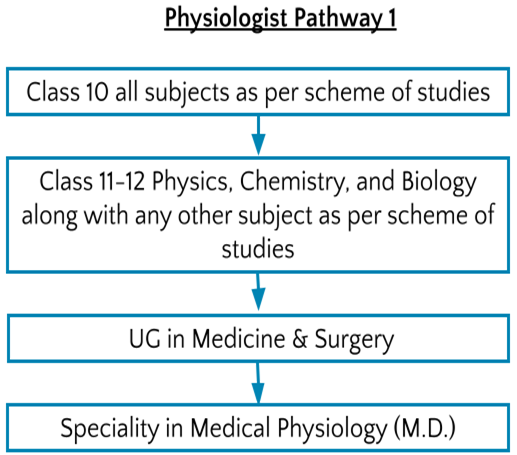
After completing Class 10 all subjects as per scheme of studies pursue Class 11-12 Physics, Chemistry, and Biology along with any other subject as per scheme of studies and then study for an undergraduate degree in Medicine & Surgery followed by a specialty degree in Medical Physiology (M.D.).
Class 10 all subjects as per scheme of studies – Class 11-12 Physics, Chemistry, and Biology along with any other subject as per scheme of studies – UG in Medicine & Surgery / Dentistry – M.D. in Physiology - Ph.D. in Medical Physiology
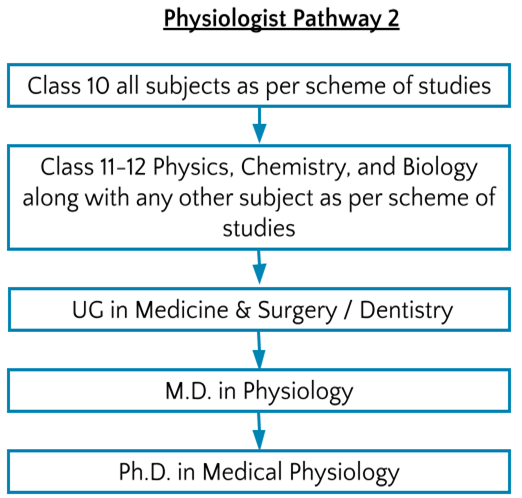
After completing Class 10 all subjects as per scheme of studies pursue Class 11-12 Physics, Chemistry, and Biology along with any other subject as per scheme of studies and then study for an undergraduate degree in Medicine & Surgery / Dentistry followed by an M.D. course in Physiology. Now you can do a Ph.D. in Medical Physiology
Class 10 all subjects as per scheme of studies – Class 11-12 Physics, Chemistry, and Biology along with any other subject as per scheme of studies – UG in Pharmacy /Physiotherapy – PG in Human Physiology (M.Sc.) – Ph.D. in Physiology.
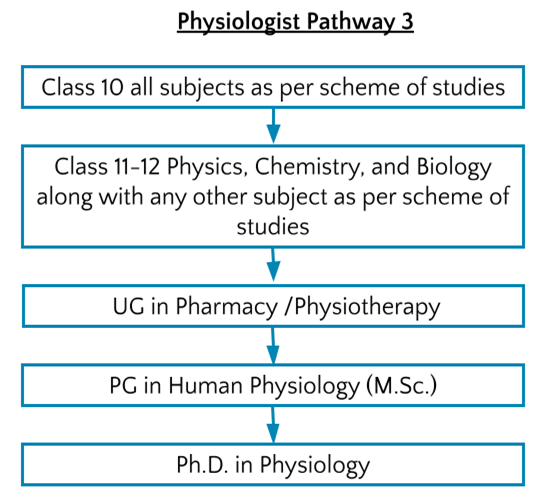
After completing Class 10 all subjects as per scheme of studies pursue Class 11-12 Physics, Chemistry, and Biology along with any other subject as per scheme of studies and then study for an undergraduate degree in Veterinary Science / Pharmacy /Physiotherapy followed by a master’s degree in Human Physiology (M.Sc.). Then you can study a Ph.D. in Physiology.
Class 10 all subjects as per scheme of studies – Class 11-12 Physics, Chemistry, and Biology along with any other subject as per scheme of studies – UG in Science in Physiology / Neurophysiology / similar field (Honours or specialisation would be an advantage)
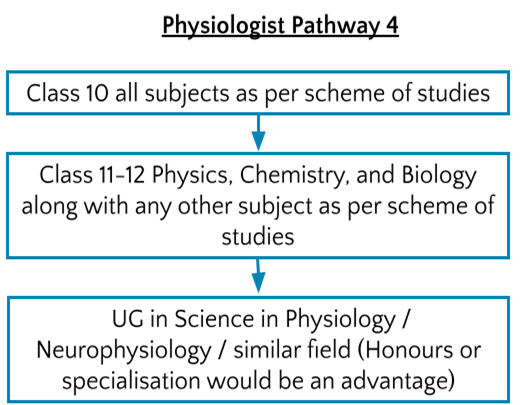
After completing Class 10 all subjects as per scheme of studies pursue Class 11-12 Physics, Chemistry, and Biology along with any other subject as per scheme of studies and then study for an undergraduate science degree in Physiology / Neurophysiology / similar field (Honors or specialization would be an advantage).
Class 10 all subjects as per scheme of studies – Class 11-12 Physics, Chemistry, and Biology along with any other subject as per scheme of studies – UG in Science in Physiology / Neurophysiology / Sports Science & Physiology / Zoology / similar field (Honors or specialization would be an advantage)– PG in Human Physiology (M.Sc.)
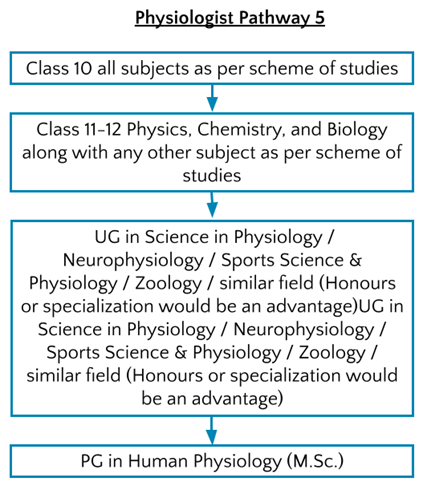
After completing Class 10 all subjects as per scheme of studies pursue Class 11-12 Physics, Chemistry, and Biology along with any other subject as per scheme of studies and then study for an undergraduate science degree in Physiology/ Applied Physical Science / Neurophysiology / Sports Science & Physiology / Zoology / Allied Health Sciences / similar field (Honours or specialization would be advantage) followed by a science master’s degree in Human Physiology / Neurophysiology / similar field.
Class 10 all subjects as per scheme of studies – Class 11-12 Physics, Chemistry, and Biology along with any other subject as per scheme of studies – UG in Science in Physiology / Neurophysiology / Sports Science & Physiology / Zoology / similar field (Honours or specialization would be an advantage)– PG in Human Physiology (M.Sc.) – Ph.D. in Physiology
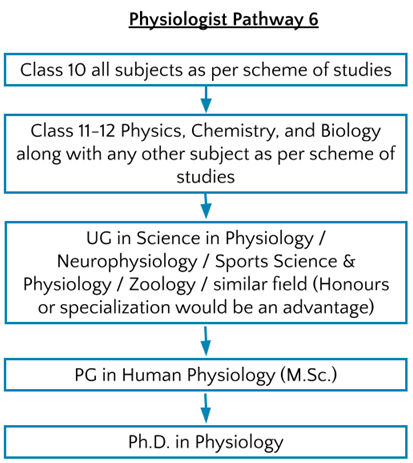
After completing Class 10 all subjects as per scheme of studies pursue Class 11-12 Physics, Chemistry, and Biology along with any other subject as per scheme of studies and then study for an undergraduate science degree in Physiology/ Applied Physical Science / Neurophysiology / Sports Science & Physiology / Zoology / Allied Health Sciences / similar field (Honours or specialization would be advantage) followed by a science master’s degree in Human Physiology / Neurophysiology / similar field. Then you can take a Ph.D. in Physiology / similar field.
Required Qualification & Competencies
Undergraduate studies after school
To become a Physiologist, you should complete your schooling with Physics, Chemistry, and Biology and join the following streams:
1. You can complete M.B.B.S.
2. You can also complete Bachelor of Pharmacy
3. You can also study for a Bachelor degree in Human Physiology / Zoology / Botany / Plant Sciences / Agricultural Science / Animal Sciences
4. You can study for a Bachelor degree in Veterinary Sciences and Animal Husbandry
Post Graduate and Doctoral studies
1. After finishing M.B.B.S., you can opt for M.D. in Medical Physiology and specialise in Clinical Neurophysiology / Clinical Exercise Physiology. You can also go for a Ph.D. in Medical Physiology.
2. If you do a graduation in Pharmacy or Human Physiology, then you can study Human Physiology with specialisation in Respiratory Physiology/ Nutritional Physiology/ Neurophysiology / Endocrine Physiology / Cellular & Molecular Physiology. Then you can opt for a Ph.D. in Physiology.
3. If you do a graduation in Zoology, then also you can do a Master's in Human Physiology. And then a Ph.D.
4. If you do a graduation in Botany / Plant Science / Agriculture, then you can do a Master's in Plant Physiology.
5. If you do a graduation in Veterinary Science, then you can do a Master degree in Veterinary Science in Animal Physiology. Then you can do a Ph.D.
6. If you do a graduation in Animal Sciences or in Zoology, then you can do a Master's in Animal Physiology and then a Ph.D.
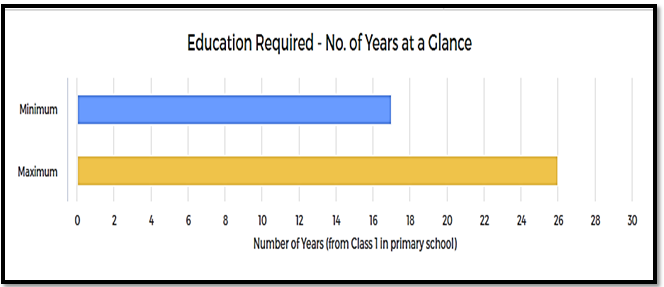
MINIMUM EDUCATION REQUIRED | MAXIMUM EDUCATION REQUIRED |
Post Graduate Postgraduate Degree / Diploma / Certificate Programs for which the minimum eligibility is a pass in Graduation / equivalent Diploma program like Honours Diploma or Graduate Diploma. | Post-Doctoral Post Ph.D. programs for which the minimum eligibility is a Doctoral degree. |
Competencies Required
You should have the following occupational interests:
1. Social: You should have interests for Social Occupations. Social occupations involve helping or assisting others; these involve working with and communicating with people to provide various services; these may involve educating and advising others.
2. Investigative: You should have interests for Investigative Occupations. Investigative occupations involve working with ideas and quite a lot of thinking, often abstract or conceptual thinking. These involve learning about facts and figures; involve the use of data analysis, assessment of situations, decision making and problem-solving.
3. Realistic: You should have interests for Realistic Occupations. Realistic occupations involve more practical and hands-on activities than paperwork or office work. Realistic occupations often involve physical activities for getting things done using various tools and equipment.
The following personality attributes are required:
1. You are always or mostly organized in your day-to-day life and activities.
2. You are always or mostly disciplined in your action and behavior.
3. You are always practical or in most situations.
4. You are always or mostly care about your actions and behaviour.
5. You are always or mostly a soft-hearted person.
6. You are always or mostly helpful to others.
7. You are always or mostly caring, supportive, sympathetic and kind to others.
You should have the following skills and knowledge:
1. Reading Comprehension: Skills in understanding written sentences and paragraphs in work related documents.
2. Critical Thinking: Skills in the analysis of complex situations, using logic and reasoning to understand the situations and take appropriate actions or make interpretations and inferences.
3. Active Listening: Giving full attention to what other people are saying, understanding the points being made by others, asking questions, etc.
4. Instruction: Skills in training others how to do something.
5. Medicine: Knowledge of the science of diagnosis, treatment, and prevention of human diseases, ailment, injuries, and disorders. This includes understanding the symptoms, knowledge of the diagnostic processes, knowledge of the treatment procedures and medicines, and preventive healthcare measures.
6. Biological Science: Knowledge of plants and animals, their anatomical structure, cell structure, tissues, physiological functions, evolution, and all other related aspects.
7. Education & Training: Knowledge of various principles and methods of developing training or teaching curriculum, the design of instructional methods, developing course materials, teaching and giving instruction individuals and groups.
You should have the following aptitudes and abilities:
1. Oral Comprehension: The ability to listen to and understand information and ideas presented through spoken words and sentences.
2. Oral Expression: The ability to communicate information and ideas in speaking so others will understand.
3. Written Comprehension: The ability to read and understand information and ideas presented in writing.
4. Inductive Reasoning: The ability to combine pieces of information from various sources, concepts, and theories to form general rules or conclusions. For example, analysing various events or situations to come out with a set of rules or conclusions.
5. Deductive Reasoning: The ability to apply general rules and common logic to specific problems to produce answers that are logical and make sense. For example, understanding the reasons behind an event or a situation using general rules and common logic.
Career - Job Opportunities & Profiles
For Clinical Physiologists:
1. After M.B.B.S., you can join the medical college as a junior resident doctor and continue your M.D. studies.
2. You can join hospitals, clinics, railway hospitals, emergency medical centres, cancer hospitals as Medical Officers.
3. You can join a military hospital at the rank of Captain.
4. You can also join the medical college at the rank of Assistant Professor.
For Human Physiologists:
1. As a Human Physiologist, there are three major career opportunities for you, i.e. academic institutes, research laboratories, hospitals and treatment centres.
2. Most of the universities and college will hire you as a professor at the position of Junior Professor or Assistant Professor. If you are into research, then you will be hired at the position of research associate. Ph.D. research fellows will be hired as a Junior Research Fellow.
3. Research laboratories will hire you as a scientist/scientist officer with the lowest grade.
4. Hospitals and treatment centres will hire you as assistant physiologists.
Work Environment
1. As a Physiologist, you would be required to spend most of your working time in laboratories. You would need to wear gloves, lab coats to keep a distance from any pathogen or parasite. You might also work on different equipments. Most of the work will be research and observation based on not so frequent interaction with co-workers, but it is a work requiring patience.
2. As a medical physiologist, you would spend your time at clinics, hospitals dealing with patients, and their illness. You will have to be patient, calm and attentive. People with different nature, attitude and problems will visit you. It might be the gloomy environment, but you would require to keep it positive.
Specialisation Tracks In This Career
1. Neurophysiologist
Neurophysiologists are physicians who specialize in studying and treating central and peripheral nervous systems through the recording of bioelectrical activity. They write different kinds of tests to find any physiological medical condition in brains, spinal cord, and nerves and then evaluate the results and give medication.
2. Exercise Physiologist
Exercise Physiologists specializes in creating programmers for patients suffering from chronic medical conditions. These programs aim at preventing, treatment and rehabilitation.
3. Cellular and Molecular Physiologist
Cellular & Molecular Physiologists are scientists who specialize in the study of physical and chemical functions of body organs at the cellular and molecular level.
4. Endocrine Physiologist
Endocrine physiologists are the scientists who specialize in the study of physical and chemical functions of endocrine organs of the body. Endocrine organs are several glands in the human body.
5. Nutritional Physiologist
Nutritional Physiologists are the scientists who specialise in the study of the role of nutrition on the human body. They study how different kinds of nutrition affects growth in the human body.
6. Respiratory Physiologist
Respiratory Physiologists are the scientists who specialise in the study of the respiration system and organs in the respiratory system like lungs, trachea, etc.
Career Growth
1. The career growth in university and college states from Assistant Professor and then Associate Professor, Professor and Professor Emeritus. Professors can also get administrative positions such as Director/Dean/Vice Chancellor, etc.
2. If you are hired as a junior resident, then you will move to senior resident and then either you can choose to be a fellow or join any hospital a Medical officer (Surgeon).
3. If you Join as a Medical Doctor, then you will go on to become Deputy Medical Superintendent and then Additional Medical Superintendent and then Medical Superintendent. You might also become director of the Hospital.
4. If you join Army hospitals, then you will move up as per the army ranks starting from Captain (and its equivalent in Navy and Air Force).
5. If you are hired as a junior resident, then you will move to senior resident and then either you can choose to be a fellow or join any hospital a Medical Officer.
6. Research laboratories will hire you as a scientist/scientist officer with the lowest grade and the grade changes from low to high. In India, grades are “Scientist “C” as the joining level and then D, E, F, G, H and finally DS. A senior-level scientist can also get into administrative positions like Principal Scientist, Assistant Director, Deputy Director, Director, etc.
Salary Offered
After completing the M.D. course:
1. At the entry level, one joins as a Consultant Physician and earn about Rs. 80,000 – 90,000 a month. With experience, their salary increases.
2. At the junior level with a work experience of 5-6 years, you would be earning anything between Rs. 1,00,000 to 2,00,000 per month.
3. At the middle level with an experience of 8-12 years, you would be earning anything between Rs. 1,40,000 to 3,00,000 per month.
4. At the senior level of over 12 years of work experience, you would be earning anything between Rs. 2,40,000 to 6,00,000 per month or even more.
If you have a Master degree in Human Physiology
1. At the entry level, you can join as a research associate with a basic salary of Rs. 25,000 to 30,000. As a doctoral research fellow (junior research fellow) you would be earning around Rs. 35,000 to 38,000 per month. At the entry level, as a Scientist (grade C) you would be earning around Rs. 80,000 to 100,000 per month. As an assistant professor, you would be earning anything between Rs. 65,000 to 70,000 per month.
2. At the junior level with a work experience of 2-6 years, you would be earning anything between Rs. 1,20,000 to 1,40,000 per month.
3. At the middle level with an experience of 10-12 years, you would be earning anything between Rs. 1,40,000 to 1,90,000 per month as a scientist and Rs. 1,20,000 to 1,60,000 as a professor.
4. At the senior level of over 15 years of work experience, you would be earning anything between Rs. 1,60,000 to 2,00,000 per month as a professor and Rs. 2,10,000 to 2,50,000 per month as a Scientist.
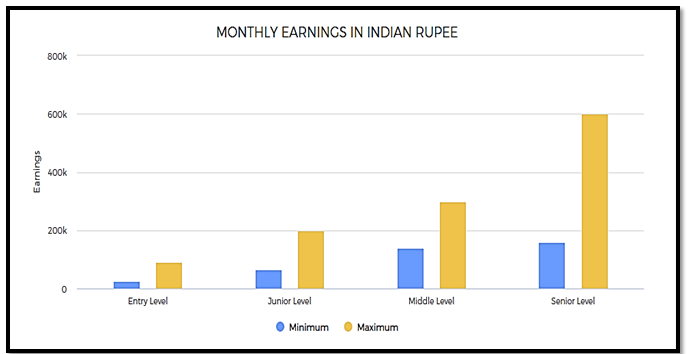
Monthly Earning In Indian Rupee
Entry Level | Junior Level | Mid-Level | Senior Level | |||||
Min Earning | Max Earning | Min Earning | Max Earning | Min Earning | Max Earning | Min Earning | Max Earning | |
25000 | 90000 | 65000 | 200000 | 140000 | 300000 | 160000 | 600000 | |
1. Entry level: 0 - 2 years of work experience
2. Junior Level: From 1 to 12 years of work experience
3. Mid Level: From 5 to 20+ years of work experience
4. Senior Level: From 10 to 25+ years of work experience (there could be exceptions in some high-end technical, financial, engineering, creative, management, sports, and other careers; also in the near future, people will reach these levels much faster in many careers and in some careers, these levels will have no meaning as those careers will be completely tech skill driven such as even now, there is almost no level in a Cyber Security Expert’s job)
Work Activities
As a Physiologist, you might be involved in various areas of human and clinical physiology. In these areas, you might be involved in different activities such as:
1. Getting information & learning: Observing, hearing, reading, using computers, or otherwise obtaining information and learning from it.
2. Updating and using relevant knowledge: Keeping updated with the latest knowledge relevant to your fields of work and use of the relevant knowledge in getting things done.
3. Assisting & caring for people: Assisting people in availing of services; taking care of people in different situations; offering help and services to others.
Future Prospects
Indian Medical industry is growing exponentially riding on strong demand due to rising incomes, greater health awareness and increase in access to insurance. It might grow to 373 Billion USD as per a report by ibef.org. Also, with the introduction of Ayushman Bharat, Insurance and the medical benefit are given by Government of India, more and more people will start using medical facilities. All these numbers indicate a bright future for physiologists.
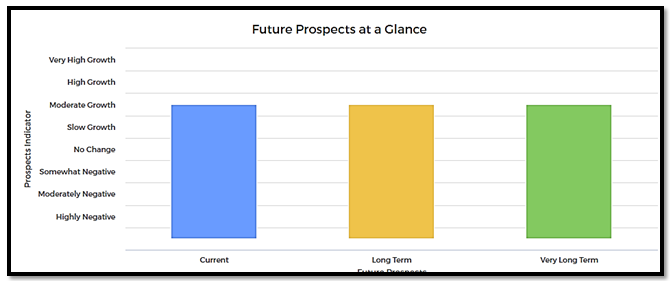
Future Prospects At A Glance
Current (0-1 year) | Long Term (2-5 year) | Very Long Term (6-10 years) |
Moderate Growth | Moderate Growth | Moderate Growth |


